Growth and survival of firms
Introduced| English | Meaning |
|---|---|
| economies of scale/ɪˈkɒnəmiz ɒv skeɪl/ | Falls in average production cost as the scale of output increases. |
| external growth/ekˈstɜːnl ɡrəʊθ/ | Business expansion through acquiring or combining with other businesses. |
| mergers/ˈmɜːdʒəz/ | mergers |
| takeovers/ˈteɪkəʊvəz/ | The acquisition of control of one business by another person or organisation. |
| diseconomies/ˌdɪsɪˈkɒnəmiz/ | Increases in average production cost associated with a larger scale of operation. |
| niche markets/niːʃ ˈmɑːkɪts/ | A relatively small, specialised segment of customers with distinctive needs or preferences. |
| principal-agent problem/ˈprɪnsɪpl ˈeɪdʒənt ˈprɒbləm/ | A conflict arising when an agent acting for a principal has different incentives and the principal cannot fully monitor the agent's actions. |
| internal growth/ɪnˈtɜːnl ɡrəʊθ/ | Business expansion by developing its own operations rather than acquiring other businesses. |
Why some firms grow huge — and some stay small
- Amazon spans the globe; the café on your corner stays one shop. Both can thrive. Why?
- Firms grow to reap economies of scale 规模经济 — but bigger isn't always better, and small firms survive for good reasons.
Firm objective lab
Classify real firm decisions by the objective they reveal.
Growth by merger or takeover is an example of:
Difficulty 1/5 · 100 coins + a small bonus on first completion today
Mergers/takeovers are external growth; expanding your own operations is internal.
Internal and external growth 外部增长
- Internal (organic) growth: expanding output, opening branches, reinvesting profit — steady.
- External growth: mergers 兼并 and takeovers 收购 — fast, but riskier (clashing cultures, overpaying).
Economies of scale mean that as output rises, long-run average cost:
Difficulty 1/5 · 100 coins + a small bonus on first completion today
Bulk buying, specialisation and spreading fixed costs lower LRAC — up to a point.
Diseconomies of scale (e.g. poor communication) can raise long-run average cost if a firm grows too large.
Difficulty 1/5 · 100 coins + a small bonus on first completion today
Beyond the optimum scale, LRAC rises — the right side of the U.
Falling long-run average cost as a firm grows is called economies of ______.
Difficulty 1/5 · 100 coins + a small bonus on first completion today
Economies of scale lower unit cost as output expands.
Economies of scale
- As a firm grows, long-run average cost can fall — economies of scale (bulk buying, specialisation, spreading fixed costs).
- Grow too big and diseconomies 规模不经济 set in (poor communication, bureaucracy), pushing LRAC back up.
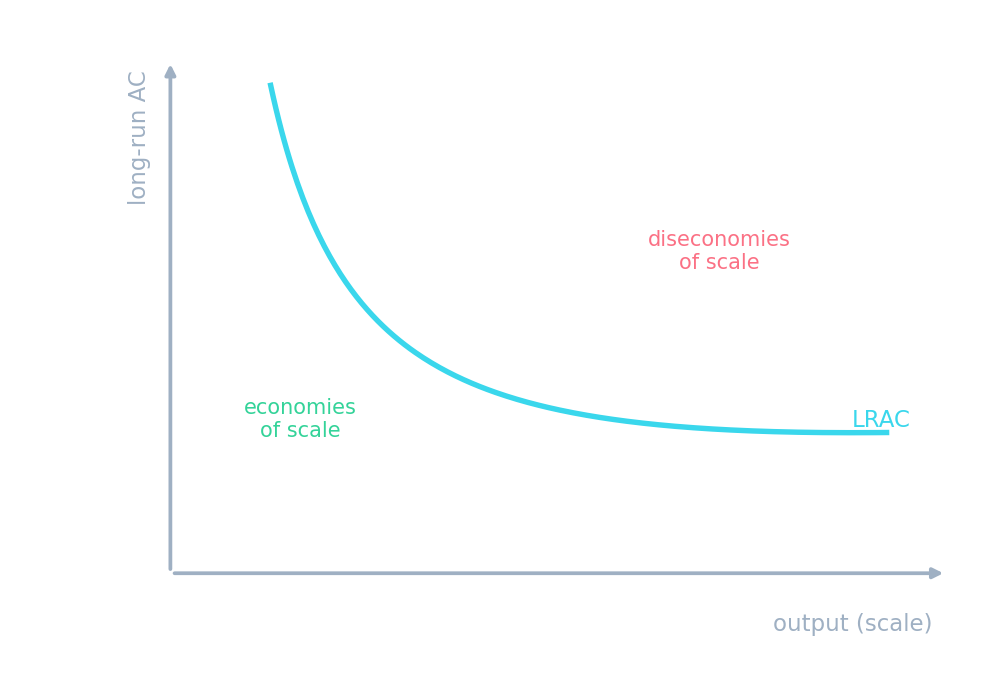
LRAC falls with economies of scale, then rises with diseconomies — a U-shaped long-run curve.
Which helps small firms survive against large rivals?
Difficulty 1/5 · 100 coins + a small bonus on first completion today
Niche focus, personal service and flexibility let small firms compete.
Why small firms survive
- Niche markets 利基市场, personal service, flexibility, low barriers, and industries where scale gives little advantage all keep small firms alive.
The principal-agent problem 委托代理问题. When managers (agents) run a firm they don't own, they may chase size or perks rather than the owners' (principals') profit — a reason growth isn't always in shareholders' interest.
You've got it
- internal growth 内部增长 (organic) vs external growth (mergers/takeovers)
- economies of scale lower LRAC as a firm grows; diseconomies raise it if it grows too big
- small firms survive via niches, service, flexibility and where scale gives little gain
Write from average cost falling to 8
- At output 100, total cost is 1000.
- At output 200, total cost is 1600.
What happens to average cost, and what does that show?
Average cost is total cost divided by output.
What happens to average cost when output doubles here?
Difficulty 1/5 · 100 coins + a small bonus on first completion today
1600 divided by 200 is 8.