- explain the fundamental economic problem of scarcity arising from finite resources and unlimited wants
- explain choice and opportunity cost for consumers, producers and governments
- distinguish positive and normative statements in the context of choice
Tips
A-Level Economics (9708) splits in two. Microeconomics: scarcity, the price system, elasticity, market failure, government intervention. Macroeconomics: national income, the multiplier, inflation, unemployment, growth, policy and trade. A2 goes deeper into the same ground rather than adding new ground.
The skill being tested is not recall. It is draw the diagram, then evaluate. An answer that describes a policy scores badly. An answer that says what the policy does, draws the diagram, then says when it would not work scores well.
"It depends on" is not hedging here — the conditions are exactly where the evaluation marks live.
-
1
Basic economic ideas and resource allocation
Watch lesson Watch lesson1.1
The fundamental economic problem
Syllabus
Source: Cambridge International syllabus
Economics starts with one big idea: scarcity 稀缺性. We never have enough to give everyone everything they want.
- resources 资源 are the things we use to make goods and services. They are finite 有限的 — there is only a limited amount, so they are scarce 稀缺.
- goods 物品 (things you can touch, like food) and services 服务 (work done for you, like a haircut) are what we make from resources.
- human wants 欲望 are unlimited. People always want more.
Because wants are bigger than resources, this is called the economic problem 经济问题. Every society must answer three questions:
- What to produce?
- How to produce it?
- For whom to produce it?
Choice and opportunity cost
Because resources are scarce, you must choose. Every choice means you give up something else.
opportunity cost 机会成本 — the next best alternative 替代选择 you give up when you make a decision.
Opportunity cost is faced by everyone:
- consumers 消费者 (people who buy and use goods): buy a phone, and you give up the holiday that money could have paid for.
- producers 生产者 and firms 企业 (the businesses that make goods): use a factory to make cars, and you give up the trucks it could have made.
- governments 政府: spend tax money on hospitals, and you give up the schools that money could have built.
Vocabulary TrainEnglish scarcity/ˈskeəsɪti/ resources/rɪˈzɔːsɪz/ finite/ˈfaɪnaɪt/ scarce/skeəs/ goods/ɡʊdz/ services/ˈsɜːvɪsɪz/ wants/wɒnts/ economic problem/ˌiːkəˈnɒmɪk ˈprɒbləm/ opportunity cost/ɒpəˈtjuːnɪti kɒst/ alternative/ɔːlˈtɜːnətɪv/ consumer/kənˈsuːmə/ producer/prəˈdjuːsə/ firm/fɜːm/ government/ˈɡʌvənmənt/ 1.2
Thinking like an economist

Syllabus
- explain economics as a social science and the use of the ceteris paribus assumption
- distinguish positive and normative statements and the role of value judgements
- distinguish microeconomics and macroeconomics
Source: Cambridge International syllabus
Economics as a social science
Economics is a social science 社会科学. It studies how people behave when they make choices. Like other sciences, it builds models 模型 (simple pictures of the real world) and tests them with data.
The real world is complex, so economists change one thing at a time and keep everything else fixed. This is the idea of ceteris paribus 其他条件不变 — a Latin phrase meaning "all other things stay the same". For example: "if the price of coffee rises, people buy less coffee, ceteris paribus".
Positive and normative statements
- a positive statement 实证表述 is about fact. It can be tested as true or false. Example: "a higher price of petrol reduces the amount people buy."
- a normative statement 规范表述 is about opinion. It says what should happen, and it cannot be tested as true or false. Example: "the government should make petrol cheaper."
Normative statements rest on a value judgement 价值判断 — a personal view about what is good or fair. Two people can agree on the facts and still disagree about what should be done.
A positive statement can be tested; a normative statement is a value judgement Microeconomics and macroeconomics
- microeconomics 微观经济学 studies single parts of the economy: one market, one firm, one consumer.
- macroeconomics 宏观经济学 studies the whole economy together: total output 产出, jobs, and rising prices.
ExploreEconomic method lab
Classify statements by the role they play in economic reasoning.
Vocabulary TrainEnglish social science/ˈsəʊʃl ˈsaɪəns/ model/ˈmɒdl/ ceteris paribus/ˈsetərɪs ˈpærɪbəs/ positive statement/ˈpɒzɪtɪv ˈsteɪtmənt/ normative statement/ˈnɔːmətɪv ˈsteɪtmənt/ value judgement/ˈvæljuː ˈdʒʌdʒmənt/ microeconomics/ˌmaɪkrəʊˌiːkəˈnɒmɪks/ macroeconomics/ˌmækrəˌriːkəˈnɒmɪks/ output/ˈaʊtpʊt/ 1.3
Factors of production
Syllabus
- define land, labour, capital and enterprise and their rewards (rent, wages, interest, profit)
- explain division of labour and specialisation and their advantages and disadvantages
- explain the mobility of factors of production
Source: Cambridge International syllabus
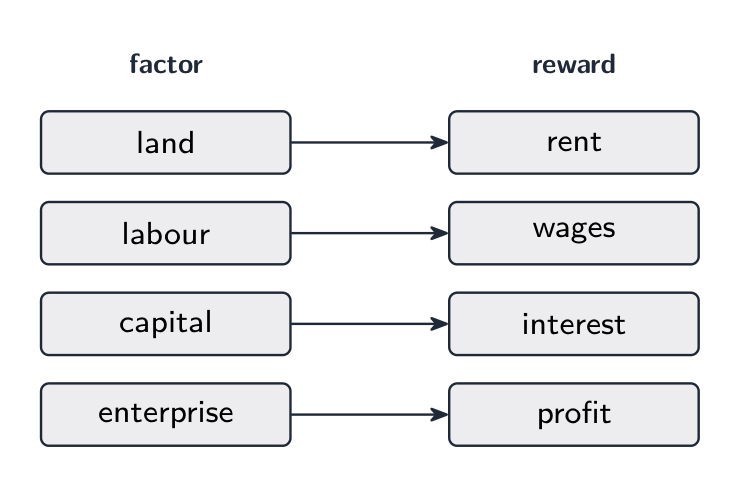
The factors of production 生产要素 are the four kinds of resource used to make goods and services. Each one earns a reward 报酬.
The four factors of production and the reward each earns Factor What it is Its reward land 土地 natural resources (fields, water, oil, minerals) rent 地租 labour 劳动 human work, both physical and mental wages 工资 capital 资本 man-made things used to produce, like machines, tools and factories interest 利息 enterprise 企业家才能 the skill of bringing the other three together and taking the risk profit 利润 Land includes some non-renewable resources 不可再生资源 (like oil and coal) that can run out. Enterprise is supplied by the entrepreneur 企业家, the person who has the business idea and risks their own money.

An open-pit copper mine: land includes the natural resources (minerals, oil, water) that firms extract. Specialisation and division of labour
specialisation 专业化 is when a worker, firm or country makes only the things it is best at, then trades for the rest.
Inside a workplace, specialisation leads to the division of labour 劳动分工: a big job is split into small tasks, and each worker 工人 does one task again and again.
Advantages Disadvantages workers get faster and better at one task doing one task is boring, so workers may quit less time wasted moving between jobs if one worker is absent, the whole line can stop output per worker rises, so costs fall workers learn only one narrow skill 
A car assembly line: capital (machines and robots) plus the division of labour, each worker repeating one task. Mobility of factors
mobility 流动性 means how easily a factor can move to a new use.
- occupational mobility 职业流动性 — how easily a factor moves from one job or use to another. A teacher who retrains as a nurse is occupationally mobile.
- geographical mobility 地理流动性 — how easily a factor moves from one place to another. Land cannot move at all, so it has no geographical mobility.
Labour is often not very mobile. Family ties, the cost of housing, and missing skills all make it hard for workers to move.
ExploreFactors of production lab
Sort real resources by the factor of production they represent.
Vocabulary TrainEnglish factors of production/ˈfæktəz ɒv prəˈdʌkʃn/ reward/rɪˈwɔːd/ land/lænd/ rent/rent/ labour/ˈleɪbə/ wages/ˈweɪdʒɪz/ capital/ˈkæpɪtl/ interest/ˈɪntrest/ enterprise/ˈentəpraɪz/ profit/ˈprɒfɪt/ non-renewable resources/nɒn rɪˈnjuːəbl rɪˈzɔːsɪz/ entrepreneur/ˌɒntrɪprəˈnjʊə/ specialisation/ˌspeʃəlaɪˈzeɪʃn/ division of labour/dɪˈvɪʒn ɒv ˈleɪbə/ worker/ˈwɜːkə/ mobility/məʊˈbɪlɪti/ occupational mobility/ˌɒkjʊˈpeɪʃənl məʊˈbɪlɪti/ geographical mobility/ˌdʒɪəˈɡræfɪkl məʊˈbɪlɪti/ 1.4
Economic systems

Syllabus
- explain how resources are allocated in market, planned and mixed economic systems
- explain the role of the price mechanism (signalling, incentive, rationing) in allocating resources
- evaluate the advantages and disadvantages of each system
Source: Cambridge International syllabus
An economic system is the way a country decides how to allocate 配置 (share out) its scarce resources. There are three types.
- a market economy 市场经济: decentralised buyers and sellers influence production and allocation through prices and purchasing decisions.
- a planned economy 计划经济 (also called a command economy 指令经济): central decisions determine resource allocation and production, often using quantities and eligibility rules.
- a mixed economy 混合经济 — a blend of the two. The private sector 私营部门 (firms and households) and the public sector 公共部门 (the government) both make decisions. Almost every real country is mixed.
Worked allocation comparison. Three illustrative clinic arrangements provide the same kind of service. Private clinics responding to paying patients illustrate market allocation: prices, demand and expected costs influence what and how much to supply, and ability to pay affects access. A central authority specifying quantities, staffing and eligibility illustrates planning. Public tax-funded appointments alongside privately sold appointments illustrate a mixed arrangement. Public provision of one service does not make the whole economy planned. Planning and tax funding do not remove scarce staff time or the need to choose who receives appointments. Ownership alone does not prove efficiency or fairness.
The price mechanism
In a market economy, resources are guided by the price mechanism 价格机制. Prices do three jobs:
- signalling 信号传递 — a price tells buyers and sellers where resources are wanted. A rising price says "this is wanted — make more".
- incentive 激励 — a higher price rewards producers, so they want to supply more of that good.
- rationing 配给 — when a good is scarce, a higher price shares it out to those who are willing and able to pay.
In a market the price does three jobs at once — it signals, it gives an incentive, and it rations the scarce good Comparing the systems
System Strengths Weaknesses market choice, low prices, strong incentive to work and invent large gap between rich and poor; some goods not supplied planned smaller gap between rich and poor; key goods provided for all weak incentive; shortages and surpluses; slow to change mixed tries to keep the good points of both the right balance is hard to find In practice no country sits at a pure extreme. China's economy, for instance, is officially a socialist market economy, where markets set most prices while the government guides key sectors and owns major enterprises. Every real system mixes the two and sits somewhere on the spectrum below.

Economic systems form a spectrum: a pure market at one end, full government planning at the other, mixed economies in between. Vocabulary TrainEnglish allocate/ˈæləkeɪt/ market economy/ˈmɑːkɪt ɪˈkɒnəmi/ planned economy/plænd ɪˈkɒnəmi/ command economy/kəˈmænd ɪˈkɒnəmi/ mixed economy/mɪkst ɪˈkɒnəmi/ private sector/ˈpraɪvət ˈsektə/ public sector/ˈpʌblɪk ˈsektə/ price mechanism/praɪs ˈmekənɪzəm/ signalling/ˈsɪɡnəlɪŋ/ incentive/ɪnˈsentɪv/ rationing/ˈræʃənɪŋ/ efficiency/ɪˈfɪʃənsi/ 1.5
Production possibility curves
Syllabus
- draw and interpret PPCs to show opportunity cost, scarcity, choice and efficiency
- explain movements along and shifts of the PPC and constant versus increasing opportunity cost
- relate the PPC to economic growth and the allocation between capital and consumer goods
Source: Cambridge International syllabus
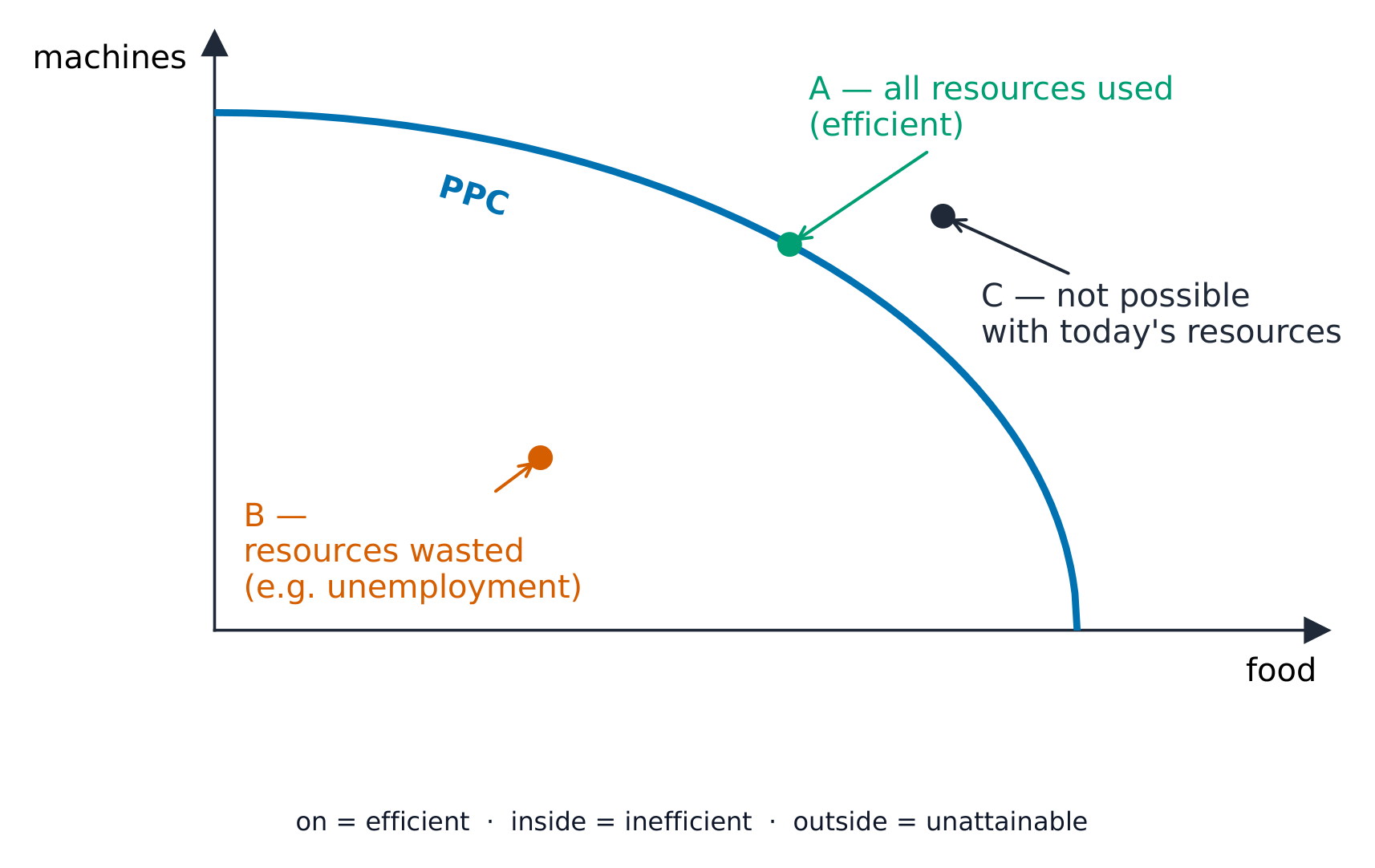
The PPF and opportunity cost A production possibility curve 生产可能性曲线 (PPC) is a line showing the largest combinations of two goods an economy can make when all its resources are fully and well used.
Imagine an economy that makes only food and machines. The PPC is drawn with food on one axis and machines on the other.
- a point on the curve: production is efficient 效率 for the given resources and technology. This alone does not establish the mix society prefers.
- a point inside the curve: resources are wasted (for example, unemployment 失业 of workers). The economy could do better.
- a point outside the curve: impossible today, because there are not enough resources. This shows scarcity.
A point on the curve uses all resources (efficient); inside the curve means waste, e.g. unemployment; outside is not possible yet. Worked frontier classification. An illustrative frontier joins food/machine combinations A=(20,0), B=(16,4), C=(10,8), D=(0,12), with food in tonnes/day and machines in units/day. E=(8,4) is inside: B permits more food at the same machine output. F=(15,8) is outside: at eight machines the maximum food is ten tonnes. C is efficient in production, but the frontier alone cannot show whether society prefers C to B. Moving from B to C gives up six tonnes/day for four extra machines/day, an interval average of 1.5 tonnes per machine. Unused capacity can permit more output without sacrificing the other plotted good; it does not make every use of scarce time, money or staff costless. Opportunity cost is not confined to points on a PPC.
Moving along the curve shows opportunity cost: to make more food, you must move resources away from machines, so you make fewer machines. This is the trade-off 取舍 between the two goods.
The shape of the curve shows how opportunity cost behaves:
- a straight-line PPC means constant opportunity cost — each extra unit of food costs the same number of machines.
- a curve that bows outwards means increasing opportunity cost — each extra unit of food costs more and more machines, because resources are not equally good at making both goods.

A straight PPC means each extra unit of food costs the same; a bowed PPC means each extra unit costs more and more machines. Shifts and growth
When the PPC moves outward, productive capacity increases: this is potential economic growth 经济增长. Actual output need not immediately rise to the new frontier. A sector-specific improvement can rotate one part of the frontier rather than shifting both intercepts. It happens when there are more resources, or better ones (new technology 技术, a bigger or more skilled workforce). War or disaster can move the PPC inward — this is economic decline 经济衰退.

More or better resources shift the whole PPC outward (growth); war or disaster shifts it inward (decline). A country must also choose between two kinds of good now:
- capital goods 资本品 — goods used to make other goods (machines, factories).
- consumer goods 消费品 — goods people use directly (food, clothes).
Making more capital goods today means fewer consumer goods today. Productive investment can increase future capacity, provided it adds effective resources after wear and replacement. More capital spending does not guarantee a larger shift: quality, use, skills and other constraints matter.
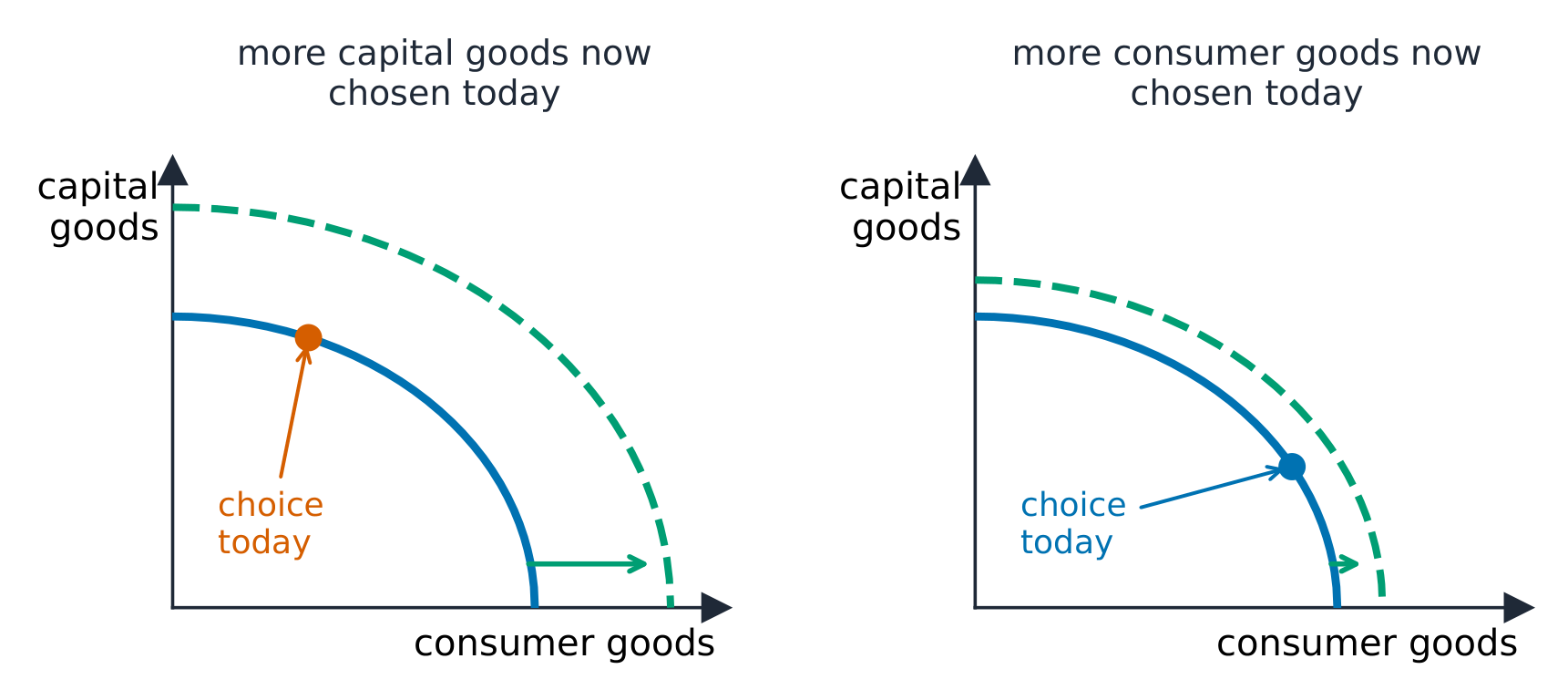
Blue is the current PPC; dashed green is an illustrative future PPC. The larger future shift assumes the extra investment adds productive capacity. Worked example. Why is a production possibility curve usually drawn concave (bowed outwards) rather than as a straight line? A straight line would mean the opportunity cost of each extra unit stays constant. The curve bows out because factors of production are not perfectly substitutable - they are specialised. Starting from all-food production, the first factors moved into making cars are the ones least suited to farming, so very little food is given up for a lot of cars. Keep going and you must move factors that are increasingly good at farming and increasingly bad at making cars, so each extra car costs more and more food. That rising cost is increasing opportunity cost, and the bowed shape is simply its picture. A straight-line PPC is not wrong - it just assumes factors are perfectly substitutable, and naming that assumption is what earns the mark.
ExploreThe production possibility frontier
Producing more of one good means giving up some of the other — that trade-off is the opportunity cost, shown by the slope of the frontier.
ExploreAllocating scarce resources
An economy can't have more of everything: making more of one good means giving up some of another — the frontier's slope is that opportunity cost.
ExploreThe production possibility curve
Move along the curve. Producing more of one good means producing less of the other — the curve shows opportunity cost and scarcity.
Vocabulary TrainEnglish production possibility curve/prəˈdʌkʃn ˌpɒsəˈbɪlɪti kɜːv/ unemployment/ʌnemˈplɔɪmənt/ trade-off/treɪd ɒf/ economic growth/ˌiːkəˈnɒmɪk ɡrəʊθ/ technology/tekˈnɒlədʒi/ economic decline/ˌiːkəˈnɒmɪk dɪˈklaɪn/ capital goods/ˈkæpɪtl ɡʊdz/ consumer goods/kənˈsuːmə ɡʊdz/ 1.6
Types of goods and services
Syllabus
- distinguish free goods and economic (private) goods
- explain the characteristics of public goods (non-rivalry, non-excludability) and the free-rider problem
- explain merit and demerit goods and the role of information and value judgements
Source: Cambridge International syllabus
Free goods and economic goods
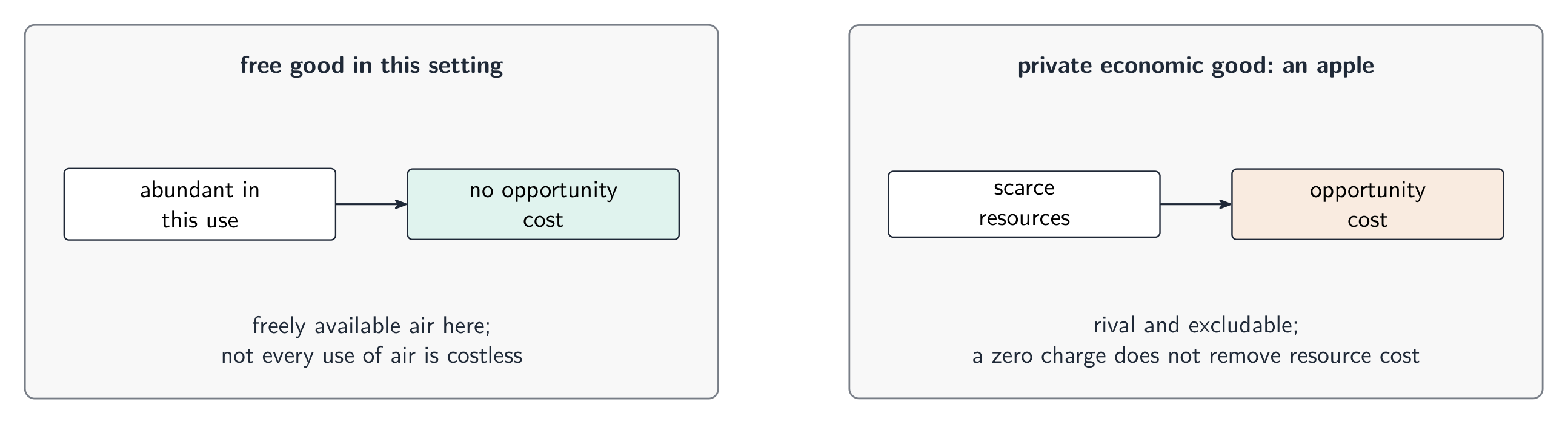
- a free good 免费物品 has no opportunity cost in the relevant use: available supply is sufficient without sacrificing another valued use. Freely available air may qualify in one setting; supplying clean air or oxygen in a hospital can require scarce resources. A zero charge alone does not prove a good is free in this economic sense.
- an economic good 经济物品 uses scarce resources and has opportunity cost. A private good 私人物品 has rivalry and excludability. An apple is an example; economic resources can also be used to provide public services. A good can have opportunity cost even if its user is not directly charged.
A private good has two features. It has rivalry 竞争性 (if I eat the apple, you cannot) and excludability 排他性 (the seller can stop you using it unless you pay).
Opportunity cost depends on scarcity in the relevant use. A private economic good also has rivalry and excludability; a zero charge does not establish zero opportunity cost. Public goods
A public good 公共物品 is the opposite of a private good. It has two features:
- non-rivalry 非竞争性 — one person using it does not reduce the amount left for others.
- non-excludability 非排他性 — you cannot stop people who do not pay from using it.
Because of non-excludability, public goods suffer from the free-rider problem 搭便车问题: people enjoy the good without paying for it. This can cause private under-provision because voluntary payments may not cover cost. It does not prove nobody contributes: donations, sponsorship or other funding can support some provision. Government financing is one response; the financing body and the actual provider need not be the same. Street lighting and national defence 国防 are standard examples under the non-rival, non-excludable assumptions.
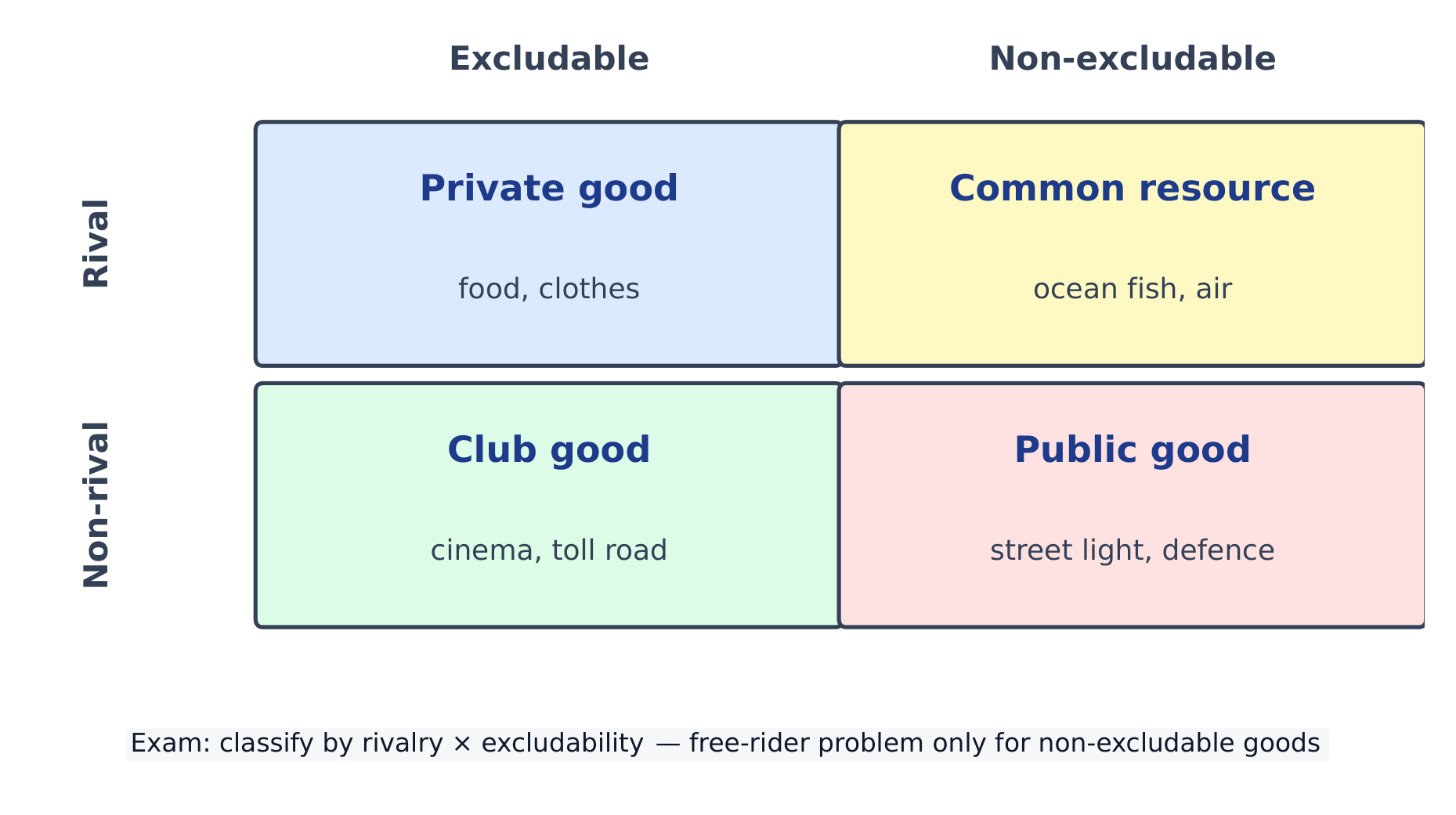
Rivalry and excludability give four types of good: private, club, common resource, and public. Worked classification. An uncrowded local street light benefits nearby users and cannot readily exclude non-payers, fitting the public-good conditions in that setting. A publicly funded hospital appointment uses a scarce doctor's time even when the patient pays nothing. It can be reserved for a patient and cannot simultaneously serve everyone, so public ownership does not make it a public good. A paid lesson can be private and merit at once if the learner underestimates its benefit; the information test differs from rivalry and exclusion.
Merit and demerit goods
- a merit good 优值品 is better for you (and for society) than you realise, so people buy too little of it. Examples: education and health care.
- a demerit good 劣值品 is worse for you than you realise, so people buy too much of it. Examples: cigarettes and alcohol.

Education is a classic merit good. Its full value — better jobs, and a more skilled society — is easy to underestimate, so left to themselves people buy less of it than is good for them or the country. That is why governments provide and subsidise it People misjudge these goods because of information failure 信息失灵 — they do not have, or do not use, the full facts about the benefit or harm.
Deciding what counts as a merit or demerit good is partly a value judgement, so people may disagree about which goods belong on each list.
ExploreGoods and services lab
Classify examples by rivalry, excludability or whether they are services.
Vocabulary TrainEnglish free good/friː ɡʊd/ economic good/ˌiːkəˈnɒmɪk ɡʊd/ private good/ˈpraɪvət ɡʊd/ rivalry/ˈraɪvəlri/ excludability/eksˌkluːdəˈbɪlɪti/ public good/ˈpʌblɪk ɡʊd/ non-rivalry/nɒn ˈraɪvəlri/ non-excludability/nɒn eksˌkluːdəˈbɪlɪti/ free-rider problem/friː ˈraɪdə ˈprɒbləm/ national defence/ˈnæʃənl dɪˈfens/ merit good/ˈmerɪt ɡʊd/ demerit good/ˈdemərɪt ɡʊd/ information failure/ˌɪnfəˈmeɪʃn ˈfeɪlɪə/ 1.6
Exam tips
- Frame answers around scarcity and choice: every choice has an opportunity cost — the next best alternative given up.
- Read a PPC: a point inside means unused resources, on the curve is efficient, outside is unattainable; the slope shows opportunity cost.
- Distinguish positive (a testable fact) from normative ("should", a value judgement) statements.
- Classify goods: free versus economic, and public / merit / demerit goods (non-excludable, non-rival, and so on).
Vocabulary card meanings
goods: Physical items that people can buy and sell. alternative: Any other option a person could have chosen. social science: A field that studies how people behave in groups and markets. ceteris paribus: Holding every other factor unchanged while one factor is studied. positive statement: A claim that can be checked against facts. normative statement: A claim about what ought to happen, resting on a value judgement. microeconomics: The study of single markets, firms, and households. reward: The payment a factor of production receives for its use. rent: The payment made for the use of land. non-renewable resources: Inputs that nature does not restore within a human lifetime after they are used. division of labour: Splitting production so that each person does one task. worker: A person who supplies labour. mobility: How easily a factor can move to another job or place. geographical mobility: How easily a person can move to work in another place. planned economy: An economy in which the state decides what is produced. command economy: An economy run by government orders rather than by prices. economic decline: A fall in production and incomes across the whole economy. national defence: Protection of a country by its armed forces.
-
2
The price system and the microeconomy
Watch lesson2.1
Demand
Syllabus
- explain the determinants of demand and supply and distinguish movements along from shifts of the curves
- derive individual and market demand and supply
- explain the relationship between marginal utility and the demand curve
Source: Cambridge International syllabus
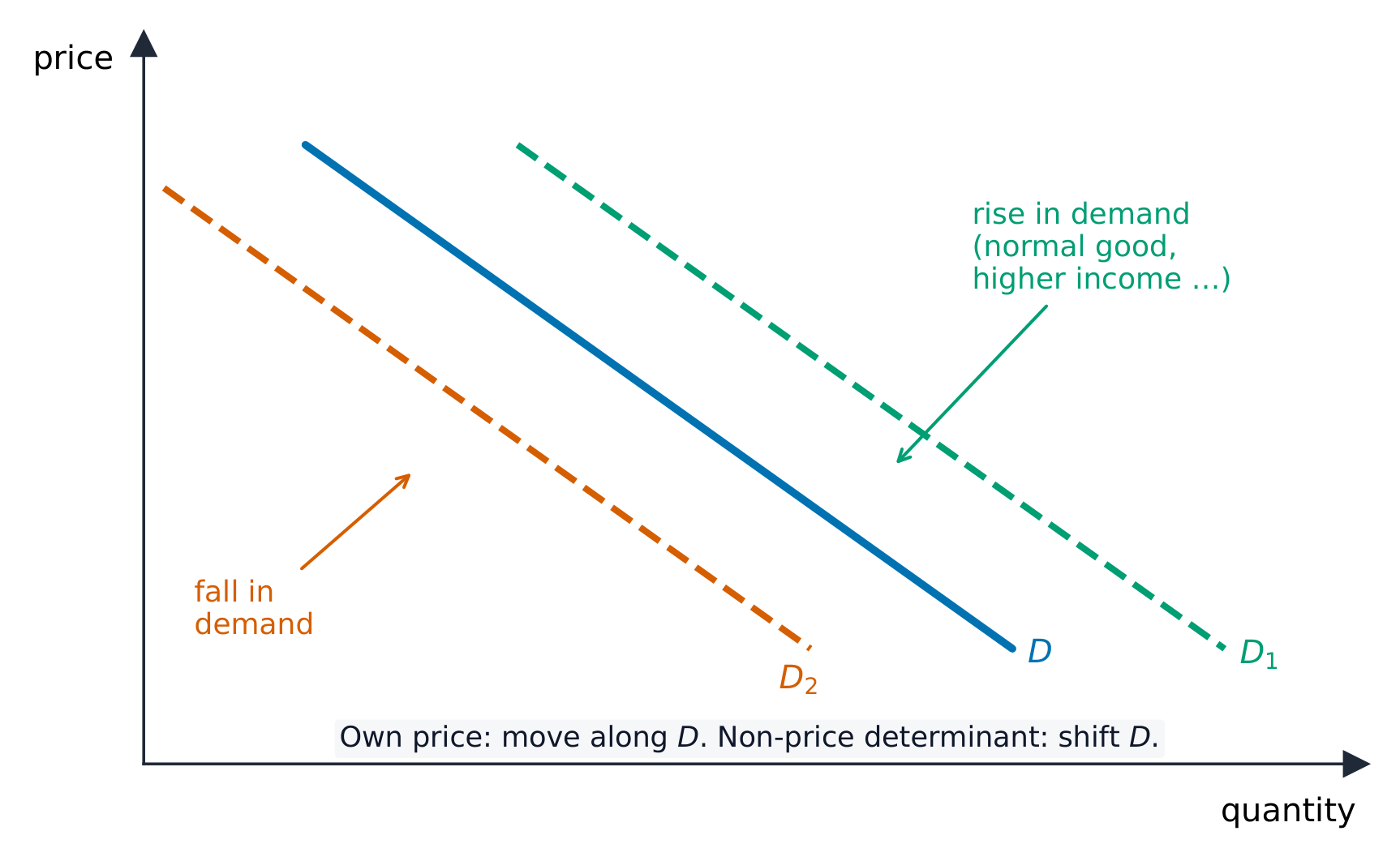
Demand shifts right: P and Q rise demand 需求 is the quantity of a good that buyers are willing and able to buy at each price 价格 in a period of time. It is not just a wish — buyers must also be able to pay.
The law of demand, holding other determinants constant, says: when the price rises, the quantity demanded 需求量 falls; when the price falls, the quantity demanded rises. Price and quantity move in opposite directions.
So the demand curve 需求曲线 slopes downward, from top-left to bottom-right.
What shifts the demand curve
A change in the good's own price is shown as a movement along the demand curve. A change in a non-price determinant shifts the whole curve to a new position — this is a shift 移动 of demand. The main causes (the determinants 决定因素) are:
- income 收入 — for most goods, higher income raises demand.
- the price of a substitute 替代品 — a good you can use instead (tea for coffee). If the substitute's price rises, demand for this good rises.
- the price of a complement 互补品 — a good used together with this one (cars and petrol). If the complement's price rises, demand for this good falls.
- tastes and fashion, the size of the population, and advertising.
A change in income, tastes or related prices shifts the whole curve ($D_1$ right, $D_2$ left); a change in the good's own price is a movement along it. Apply movement versus shift. Consider three separate coffee-market events. (1) Coffee price falls from $\$7$ to $\$6$, all other conditions fixed: quantity demanded rises along the original curve. (2) Tea becomes dearer: coffee demand shifts right if tea is a substitute. (3) Income rises, but no income relationship is given: the direction needs a normal/inferior-good assumption. Draw the relevant change before reading each explanation.
Individual and market demand
One consumer 消费者 has an individual demand. The market demand 市场需求 is found by adding up the quantity that all consumers want at each price (adding the curves sideways).
Marginal utility and demand
utility 效用 is the satisfaction you get from consuming a good. marginal utility 边际效用 is the extra utility from one more unit.
The law of diminishing marginal utility 边际效用递减 says each extra unit gives less extra satisfaction than the one before. This can help explain lower willingness to pay in a simple model, but it is not by itself a general proof of downward-sloping demand. Full utility analysis is an A-Level Topic 7 preview here. For marginal utilities $12,9,6,3$, total utility is $12,21,27,30$: total utility rises while marginal utility stays positive.
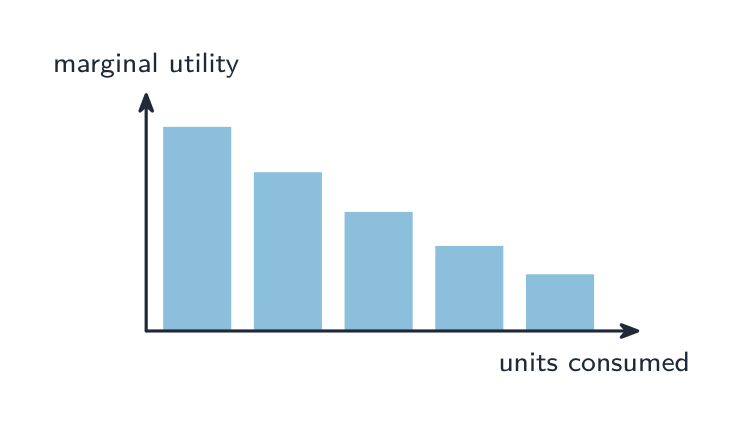
Each extra unit adds less satisfaction in this illustrative diminishing-marginal-utility model ExploreDemand & supply
Demand slopes down — a lower price, more is wanted.
Vocabulary TrainEnglish demand/dɪˈmænd/ price/praɪs/ quantity demanded/ˈkwɒntɪti dɪˈmændɪd/ demand curve/dɪˈmænd kɜːv/ shift/ʃɪft/ determinants/dɪˈtɜːmɪnənts/ income/ˈɪŋkʌm/ substitute/ˈsʌbstɪtjuːt/ complement/ˈkɒmplɪmənt/ consumer/kənˈsuːmə/ market demand/ˈmɑːkɪt dɪˈmænd/ utility/juːˈtɪlɪti/ marginal utility/ˈmɑːdʒɪnl juːˈtɪlɪti/ diminishing marginal utility/dɪˈmɪnɪʃɪŋ ˈmɑːdʒɪnl juːˈtɪlɪti/ 2.1
Supply
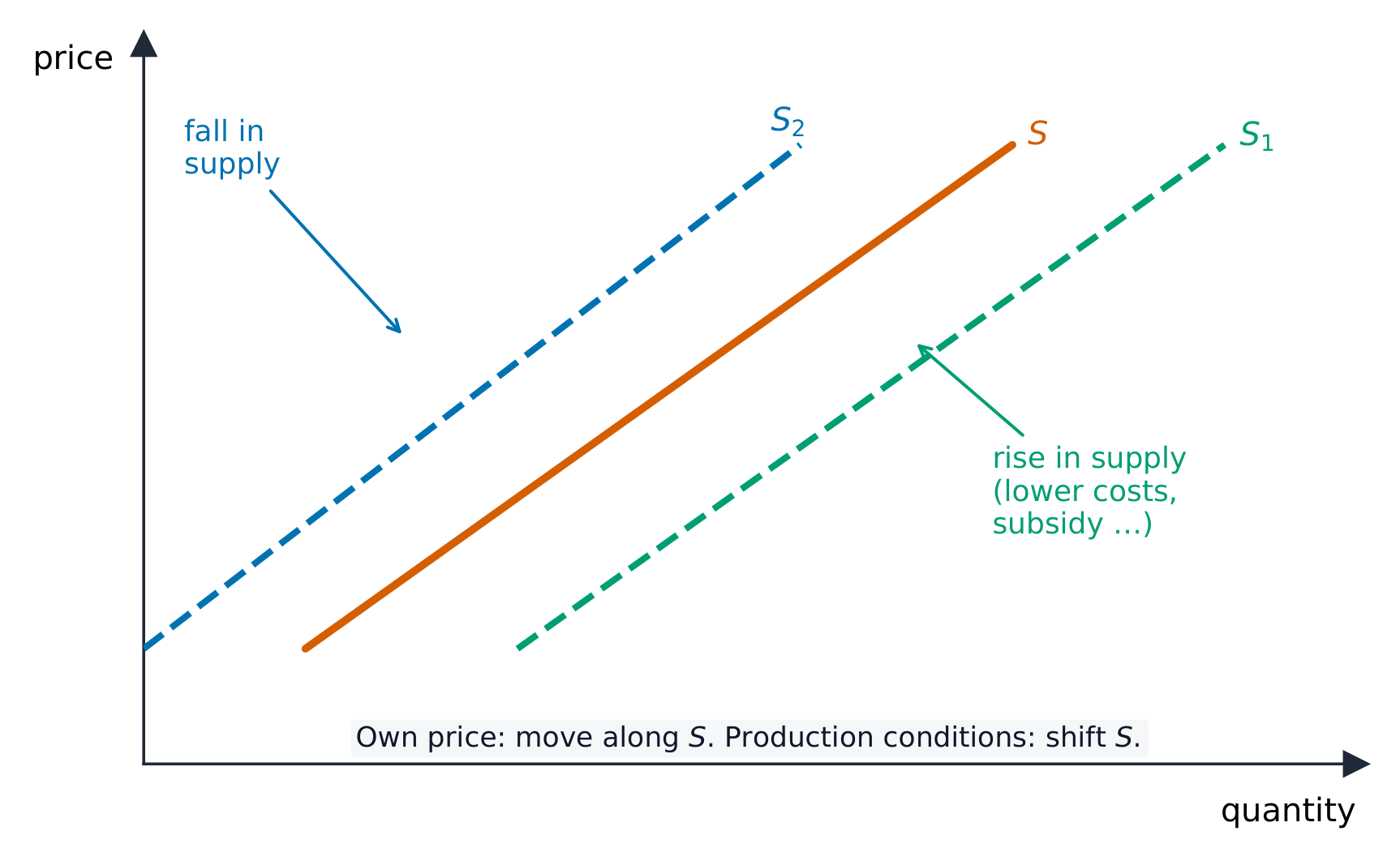
Supply shifts right: P falls, Q rises supply 供给 is the quantity of a good that producers 生产者 are willing and able to sell at each price in a period of time.
The law of supply, holding other determinants constant, says: when the price rises, the quantity supplied 供给量 rises. Higher prices can make extra output worthwhile. Total profit 利润 also depends on costs; price alone does not establish it. So the supply curve 供给曲线 slopes upward.
What shifts the supply curve
A change in the good's own price is a movement along the supply curve. Other causes shift the whole curve:
- costs of production 生产成本 — if wages, raw materials or rent get dearer, supply falls.
- technology — better machines raise supply.
- a per-unit producer subsidy 补贴 raises supply; a per-unit tax on sellers lowers it.
- the number of firms 企业 in the market, and weather (for farm goods).
Lower costs, better technology or a subsidy shift supply right ($S_1$); higher costs or a tax shift it left ($S_2$). Bakery application. A higher bread price, other conditions fixed, raises quantity supplied along the original curve. Cheaper flour or a more efficient oven shifts supply right: more bread can be offered at the same price. A change unrelated to willingness or ability to produce does not automatically shift supply.
Individual and market supply
The market supply 市场供给 is found by adding up the quantity all firms will sell at each price.
ExploreDemand & supply
A demand shift changes equilibrium and moves quantity supplied along the unchanged upward-sloping supply curve.
ExploreSupply shifts and equilibrium
A change in production conditions shifts supply and changes equilibrium. This activity shows a shift, not a measurement of price elasticity of supply.
Vocabulary TrainEnglish supply/səˈplaɪ/ producer/prəˈdjuːsə/ quantity supplied/ˈkwɒntɪti səˈplaɪd/ profit/ˈprɒfɪt/ supply curve/səˈplaɪ kɜːv/ costs of production/kɒsts ɒv prəˈdʌkʃn/ subsidy/ˈsʌbsɪdi/ firm/fɜːm/ market supply/ˈmɑːkɪt səˈplaɪ/ 2.2
Price elasticity of demand

Syllabus
- define, calculate and interpret price elasticity of demand (PED), income elasticity (YED) and cross elasticity (XED)
- explain the determinants of each and the relationship between PED and total revenue/expenditure
- explain the usefulness of elasticities to firms and government
Source: Cambridge International syllabus
Elastic vs inelastic demand price elasticity of demand 需求价格弹性 (PED) measures how much the quantity demanded responds when the price changes.
$$\text{PED} = \frac{\%\ \text{change in quantity demanded}}{\%\ \text{change in price}}$$PED is normally negative (because of the law of demand), but we usually look at the size and drop the minus sign.
Worked example. The price of a good rises by 10% and the quantity demanded falls by 25%. Find the PED and classify the demand.
$$\text{PED} = \frac{-25}{10} = -2.5$$Ignoring the minus sign, $2.5 > 1$, so demand is elastic — quantity responded much more than the price did.
A petrol station: demand responsiveness depends on available alternatives and adjustment time; the photo alone cannot establish PED. PED magnitude Name Meaning more than 1 elastic 富有弹性 quantity responds a lot less than 1 inelastic 缺乏弹性 quantity responds a little equal to 1 unit elastic 单位弹性 quantity changes by the same % as price 0 perfectly inelastic 完全无弹性 quantity does not change at all infinity perfectly elastic 完全有弹性 horizontal demand at a given price in the idealized model 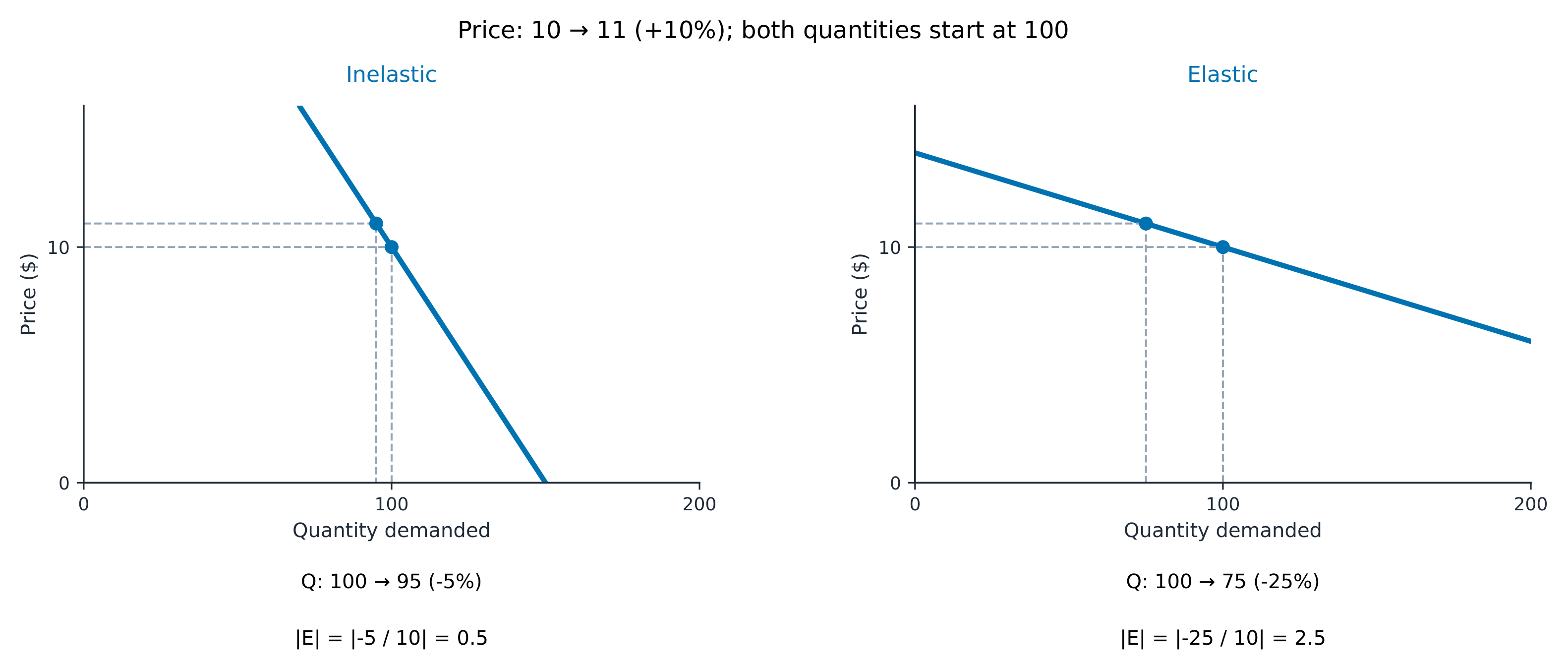
The same 10% price rise gives quantity falls of 5% and 25%: PED magnitudes 0.5 and 2.5. Compare percentages, not slope alone. What makes demand elastic or inelastic
- the number and closeness of substitutes (more substitutes → more elastic).
- whether the good is a necessity 必需品 or a luxury 奢侈品; these influence responsiveness but do not guarantee a particular own-price coefficient.
- the share of income spent on the good (a large share → more elastic).
- time — more time usually lets buyers find alternatives, making demand more responsive; it does not guarantee elasticity above 1.
- habit or addiction can reduce responsiveness, alongside other determinants.
One straight-line curve. For $Q_d=10-P$, the gradient $\Delta Q_d/\Delta P=-1$ is constant. Point elasticity 点弹性 uses that gradient with the current price and quantity:
$$PED=\frac{\Delta Q_d}{\Delta P}\frac{P}{Q_d}.$$At $(P,Q)=(8,2)$, $PED=(-1)(8/2)=-4$; at $(5,5)$, it is $-1$; at $(2,8)$, it is $-0.25$. The curve has the same slope but different percentage responsiveness. These are point values, not a claim that a large finite change has the same elasticity. Revenue $TR=PQ$ is $16,25,16$ respectively: the midpoint maximizes revenue on this straight-line curve with positive intercepts. A constant unit-elastic demand curve instead keeps revenue constant throughout its unit-elastic segment.PED and total revenue
total revenue 总收益 is the money a firm earns: $\text{TR} = \text{price} \times \text{quantity}$. PED tells a firm what happens to revenue when it changes the price:
If demand is… price rises price falls inelastic total revenue rises total revenue falls elastic total revenue falls total revenue rises unit-elastic segment total revenue stays the same total revenue stays the same Worked revenue comparison. Both goods start at price $\$10$ and quantity $100$. Price rises to $\$11$ ($+10\%$, using the initial base). Good A sells $95$ ($-5\%$); good B sells $75$ ($-25\%$).
$$PED_A=\frac{-5}{10}=-0.5,\qquad PED_B=\frac{-25}{10}=-2.5.$$$$TR_0=P_0Q_0=10(100)=\$1000.$$$$TR_{A,1}=P_1Q_{A,1}=11(95)=\$1045,\qquad TR_{B,1}=11(75)=\$825.$$Higher revenue does not establish higher profit without cost information. Governments 政府 also use responsiveness when considering taxes, but tax revenue requires the tax per unit and the taxed quantity; PED alone gives neither.Official application: 9708/21 O/N/25 Q2(a). Explain why a commuter may keep using petrol this week but change transport or car over a year. Then judge whether time is decisive: a remote commuter with no viable alternatives may still be unresponsive later. Use the formula, explain the adjustment mechanism and reach a conditional judgement; do not just list determinants.
Vocabulary TrainEnglish price elasticity of demand/praɪs ɪlæˈstɪsɪti ɒv dɪˈmænd/ elastic/ɪˈlæstɪk/ inelastic/ɪnɪˈlæstɪk/ unit elastic/ˈjuːnɪt ɪˈlæstɪk/ perfectly inelastic/ˈpɜːfektlɪ ɪnɪˈlæstɪk/ perfectly elastic/ˈpɜːfektlɪ ɪˈlæstɪk/ necessity/nəˈsesɪti/ luxury/ˈlʌkʃəri/ total revenue/ˈtəʊtl ˈrevənjuː/ government/ˈɡʌvənmənt/ point elasticity/pɔɪnt ɪlæˈstɪsɪti/ 2.2
Income elasticity of demand

income elasticity of demand 需求收入弹性 (YED) measures how much demand responds when income changes.
As income rises, demand for a normal good rises but an inferior good falls $$\text{YED} = \frac{\%\ \text{change in quantity demanded}}{\%\ \text{change in income}}$$- a normal good 正常品 has positive YED: demand rises as income rises. Necessities have YED between 0 and 1; luxuries have YED above 1.
- an inferior good 低档品 has negative YED: demand falls as income rises (people switch to better goods). Cheap instant noodles may be inferior for some consumers over a particular income range; the label is not a judgement about quality.
Worked example. A person's income rises by 20% and their demand for restaurant meals rises by 30%. Find the YED and classify the good.
$$\text{YED} = \frac{+30}{+20} = +1.5$$YED is positive and greater than 1, so restaurant meals are a normal good — and a luxury.
YED helps firms plan for income changes. The nature of the good, income level and whether alternatives are available can affect its value; the estimate need not remain fixed as conditions change.
Vocabulary TrainEnglish income elasticity of demand/ˈɪŋkʌm ɪlæˈstɪsɪti ɒv dɪˈmænd/ normal good/ˈnɔːml ɡʊd/ inferior good/ɪnˈfɪərɪə ɡʊd/ 2.2
Cross elasticity of demand

cross elasticity of demand 需求交叉弹性 (XED) measures how much demand for one good responds when the price of another good changes.
$$\text{XED} = \frac{\%\ \text{change in quantity demanded of A}}{\%\ \text{change in price of B}}$$- for substitutes, XED is positive (the price of B rises, so people buy more A).
- for complements, XED is negative (the price of B rises, so people buy less A and less B).
- for goods that are not related, XED is about zero.
Worked example. When the price of tea rises by 10%, the quantity of coffee demanded rises by 4%. Find the XED and say how the two goods are related.
$$\text{XED} = \frac{+4}{+10} = +0.4$$The sign of XED: positive for substitutes, negative for complements, about zero for unrelated goods XED is positive, so tea and coffee are substitutes.
XED depends on the closeness of substitutes or strength of complementary use, and on the market definition. A positive value predicts that a rival price cut reduces this good's demand, other determinants fixed.
Complement practice. Printer price rises $10\%$ and ink quantity demanded falls $6\%$: $XED_{ink,printer}=\frac{-6}{10}=-0.6$. The negative sign supports complementary use. It says nothing about whether ink is an inferior good; that needs an income change.
Decision practice for 9708/21 O/N/25 Q2(b). A fictional restaurant has YED $=1.5$ and XED with a close rival $=0.8$. In separate scenarios, income rises $2\%$ or the rival cuts price $10\%$.
$$\%\Delta Q=YED(\%\Delta Y)=1.5(2)=+3\%.$$$$\%\Delta Q=XED(\%\Delta P_B)=0.8(-10)=-8\%.$$YED matters for income forecasts; XED matters for rival-price changes. Use the expected changes and business decision to judge which is more useful. These are estimates holding other determinants fixed, not guaranteed exact forecasts or an unconditional ranking of the two measures.Vocabulary TrainEnglish cross elasticity of demand/krɒs ɪlæˈstɪsɪti ɒv dɪˈmænd/ 2.3
Price elasticity of supply
Syllabus
- define, calculate and interpret price elasticity of supply (PES)
- explain the determinants of PES, including time period (momentary, short run, long run)
Source: Cambridge International syllabus
price elasticity of supply 供给价格弹性 (PES) measures how much the quantity supplied responds when the price changes.
$$\text{PES} = \frac{\%\ \text{change in quantity supplied}}{\%\ \text{change in price}}$$PES is nonnegative for an upward-sloping or vertical supply curve. A value above 1 is elastic; below 1 is inelastic. Compare percentage changes, not slope alone.
Compare two firms
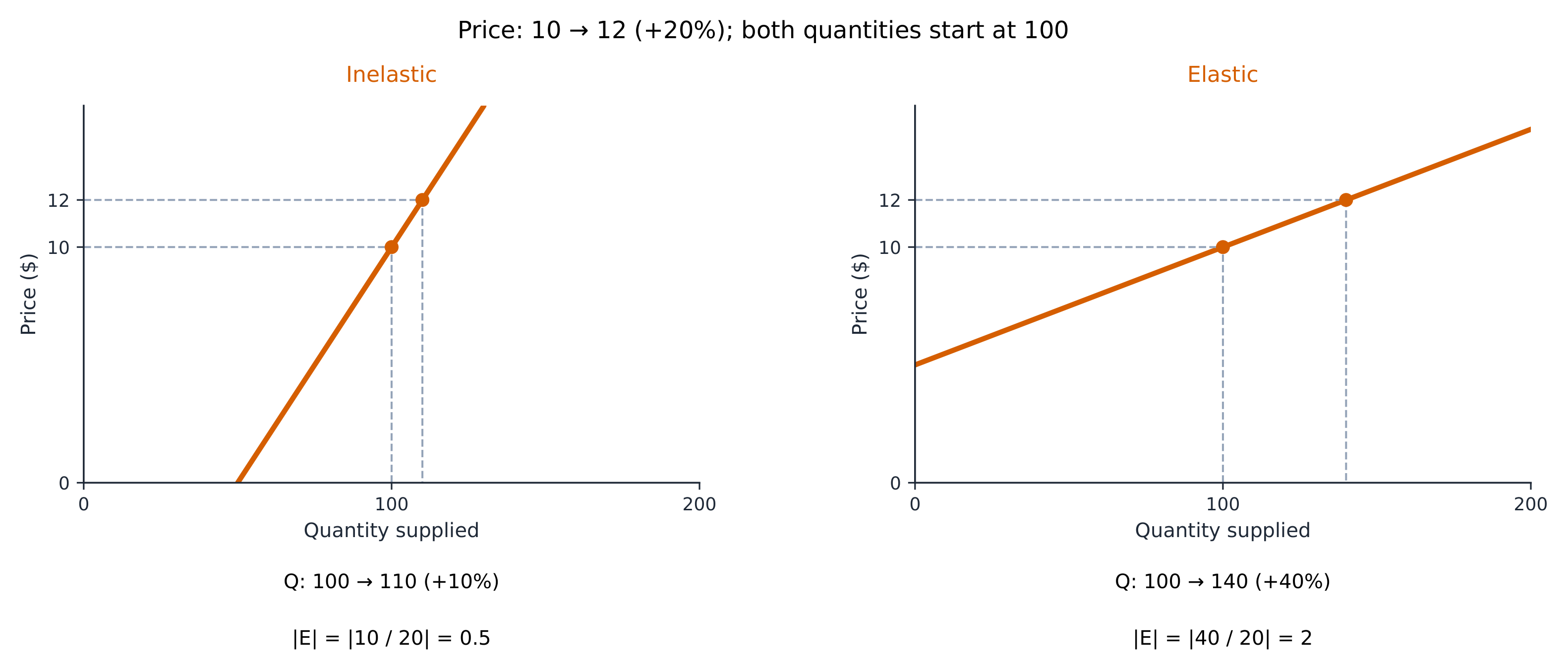
Both start at price $10$, quantity $100$. Price rises to $12$ ($+20\%$). A supplies $110$ ($+10\%$); B supplies $140$ ($+40\%$). Percentages use the initial values.
$$PES_A=\frac{\%\Delta Q_s}{\%\Delta P}=\frac{10}{20}=0.5,\qquad PES_B=\frac{40}{20}=2.$$Firm A is inelastic and firm B elastic. The diagram uses the same initial values and scales; visual steepness alone cannot classify arbitrary supply curves.The same price rise: a small supply response when PES is below 1, a large one when PES is above 1 What makes supply more elastic:
- spare capacity 闲置产能 — unused machines and workers, so firms can quickly make more.
- stocks 库存 — goods stored in a warehouse that can be sold fast.
- how easily factors of production can move into the industry.
- time. Economists split time into three periods:
- the momentary 瞬时 period — supply is fixed; PES is zero.
- the short run 短期 — at least one factor is fixed; spare capacity and stocks may still allow a substantial response.
- the long run 长期 — all factors can change, usually allowing more adjustment. This does not guarantee PES above 1.
Policy application: 9708/02/SP/23 Q3(b)
Refrigeration can preserve saleable stocks; training can ease skill constraints. Neither necessarily makes all agricultural supply elastic: perishability, costs and biological growing time differ. Explain the constraint removed, a limitation, then a product-specific judgement. A supply shift after a subsidy is not by itself evidence that PES has increased.
Vocabulary TrainEnglish price elasticity of supply/praɪs ɪlæˈstɪsɪti ɒv səˈplaɪ/ spare capacity/speə kəˈpæsɪti/ stocks/stɒks/ momentary/ˈməʊməntəri/ short run/ʃɔːt rʌn/ long run/lɒŋ rʌn/ 2.4
The interaction of demand and supply

Syllabus
- explain equilibrium price and quantity and how shifts in demand and supply change equilibrium
- explain disequilibrium (excess demand and excess supply) and the functions of the price mechanism
- apply demand and supply analysis to product, factor and foreign exchange markets
Source: Cambridge International syllabus
Compare the quantities demanded and supplied at the same price.
A stall offers goods at posted prices; this photograph does not establish market equilibrium Equilibrium
The market is in equilibrium 均衡 where the demand curve crosses the supply curve. Here quantity demanded equals quantity supplied at the same price. This gives the equilibrium price 均衡价格 and the equilibrium quantity 均衡数量. There is no pressure for the price to change.
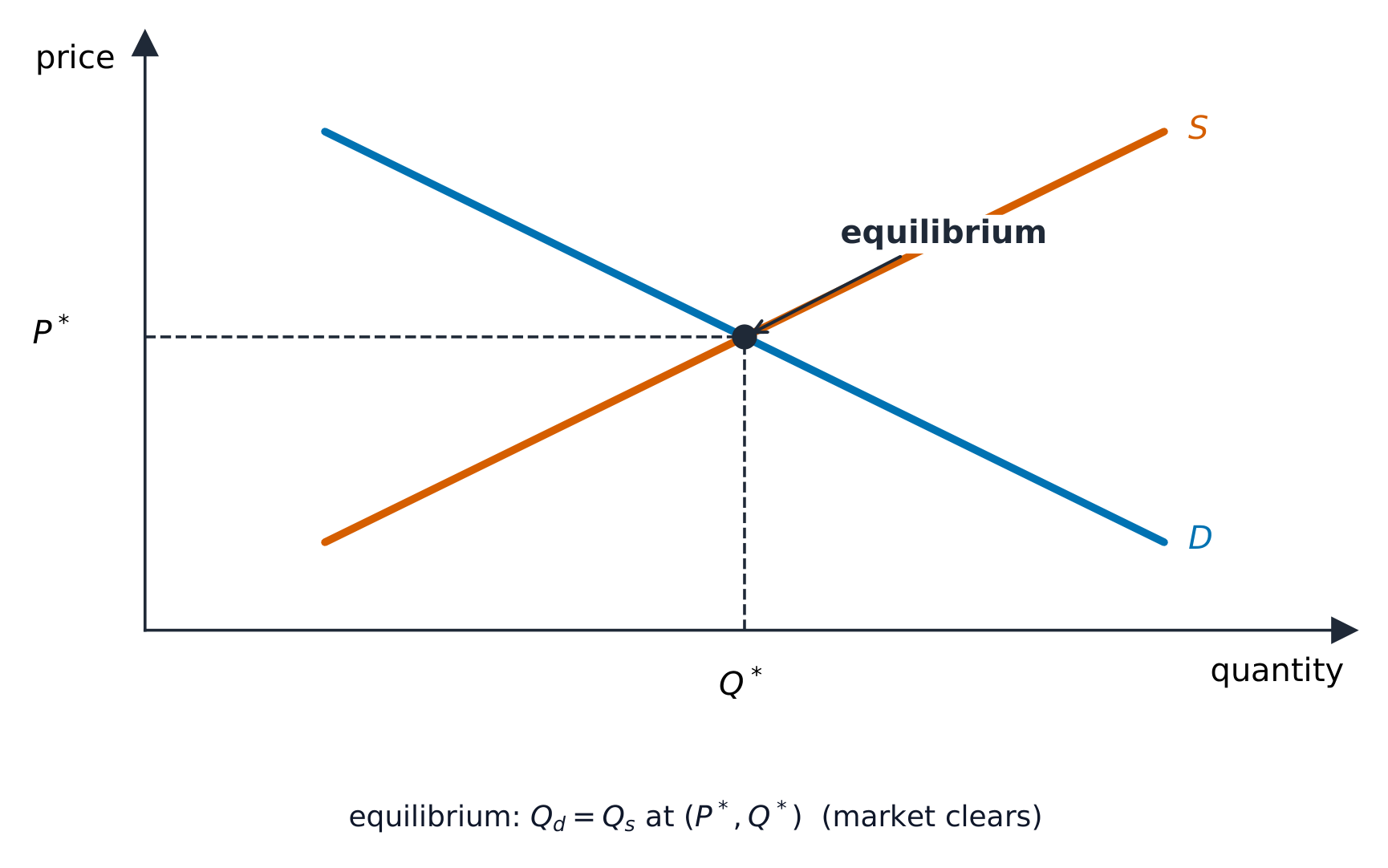
At the equilibrium price $P^*$ and quantity $Q^*$ the curves cross, so quantity demanded equals quantity supplied. Worked market. Let $Q_d=12-P$ and $Q_s=P-2$. At prices $4,6,7,8$, the corresponding demand quantities are $8,6,5,4$ and supply quantities $2,4,5,6$. Solve the equality:
$$Q_d=Q_s,\qquad12-P=P-2,\qquad P^*=\$7,\quad Q^*=5.$$At $\$6$, excess demand is $6-4=2$ units; at $\$8$, excess supply is $6-4=2$ units. A shortage provides signalling 信号传递 of unmet demand. A higher price performs rationing 配给 through willingness and ability to pay and gives suppliers an incentive 激励 to offer more, other costs unchanged.Disequilibrium
When the price is not at equilibrium, the market is in disequilibrium 非均衡:
- if the price is too low, there is excess demand 超额需求 (a shortage 短缺). Buyers compete, so the price is pushed up.
- if the price is too high, there is excess supply 超额供给. Sellers cannot sell everything, so the price is pushed down.
With other conditions unchanged and prices free to adjust, these imbalances create pressure towards equilibrium. Contracts, controls or new shocks can interrupt the path. This shows the price mechanism doing its jobs of signalling, rationing and giving an incentive.
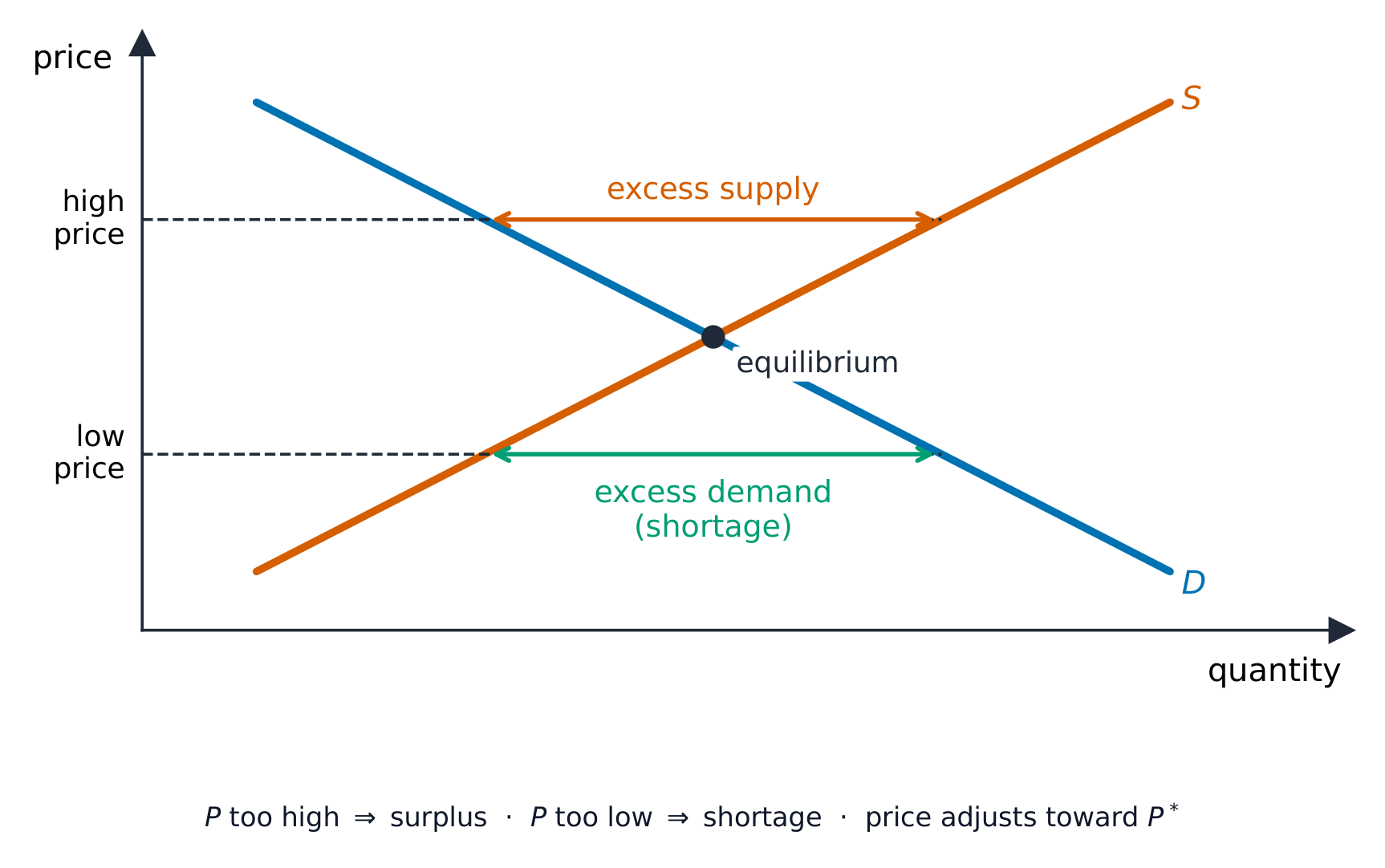
Above the equilibrium price there is excess supply; below it there is excess demand (a shortage). With flexible prices and other conditions unchanged, the imbalance creates pressure towards equilibrium. How shifts change the equilibrium
Change Effect on price Effect on quantity demand rises (shifts right) rises rises demand falls (shifts left) falls falls supply rises (shifts right) falls rises supply falls (shifts left) rises falls 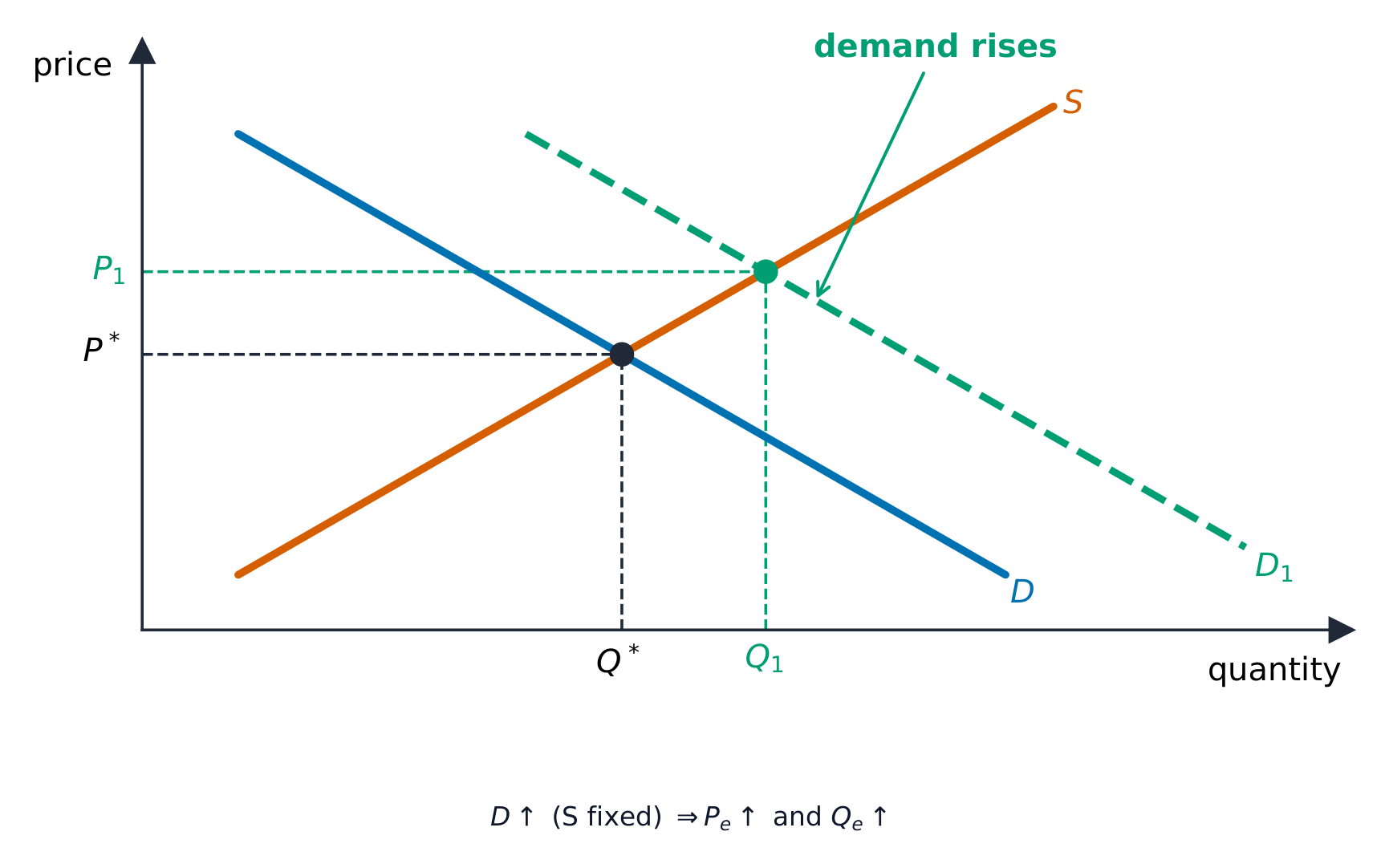
With supply fixed, a rise in demand ($D \to D_1$) raises both the equilibrium price and the equilibrium quantity. Demand and supply in different markets
The same analysis works in many markets:
- in product markets 产品市场, demand and supply set the price of goods and services.
- in factor markets 要素市场, they set the price of factors — for example, the demand for and supply of labour set the wage 工资.
- in a floating foreign exchange market 外汇市场, the demand for and supply of a currency set the exchange rate 汇率 (the price of one currency in terms of another).
Relationships between markets
- Joint demand 共同需求: printers and ink are complements; more printer use can increase ink demand.
- Alternative demand 替代需求: substitutes such as tea and coffee; dearer tea can increase coffee demand.
- Derived demand 派生需求: bread demand creates demand for bakers' labor.
- Joint supply 联合供给: beef production also produces hides; more beef output can increase leather supply.
Identify the market and relevant determinant before drawing its curve.
ExploreDemand & supply
Where demand meets supply sets the equilibrium price and quantity.
ExploreFinding the equilibrium price
Shift demand or supply and watch the equilibrium price and quantity move to where the two lines cross.
Vocabulary TrainEnglish equilibrium/ˌiːkwɪˈlɪbrɪəm/ equilibrium price/ˌiːkwɪˈlɪbrɪəm praɪs/ equilibrium quantity/ˌiːkwɪˈlɪbrɪəm ˈkwɒntɪti/ disequilibrium/ˌdɪˌsiːkwɪˈlɪbrɪəm/ excess demand/ekˈses dɪˈmænd/ shortage/ˈʃɔːtɪdʒ/ excess supply/ekˈses səˈplaɪ/ product market/ˈprɒdʌkt ˈmɑːkɪt/ factor market/ˈfæktə ˈmɑːkɪt/ wage/weɪdʒ/ foreign exchange market/ˈfɒrən eksˈtʃeɪndʒ ˈmɑːkɪt/ exchange rate/eksˈtʃeɪndʒ reɪt/ joint demand/dʒɔɪnt dɪˈmænd/ alternative demand/ɔːlˈtɜːnətɪv dɪˈmænd/ derived demand/dɪˈraɪvd dɪˈmænd/ joint supply/dʒɔɪnt səˈplaɪ/ signalling/ˈsɪɡnəlɪŋ/ rationing/ˈræʃənɪŋ/ incentive/ɪnˈsentɪv/ 2.5
Consumer and producer surplus
Syllabus
- define and identify consumer surplus and producer surplus on a diagram
- explain how changes in demand, supply and price affect consumer and producer surplus
Source: Cambridge International syllabus
consumer surplus 消费者剩余 is the gain to buyers. It is the difference between the most a consumer was willing to pay and the price actually paid. On a diagram it is the area below the demand curve and above the price line.
producer surplus 生产者剩余 is the gain to sellers. It is the difference between the price a producer receives and the lowest price the producer would have accepted. On a diagram it is the area above the supply curve and below the price line.
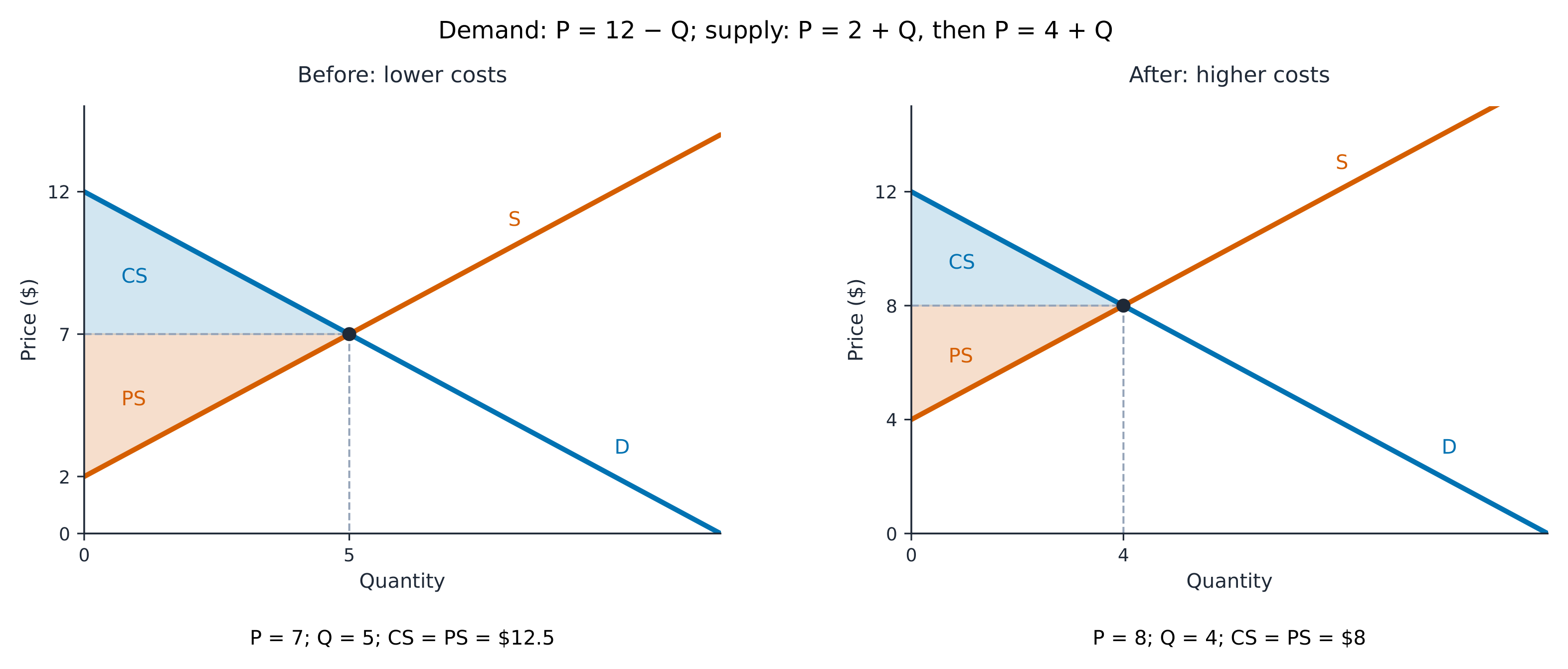
Worked surplus and cost change. Use the same fictional competitive market: inverse demand $P_D=12-Q$ and inverse supply $P_S=2+Q$. Equilibrium is $Q=5$, $P=\$7$.
$$CS=\tfrac12Q(P_{D,0}-P)=\tfrac12(5)(12-7)=\$12.50.$$$$PS=\tfrac12Q(P-P_{S,0})=\tfrac12(5)(7-2)=\$12.50.$$$$TS=CS+PS=\$25.$$For 9708/22 O/N/25 Q2(a), consider the claim that producers always gain when a cost increase raises price. These are illustrative numbers, not data from that paper. Higher input costs shift supply to $P_{S,1}=4+Q$:$$P_D=P_{S,1},\qquad12-Q=4+Q,\qquad Q_1=4,\quad P_1=\$8.$$$$PS_1=\tfrac12Q_1(P_1-4)=\tfrac12(4)(8-4)=\$8.$$$$CS_1=\tfrac12Q_1(12-P_1)=\tfrac12(4)(12-8)=\$8.$$$$TR_0=P_0Q_0=7(5)=\$35,\qquad TR_1=P_1Q_1=8(4)=\$32.$$Price rises, but producer surplus and revenue fall in this example. The new equilibrium can still be efficient: lower total surplus reflects the higher real production costs, not automatically deadweight loss. Judge the outcome using the new cost curve, quantity and demand/supply responsiveness. Producer surplus is not automatically total profit because fixed costs also matter.Consumer surplus is the area below demand and above the price; producer surplus is the area above supply and below the price. A demand increase raises equilibrium price and quantity with supply fixed, but do not infer consumer surplus from price alone: both the demand curve and price have changed. A supply increase raises consumer surplus with demand fixed; producer surplus depends on the new curve and outcome. If a price is imposed away from equilibrium, specify the quantity actually traded and any rationing before measuring areas.
Consumer surplus plus producer surplus is total market welfare 福利 in this simple model. Competitive equilibrium maximizes it when private costs and benefits reflect social costs and benefits and there are no market failures. This is a conditional benchmark, not a claim about every real market.
ExploreDemand & supply
Consumer surplus is below demand and above price; producer surplus is above supply and below price. Reassess the areas after a curve shifts.
Vocabulary TrainEnglish consumer surplus/kənˈsuːmə ˈsɜːpləs/ producer surplus/prəˈdjuːsə ˈsɜːpləs/ welfare/ˈwelfeə/ 2.5
Exam tips
- Quote the elasticity formula and interpret the value: PED magnitude inelastic ($<1$), elastic ($>1$); link PED to total revenue.
- Distinguish a movement along (a price change) from a shift (a non-price factor) of demand or supply.
- Use the sign of XED (substitutes $+$, complements $-$) and YED (normal $+$, inferior $-$).
- On a diagram, label consumer and producer surplus and show how a price change alters each.
Vocabulary card meanings
market demand: The total amount buyers want at each price. diminishing marginal utility: Each extra unit adds less satisfaction than the unit before it. market supply: The total amount sellers offer at each price. perfectly elastic: A situation in which price stays unchanged across the whole range of quantities buyers or sellers choose. momentary: Lasting only an instant, before anyone can adjust. equilibrium quantity: The amount bought and sold when buyers' and sellers' plans match. product market: The place where finished goods and services are traded. point elasticity: Responsiveness of quantity, measured at one exact price. joint demand: Demand for two products that are wanted together. alternative demand: Demand for two products that can replace each other. joint supply: Two products that come from the same production process.
-
3
Government microeconomic intervention
Watch lesson3.1
Why markets fail

Syllabus
- explain market failure as the failure to achieve an efficient allocation of resources
- explain the reasons for intervention: externalities, public goods, merit/demerit goods, monopoly power, inequality, asymmetric information
Source: Cambridge International syllabus
A free market often gives a good result, but not always. market failure 市场失灵 is when the market does not allocate 配置 (share out) resources efficiently — too much or too little of a good is made. Then the government may step in.
The AS core in this topic is public goods, merit and demerit goods, price intervention, and income and wealth inequality. The externality diagrams and permit discussion below are a preview of the later A-Level microeconomics units; they do not replace the AS requirements.
A coal power station: producing electricity can impose a negative externality such as pollution on people who are not part of the deal. Externalities
An externality 外部性 is a cost or a benefit that falls on a third party 第三方 — someone who is not the buyer or the seller.
- a negative externality 负外部性 is an external cost 外部成本 paid by others, like the pollution from a factory. The social cost 社会成本 (the cost to all of society) is bigger than the private cost 私人成本 (the cost to the producer). When people ignore the external cost, the market makes too much of the good.
- a positive externality 正外部性 is an external benefit 外部收益 enjoyed by others, like the protection that vaccination gives to everyone. Here the market makes too little, because buyers ignore the benefit to others.
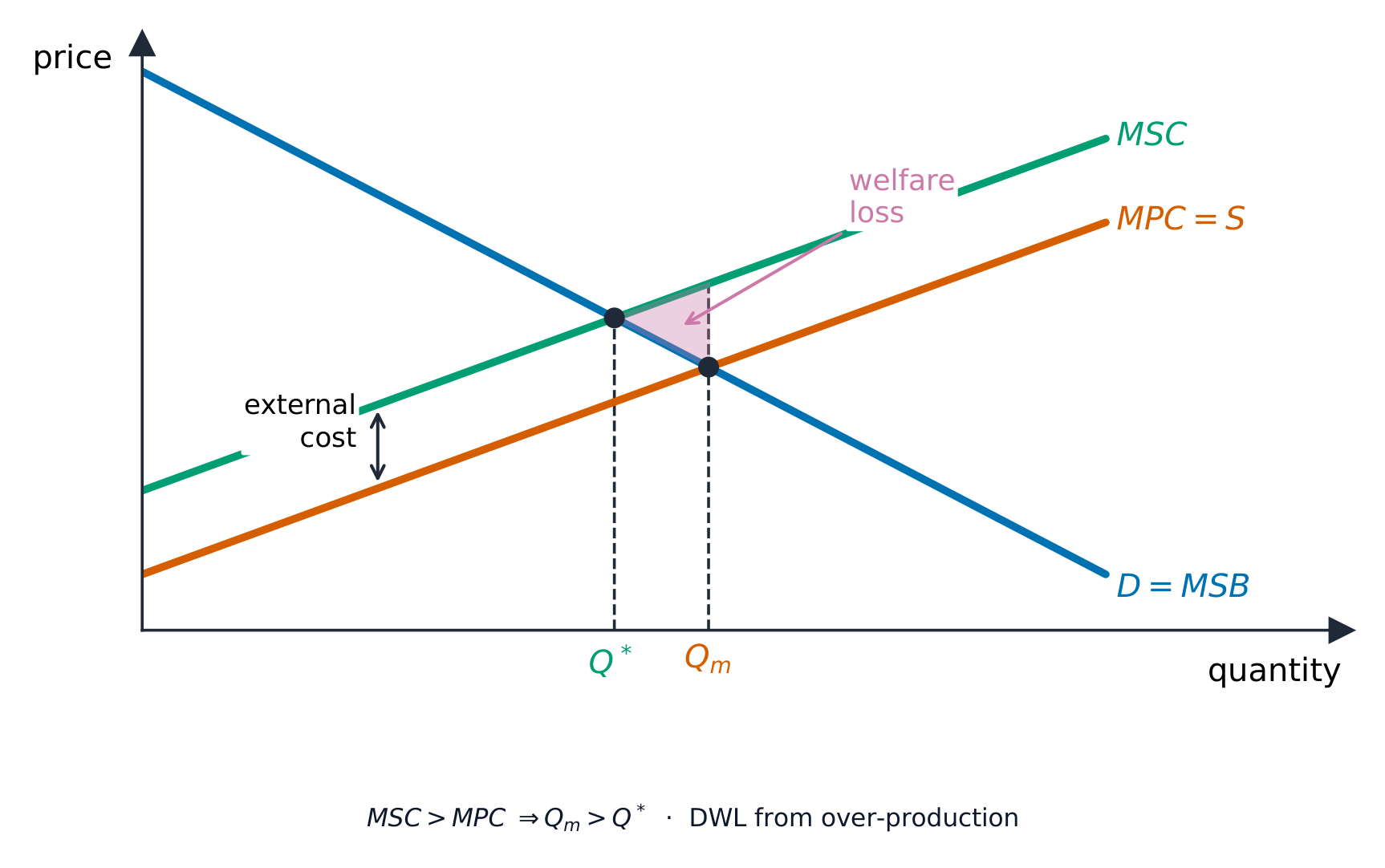
With a negative externality, social cost (MSC) is above private cost (MPC), so the market over-produces at $Q_m$ instead of the social optimum $Q^*$; the shaded triangle is the welfare loss. 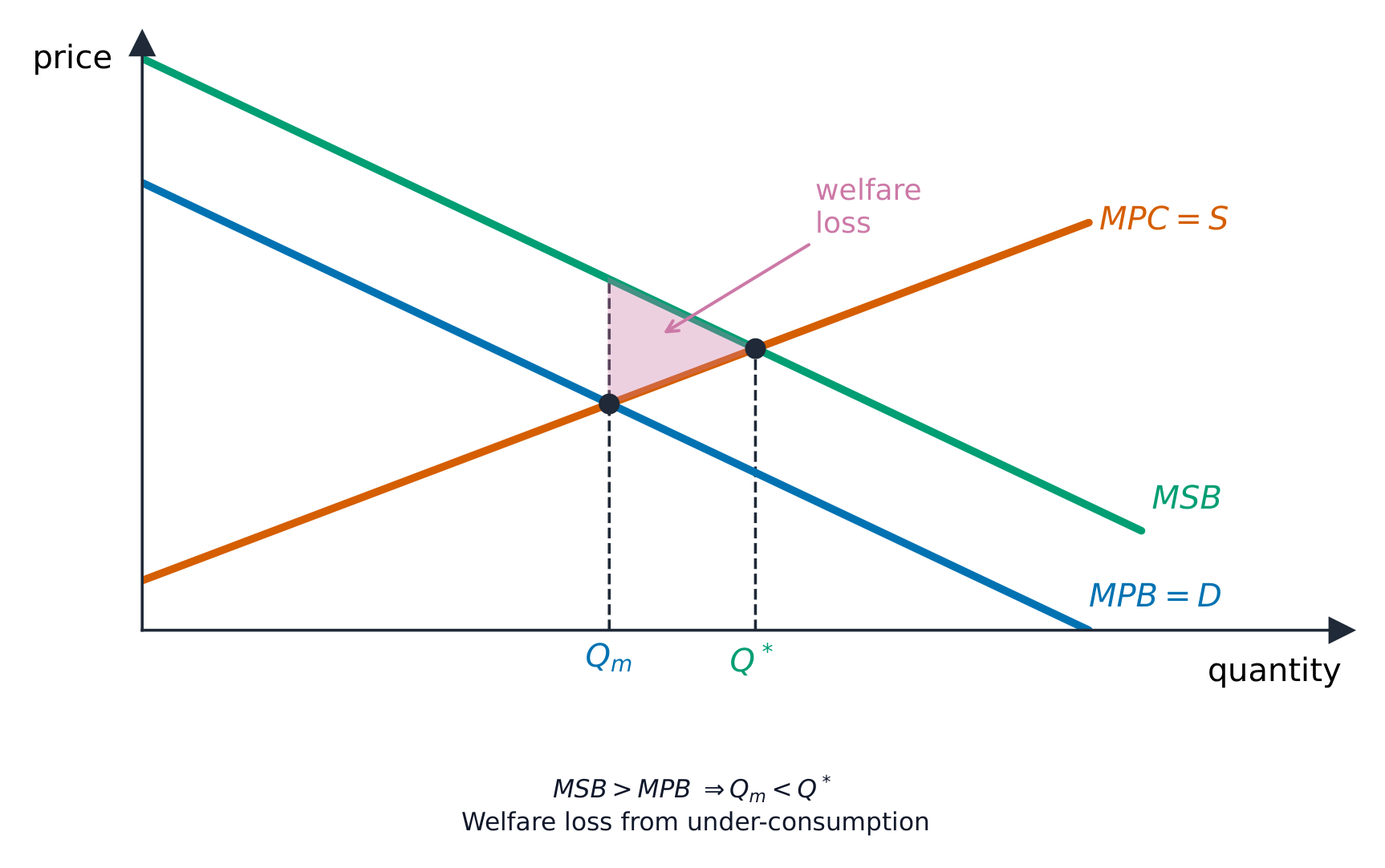
With a positive externality, social benefit (MSB) is above private benefit (MPB), so the market under-produces at $Q_m$ instead of the social optimum $Q^*$. Public goods
A public good 公共物品 has non-rivalry 非竞争性: one more user's benefit does not reduce what existing users receive. It also has non-excludability 非排他性: preventing non-payers from benefiting is impractical. A flood-warning broadcast to a whole valley is an example. An individual cinema seat is different: a ticket can exclude non-payers and an occupied seat is unavailable to another person. A school lesson can be a merit good without being a pure public good; places and teacher time are limited.
Worked financing problem. A warning service costs £90 for one period. Three households value it at £50, £40 and £30. Their combined benefit is £120, above its cost, but no household values it enough to pay the entire £90 alone. Once the warning is broadcast, each can benefit without paying. This free-rider problem 搭便车问题 can prevent an ordinary seller from recovering the cost. It is not proof that every voluntary contribution is impossible: agreement, donations or a larger organisation may fund some provision. Tax-funded provision can solve the charging problem, but government must still estimate benefits and costs and decide which service to fund.
Merit and demerit goods
A merit good 优值品 is consumed less than is considered desirable when people underestimate or overlook its benefits. A demerit good 劣值品 is consumed more than is considered desirable when people underestimate or overlook its harm. This information failure 信息失灵 concerns people's decisions about their own benefits and costs. A benefit or harm to a third party is a separate externality; one activity may involve both.
Compare two barriers. A training course charges £200. Some adults wrongly believe the qualification has no value; others understand its value but cannot pay. Information about recognised qualifications addresses the first barrier. A subsidy or free state place may address the second. If there are only 20 places, a campaign alone cannot create another 30 places. A good answer identifies the cause, explains the policy's effect on consumption, and checks resources and opportunity cost.

Cigarettes illustrate a demerit good: users may underestimate their own harm. Smoke affecting others is a separate external effect. Monopoly power
A monopoly 垄断 is a single seller in a defined market. Monopoly power 垄断势力 is the ability to influence price rather than accept it. Restricting output can raise price and harm consumers, but costs, entry barriers and available substitutes matter. Formal efficiency and firm-behaviour analysis belongs to the later A-Level microeconomics units.
Inequality and asymmetric information
- differences in earnings and asset ownership can produce inequality 不平等. An unequal distribution and an inefficient allocation are different claims: inequality alone does not establish a failure of allocative efficiency.
- asymmetric information 信息不对称 means one party knows relevant information the other lacks. If a buyer cannot distinguish a reliable used car worth £6000 from a faulty one worth £2000, a cautious offer of £4000 may discourage reliable-car sellers. Inspection or a credible warranty may improve the deal. It is not inevitable that only faulty cars remain; detailed information problems are a later A-Level extension.
ExplorePrivate steel market equilibrium
Explore private demand and supply shifts. This display does not draw external costs or social curves and cannot by itself identify a socially efficient quantity.
Vocabulary TrainEnglish market failure/ˈmɑːkɪt ˈfeɪlɪə/ allocate/ˈæləkeɪt/ externality/ekˈstɜːnælɪti/ third party/θɜːd ˈpɑːti/ negative externality/ˈneɡətɪv ekˈstɜːnælɪti/ external cost/ekˈstɜːnl kɒst/ social cost/ˈsəʊʃl kɒst/ private cost/ˈpraɪvət kɒst/ positive externality/ˈpɒzɪtɪv ekˈstɜːnælɪti/ external benefit/ekˈstɜːnl ˈbenɪfɪt/ public good/ˈpʌblɪk ɡʊd/ non-rivalry/nɒn ˈraɪvəlri/ non-excludability/nɒn eksˌkluːdəˈbɪlɪti/ free-rider problem/friː ˈraɪdə ˈprɒbləm/ merit good/ˈmerɪt ɡʊd/ demerit good/ˈdemərɪt ɡʊd/ information failure/ˌɪnfəˈmeɪʃn ˈfeɪlɪə/ monopoly/məˈnɒpəli/ monopoly power/məˈnɒpəli ˈpaʊə/ inequality/ɪniːˈkwɒlɪti/ asymmetric information/ˌeɪsɪˈmetrɪk ˌɪnfəˈmeɪʃn/ 3.2
Methods of government intervention

Syllabus
- explain methods of intervention: indirect taxes, subsidies, maximum and minimum prices, buffer stocks, regulation, provision, tradable permits
- analyse the effects of intervention, including the incidence of indirect taxes and the concept of government failure
Source: Cambridge International syllabus
A binding maximum price in a competitive market creates a shortage Indirect taxes
An indirect tax 间接税 is charged on goods or services. A specific tax is a fixed amount per unit; its amount does not rise with the selling price. In the competitive market model, it creates a wedge between the buyer's price and the amount the producer keeps. Keep these two prices separate.
The diagram's model is demand P=12−Q, supply P=2+Q, and a specific tax 3. Buyers pay 8.5 while producers keep 5.5. Both bear 1.5 of the tax relative to the original price 7. Worked price wedge. Here P is pounds per unit and Q is units per period. Before tax, demand is P = 12 − Q and supply is P = 2 + Q:
$$P_D=P_S\quad\Rightarrow\quad12-Q=2+Q$$$$Q_0=(12-2)/2=5\text{ units per period}$$$$P_0=12-Q_0=12-5=\text{£}7\text{ per unit}$$A specific tax of £3 per unit changes the price buyers must pay for each supplied quantity to 5 + Q. The producer still keeps 2 + Q:
$$P_b=P_s+t\quad\Rightarrow\quad12-Q=2+Q+3$$$$Q_t=(12-5)/2=3.5\text{ units per period}$$$$P_b=12-Q_t=12-3.5=\text{£}8.5\text{ per unit}$$$$P_s=P_b-t=8.5-3=\text{£}5.5\text{ per unit}$$$$R=tQ_t=3(3.5)=\text{£}10.5\text{ per period}$$The incidence of a tax 税收归宿 is the distribution of the economic burden. Here buyers pay £1.5 more and producers keep £1.5 less per unit, so the burden is shared equally. The side legally sending the tax to government does not necessarily bear all of it.
Relative response matters. Holding supply conditions fixed, more inelastic 缺乏弹性 demand allows a larger buyer-price increase than more elastic 富有弹性 demand. When comparing who bears most, consider both demand and supply: the less responsive side bears more under the standard competitive model. Demand being inelastic alone does not prove that buyers bear most.
Counterexample: a different market. Demand is Qd = 120 − 2Pb and supply is Qs = 95 + 0.5Ps. The original price is £10 and quantity 100. At that point, absolute PED is 0.2 and PES is 0.05: demand is inelastic, but supply is even less responsive. A £2 tax gives Ps = Pb − 2:
$$Q_d=Q_s\quad\Rightarrow\quad120-2P_b=95+0.5(P_b-2)$$$$P_b=(120-94)/2.5=\text{£}10.4\text{ per unit}$$$$P_s=P_b-2=10.4-2=\text{£}8.4\text{ per unit}$$$$Q_t=120-2P_b=120-2(10.4)=99.2\text{ units per period}$$Buyers bear 0.4/2 =20% of the tax; producers bear 1.6/2 =80%. This is a constructed counterexample, not an estimate for a real cigarette market.
Judge each policy aim separately. Raising revenue, reducing consumption and improving allocation are different outcomes. A small quantity fall can coexist with substantial revenue; it does not establish that the tax has no health benefit. For external costs, consider marginal harm and other conditions; not every tax moves output toward the social optimum. Whether its household burden is regressive also depends on spending and income patterns, not merely the name of the taxed good.
Subsidies
A subsidy 补贴 is a government payment; this example is a specific payment to producers for each unit sold. It creates a wedge in the opposite direction: producers receive the buyer's payment plus the subsidy. Effects depend on responses and market conditions; a fixed grant is not automatically a per-unit supply shift.

This separate model uses demand P=12−Q, original supply P=2.5+Q and a producer subsidy 2.4 per unit. The new buyer price is 6.05; the producer receives 8.45 including the subsidy. Worked producer subsidy. Before subsidy, equating 12 − Q and 2.5 + Q gives Q0 =4.75 and P0 =£7.25. With a subsidy £2.4 per unit, the buyer-facing supply price becomes 0.1 + Q:
$$P_D=P_S-s\quad\Rightarrow\quad12-Q=2.5+Q-2.4$$$$Q_{sub}=(12-0.1)/2=5.95\text{ units per period}$$$$P_b=12-Q_{sub}=12-5.95=\text{£}6.05\text{ per unit}$$$$P_s=P_b+s=6.05+2.4=\text{£}8.45\text{ per unit}$$$$G=sQ_{sub}=2.4(5.95)=\text{£}14.28\text{ per period}$$Buyer price falls by £1.2 and producer receipts rise by £1.2 per unit; neither side receives the whole benefit of the subsidy in this model. Government spending is not the same as the increase in producers' receipts relative to the old price.
Merit-good decision. A subsidy may make a training course cheaper, but low awareness, travel costs or a shortage of teachers may still limit attendance. Compare a production subsidy with information about benefits and direct provision of places. Evaluate consumption achieved, who benefits and the opportunity cost of public funds. Do not conclude that any payment automatically corrects all underconsumption.
Maximum and minimum prices
A maximum price 最高限价 is a legal upper limit. It binds when below the relevant equilibrium; a higher ceiling may leave price and quantity unchanged. A minimum price 最低限价 is a lower limit, binding when above equilibrium. First test whether the control binds, then compare quantities demanded and supplied.
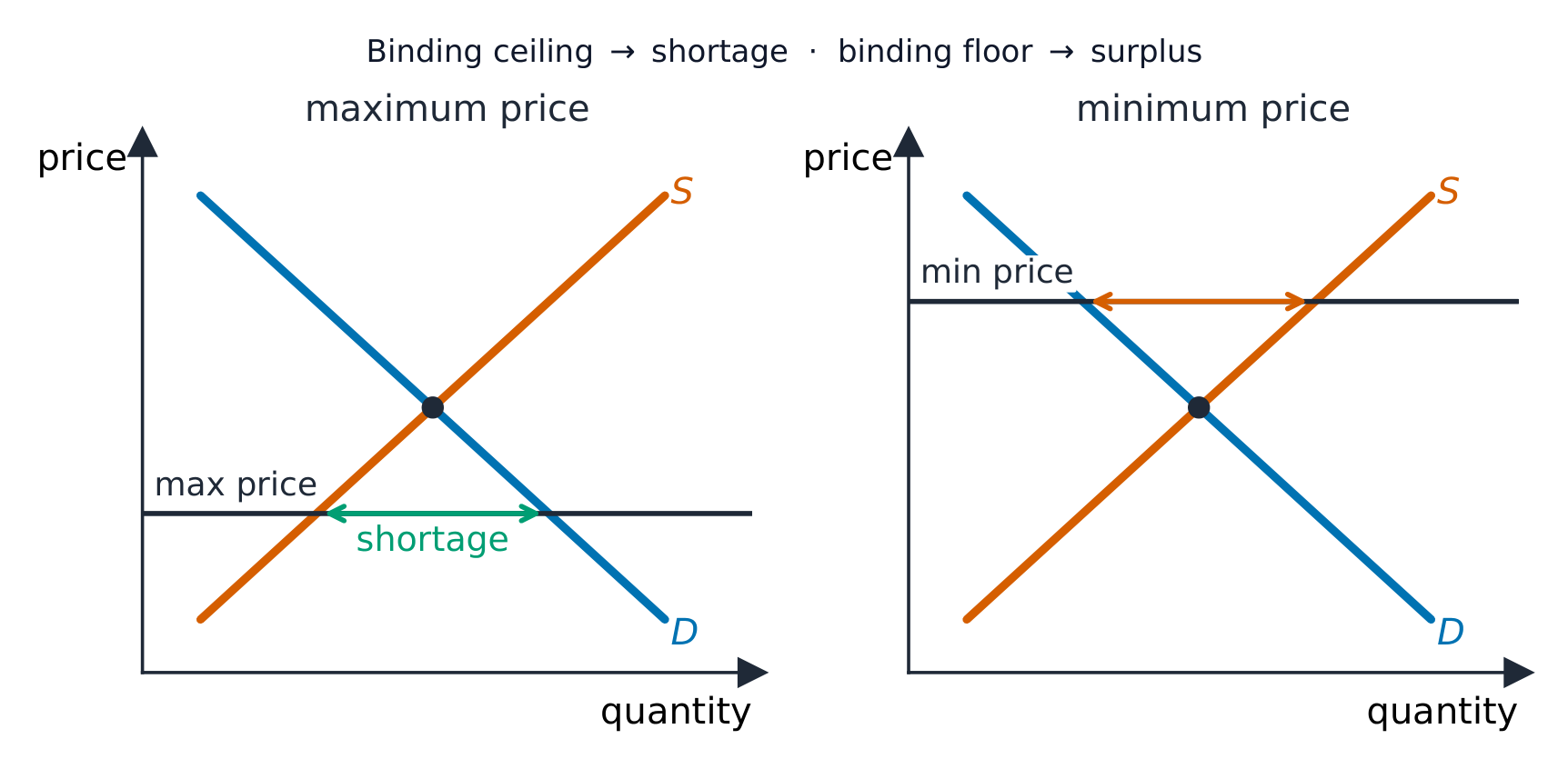
For the diagram's competitive market P=10−Q and P=Q, equilibrium is P5/Q5. A ceiling 3 creates a shortage 4; a floor 7 creates excess supply 4. The controls do not shift either curve. Ceiling case. In this separate market, Qd =10 − P and Qs =P. At a ceiling £3:
$$Q_d=10-P_c=10-3=7\text{ units per period}$$$$Q_s=P_c=3\text{ units per period}$$$$\text{shortage}=Q_d-Q_s=7-3=4\text{ units per period}$$Without additional supply, only three units can be traded legally at that price. A shortage 短缺 is not a promise that every buyer gets cheaper goods. Queues, allocation rules or an illegal resale market may result. A ceiling £6 is above equilibrium and does not bind.
Floor case. At a floor £7, Qs =7 but Qd =3, creating excess supply 超额供给 of four units. Without government purchases, private buyers take only three units. If government guarantees to buy the remaining four at the floor, its spending is 7(4) =£28 per period and it must store or dispose of those units. A floor £4 does not bind. Changing the legal price is not the same as guaranteeing sales or household income.
Buffer stocks
A buffer stock 缓冲库存 scheme buys and stores a storable commodity when its price reaches a lower intervention price, then sells stock when price reaches the upper intervention price. Holding a band requires enough money and storage to buy, and enough usable stock to sell. It is not an automatic guarantee.

The band is a policy target. Purchases support the lower price; stock releases limit the higher price. The target can fail when funding or usable stocks run out. Worked harvest decisions. Demand is P =10 − Q. Normal supply P =Q gives equilibrium P5/Q5. The government targets a band £4.5–£5.5. An opening store contains three units.
Harvest Farm supply Intervention price Qd Farm Qs Bumper P=Q−2 £4.5 floor 5.5 6.5 Poor P=Q+2 £5.5 ceiling 4.5 3.5 With the bumper crop, free-market price would be £4. At the target floor, buy 6.5 −5.5 =1 unit for £4.5; stock rises 3→4. With the poor crop, free-market price would be £6. At the target ceiling, sell 4.5 −3.5 =1 unit for £5.5; stock falls 4→3. These numbers exclude storage costs and spoilage.
If three poor-harvest periods start with stock 3 and no purchases, one-unit releases empty the store. In a fourth poor period the scheme cannot supply the missing unit without another source. Perishable goods, changing long-run demand and persistent surpluses create further problems.
Price stability is not identical to income stability. Farmers' receipts here are 4.5(6.5) =£29.25 after a bumper harvest, but 5.5(3.5) =£19.25 after a poor harvest: their own output differs. Selling stored stock does not give farmers the receipts from the current stock release. Compare buffer stocks with diversification, subsidies or other support when evaluating farm income.
Information and direct provision
State provision 政府提供 means that the government 政府 supplies or arranges a service. The service need not be free, and public funding does not by itself make it a public good. A free clinic still uses scarce appointments, staff and medicines. Direct provision can add capacity where a subsidy would only raise demand for fixed places; it needs finance, suitable staff and access for the intended users.
Choose an intervention. A district has 100 eligible children but only 60 childcare places. Forty additional places cost £4000 per period. A £1000 information campaign may help parents find existing vacancies, but it cannot remove this capacity shortfall if all 60 places are full. Compare the additional places with a different use of the same £4000, and check quality and location. Free childcare may enable parents to work; its total benefit is not measured only by the fee saved.
Later A-Level extension: regulation and permits
Regulation 管制 uses rules such as safety standards or pollution limits. Tradable permits 可交易许可证 allow firms to trade permission to emit under an enforced cap. Trading can move reductions towards firms able to cut pollution cheaply, but this depends on monitoring, enforcement and a functioning market; it does not guarantee minimum costs under all conditions. For example, if A can cut one unit for £10 and B for £30, making A cut meets a one-unit reduction target at lower resource cost. A trade can reward that cheaper reduction. The cap and compliance must still be checked.
Evaluating intervention and government failure
A policy being costly is not enough to show government failure 政府失灵. Compare its benefits and full costs with the outcome without the policy and with a relevant alternative. Failure means intervention makes resource allocation worse. Poor information, administration costs, unintended effects or decisions serving a narrow group can cause this. A binding ceiling can encourage an illegal black market 黑市, but that is a risk to analyse, not an automatic result of every price control. Formal government-failure analysis is developed in the later A-Level unit.
Illustrative comparison. A programme produces benefits worth £120 and uses resources costing £100, giving a net gain of £20. It is not a failure just because it costs £100. If another feasible programme gives benefits £140 for the same cost and the same relevant risks, its net gain is £40. Identify the objective, evidence and alternative before judging.
ExploreEducation market: demand and supply shifts
Compare changes in a single education market. This is a private demand and supply display, not an aggregate-demand model or a measurement of external benefits.
Vocabulary TrainEnglish indirect tax/ɪndaɪˈrekt tæks/ incidence of a tax/ˈɪnsɪdəns əvə tæks/ inelastic/ɪnɪˈlæstɪk/ elastic/ɪˈlæstɪk/ subsidy/ˈsʌbsɪdi/ maximum price/ˈmæksɪməm praɪs/ shortage/ˈʃɔːtɪdʒ/ minimum price/ˈmɪnɪməm praɪs/ excess supply/ekˈses səˈplaɪ/ buffer stock/ˈbʌfə stɒk/ regulation/ˌreɡjʊˈleɪʃn/ state provision/steɪt prəˈvɪʒn/ government/ˈɡʌvənmənt/ tradable permits/ˈtreɪdəbl ˈpɜːmɪts/ government failure/ˈɡʌvənmənt ˈfeɪlɪə/ black market/blæk ˈmɑːkɪt/ 3.3
Income and wealth inequality

Syllabus
- distinguish income and wealth and explain the causes of inequality
- explain policies to redistribute income and wealth (progressive taxation, benefits, provision of services) and their effects
Source: Cambridge International syllabus
Income 收入 is a flow 流量 received over a period, such as wages, rent and interest. Wealth 财富 is a stock 存量 of assets owned at a point in time; net wealth subtracts debts. A person receiving £2000 each month does not therefore own £2000 of wealth. A house worth £150000 with a mortgage of £100000 contributes £50000 to net wealth. Savings can build wealth, and assets can produce income, but these are different measures.
Measuring and explaining inequality
The Gini coefficient 基尼系数 summarises inequality on a scale from 0 (complete equality) to 1 (the complete-inequality limit). Specify whether the data measure income or wealth, and use a comparable population, period and definition. The AS syllabus requires interpretation, not calculation of the coefficient.
Worked interpretation. A fictional country's disposable-income Gini falls from 0.42 to 0.35. Its measured income distribution becomes more equal. This does not establish that every poor household receives more money, that average real income rises, that wealth becomes more equal, or that one policy caused the change. Government can use the measure to review redistribution, alongside household-group data, employment, prices and access to services. Two countries with the same Gini may have different average living standards and different distributions within income groups.
Income differences may reflect qualifications, experience, demand for occupations, hours worked, unemployment, discrimination or bargaining power. Wealth differences may reflect accumulated savings, inheritance, asset-price changes and debts. Causes interact: unequal access to education may affect future earnings, and inherited assets may generate rent. Do not rank one cause as universally most important without evidence.
Progressive taxes and transfer payments
A progressive tax 累进税 takes a higher average percentage 百分比 of higher incomes. Compare average rates, not just amounts paid. Benefits 福利金, also called transfer payments 转移支付, are government payments without a current good or service received in return; eligibility differs between programmes.
Worked redistribution. Two households have annual incomes £10000 and £40000. Taxes of £1000 and £8000 give average rates 10% and 20%. If the lower-income household receives a £2000 transfer, their disposable incomes are:
$$Y_{d,L}=Y_L-T_L+B_L=10000-1000+2000=\text{£}11000\text{ per year}$$$$Y_{d,H}=Y_H-T_H+B_H=40000-8000+0=\text{£}32000\text{ per year}$$The income ratio falls from 4 to about 2.91. This is a two-household illustration, not a calculation of a national Gini or a claim that these taxes alone finance the entire government. Equal £1000 taxes instead take 10% and 2.5% of the original incomes; paying more pounds is not the definition of progressivity.
Minimum wages and access to essential services
A minimum wage is a legal floor on hourly pay. In an illustrative competitive labour market, demand is Ld =100 −5w and supply is Ls =5w. The original hourly wage is £10 and employment 50 workers. A binding £12 floor gives demand 40 and supply 60: 40 jobs and excess labour supply of 20 under this model. Workers who keep the same hours earn more, but excluded workers do not receive that wage. Household effects also depend on hours, other earners, prices and benefits. A floor £8 does not bind here. Other labour-market structures and their full analysis are developed later; the competitive prediction is not a universal empirical law.
Free or subsidised essential services can raise real living standards without increasing cash income. A £500 saving on childcare can matter to a household even if its measured cash income is unchanged. Funding, quality, waiting times and location determine whether poorer households can actually use the service. Education and childcare access may also improve future earnings; redistribution need not always reduce efficiency.
Income taxes compared with inheritance and capital taxes
Inheritance taxes target transfers of assets after a death; capital taxes target specified assets, ownership or gains, depending on the policy. They can address accumulated wealth that an income tax misses. Accurate valuation, debt, exemptions, collection and avoidance matter. A valuable house may produce little cash for paying a tax, while assets with reliable ownership records may be easier to assess than hidden business holdings.
Policy judgement. Regular recorded wages can make income taxation and transfers easier to administer than taxes on hard-to-value wealth. This is a conditional argument, not a rule that wealth can never be redistributed. Land records or estate information can assist wealth taxation; informal earnings can make income taxation difficult too. Assess which inequality is targeted, administrative capacity, avoidance and the effects on work, investment and opportunity. This redistribution 再分配 can involve a trade-off 取舍 when marginal tax and benefit rules weaken an incentive 激励 to earn more, but the strength of that response needs evidence.
Different housing conditions may prompt investigation; this photograph alone cannot measure incomes, wealth, poverty or a Gini coefficient. ExploreInequality policy route
Follow how policy can change disposable income and opportunity.
Vocabulary TrainEnglish income/ˈɪŋkʌm/ flow/fləʊ/ wealth/welθ/ stock/stɒk/ progressive tax/prəˈɡresɪv tæks/ percentage/pəˈsentɪdʒ/ benefits/ˈbenɪfɪts/ transfer payments/ˈtrænsfɜː ˈpeɪmənts/ redistribution/ˌriːˌdɪstrɪˈbjuːʃn/ trade-off/treɪd ɒf/ incentive/ɪnˈsentɪv/ Gini coefficient/ˈdʒiːni ˌkəʊɪˈfɪʃənt/ 3.3
Exam tips
- Identify the actual problem: public-good financing, misjudged benefit or harm, a price objective, or income/wealth inequality.
- Explain the mechanism with a relevant example, diagram or calculation. Distinguish prices, quantities, fiscal costs and household outcomes.
- Evaluate against the stated aim and a feasible alternative. Give a reasoned conclusion using conditions, not a fixed list of advantages and disadvantages.
- In tax incidence compare both demand and supply responses. For Gini data explain what the measure can and cannot establish; no Gini calculation is required.
- The externality diagrams, monopoly discussion and pollution permits in this handout are later A-Level previews. Study the AS core requirements first.
Vocabulary card meanings
private cost: A cost paid by the person or firm that causes it. external benefit: A gain received by a third party who is outside the deal between buyer and seller. buffer stock: A store of a commodity kept to steady its price. black market: Trade that breaks a legal rule on price or quantity. wealth: The value of what a person owns after subtracting what that person owes, measured at one moment. stock: A quantity measured at one moment, not over a period of time. benefits: Payments from the state to people who qualify for help.
-
4
The macroeconomy
Watch lessonMacroeconomics 宏观经济学 studies the economy as a whole: output, jobs and prices. A bakery can sell more bread because it produces more, because prices rise, or both. National accounts help us separate these changes before judging economic performance.
4.1
National income statistics

Syllabus
- define GDP, GNI and national income and distinguish nominal and real, and total and per capita values
- explain the uses and limitations of national income statistics for measuring living standards and making comparisons
Source: Cambridge International syllabus
National income 国民收入 describes income generated by production during a period. GDP, GNI and NNI are related measures, but answer different questions. State the period, currency and price basis when comparing them.
GDP measures domestic production; GNI measures residents' primary income. Count final output or value added
Gross domestic product 国内生产总值 (GDP) is the value of final goods and services produced within an economy during a period. It includes government services, not just goods sold by private firms. Intermediate inputs are used to produce other output; do not count them again alongside that final output.
Value added 增加值 is output value minus the value of intermediate inputs bought from other producers.
Worked example — one domestic bread chain. All amounts are £ per batch. Assume no other bought inputs or product taxes.
Producer Sales Bought inputs Value added Farmer 20 0 20 Miller 35 20 15 Baker 60 35 25 The farmer sells grain, the miller sells flour and the baker sells the final bread to households. Adding sales gives £115, but counts the grain and flour more than once. Adding value added gives £60, the same as final bread sales.
Domestic, national, gross and net
Gross national income 国民总收入 (GNI) is residents' total primary income. Start with GDP, add primary income residents receive from abroad and subtract primary income paid to non-residents. Residency is different from citizenship. Export receipts are payments for output, not primary income from abroad.
$$\text{GNI}=\text{GDP}+\text{primary income received}-\text{primary income paid}$$Worked example — annual accounts. GDP is £800 billion/year, primary income received from abroad is £50 billion/year and income paid abroad is £70 billion/year, all at the same price basis.
$$\text{GNI}=\text{GDP}+\text{income received}-\text{income paid}=800+50-70=780\text{ (£ billion/year)}$$A foreign-owned factory's domestic output counts in GDP. Income it pays to non-residents enters the GNI adjustment; we do not remove its entire output simply because its owners live abroad.
Capital depreciation 资本折旧 means consumption of fixed capital through wear and obsolescence. Net national income 国民净收入 (NNI) deducts this from GNI. If capital depreciation is £60 billion/year:
$$\text{NNI}=\text{GNI}-\text{capital depreciation}=780-60=720\text{ (£ billion/year)}$$Gross/net adjusts for capital used up. It does not remove inflation.
Market prices and basic prices
Market prices 市场价格 include taxes on products less subsidies on products. Basic prices 基本价格 remove this net product-tax component. For the syllabus conversion:
$$\text{GDP at basic prices}=\text{GDP at market prices}-\text{taxes on products}+\text{subsidies on products}$$Worked example — separate accounts. GDP at market prices is £500 billion/year, product taxes £80 billion/year and product subsidies £20 billion/year.
$$\text{GDP}_{b}=\text{GDP}_{m}-\text{product taxes}+\text{product subsidies}=500-80+20=440\text{ (£ billion/year)}$$Reverse the signs to check the original market-price value:
$$\text{GDP}_{m}=\text{GDP}_{b}+\text{product taxes}-\text{product subsidies}=440+80-20=500\text{ (£ billion/year)}$$Do not subtract personal income tax or capital depreciation in this price-basis step.
Nominal, real and per capita
Nominal 名义 values use current prices. Real 实际 values remove price changes so that changes in the amount of output can be compared. Nominal figures remain useful for current money receipts and payments.
Worked example — separate two-year series. Nominal GDP is £800 billion/year in Year 0 and £924 billion/year in Year 1. The given GDP price index rises from 100 to 110, with Year 0 as the base. Use a GDP price index, rather than assuming a consumer price index measures all GDP prices.
$$\text{Real GDP}=\frac{\text{nominal GDP}}{\text{GDP price index}}\times100$$$$\text{Real GDP}_{1}=\frac{\text{nominal GDP}_{1}}{\text{GDP price index}_{1}}\times100=\frac{924}{110}\times100=840\text{ (£ billion/year)}$$$$\text{Real growth}=\frac{\text{real GDP}_{1}-\text{real GDP}_{0}}{\text{real GDP}_{0}}\times100\%=\frac{840-800}{800}\times100\%=5\%$$Per capita 人均 means per person. If population rises from 40 million to 42 million in this example:
$$\text{Real GDP per capita}_{0}=\frac{\text{real GDP}_{0}}{\text{population}_{0}}=\frac{800\text{ billion £/year}}{40\text{ million people}}=£20{,}000\text{/person/year}$$$$\text{Real GDP per capita}_{1}=\frac{\text{real GDP}_{1}}{\text{population}_{1}}=\frac{840\text{ billion £/year}}{42\text{ million people}}=£20{,}000\text{/person/year}$$Output and population both rise 5%, leaving real output per person unchanged. The average does not show who receives income.
A lower positive growth rate does not mean falling output. If a real output index starts at 100, rises 4% and then 2%, its levels are 104 and 106.08. Growth slows by 2 percentage points but output rises in both years. Distinguish a forecast from an observed outcome.
Uses and limitations
National income statistics help compare output over time and resources available for consumption and public services. For comparisons across countries, check prices, currency conversion, purchasing power, population and data quality.
The standard of living 生活水平 is wider than output per person. Consider distribution 分配, leisure, health, access to services and pollution. For example, two economies can have the same average but give the poorest fifth 10% and 3% of income respectively. The average alone cannot rank their living conditions.
Most unpaid household services, such as cleaning your own home, are outside GDP; paying someone to provide the service can count. The informal economy 非正规经济 includes activity outside or insufficiently covered by formal arrangements. Production within the GDP boundary should be included in principle, but it can be difficult to measure fully. Do not claim that all informal production is excluded because it is untaxed.
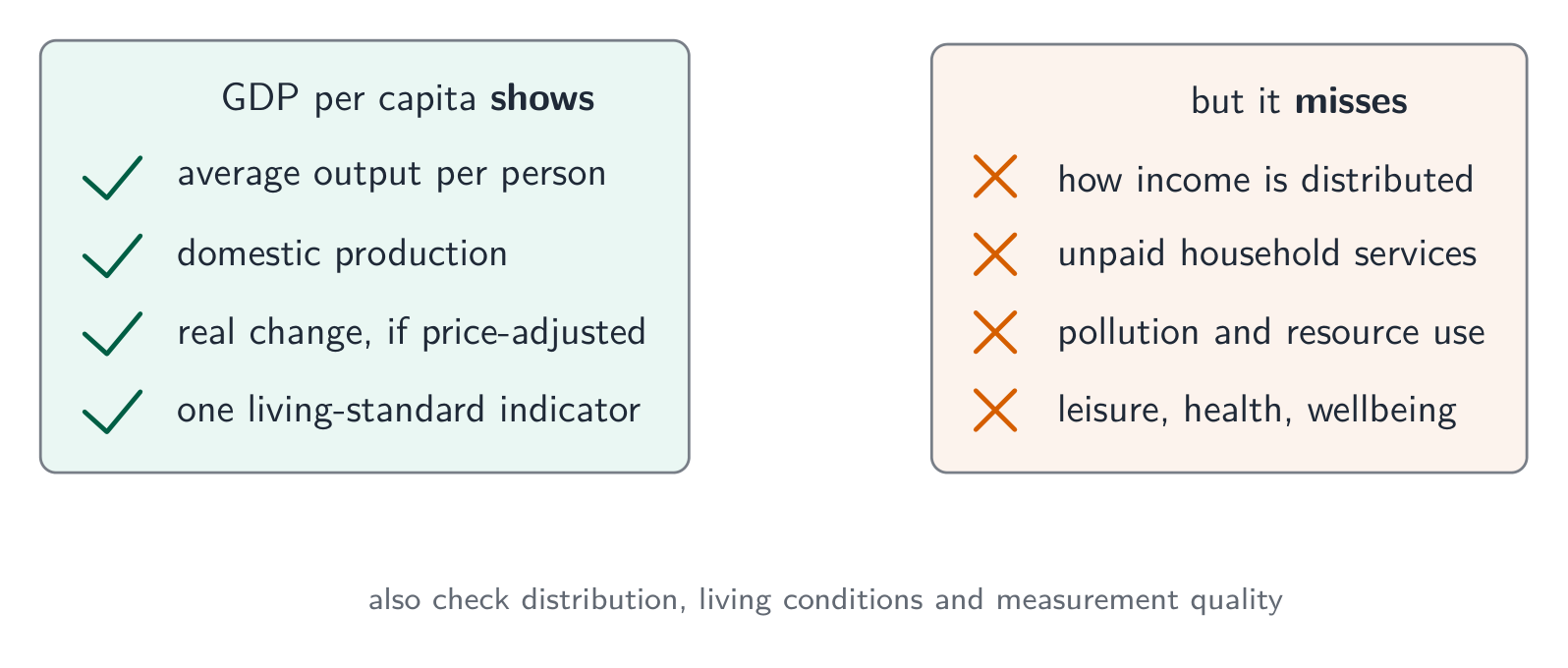
Use real GDP per person as one indicator, alongside evidence about living conditions and measurement quality. ExploreNational income flow
Watch spending become income, output and expenditure in the circular flow.
Vocabulary TrainEnglish macroeconomics/ˌmækrəˌriːkəˈnɒmɪks/ national income/ˈnæʃənl ˈɪŋkʌm/ gross domestic product/ɡrəʊs dəˈmestɪk ˈprɒdʌkt/ gross national income/ɡrəʊs ˈnæʃənl ˈɪŋkʌm/ nominal/ˈnɒmɪnl/ real/rɪəl/ per capita/pɜː ˈkæpɪtə/ standard of living/ˈstændəd ɒv ˈlɪvɪŋ/ distribution/ˌdɪstrɪˈbjuːʃn/ informal economy/ɪnˈfɔːml ɪˈkɒnəmi/ value added/ˈvæljuː ˈædɪd/ net national income/net ˈnæʃənl ˈɪŋkʌm/ capital depreciation/ˈkæpɪtl dɪˌpriːʃɪˈeɪʃn/ market prices/ˈmɑːkɪt ˈpraɪsɪz/ basic prices/ˈbeɪsɪk ˈpraɪsɪz/ 4.2
The circular flow of income

Syllabus
- explain the circular flow of income with injections (investment, government spending, exports) and leakages (saving, taxation, imports)
- explain equilibrium in the circular flow and the distinction between a closed and open economy
Source: Cambridge International syllabus
Follow the money payments around the income loop. The circular flow of income 收入循环流 links production, income and expenditure. Households 家庭 supply factor services to firms 企业 and receive wages, rent, interest and profit. Households buy goods and services from firms.
Transaction Real flow Money flow Employment Labour to firms Wages to households Bread purchase Bread to households Spending to firms In each transaction the real flow and its payment go in opposite directions. Saving means households need not spend all current income on consumption.
Leakages and injections
Leakages 漏出 are saving 储蓄 ($S$), taxation 税收 ($T$) and imports 进口 ($M$). Injections 注入 are investment 投资 ($I$), government spending 政府支出 on goods and services ($G$), and exports 出口 ($X$).
A newly produced factory machine is investment; buying an existing share is an asset transaction, not new capital production. Government purchases of teaching services count in G. A pension is a transfer payment, rather than payment for current output; the recipient's later purchases may enter consumption. Imported shoes enter household consumption and imports: subtracting M prevents foreign production from being counted as domestic GDP.
Saving, taxes and imports leave the domestic spending loop; investment, government purchases and exports enter it. A closed economy 封闭经济 has no foreign trade, so X and M are zero. An open economy 开放经济 includes international transactions. Government can be present in either.
Equilibrium and disequilibrium
Equilibrium 均衡 in this simple model requires planned injections to equal planned leakages at the current income level. Actual expenditure accounts include unplanned inventory changes; do not mistake an accounting identity for proof that plans are in balance.
Worked example — annual planned flows at fixed prices. Income Y is £300 billion/year; S = 35, T = 25, M = 30, I = 30, G = 40 and X = 20, all in £ billion/year. Assume no transfer payments. Find consumption C:
$$C=Y-S-T=300-35-25=240\text{ (£ billion/year)}$$$$\text{Planned injections}=I+G+X=30+40+20=90\text{ (£ billion/year)}$$$$\text{Planned leakages}=S+T+M=35+25+30=90\text{ (£ billion/year)}$$$$\text{Planned expenditure}=C+I+G+X-M=240+30+40+20-30=300\text{ (£ billion/year)}$$Planned expenditure equals current output, so there is no unplanned inventory change.
Change the plan. Investment rises to 40 while current output and other planned flows initially stay fixed.
$$\text{Planned expenditure}=C+I+G+X-M=240+40+40+20-30=310\text{ (£ billion/year)}$$$$\text{Unplanned inventory change}=Y-\text{planned expenditure}=300-310=-10\text{ (£ billion/year)}$$Unexpected inventory falls give firms a reason to raise production and employment if spare capacity allows. Near capacity, extra demand may mainly raise prices. As income changes, saving, taxes and imports may also change. An initial excess of injections does not guarantee a particular rise in real output. If planned spending falls below output, inventories rise unexpectedly and firms may reduce production. No multiplier calculation is needed here.
Check yourself
New annual data, all £ billion at the same price basis: GDP at market prices 600; product taxes 90; product subsidies 10; primary income received 30 and paid 50; capital depreciation 40. Find GDP at basic prices and NNI at market prices. Explain why neither answer alone establishes real growth.
Worked answer. The price-basis adjustment is:
$$\text{GDP}_{b}=\text{GDP}_{m}-\text{product taxes}+\text{product subsidies}=600-90+10=520\text{ (£ billion/year)}$$The resident-income and capital-use adjustments are:
$$\text{NNI}_{m}=\text{GDP}_{m}+\text{income received}-\text{income paid}-\text{capital depreciation}=600+30-50-40=540\text{ (£ billion/year)}$$Real growth needs comparable real output for at least two periods. These are different measures for one period.
ExploreInjections & leakages
Money loops between households and firms. Injections grow national income, leakages shrink it; they are equal at equilibrium.
ExploreThe circular flow of income
Money flows in a loop: households earn income from firms, then spend it back on the firms' goods. Step round the cycle.
Vocabulary TrainEnglish circular flow of income/ˈsɜːkjʊlə fləʊ ɒv ˈɪŋkʌm/ household/ˈhaʊshəʊld/ firm/fɜːm/ leakages/ˈliːkɪdʒɪz/ saving/ˈseɪvɪŋ/ taxation/tækˈseɪʃn/ imports/ɪmˈpɔːts/ injections/ɪnˈdʒekʃnz/ investment/ɪnˈvestmənt/ government spending/ˈɡʌvənmənt ˈspendɪŋ/ exports/ˈekspɔːts/ equilibrium/ˌiːkwɪˈlɪbrɪəm/ closed economy/kləʊzd ɪˈkɒnəmi/ open economy/ˈəʊpən ɪˈkɒnəmi/ 4.3
Aggregate demand and aggregate supply
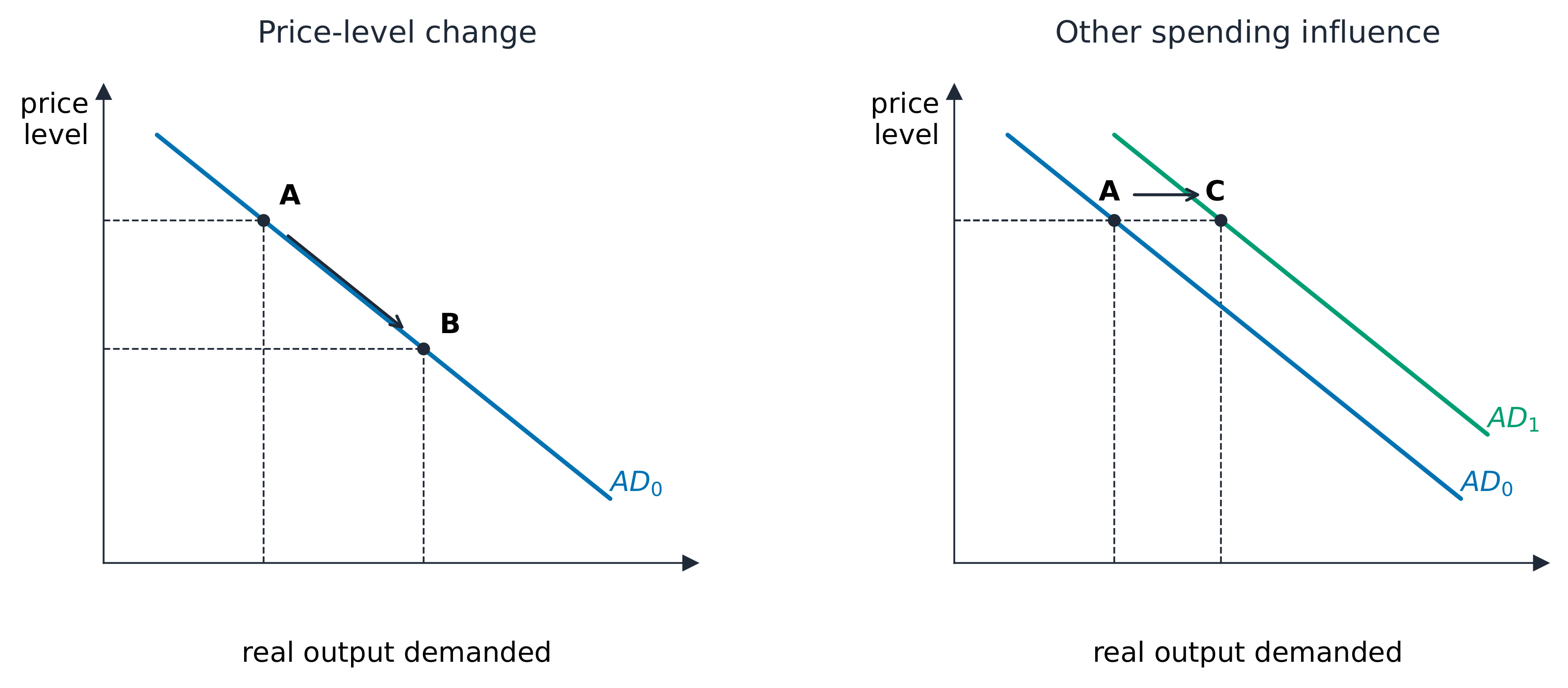
Syllabus
- define the components of aggregate demand (C + I + G + (X−M)) and explain the shape of the AD curve
- explain short-run and long-run aggregate supply and the determinants of AD and AS
- use AD/AS analysis to determine macroeconomic equilibrium and the price level and real output
Source: Cambridge International syllabus
This animation introduces a simple AD/AS intersection; compare it with the worked changes below. Aggregate demand
Aggregate demand 总需求 (AD) is planned spending on domestic goods and services at each price level. Its components are household consumption 消费 C, spending on new capital I, government purchases of goods and services G, and net exports 净出口 X − M.
$$AD=C+I+G+(X-M)$$Worked example — stated price level. Planned annual spending is C = 150, I = 30, G = 40, X = 25 and M = 35, all £ billion/year.
$$AD=C+I+G+(X-M)=150+30+40+(25-35)=210\text{ (£ billion/year)}$$Net exports are negative: imports can exceed exports. Imported products can appear in C, I or G, so subtract M to remove foreign production. Buying an existing share is not spending on newly produced capital, and a pension is not a government purchase of current output.
A movement along AD and a shift
Hold other influences constant. A lower domestic price level can raise the purchasing power of money balances and make domestic goods cheaper relative to foreign goods. Real output demanded rises along the existing AD curve. This helps explain its downward slope.
By contrast, higher household confidence can increase consumption at each price level, shifting AD right. A change in a non-price influence changes the relationship, rather than moving along it.
A to B moves along AD after a price-level change. A to C shifts demand at the same price level. Explain the decisions. A tax cut raises disposable income and may raise C, but households may save or repay debt; some purchases may be imports. Higher expected sales may encourage firms to buy new machinery, raising I, but spare existing capacity, expensive credit or uncertainty can weaken the response. Higher government purchases directly raise G. Stronger foreign demand may raise X. Explain the component and mechanism before drawing an AD shift; do not assume every change in income or borrowing causes the same spending response.
Aggregate supply
Aggregate supply 总供给 (AS) relates the price level to real output supplied. Short-run aggregate supply 短期总供给 (SRAS) slopes upward when some input costs adjust slowly. If output prices rise while wage rates and input prices initially stay fixed, producing extra output becomes more attractive: move up the same SRAS.
Higher imported fuel costs reduce profitable supply at each price level and shift SRAS left/up. Better productivity 生产率 can reduce unit costs and shift SRAS right. Separate a change in the price level from a change in a supply determinant.
Macroeconomic equilibrium
Macroeconomic equilibrium 宏观经济均衡 is the relevant AD/AS intersection. It determines the price level 价格水平 and real output 实际产出 in that model.
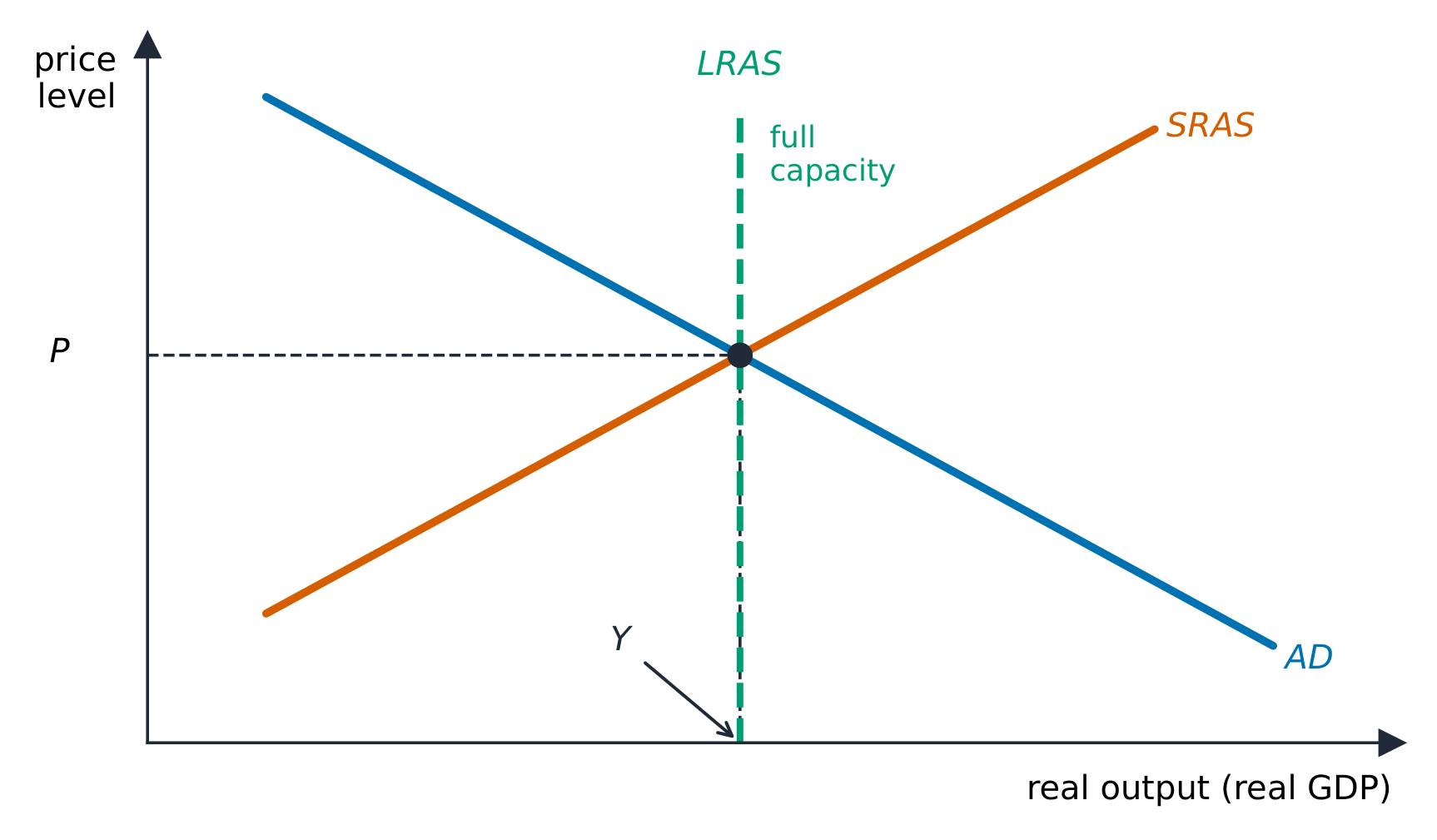
Here the current intersection happens to lie at capacity. An AD/SRAS intersection need not always lie on LRAS. Compare changes in demand and supply
The paired diagrams below use a separate illustrative short-run model with upward-sloping SRAS and room for output to change. Each starts at the same initial intersection.
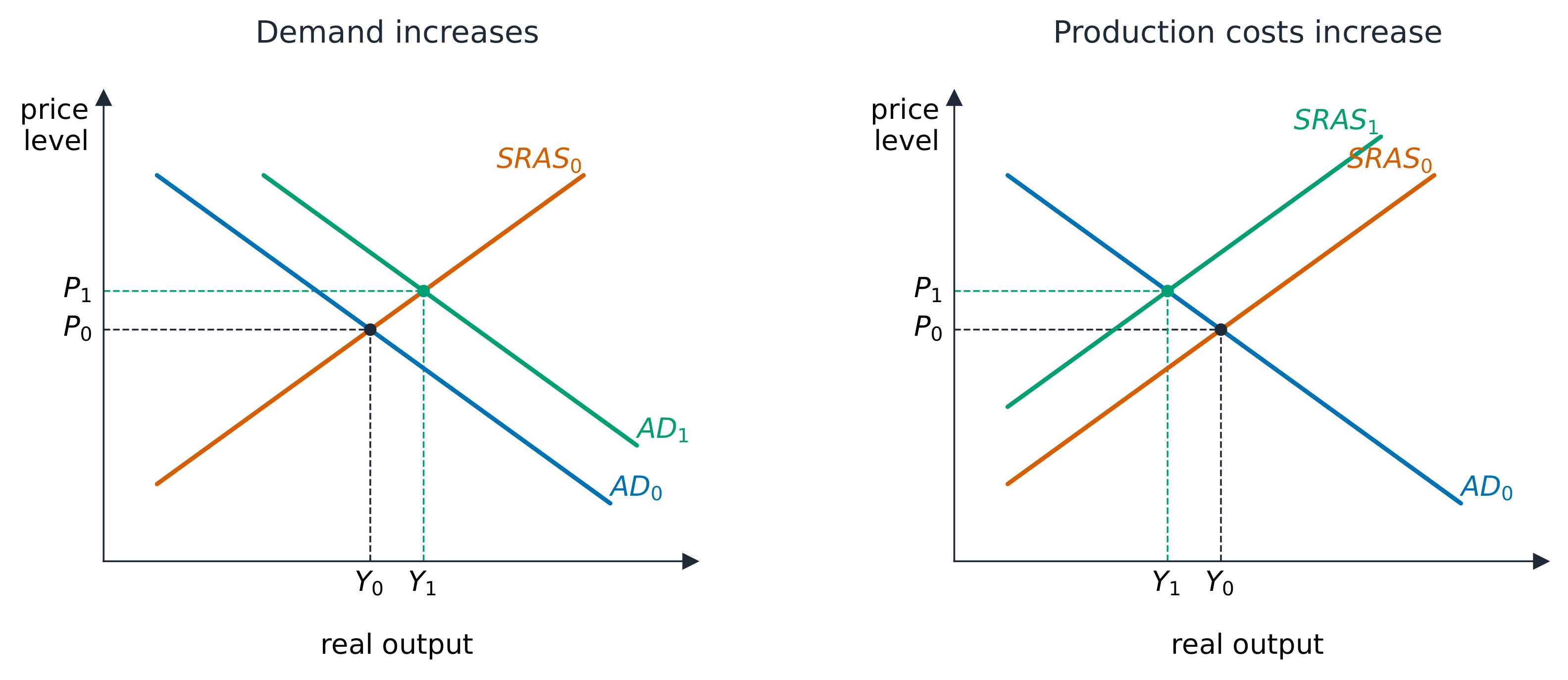
Demand growth raises both the price level and output; higher costs raise prices but reduce output, other influences unchanged. - When AD shifts right along upward-sloping SRAS, real output and the price level rise. Firms may need more workers; the employment response also depends on productivity and hours worked.
- When SRAS shifts left with AD unchanged, the price level rises while real output falls. Firms may reduce employment as they reduce production. This is a different mechanism from higher spending.
A shift showing a higher price level illustrates inflation pressure between periods. Persistent inflation means prices keep rising over time; one shock alone does not establish a permanently continuing inflation rate.
Capacity and the long run
Long-run aggregate supply 长期总供给 (LRAS) depends on productive capacity 生产能力: resources, skills, technology and productivity. More reliable electricity can reduce factory outages and expand sustainable production. Extra household spending initially shifts AD. Some spending, such as infrastructure construction, can raise demand now and improve supply later.
The syllabus permits vertical LRAS or a three-section representation: a highly elastic/flat section with spare capacity, an upward section as constraints increase, and a vertical section at capacity.
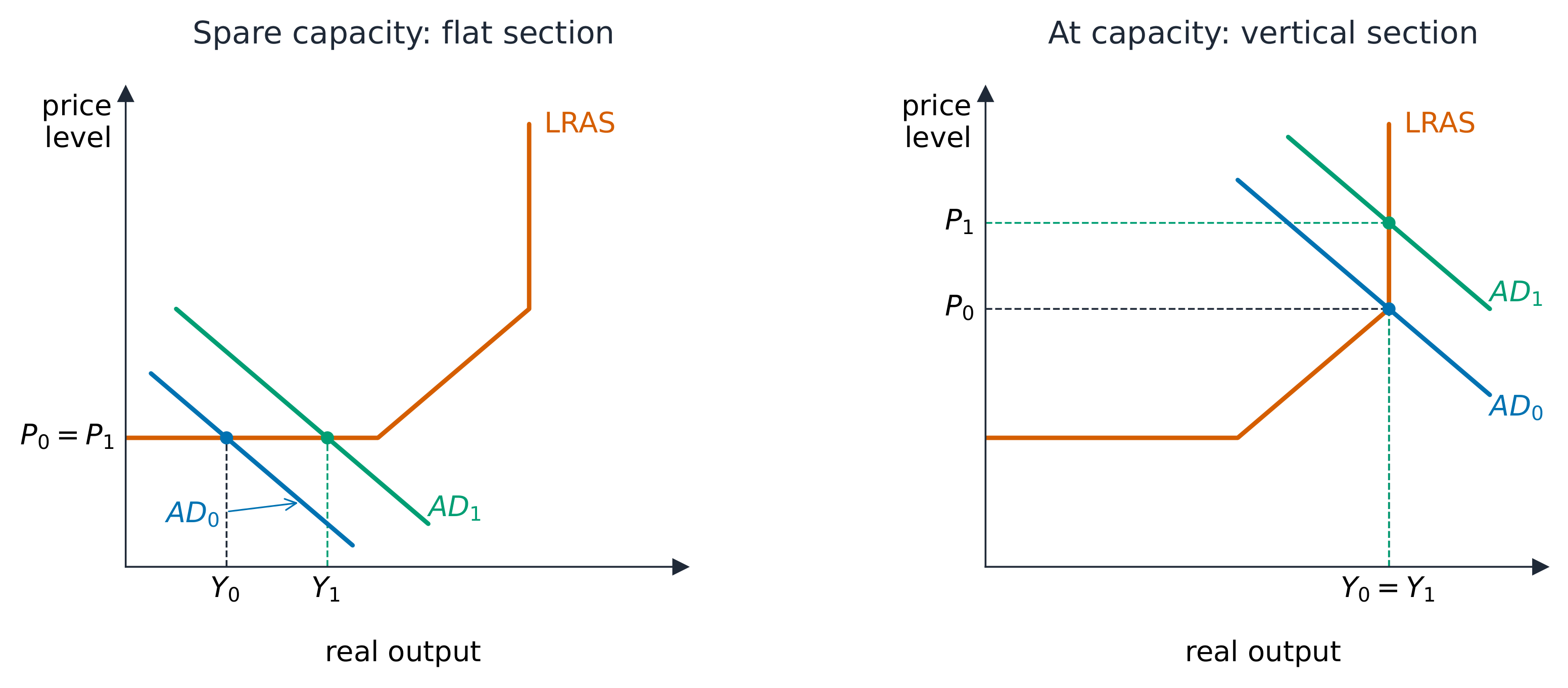
With spare capacity, output can rise without a higher price level. At capacity, extra demand can raise prices without increasing real output. In the upward section, both output and prices can rise. Identify the model, the capacity position and the time period before concluding that every AD or AS shift changes both variables. Extra capacity does not guarantee enough demand to use it. These conditions explain why an increase in AD does not always lead to inflation.
ExploreAggregate demand & supply
AD and AS cross at the price level and national output.
Vocabulary TrainEnglish aggregate demand/ˈæɡrɪɡeɪt dɪˈmænd/ consumption/kənˈsʌmpʃn/ net exports/net ˈekspɔːts/ aggregate supply/ˈæɡrɪɡeɪt səˈplaɪ/ short-run aggregate supply/ʃɔːt rʌn ˈæɡrɪɡeɪt səˈplaɪ/ long-run aggregate supply/lɒŋ rʌn ˈæɡrɪɡeɪt səˈplaɪ/ productive capacity/prəˈdʌktɪv kəˈpæsɪti/ macroeconomic equilibrium/ˌmækrəˌriːkəˈnɒmɪk ˌiːkwɪˈlɪbrɪəm/ price level/praɪs ˈlevl/ real output/rɪəl ˈaʊtpʊt/ productivity/ˌprɒdəkˈtɪvɪti/ 4.4
Economic growth
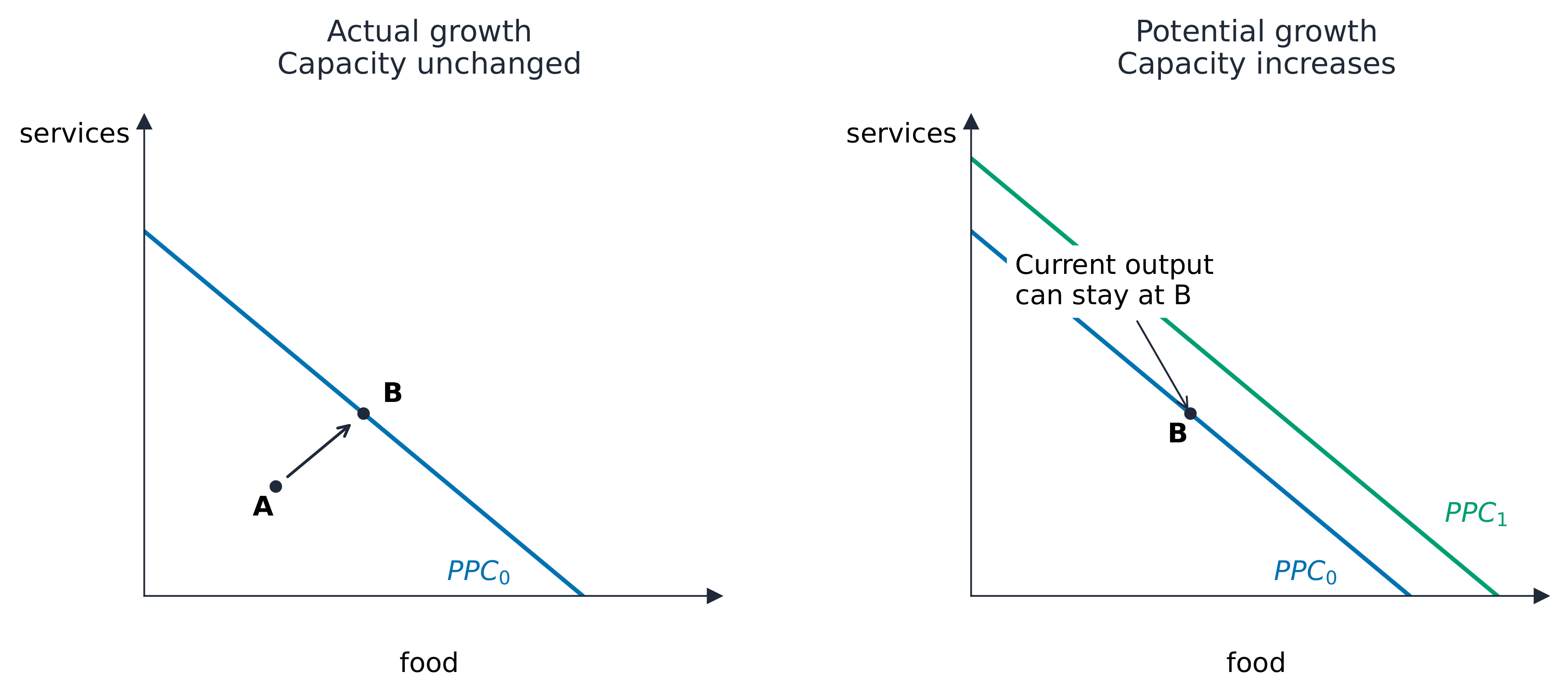
Syllabus
- distinguish actual and potential growth and explain the causes of economic growth
- explain the costs and benefits of economic growth and the business (trade) cycle
Source: Cambridge International syllabus
Economic growth 经济增长 is an increase in real output over time. Actual growth 实际增长 is the observed increase. Potential growth 潜在增长 expands what the economy can sustainably produce.
Compare two changes. Restarting idle factories raises current output using existing capacity. Better machinery can expand capacity and shift LRAS right, even before firms receive more orders. Actual growth can occur without new capacity; potential growth can occur before actual output rises.
A production possibility curve 生产可能性曲线 (PPC) shows feasible output combinations using available resources and technology.
Left: A to B uses existing capacity. Right: the PPC expands, but current output can initially remain at B. Causes of growth
More working-age residents can increase labour input; training can reduce defects and raise useful output per worker. Investment can improve capital, while technology and infrastructure can increase productivity. These mechanisms require suitable resources and demand: an unused machine does not automatically increase actual output.
For real output per person to rise, real output must grow faster than population. The earlier example shows why 5% real GDP growth alongside 5% population growth leaves the average unchanged. Distribution also affects who gains.
The business cycle
Real output does not grow smoothly. The business cycle 经济周期 includes boom 繁荣, recession 衰退, slump 萧条 and recovery 复苏. A recession involves falling real output; a recovery involves rising output after a downturn. Definitions using a particular quarterly rule require suitable quarterly data.

Read the curve's slope to judge output growth; being below the trend does not itself mean output is falling. Worked example — separate annual output series. The real-output index is 104 in Year 1, 102 in Year 2 and 103 in Year 3.
$$g_t=\frac{Y_t-Y_{t-1}}{Y_{t-1}}\times100\%$$$$g_2=\frac{Y_2-Y_1}{Y_1}\times100\%=\frac{102-104}{104}\times100\%\approx-1.92\%$$$$g_3=\frac{Y_3-Y_2}{Y_2}\times100\%=\frac{103-102}{102}\times100\%\approx0.98\%$$Output falls and then rises, but 103 is still below 104. Recovery does not mean the previous output level has already been regained. A slower positive growth rate is also different from negative growth.
Costs and benefits of growth
Higher output can support incomes, jobs, tax receipts and public services. But examine employment, real output per person and distribution before assuming that everyone benefits equally or poverty falls.
Compare two illustrative paths: A reopens idle low-pollution factories; B produces more through longer working hours and more polluting activity. Both can raise GDP, but B may lose leisure and face health costs or resource depletion. Growth caused by extra demand near capacity can create inflation pressure; growth expanding supply can ease pressure. Judge the mechanism, scale, sustainability and who gains or loses.
ExploreEconomic growth shifts the frontier out
Growth means the economy can produce more of BOTH goods — the whole frontier moves outward as resources or technology improve.
Vocabulary TrainEnglish economic growth/ˌiːkəˈnɒmɪk ɡrəʊθ/ actual growth/ˈæktʃuːəl ɡrəʊθ/ potential growth/pəˈtenʃl ɡrəʊθ/ business cycle/ˈbɪznəs ˈsaɪkl/ boom/buːm/ recession/rɪˈseʃn/ slump/slʌmp/ recovery/rɪˈkʌvəri/ production possibility curve/prəˈdʌkʃn ˌpɒsəˈbɪlɪti kɜːv/ 4.5
Unemployment
Syllabus
- define and measure unemployment (claimant count and labour force survey)
- explain the types and causes of unemployment (frictional, structural, cyclical, seasonal) and its consequences
Source: Cambridge International syllabus
unemployment 失业 means having no job while available for work and actively seeking it. The labour force 劳动力 is employed people plus unemployed people. People neither working nor actively seeking work are outside it; they are economically inactive. Classify students and retired people by their actual work and search status, not their label alone.
Measuring unemployment
The claimant count 申领救济人数 counts people claiming specified unemployment benefits. Administrative records are relatively cheap to collect, but miss non-claimants and ineligible jobseekers. Changes in eligibility can change the count without a change in jobs.
The labour force survey 劳动力调查 asks a representative sample about work, availability and active search. A common international definition helps comparisons, but sampling error, inaccurate replies and differences in implementation affect estimates. Discouraged people who stop searching are outside measured unemployment. A person working fewer hours than they want can still be classified as employed.
Worked example: choose the denominator. An illustrative population has 1000 people: 540 employed, 60 without jobs but available and seeking work, 150 inactive working-age people and 250 children. Let employed people be $E$ and unemployed people be $U$.
$$\text{labour force}=E+U=540+60=600\text{ people}.$$The unemployment rate measures the unemployed share of the labour force, not the whole population:
$$\text{unemployment rate}=\frac{U}{E+U}\times100\%.$$$$\text{unemployment rate}=\frac{60}{540+60}\times100\%=10\%.$$Dividing by 1000 would give $6\%$, the unemployed share of the total population, which is a different measure.
Worked example: a rate can fall without new jobs. Forty of these unemployed people stop seeking work; nobody gains or loses a job. Unemployment becomes 20 and the labour force becomes 560.
$$\text{unemployment rate}=\frac{U}{E+U}\times100\%.$$$$\text{unemployment rate}=\frac{20}{540+20}\times100\%\approx3.57\%.$$Employment stays at 540. Read employment and participation alongside the unemployment rate before concluding that jobs have improved.
Types and causes
- frictional unemployment 摩擦性失业: matching a worker to a vacancy takes time, for example while searching between jobs. It is often brief, but its duration is not fixed.
- structural unemployment 结构性失业: changes in production and demand leave workers' skills or locations mismatched with available jobs, for example after a local industry declines.
- cyclical unemployment 周期性失业: weak AD reduces sales and firms' demand for labour during a downturn. Its size and duration depend on the downturn and recovery.
- seasonal unemployment 季节性失业: predictable seasonal changes remove jobs at certain times, for example winter layoffs at a summer resort.
- technological unemployment 技术性失业: machines or software replace particular labour tasks. It overlaps with structural unemployment when displaced workers lack the skills needed for new jobs. Automation can also create jobs and reduce costs elsewhere; the displaced workers do not necessarily gain those jobs immediately. Do not count overlapping causes twice.
Consequences and comparison
Lost earnings can reduce household spending and living standards. Long spells without work can harm skills and health; savings, benefits and access to another job affect the harm. Unused willing labour means forgone output, and falling household spending can weaken firms' sales further. Production may lie inside the PPC when usable resources are idle, although jobseekers cannot necessarily fill every vacancy immediately.
Lower taxable earnings reduce government receipts; eligible benefit claims raise spending. The effect depends on tax and benefit rules, numbers affected and duration.
Worked comparison. In illustrative case A, 2000 workers lose jobs after a local industry closes and nearby vacancies need different skills. In B, 20000 workers lose jobs across industries during a demand downturn. A may cause persistent regional harm if retraining and moving are difficult. B affects ten times as many people and may cause a larger immediate loss of income and output. Neither type is always worse: compare numbers, duration, regional concentration, lost income and routes back to work. Without these data, a definite ranking is unjustified. Stronger AD helps weak sales; training helps a mismatch, but neither guarantees a suitable job. Unit 5 develops the policy analysis.
ExploreUnemployment in the labour market
If the wage is stuck ABOVE the equilibrium, more workers want jobs than firms will hire — that gap is unemployment.
Vocabulary TrainEnglish unemployment/ʌnemˈplɔɪmənt/ claimant count/ˈkleɪmənt kaʊnt/ labour force survey/ˈleɪbə fɔːs ˈsɜːveɪ/ labour force/ˈleɪbə fɔːs/ frictional unemployment/ˈfrɪkʃənl ʌnemˈplɔɪmənt/ structural unemployment/ˈstrʌktʃərəl ʌnemˈplɔɪmənt/ cyclical unemployment/ˈsaɪklɪkl ʌnemˈplɔɪmənt/ seasonal unemployment/ˈsiːzənl ʌnemˈplɔɪmənt/ technological unemployment/ˌteknəˈlɒdʒɪkl ʌnemˈplɔɪmənt/ 4.6
Price stability

Syllabus
- define inflation, deflation and disinflation and explain how the price level is measured
- explain the causes (demand-pull and cost-push) and consequences of inflation and deflation
Source: Cambridge International syllabus
Inflation, deflation and disinflation
inflation 通货膨胀 is a sustained rise in the general price level. Money's purchasing power 购买力 falls: a given sum buys less. deflation 通货紧缩 is a sustained fall in the general price level. disinflation 反通货膨胀 means inflation slows while remaining positive: prices still rise, more slowly. A fall in one product's price does not establish economy-wide deflation.
A CPI follows prices across a household consumption basket, not just one product. Building and interpreting a CPI
The consumer price index 消费者价格指数 (CPI) tracks prices of a household consumption basket against a base period. A weight 权重 reflects a category's share of household spending, not the number of products. In this simplified calculation, category price indices use the same base year and weights sum to 1:
$$\mathrm{CPI}=\sum_i w_iP_i.$$Worked example: a two-category basket. Food has weight $0.60$ and price index $120$; transport has weight $0.40$ and index $110$.
$$\mathrm{CPI}=(0.60\times120)+(0.40\times110)=116.$$The simple average, 115, incorrectly gives equal weight to unequal spending shares. With a base-year index of 100, this basket costs $16\%$ more than in the base year.
Next year, food's index is 126 and transport's is 121. Keep the same weights:
$$\mathrm{CPI}_t=\sum_i w_iP_{i,t}.$$$$\mathrm{CPI}_t=(0.60\times126)+(0.40\times121)=124.$$The inflation rate is the percentage change from the previous index:
$$\pi_t=\frac{\mathrm{CPI}_t-\mathrm{CPI}_{t-1}}{\mathrm{CPI}_{t-1}}\times100\%.$$$$\pi_t=\frac{124-116}{116}\times100\%\approx6.90\%.$$The index rose 8 points, but prices rose about $6.90\%$, not $8\%$.
Worked example: disinflation. A separate annual CPI series is 100, 104, then 107.
$$\pi_1=\frac{\mathrm{CPI}_1-\mathrm{CPI}_0}{\mathrm{CPI}_0}\times100\%=\frac{104-100}{100}\times100\%=4\%.$$$$\pi_2=\frac{\mathrm{CPI}_2-\mathrm{CPI}_1}{\mathrm{CPI}_1}\times100\%=\frac{107-104}{104}\times100\%\approx2.88\%.$$The rate falls, but the price level still rises: disinflation, not deflation.
Difficulties in measurement
An average basket does not represent every household. Using food index 120 and transport index 110, a household spending $80\%$ on food and $20\%$ on transport has a different cost index:
$$P_H=w_fP_f+w_tP_t.$$$$P_H=(0.80\times120)+(0.20\times110)=118.$$Its basket costs $18\%$ more than in the common base year, compared with $16\%$ for the official example. Basket updates can lag changes in buying habits. Quality changes, new products and representative price sampling also make like-for-like measurement difficult.
Nominal and real pay
Worked example. Weekly nominal pay rises from $\text{\pounds}500$ to $\text{\pounds}520$ while the CPI rises from 100 to 104. Express real pay in base-year pounds:
$$\text{real pay}=\frac{\text{nominal pay}}{\mathrm{CPI}}\times100.$$$$\text{real pay}_1=\frac{\text{\pounds}520/\text{week}}{104}\times100=\text{\pounds}500/\text{week}.$$Initial real pay was also £500 per week. The pay rise buys the same basket. Wider living standards also depend on working hours, other income, household needs and public services.
Practice with solution. Pay rises from £500 to £550; CPI rises from 100 to 105. Find real pay and its percentage change before reading on.
$$W^R_1=\frac{W^N_1}{\mathrm{CPI}_1}\times100=\frac{\text{\pounds}550/\text{week}}{105}\times100\approx\text{\pounds}523.81/\text{week}.$$$$g_R=\frac{W^R_1-W^R_0}{W^R_0}\times100\%=\frac{523.81-500}{500}\times100\%\approx4.76\%.$$Subtracting nominal and price growth rates gives an approximation ($10\%-5\%=5\%$), not the exact change.
Causes of inflation
demand-pull inflation 需求拉动型通货膨胀 comes from stronger planned spending shifting AD right. Price pressure depends on spare capacity and the supply response; an AD increase need not cause a large price rise. Investment can raise AD now and productive capacity later.
cost-push inflation 成本推动型通货膨胀 comes from higher input costs shifting SRAS left. With AD unchanged and upward-sloping SRAS, the new equilibrium has a higher price level and lower real output.
These separate short-run models hold the other curve unchanged. Spare capacity and later supply changes affect the outcome. A one-off fuel-cost increase can raise the price level without causing repeated annual price rises. Continuing inflation requires continuing pressure or further adjustments. State the time period and AS conditions rather than treating every increase in spending or costs as continuing inflation.
Consequences of inflation
For consumers, income that fails to keep pace loses purchasing power. The effect varies with spending patterns, wage adjustment and savings. High, unpredictable inflation can make planning harder and weaken confidence.
Worked example: fixed nominal debt. A debt stays at £1000 while the price index rises from 100 to 120.
$$D^R=\frac{D^N}{P}\times100.$$$$D^R=\frac{\text{\pounds}1000}{120}\times100\approx\text{\pounds}833.33.$$Its real value falls from £1000 in base-year pounds. Unexpected inflation can favour a fixed-rate borrower over the lender. Indexed debts or higher interest charges can offset this; repayment ability depends on income. Savers' real returns depend on the interest earned relative to inflation. Borrowers do not always gain and savers do not always lose.
For firms, higher prices do not guarantee higher profit. Demand-led inflation may support sales, whereas cost-push inflation may squeeze margins. Export competitiveness depends on foreign prices and exchange rates as well as domestic inflation.
Worked example: price, cost and sales. An illustrative firm has no other costs. Price starts at £10 per unit, unit cost £8 and sales 100 units. Later price is £12, unit cost £11 and sales 80 units.
$$\text{profit}=(p-c)Q.$$$$\text{profit}_0=(\text{\pounds}10-\text{\pounds}8)/\text{unit}\times100\text{ units}=\text{\pounds}200.$$$$\text{profit}_1=(\text{\pounds}12-\text{\pounds}11)/\text{unit}\times80\text{ units}=\text{\pounds}80.$$Selling prices rise but profit falls because margins and sales fall. High inflation also makes frequent repricing costly; uncertain costs and demand can discourage investment and make price signals harder to interpret.
Assessment practice. Is high inflation always more damaging to consumers than to firms? Compare a fixed-income household buying essentials with a firm using imported inputs that cannot quickly raise selling prices. Explain each mechanism, then judge using income adjustment, debt terms, spending patterns, market power, input exposure and duration. Keep the answer about high inflation if that is the question's context. Neither group is always harmed more.
Why deflation's cause matters
A collapse in AD can lower both prices and output, increasing unemployment. Expectations of further price falls may delay some purchases, especially durable goods, weakening demand further. Fixed nominal debts become more burdensome in real terms. But productivity improvements can lower prices while raising output. Falling prices alone do not prove a demand collapse: cause, expectations and debt exposure determine the risks.
ExploreAggregate demand and supply
The overall price level sits where aggregate demand meets aggregate supply — a shock to either moves prices and output.
Vocabulary TrainEnglish inflation/ɪnˈfleɪʃn/ purchasing power/ˈpɜːtʃɪsɪŋ ˈpaʊə/ deflation/diːˈfleɪʃn/ disinflation/ˌdɪsɪnˈfleɪʃn/ consumer price index/kənˈsuːmə praɪs ˈɪndeks/ weight/weɪt/ demand-pull inflation/dɪˈmænd pʊl ɪnˈfleɪʃn/ cost-push inflation/kɒst pʊʃ ɪnˈfleɪʃn/ 4.6
Exam practice and checks
- Nominal GDP rises $8\%$ while the GDP price index rises $10\%$. Does real output rise? Explain rather than subtracting rates as an exact calculation.
- The unemployment rate falls with employment unchanged. Explain a possible cause.
- Factories have spare capacity. Why need higher investment not cause a large immediate price rise? Name a leakage and distinguish it from an injection.
- CPI rises from 125 to 130; weekly pay rises £600 to £612. Calculate inflation and the real-pay change.
- Automation displaces packers while technician vacancies remain. Explain the unemployment type and evidence needed to compare the harm with a demand downturn.
Check after attempting. (1) Real-output factor $1.08/1.10\approx0.982$: real GDP falls about $1.82\%$. (2) Some jobseekers may leave the labour force. (3) Spare capacity allows more production with limited price pressure; later investment may expand supply. Saving, taxation and imports are leakages; investment, government spending and exports are injections. (4) Inflation is $[(130-125)/125]\times100\%=4\%$. Real-pay change is $[(612/600)/(130/125)-1]\times100\%\approx-1.92\%$. (5) Technological displacement can overlap with structural skill mismatch; compare numbers, duration, lost income and access to suitable jobs before ranking harm against cyclical unemployment.
Vocabulary card meanings
gross national income: Total income earned by a country's residents, at home and abroad. real: Adjusted so that rising prices do not inflate the figure. standard of living: The material comfort people can afford from their income. distribution: How income or output is shared among people. leakages: Income that leaves the circular flow through saving, tax, or imports. closed economy: An economy that does not trade with other countries. open economy: An economy that trades goods and capital with other countries. productive capacity: The most an economy can make with the resources it has now. real output: Production counted in constant prices, so inflation is removed. slump: A deep, long fall in production and jobs. purchasing power: How much a given sum of money can buy. cost-push inflation: Rising prices caused by higher costs of making goods. value added: The extra worth a firm creates beyond the inputs it buys. net national income: Residents' income after wear and tear on capital is subtracted. capital depreciation: The loss of value in machines and buildings as they wear out. market prices: The prices buyers actually pay, including indirect tax. basic prices: The prices producers receive before indirect tax is added. technological unemployment: Job loss because a machine now does the work.
-
5
Government macroeconomic intervention
Watch lessonGovernments use taxes, spending and monetary tools to influence activity. Begin with the problem: weak spending, rapidly rising prices and a skills mismatch need different explanations and responses.
5.1
Macroeconomic policy objectives
Syllabus
- state the macroeconomic policy objectives: stable low inflation, full employment, economic growth, balance of payments stability, redistribution of income
- explain potential conflicts between objectives
Source: Cambridge International syllabus
The core AS objectives in this unit are price stability 物价稳定, low unemployment and economic growth 经济增长. Price stability means low, stable inflation 通货膨胀; use the target stated in a question rather than assuming every country has the same numerical target. Growth means rising real output. Check population and distribution before claiming higher output improves everyone's living standards.
Low unemployment means people seeking and available for work can find suitable jobs. full employment 充分就业 does not require zero measured unemployment: workers and vacancies take time to match. Read employment and participation alongside the unemployment rate.
Fiscal and monetary tools are often called demand-side policies 需求侧政策 because they influence aggregate demand 总需求. But policy labels can overlap: the design can also affect aggregate supply 总供给.
Worked explanation. Government purchases of port construction immediately raise $G$, a component of AD. If the finished port reduces transport delays, it can later raise productive capacity. Fiscal spending can therefore have a demand effect now and a supply effect later; the second effect depends on the project's quality and use.
Broader objectives include a sustainable current-account position within the balance of payments 国际收支 and redistribution of income 收入再分配. A possible conflict 冲突 between objectives needs a causal explanation and conditions, not an automatic rule. These broader objectives and policy trade-offs are not required by AS syllabus section 5.1; the core work here is explaining the three policy types and their effects.
ExploreMacro objective lab
Classify policy examples by the macroeconomic objective they target.
Vocabulary TrainEnglish price stability/praɪs stəˈbɪlɪti/ inflation/ɪnˈfleɪʃn/ full employment/fʊl emˈplɔɪmənt/ economic growth/ˌiːkəˈnɒmɪk ɡrəʊθ/ balance of payments/ˈbæləns ɒv ˈpeɪmənts/ redistribution of income/ˌriːˌdɪstrɪˈbjuːʃn ɒv ˈɪŋkʌm/ conflict/ˈkɒnflɪkt/ aggregate demand/ˈæɡrɪɡeɪt dɪˈmænd/ demand-side policies/dɪˈmænd saɪd ˈpɒlɪsiz/ aggregate supply/ˈæɡrɪɡeɪt səˈplaɪ/ 5.2
Fiscal policy

Syllabus
- explain fiscal policy (government spending and taxation) and the budget balance
- distinguish direct and indirect taxes and progressive, proportional and regressive taxes
- explain the use and effectiveness of fiscal policy
Source: Cambridge International syllabus
fiscal policy 财政政策 uses government taxation and spending. The budget 预算 records planned revenue and expenditure over a period. A budget deficit 预算赤字 means expenditure exceeds revenue; a budget surplus 预算盈余 means revenue exceeds expenditure. national debt 国债 is the outstanding stock of government borrowing, measured at a point in time. The annual deficit is a flow, not the debt itself.
Taxation and government spending are fiscal-policy tools. Budget flows and the debt stock
Worked example. Illustrative annual spending is £120bn and revenue £100bn. Debt starts at £500bn. Assume the entire deficit is financed by net borrowing, with no other adjustments.
$$\text{deficit}=\text{spending}-\text{revenue}.$$$$\text{deficit}=\text{\pounds}120\text{bn/year}-\text{\pounds}100\text{bn/year}=\text{\pounds}20\text{bn/year}.$$$$D_1=D_0+\text{net borrowing during year}.$$$$D_1=\text{\pounds}500\text{bn}+\text{\pounds}20\text{bn}=\text{\pounds}520\text{bn}.$$Next year spending is £118bn and revenue £110bn. Under the same financing assumptions:
$$\text{deficit}=\text{spending}-\text{revenue}=\text{\pounds}118\text{bn}-\text{\pounds}110\text{bn}=\text{\pounds}8\text{bn}.$$$$D_2=D_1+\text{net borrowing}=\text{\pounds}520\text{bn}+\text{\pounds}8\text{bn}=\text{\pounds}528\text{bn}.$$The deficit falls from £20bn to £8bn, but debt still rises. Actual debt also depends on financing choices and other adjustments. Debt servicing uses budget resources; whether borrowing is sustainable depends on the cost and capacity to service it, not just the debt's cash size.
Types and reasons for spending
capital spending 资本支出 buys or improves long-lived assets, such as new classroom computers or a new road. current spending 经常性支出 supports ongoing activity, such as teachers' wages and rent for services this year.
A grant to a student is a transfer of income rather than a direct purchase of current output. Government purchases enter $G$; a transfer itself does not, although recipients may later spend it on consumption.
Spending can provide public services and infrastructure, improve access to education or support incomes. It may address market failure and support demand in a downturn. Judge benefits against resource costs and opportunity costs; not every public project automatically raises productivity.
Tax bases and income patterns
A direct tax 直接税 is levied on income or profit, such as income tax or corporation tax. An indirect tax 间接税 is levied on expenditure and collected through suppliers, such as a sales tax. These labels describe the tax base and collection route, not who ultimately bears the burden.
Taxes can raise revenue for services, influence demand, redistribute income or discourage activities with external costs. A tax on a harmful product may discourage consumption, but its effectiveness depends on demand response and alternatives.
A different classification asks how total tax as a share of income changes when income rises:
- progressive tax 累进税: the average rate rises.
- proportional tax 比例税: the average rate stays constant.
- regressive tax 累退税: the average rate falls.
Worked tax bands: total, average and marginal tax
The following annual tax system is hypothetical, not any country's current rules. There are no deductions. Only income within each band faces that band's rate.
Annual income band Rate First £10000 0% Next £10000 10% Above £20000 20% At income £25000, the first £10000 faces 0%, the next £10000 faces 10%, and only the remaining £5000 faces 20%.
$$T=\sum_i t_iY_i.$$$$T=(0\times\text{\pounds}10000)+(0.10\times\text{\pounds}10000)+(0.20\times\text{\pounds}5000)=\text{\pounds}2000.$$The average tax rate 平均税率 (ATR) is the share of total income paid in tax:
$$\mathrm{ATR}=\frac{T}{Y}\times100\%.$$$$\mathrm{ATR}=\frac{\text{\pounds}2000}{\text{\pounds}25000}\times100\%=8\%.$$At income £26000, total tax is £2200. The marginal tax rate 边际税率 (MTR) measures the tax on extra income. This £1000 increment stays inside the 20% band:
$$\mathrm{MTR}=\frac{\Delta T}{\Delta Y}\times100\%.$$$$\mathrm{MTR}=\frac{\text{\pounds}2200-\text{\pounds}2000}{\text{\pounds}26000-\text{\pounds}25000}\times100\%=20\%.$$A marginal rate does not apply to all earlier income. If an income increment crosses bands, its extra tax must be calculated across the relevant bands.
Practice with solution. At income £15000, total tax is £500. Compare its ATR with the 8% rate at £25000:
$$\mathrm{ATR}=\frac{T}{Y}\times100\%=\frac{\text{\pounds}500}{\text{\pounds}15000}\times100\%\approx3.33\%.$$The rising average rate makes this system progressive. A flat 10% income tax is proportional. A fixed £1000 charge per person is regressive: its income share falls from $1000/15000\times100\%\approx6.67\%$ to $1000/25000\times100\%=4\%$. Paying more pounds does not itself show a progressive tax. An indirect tax may be regressive relative to income when lower-income households spend a larger share on taxed goods; check their spending patterns and exemptions.
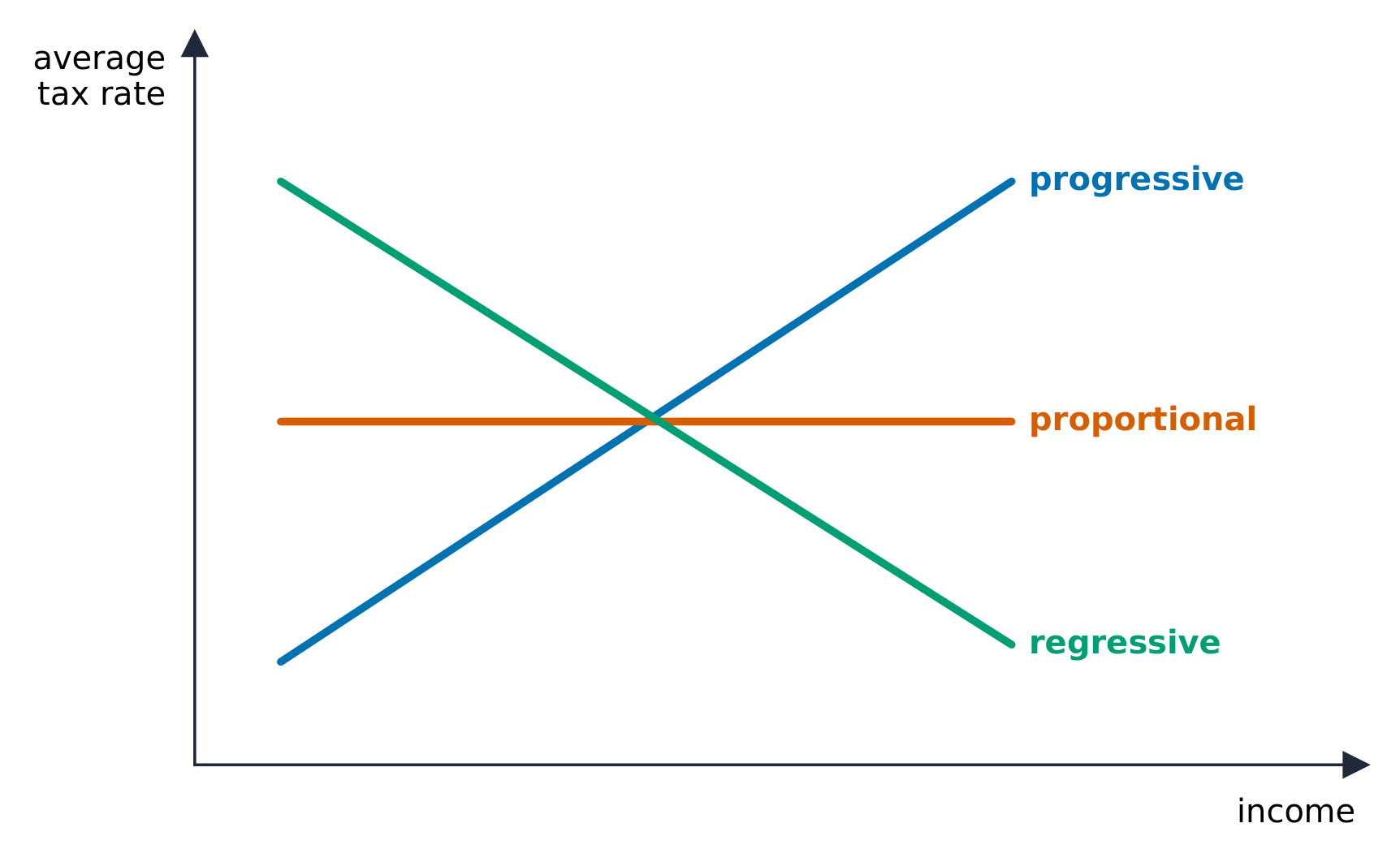
The classification uses the average tax rate, not the cash amount paid or the marginal rate alone. Fiscal policy through AD and AS
expansionary 扩张性 fiscal policy aims to raise demand through higher government purchases or lower taxes. contractionary 紧缩性 fiscal policy uses the reverse changes. A deficit alone does not prove a new discretionary expansion: weak activity can reduce revenue without a deliberate policy change.
Worked explanation. Compare an additional £10bn of government purchases of domestic services with a £10bn household income-tax cut. Purchases directly raise $G$ in $AD=C+I+G+(X-M)$. The tax cut raises disposable income, but households may save part or buy imports, so extra domestic consumption need not equal £10bn. Identify the route to domestic planned spending instead of assuming equal effects.
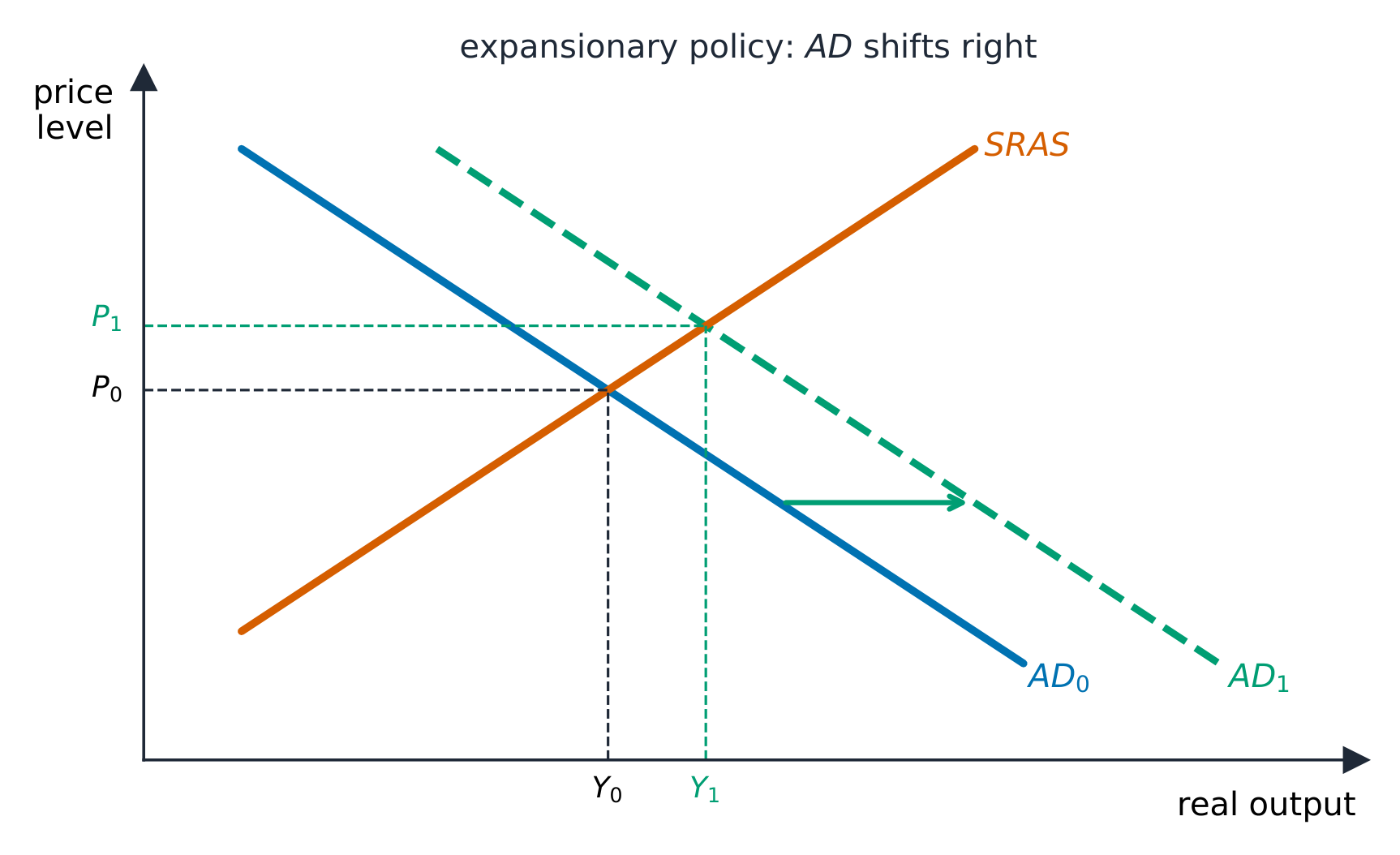
With upward-sloping SRAS and other influences unchanged, an AD increase raises real output and the price level. Capacity conditions affect the balance of these changes. With substantial spare capacity, extra demand can raise production with limited price pressure. Near capacity, demand mainly raises prices. Employment effects depend on how firms meet extra output, including changes in hours and productivity. Fiscal contraction reverses the demand pressure in this model, but it can reduce output and jobs as well as price pressure. Spending on useful infrastructure or education can have supply effects later.
Evaluate the constraint
Purchases can support demand directly, but planning and delivery may delay them. Income-tax cuts may support consumption, but cautious households may save the gain; imports can absorb part. The timing depends on the measure, not a rule that budgets can change only once a year.
Borrowing may add debt-service costs. crowding out 挤出效应 can occur if government borrowing raises financing costs or public demand draws resources away from private activity. Its extent depends on credit conditions, spare resources and the policy response. It is not automatically large or absent. Match the judgement to the problem, financing and expected response rather than treating one policy as always best.
ExploreFiscal policy shifts AD
Government spending and taxes move aggregate demand (AD). Drag AD to see real output and the price level change.
Vocabulary TrainEnglish fiscal policy/ˈfɪskl ˈpɒlɪsi/ budget/ˈbʌdʒɪt/ budget deficit/ˈbʌdʒɪt ˈdefɪsɪt/ national debt/ˈnæʃənl det/ budget surplus/ˈbʌdʒɪt ˈsɜːpləs/ direct tax/daɪˈrekt tæks/ indirect tax/ɪndaɪˈrekt tæks/ progressive tax/prəˈɡresɪv tæks/ proportional tax/prəˈpɔːʃənl tæks/ regressive tax/rɪˈɡresɪv tæks/ expansionary/ekˈspænʃənəri/ contractionary/kənˈtrækʃənəri/ crowding out/ˈkraʊdɪŋ aʊt/ capital spending/ˈkæpɪtl ˈspendɪŋ/ current spending/ˈkʌrənt ˈspendɪŋ/ average tax rate/ˈævrɪdʒ tæks reɪt/ marginal tax rate/ˈmɑːdʒɪnl tæks reɪt/ 5.3
Monetary policy

Syllabus
- explain monetary policy (interest rates, money supply, exchange rate) and the role of the central bank
- explain the transmission mechanism and the effectiveness of monetary policy
Source: Cambridge International syllabus
monetary policy 货币政策 influences monetary and credit conditions through the central bank 中央银行. The required tools are the interest rate 利率, money supply 货币供给 and credit regulation 信贷管制 (restrictions on lending).
Lower policy rates, an increased money supply in the simplified model, or easier lending restrictions can support spending. These are expansionary changes; contractionary changes work in the opposite direction. Banks must be willing to lend and customers willing to borrow for credit to support spending. In the simplified money-market model, an increase in money supply lowers interest rates with money demand unchanged; do not treat this as an unconditional prediction for every policy framework.
A central bank influences monetary and credit conditions; policy rates and commercial loan rates need not be identical. Worked borrowing and credit examples
An illustrative £10000 variable-rate loan has no repayments or fees during the year. Its annual rate rises from 6% to 7%.
$$\text{annual interest}=\text{principal}\times\text{annual rate}.$$$$\text{interest}_0=\text{\pounds}10000\times0.06=\text{\pounds}600/\text{year}.$$$$\text{interest}_1=\text{\pounds}10000\times0.07=\text{\pounds}700/\text{year}.$$The extra £100 annual cost may make some projects less attractive. An existing fixed-rate loan need not change immediately. Policy-rate changes influence commercial rates, but pass-through depends on contracts and banks.
A hypothetical borrowing limit falls from four times annual income to three times. With income £40000 per year, the maximum loan falls from £160000 to £120000. The income multiple represents a number of years of that annual income:
$$\text{maximum loan}=\text{income multiple}\times\text{annual income}.$$$$L_0=4\text{ years}\times\text{\pounds}40000/\text{year}=\text{\pounds}160000.$$$$L_1=3\text{ years}\times\text{\pounds}40000/\text{year}=\text{\pounds}120000.$$This tighter credit rule can limit spending even if the interest rate is unchanged. A borrower who did not need the extra credit may not change spending. Easing a limit does not force borrowing. These are teaching figures, not an actual country's lending rules.
The transmission mechanism
The transmission mechanism 传导机制 links policy to spending, then to output and prices. A higher interest rate can make borrowing dearer and saving more rewarding. Households may reduce credit-financed consumption and firms may reduce investment, but contracts, confidence and income effects affect the response.
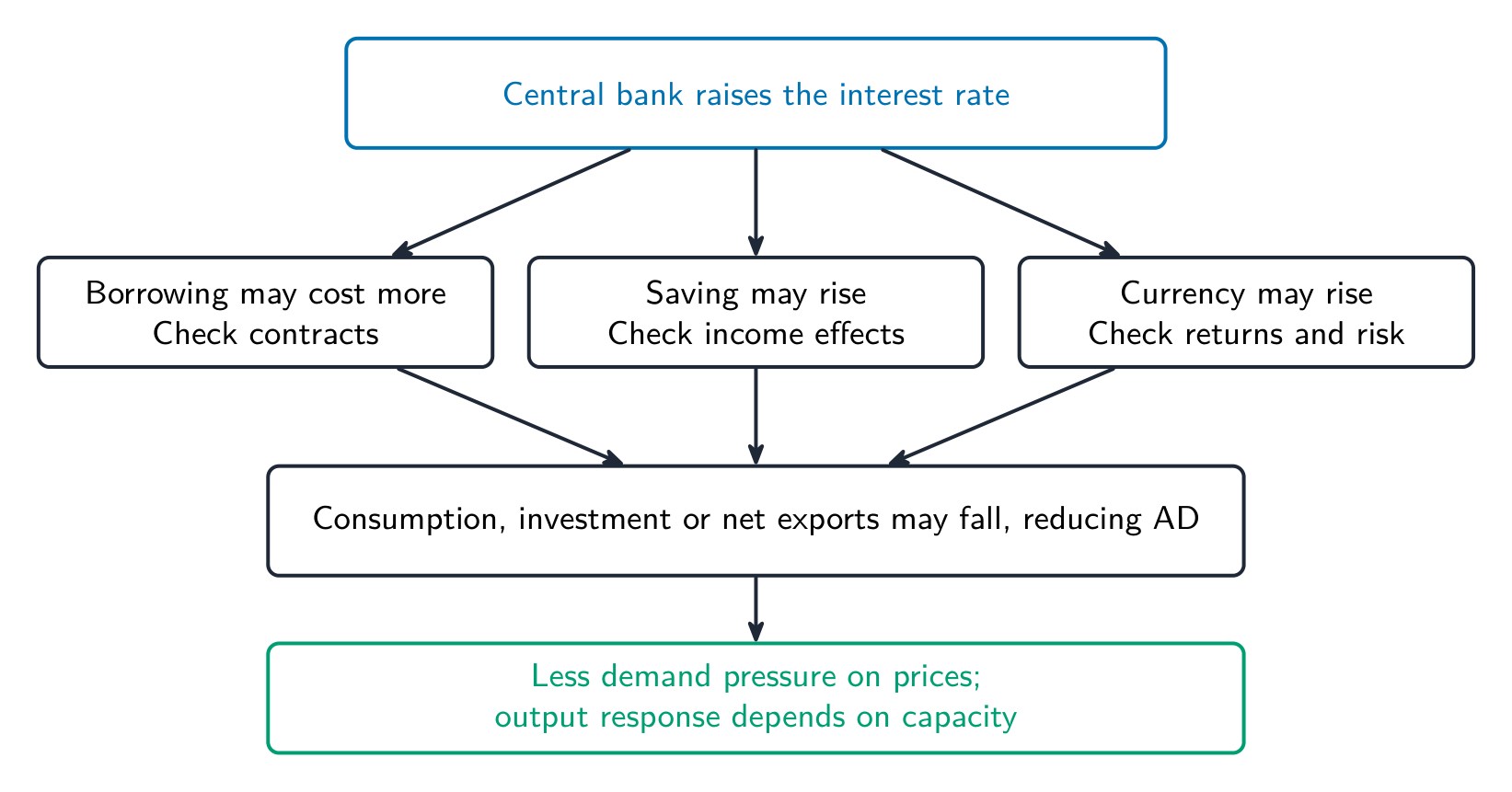
These are possible responses, not guaranteed changes. Contracts, confidence, international conditions and spare capacity affect the strength and timing. If domestic rates rise relative to foreign rates, higher expected returns may attract funds and increase demand for the currency. A stronger exchange rate 汇率 can make exports dearer to foreign buyers and imports cheaper domestically, weakening net exports and AD. But expectations, risk and changes abroad also affect capital flows. Trade quantities depend on contracts and responsiveness to prices. An interest-rate rise alone does not prove that exports must fall.
Effective monetary expansion may raise $C$ or $I$ and shift AD right, like the fiscal AD increase illustrated earlier. With upward-sloping SRAS, real output and price level rise, other things unchanged. Near capacity, price pressure dominates; with spare capacity, output can respond more. Employment depends on how firms meet extra output, including hours and productivity. Rate decisions can change quickly, but borrowing, spending and production take time; there is no fixed lag for every economy or instrument.
Worked comparison. Factories have idle capacity, confidence is weak and policy rates are near zero. Extra public purchases can support demand directly, but delivery, funding and imports affect their impact. Weak confidence may limit borrowing even when credit is cheap; near-zero rates restrict further conventional rate cuts. This does not prove every monetary tool is exhausted or that fiscal action must succeed. Compare feasible measures, their likely response and timing. A different starting interest rate alone does not determine the best policy.
ExploreMonetary policy shifts AD
Changing interest rates moves aggregate demand. Lower rates → more borrowing and spending → AD shifts right.
Vocabulary TrainEnglish monetary policy/ˈmʌnɪtəri ˈpɒlɪsi/ central bank/ˈsentrəl bæŋk/ interest rate/ˈɪntrest reɪt/ money supply/ˈmʌni səˈplaɪ/ exchange rate/eksˈtʃeɪndʒ reɪt/ transmission mechanism/trænˈsmɪʃn ˈmekənɪzəm/ credit regulation/ˈkredɪt ˌreɡjʊˈleɪʃn/ 5.4
Supply-side policy
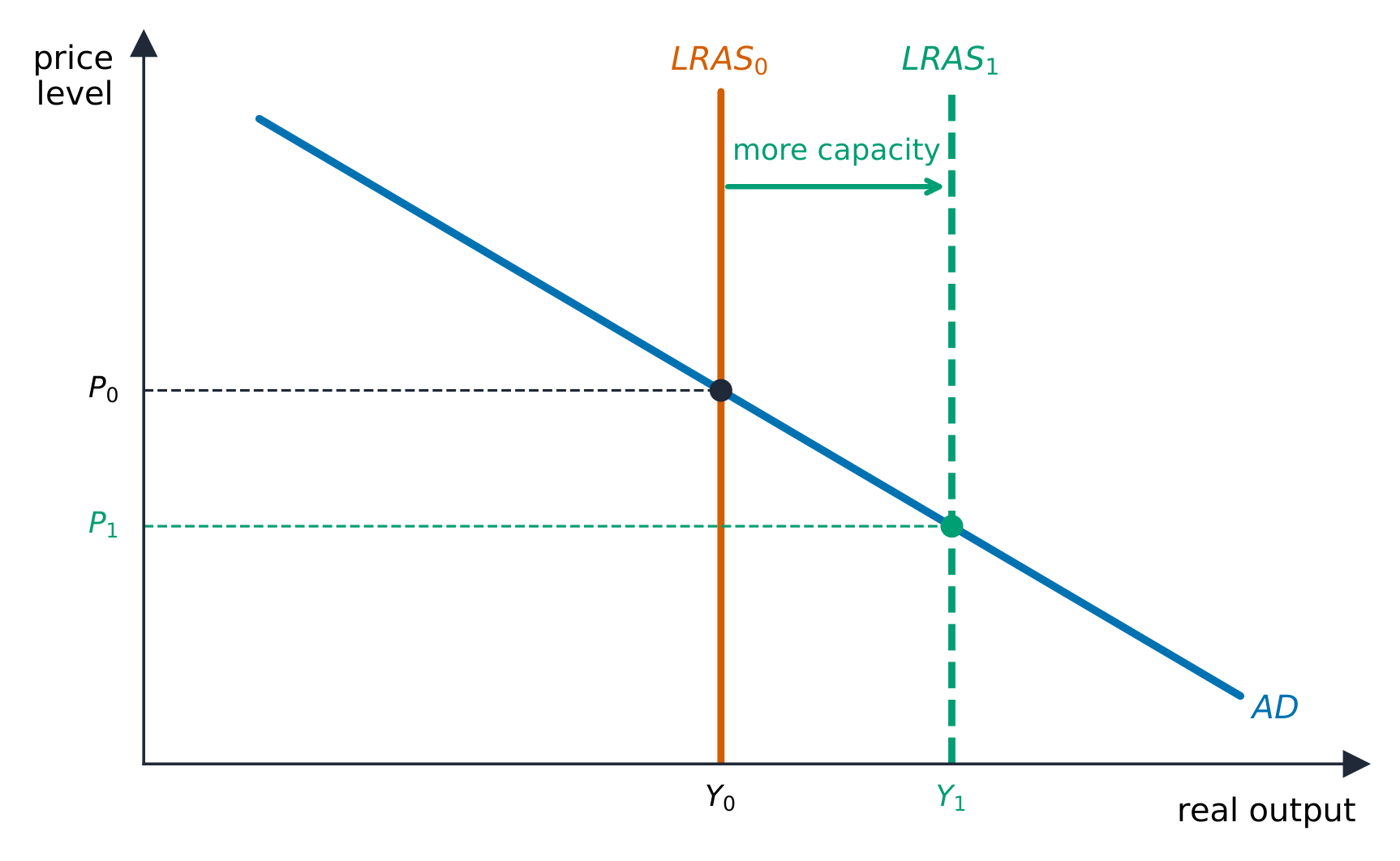
Syllabus
- explain supply-side policies (market-based and interventionist: education and training, incentives, privatisation, deregulation, infrastructure)
- explain the use and effectiveness of supply-side policy
Source: Cambridge International syllabus
supply-side policy 供给侧政策 aims to raise productivity 生产率 and productive capacity 生产能力, shifting LRAS right. Productivity is useful output per unit of input; raising it need not mean employing more people.
Worked productivity example
In an illustrative factory, 100 workers each work 8 hours per day. Useful training and new machinery raise output per worker-hour from 10 to 12 units, with workers and hours unchanged.
$$\text{daily output}=\text{workers}\times\text{hours per worker-day}\times\text{units per worker-hour}.$$$$Q_0=100\times8\times10=8000\text{ units/day}.$$$$Q_1=100\times8\times12=9600\text{ units/day}.$$Possible output rises by 20%, with no extra workers in this case. Actual output and sales also require demand, inputs and use of the improved process.
In this model, higher capacity supports higher real output at a lower price level. A comparison of price levels does not prove a continuing fall in inflation every year. Direct provision: skills, infrastructure and technology
training 培训 can improve relevant skills and reduce a mismatch between jobseekers and vacancies. Suppose an industry closes while local technician vacancies remain. Of 140 trainees, 120 qualify and 90 find suitable jobs. Qualifications alone do not create vacancies: location, demand and access matter. Check completion, matching and whether jobs are additional rather than displaced from other applicants. Retraining alone need not restore sales during a general demand slump.
Better infrastructure 基础设施 can reduce transport delays, improve access to suppliers and lower unit costs. Check reliability, use and the value of saved resources against construction costs. Research support can improve production methods, but success and adoption are uncertain. Funding alone does not prove higher productivity. Construction spending can raise AD before supply benefits arrive; time and quality vary by measure.
Market-based approaches
Lower income tax can increase the reward for extra work or investment, changing the incentive 激励. The response depends on available jobs, finance and people's preferences; some may value more leisure. Lower benefits may change job-search incentives but do not create suitable vacancies by themselves. Consider access and hardship as well as incentives.
privatisation 私有化 transfers state enterprises to private ownership. It may strengthen incentives to control costs, but ownership alone does not create competition or better management. deregulation 放松管制 can remove unnecessary entry barriers and encourage competition. Removing useful safety or environmental rules can also impose costs.
Comparing tools and evaluating claims
Worked comparison. Region A has workers with unsuitable skills and poor transport. Region B has qualified workers and efficient transport but few orders. Direct training and infrastructure may address A's gaps if useful and used. Tax incentives and easier entry can encourage work and investment, but do not automatically supply missing skills or transport. B's immediate constraint is weak demand, so extra capacity may remain unused. Compare cause, response, cost and timing; combinations may complement each other.
A useful supply improvement can support higher output with less price pressure in the stated model. It is not a promise of no costs. Funding uses resources, taxes can change spending and incentives, and gains may arrive unevenly or late. Judge quality, opportunity costs, distribution, demand and timing. Distinguish a lower price level in a diagram from a sustained change in the inflation rate.
ExploreSupply-side policy shifts AS
Supply-side policies raise the economy's productive capacity — aggregate supply (AS) shifts right, lowering the price level at higher output.
Vocabulary TrainEnglish supply-side policy/səˈplaɪ saɪd ˈpɒlɪsi/ productive capacity/prəˈdʌktɪv kəˈpæsɪti/ productivity/ˌprɒdəkˈtɪvɪti/ incentive/ɪnˈsentɪv/ privatisation/ˌpraɪvətaɪˈzeɪʃn/ deregulation/diːˌreɡjʊˈleɪʃn/ training/ˈtreɪnɪŋ/ infrastructure/ˈɪnfrəstrʌktʃə/ 5.4
Policy judgement and retrieval
Diagnose rising prices. Economy A has strong spending near capacity. B has a fuel-cost shock and weak sales. Monetary tightening may restrain demand pressure in A. In B, weaker demand does not directly remove the fuel shortage and may reduce output further. Supply measures may reduce costs but may take time or fail to address the specific shock. Compare source, persistence and feasible response rather than choosing an instrument from inflation alone.
Improve the assessment. "Training reduces unemployment, but there is a time lag" is incomplete. Explain that training can reduce a skills mismatch if vacancies need the new skills. Completion and matching take time, so lost income may persist. If firms lack orders, demand support may address the immediate sales constraint more directly. A judgement compares mechanisms, scale, time and costs; merely naming a lag is not complete evaluation.
Attempt before checking. Spending is £90bn/year and revenue £84bn/year; starting debt is £300bn. Assume the deficit is financed by net borrowing with no other adjustments. Find deficit and closing debt. A worker pays £3000 tax on £30000 income, then £3200 on £31000: find ATR and MTR on the extra income.
$$\text{deficit}=\text{spending}-\text{revenue}=\text{\pounds}90\text{bn/year}-\text{\pounds}84\text{bn/year}=\text{\pounds}6\text{bn/year}.$$$$D_1=D_0+\text{net borrowing}=\text{\pounds}300\text{bn}+\text{\pounds}6\text{bn}=\text{\pounds}306\text{bn}.$$$$\mathrm{ATR}=\frac{T}{Y}\times100\%=\frac{\text{\pounds}3000}{\text{\pounds}30000}\times100\%=10\%.$$$$\mathrm{MTR}=\frac{\Delta T}{\Delta Y}\times100\%=\frac{\text{\pounds}3200-\text{\pounds}3000}{\text{\pounds}31000-\text{\pounds}30000}\times100\%=20\%.$$Final check. Explain a monetary tool other than interest rates. Explain why training can raise capacity without guaranteeing jobs. Why can a government package that raises income tax and funds apprenticeships be both fiscal and supply-side?
Check after attempting. Easing credit regulation may allow more financed spending if banks and borrowers respond; increased money supply may lower rates in the simplified model with unchanged money demand. Training can improve productivity or matching, but suitable vacancies and demand remain necessary. Tax and purchases are fiscal tools, while useful apprenticeships can also improve skills and capacity. Explain demand and supply effects separately and state their time periods.
Vocabulary card meanings
redistribution of income: Shifting income from some households to others, often by tax. demand-side policies: Government actions aimed at the level of total spending. privatisation: Selling firms owned by the state to private owners. deregulation: Removing rules that limit how firms may compete. capital spending: Public money spent on long-lived assets such as roads. current spending: Public money used up within the year, such as wages. average tax rate: Tax paid divided by total income. marginal tax rate: The share taken in tax from one extra unit of income. credit regulation: Rules that limit how much households and firms may borrow.
-
6
International economic issues
Watch lesson6.1
Why countries trade

Syllabus
- explain absolute and comparative advantage and the gains from specialisation and trade
- explain the terms of trade and the benefits and limitations of trade theory
Source: Cambridge International syllabus
international trade 国际贸易 lets residents exchange goods and services across borders. To specialise 专业化 means to concentrate on producing particular goods or services. Specialisation and trade can increase consumption choices; calculate the possible gain and then consider costs and adjustment.
A container port: trade connects producers and buyers across borders. Absolute and comparative advantage
An absolute advantage 绝对优势 means producing more with the same stated resources. A comparative advantage 比较优势 means producing at lower opportunity cost 机会成本. They answer different questions.
Illustrative maximum outputs with the same quantity of resources in each country; assume straight-line PPCs and unchanged technology:
Country Wine only Cloth only A 20 units 10 units B 5 units 5 units A has an absolute advantage in both. To find comparative advantage, divide output forgone by output gained:
$$\mathrm{OC}_A(\text{cloth})=\frac{\text{wine forgone}}{\text{cloth gained}}=\frac{20}{10}=2\text{ wine/cloth}.$$$$\mathrm{OC}_B(\text{cloth})=\frac{\text{wine forgone}}{\text{cloth gained}}=\frac{5}{5}=1\text{ wine/cloth}.$$$$\mathrm{OC}_A(\text{wine})=\frac{\text{cloth forgone}}{\text{wine gained}}=\frac{10}{20}=0.5\text{ cloth/wine}.$$$$\mathrm{OC}_B(\text{wine})=\frac{\text{cloth forgone}}{\text{wine gained}}=\frac{5}{5}=1\text{ cloth/wine}.$$B gives up less wine per cloth, so has comparative advantage in cloth. A gives up less cloth per wine, so has comparative advantage in wine. One country being more productive in both goods does not remove possible gains from trade.
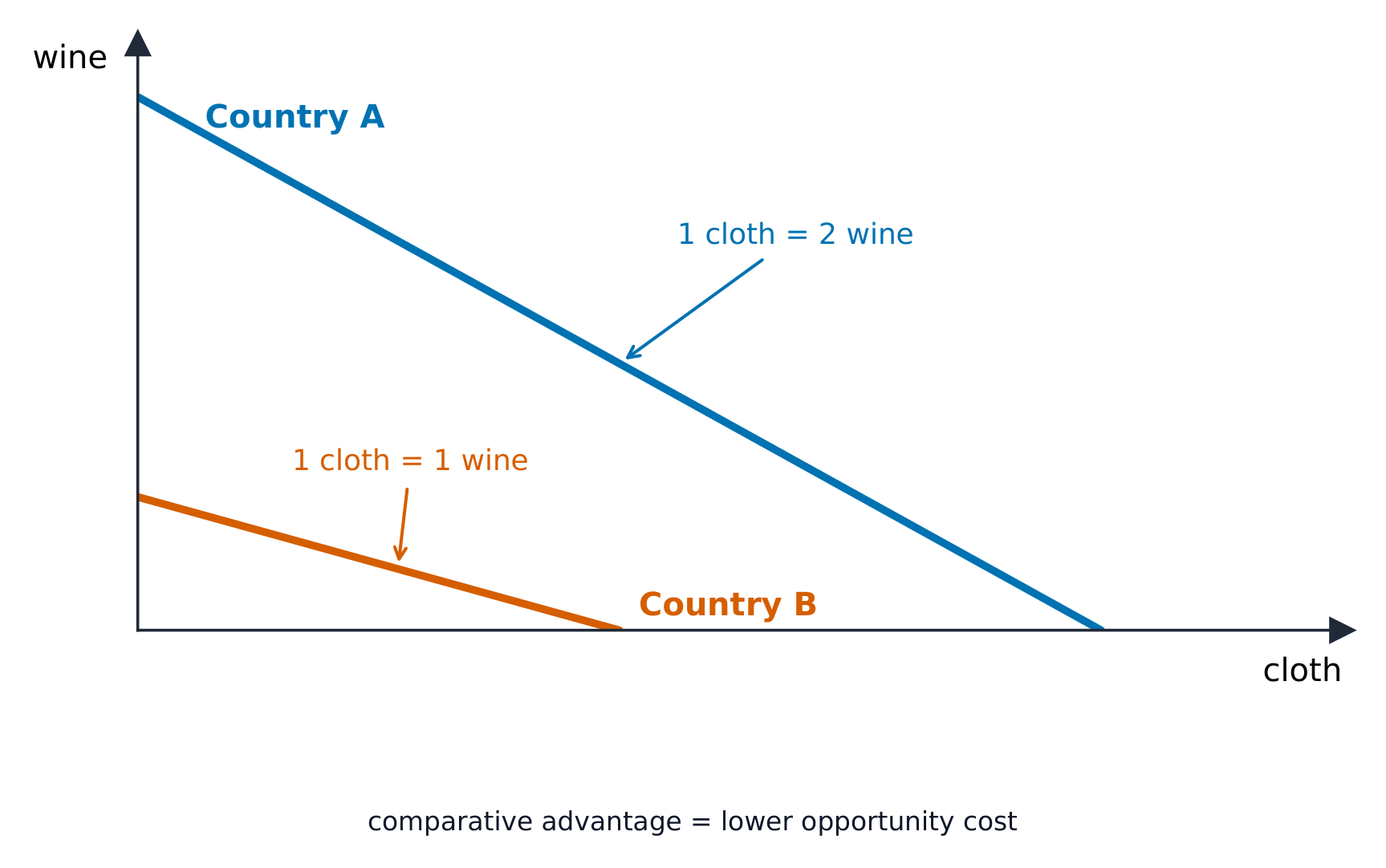
Different slopes show different opportunity costs: A gives up 2 wine per cloth; B gives up 1. Gains in consumption and the trading possibility curve
Worked exchange ratio. B gives up 1 wine to make 1 cloth; A gives up 2 wine to make it. At 1 cloth for 1.5 wine, B receives 0.5 wine more than its cost and A saves 0.5 wine compared with making cloth at home. Both strictly gain per traded unit when the wine-per-cloth ratio is between 1 and 2, before trading costs. At an endpoint, one side is indifferent in this model.
Worked consumption bundles. Without trade, A makes 16 wine and 2 cloth; B makes 3 wine and 2 cloth. Both lie on their own PPCs. After specialisation, A makes 20 wine and B makes 5 cloth. B sends 2.5 cloth to A in exchange for 3.75 wine, consistent with 1.5 wine per cloth.
Country Wine consumed Cloth consumed A 20 − 3.75 = 16.25 0 + 2.5 = 2.5 B 0 + 3.75 = 3.75 5 − 2.5 = 2.5 Both can consume more of both goods than in the stated no-trade bundles. Total consumption equals total production: 20 wine and 5 cloth. The example shows a possible gain, not a promise that all trades or all households gain equally.
A trading possibility curve 贸易可能性曲线 shows consumption combinations available through production and trade at a stated exchange ratio. It can extend beyond a country's production PPC without moving that PPC. The country's technology and resources have not changed; trade changes access to goods. Here B can supply at most 5 cloth, so the shown trading segment is limited to those imports.
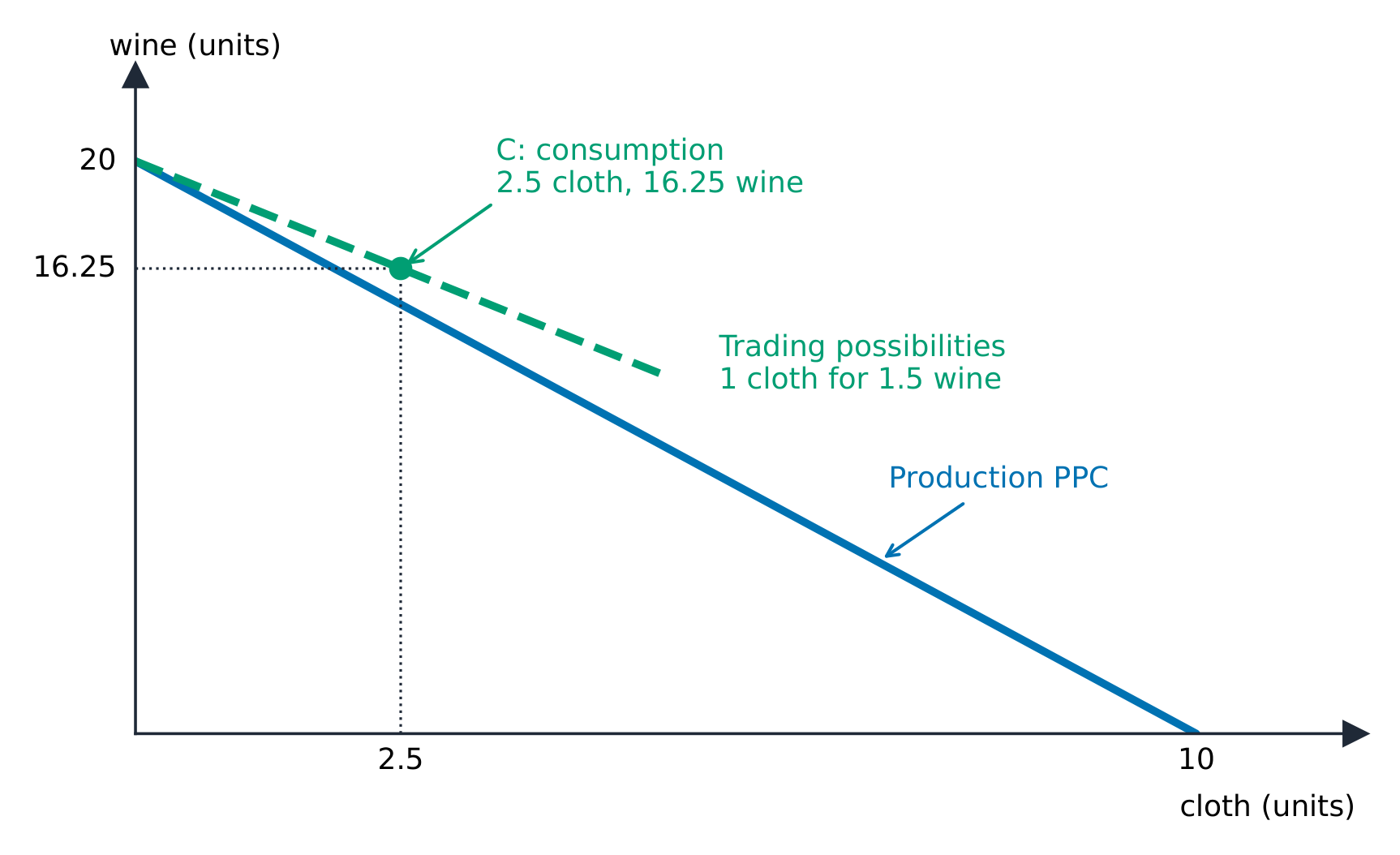
At 2.5 cloth, A's own production PPC permits 15 wine; the agreed trade permits consumption of 16.25 wine. This is a consumption gain, not a shift in production capacity. Terms of trade: prices, not the trade balance
terms of trade 贸易条件 compare export prices with import prices, using indices with the same base period:
$$\mathrm{ToT}=\frac{P_X}{P_M}\times100.$$With export-price index 110 and import-price index 105:
$$\mathrm{ToT}=\frac{110}{105}\times100\approx104.8.$$A fixed export quantity now buys about 4.8% more imports than in the base period. The index does not measure export volumes or the current-account balance. An improvement could reflect higher export prices or lower import prices, with different effects on sales and costs. Commodity demand, supply and production costs influence the ratio. Dearer exports may sell fewer units; improved terms of trade do not automatically mean higher export revenue or welfare.
Transfer task with solution. Terms of trade fall from 95 to 85 while the import-price index stays 120. Find both export-price indices and their change:
$$\mathrm{ToT}=\frac{P_X}{P_M}\times100\quad\Rightarrow\quad P_X=\frac{\mathrm{ToT}\times P_M}{100}.$$$$P_{X0}=\frac{95\times120}{100}=114.$$$$P_{X1}=\frac{85\times120}{100}=102.$$$$\Delta P_X=P_{X1}-P_{X0}=102-114=-12.$$Export prices fall 12 index points, not 10. Distinguish an index-point change from a percentage change.
Limits and distribution of gains
If the calculated saving is 0.5 wine per cloth but shipping and border costs use resources worth 0.6 wine per cloth, the saving is lost. The simple model holds technology and resources fixed, assumes constant opportunity costs, and omits trading costs and barriers. Moving workers and capital into expanding industries can require time, retraining and investment. Changing costs, product quality and reliance on one export also matter. Trade can widen choice and competition; assess adjustment losses and the distribution of gains instead of assuming everyone benefits equally.
ExploreWhy countries trade
Each country specialises where its opportunity cost is lowest, then trades — both can consume beyond their own frontier.
Vocabulary TrainEnglish international trade/ˌɪntəˈnæʃənl treɪd/ specialise/ˈspeʃəlaɪz/ absolute advantage/ˈæbsəluːt ədˈvæntɪdʒ/ comparative advantage/kəmˈpærətɪv ədˈvæntɪdʒ/ opportunity cost/ɒpəˈtjuːnɪti kɒst/ terms of trade/tɜːmz ɒv treɪd/ trading possibility curve/ˈtreɪdɪŋ ˌpɒsəˈbɪlɪti kɜːv/ 6.2
Protectionism

Syllabus
- describe tools of protection (tariffs, quotas, subsidies, embargoes, administrative barriers)
- explain the arguments for and against protectionism and its effects on stakeholders
Source: Cambridge International syllabus
protectionism 贸易保护主义 shields home producers from foreign competition. Explain each tool's direct mechanism before judging its effects:
- A tariff 关税 taxes imports. In the small-country model below, it raises the domestic price while imports remain available.
- A quota 配额 caps the quantity imported. A quota above existing imports may not bind.
- An export subsidy 补贴 pays exporters, reducing effective costs and potentially expanding foreign sales. It requires public funding; it does not automatically raise every domestic price.
- An embargo 禁运 bans specified trade, potentially increasing the cost of alternatives.
- administrative barriers 行政壁垒 are excessive procedures that hinder imports. Distinguish these from useful safety or environmental standards.
Tariffs change import costs, quotas limit import quantities, and subsidies support specified producers. Their revenue and spending effects differ. Worked tariff: imports and revenue
Assume a small country facing an unchanged world price, no evasion and full pass-through of the tariff into the domestic price. Prices are £/unit; quantities are million units/year. At world price 4, domestic supply is 2 and demand 8. A tariff of 2 raises the domestic price to 6: supply rises to 4 and demand falls to 6.
$$M_0=Q_{d0}-Q_{s0}=8-2=6\text{ million units/year}.$$$$M_1=Q_{d1}-Q_{s1}=6-4=2\text{ million units/year}.$$$$R=t\times M_1.$$$$R=\text{\pounds}2/\text{unit}\times2\text{ million units/year}=\text{\pounds}4\text{ million/year}.$$Use imports after the tariff. Multiplying the tariff by all domestic consumption or the old import quantity gives the wrong revenue.
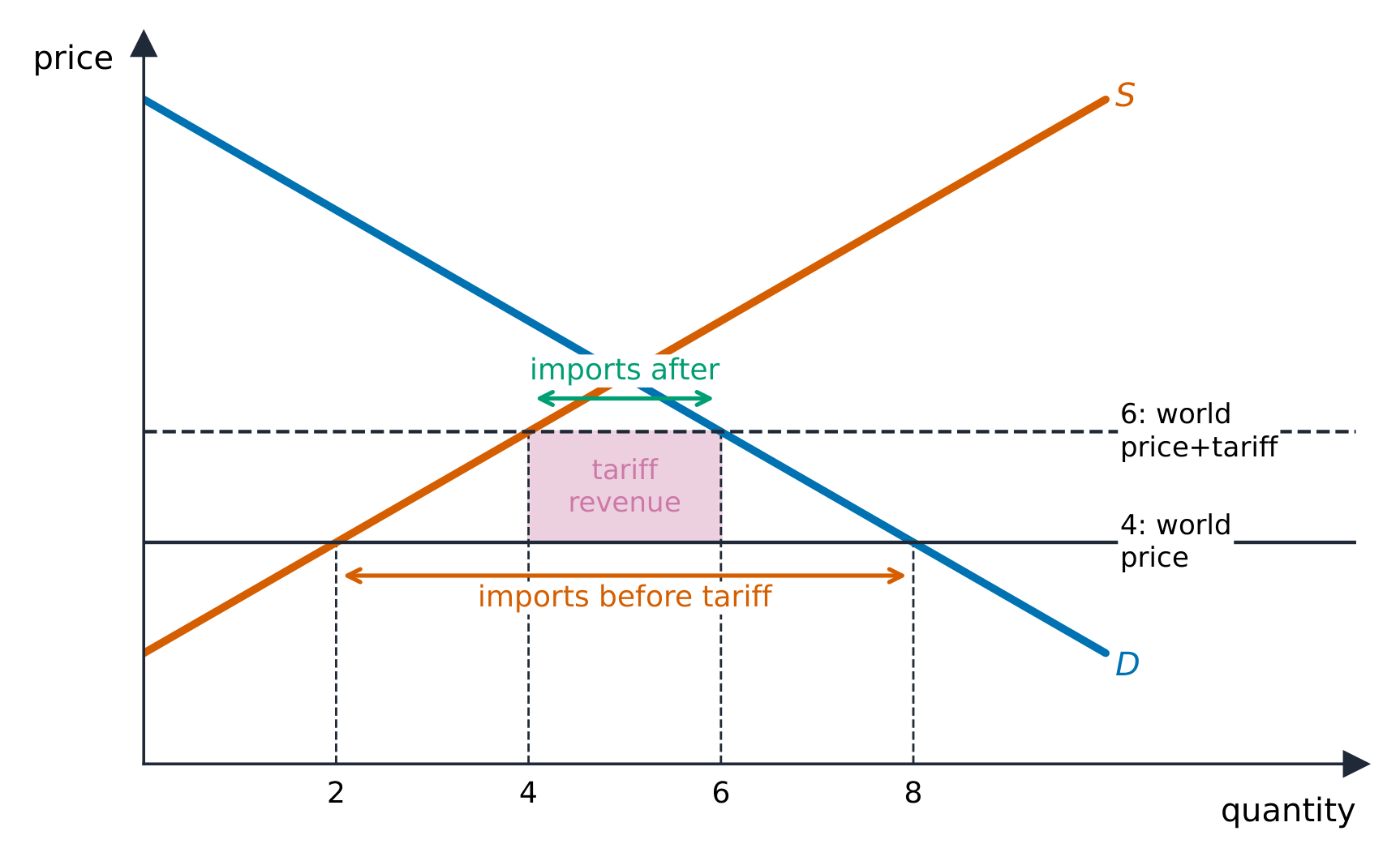
Under these assumptions, imports fall from 6 to 2 million units/year; the rectangle is the tariff per unit multiplied by remaining imports. Effects on stakeholders
A stakeholder 利益相关者 is a person or group affected. Consumers pay 6 rather than 4 and buy 6 rather than 8 million units, reducing purchasing power. Home producers sell 4 rather than 2 million units at the higher price, but higher-cost production may expand. Government receives £4 million/year while taxable imports continue; revenue is a transfer, not evidence of a net national gain. Foreign suppliers sell fewer units in this model. Domestic firms using imported inputs can face higher costs. Compare the gains and losses and wider responses.
A quota need not give gains to the same recipient
Suppose an import quota of 2 million units/year produces the same domestic price 6 while foreign supply remains available at 4. A licence holder buying at 4 and selling at 6 may receive the difference. Government can capture some or all of it by auctioning licences; foreign suppliers may receive gains if they hold licences or market power. Do not claim that every quota generates no government receipts or always benefits domestic importers. A tariff fixes a tax per imported unit; a quota fixes the permitted quantity, so their response to changing demand can differ.
Evaluate arguments for and against protection
An infant industry 幼稚产业 may need time to learn or reach efficient scale. A credible temporary-protection case needs evidence of falling costs, measurable targets and an end date. Protection may instead preserve inefficiency and impose costs on consumers. Strategic capacity and time for workers to adjust may also matter.
dumping 倾销 concerns export prices below normal value, commonly compared with home-market prices or assessed using costs. Cheap imports alone do not prove an intention to destroy competitors. WTO definition.
retaliation 报复 by trading partners can weaken export sales. Judge a specified tool against its objectives, duration, consumer and input costs, possible foreign responses and alternatives. A justified conclusion weighs the actual conditions; it does not simply repeat that protection saves jobs or raises prices.
ExploreProtectionism in the market
A tariff or quota shifts effective supply and raises the domestic price, protecting home producers but costing consumers. Shift the lines to see it.
Vocabulary TrainEnglish protectionism/prəˈtekʃənɪzəm/ tariff/ˈtærɪf/ quota/ˈkwəʊtə/ subsidy/ˈsʌbsɪdi/ embargo/emˈbɑːɡəʊ/ administrative barriers/ədˈmɪnɪstrətɪv ˈbærɪəz/ infant industry/ˈɪnfənt ˈɪndʌstri/ dumping/ˈdʌmpɪŋ/ retaliation/rɪˌtælɪˈeɪʃn/ stakeholder/ˈsteɪkhəʊldə/ 6.3
The balance of payments

Syllabus
- describe the structure of the balance of payments and the components of the current account (trade in goods and services, primary and secondary income)
- explain the causes and consequences of current account deficits and surpluses
Source: Cambridge International syllabus
The balance of payments 国际收支 records transactions between residents and non-residents during a period. The current account 经常账户 is one part; it records goods, services, primary income and secondary income. A receipt is a credit, and a payment is a debit. Use the same period, currency and sign convention throughout a calculation.
Classify transactions before calculating
- trade in goods 货物贸易: exports and imports of physical products. A resident firm exporting machinery receives a goods credit.
- trade in services 服务贸易: services supplied across the resident/non-resident boundary. A foreign visitor paying a resident hotel creates a service credit.
- primary income 初次收入: income from labour or ownership of assets across borders. Interest received by a resident on a foreign bond is a credit; interest paid abroad is a debit.
- secondary income 二次收入: current transfers without an equivalent item received in return, such as a household gift from abroad.
Buying an existing foreign bond is a financial-asset transaction, not primary income. Its later interest is income. Goods made and consumed domestically are not exports simply because they are valuable.
Calculate the net balance of each component; then add all four, including income and transfers. Worked account: trade surplus but current-account deficit
Illustrative annual flows, all £bn/year:
Component Receipts Payments Goods 80 100 Services 50 20 Primary income 5 20 Secondary income 2 5 For goods and services, receipts are export earnings and payments are import expenditure. Let $B_g$ and $B_s$ be their balances, $B_t$ the combined trade balance, and $N_p$ and $N_s$ net primary and secondary income. For income, $R$ means receipts and $P$ payments.
$$B_g=X_g-M_g=80-100=-20.$$$$B_s=X_s-M_s=50-20=+30.$$$$B_t=B_g+B_s=-20+30=+10.$$Goods are in deficit, services in surplus, and combined trade in surplus. Income and transfers still matter:
$$\begin{aligned} N_p&=R_p-P_p=5-20=-15\\ N_s&=R_s-P_s=2-5=-3\\ \mathrm{CAB}&=B_t+N_p+N_s\\ \mathrm{CAB}&=10+(-15)+(-3)=-8\text{ (£bn/year)}. \end{aligned}$$A current account deficit 经常账户赤字 means total current-account debits exceed credits. A current account surplus 经常账户盈余 means credits exceed debits. Neither is defined solely by imports and exports. This example has a £10bn trade surplus alongside an £8bn current-account deficit.
Explain the cause before choosing a policy
Transfer task with solution. Starting from CAB $=-8$, compare an extra £12bn/year of service exports with an extra £12bn/year of interest payments abroad. Hold all other flows constant.
$$\mathrm{CAB}_{\mathrm{exports}}=\mathrm{CAB}_0+\Delta X_s=-8+12=+4\text{ (£bn/year)}.$$$$\mathrm{CAB}_{\mathrm{interest}}=\mathrm{CAB}_0-\Delta P_p=-8-12=-20\text{ (£bn/year)}.$$Stronger overseas demand can raise exports; stronger domestic spending can raise imports. Exchange rates, relative prices, product quality and capacity influence trade. Income payments and transfers can change CAB even when trade is unchanged. A single balance does not identify its cause.
Assess consequences and financing
Compare two economies with the same deficit. Economy A imports machinery for a viable new export industry. Economy B persistently loses overseas customers while paying more income abroad. A's imports may improve future capacity and earnings if the investment succeeds. B's lost sales may weaken demand and employment, although other expenditure can offset this. Size alone cannot settle the judgement.
A deficit requires counterpart financing or asset/reserve changes in the wider accounts. Borrowing, equity investment and selling assets differ: external debt does not automatically rise by the current-account deficit. Consider persistence, financing terms, future income payments, exchange-rate pressures and productive use of imports. A surplus can reflect strong competitiveness or weak domestic spending; it is not automatically a welfare gain.
ExploreCurrent account flow
Track exports, imports and income flows into the current account.
Vocabulary TrainEnglish balance of payments/ˈbæləns ɒv ˈpeɪmənts/ current account/ˈkʌrənt əˈkaʊnt/ trade in goods/treɪd ɪn ɡʊdz/ trade in services/treɪd ɪn ˈsɜːvɪsɪz/ primary income/ˈpraɪməri ˈɪŋkʌm/ secondary income/ˈsekəndəri ˈɪŋkʌm/ current account deficit/ˈkʌrənt əˈkaʊnt ˈdefɪsɪt/ current account surplus/ˈkʌrənt əˈkaʊnt ˈsɜːpləs/ 6.4
Exchange rates

Syllabus
- explain the determination of floating exchange rates by demand and supply of currency, and fixed and managed systems
- explain the causes and effects of appreciation and depreciation on the economy
Source: Cambridge International syllabus
An exchange rate 汇率 is the price of one currency in another. State the quote before describing a rise or fall. For example, US$1.40 per pound means £1 buys US$1.40. If this rises to US$1.60 per pound, the pound buys more dollars: appreciation 升值. A fall in the dollar-per-pound quote is depreciation 贬值. A quote in pounds per dollar moves the opposite way.
Read the currencies and quote direction before interpreting a number. The floating currency market
A floating exchange rate 浮动汇率 adjusts where demand for the currency meets supply. In the market for pounds, a buyer exchanging dollars for pounds to pay a UK exporter demands pounds. A UK importer exchanging pounds for dollars supplies pounds. Follow the currency exchanged, not the buyer's nationality.
With currency supply unchanged, stronger demand for pounds raises foreign currency per pound: appreciation. Higher export demand or inward investment may raise demand. With currency demand unchanged, UK residents buying more foreign goods can increase supply of pounds and cause depreciation. Outward investment can also increase supply. Higher relative interest returns may attract funds, but expectations and risk can offset that response.
A change in the pound's own price causes movement along a curve; a change in export demand or investment flows can shift a curve. State other influences held constant.

The new equilibrium lies on both the shifted demand curve and unchanged supply curve. This is a conditional demand-shift example, not a forecast of every exchange-rate change. For context, a fixed exchange rate 固定汇率 is maintained at a stated rate or band using intervention or other policy measures. Maintaining it can require reserves and policy adjustments. A managed exchange rate 管理浮动汇率 combines market forces with intervention to influence the rate. These arrangements describe currency pricing; a current-account surplus describes a different account and does not identify the currency system. The required AS model here focuses on floating rates.
Worked export conversion
A UK machine keeps its £200 price. The rate rises from US$1.40/£ to US$1.60/£. Assume the change is passed through to the US buyer. Let $P_{\mathrm{US}}$ be its dollar price, $P_{\mathrm{UK}}$ its pound price and $e$ dollars per pound. Multiply so pounds cancel:
$$P_{\mathrm{US}}=P_{\mathrm{UK}}\times e.$$$$P_{\mathrm{US},0}=P_{\mathrm{UK}}\times e_0=\text{\pounds}200\times\text{US\$}1.40/\text{\pounds}=\text{US\$}280.$$$$P_{\mathrm{US},1}=P_{\mathrm{UK}}\times e_1=\text{\pounds}200\times\text{US\$}1.60/\text{\pounds}=\text{US\$}320.$$The machine becomes dearer in dollars. Sales may fall, depending on demand, contracts, quality and how firms adjust prices. Conversion arithmetic alone does not establish the quantity response.
Worked import conversion
A UK firm owes a fixed US$700 invoice. Use the same rates. Dividing dollars by dollars per pound gives pounds:
$$P_{\mathrm{UK}}=\frac{P_{\mathrm{US}}}{e}.$$$$P_{\mathrm{UK},0}=\frac{P_{\mathrm{US}}}{e_0}=\frac{\text{US\$}700}{\text{US\$}1.40/\text{\pounds}}=\text{\pounds}500.$$$$P_{\mathrm{UK},1}=\frac{P_{\mathrm{US}}}{e_1}=\frac{\text{US\$}700}{\text{US\$}1.60/\text{\pounds}}=\text{\pounds}437.50.$$Appreciation lowers this invoice's pound cost. Always check the units rather than memorising that imports mean multiplication or division.
Price effects do not settle the trade balance
Transfer task with solution. The pound depreciates from US$1.40/£ to US$1.20/£. A fixed £200 export now costs US$240, while a fixed US$700 import costs about £583.33:
$$P_{\mathrm{US}}=P_{\mathrm{UK}}\times e=\text{\pounds}200\times\text{US\$}1.20/\text{\pounds}=\text{US\$}240.$$$$P_{\mathrm{UK}}=\frac{P_{\mathrm{US}}}{e}=\frac{\text{US\$}700}{\text{US\$}1.20/\text{\pounds}}\approx\text{\pounds}583.33.$$Export receipts and import spending equal price times quantity. Buyers may be tied to contracts, essential imports may be hard to replace, and exporters may lack capacity. Cheaper exports do not automatically mean higher receipts; dearer imports do not automatically mean a lower import bill. Assess demand responsiveness, timing and the currency in which values are measured. The whole current account also includes income and transfers. A short technical label alone cannot replace this reasoning.
AD/AS: demand and imported costs
A depreciation can raise net exports if quantities respond, increasing aggregate demand 总需求 (AD). With upward-sloping short-run supply and other influences unchanged, AD shifting right raises real output and the price level. Employment also depends on how firms meet extra demand, including hours and productivity.
Dearer imported fuel, components or machinery can increase production costs. Higher costs shift short-run aggregate supply 短期总供给 (SRAS) left: holding AD unchanged, real output falls and the price level rises. If demand and cost effects occur together, their relative size determines the output change. Depreciation does not automatically remove structural unemployment or guarantee higher output and jobs.
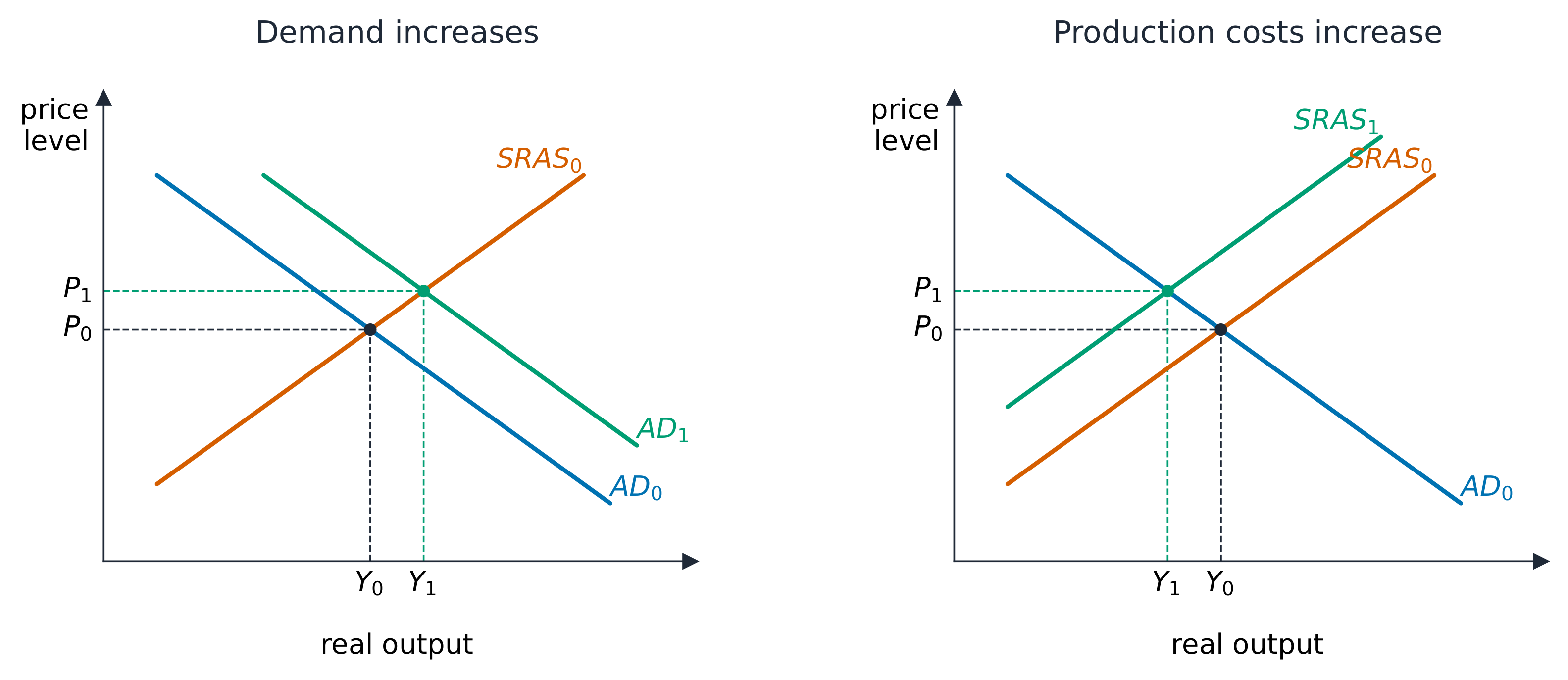
Two conditional channels: each panel holds the other curve unchanged. Do not add their output effects as if both pointed the same way. ExploreThe foreign-exchange market
A currency has its own market. More demand for £ (or less supply) pushes the exchange rate up — it appreciates.
Vocabulary TrainEnglish exchange rate/eksˈtʃeɪndʒ reɪt/ floating exchange rate/ˈfləʊtɪŋ eksˈtʃeɪndʒ reɪt/ fixed exchange rate/fɪkst eksˈtʃeɪndʒ reɪt/ managed exchange rate/ˈmænɪdʒd eksˈtʃeɪndʒ reɪt/ appreciation/əˌpriːʃɪˈeɪʃn/ depreciation/dɪˌpriːʃɪˈeɪʃn/ aggregate demand/ˈæɡrɪɡeɪt dɪˈmænd/ short-run aggregate supply/ʃɔːt rʌn ˈæɡrɪɡeɪt səˈplaɪ/ 6.5
Correcting a current account deficit

Syllabus
- explain expenditure-switching and expenditure-reducing policies and supply-side measures to correct a deficit
- evaluate the effectiveness of these policies
Source: Cambridge International syllabus
First identify the component causing the imbalance, its persistence and financing. The aim of stability does not mean forcing a zero balance every year at any cost. Compare outcomes for growth, jobs, inflation and future income payments.
Fiscal and monetary policies: reducing expenditure
expenditure-reducing 支出减少 policies lower domestic demand. Higher income taxes or lower government purchases may reduce spending and imports. If demand is already weak, output and employment can also fall. The import response depends on which spending changes and the availability of domestic alternatives.
Higher interest rates may reduce borrowing and spending, including imports. They may also attract capital and appreciate the currency, making exports dearer abroad and imports cheaper at home. Expectations and risk matter. Explain both channels before claiming that tighter monetary policy must improve CAB.
Protection and relative prices: switching expenditure
expenditure-switching 支出转换 changes relative prices to favour domestic goods. A tariff may reduce imports; an export subsidy may support foreign sales but directly costs public funds. A tariff's receipts and a subsidy's costs have different effects on the government budget. A quota changes permitted quantities and its revenue effects depend on licence arrangements.
Depreciation can also change relative prices, but a floating rate is not simply set lower by government command. Monetary policy can influence it with uncertain responses. Higher import costs, retaliation, weak demand responses and limited capacity can offset gains. Compare a specified policy with feasible alternatives rather than promising all effects from its label.
Supply-side policies: address the actual constraint
Supply-side policy can improve competitiveness 竞争力 through productivity, quality, costs and reliability. Compare two exporters: A cannot deliver reliably because a port is congested; B has spare capacity but foreign buyers no longer want its product. Port investment may address A's constraint; B may need product development or a different market. The same training programme need not solve both.
Skills, infrastructure and technology use resources and may take time. Higher capacity does not guarantee sales. Judge opportunity cost, the actual bottleneck and overseas demand before predicting higher exports.
Diagnose before giving a conclusion
Worked judgement. CAB is −£8bn/year despite a £10bn trade surplus because net primary and secondary income together are −£18bn/year. A tariff targets imports, not the income payments causing the imbalance. It could still change trade, but consumer and input costs, the size of the response and retaliation matter. Recommend a policy using the identified cause and compare benefits with other objectives.
Trade is only part of the current account: include net income and transfers when diagnosing an imbalance. ExploreCurrent account flow
Track exports, imports and income flows into the current account.
Vocabulary TrainEnglish expenditure-reducing/ekˈspendɪtʃə rɪˈdjuːsɪŋ/ expenditure-switching/ekˈspendɪtʃə ˈswɪtʃɪŋ/ competitiveness/kəmˈpetɪtɪvnəs/ 6.5
Apply and review
Attempt before checking. Annual balances, in £bn/year: goods−12, services+8, primary income−7, secondary income+1. Find CAB. Then £1 falls from US$1.50 to US$1.20. Find the dollar price of a fixed £150 export. Does the lower foreign price prove that CAB will improve?
Solution. Add all four components:
$$\mathrm{CAB}=B_g+B_s+N_p+N_s=-12+8-7+1=-\text{\pounds}10\text{bn/year}.$$$$P_{\mathrm{US}}=P_{\mathrm{UK}}\times e=\text{\pounds}150\times\text{US\$}1.20/\text{\pounds}=\text{US\$}180.$$Previously the export cost US$225. The pound depreciates; export quantities, import costs, income and transfers still determine the overall account.
Improve a judgement. Replace “depreciation will solve the deficit and unemployment, so it is the best policy” with a conditional explanation. A lower foreign price can support export demand if buyers respond and firms can expand. Dearer inputs may increase costs and prices, while essential imports can keep the import bill high. Judge the cause of the imbalance, demand responsiveness, capacity and timing, then compare alternatives that address the problem. A justified conclusion follows those conditions instead of promising that one tool meets every objective.
Vocabulary card meanings
international trade: Buying and selling across national borders. embargo: A government ban on trade with a named country or product. administrative barriers: Paperwork and rules that make imports harder without using a tariff. infant industry: A new home industry not yet able to match foreign rivals. current account deficit: Paying more to other countries for trade and income than is received. current account surplus: Receiving more from other countries for trade and income than is paid. managed exchange rate: A currency price that the central bank steers rather than leaving fully free. trading possibility curve: The combinations of goods a country can enjoy once it specialises and trades.
-
7
The price system and the microeconomy (A Level)
Watch lessonThis topic studies consumers, costs and firms in more detail. Start by comparing choices inside a budget, not by assuming that buying more always gives more satisfaction.
7.1
Utility and consumer choice

Syllabus
- explain total and marginal utility and the law of diminishing marginal utility
- derive the equi-marginal principle and explain how it relates to the demand curve, including the limitations of the marginal utility approach
Source: Cambridge International syllabus
utility 效用 means satisfaction. The numbers below are illustrative utility units for one person. They are a model, not objective measurements that can be compared across people.
Consumers choose within limited incomes and available options. Preferences, prices and income all matter. Calculate total and marginal utility
total utility 总效用 is satisfaction from the whole quantity consumed. marginal utility 边际效用 is the change in satisfaction from an extra unit. With other influences unchanged, diminishing marginal utility 边际效用递减 means each extra unit gives less additional satisfaction.
Quantity TU MU of extra unit 0 0 — 1 12 12 2 22 10 3 30 8 4 36 6 5 40 4 6 40 0 7 38 −2 Worked example. MU is a change, not TU divided by quantity. For one-unit steps:
$$MU=\frac{\Delta TU}{\Delta Q}.$$$$MU_4=\frac{TU_4-TU_3}{4-3}=\frac{36-30}{1}=6\text{ utility units/unit}.$$$$MU_6=\frac{TU_6-TU_5}{6-5}=\frac{40-40}{1}=0.$$$$MU_7=\frac{TU_7-TU_6}{7-6}=\frac{38-40}{1}=-2\text{ utility units/unit}.$$TU rises while MU is positive, stays unchanged for the zero-MU sixth unit, and falls for the negative-MU seventh unit. Diminishing MU does not itself imply that TU always rises. Here TU reaches 40 at both 5 and 6 units.
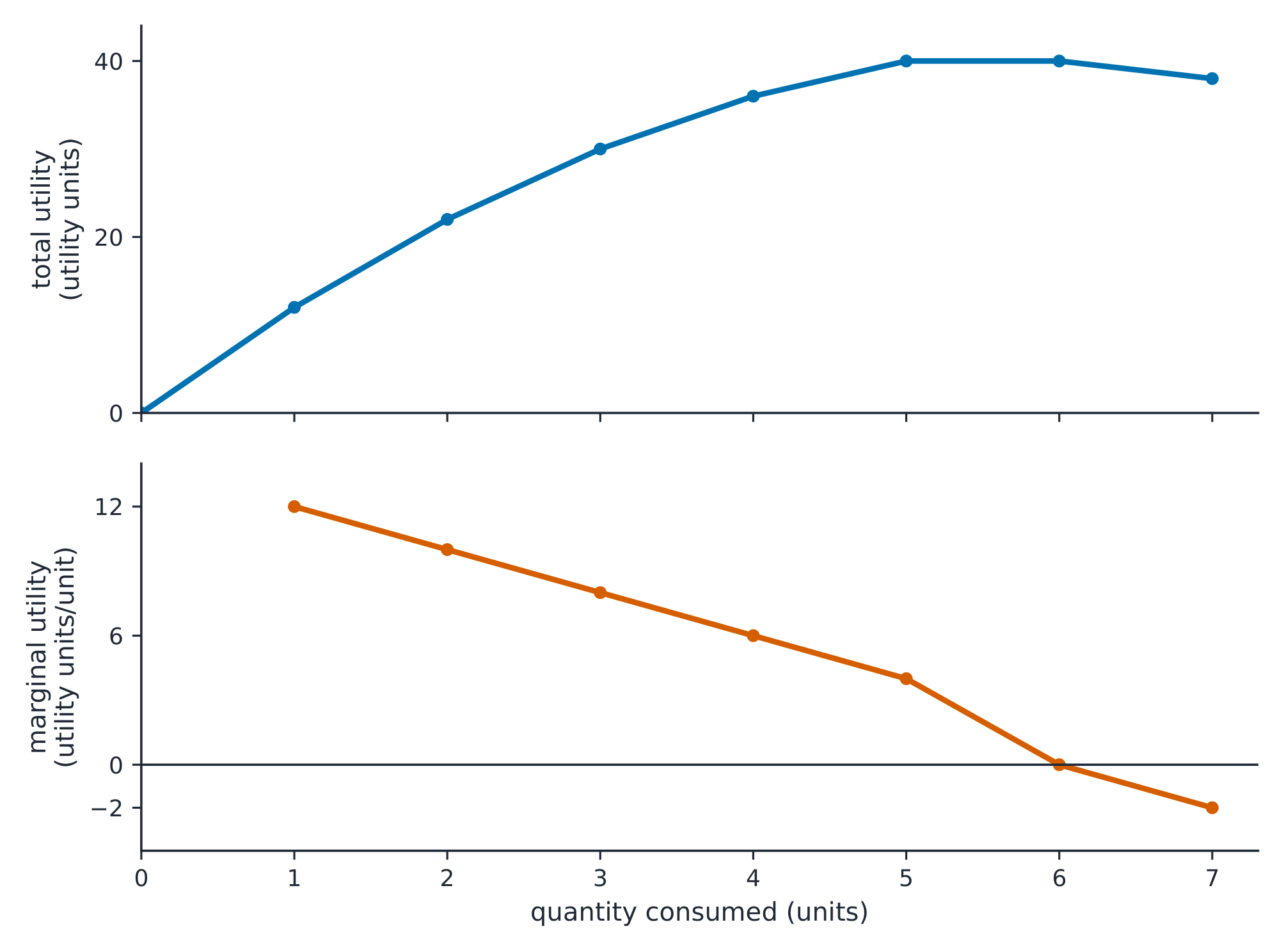
Read the two series together: positive MU adds to TU, zero MU adds nothing, and negative MU reduces TU. Points are joined to show the pattern in these discrete data. Compare all feasible bundles
Income is £8; A costs £2/unit and B £1/unit. Only whole units can be bought, with at most 4A and 8B available. Assume the utilities of A and B add without interaction. A's MU for units 1–4 is 12, 8, 4, 0. B's MU for units 1–8 is 7, 6, 5, 4, 3, 2, 1, 0. Add successive MU values to calculate each good's TU.
For example, 2A gives $12+8=20$ utility and 4B gives $7+6+5+4=22$. The budget and combined-utility relationships are:
$$I=P_AQ_A+P_BQ_B.$$$$I=P_AQ_A+P_BQ_B=\text{\pounds}2/\text{unit}\times2\text{ units}+\text{\pounds}1/\text{unit}\times4\text{ units}=\text{\pounds}8.$$$$TU=TU_A(Q_A)+TU_B(Q_B).$$$$TU(2,4)=TU_A(2)+TU_B(4)=20+22=42.$$Since all additional utility in the available ranges is non-negative, a best bundle can be found among the whole-unit bundles that spend the full budget:
A units B units Spending Combined TU 0 8 £8 28 1 6 £8 39 2 4 £8 42 3 2 £8 37 4 0 £8 24 The best listed bundle is 2A and 4B. A high first-unit MU alone does not identify the best complete budget allocation.
The equi-marginal principle and its conditions
The equi-marginal principle 等边际原则 compares extra utility per pound spent. For a usual interior optimum with divisible goods and a binding budget, the ratios are equal:
$$\frac{MU_A}{P_A}=\frac{MU_B}{P_B}.$$At the chosen 2A/4B bundle, the last A unit gives 8 utility and the last B unit gives 4:
$$\frac{MU_A}{P_A}=\frac{8\text{ utility units/unit}}{\text{\pounds}2/\text{unit}}=4\text{ utility units/\pounds}.$$$$\frac{MU_B}{P_B}=\frac{4\text{ utility units/unit}}{\text{\pounds}1/\text{unit}}=4\text{ utility units/\pounds}.$$Compare MU per pound, not MU alone. If a small transfer of spending can buy more extra utility from A than it gives up from B, reallocating can improve satisfaction. At a corner or with indivisible goods, exact equality may not be possible. Check feasible bundles and the budget instead of forcing the equation to hold.
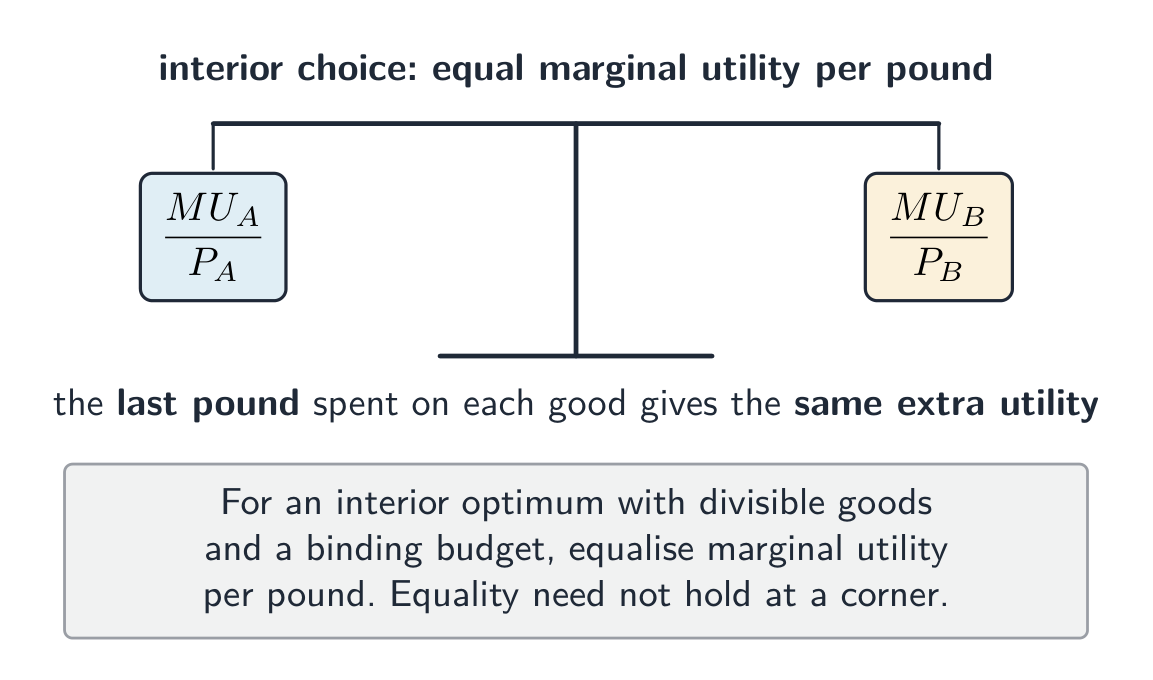
Equal ratios are a conditional interior rule. Feasibility and the budget must also be checked. A change in tastes: recheck the optimum
Keep prices and income unchanged but double every MU value for B, leaving A unchanged. Combined utility at each full-budget bundle becomes:
A units B units New TU 0 8 56 1 6 66 2 4 64 3 2 50 4 0 24 The best listed bundle becomes 1A/6B: more B and less A, with the same £8 budget. Quantity can change because preferences change. A price fall is not the only reason someone might buy more.
Derive a demand response with other influences fixed
Return to the original preferences, keep income £8 and B's price £1, then cut A's price from £2 to £1. Within the same available quantities, the new full-budget comparisons are:
A units B units TU with original tastes 0 8 28 1 7 40 2 6 47 3 5 49 4 4 46 A's chosen quantity rises from 2 to 3 as its own price falls from £2 to £1: two points on this person's demand curve 需求曲线. The optimum is found by comparison even though exact MU/P equality is unavailable for this whole-unit choice. Holding preferences, income and the other price fixed is essential when deriving an own-price response.
Limitations of marginal-utility reasoning
The result is conditional on the person's preferences, budget and available goods. The tables also assume utility from A and B can be added without interaction. Utility numbers are illustrative rather than objective readings of satisfaction. Real choices may involve habits, incomplete information and changing preferences, and people need not explicitly calculate a table. The model gives a conditional prediction, not a universal instruction to buy 2A and 4B.
ExploreDiminishing marginal utility lab
total utility rises more slowly as quantity increases
Add units consumed and see why extra satisfaction usually falls.
Vocabulary TrainEnglish utility/juːˈtɪlɪti/ total utility/ˈtəʊtl juːˈtɪlɪti/ marginal utility/ˈmɑːdʒɪnl juːˈtɪlɪti/ diminishing marginal utility/dɪˈmɪnɪʃɪŋ ˈmɑːdʒɪnl juːˈtɪlɪti/ equi-marginal principle/ˈekwi ˈmɑːdʒɪnl ˈprɪnsɪpl/ demand curve/dɪˈmænd kɜːv/ 7.2
Indifference curves and budget lines
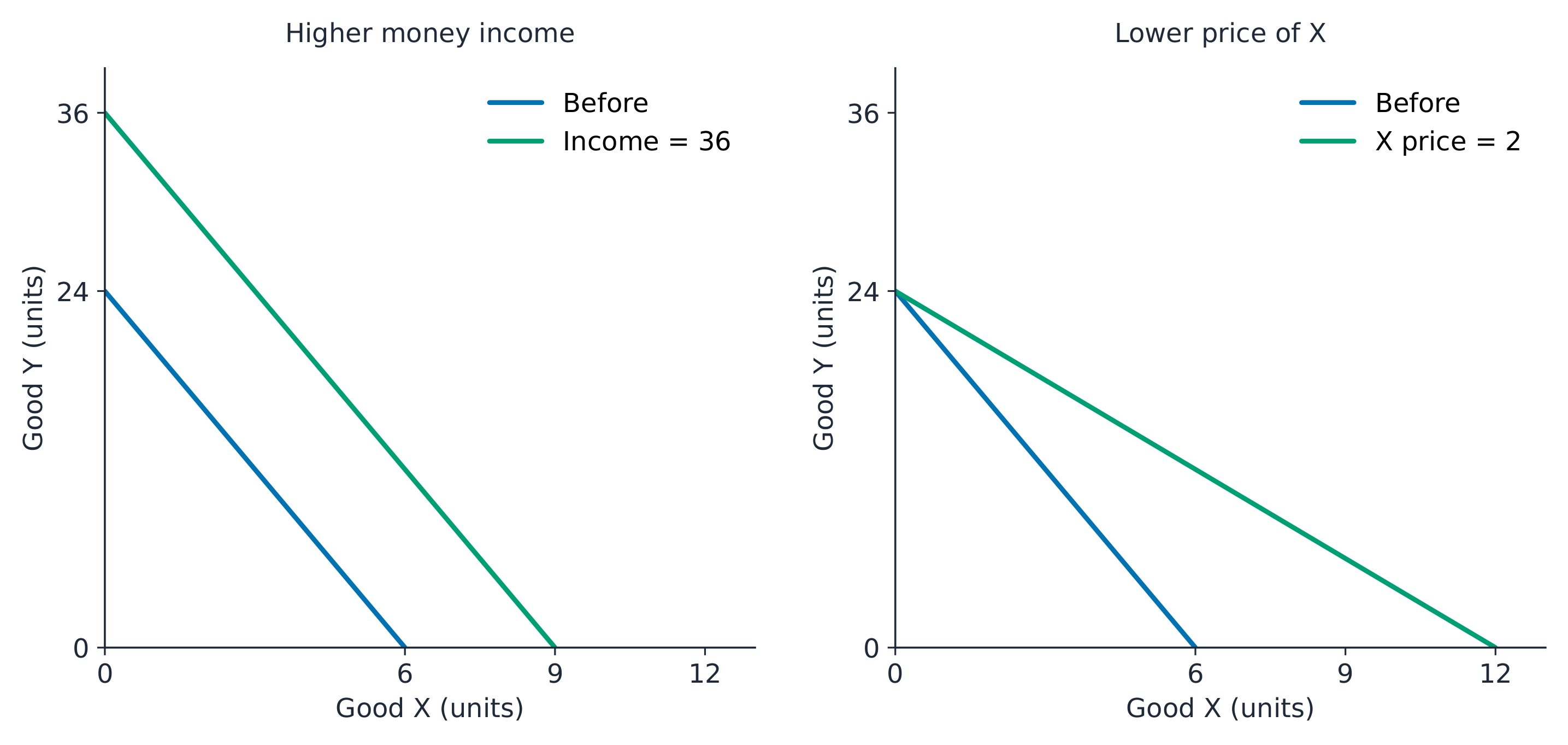
Syllabus
- explain indifference curves and budget lines and consumer equilibrium
- explain income and substitution effects for normal, inferior and Giffen goods
Source: Cambridge International syllabus
Calculate the affordable set
A budget line 预算线 shows bundles that use all income at the stated prices. Points below it are affordable; points above it are not. For divisible goods X and Y, spending cannot exceed income:
$$P_XQ_X+P_YQ_Y\le I.$$On the line, equality holds. With X horizontal, rearrange to express Y:
$$Q_Y=\frac{I}{P_Y}-\frac{P_X}{P_Y}Q_X.$$The vertical intercept is $I/P_Y$, the horizontal intercept is $I/P_X$, and the slope is $-P_X/P_Y$.
Worked example. Income is £24; X costs £4/unit and Y costs £1/unit. Find the intercepts and check the bundle (3X,12Y).
$$Q_X^{\max}=\frac{I}{P_X}=\frac{\text{\pounds}24}{\text{\pounds}4/\text{unit}}=6\text{ units}.$$$$Q_Y^{\max}=\frac{I}{P_Y}=\frac{\text{\pounds}24}{\text{\pounds}1/\text{unit}}=24\text{ units}.$$$$E=P_XQ_X+P_YQ_Y=\text{\pounds}4/\text{unit}\times3\text{ units}+\text{\pounds}1/\text{unit}\times12\text{ units}=\text{\pounds}24.$$The bundle uses the full budget. This establishes feasibility, not maximum satisfaction.
Income shifts and price pivots
Start from the same income and prices. Each change below occurs on its own; quantities are in units.
Change X intercept Y intercept Income rises to £36 9 36 X price falls to £2/unit 12 24 Y price rises to £2/unit 6 12 Higher money income moves both intercepts out in the same proportion, leaving the slope unchanged. Lower income shifts the line inward. A change in only X's price pivots the line about the unchanged Y intercept; a lower X price makes it flatter. A change in only Y's price keeps the X intercept fixed.
Left: income rises £24→£36 at unchanged prices. Right: X's price falls £4→£2/unit at unchanged income and Y price. Affordability changes do not by themselves identify the chosen bundle. A parallel outward shift need not prove that money income rose. At unchanged £24 income, reducing both prices to two-thirds of their old levels also moves the intercepts from (6X,24Y) to (9X,36Y). The price ratio is unchanged. A taste change affects the preference map, not the budget line if income and prices stay fixed.
Rank satisfaction, then find the best affordable bundle
An indifference curve 无差异曲线 joins bundles giving the same satisfaction. An indifference map contains several such curves. In the usual model both goods are desirable: more of either, with the other unchanged, is preferred. Curves therefore slope downward; giving up one good requires more of the other to keep satisfaction unchanged. The usual bowed-in shape represents a declining willingness to give up Y for another X as X becomes more plentiful. Curves do not cross when preferences are consistent; a crossing would give contradictory rankings. These are model assumptions, not shapes required for every possible preference pattern.
Unlike the illustrative utility tables, this model needs only rankings of satisfaction, not an objective numerical measurement of it.
Worked example. In the illustrated map, (2X,18Y), (3X,12Y) and (6X,6Y) lie on the same curve. With prices £4/unit and £1/unit:
$$E=P_XQ_X+P_YQ_Y=\text{\pounds}4/\text{unit}\times2\text{ units}+\text{\pounds}1/\text{unit}\times18\text{ units}=\text{\pounds}26.$$$$E=P_XQ_X+P_YQ_Y=\text{\pounds}4/\text{unit}\times3\text{ units}+\text{\pounds}1/\text{unit}\times12\text{ units}=\text{\pounds}24.$$$$E=P_XQ_X+P_YQ_Y=\text{\pounds}4/\text{unit}\times6\text{ units}+\text{\pounds}1/\text{unit}\times6\text{ units}=\text{\pounds}30.$$Equal satisfaction does not imply equal spending. Only (3,12) is affordable among these three bundles with £24 income.
Consumer equilibrium 消费者均衡 is the most preferred affordable bundle. In this smooth example, the budget line is tangent to the highest reachable curve at A (3,12). A lower curve gives less satisfaction; a higher one has no affordable point.
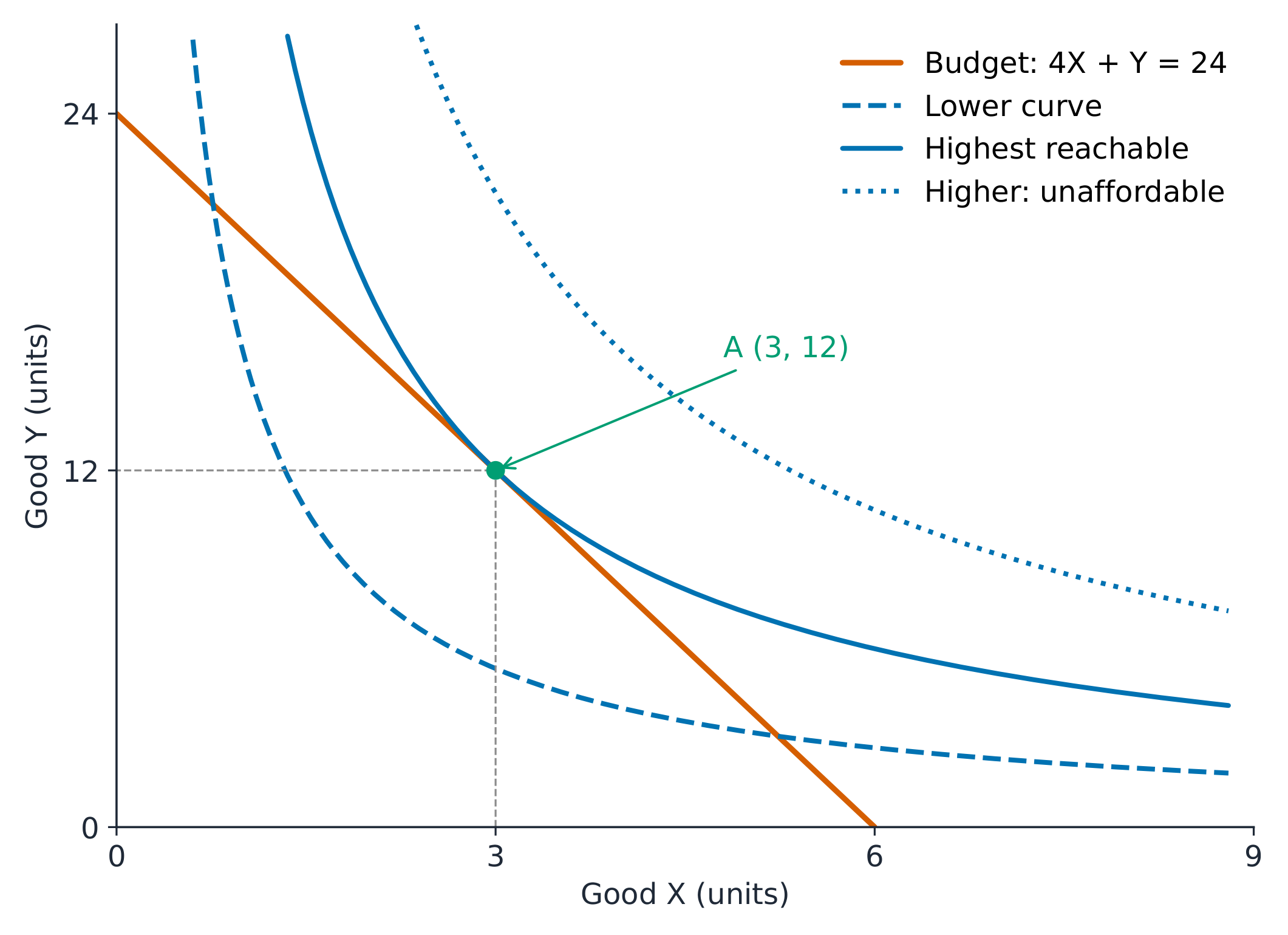
This particular interior optimum is a tangency. The general rule is the highest reachable satisfaction; not every optimum must be tangent. Corner counterexample. Suppose preferences are represented by $U=3Q_X+Q_Y$, with £24 income and the same prices. The extra satisfaction per pound is:
$$\frac{MU_X}{P_X}=\frac{3\text{ utility units/unit}}{\text{\pounds}4/\text{unit}}=0.75\text{ utility units}/\text{\pounds}.$$$$\frac{MU_Y}{P_Y}=\frac{1\text{ utility unit/unit}}{\text{\pounds}1/\text{unit}}=1\text{ utility unit}/\text{\pounds}.$$Y gives more satisfaction per pound at every bundle. The best choice is 0X and 24Y, a corner. Its straight indifference curve is not tangent to the budget line. Divisible goods, smooth convex curves and an interior choice are extra conditions behind the familiar tangent diagram.
Separate income and substitution effects
A price fall changes relative prices and purchasing power. The substitution effect 替代效应 isolates the response to the changed price ratio while keeping satisfaction unchanged. The income effect 收入效应 then isolates the response to the gain in real purchasing power at the new price ratio. The total price effect is their sum. Money income need not change for real purchasing power to change.
In the following smooth illustrative map, income stays £24 and Y costs £1/unit. X's price falls from £4 to £1/unit. The old optimum is A (3X,12Y); the new optimum is B (12X,12Y).
Draw a comparison line parallel to the new budget line, touching the original indifference curve at C (6X,6Y). This compensated line has the new price ratio but reduces income enough to keep satisfaction unchanged. C is a comparison point, not the final choice with actual income.
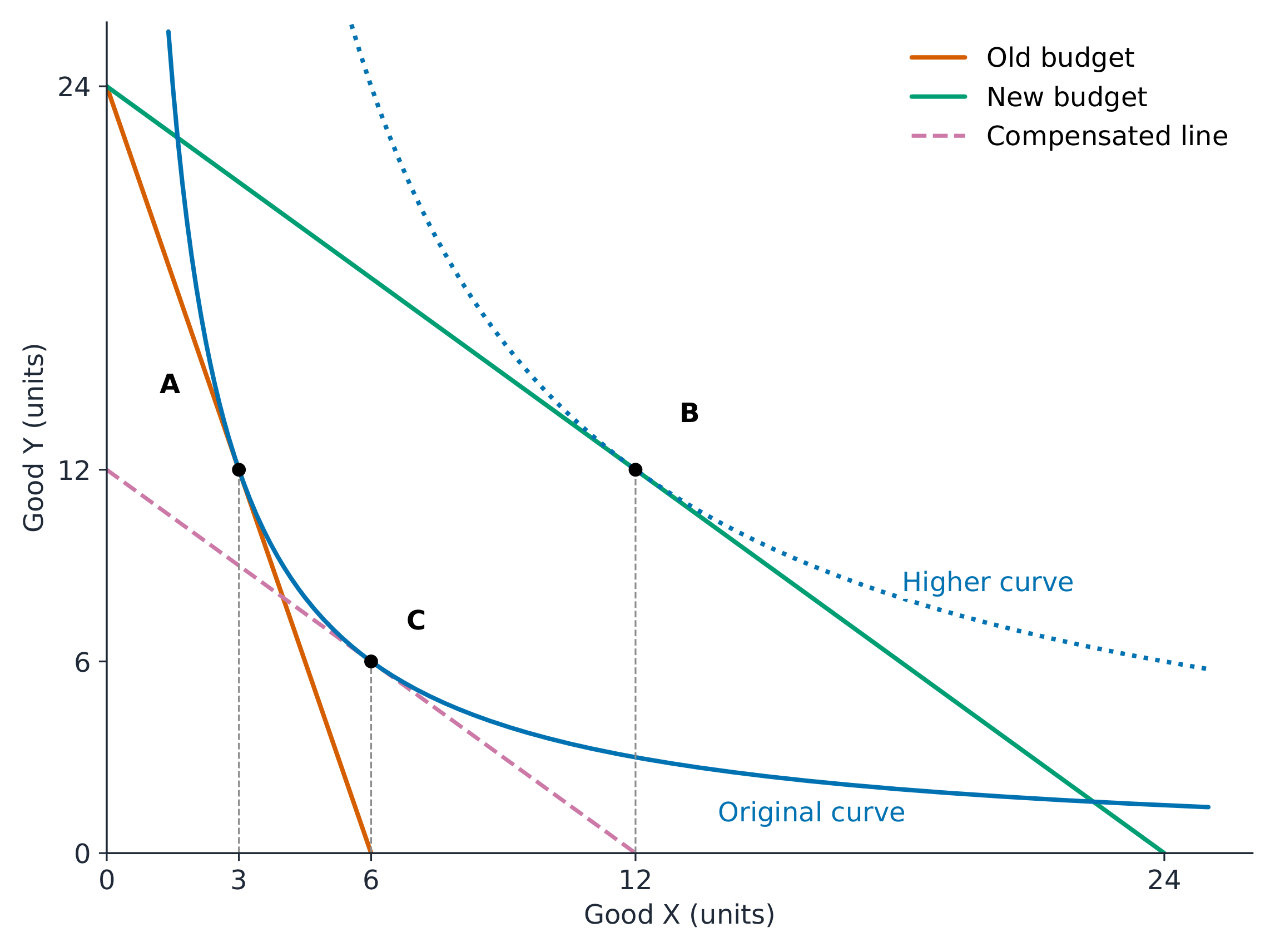
A→C is substitution along the original curve; C→B is the income effect at the new price ratio. Read the changes in horizontal X quantity, not the distance travelled along a curve. Worked example. Use the X coordinates to calculate each effect:
$$\Delta Q_X^{\rm sub}=Q_X^C-Q_X^A=6-3=+3\text{ units}.$$$$\Delta Q_X^{\rm inc}=Q_X^B-Q_X^C=12-6=+6\text{ units}.$$$$\Delta Q_X=\Delta Q_X^{\rm sub}+\Delta Q_X^{\rm inc}=3+6=+9\text{ units}.$$This is a normal good 正常品 example: substitution and income effects both raise X. On the new-price comparison line C costs £12; restoring actual £24 income leads to B on a higher curve. The diagram is consistent with the stated coordinates and budgets; it is an illustration, not observed consumer data.
Inferior goods and the Giffen exception
For an inferior good 低档品, higher real income reduces the quantity chosen. The income effect opposes substitution towards the now cheaper good. If substitution is stronger, quantity still rises when price falls. A Giffen good 吉芬品 is the special inferior case where the opposing income effect is stronger, so quantity falls when its price falls, with other influences fixed. Inferiority alone does not establish Giffen behaviour.
These separate hypothetical price-fall cases are not extra points on the preceding map. All entries are changes in X quantity, in units.
Case Substitution Income Total Normal +3 +6 +9 Inferior, not Giffen +3 −1 +2 Giffen +3 −5 −2 The total follows from adding the two effects. Classify the inferior cases by the negative income effect; distinguish Giffen by its size relative to substitution. An upward-sloping own-price demand response requires the Giffen condition, not simply a cheap product or a low-income buyer.
Evaluate the model with the diagram
For an exam response about a price change, label both goods, show the budget pivot and the old/new highest reachable curves, then add the compensated line to distinguish the two effects. Compare normal, inferior and Giffen responses before judging the claim that a lower price always raises quantity. A pivot alone cannot prove that claim.
The model assumes consistent preferences, the ability to rank bundles and a choice of the most preferred affordable bundle. Two goods simplify the many alternatives available in real markets. Habits and incomplete information can affect choice; advertising or changing tastes can change the map itself. Indivisible goods or corner choices can prevent a smooth interior tangency. These limitations explain when a prediction may fail; simply listing them does not evaluate a particular price response.
Check yourself. Intercepts rise from (6X,24Y) to (9X,36Y). Give an income explanation and a price explanation. Then explain why a +3-unit substitution effect and a −5-unit income effect make a price fall reduce total quantity by 2 units.
Answer. At unchanged prices, income £24→£36 produces the shift; at unchanged £24 income, both prices falling to two-thirds of their old levels also does so. In the effects case, the good is inferior and the opposing income effect is larger, so it is Giffen over the illustrated change. The total price effect is $+3+(-5)=-2$ units.
ExploreBudget line lab
good B = income / priceB - slope x good A
Move quantity of one good and see the trade-off with the other good.
Vocabulary TrainEnglish indifference curve/ɪnˈdɪfrəns kɜːv/ budget line/ˈbʌdʒɪt laɪn/ consumer equilibrium/kənˈsuːmə ˌiːkwɪˈlɪbrɪəm/ substitution effect/ˌsʌbstɪˈtjuːʃn ɪˈfekt/ income effect/ˈɪŋkʌm ɪˈfekt/ normal good/ˈnɔːml ɡʊd/ inferior good/ɪnˈfɪərɪə ɡʊd/ Giffen good/ˈdʒɪfən ɡʊd/ 7.3
Efficiency and market failure

Syllabus
- explain productive and allocative efficiency, Pareto optimality and dynamic efficiency
- explain market failure, including from monopoly, externalities, public goods, information failure and factor immobility
Source: Cambridge International syllabus
Efficiency has several meanings. A plant can cut its cost per unit without making the right quantity for society, and a useful innovation can still leave someone worse off. State which test is being applied.
Use this distinction as a starting point: the conditions and evidence for the two kinds of efficiency differ. Productive efficiency: test cost per unit
Productive efficiency 生产效率 means producing at the lowest possible average cost 平均成本. Resources are used without avoidable waste. For a firm, compare its output with the minimum of the relevant average-cost curve; a large output alone does not establish efficiency.
Worked example. A plant has these illustrative monthly costs at unchanged input prices and product quality. Calculate average cost, then identify the lowest observed value.
Output (units/month) Total cost (£/month) AC (£/unit) 50 450 9 100 800 8 150 1350 9 $$AC=\frac{TC}{Q}=\frac{\text{\pounds}450/\text{month}}{50\text{ units/month}}=\text{\pounds}9/\text{unit}.$$$$AC=\frac{TC}{Q}=\frac{\text{\pounds}800/\text{month}}{100\text{ units/month}}=\text{\pounds}8/\text{unit}.$$$$AC=\frac{TC}{Q}=\frac{\text{\pounds}1350/\text{month}}{150\text{ units/month}}=\text{\pounds}9/\text{unit}.$$100 units/month has the lowest AC among the observations. The full cost curve is needed to establish the overall minimum. Raising output from 100 to 150 lowers neither total cost nor average cost. A fall in input prices or product quality could also lower measured unit cost, so these must be controlled before inferring an improvement in the use of resources.
Allocative efficiency: compare the benefit and cost of extra output
Allocative efficiency 配置效率 means resources are allocated to the output mix that maximises net social benefit. The condition is marginal social benefit 边际社会收益 equal to marginal social cost 边际社会成本, with no remaining beneficial reallocation. If marginal benefit exceeds marginal cost 边际成本, a small expansion adds net benefit; if marginal cost exceeds marginal benefit, reduce output. The usual crossing with falling benefit and rising cost identifies the best quantity.
The familiar condition $P=MC$ applies when price represents consumers' marginal benefit and private benefits/costs match social ones. A price equal to private marginal cost does not prove allocative efficiency if external costs or benefits are ignored.
Worked example. In this separate continuous-output illustration, there are no external costs or benefits. MB means the benefit to consumers from extra output and MC its resource cost. Values are illustrative, not the cost data in the previous example.
Output (units/month) MB (£/unit) MC (£/unit) Direction 3 9 5 Expand 5 7 7 Best margin 7 5 9 Reduce At output near 3, extra output is worth more than it costs. Near 7, reducing output saves more cost than the benefit lost. At 5, the two margins are equal. This is a test of quantity and benefit, not a test of minimum average cost.

With no externalities, these private and social margins coincide. The curves cross at (5 units/month, £7/unit); below 5 expansion adds net benefit and above 5 it reduces net benefit. Productive and allocative efficiency need not occur at the same output. For example, the output where a demand curve meets marginal cost need not be at the minimum of average cost. Inspect each condition separately rather than treating low price, normal profit or high output as proof of both.
Pareto optimality: can someone gain without anyone losing?
A Pareto improvement makes at least one person better off and nobody worse off. Pareto optimality 帕累托最优 means no feasible Pareto improvement remains. It does not establish fairness or a unique best distribution.
Worked example. The following four outcomes are the complete feasible list in a toy model. A larger score means a better outcome for that person; the scores only rank outcomes and are not added across people.
Outcome Person 1 Person 2 A 10 10 B 12 10 C 13 9 D 11 11 A→B helps Person 1 without harming Person 2; A→D helps both. A is therefore not Pareto optimal. B, C and D are each Pareto optimal within this complete feasible list: moving between them helps one person at the expense of the other. Their different distributions show why Pareto optimality alone does not select a fair outcome. If another feasible outcome were added, the judgement would need to be checked again.
Training or removing waste may create the resources for a Pareto improvement, but consider the training cost and who gains or loses. A rise in aggregate benefit is not by itself proof that nobody is worse off.
Dynamic efficiency: improvements over time
Dynamic efficiency 动态效率 concerns improvements through innovation, better methods and better products over time. It changes future production or consumption possibilities. Productive and allocative efficiency test the use and allocation of resources at a particular time.
Worked example. Successful research creates a process that makes the same 100 units/month, at unchanged product quality and input prices, for £600/month rather than £800/month:
$$AC_{\rm old}=\frac{TC_{\rm old}}{Q}=\frac{\text{\pounds}800/\text{month}}{100\text{ units/month}}=\text{\pounds}8/\text{unit}.$$$$AC_{\rm new}=\frac{TC_{\rm new}}{Q}=\frac{\text{\pounds}600/\text{month}}{100\text{ units/month}}=\text{\pounds}6/\text{unit}.$$This is evidence of an improvement in production possibilities. It does not prove the firm is at its new minimum AC, chooses the allocatively efficient output, passes the saving to consumers, or recovers the research cost. Those require further information. A new product or better quality can also be a dynamic improvement even when its unit cost does not fall.
Competition can encourage innovation by rewarding better quality or lower costs. Market power and profits may provide finance for a costly project, but they do not guarantee that it will be undertaken. Conversely, competition does not automatically prevent research or access to finance. Judge the incentive, available resources, ability to keep the gains from invention and actual results. Do not claim that a competitive firm cannot innovate simply because it earns normal profit in a long-run model.
Market failure: identify the mechanism and the allocation problem
Market failure 市场失灵 occurs when the market fails to allocate resources efficiently. A high price, unequal income or low profit is not sufficient evidence by itself. Identify the missing cost or benefit, the incentive problem or the constraint, and explain its effect on the quantity or use of resources.
Market power. A sole seller may restrict output even though buyers value extra output more than its full resource cost. Such mutually beneficial output is left unproduced. Compare benefit and cost at the margin; a high price alone does not prove this gap.
Externalities 外部性. A factory may ignore damage its smoke causes to nearby households. Its private calculation then understates the cost to society, potentially causing excess output. The next section distinguishes the production and consumption cases, including external benefits.
Public goods 公共物品 are non-rival and non-excludable. In a flood-warning broadcast, another listener does not reduce anyone else's reception and non-payers cannot be excluded from the signal. Residents can benefit while leaving others to pay, weakening voluntary private funding. The sum of benefits may justify provision even when a private seller cannot collect enough payment to cover cost. The allocation problem is possible underprovision, not an absence of value. Public ownership is not the definition; test rivalry and exclusion.
Information failure 信息失灵. If a buyer cannot assess a machine's safety, they may buy a model with hidden defects that they would reject with better information. Expected and informed benefits differ, potentially causing a poor allocation. The cost of acquiring information also matters.
Factor immobility 要素不流动性. Workers or capital may not move quickly to more useful activities despite higher returns. Retraining, relocation and other barriers delay adjustment. However, moving and training use real resources: unemployment or a price difference alone does not prove inefficiency. Explain why the barrier prevents a beneficial reallocation after allowing for those costs.
Check yourself. A process lowers unit resource cost from £8 to £6 at fixed quality and input prices. At the chosen output, marginal social benefit is £5/unit and marginal social cost £7/unit. A resident loses from the associated noise. Which efficiency claims follow?
Answer. The innovation is evidence of a dynamic improvement and lower cost at that output, but does not prove minimum AC. Because marginal social cost exceeds marginal social benefit at the chosen margin, reducing output would raise net social benefit: allocative efficiency has not been achieved. The resident's loss means the change is not a Pareto improvement as described, even if other people gain more in total.
ExploreAllocative efficiency
The market is allocatively efficient where supply meets demand — price equals marginal cost. Market failure pushes it away from that point.
Vocabulary TrainEnglish productive efficiency/prəˈdʌktɪv ɪˈfɪʃənsi/ allocative efficiency/ˈæləkətɪv ɪˈfɪʃənsi/ Pareto optimality/pæˈriːtəʊ ˌɒptɪˈmælɪti/ dynamic efficiency/daɪˈnæmɪk ɪˈfɪʃənsi/ market failure/ˈmɑːkɪt ˈfeɪlɪə/ public good/ˈpʌblɪk ɡʊd/ information failure/ˌɪnfəˈmeɪʃn ˈfeɪlɪə/ factor immobility/ˈfæktə ɪˌməʊˈbɪlɪti/ marginal social cost/ˈmɑːdʒɪnl ˈsəʊʃl kɒst/ marginal social benefit/ˈmɑːdʒɪnl ˈsəʊʃl ˈbenɪfɪt/ average cost/ˈævrɪdʒ kɒst/ marginal cost/ˈmɑːdʒɪnl kɒst/ 7.4
Externalities and social costs and benefits

Syllabus
- distinguish private, external and social costs and benefits
- analyse positive and negative externalities of production and consumption using marginal analysis and explain deadweight welfare loss
Source: Cambridge International syllabus
A factory's smoke may harm neighbours who did not choose its output. A vaccination may protect people other than the person receiving it. The private decision and its full effect on society can therefore differ. An externality is a cost or benefit affecting a third party outside the transaction, not simply any price paid by the buyer.
Calculate total private, external and social values
A private cost 私人成本 falls on the decision-maker; an external cost 外部成本 falls on third parties. The social cost 社会成本 includes both. A private benefit 私人收益 accrues to participants; an external benefit 外部收益 accrues to other people. The social benefit 社会收益 includes both.
Worked example: cost. A factory uses resources costing £800/month and causes pollution damage of £200/month. Assume these are all relevant costs for that output:
$$SC=PC+EC=\text{\pounds}800/\text{month}+\text{\pounds}200/\text{month}=\text{\pounds}1000/\text{month}.$$The factory's private calculation omits the neighbours' damage. A compensation payment is a transfer between parties, not another resource cost to add on top of the same damage. Count each effect once; any separate administrative or prevention cost would need its own treatment.
Identify who bears the damage and why the firm's private calculation may omit it. The photograph alone does not establish the size of the cost or the efficient output. Worked example: benefit. In a separate training programme, participants gain benefits valued at £1200/year and others gain £400/year as skills spread:
$$SB=PB+EB=\text{\pounds}1200/\text{year}+\text{\pounds}400/\text{year}=\text{\pounds}1600/\text{year}.$$These are valuations of benefits, not just sales receipts. A price paid or received is not automatically the full benefit or resource cost to society. Use the same activity, quantity and time period when adding components.
Marginal values concern an extra unit
Marginal analysis 边际分析 compares changes. Marginal private cost 边际私人成本 (MPC) and marginal private benefit 边际私人收益 (MPB) concern the private cost and benefit of extra output or consumption. Marginal external cost 边际外部成本 (MEC) and marginal external benefit 边际外部收益 (MEB) concern its effects on third parties. MSC and MSB are the marginal social cost and benefit, defined in the efficiency section.
Worked example. An extra unit of production uses £7 of the firm's resources and imposes £2 of external damage:
$$MSC=MPC+MEC=\text{\pounds}7/\text{unit}+\text{\pounds}2/\text{unit}=\text{\pounds}9/\text{unit}.$$In a separate service, an extra unit gives its user £5 of benefit and others £2:
$$MSB=MPB+MEB=\text{\pounds}5/\text{unit}+\text{\pounds}2/\text{unit}=\text{\pounds}7/\text{unit}.$$These extra-unit values are not totals or averages. Dividing total social cost by quantity gives an average, not necessarily the marginal cost.
Use private and social equilibrium conditions separately
In the simple competitive-market model without corrective intervention, output is where $MPB=MPC$. The social test is $MSB=MSC$. With falling marginal benefit and rising marginal cost, the social intersection maximises net benefit. Monopoly, taxes or other distortions require separate treatment; the private intersection is not a universal rule for every market structure.
The following four diagrams are separate illustrations. Each isolates one spillover and assumes other distortions absent. A negative externality 负外部性 harms third parties; a positive externality 正外部性 benefits them. The diagram's cost/benefit convention must be stated so a spillover is counted once.
Negative production externality
Factory pollution adds damage to production's private cost, so MSC exceeds MPC. With no consumption spillover, MPB=MSB. The competitive market produces too much.
Worked example. Let $MPB=MSB=12-Q$, $MPC=2+Q$ and $MSC=4+Q$. Here $Q$ is the numerical value of output in units/month, and each marginal function gives £/unit. These are illustrative linear relationships, not observed data.
$$MPB=MPC\ \Rightarrow\ 12-Q=2+Q\ \Rightarrow\ Q_m=5\text{ units/month}.$$$$MSB=MSC\ \Rightarrow\ 12-Q=4+Q\ \Rightarrow\ Q^*=4\text{ units/month}.$$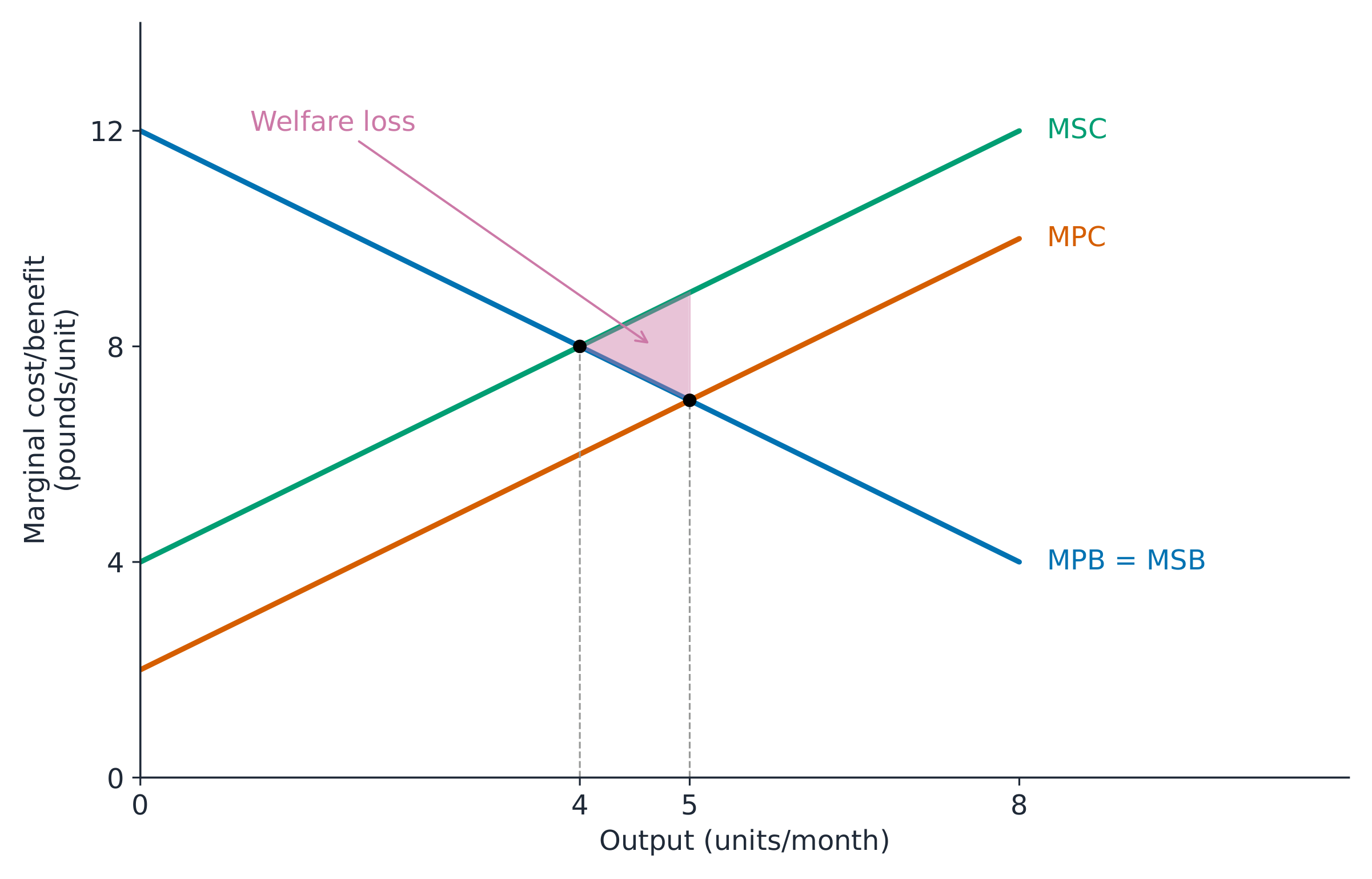
The shaded loss lies between outputs 4 and 5, where the social cost of excess units exceeds their social benefit. Private benefit equals social benefit in this single-spillover example. Positive consumption externality
Vaccination can reduce infection risks for other people, so MSB exceeds MPB. With no production spillover, MPC=MSC. The market consumes too little because the private decision omits benefits to others.
Worked example. Let $MPB=10-Q$, $MSB=12-Q$ and $MPC=MSC=2+Q$, in the same output and marginal-value units:
$$MPB=MPC\ \Rightarrow\ 10-Q=2+Q\ \Rightarrow\ Q_m=4\text{ units/month}.$$$$MSB=MSC\ \Rightarrow\ 12-Q=2+Q\ \Rightarrow\ Q^*=5\text{ units/month}.$$
The shaded loss is the net benefit of missing units between 4 and 5. It lies below the optimum, not on units traded beyond it. Positive production externality
Research by one firm can help other producers. In the usual production diagram, this spillover benefit is deducted from net marginal social cost, putting net MSC below MPC. Do not also add the same benefit to MSB; that would count it twice. This representation concerns a net cost after the external benefit, not a claim that society physically uses fewer inputs than the firm.
In this separate example, $MPB=MSB=12-Q$, $MPC=4+Q$ and net $MSC=2+Q$. Applying the private and social conditions gives $Q_m=4$ and $Q^*=5$ units/month.
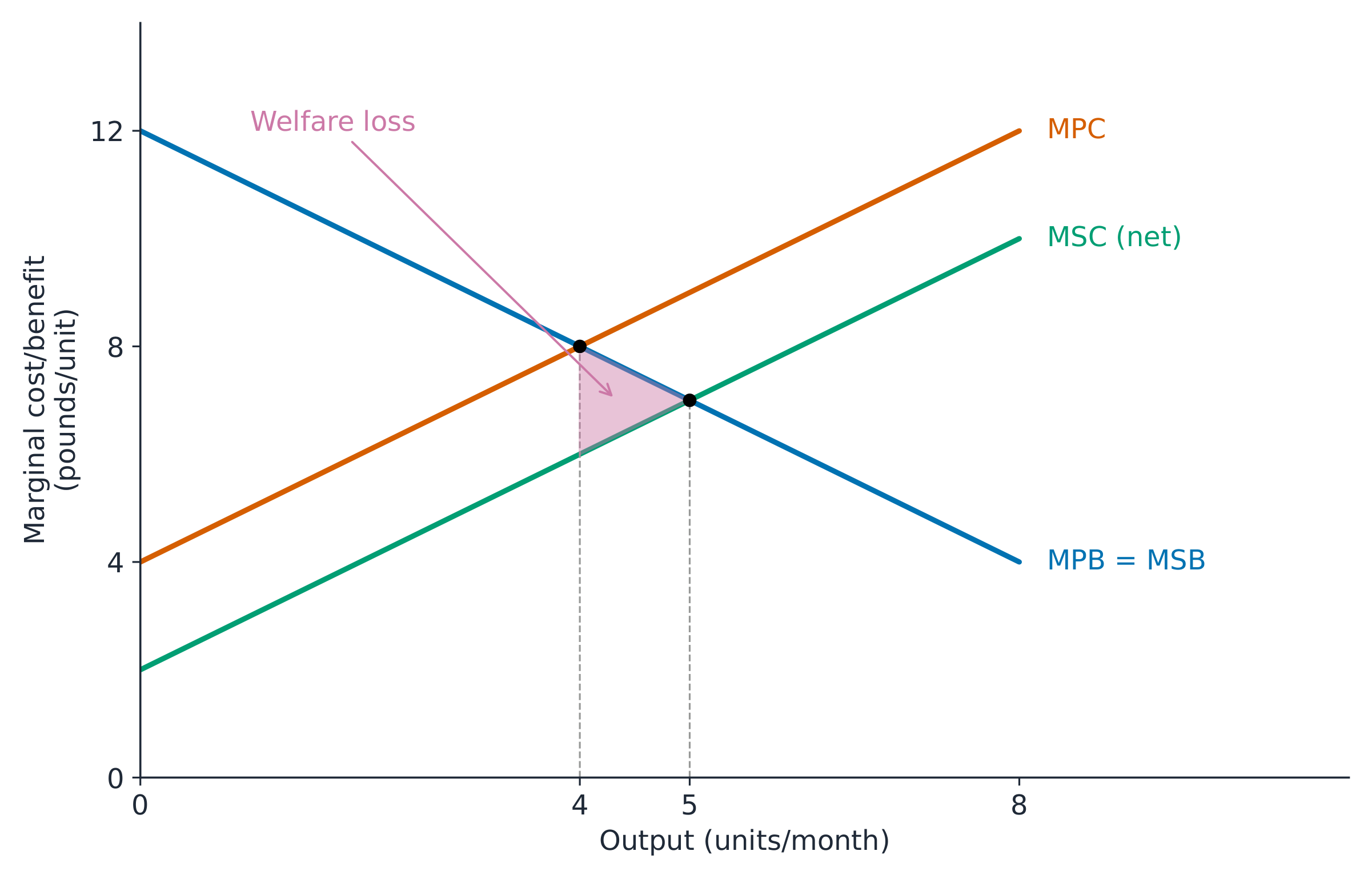
The market underproduces when it ignores the production spillover benefit. The shaded triangle is the net benefit of the missing output. Negative consumption externality
Loud leisure activity can disturb neighbours. The usual consumption diagram deducts that harm from net marginal social benefit, putting net MSB below MPB. With no production spillover, MPC=MSC. Do not also add the same harm to MSC.
In this separate example, $MPB=12-Q$, net $MSB=10-Q$ and $MPC=MSC=2+Q$. The private and social conditions give $Q_m=5$ and $Q^*=4$ units/month.
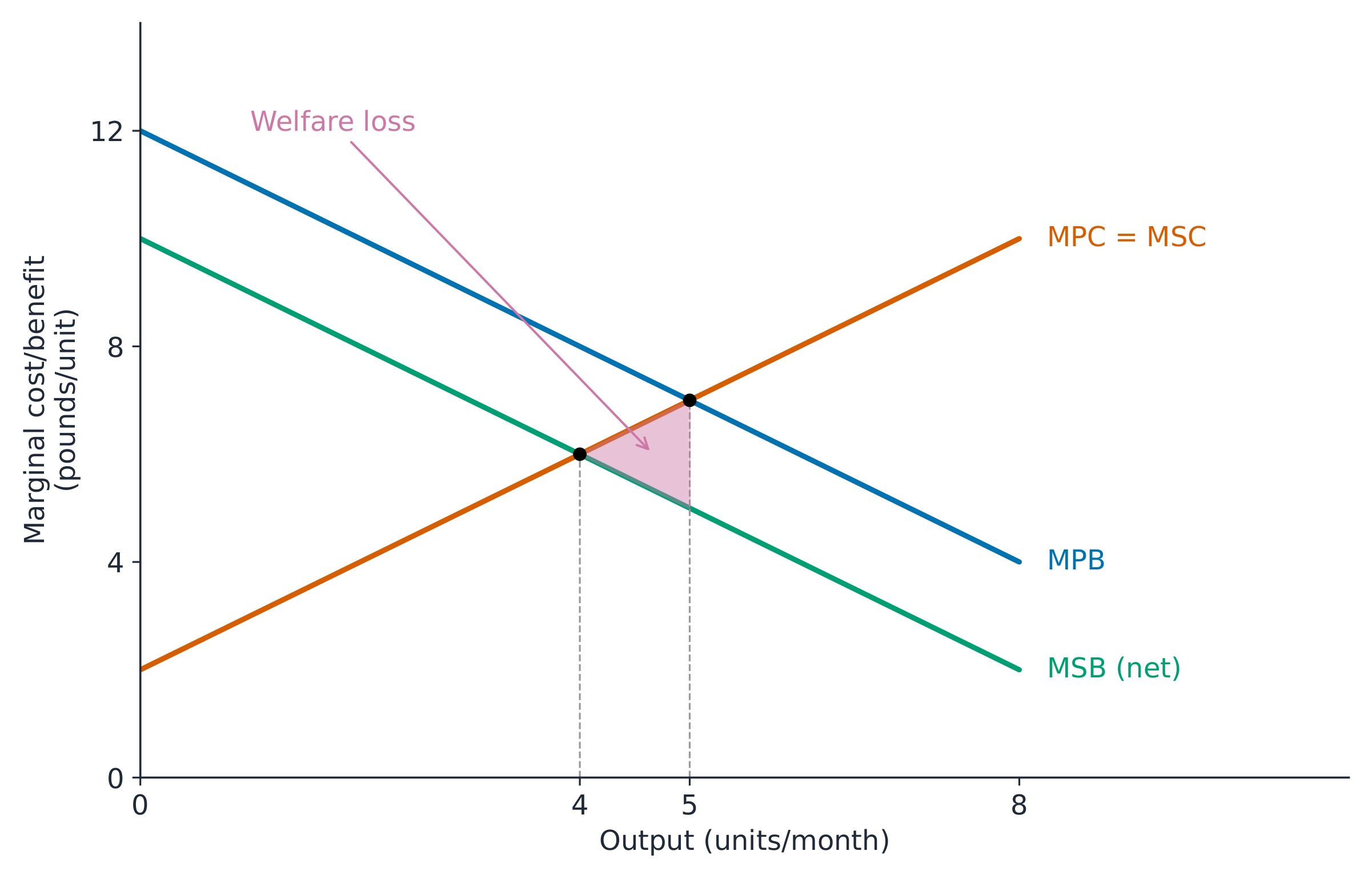
Excess consumption creates a loss where MSC exceeds net MSB. A consumption harm need not appear as MSC above MPC in the chosen diagram convention. Calculate the loss on excess or missing units
Deadweight welfare loss 无谓损失 is net social benefit lost because the quantity differs from the optimum. With excess output, social cost exceeds social benefit on the excess units. With underprovision, social benefit exceeds social cost on missing units. It is not necessarily the entire external cost or benefit.
Worked example. In each of the four linear diagrams, market output differs from the optimum by 1 unit/month. At market output, the social marginal gap is £2/unit and closes linearly to zero at the optimum. The shaded area is therefore a triangle:
$$DWL=\frac12\times|Q_m-Q^*|\times\text{social marginal gap}.$$$$DWL=\frac12\times1\text{ unit/month}\times\text{\pounds}2/\text{unit}=\text{\pounds}1/\text{month}.$$A vertical gap has units £/unit; multiplying by the horizontal quantity range gives £/month. The one-half factor applies to a triangular straight-line gap, not every possible curve shape. Label the social curves and the quantity interval before shading; a rectangle for all external damage is not the welfare-loss triangle.
Compare decisions by net social benefit
For a discrete project, compare total social benefit with total social cost. This differs from choosing a continuous output by equality of marginal values. Net present value is outside the required scope here.
Worked example. Projects A and B are mutually exclusive. All values cover the same year and include all relevant private and external effects.
Project SB (£/year) SC (£/year) A 1600 1000 B 1900 1500 $$NSB_A=SB_A-SC_A=\text{\pounds}1600/\text{year}-\text{\pounds}1000/\text{year}=\text{\pounds}600/\text{year}.$$$$NSB_B=SB_B-SC_B=\text{\pounds}1900/\text{year}-\text{\pounds}1500/\text{year}=\text{\pounds}400/\text{year}.$$A has the larger net social gain despite B's higher gross benefit. If A's social cost estimate rises to £1300/year:
$$NSB_A=SB_A-SC_A=\text{\pounds}1600/\text{year}-\text{\pounds}1300/\text{year}=\text{\pounds}300/\text{year}.$$B is then preferred on these estimates. Check common time periods, opportunity costs, omitted effects and double counting. Consider who gains or loses and how reliable the valuations are. A positive total net gain does not establish a Pareto improvement.
Asymmetric information and moral hazard
Asymmetric information 信息不对称 means one party has relevant information the other lacks. For example, a seller knows a car has a hidden defect that the buyer cannot assess. This can distort the buyer's valuation and choice. It is a particular information imbalance, not every case in which both parties lack knowledge.
Moral hazard 道德风险 occurs when bearing less of an action's risk weakens the incentive to take care and can encourage risk-taking. An insured operator may become less careful because the insurer bears most accident costs. Identify the changed incentive, not just the existence of insurance.
The mechanisms can coexist, but a hidden defect alone does not establish increased risk-taking. Harm to a third party alone establishes neither unequal information nor a changed risk incentive. Explain the mechanism before selecting the label.
Transfer to a case with both cost and benefit spillovers
Check yourself. Let $MPB=10-Q$, $MPC=2+Q$, $MSB=14-Q$ and $MSC=4+Q$, using numerical output in units/month and marginal values in £/unit. A student predicts excess output simply because MSC exceeds MPC. Test the prediction.
Worked answer. Under the competitive private-market conditions:
$$MPB=MPC\ \Rightarrow\ 10-Q=2+Q\ \Rightarrow\ Q_m=4\text{ units/month}.$$For the social optimum:
$$MSB=MSC\ \Rightarrow\ 14-Q=4+Q\ \Rightarrow\ Q^*=5\text{ units/month}.$$The market underprovides: the external-benefit wedge exceeds the external-cost wedge. Use both social curves. A single-wedge rule cannot decide a mixed case; depending on the relative effects, the market could produce too much, too little or the same quantity as the social optimum.
ExploreExternalities shift the social curve
A negative externality means the social cost is above the private supply curve; the free-market quantity is then too high.
Vocabulary TrainEnglish externality/ekˈstɜːnælɪti/ private cost/ˈpraɪvət kɒst/ private benefit/ˈpraɪvət ˈbenɪfɪt/ external cost/ekˈstɜːnl kɒst/ external benefit/ekˈstɜːnl ˈbenɪfɪt/ social cost/ˈsəʊʃl kɒst/ social benefit/ˈsəʊʃl ˈbenɪfɪt/ marginal analysis/ˈmɑːdʒɪnl əˈnæləsɪs/ marginal private cost/ˈmɑːdʒɪnl ˈpraɪvət kɒst/ marginal private benefit/ˈmɑːdʒɪnl ˈpraɪvət ˈbenɪfɪt/ negative externality/ˈneɡətɪv ekˈstɜːnælɪti/ positive externality/ˈpɒzɪtɪv ekˈstɜːnælɪti/ deadweight welfare loss/ˈdedweɪt ˈwelfeə lɒs/ marginal external cost/ˈmɑːdʒɪnl ekˈstɜːnl kɒst/ marginal external benefit/ˈmɑːdʒɪnl ekˈstɜːnl ˈbenɪfɪt/ asymmetric information/ˌeɪsɪˈmetrɪk ˌɪnfəˈmeɪʃn/ moral hazard/ˈmɒrəl ˈhæzəd/ 7.5
Costs, revenue and profit
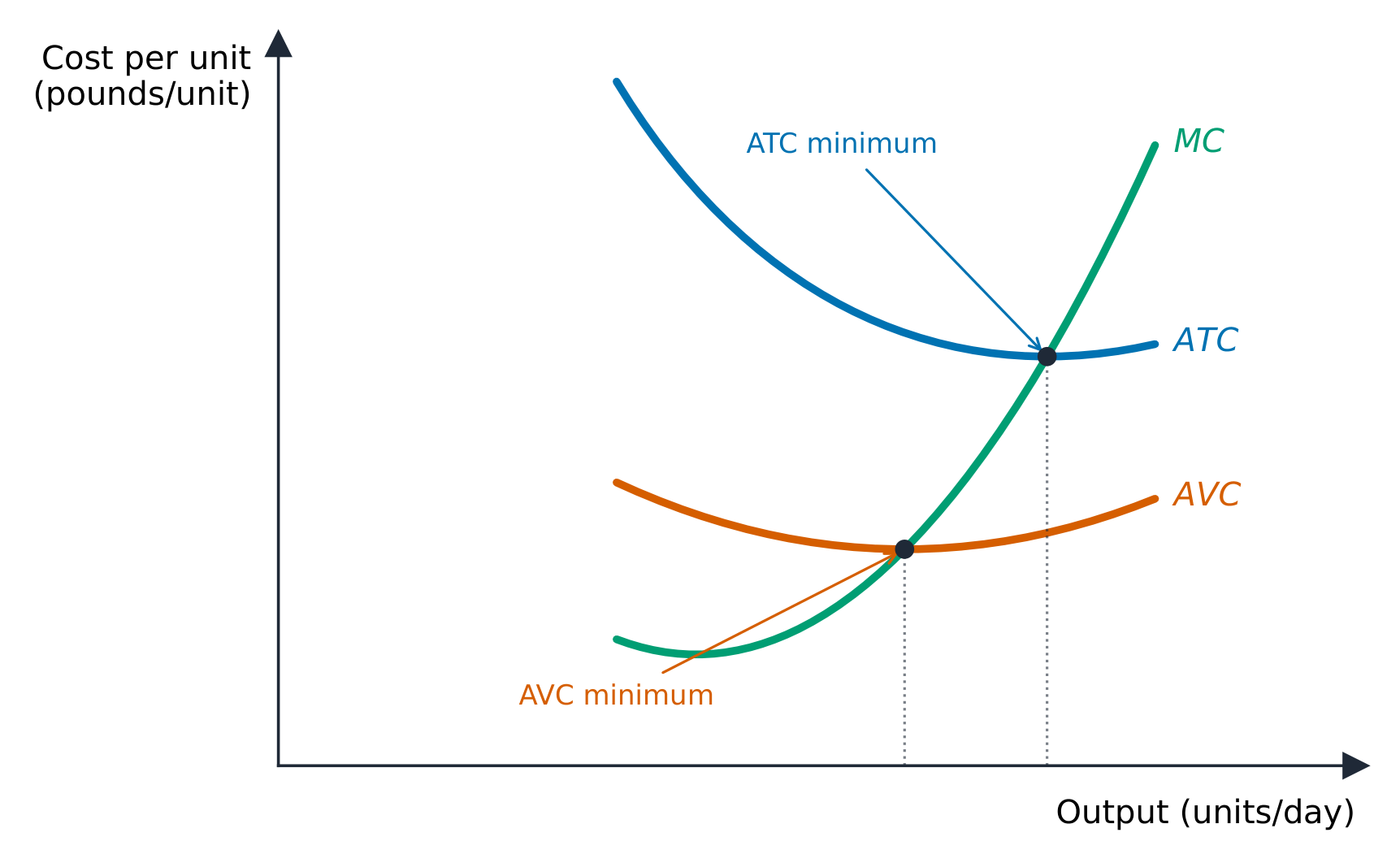
Syllabus
- explain fixed, variable, total, average and marginal cost and short-run and long-run production (law of diminishing returns, returns to scale)
- explain total, average and marginal revenue and normal, supernormal (abnormal) and subnormal profit
Source: Cambridge International syllabus
Economies of scale: average cost falls Short-run production: total, average and marginal product
In the short run 短期, at least one factor of production is fixed; in the long run 长期, all factors can change. These are economic conditions, not fixed numbers of months. A production function relates combinations of inputs to the output obtainable with a given technology.
Worked example. A bakery keeps one oven and the same technology. It changes the number of workers. Total product 总产量 (TP) is the output per day. Average product 平均产量 (AP) is output per unit of the variable input. Marginal product 边际产量 (MP) is the extra output per extra unit of that input.
Workers L TP (loaves/day) AP (loaves/worker/day) MP (loaves/worker/day) 0 0 undefined — 1 12 12 12 2 30 15 18 3 42 14 12 4 48 12 6 5 50 10 2 6 48 8 −2 For two workers:
$$AP_L=\frac{TP}{L}=\frac{30\text{ loaves/day}}{2\text{ workers}}=15\text{ loaves/worker/day}.$$For the second worker:
$$MP_L=\frac{\Delta TP}{\Delta L}=\frac{(30-12)\text{ loaves/day}}{(2-1)\text{ workers}}=18\text{ loaves/worker/day}.$$The second worker adds more than the first, perhaps because tasks can be shared. From the third worker, MP falls: extra workers must share the same oven. The law of diminishing returns 边际报酬递减 says that, with at least one input fixed and technology unchanged, extra units of the variable input eventually add less output. It does not say that total output immediately falls. TP rises while MP is positive; TP falls when MP is negative. Zero MP means no change in TP over that interval.
MP above AP pulls AP up; MP below AP pulls AP down. In a smooth model, MP crosses AP at AP's maximum. A discrete table need not contain exact equality: here AP peaks at two workers. Diminishing returns is a short-run change in the input mix; returns to scale changes all inputs together in the long run.
Short-run costs: totals, averages and changes
A fixed cost 固定成本 does not change with output in the chosen short-run period. A variable cost 可变成本 changes with output. Total fixed cost (TFC) and total variable cost (TVC) add to total cost 总成本 (TC). Fixed does not mean sunk: a sunk cost cannot be recovered, whereas a fixed cost is defined by its relationship with output.
Worked example. The bakery pays £60/day for its oven at every output, including zero. The following is a separate cost schedule, not a claim that it is calculated from the preceding worker table.
Q (loaves/day) TFC (£/day) TVC (£/day) TC (£/day) MC (£/loaf) 0 60 0 60 — 10 60 40 100 4 20 60 60 120 2 30 60 90 150 3 40 60 140 200 5 At 30 loaves/day:
$$TC=TFC+TVC=\text{\pounds}60/\text{day}+\text{\pounds}90/\text{day}=\text{\pounds}150/\text{day}.$$For the increase from 20 to 30 loaves/day:
$$MC=\frac{\Delta TC}{\Delta Q}=\frac{(150-120)\text{\pounds/day}}{(30-20)\text{ loaves/day}}=\text{\pounds}3/\text{loaf}.$$This is the average additional cost of that ten-loaf block; the table does not observe each individual loaf's marginal cost. Since TFC is unchanged, the change in TC equals the change in TVC.
Average fixed cost 平均固定成本 (AFC), average variable cost 平均可变成本 (AVC) and average total cost (ATC) use the same output denominator. Here AC means ATC. At 20 loaves/day:
$$AFC=\frac{TFC}{Q}=\frac{\text{\pounds}60/\text{day}}{20\text{ loaves/day}}=\text{\pounds}3/\text{loaf}.$$$$AVC=\frac{TVC}{Q}=\frac{\text{\pounds}60/\text{day}}{20\text{ loaves/day}}=\text{\pounds}3/\text{loaf}.$$$$ATC=\frac{TC}{Q}=\frac{\text{\pounds}120/\text{day}}{20\text{ loaves/day}}=\text{\pounds}6/\text{loaf}.$$$$ATC=AFC+AVC=\text{\pounds}3/\text{loaf}+\text{\pounds}3/\text{loaf}=\text{\pounds}6/\text{loaf}.$$Q (loaves/day) AFC (£/loaf) AVC (£/loaf) ATC (£/loaf) 10 6 4 10 20 3 3 6 30 2 3 5 40 1.5 3.5 5 AFC continually falls as positive output increases because the same fixed cost is spread over more output. ATC need not continually fall: AVC can rise. Here the last block's MC equals the preceding ATC, so ATC is unchanged. The lowest observed ATC does not prove the minimum at every possible output. At zero output, none of these averages is defined.
Explain cost curves using productivity and marginal changes
With a fixed wage and only labour changing as a variable input, labour's additional cost per unit of output is wage divided by positive MP. If an extra worker costs £60/day and adds 12 loaves/day:
$$MC_{\text{labour}}=\frac{w}{MP_L}=\frac{\text{\pounds}60/\text{worker/day}}{12\text{ loaves/worker/day}}=\text{\pounds}5/\text{loaf}.$$If an extra worker adds only 6 loaves/day:
$$MC_{\text{labour}}=\frac{w}{MP_L}=\frac{\text{\pounds}60/\text{worker/day}}{6\text{ loaves/worker/day}}=\text{\pounds}10/\text{loaf}.$$Thus falling positive MP can raise MC when the wage is unchanged. Other changing input costs must also be counted. The usual smooth short-run model has initially increasing productivity and later diminishing returns, giving U-shaped AVC and MC; this is a model, not a rule that every observed cost schedule must have exactly that shape.
An illustrative smooth model consistent with TC = TFC + TVC. MC crosses AVC and ATC at their separate minima. The ATC−AVC gap is AFC and shrinks with output. This is not the preceding discrete bakery schedule. An additional unit costing less than the current average pulls the average down; one costing more pulls it up. In a smooth differentiable model, MC equals AVC at AVC's minimum and ATC at ATC's minimum. The two minima generally occur at different outputs.
Transfer question. A firm sells 10000 units/month at £10/unit. TFC is £40000/month and the firm makes only normal profit. Find AVC, including normal profit in economic costs.
Worked answer. Normal profit means zero economic profit, so TC equals TR:
$$TC=TR=P Q=\text{\pounds}10/\text{unit}\times10000\text{ units/month}=\text{\pounds}100000/\text{month}.$$$$TVC=TC-TFC=\text{\pounds}100000/\text{month}-\text{\pounds}40000/\text{month}=\text{\pounds}60000/\text{month}.$$$$AVC=\frac{TVC}{Q}=\frac{\text{\pounds}60000/\text{month}}{10000\text{ units/month}}=\text{\pounds}6/\text{unit}.$$Here AR equals ATC, so subtracting AFC from price also gives AVC. That shortcut would fail if the firm earned supernormal or subnormal profit.
Long-run costs and scale

A large plant may gain economies of scale; size alone does not establish that its average cost is falling. In the long run, no factor of production is fixed. Returns to scale 规模报酬 compare output when all inputs change in the same proportion, with technology unchanged. This differs from diminishing marginal returns, which changes the variable input while at least one other input remains fixed.
Worked example. A firm uses 100 workers and 2 machines to produce 1000 units/day. It doubles both inputs to 200 workers and 4 machines, producing 2500 units/day.
$$\text{Labour factor}=\frac{L_2}{L_1}=\frac{200\text{ workers}}{100\text{ workers}}=2.$$$$\text{Capital factor}=\frac{K_2}{K_1}=\frac{4\text{ machines}}{2\text{ machines}}=2.$$$$\text{Output factor}=\frac{Q_2}{Q_1}=\frac{2500\text{ units/day}}{1000\text{ units/day}}=2.5.$$This is increasing returns to scale 规模报酬递增: output rises more than proportionately. With the same doubling of inputs, an output of 2000 units/day would show constant returns to scale 规模报酬不变; 1500 units/day would show decreasing returns to scale 规模报酬递减. These are alternative hypothetical results, not extra observations of this firm.
Physical returns and cost changes are linked only with suitable assumptions about input prices. Suppose the input bundle costs £10000/day initially and £20000/day after doubling, at unchanged input prices:
$$AC_1=\frac{TC_1}{Q_1}=\frac{\text{\pounds}10000/\text{day}}{1000\text{ units/day}}=\text{\pounds}10/\text{unit}.$$$$AC_2=\frac{TC_2}{Q_2}=\frac{\text{\pounds}20000/\text{day}}{2500\text{ units/day}}=\text{\pounds}8/\text{unit}.$$Economies of scale 规模经济 lower long-run average cost as scale increases. Here cost doubles while output rises by 2.5 times. If input prices change, the physical comparison alone does not determine the cost change. Compare the same product quality and technology; a cost reduction caused by new technology alone is not automatically caused by scale.
Long-run average cost (LRAC) is the lowest attainable average cost at each output when all inputs can be chosen. Minimum efficient scale 最小有效规模 (MES) is the smallest output at the minimum LRAC. It need not be the largest output shown, and a flat minimum can contain several equally efficient scales.
Worked example. Treat the following listed outputs as the available choices:
Output (hundreds of units/day) LRAC (£/unit) 1 12 2 9 3 8 4 8 5 9 The minimum cost is £8/unit at both 300 and 400 units/day. MES is the first of these, 300 units/day. The following illustrative smooth model also has a flat minimum from 300 to 400 units/day. Diseconomies of scale 规模不经济 raise LRAC as scale increases beyond that range.
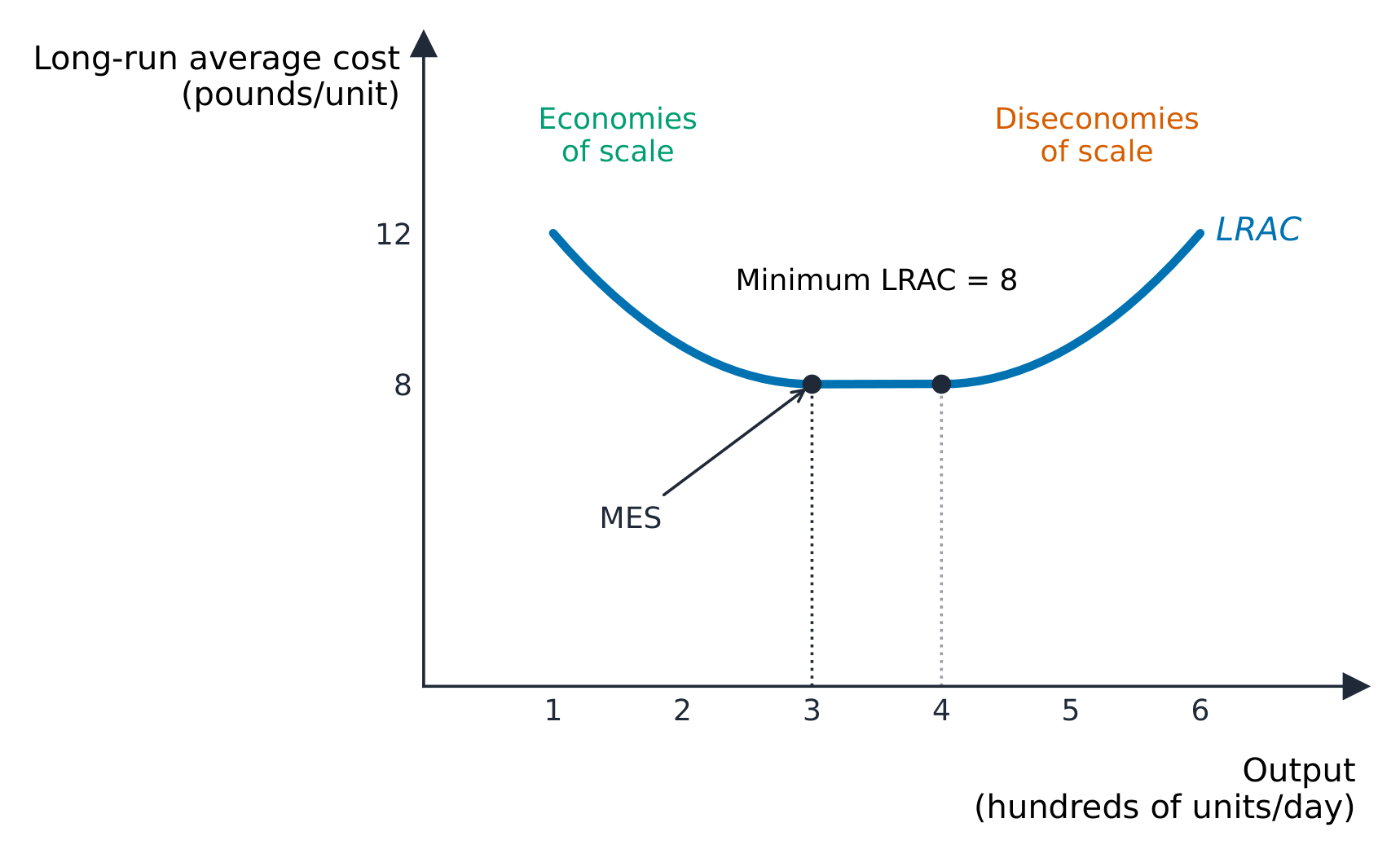
The first minimum is MES, even though a larger output has the same LRAC. LRAC describes unit cost, not total cost. This is an illustrative curve, not evidence that every industry's curve has this shape. Internal and external scale effects
Classify the effect by whose expansion causes the cost change, then explain the mechanism:
- Internal economies of scale 内部规模经济 arise from the firm's own expansion. A specialised machine or division of tasks can increase output per resource. Bulk purchasing or cheaper finance can reduce input costs. The gain must lower cost per unit, not merely increase total output.
- External economies of scale 外部规模经济 arise from expansion of the industry. A larger local industry can support specialist suppliers, repair services or a pool of trained workers. A firm can gain even if its own size is unchanged.
- Internal diseconomies of scale 内部规模不经济 arise from the firm's expansion. More management layers, communication failures and weaker coordination can raise its unit cost.
- External diseconomies of scale 外部规模不经济 arise from industry expansion. Competition for local sites or skilled labour can bid up rents and wages; congestion can raise transport costs for several firms.
Internal/external here describes the source of a scale effect. It does not mean private/social cost, and a benefit to a neighbour is not automatically an external economy of scale: industry expansion must cause the cost reduction.
Spreading an unchanged fixed cost over more output is a short-run AFC effect, not by itself evidence of a long-run scale economy. AFC can fall while rising AVC causes ATC to rise. Long-run comparisons allow every input to change. Lower total cost alone proves neither lower average cost nor greater efficiency at a different quality of output.
Read average cost from long-run total cost
On a total-cost diagram, average cost is total cost divided by output: the slope of a straight ray from the origin to the point on the total-cost curve. The local slope of the curve instead measures marginal cost in a smooth model. Do not choose the flattest part of LRTC when asked for minimum LRAC.
Worked example. The following separate model has LRTC values of £1200, £1800, £2400 and £3600/day at 100, 200, 300 and 400 units/day. Divide each total by its own output to obtain LRAC values of £12, £9, £8 and £9/unit.
$$LRAC=\frac{LRTC}{Q}=\frac{\text{\pounds}2400/\text{day}}{300\text{ units/day}}=\text{\pounds}8/\text{unit}.$$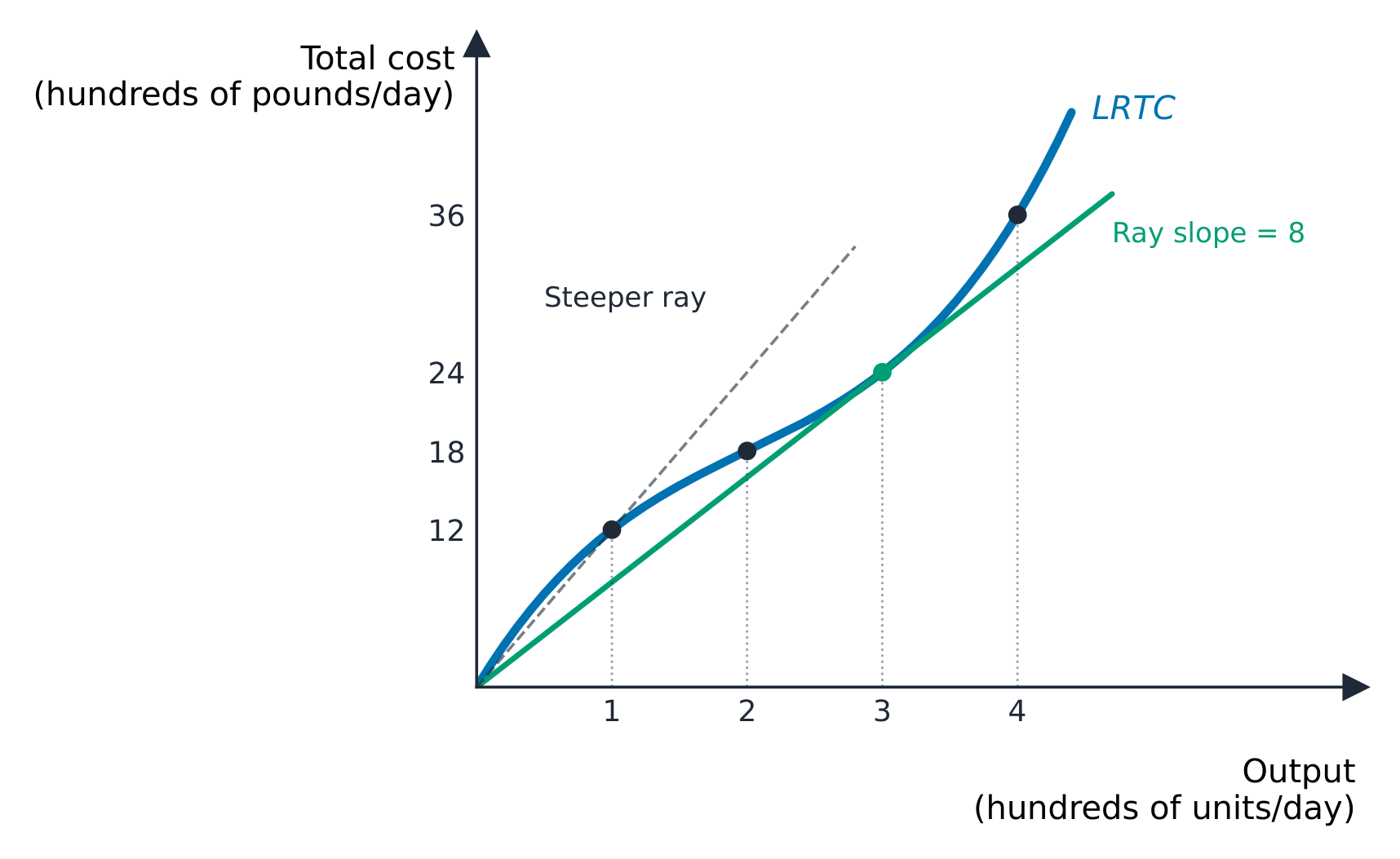
The origin ray is shallowest at output 300 units/day and is tangent there in this smooth model. Total cost is still rising; minimum average cost does not mean minimum total cost. This model has a single LRAC minimum, unlike the preceding flat-minimum example. Revenue: separate totals, averages and changes
Total revenue 总收益 (TR) is all revenue from sales. Average revenue 平均收益 (AR) is revenue per unit sold. Marginal revenue 边际收益 (MR) is the additional revenue per extra unit of output. When the firm charges one price for all units:
$$TR=PQ,\qquad AR=\frac{TR}{Q}=P,\qquad MR=\frac{\Delta TR}{\Delta Q}.$$Worked example. A firm sells 10 units/day at £50/unit. To sell 11 units/day it must lower the price to £48/unit on every unit.
$$TR_{10}=P_{10}Q_{10}=\text{\pounds}50/\text{unit}\times10\text{ units/day}=\text{\pounds}500/\text{day}.$$$$TR_{11}=P_{11}Q_{11}=\text{\pounds}48/\text{unit}\times11\text{ units/day}=\text{\pounds}528/\text{day}.$$$$AR_{11}=\frac{TR_{11}}{Q_{11}}=\frac{\text{\pounds}528/\text{day}}{11\text{ units/day}}=\text{\pounds}48/\text{unit}.$$$$MR=\frac{\Delta TR}{\Delta Q}=\frac{(528-500)\text{\pounds/day}}{(11-10)\text{ units/day}}=\text{\pounds}28/\text{unit}.$$The extra unit brings £48, but the price cut loses £2 on each of the previous ten units. Net revenue rises by only £28/day. MR is not the new selling price.
Contrast. A price taker can sell either 10 or 11 units/day at an unchanged £50/unit. With no price cut on earlier sales:
$$MR=\frac{\Delta TR}{\Delta Q}=\frac{(550-500)\text{\pounds/day}}{(11-10)\text{ units/day}}=\text{\pounds}50/\text{unit}.$$An unchanged price gives MR=AR=P. With downward-sloping demand and a single price, MR is generally below AR because selling more requires a lower price on existing sales. With price discrimination, calculate actual total receipts; one common price cannot be assumed. Average revenue at zero sales is undefined.
Profit: include the opportunity cost of the owner's resources
Economic profit 经济利润 is total revenue minus all economic costs, including the opportunity cost of the owner's time and funds. Normal profit 正常利润 is the minimum required return that keeps the entrepreneur's resources in this use. It is counted within economic cost. Supernormal profit 超常利润 is profit above normal; subnormal profit 次正常利润 is a return below normal.
Worked example. Annual revenue is £24000 and explicit costs are £18000. The owner's time and funds have an implicit opportunity cost of £6000/year, with no other costs in this example:
$$TC=\text{explicit costs}+\text{opportunity costs}=\text{\pounds}18000/\text{year}+\text{\pounds}6000/\text{year}=\text{\pounds}24000/\text{year}.$$$$\pi=TR-TC=\text{\pounds}24000/\text{year}-\text{\pounds}24000/\text{year}=0.$$The firm makes normal profit: its required return is covered, so economic profit is zero. Accounting profit is £6000/year here because it omits that implicit cost. Zero economic profit does not mean the owner receives nothing.
For positive output, profit can also be calculated from the gap between average revenue and average total cost:
$$\pi=TR-TC=(AR-AC)Q.$$Worked example. Keep output at 100 units/month and economic AC at £9/unit across three alternative revenue conditions:
$$\pi=(AR-AC)Q=(\text{\pounds}12/\text{unit}-\text{\pounds}9/\text{unit})\times100\text{ units/month}=\text{\pounds}300/\text{month}.$$$$\pi=(AR-AC)Q=(\text{\pounds}9/\text{unit}-\text{\pounds}9/\text{unit})\times100\text{ units/month}=0.$$$$\pi=(AR-AC)Q=(\text{\pounds}8/\text{unit}-\text{\pounds}9/\text{unit})\times100\text{ units/month}=-\text{\pounds}100/\text{month}.$$These are supernormal, normal and subnormal profit respectively. Profit is the total gap over the period, not just the per-unit AR−AC difference.
Compare feasible output choices using profit
Try it. Only the following outputs are feasible in a separate daily example. Calculate profit for each row, then identify the best choice.
Q (units/day) TR (£/day) TC (£/day) Profit (£/day) 0 0 4 −4 1 10 8 2 2 18 13 5 3 24 19 5 4 28 26 2 Worked answer. Outputs 2 and 3 both maximise profit at £5/day. Increasing output from 2 to 3 gives:
$$\Delta\pi=\Delta TR-\Delta TC=(24-18)\text{\pounds/day}-(19-13)\text{\pounds/day}=0.$$Across the successive one-unit steps, MR is £10, £8, £6 and £4/unit; MC is £4, £5, £6 and £7/unit. Profit rises when the extra revenue exceeds extra cost, is unchanged when they are equal, and falls when MC exceeds MR. The last unit raises total revenue but reduces profit. A discrete table can have a tie, so a unique output cannot always be inferred from MR=MC.
Profit levels and output decisions answer different questions
AR=AC means zero economic profit. It does not identify the output with the largest profit. MR=MC is a marginal condition: for a smooth interior maximum, marginal profit must change from positive to negative. Check feasible boundaries and stopping production too. With several intersections, compare total profit rather than assuming every MR=MC point is a maximum.

In this illustrative model AR=AC at outputs 1 and 5, giving normal profit. MR=MC at output 3, where profit is largest. The marked intersections represent different tests. Worked example. In the graph, AR=14−Q, MR=14−2Q and MC=2+2Q, in £/unit, where Q is the numeric output in units/day. Total cost is £(10+2Q+Q²)/day. Marginal revenue exceeds marginal cost below 3 and falls below it above 3:
$$MR=MC\quad\Rightarrow\quad14-2Q=2+2Q\quad\Rightarrow\quad Q_\pi=3\text{ units/day}.$$At 3 units/day, price is £11/unit, total revenue £33/day and total cost £25/day, giving profit £8/day. At either 1 or 5 units/day, revenue equals cost and profit is zero. This shows why a normal-profit question asks for the AR/AC intersection, not the MR/MC intersection.
A short-run loss and the decision to stop production
A negative economic profit does not automatically mean immediate closure is best. Some fixed costs may be unavoidable for the current period. Compare the loss from producing with the loss from stopping; keep long-run exit separate.
Worked example. Only 0 or 100 units/month are feasible this month. At 100 units, AVC is £4/unit and ATC is £6/unit. Fixed cost is £200/month and unavoidable; variable costs can be avoided by stopping. At a price of £5/unit:
$$\pi=(P-ATC)Q=(\text{\pounds}5/\text{unit}-\text{\pounds}6/\text{unit})\times100\text{ units/month}=-\text{\pounds}100/\text{month}.$$Stopping gives no revenue and no variable cost, leaving the £200/month fixed-cost loss. Producing is preferable at this price because it covers variable cost and contributes to fixed cost. At a price of £3/unit:
$$\pi=(P-ATC)Q=(\text{\pounds}3/\text{unit}-\text{\pounds}6/\text{unit})\times100\text{ units/month}=-\text{\pounds}300/\text{month}.$$Now stopping loses less. At a price equal to AVC, producing and stopping give the same loss under these assumptions. With more output choices, compare their contributions too. Long-run exit allows a new choice of all resources: reconsider avoidable costs, alternative opportunities and expected future returns rather than treating current fixed costs as unavoidable for ever.
ExploreRevenue & profit
y = ax² + bx + c
Total revenue rises then falls as price changes.
ExploreCosts and the firm
Average cost is U-shaped; marginal cost cuts it at the minimum. Different market structures price relative to these curves.
ExploreAverage and marginal cost
Change output. Marginal cost cuts average cost at its lowest point — the heart of the theory of the firm.
Vocabulary TrainEnglish short run/ʃɔːt rʌn/ long run/lɒŋ rʌn/ fixed cost/fɪkst kɒst/ variable cost/ˈveərɪəbl kɒst/ total cost/ˈtəʊtl kɒst/ diminishing returns/dɪˈmɪnɪʃɪŋ rɪˈtɜːnz/ returns to scale/rɪˈtɜːnz tə skeɪl/ economies of scale/ɪˈkɒnəmiz ɒv skeɪl/ diseconomies of scale/ˌdɪsɪˈkɒnəmiz ɒv skeɪl/ total revenue/ˈtəʊtl ˈrevənjuː/ average revenue/ˈævrɪdʒ ˈrevənjuː/ marginal revenue/ˈmɑːdʒɪnl ˈrevənjuː/ normal profit/ˈnɔːml ˈprɒfɪt/ supernormal profit/ˈsuːpənɔːml ˈprɒfɪt/ subnormal profit/ˈsʌbnɔːml ˈprɒfɪt/ total product/ˈtəʊtl ˈprɒdʌkt/ average product/ˈævrɪdʒ ˈprɒdʌkt/ marginal product/ˈmɑːdʒɪnl ˈprɒdʌkt/ average fixed cost/ˈævrɪdʒ fɪkst kɒst/ average variable cost/ˈævrɪdʒ ˈveərɪəbl kɒst/ increasing returns to scale/ɪnˈkriːsɪŋ rɪˈtɜːnz tə skeɪl/ constant returns to scale/ˈkɒnstənt rɪˈtɜːnz tə skeɪl/ decreasing returns to scale/ˈdiːkriːsɪŋ rɪˈtɜːnz tə skeɪl/ minimum efficient scale/ˈmɪnɪməm ɪˈfɪʃənt skeɪl/ internal economies of scale/ɪnˈtɜːnl ɪˈkɒnəmiz ɒv skeɪl/ external economies of scale/ekˈstɜːnl ɪˈkɒnəmiz ɒv skeɪl/ internal diseconomies of scale/ɪnˈtɜːnl ˌdɪsɪˈkɒnəmiz ɒv skeɪl/ external diseconomies of scale/ekˈstɜːnl ˌdɪsɪˈkɒnəmiz ɒv skeɪl/ economic profit/ˌiːkəˈnɒmɪk ˈprɒfɪt/ 7.6
Market structures
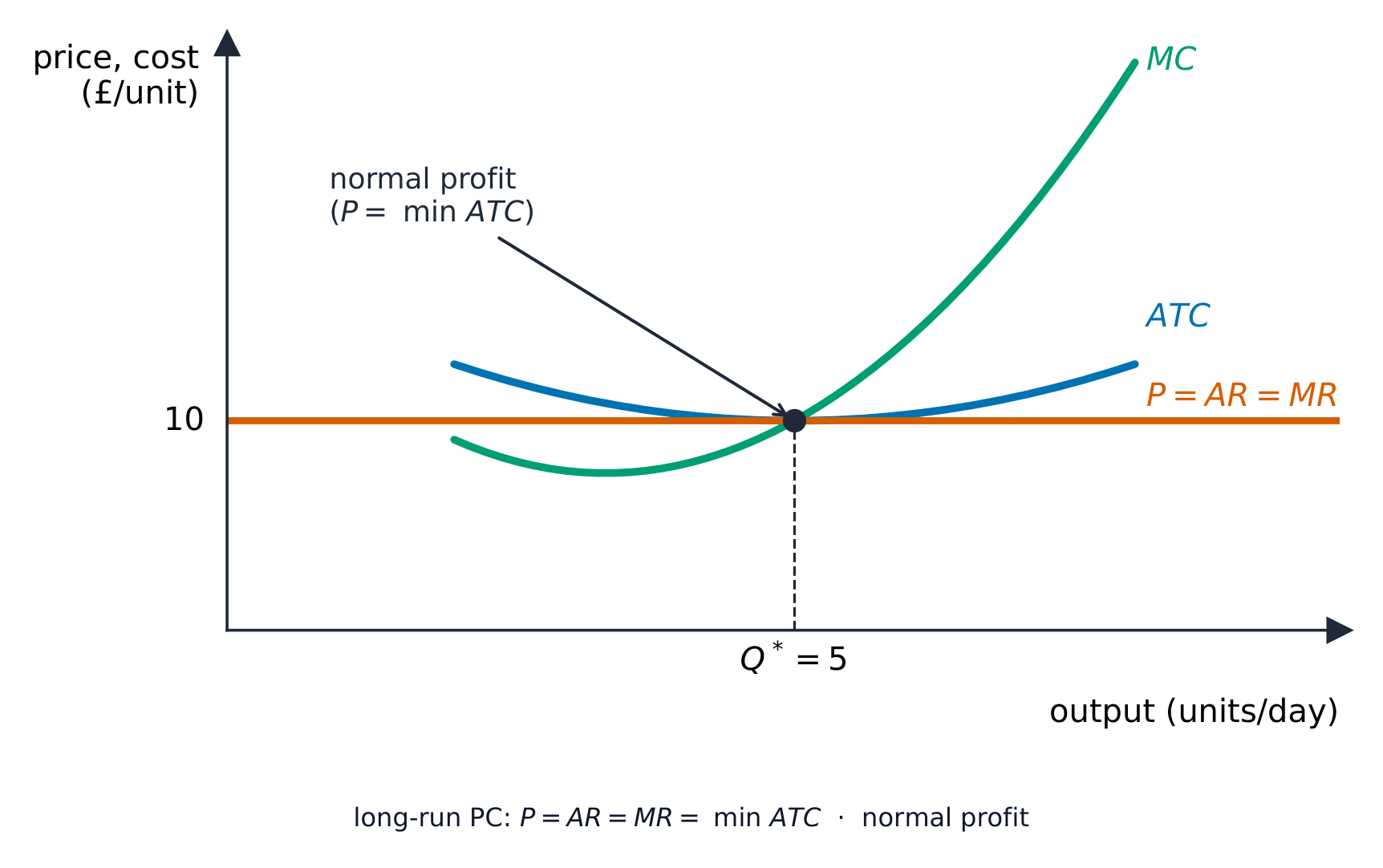
Syllabus
- explain the assumptions, behaviour and outcomes of perfect competition, monopolistic competition, oligopoly and monopoly
- explain price and non-price competition, collusion, price discrimination and the efficiency of each market structure
Source: Cambridge International syllabus
A market structure 市场结构 describes the number and size of sellers, entry conditions and the product sold. Define the product and geographical market before counting firms: a cafe may have no rival on one street but face rivals within walking distance.
Structure Sellers Product Entry conditions perfect competition 完全竞争 very many identical free entry and exit monopolistic competition 垄断竞争 many differentiated relatively easy oligopoly 寡头垄断 a few dominate identical or different substantial barriers monopoly 垄断 one no close substitute protected entry Product differentiation 产品差异化 means buyers see differences in quality, location, branding or service. It can give a firm some price-setting power. Barriers to entry 进入壁垒 include legal restrictions, difficult access to key inputs and cost advantages that a new supplier cannot readily match. They can help profit persist, but cannot guarantee profitable demand. A monopoly can make normal profit or a loss; an oligopoly need not form a cartel 卡特尔. Collusion 合谋 means firms coordinate decisions instead of acting independently. A cartel is an agreement between otherwise separate firms to restrict supply or fix prices. Potential competition must also be considered: a small number of current sellers does not by itself establish freedom from competitive pressure.
Worked classification. Many small farms selling the same grade of wheat at the market price fit perfect competition most closely. Many cafes with different menus and easy entry fit monopolistic competition. Three airlines that watch each other's fares and face expensive entry fit oligopoly. These are illustrative models, not claims that real markets meet every assumption. Reported profit alone does not identify structure.
Perfect competition: distinguish firm and market
A small price taker 价格接受者 accepts a market price that its own sales do not change. Market demand and supply determine this price. The individual firm's demand is horizontal at it; the whole market's demand curve is generally downward sloping.
At £10/unit, the firm sells 4 or 5 units/day:
$$TR_4=PQ=£10/\text{unit}\times4\text{ units/day}=£40/\text{day}$$$$TR_5=PQ=£10/\text{unit}\times5\text{ units/day}=£50/\text{day}$$$$AR_5=TR/Q=£50/\text{day}\div5\text{ units/day}=£10/\text{unit}$$$$MR=\Delta TR/\Delta Q=(£50-£40)/1\text{ unit}=£10/\text{unit}$$Thus $P=AR=MR$. Unlike the earlier price-cut example, an extra sale does not reduce the price received on previous sales. Find the best feasible output using marginal and total comparisons, not from the firm's name.
Short-run profit and shutdown
Worked comparison. In each separate case below, the best positive output is supplied as 4 units/day, TC is £40/day and TVC is £24/day. These are supplied case data, not a claim that a firm's optimum never changes when price changes. Use $TR=PQ$ and $\pi=TR-TC$.
Price (£/unit) TR (£/day) TC (£/day) Profit (£/day) 12 48 40 8 10 40 40 0 8 32 40 −8 All three outcomes are possible for a competitive firm in the short run. Zero economic profit includes the normal return on the owner's resources. Unavoidable fixed cost and average variable cost are:
$$TFC=TC-TVC=£40/\text{day}-£24/\text{day}=£16/\text{day}$$$$AVC=TVC/Q=£24/\text{day}\div4\text{ units/day}=£6/\text{unit}$$At £8/unit, production covers TVC and contributes £8/day towards fixed cost. The £8/day loss is smaller than the £16/day loss from stopping. In general compare the best positive-output contribution with stopping, allowing for which costs are actually avoidable. Do not use a short-run shutdown rule as an automatic long-run exit decision.
Entry, exit and the long-run competitive equilibrium
With free entry, economic profit attracts new firms. Market supply increases, tending to lower price and existing firms' profits. Losses encourage exit; reduced supply tends to raise price. This adjustment takes time. The familiar long-run result assumes unchanged conditions, informed buyers, access to the required inputs and technology, and no effective barriers to entry or exit. It is not a prediction that every observed farm earns exactly normal profit today.
Illustrative long-run equilibrium: P = AR = MR = MC = minimum ATC. The firm's price comes from its market. The diagram uses $ATC=10+0.3(Q-5)^2$ and the consistent $MC=d(Q\times ATC)/dQ=17.5-6Q+0.9Q^2$. Costs are £/unit and output is units/day. At $Q=5$, ATC and rising MC are both £10/unit; the other lower-output MC intersection is not the maximum-profit choice. For this illustration the total-cost model is $TC=17.5Q-3Q^2+0.3Q^3$; it is separate from the earlier fixed-cost examples.
$$\pi=(P-ATC)Q=(£10-£10)/\text{unit}\times5\text{ units/day}=£0/\text{day}$$Producing at minimum ATC is productive efficiency for the given technology and input prices. The equality $P=MC$ implies allocative efficiency only when price represents marginal benefit and private and social margins coincide. External effects or poor information can break this welfare conclusion. Neither normal profit nor a cost minimum alone proves dynamic efficiency: judge investment, finance and innovation incentives separately. Under the standard exam model, the absence of sustained supernormal profit can limit internal finance for research; this does not mean no competitive firm ever innovates.
Derive a firm's short-run supply
Worked discrete comparison. A different firm can produce only 0,1,2,3,4 units/day. TFC is £6/day, unavoidable in the short run; TVC is £0,£2,£6,£12,£20/day. Successive one-unit marginal costs are therefore £2,£4,£6,£8/unit. Compare all feasible outputs, including zero, at each price using $\pi=PQ-(TFC+TVC)$.
Price (£/unit) Best Q (units/day) TR (£/day) TC (£/day) Profit (£/day) 1 0 0 6 −6 3 1 3 8 −5 5 2 10 12 −2 7 3 21 18 3 At £3, selling a second unit earns £3 but costs £4; adding it lowers profit. At £7, the fourth unit costs £8 and earns £7. Price below £2 leads to zero output; at £2 the firm is indifferent between zero and one unit. At prices £4,£6 and £8 the corresponding adjacent outputs tie. Do not force an equality rule on discrete steps when price lies between marginal costs.
For a conventional smooth cost model, the firm's short-run supply is the rising part of MC above minimum AVC. Below minimum AVC it supplies zero. At that minimum price it is indifferent between stopping and the best positive output. This assumes the indicated branch gives the best feasible contribution and fixed costs are unavoidable. Add the quantities supplied by firms at the same price to obtain industry supply. A monopoly's optimum depends on demand and MR as well as costs, so it has no equivalent price-only supply curve.
Monopoly: choose output, then read price and profit
A monopoly faces the market demand curve. An extra sale normally requires a lower price, so MR is below AR on the downward-sloping demand curve. Choosing a price does not let the firm sell any quantity it wants: its price and sales must be consistent with demand.
Worked model. Use $AR=P=18-Q$, $MR=18-2Q$ and $TC=20+2Q+Q^2$, with the consistent $MC=2+2Q$ and $ATC=20/Q+2+Q$. Output is units/day, price and marginal costs are £/unit and total cost is £/day. These numerical equations are an illustrative model, separate from the earlier competitive firm's cost curves.
At a smooth interior profit maximum:
$$MR=MC$$$$18-2Q=2+2Q\quad\Rightarrow\quad Q=4\text{ units/day}$$Read price from AR, not MR:
$$P=18-Q=18-4=£14/\text{unit}$$$$TR=PQ=£14/\text{unit}\times4\text{ units/day}=£56/\text{day}$$$$TC=20+2Q+Q^2=20+2(4)+4^2=£44/\text{day}$$$$\pi=TR-TC=£56/\text{day}-£44/\text{day}=£12/\text{day}$$The marginal difference $MR-MC=16-4Q$ is positive below 4 and negative above it. Thus the firm gains by expanding towards 4 from below and loses by expanding beyond 4. This quadratic profit model has a single positive-output maximum. Stopping loses the £20/day fixed cost if it is unavoidable; producing is better. For other cost/demand shapes, check all relevant branches, boundaries and feasible total profits.
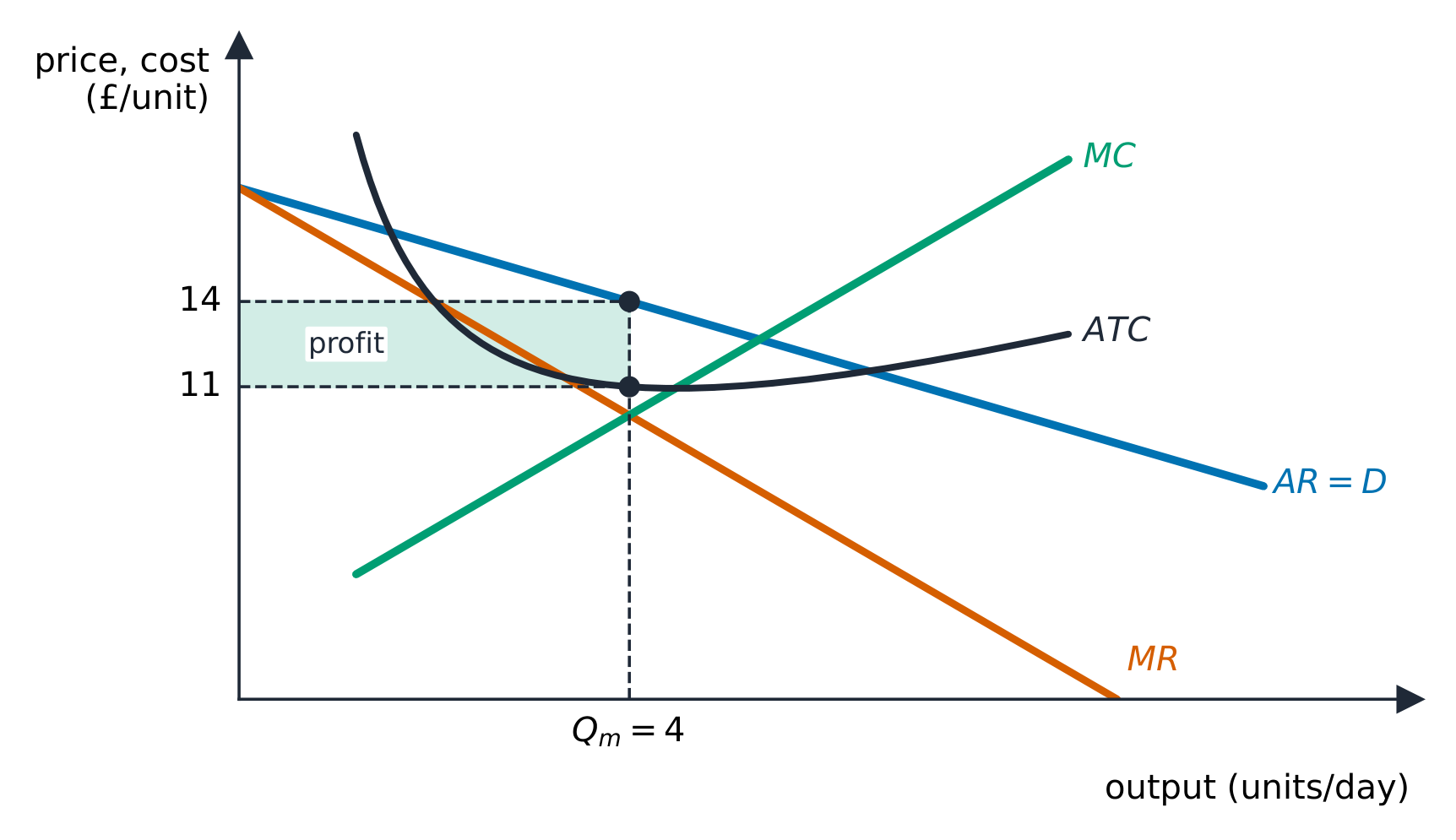
Read Q from MR = MC, price £14/unit from AR, and ATC £11/unit at that Q. The shaded rectangle is total profit, not revenue. $$ATC=TC/Q=£44/\text{day}\div4\text{ units/day}=£11/\text{unit}$$$$\pi=(P-ATC)Q=(£14-£11)/\text{unit}\times4\text{ units/day}=£12/\text{day}$$The gap between price and MC is not profit per unit. It excludes some costs; use price minus ATC instead.
Entry barriers do not guarantee supernormal profit
Keep this demand and variable cost $TVC=2Q+Q^2$ unchanged but compare three alternative unavoidable fixed costs. The same MC implies the same optimum $Q=4$ and $P=£14$/unit in these particular cases.
TFC (£/day) TR (£/day) TC (£/day) Profit (£/day) 20 56 44 12 32 56 56 0 40 56 64 −8 At this output, variable cost is £24/day in every case. Changing unavoidable fixed cost shifts ATC and profit, but not MC here. The first monopoly earns supernormal profit, the second normal profit, and the third a loss. In the third case producing loses £8/day, whereas stopping loses £40/day, so production is preferable in the short run. If the cost becomes avoidable, or future demand changes, compare the long-run options again. Barriers can prevent entrants from competing a profit away; they cannot create sufficient demand or remove a firm's costs.
Compare profit maximisation with the social margin
With no external effects or information problems, suppose the demand price represents marginal social benefit and MC represents marginal social cost. At the monopoly output of 4, buyers value a small extra unit at £14 while it costs £10 to supply. Extra output can therefore add net social benefit even though it reduces the monopoly's profit.
The illustrative social optimum uses $MSB=MSC$, not $MR=MC$:
$$MSB=MSC$$$$18-Q=2+2Q\quad\Rightarrow\quad Q^*=16/3\text{ units/day}\approx5.33\text{ units/day}$$$$P^*=18-Q^*=18-16/3=£38/3\text{ per unit}\approx£12.67/\text{unit}$$This compares outcomes using unchanged demand and costs, without other distortions. It is not a claim that every price control will work: a real policy must consider information, cost recovery, investment incentives and implementation. Nor does monopoly status prove poor innovation or inefficient management; investigate costs, incentives and evidence.
Monopolistic competition: entry, normal profit and excess capacity
Many sellers offer differentiated products, with relatively easy entry and exit. Buyers may not know every quality difference or price. Each firm faces a downward-sloping demand curve because it can lose customers to close substitutes; some price-setting power does not mean unlimited freedom to raise price. In the short run, demand and costs can give profit or loss. In the standard long-run model, profit attracts entry of close substitutes, reducing each incumbent's demand until economic profit is zero. Losses encourage exit. The remaining firm's demand does not become horizontal merely because entry is free.
Worked long-run illustration. Keep $AR=18-Q$, $MR=18-2Q$ and $MC=2+2Q$, but use $TC=32+2Q+Q^2$. At $Q=4$ units/day, $MR=MC$ and price read from AR is £14/unit:
$$TC=32+2Q+Q^2=32+2(4)+4^2=£56/\text{day}$$$$ATC=TC/Q=£56/\text{day}\div4\text{ units/day}=£14/\text{unit}$$$$\pi=(P-ATC)Q=(£14-£14)/\text{unit}\times4\text{ units/day}=£0/\text{day}$$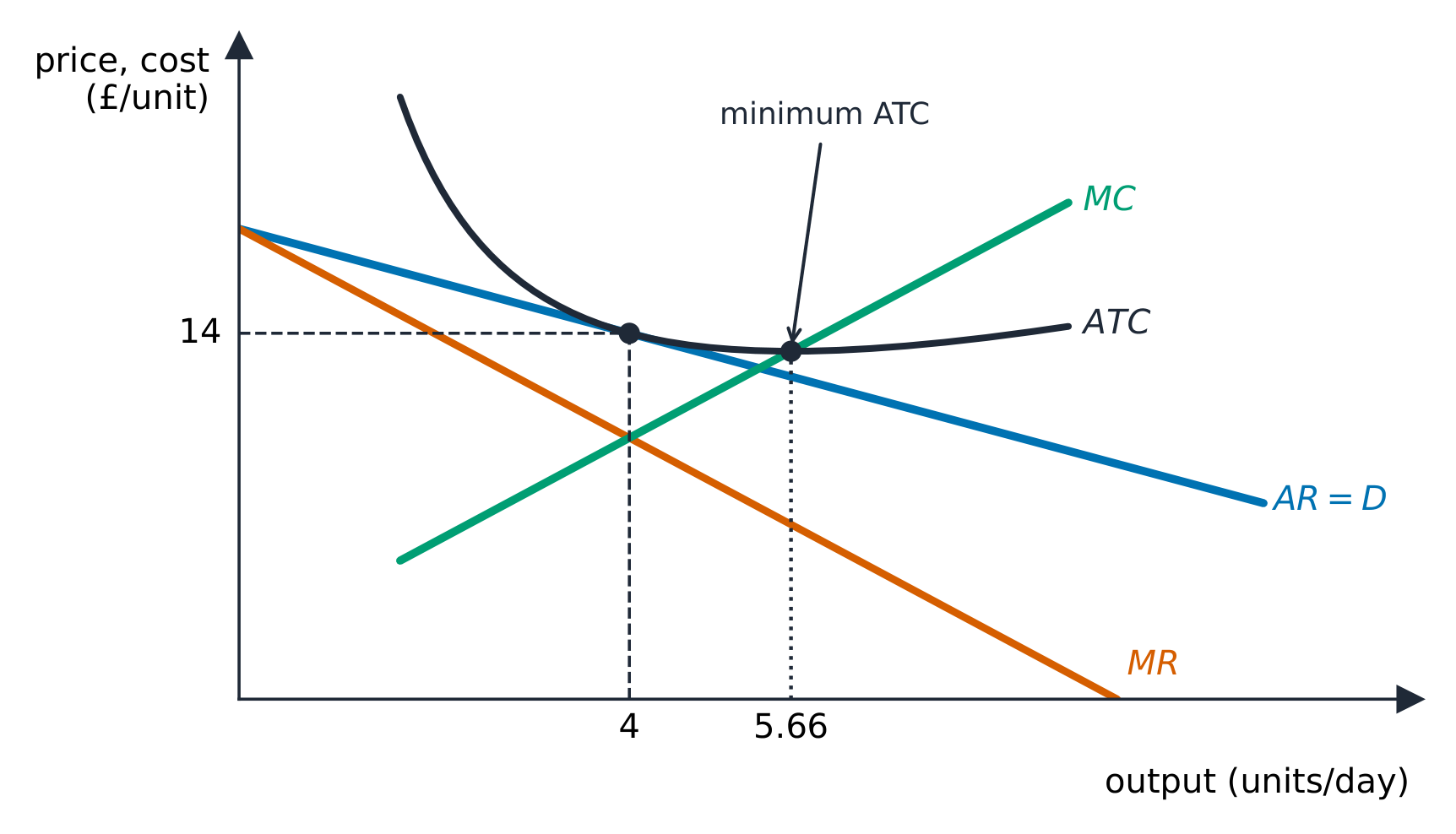
At output 4, AR touches ATC and the firm makes normal profit. The minimum ATC occurs at about 5.66, so normal profit does not prove productive efficiency. Here $ATC=32/Q+2+Q$. At output 5 it is £13.40/unit, already below £14/unit at 4; the minimum is about £13.31/unit at output 5.66. Thus the firm has excess capacity relative to the output minimising ATC in this model. Also $P=14>MC=10$, so the private marginal condition for allocative efficiency is not met. Free entry and normal profit do not make this the same outcome as perfect competition. Product variety may benefit buyers; weigh that benefit rather than assuming that identical products must always be best.
Natural monopoly and the relevant cost range
A natural monopoly 自然垄断 exists when one firm can supply the relevant market at lower total cost than multiple firms. A large network cost and falling LRAC over the range of market demand can produce this condition. It is a cost argument, not simply a statement that one seller happens to exist.
Worked network. Market demand is 100 identical service units/month. Each active network requires £120/month of overhead plus £2/unit supplied. Treat these as the least feasible costs of a network in this illustration, allowing a provider to close; two providers require two separate networks. Quality and input prices are identical.
$$TC_{\text{one}}=120+2Q=120+2(100)=£320/\text{month}$$$$TC_{\text{two}}=2[120+2(50)]=£440/\text{month}$$$$AC_{\text{one}}=TC_{\text{one}}/Q=£320/\text{month}\div100\text{ units/month}=£3.20/\text{unit}$$$$AC_{\text{two}}=TC_{\text{two}}/Q=£440/\text{month}\div100\text{ units/month}=£4.40/\text{unit}$$Duplicating the network adds £120/month. Over this relevant demand range, one provider has the lower total cost. This does not justify any price it chooses or prove good management. A larger market, different technology or shared network access may change the comparison. Regulation must consider service standards, cost recovery and investment as well as price.
X-inefficiency: avoidable cost at a given output
X-inefficiency X低效率 means avoidable costs above a feasible best-practice cost for the same output. Weak pressure to control costs may permit waste, poor supervision or slack management, but neither monopoly status nor a high observed cost proves this on its own.
Worked comparison. A network supplies 100 service units/month at an actual cost of £440/month. A feasible best-practice method costs £320/month, with the same input prices, quality and reliability:
$$\text{Avoidable cost}=TC_{\text{actual}}-TC_{\text{best}}=£440/\text{month}-£320/\text{month}=£120/\text{month}$$$$\text{Gap per unit}=\text{Avoidable cost}/Q$$$$\text{Gap per unit}=£120/\text{month}\div100\text{ units/month}=£1.20/\text{unit}$$A costly remote location or higher quality might instead explain higher costs without avoidable inefficiency. Control those differences before drawing the conclusion. Producing away from minimum ATC concerns output choice along a cost curve. X-inefficiency concerns avoidable cost above the feasible curve at a given output. These are different tests.
Concentration ratios: combined shares of the largest firms
A concentration ratio 集中度 is the combined market share of a specified number of the largest firms. Define the product, geographical market, period and measure, such as sales revenue. Use a consistent measure in both numerator and denominator.
Worked four-firm ratio. Firms A–F have annual sales of £60m, £50m, £40m, £20m, £16m and £14m. Total market sales are £200m/year. The largest four have £170m/year:
$$CR_4=\frac{\text{sales of largest four}}{\text{total market sales}}\times100$$$$CR_4=\frac{(60+50+40+20)\text{ £m/year}}{200\text{ £m/year}}\times100=85\%$$Now A and B merge and all sales stay unchanged. The merged firm has £110m/year, followed by firms with £40m, £20m, £16m and £14m. Re-rank before selecting the largest four:
$$CR_{4,\text{after}}=\frac{(110+40+20+16)\text{ £m/year}}{200\text{ £m/year}}\times100=93\%$$All numerator and denominator values use £million/year. The increase is 8 percentage points. Do not count A and B separately after they merge; do not confuse an 85% combined share with 85% for each firm. High concentration shows dominance by a few large sellers but does not alone prove collusion, high prices or weak potential entry.
Entry, exit and contestability
Explain how a barrier works. A restrictive licence is a legal barrier. A scarce suitable harbour site is a physical obstacle. An incumbent's large low-cost network may give a cost advantage that a smaller entrant cannot match. Strong buyer loyalty to an established brand is a market obstacle. Categories can overlap; the mechanism matters more than assigning a single label. Perfect competition assumes many buyers and sellers, informed choices, an identical product and free entry and exit. Few sellers with imperfect information may have a different competitive position even when other features look similar.
A contestable market 可竞争市场 faces effective pressure from potential entrants. In the ideal model, entry and exit are free, entrants can access comparable technology and costs, and there are no unrecoverable entry costs. Even a few current sellers may keep prices close to cost if a newcomer can quickly win business and leave without a large loss. The number of current firms is therefore not a complete test of competition. A temporary profit opportunity is less threatening if entering takes years or incumbents can react before entrants recover their investment.
A sunk cost 沉没成本 is unrecoverable once incurred. It is different from a fixed cost, which describes how cost varies with output during a period. Equipment that can be sold on exit is not wholly sunk.
Worked entry investment. A newcomer spends £20,000 on equipment and £5,000 on launch advertising. It can resell the equipment for £18,000 on exit; the advertising cannot be recovered. Ignoring other costs and receipts:
$$\text{Sunk cost}=\text{initial outlay}-\text{recoverable value}$$$$\text{Sunk cost}=(£20{,}000+£5{,}000)-£18{,}000=£7{,}000$$This £7,000 makes quick entry and exit less attractive than the full-recovery case. Once already incurred, however, sunk cost should not itself justify continued production: compare future avoidable costs and returns. Future exit penalties and obligations may affect that comparison. Do not claim that past sunk spending automatically traps a firm into rationally operating at a continuing avoidable loss.
Oligopoly: interdependent choices and a payoff matrix
In oligopoly, a few firms dominate and each firm's outcome depends on how rivals respond. Firms may compete on price, service or quality, or coordinate decisions. Neither collusion nor a price war is inevitable. A payoff matrix 收益矩阵 lists each player's outcome for every combination of choices.
Illustrative one-shot game. Two firms independently and simultaneously choose high or low prices, without a binding agreement. Each cell gives (A's profit, B's profit) in £/week. These are teaching data, not a prediction of actual airline or cafe profits.
A's choice B: high B: low High (700, 700) (200, 900) Low (900, 200) (400, 400) Read the first number for A and the second for B. If B chooses high, A prefers low: £900/week rather than £700/week. If B chooses low, A still prefers low: £400/week rather than £200/week. The symmetric reasoning gives the same preferred responses for B. Thus both choose low, making £400/week each. Neither can improve by changing alone from low/low.
Yet high/high would give £700/week each. This is a Prisoner's Dilemma 囚徒困境: each firm's individually preferred response produces an outcome worse for both than mutual cooperation in this table.
$$\text{Joint profit}_{HH}=£700/\text{week}+£700/\text{week}=£1{,}400/\text{week}$$$$\text{Joint profit}_{LL}=£400/\text{week}+£400/\text{week}=£800/\text{week}$$The higher joint total does not remove the temptation for one firm to undercut while the other keeps a high price. A cartel must address incentives, monitoring and responses to cheating. New entrants, differing costs and many participants can weaken coordination. Repeated dealings and credible future responses may change incentives; the one-shot result is conditional on the displayed payoffs and assumptions. Do not infer one universal outcome for every oligopoly.
Price and non-price competition: compare profits, not only sales
Price competition 价格竞争 means changing price to attract buyers. Non-price competition 非价格竞争 uses quality, service, branding or promotion. Advertising can communicate useful differences or build loyalty; better service may increase costs as well as demand. Rivals may imitate either approach, so neither is guaranteed to succeed.
Worked monthly forecasts. Initially price is £10/unit, sales are 100 units/month, unit variable cost is £6 and fixed cost is £200/month. A price cut to £9 is forecast to sell 115 units/month with the same fixed cost. Alternatively, price stays £10 and extra service/advertising costing £60/month is forecast to raise sales to 120 units/month. Use $TR=PQ$, $TC=TFC+vQ$ and $\pi=TR-TC$, where $v=£6$/unit.
Case Q TR TC Profit Initial 100 1000 800 200 Price cut 115 1035 890 145 Service/ad 120 1200 980 220 Output is units/month; money totals are £/month. The price cut increases revenue by £35/month but reduces profit by £55/month. The service/advertising forecast increases profit by £20/month after its extra cost. For example:
$$TC_{\text{ad}}=TFC+vQ=£260/\text{month}+£6/\text{unit}\times120\text{ units/month}=£980/\text{month}$$$$\pi_{\text{ad}}=TR-TC=£1{,}200/\text{month}-£980/\text{month}=£220/\text{month}$$These are forecasts. If rivals match the offer or demand disappoints, recalculate rather than assuming the stated sales increase. A price reduction may benefit buyers even if it reduces the firm's profit.
Price discrimination: distinguish the pricing rule
Price discrimination 价格歧视 means different prices for the same product where the difference is not explained by different supply costs. A higher delivery charge for a distant address may reflect a higher cost, so different prices alone do not prove discrimination. A ticket bought early and a ticket bought just before departure may sort travellers by their willingness to pay; changing demand or capacity also needs consideration. Do not infer the precise degree from timing alone.
- First-degree price discrimination 一级价格歧视 charges each unit at the individual buyer's maximum willingness to pay for that unit. It requires detailed information and control over resale; it is an idealised benchmark, not simply charging one high price to everyone.
- Second-degree price discrimination 二级价格歧视 varies the unit price with quantity or a menu of purchase options. Buyers select an option rather than the seller assigning a price from their identity. A quantity discount is discriminatory only insofar as its price differences are not explained by cost differences.
- Third-degree price discrimination 三级价格歧视 charges different identifiable groups different prices for the same product, for example an ID-checked student ticket and an adult ticket. Groups must be kept separate. Different demand responses allow different profit-maximising mark-ups; it is not necessary for every group to have inelastic demand.
Compare a uniform price with first-degree pricing
Illustrative three-unit model. One buyer is willing to pay up to £12 for the first unit, £9 for the second and £6 for the third. Additional units have no value to this buyer. Each unit costs £4 to supply, there is no fixed cost, and the buyer purchases when willingness to pay is at least the price. Ignore administration costs initially.
Uniform price (£/unit) Units bought TR (£) Cost (£) Profit (£) 12 1 12 4 8 9 2 18 8 10 6 3 18 12 6 These willingness-to-pay thresholds give the best uniform prices for each possible positive quantity. A higher price within a range cannot sell more; lowering it within that range only reduces revenue. Not selling gives zero profit. The best uniform choice is therefore £9/unit and two units, with profit £10.
Under first-degree pricing the seller charges £12, £9 and £6 for the three units. All three units' marginal values here exceed the £4 marginal cost:
$$TR=\sum P_i=£12+£9+£6=£27.$$$$TC=MC\times Q=(£4/\text{unit})(3\text{ units})=£12.$$$$\pi=TR-TC=£27-£12=£15.$$The uniform-price buyer keeps £3 of consumer surplus on the first unit. Perfect first-degree pricing takes that surplus and also serves the third unit. Consumer surplus is zero under the stated purchase-at-indifference assumption. With marginal willingness to pay representing social benefit, marginal cost representing social cost and no other distortion, supplying the third unit adds £2 of total surplus. This efficiency result does not establish a fair distribution or that perfect information is realistic.
Second-degree pricing: let the buyer choose a quantity
Keep the same buyer and constant £4/unit cost. Offer the first two units at £9 each and the third at £5. The total bill is £9 for one, £18 for two and £23 for three. The buyer's total willingness to pay is £12, £21 and £27 respectively. Net benefits are £3, £3 and £4, so the buyer strictly prefers three units. This is a quantity menu, not a price based on a student ID.
$$\pi=TR-TC=£23-(£4/\text{unit})(3\text{ units})=£11.$$Profit is £1 above the best uniform-price profit. Extra administration cost above £1 removes that gain. The constant cost assumption makes clear that this price pattern is not simply passing on a cheaper cost of supplying the third unit. A different buyer may choose another quantity; the menu does not force everyone to buy three.
Third-degree pricing: separate identifiable groups
A separate illustrative market. Each customer buys at most one visit; cost is £4/visit, with no fixed or administration cost. In group A two customers will pay up to £12 and £10. In group B two will pay up to £7 and £5. Customers buy at a price equal to their maximum willingness to pay. Group membership can be verified and tickets cannot be transferred.
One price (£/visit) Visits sold TR (£) Profit (£) 12 1 12 8 10 2 20 12 7 3 21 9 5 4 20 4 The best uniform price is £10, giving two visits and £12 profit. For separate group prices, A's best choice is £10 for two visits, giving £12 profit. B's best choice is £7 for one visit, giving £3 profit, rather than £5 for two visits giving £2 profit. Together:
$$TR=P_AQ_A+P_BQ_B=(£10/\text{visit})(2\text{ visits})+(£7/\text{visit})(1\text{ visit})=£27.$$$$TC=MC(Q_A+Q_B)=(£4/\text{visit})(3\text{ visits})=£12.$$$$\pi=TR-TC=£27-£12=£15.$$One extra B customer is served and profit rises by £3 before administration costs. This numerical result does not imply that all customers gain or that discrimination always expands output. The values are illustrative thresholds, not estimates of demand elasticities. In the usual smooth third-degree model with a common marginal cost, the group with less elastic demand at its chosen price bears a higher mark-up. Apply that rule to the relevant demand response rather than assuming age or income alone proves elasticity.
Conditions and consequences: test the mechanism
Effective discrimination requires some price-setting power, information that allows useful prices or options to be set, and limits on resale or switching between prices. Third-degree group pricing additionally needs identifiable, separable segments with different demand responses. A full single-seller monopoly is not required; price leadership is not a necessary condition. ID checks, non-transferable services or quantity menus may help, but verification costs and customer behaviour matter.
If any adult can buy a transferable student ticket and resell it, the higher-price group can bypass the adult price. Cheap resale undermines separation. An ID check may reduce that route, but its cost and enforcement determine whether it works. A firm that guesses willingness to pay badly can lose buyers; the original uniform price remains an available alternative only if the firm can choose it and avoid extra costs.
Compare the whole outcome with a feasible alternative. Some buyers may pay more, others may gain access at a lower price. Output can rise, fall or remain unchanged, so the effect on allocative efficiency is conditional. Perfect first-degree pricing can remove the restricted-output loss under the benchmark assumptions above while transferring consumer surplus to the firm. Third-degree pricing does not in general remove that loss. Higher profit might finance investment or keep a service operating, but neither follows automatically. Administration costs, information limits, resale and entry can reduce or remove the gain. Judge profit, access, efficiency and distribution separately.
ExplorePricing and competition
How a firm prices depends on demand and supply; with market power it can charge above the competitive level.
Vocabulary TrainEnglish market structure/ˈmɑːkɪt ˈstrʌktʃə/ perfect competition/ˈpɜːfekt ˌkɒmpəˈtɪʃn/ monopolistic competition/məˈnɒpəlɪstɪk ˌkɒmpəˈtɪʃn/ oligopoly/ˌɒlɪˈɡɒpəli/ monopoly/məˈnɒpəli/ price taker/praɪs ˈteɪkə/ product differentiation/ˈprɒdʌkt ˌdɪfəˌrenʃɪˈeɪʃn/ collusion/kəˈluːʒn/ cartel/kɑːˈtel/ barriers to entry/ˈbærɪəz tʊ ˈentri/ price competition/praɪs ˌkɒmpəˈtɪʃn/ non-price competition/nɒn praɪs ˌkɒmpəˈtɪʃn/ price discrimination/praɪs dɪˌskrɪmɪˈneɪʃn/ natural monopoly/ˈnætʃərəl məˈnɒpəli/ X-inefficiency/eks ɪnɪˈfɪʃənsi/ concentration ratio/ˌkɒnsənˈtreɪʃn ˈreɪʃɪəʊ/ contestable market/kənˈtestəbl ˈmɑːkɪt/ sunk cost/sʌŋk kɒst/ payoff matrix/ˈpeɪɒf ˈmeɪtrɪks/ Prisoner's Dilemma/ˈprɪzənəz daɪˈlemə/ first-degree price discrimination/fɜːst dɪˈɡriː praɪs dɪˌskrɪmɪˈneɪʃn/ second-degree price discrimination/ˈsekənd dɪˈɡriː praɪs dɪˌskrɪmɪˈneɪʃn/ third-degree price discrimination/θɜːd dɪˈɡriː praɪs dɪˌskrɪmɪˈneɪʃn/ 7.7
The growth and survival of firms
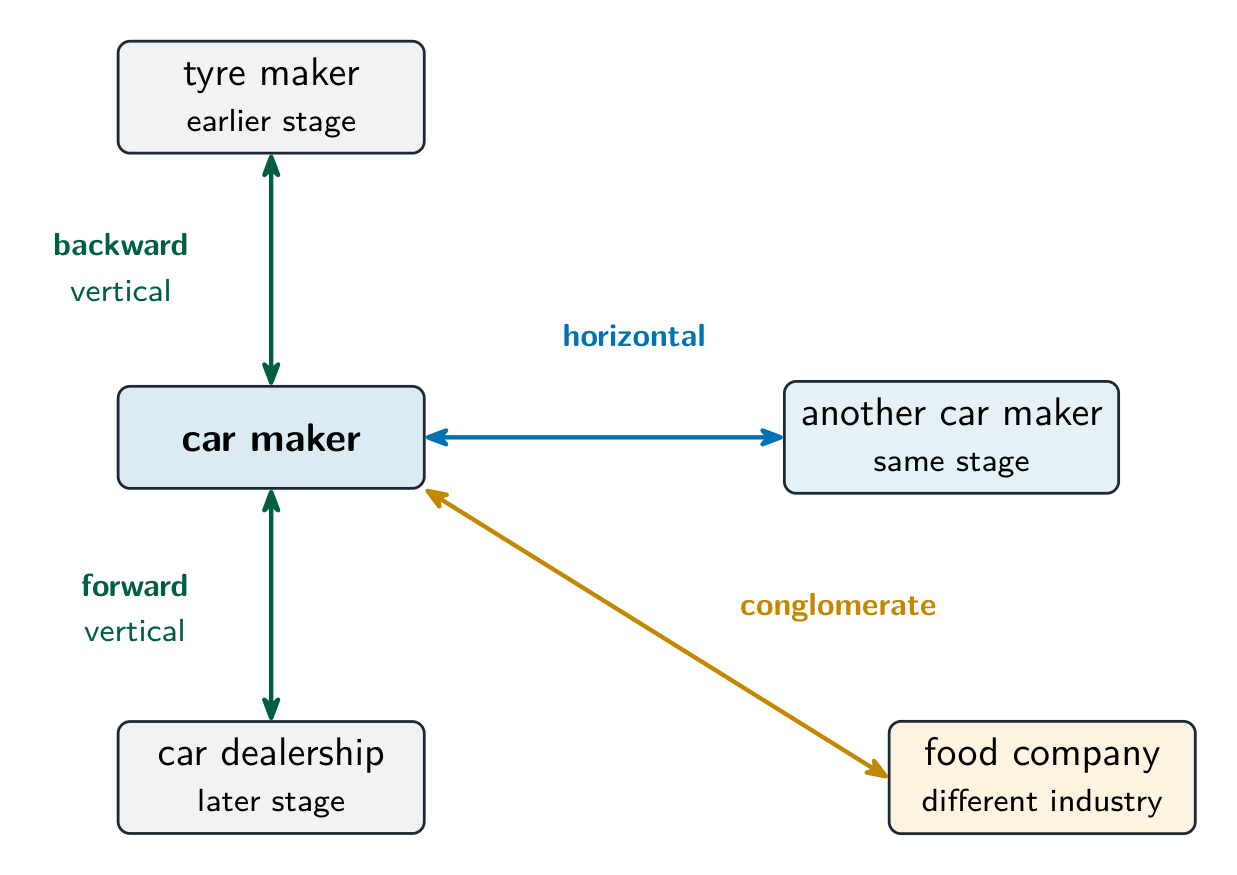
Syllabus
- explain why firms grow (internal and external — horizontal, vertical, conglomerate integration) and why some remain small
- explain barriers to entry and exit and the survival of small firms
Source: Cambridge International syllabus
A firm may expand to meet growing demand, reduce unit cost, gain bargaining power, secure supplies or enter a new market. Its size also depends on finance, management capacity, technology, the size of its market and the owner's objectives. None of these makes growth automatically profitable or socially beneficial.
Internal growth, external growth and diversification
Internal growth 内部增长, also called organic growth 有机增长, expands a business through its own investment and activities: employing staff, adding equipment, opening branches or developing products. A bakery opening its own second shop is an example. Higher sales may follow, but simply defining growth as selling more omits the investment and capacity decisions.
Diversification 多元化经营 expands into a different product or market. It can be internal: a car maker develops its own food business without buying another firm. It can also be external, through acquiring a business in another industry. Diversification and the method of growth answer different questions.
External growth 外部增长 combines existing businesses through a merger 合并 or takeover 收购. A takeover transfers control of another business; it is different from building an additional branch. Combining two existing businesses can increase capacity quickly, but integration takes time and resources. Growing internally can allow closer control over development, but may be slower or limited by available finance and skills. Judge the actual plans rather than assuming one method is always better.
Integration: start from the acquiring firm's position
Worked classification. A car maker buys four different businesses in four separate cases:
- Another car maker: horizontal integration 横向一体化, combining firms at the same stage of the same industry.
- A tyre supplier: backward vertical integration 后向纵向一体化, moving towards an earlier input-supply stage.
- A car dealership: forward vertical integration 前向纵向一体化, moving towards distribution and final buyers.
- A food company: conglomerate integration 混合一体化, combining businesses in different industries. This is external diversification.
Backward and forward are both vertical integration 纵向一体化: different stages of the same production chain are combined. Reversing who buys whom reverses the direction. A tyre supplier buying a car maker moves forward; a dealership buying a car maker moves backward. Draw the chain and identify the buyer before naming the type.
From the car maker's position, buying the tyre supplier is backward vertical integration and buying the dealership is forward vertical integration. Arrows show joining choices, not physical product flows. A horizontal merger may share specialist equipment, remove duplicated costs and increase bargaining power, but also reduce competitive pressure. Backward integration may secure supplies and quality; forward integration may secure distribution and information about buyers. Both can introduce unfamiliar management tasks or reduce flexibility in choosing other suppliers. Conglomerate integration may spread exposure across markets, but risks can remain linked and management may lack experience in the new industry. Explain a specific mechanism and its limits instead of saying that every merger achieves economies of scale.
Compare merger savings with costs and stakeholder effects
Worked monthly forecast. Two firms together sell 200 units/month at £6/unit. Their combined cost is £1,000/month. A merger is forecast to reduce recurring cost to £800/month at the same output and quality, but there is a £300 transition bill in its first month. Use $AC=TC/Q$, $TR=PQ$ and $\pi=TR-TC$.
$$TR=PQ=£6/\text{unit}\times200\text{ units/month}=£1{,}200/\text{month}$$Case TC (£/month) AC (£/unit) Profit (£/month) Before 1000 5.00 200 First month 1100 5.50 100 Later month 800 4.00 400 The first-month cost includes the transition payment:
$$TC_{\text{first}}=TC_{\text{recurring}}+\text{transition cost}=£800/\text{month}+£300/\text{month}=£1{,}100/\text{month}$$$$AC_{\text{first}}=TC_{\text{first}}/Q=£1{,}100/\text{month}\div200\text{ units/month}=£5.50/\text{unit}$$$$\pi_{\text{first}}=TR-TC_{\text{first}}=£1{,}200/\text{month}-£1{,}100/\text{month}=£100/\text{month}$$Later recurring savings are conditional on the forecast being achieved. Lost customers, incompatible systems or management problems can change them. This operating-cost illustration is not a full investment appraisal: acquisition price, financing and opportunity costs also matter. Compare the same period, output and quality rather than hiding a one-off bill in a different period.
Lower costs need not mean lower prices if market power increases. Buyers may gain from quality or lower prices, or lose from reduced choice and higher prices. Workers may face training opportunities or job losses; suppliers may gain stable contracts or face stronger bargaining pressure. Owners' profit is only one part of the assessment.
Why small firms survive and why some choose not to grow
A specialist repairer may have limited local demand and provide personal service with few scale economies. That does not mean every local service has no route to expansion: another profitable location, a new service model or a franchise may permit growth. An online craft seller can reach a large geographical market and still choose to stay small to keep control. A supplier can remain small by meeting specialised orders from large manufacturers reliably.
A niche 利基市场 is a narrow customer need or market segment. Distinctive products, personal service, flexibility and supplying larger firms can help a small firm survive. They do not guarantee profit: easy entry may attract rivals, and customers' needs can change. Finance, management capacity, demand and the cost path constrain the decision to expand. Small size is not by itself evidence of failure; large size is not proof of efficiency.
Barriers to exit 退出壁垒 include future penalties or obligations that make leaving costly. Past sunk spending is different. Once a machine's unrecoverable purchase cost is already sunk, that spending alone should not justify continued avoidable losses. Compare future avoidable costs, receipts, exit obligations and alternative opportunities.
Effective cartels: conditions and consequences
Revisit the earlier payoff matrix. A high joint profit does not remove each firm's incentive to undercut or supply more than its agreed quantity. A small number of firms can make coordination easier, similar costs can make preferred prices more alike, and observable sales can make cheating easier to detect. Stable demand can help distinguish cheating from an unexpected change in orders. Barriers to entry reduce the threat of outside suppliers taking profitable business.
Worked comparison. Industry A has three similar-cost firms, stable demand, observable sales and difficult entry. Industry B has twenty different-cost firms, volatile orders, hard-to-observe sales and easy entry. A has more favourable conditions for maintaining a supply agreement, but it is not guaranteed to do so. B faces more coordination problems, conflicting preferred prices, difficult monitoring and outside entry. High concentration by itself does not establish a stable cartel.
An effective supply restriction can raise prices and member profits while reducing output and buyer choice. Where no other distortion offsets the restriction, output below the social optimum can cause a welfare loss. Cheating, entry or changed costs and demand can undermine the agreement. Evaluate the mechanism and the evidence, not the label alone.
Owners, managers and the principal-agent problem
The principal-agent problem 委托代理问题 arises when a person making decisions has different incentives from the person represented, especially when actions or effort are hard to observe. The divorce of ownership from control 所有权与控制权分离 can create this problem: shareholders own a large company while managers make many decisions. Conflict is possible, not inevitable; owners' objectives can differ too.
Worked incentives. Project A produces £10,000/month profit before bonuses and offers the manager an easier schedule. B produces £12,000/month before bonuses but needs more supervision. The manager receives the same fixed salary in either case. A profit-seeking owner prefers B here; the manager may prefer A's easier schedule. A 10% profit bonus gives:
$$\text{Bonus}_A=0.10\times\text{profit}_A=0.10\times£10{,}000/\text{month}=£1{,}000/\text{month}$$$$\text{Bonus}_B=0.10\times\text{profit}_B=0.10\times£12{,}000/\text{month}=£1{,}200/\text{month}$$B gives the manager £200/month more bonus. Owners also prefer B after these bonuses: retained profit is £10,800/month rather than £9,000/month, before any unchanged salary already accounted for in the original profit figures. The incentive narrows the conflict but does not guarantee alignment: an easier schedule could be worth more than £200/month to the manager.
Monitoring, profit-related pay and longer-term share incentives can help. They also have costs and can encourage manipulation of short-term targets or risky choices. Choose a measure that reflects the intended outcome and check behaviour rather than assuming any bonus solves the problem completely.
ExploreFirm objective lab
Classify real firm decisions by the objective they reveal.
Vocabulary TrainEnglish internal growth/ɪnˈtɜːnl ɡrəʊθ/ external growth/ekˈstɜːnl ɡrəʊθ/ merger/ˈmɜːdʒə/ horizontal integration/ˌhɒrɪˈzɒntl ˌɪntɪˈɡreɪʃn/ vertical integration/ˈvɜːtɪkl ˌɪntɪˈɡreɪʃn/ conglomerate integration/kənˈɡlɒməreɪt ˌɪntɪˈɡreɪʃn/ niche/niːʃ/ barriers to exit/ˈbærɪəz tʊ ˈeɡzɪt/ divorce of ownership from control/dɪˈvɔːs ɒv ˈəʊnəʃɪp frɒm kənˈtrəʊl/ principal-agent problem/ˈprɪnsɪpl ˈeɪdʒənt ˈprɒbləm/ organic growth/ɔːˈɡænɪk ɡrəʊθ/ diversification/daɪˌvɜːsɪfɪˈkeɪʃn/ takeover/ˈteɪkəʊvə/ backward vertical integration/ˈbækwəd ˈvɜːtɪkl ˌɪntɪˈɡreɪʃn/ forward vertical integration/ˈfɔːwəd ˈvɜːtɪkl ˌɪntɪˈɡreɪʃn/ 7.8
The objectives of firms
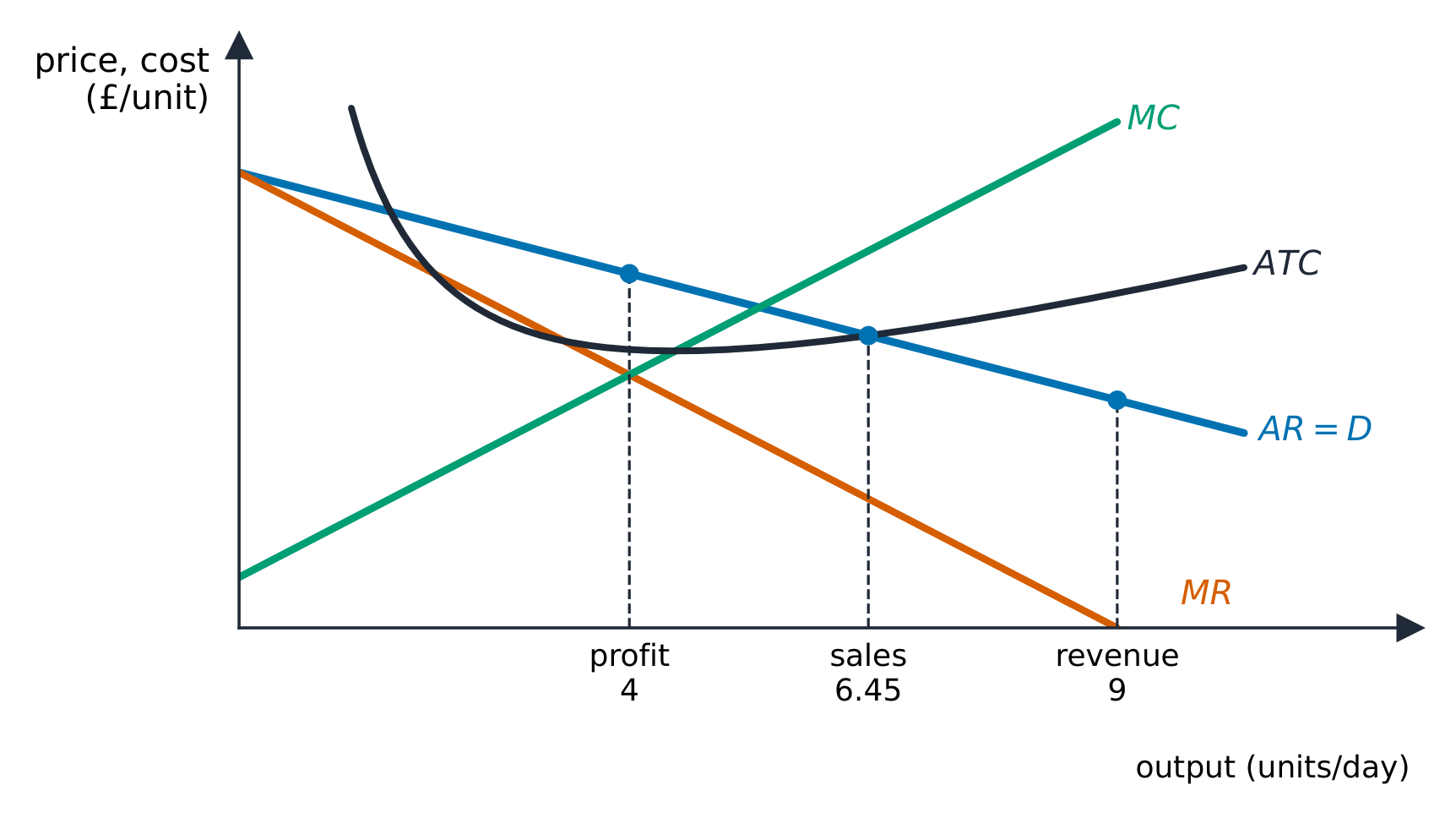
Syllabus
- explain alternative objectives of firms: profit maximisation, revenue maximisation, sales maximisation, satisficing
- explain the divorce of ownership from control (principal–agent problem) and its consequences
Source: Cambridge International syllabus
An objective is what the firm tries to achieve. A constraint limits the choices it can make. Profit, revenue and quantity sold are different measures. Compare them using the same demand, costs and period; do not infer an objective from one observed price alone.
Profit, revenue and sales: compare the same firm
Profit maximisation 利润最大化 means choosing the feasible output with the greatest total economic profit, including comparison with stopping production. For a smooth interior maximum, $MR=MC$ with marginal profit changing from positive to negative. An intersection alone does not prove a maximum; discrete outputs, capacity limits and several intersections require comparison of total profit.
Revenue maximisation 收益最大化 means choosing the greatest total revenue, $TR=PQ$, without subtracting costs. At a smooth interior revenue maximum, MR changes from positive to negative through zero. A price-taking firm with a positive fixed price has no such interior maximum: revenue rises until its feasible output limit. Revenue maximisation need not cover costs.
Sales maximisation 销售最大化 here means choosing the largest quantity subject to at least normal profit, so economic profit must be non-negative. In the standard continuous diagram, this is the largest feasible output where AR is at least ATC, often the higher-output AR=ATC intersection. The profit constraint is essential; the highest revenue and highest quantity are different objectives. Other stated constraints can change the answer.
Worked comparison. Reuse the illustrative monopoly model with daily demand $P=AR=18-Q$ and economic cost $TC=20+2Q+Q^2$. Prices/costs per unit are in pounds and Q is in units/day. The numerical coefficients have the compatible units. Then $TR=18Q-Q^2$ and $\pi=TR-TC=16Q-2Q^2-20$. Economic cost includes normal profit. This is a demand and cost model, not a claim about all firms.
Q (units/day) TR (£/day) TC (£/day) Profit (£/day) 0 0 20 −20 1 17 23 −6 2 32 28 4 3 45 35 10 4 56 44 12 5 65 55 10 6 72 68 4 7 77 83 −6 8 80 100 −20 9 81 119 −38 10 80 140 −60 Among these feasible integer outputs, profit is greatest at Q=4, revenue at Q=9, and the largest quantity with non-negative profit is Q=6. At Q=0 the fixed cost remains; stopping gives −£20/day, below the £12/day maximum. Moving from Q=4 to Q=9 raises revenue by £25/day but cost by £75/day, so profit falls by £50/day.
$$\Delta TR=TR_9-TR_4=£81/\text{day}-£56/\text{day}=£25/\text{day}.$$$$\Delta TC=TC_9-TC_4=£119/\text{day}-£44/\text{day}=£75/\text{day}.$$$$\Delta\pi=\Delta TR-\Delta TC=£25/\text{day}-£75/\text{day}=-£50/\text{day}.$$For a uniform-price seller, the price cut also affects earlier units. The extra five units bring in £45/day, but the original four each bring in £5 less, losing £20/day. Net revenue rises by £25/day. On a smooth diagram, the signed area under MR between the two outputs is the change in TR. A price-times-quantity rectangle gives total revenue at one output, not profit.
For divisible output in this model, profit maximisation gives $18-2Q=2+2Q$, so Q=4. Revenue maximisation gives $18-2Q=0$, so Q=9. The upper zero-profit boundary solves $16Q-2Q^2-20=0$, giving $Q=4+\sqrt{6}\approx6.45$ units/day. That is the continuous sales maximum subject to non-negative economic profit, rather than Q=6 from the integer table. Price is read from AR after choosing output. Do not round a continuous boundary upward to an infeasible integer output.
Illustrative continuous choices: profit Q=4, constrained sales Q≈6.45 and revenue Q=9. At the revenue maximum, AR is below ATC, so the firm makes a loss. The order shown belongs to this model and its constraint. Profit satisficing and survival
Profit satisficing 满意化 means accepting a satisfactory profit target rather than the greatest possible profit. The target must be stated. In the integer table, a target of at least £10/day allows Q=3, 4 or 5. A manager who meets that target and then prefers the greatest quantity chooses Q=5, although Q=4 earns more profit. A different secondary aim could select another acceptable output. Satisficing does not mean every stakeholder must be happy or that all acceptable choices are equally good.
Survival means keeping the business operating, particularly when demand or access to finance is weak. A firm may cut investment or preserve cash while accepting a temporary economic loss. Profit and cash available to pay bills are different: a £200 monthly profit does not pay a bill if the customer has not yet paid. If only £1,200 is available and £1,500 must be paid now, the cash gap is £300. Borrowing or an agreed delay might bridge it, but neither is guaranteed. A temporary loss does not automatically imply immediate closure; compare future receipts with avoidable costs, cash needs and finance. Persisting indefinitely with avoidable losses does not establish a viable survival policy.
Objectives can change with ownership, competition, the economic climate and the time period. Owners and managers may disagree, as in the previous principal-agent example. A manager's revenue-linked bonus may encourage sales even when profit falls. Judge evidence about the stated target, constraints and behaviour rather than assuming every large firm follows one objective.
Limit pricing, predatory pricing and price leadership
Limit pricing 限制性定价 aims to discourage potential entrants. An established firm sets a price low enough to make entry unattractive, possibly sacrificing the higher short-run profit available at another price. The price need not be below the established firm's own cost. Predatory pricing 掠夺性定价 aims to force an existing rival out, using very low prices and potentially accepting short-run losses, with the intention of raising prices later to recover them. A low price or temporary loss alone does not establish that purpose: a promotion, falling costs or weak demand may also explain it.
Worked distinction. At the relevant output, an established firm's average cost is £4/unit and a potential entrant's expected average cost is £7/unit. A price of £6/unit leaves a £2/unit margin over the established firm's average cost but is £1/unit below the entrant's expected average cost. If used to deter entry, it is consistent with limit pricing. It may fail if the entrant lowers its costs, serves a different niche or expects prices to rise later. The cost estimates and the entrant's expectations matter; one observed price does not prove deterrence.
In a separate case, a firm charges £3/unit while its own average cost is £4/unit and an existing rival's is £5/unit at the relevant outputs. Both would make losses at those outputs. If the firm uses this to remove the rival and plans a later price rise to recoup losses, the strategy is consistent with predatory pricing. Success depends on finance, the rival's ability to survive and whether entry or re-entry prevents the later price rise. These illustrative costs do not prove the purpose or success of the strategy.
Price leadership 价格领导 means one firm sets or announces a price change and other firms follow. The leader may be a dominant firm or a firm regarded as a useful guide to market conditions. Following does not require a formal agreement. If a large supplier raises its price to £5 and others follow, the pattern is consistent with leadership; common input-cost changes could also explain similar prices. Evidence about timing, independent costs and communication is needed before claiming collusion. Leadership and entry deterrence describe different features of pricing and can coexist.
Demand elasticity and revenue on a normal demand curve
Price elasticity of demand 需求价格弹性 (PED) measures percentage quantity response divided by percentage price change. As in Topic 2, use the magnitude when classifying demand and distinguish point elasticity from a finite-change estimate. Revenue is $TR=PQ$, not profit.
For the illustrative straight-line demand $Q=18-P$, the gradient $\Delta Q/\Delta P=-1$ is constant. Point elasticity is $PED=(\Delta Q/\Delta P)(P/Q)$, so its magnitude varies along the line:
P (£/unit) Q (units/day) PED magnitude TR (£/day) 14 4 3.5 56 9 9 1 81 6 12 0.5 72 At the elastic point, a small price cut raises revenue; in the inelastic part, a small price cut lowers it. Verify two finite changes directly rather than treating a point coefficient as an exact large-change forecast:
$$TR_{14}=P_{14}Q_{14}=(£14/\text{unit})(4\text{ units/day})=£56/\text{day}.$$$$TR_{13}=P_{13}Q_{13}=(£13/\text{unit})(5\text{ units/day})=£65/\text{day}.$$$$TR_6=P_6Q_6=(£6/\text{unit})(12\text{ units/day})=£72/\text{day}.$$$$TR_5=P_5Q_5=(£5/\text{unit})(13\text{ units/day})=£65/\text{day}.$$The midpoint P=9, Q=9 maximises revenue on this line. Unit point elasticity identifies that point; it does not mean revenue is unchanged over every finite movement away from it. Revenue is constant along a whole unit-elastic demand segment, which is a different statement. Revenue changes alone do not establish profit changes without costs.
Kinked demand: specify how rivals react
A kinked demand curve 拐折需求曲线 models a firm expecting rivals to ignore a price rise but match a price cut. Above the current price, buyers can switch to rivals, making demand relatively elastic. Below it, matching cuts limit the extra buyers gained, making demand relatively inelastic. These are assumptions about reactions, not a rule for every oligopoly.
Illustrative model. At the kink, P=£10/unit and Q=10 units/day. Above that price, inverse demand is $P=15-0.5Q$ for Q up to 10. Below it, $P=30-2Q$ for Q from 10 to 15. The coefficients use compatible units. At the kink the upper and lower one-sided PED magnitudes are 2 and 0.5 respectively; the point at the kink itself has no single slope.
A rise to £11/unit gives Q=8, so TR falls from £100/day to £88/day. A cut to £9/unit gives Q=10.5, so TR falls to £94.50/day. The smaller quantity response below the kink does not mean quantity fails to rise; it rises too little to offset the lower price.
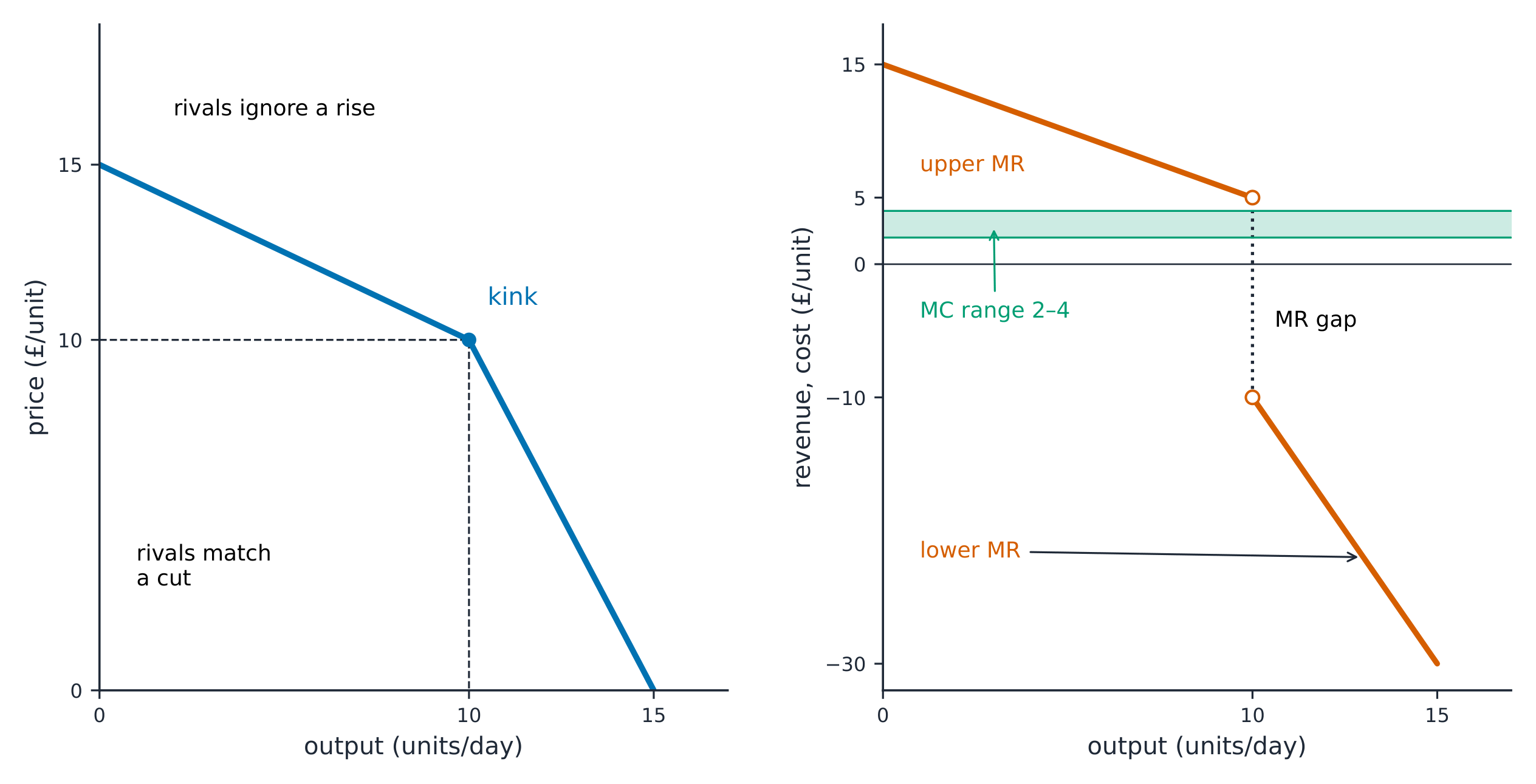
The upper MR branch reaches £5/unit at Q=10; the lower starts at −£10/unit. A change in constant MC from £2 to £4/unit remains within that gap. The two marginal-revenue branches are $MR=15-Q$ above the kink and $MR=30-4Q$ below it. At Q=10 the gap extends from −£10 to £5/unit. If constant MC changes from £2 to £4/unit, both lie inside it: reducing output loses revenue greater than saved cost, while expanding adds cost greater than revenue. The profit-maximising output remains 10 and price remains £10/unit.
With fixed cost £10/day, the profit calculation changes even though price and output do not:
$$TC_2=F+MC_2Q=£10/\text{day}+(£2/\text{unit})(10\text{ units/day})=£30/\text{day}.$$$$\pi_2=TR-TC_2=£100/\text{day}-£30/\text{day}=£70/\text{day}.$$$$TC_4=F+MC_4Q=£10/\text{day}+(£4/\text{unit})(10\text{ units/day})=£50/\text{day}.$$$$\pi_4=TR-TC_4=£100/\text{day}-£50/\text{day}=£50/\text{day}.$$This rigidity result has limits. At MC=£6/unit, above the gap, the best output becomes Q=9 and price £10.50/unit in this same model. Rival reactions, demand and costs can also change. The kinked-demand model illustrates why an existing price might persist over a range of costs; it does not explain how the initial price was chosen or prove collusion.
ExploreFirm objective lab
Classify real firm decisions by the objective they reveal.
Vocabulary TrainEnglish profit maximisation/ˈprɒfɪt ˌmæksɪmaɪˈzeɪʃn/ revenue maximisation/ˈrevənjuː ˌmæksɪmaɪˈzeɪʃn/ sales maximisation/seɪlz ˌmæksɪmaɪˈzeɪʃn/ satisficing/ˈsætɪsfɪsɪŋ/ limit pricing/ˈlɪmɪt ˈpraɪsɪŋ/ predatory pricing/ˈpredətəri ˈpraɪsɪŋ/ price leadership/praɪs ˈliːdəʃɪp/ price elasticity of demand/praɪs ɪlæˈstɪsɪti ɒv dɪˈmænd/ kinked demand curve/kɪŋkt dɪˈmænd kɜːv/ 7.8
Exam tips
- Identify the measure and constraint before choosing an output. Compute TR, TC and profit separately; more sales or revenue does not necessarily mean more profit.
- Use MR=MC as a conditional marginal test and compare feasible alternatives, boundaries and stopping. Read price from AR at the chosen Q, not from MR or MC.
- On a standard smooth U-shaped cost diagram, MC crosses AC at its interior minimum because MC below AC lowers AC and MC above AC raises it. This is not a universal shape for every technology or discrete table.
- Distinguish market structures by entry/exit, product differences, information and price-setting power as well as firm numbers. Normal profit means economic cost is covered, not that revenue is zero.
Vocabulary card meanings
Pareto optimality: A situation in which nobody can gain unless someone else loses. dynamic efficiency: Improvement over time through new products and better methods. factor immobility: When land, labour, or capital cannot easily move to a better use. private benefit: The gain kept by the person who takes an action. social benefit: The gain to society, including gains to people who did not pay. marginal analysis: Comparing the extra cost and extra gain of one more unit. perfect competition: A market with many firms, an identical product, and free entry. price competition: Rivalry that tries to win buyers by charging less. horizontal integration: Joining with a firm at the same stage of production. vertical integration: Joining with a firm at another stage of the same chain. conglomerate integration: Joining with a firm in an unrelated industry. barriers to exit: Costs that make it hard for a firm to leave an industry. revenue maximisation: Choosing the output that brings in the largest sales income. sales maximisation: Choosing the output that brings in the most sales income while profit stays at or above a required minimum. divorce of ownership from control: Shareholders own the firm, but hired managers run it. marginal external cost: The extra cost one more unit imposes on other people. marginal external benefit: The extra gain one more unit gives to other people. moral hazard: Taking bigger risks because someone else will bear the loss. increasing returns to scale: Output rises by a larger percentage than all of the inputs. decreasing returns to scale: Output rises by a smaller percentage than all of the inputs. minimum efficient scale: The smallest output at which long-run average cost is lowest. internal economies of scale: Lower average cost that a firm gains by growing itself. external economies of scale: Lower average cost that a firm gains because its industry grows. internal diseconomies of scale: Higher average cost as one firm becomes too large to manage. external diseconomies of scale: Higher average cost as the surrounding industry grows too crowded. X-inefficiency: Extra cost because a sheltered firm does not work to cut waste. contestable market: A market that new firms can enter and leave at low cost. Prisoner's Dilemma: A game in which each side's safe choice leaves both worse off. backward vertical integration: Taking over a supplier at an earlier stage of the chain. forward vertical integration: Taking over a customer at a later stage, such as a retailer. first-degree price discrimination: Charging each buyer the highest price that buyer will pay. second-degree price discrimination: Charging different prices for different amounts bought. third-degree price discrimination: Charging different groups of buyers different prices. limit pricing: Setting a low enough price to keep a new rival out. predatory pricing: Pricing below cost in order to drive a rival out. price leadership: One firm sets the price and the other firms follow it. kinked demand curve: Demand that is flatter above the current price and steeper below it.
-
8
Government microeconomic intervention (A Level)
Watch lessonThis topic looks at how governments correct market failure 市场失灵, make incomes fairer, and act in the labour market.
8.1
Correcting market failure
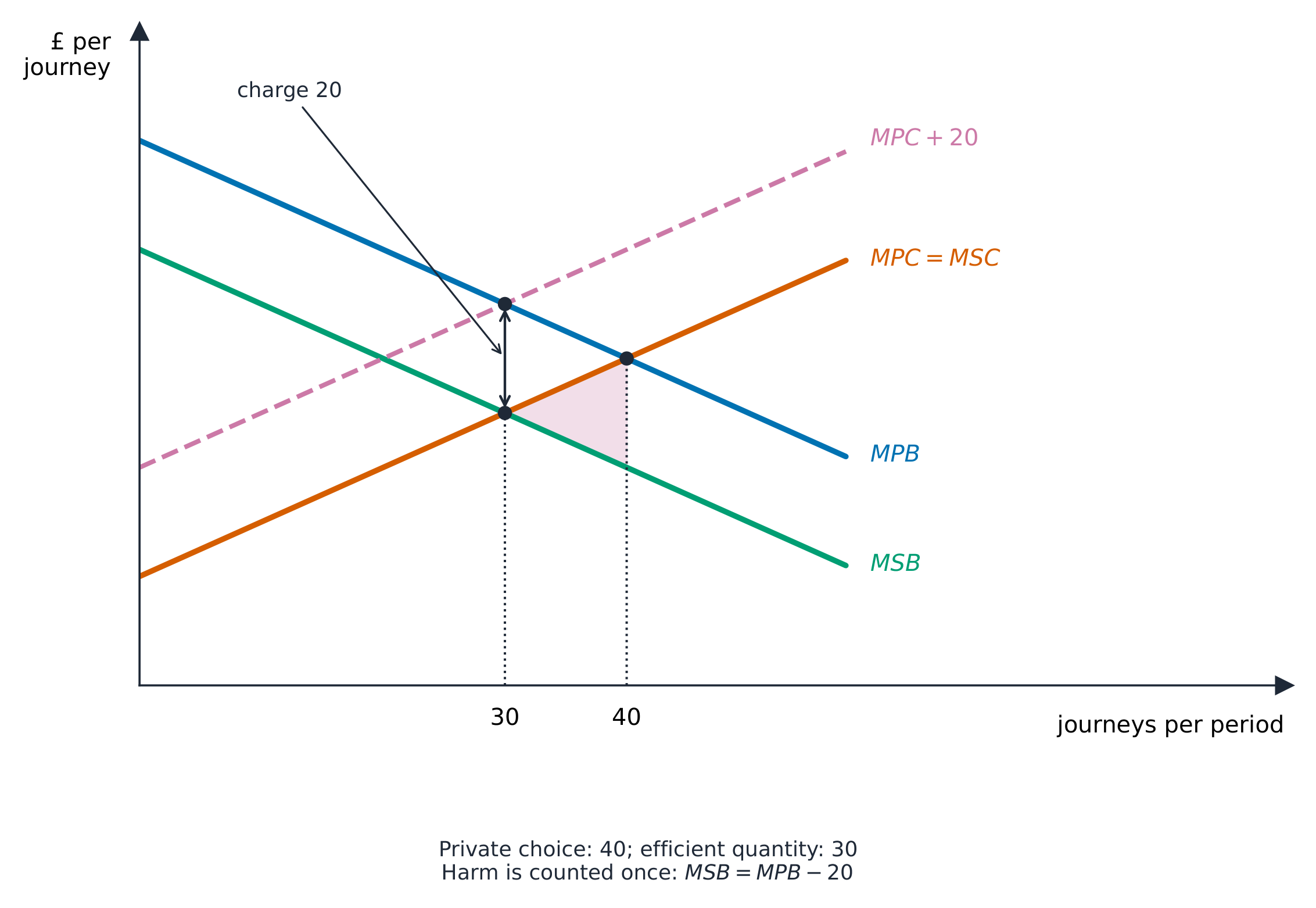
Syllabus
- explain policies to correct market failure: taxes, subsidies, price controls, tradable permits, regulation, provision, nationalisation and privatisation
- explain competition policy and the concept of government failure
Source: Cambridge International syllabus
Start with the cause of market failure and the outcome being targeted. Reducing a quantity, raising revenue and improving resource allocation are different aims. This unit builds on the private/social cost and benefit diagrams in the earlier A-Level microeconomics topic; a policy answer must use those diagrams, not just name a tool.
Congestion: identify harm to other people
A driver considers their own journey benefit and private costs. An extra trip can also delay other road users. That extra delay is an external harm; it is different from the driver's own time cost. In a negative consumption-externality diagram, marginal social benefit is below marginal private benefit. Alternatively the extra harm can be represented on the cost side, but do not subtract it from benefits and add it to costs in the same calculation.
Worked illustrative model. Quantity Q is journeys per period; all marginal benefits and costs are in pounds per journey. Marginal private benefit is MPB =100 −Q. Marginal private cost is MPC =20 +Q. External harm is £20 per journey. In the benefit-side diagram, MSB =80 −Q and MSC =MPC. These are constructed values, not estimates of a real city's optimal charge. The private outcome ignores harm to others:
$$MPB=MPC\quad\Rightarrow\quad 100-Q=20+Q$$$$Q_m=(100-20)/2=40\text{ journeys per period}$$$$C_m=20+Q_m=20+40=\text{£}60\text{ per journey}$$The efficient quantity balances marginal social benefit and cost:
$$MSB=MSC\quad\Rightarrow\quad 80-Q=20+Q$$$$Q^*=(80-20)/2=30\text{ journeys per period}$$$$C^*=20+Q^*=20+30=\text{£}50\text{ per journey}$$For journeys between 30 and 40, marginal social cost exceeds marginal social benefit. Removing these trips avoids a triangular deadweight loss:
$$DWL=\tfrac 12(Q_m-Q^*)\,MEC=\tfrac 12(40-30)(20)=\text{£}100\text{ per period}$$Private choice gives 40 journeys. Including the external harm gives 30. A 20-pound charge raises private marginal journey cost and reaches 30 in this model; the charge is a transfer, not an extra 20 pounds of real resource cost per journey. A charge: follow incentives, output and revenue
An indirect tax 间接税 or road-use charge raises the private marginal cost faced by the traveller. In this model a specific £20 charge gives:
$$MPB=MPC+t\quad\Rightarrow\quad 100-Q=20+Q+20$$$$Q_t=(100-40)/2=30\text{ journeys per period}$$$$C_{\rm faced}=MPC(Q_t)+t=20+30+20=\text{£}70\text{ per journey}$$$$R=tQ_t=20(30)=\text{£}600\text{ per period}$$The £70 is the traveller's marginal private journey cost including the charge; £50 is private cost excluding it. Costs may include time as well as money, so do not describe these numbers as a fare and a transport company's cash receipts. Tax revenue must not be counted as an additional social loss: it is transferred to government. External harm from the remaining 30 journeys is still £600; efficient output does not mean zero harm. The aim is to remove trips whose social cost exceeds their social benefit, not necessarily to ban all travel.
The corrective charge equals marginal external harm at the efficient quantity under this model's assumptions. With varying harm, different times, incomplete coverage, market power or uncertain behaviour, a uniform charge need not be exactly efficient. Diversion to another road may move harm rather than remove it. Assess monitoring, collection costs, distributional effects, availability of alternatives and how revenue is used.
A specific tax is a fixed amount per unit. An ad valorem tax 从价税 is a proportion of a taxable price: at a 20% rate the tax on a £50 taxable price is £10, while on £80 it is £16. Neither the rate nor revenue alone establishes that the tax matches external harm.
Subsidising an alternative is a different mechanism
A subsidy 补贴 can make public transport cheaper or support additional capacity. It reduces road congestion only to the extent that it changes relevant travel choices; not every additional passenger was previously a car user.
Separate transport-market example. Bus demand is P =50 −Q and original supply is P =10 +Q, with pounds per trip and trips per period. Before subsidy, Q 20/P 30. A per-trip producer subsidy £10 gives buyer-facing supply P =Q:
$$P_D=P_S-s\quad\Rightarrow\quad 50-Q=10+Q-10$$$$Q_1=50/2=25\text{ bus trips per period}$$$$P_b=50-Q_1=50-25=\text{£}25\text{ per trip}$$$$P_s=P_b+s=25+10=\text{£}35\text{ per trip}$$$$G=sQ_1=10(25)=\text{£}250\text{ per period}$$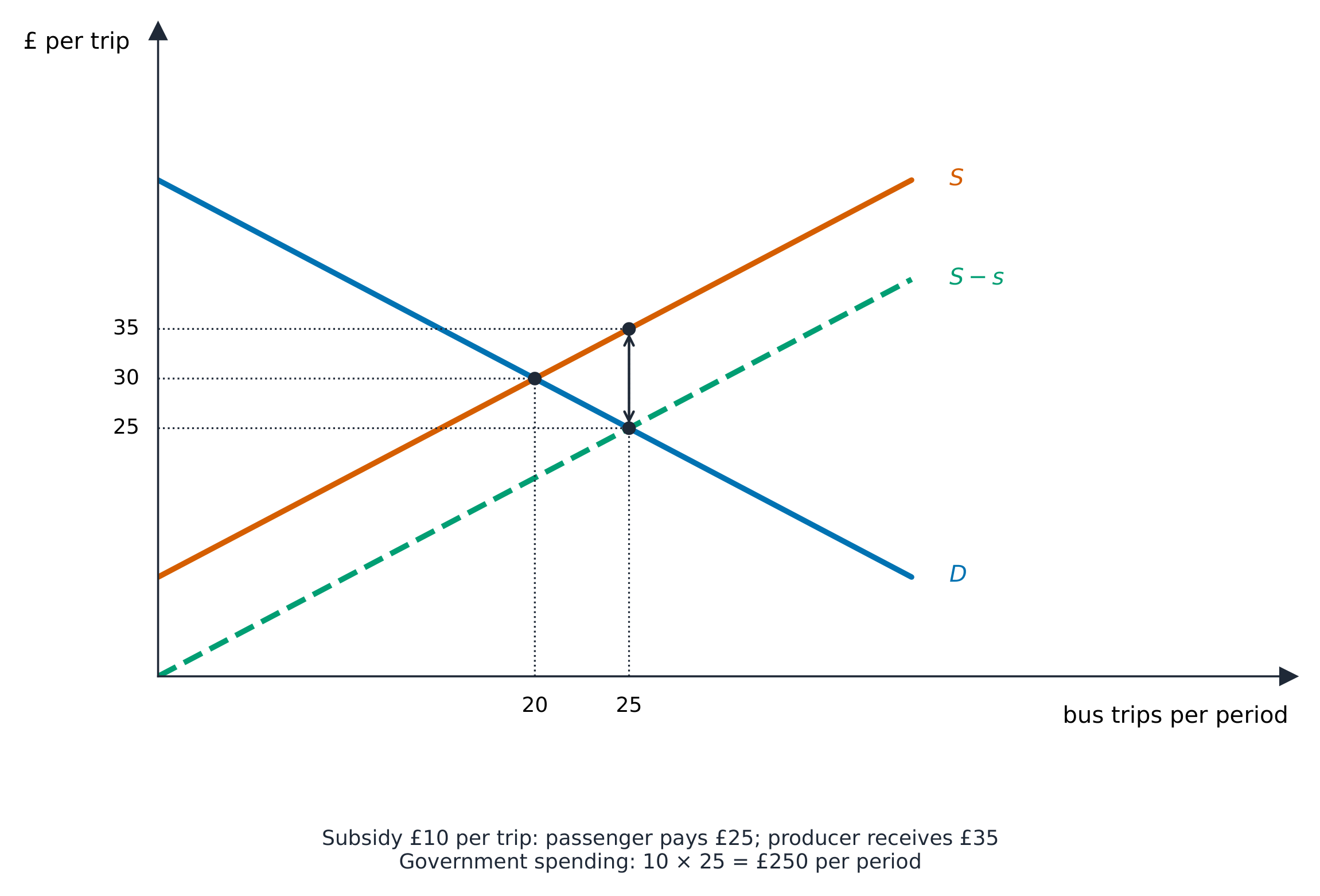
In this separate market, passengers pay 25, producers receive 35 and quantity rises 20→25; the fiscal cost is 250 per period. The five extra bus trips do not establish five fewer car trips. Some passengers may switch from walking, and the routes or times may not serve congested journeys. Compare a road charge with this subsidy using price responses, substitution, service quality and fiscal opportunity cost. A subsidy also does not create new buses or staff immediately when capacity is fixed.
Price controls: distinguish affordability from allocation
A price control 价格管制 sets a legal ceiling or floor. In a separate competitive market, demand is Qd =30 −P and supply Qs =P. Original equilibrium is P 15/Q 15. A ceiling 12 gives demand 18 but supply 12: a shortage 6, with only 12 units supplied legally without another source. A lower posted price does not establish better availability or efficient allocation. In a market with power or a different supply structure, first identify the relevant model; do not assume every ceiling has the same effects. Minimum wages below provide a further price-floor application.
Quantity rules, permits and property rights
Regulation 管制 can impose standards or restrictions. A production quota 生产配额 limits a stated quantity; a prohibition 禁令 bans a stated activity; a licence 许可证 sets conditions for legal participation. A cap can make the allowed quantity clear, but enforcement, exemptions and illegal activity determine the actual outcome. Different rules work through different channels; not all regulation is simply a quantity limit.
Tradable permits 可交易许可证 combine an overall emissions cap with trade in permission to emit. Suppose two firms would otherwise emit two units each. A cap of two units requires two reductions overall. Each of A's two possible reductions costs £10; each of B's costs £30. Making each cut one costs £40. Allowing A to cut two and B none costs £20 and meets the same cap. A permit trade can reward these cheaper reductions. This least-cost argument assumes the emissions are comparable, trades are feasible and compliance is monitored; local hotspots, market power or poor enforcement can change the result. A permit price is a transfer between traders, not another resource cost of abatement.
Clear property rights 产权 may let affected parties negotiate. If reducing a factory's noise costs £80 and benefits a neighbouring household by £120, there is a possible gain of £40 to share through agreement. Bargaining can be difficult when thousands of people are affected, harm is hard to measure, rights are unclear or enforcing agreement is costly. This is a conditional alternative to a direct tax or ban, not proof that all externalities solve themselves.
Information, nudges, provision and ownership
State provision 政府提供 means government supplies or arranges a service; it need not be free. Extra buses or safer cycling routes may address an actual missing alternative. Information about routes or travel times may help where people lack knowledge, but cannot by itself supply a bus that does not exist. A nudge 轻推 changes how a choice is presented while leaving options available, such as making a public-transport route the default suggestion. Its effect depends on the cause of behaviour and whether travellers can use the suggested option.
Nationalisation 国有化 transfers ownership into the public sector; privatisation 私有化 transfers it to private owners. Neither change alone removes monopoly power, creates a third-party price or ensures adequate capacity. Compare objectives, incentives, regulation, investment and accountability before predicting the outcome.
Competition policy and government failure
Competition policy 竞争政策 addresses practices or structures that weaken effective competition. A firm with monopoly power 垄断势力 may restrict output and raise price. Preventing price-fixing, reviewing mergers or reducing entry barriers can help, but a large size alone does not establish harmful behaviour. Merger cost savings must be compared with effects on rivalry and customers; regulation of a natural monopoly must consider costs, quality and investment.
Government failure 政府失灵 means intervention produces worse resource allocation than the relevant alternative. A policy being costly, imperfect or unpopular is not enough to establish failure. Compare benefits with administration, compliance and opportunity costs. Poor estimates of harm, weak enforcement, time lags, unintended diversion or decisions serving a narrow group can reduce the gain.
Deregulation 放松管制 removes or relaxes a restriction. Suppose an exclusive route licence blocks other bus operators. Allowing entry may increase choice and rivalry, but entry is not guaranteed if depot access or scale remain barriers. Retaining safety standards and managing scarce road space may still be needed. Removing a rule does not by itself remove congestion or establish a welfare gain. Compare benefits from entry with service quality, coverage and external costs.
Build a two-policy judgement. For congestion, explain the external harm and inefficient quantity with a labelled diagram. Show how a charge changes private incentives; compare it with an alternative-transport subsidy or direct provision. Evaluate responsiveness, routes and capacity, time, costs and who is affected. A justified combination may work better than either policy alone, but must be assessed against feasible alternatives. In a climate-change question also consider cross-border effects, coordination, bargaining or private action; do not conclude that all government intervention succeeds or that government is the only possible source of improvement.

Cigarettes can involve underestimated harm to the smoker and harm to others. These are different mechanisms; a policy should address the relevant one. ExploreA private-market charge shift
Explore how an extra cost changes private equilibrium. This display does not show social-benefit curves, efficient quantity or welfare loss; use the handout diagram for those.
Vocabulary TrainEnglish market failure/ˈmɑːkɪt ˈfeɪlɪə/ indirect tax/ɪndaɪˈrekt tæks/ subsidy/ˈsʌbsɪdi/ price control/praɪs kənˈtrəʊl/ tradable permits/ˈtreɪdəbl ˈpɜːmɪts/ regulation/ˌreɡjʊˈleɪʃn/ state provision/steɪt prəˈvɪʒn/ nationalisation/ˌnæʃənəlaɪˈzeɪʃn/ privatisation/ˌpraɪvətaɪˈzeɪʃn/ monopoly power/məˈnɒpəli ˈpaʊə/ competition policy/ˌkɒmpəˈtɪʃn ˈpɒlɪsi/ government failure/ˈɡʌvənmənt ˈfeɪlɪə/ ad valorem tax/æd ˈvælɒrəm tæks/ production quota/prəˈdʌkʃn ˈkwəʊtə/ prohibition/prəhɪˈbɪʃn/ licence/ˈlaɪsəns/ property rights/ˈprɒpəti raɪts/ nudge/nʌdʒ/ deregulation/diːˌreɡjʊˈleɪʃn/ 8.2
Equity and redistribution

Syllabus
- distinguish equity, equality, and the difference between income and wealth
- explain the Lorenz curve and Gini coefficient and policies to redistribute income and wealth (taxation, benefits, the difficulty of redistributing wealth)
Source: Cambridge International syllabus
Equity 公平 means fairness; equality 平等 means equal amounts, treatment or opportunities, depending on the comparison. People may disagree about what is fair. Two households each receive £100: equal cash amounts, but not necessarily equal opportunities if one needs costly disability support. Allocative efficiency concerns whether resources produce the greatest net social benefit. An efficient allocation can still be judged unfair. Better access to education may improve both fairness and efficiency; neither a conflict nor a joint gain is automatic.
Equal amounts and fair treatment are different judgements. Inequality 不平等 describes differences in a distribution. Income 收入 is a flow over a period. Wealth 财富 is a stock of assets less relevant debts at a date. A person earning £2000 per month with a £150000 home and £100000 mortgage has £50000 net housing wealth, before other assets and debts. Monthly income and this stock cannot be added as if they had the same units.

A photograph may suggest differences in living conditions; it does not measure an income Gini or prove their cause. Measuring inequality
A Lorenz curve 洛伦兹曲线 plots cumulative income share vertically against cumulative population share horizontally, ordering people from poorest to richest. Both axes run from 0 to 100%. The diagonal represents equal shares. Let A be the area between the diagonal and the curve, and B the area below the curve. The Gini coefficient 基尼系数 is:
$$G=\frac{A}{A+B}$$Zero represents perfect equality; values nearer one indicate greater measured inequality. Use the same population, income definition and period when comparing. Income and wealth Ginis describe different distributions. A Gini does not establish absolute living standards, the cause of a change or the position of every group.
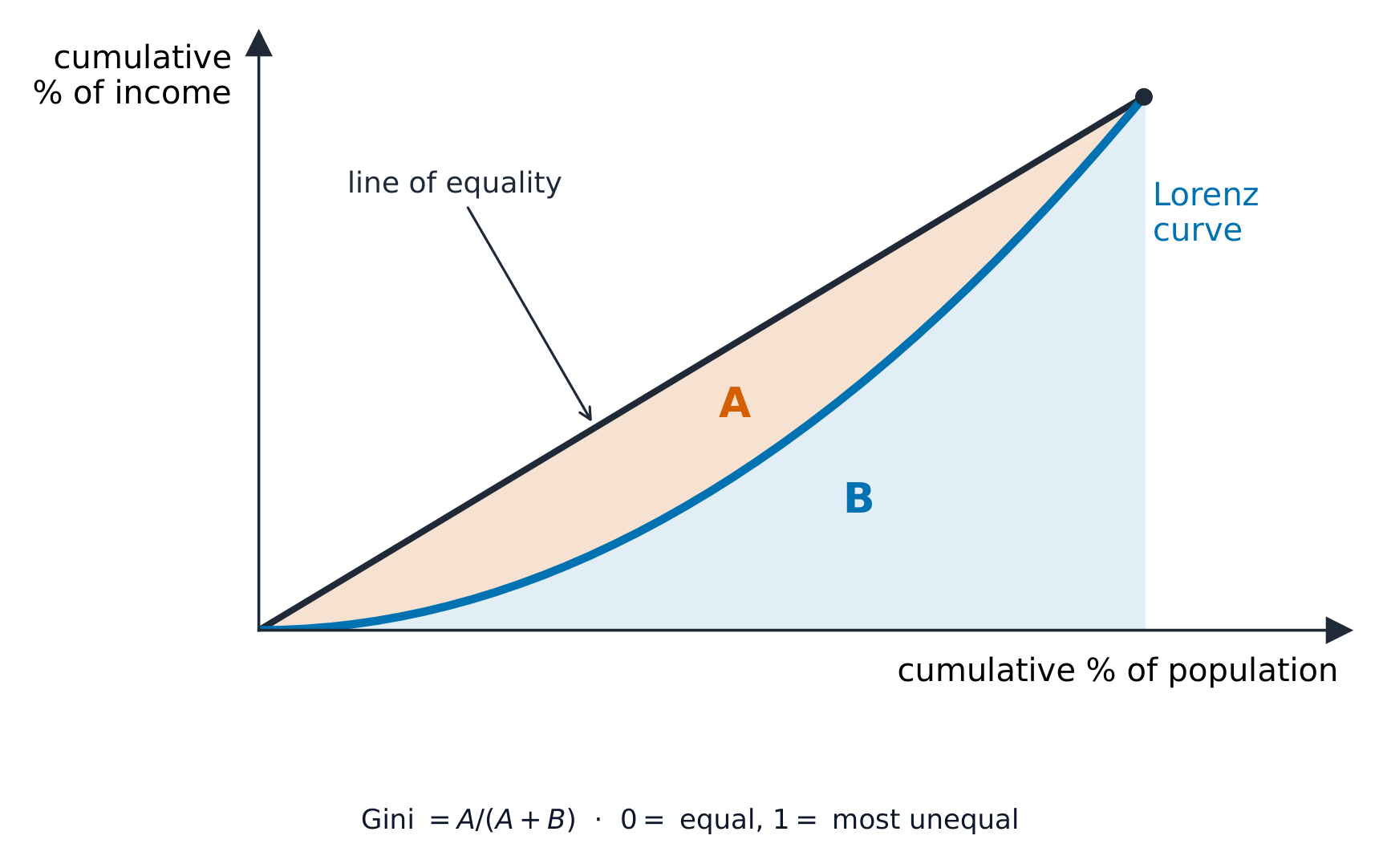
The area ratio summarises the whole distribution. It does not identify every household's income. Worked data comparison. Each row below is one fifth of the population, ordered by income within that economy. Entries are shares of total income, not pounds.
Fifth, poorest first A share % B share % 1 5 2 2 10 18 3 15 20 4 20 25 5 50 35 Add the shares: A's cumulative percentages are 0, 5, 15, 30, 50, 100; B's are 0, 2, 20, 40, 65, 100. Their Lorenz curves cross. For straight segments between these grouped points, the illustrative Ginis are 0.400 and 0.292. B has a lower overall Gini but its poorest fifth receives a smaller share, 2% rather than 5%. A lower Gini alone cannot prove that one Lorenz curve lies everywhere above another. Nor do these percentages establish which poorest group has more pounds without total income and population information.
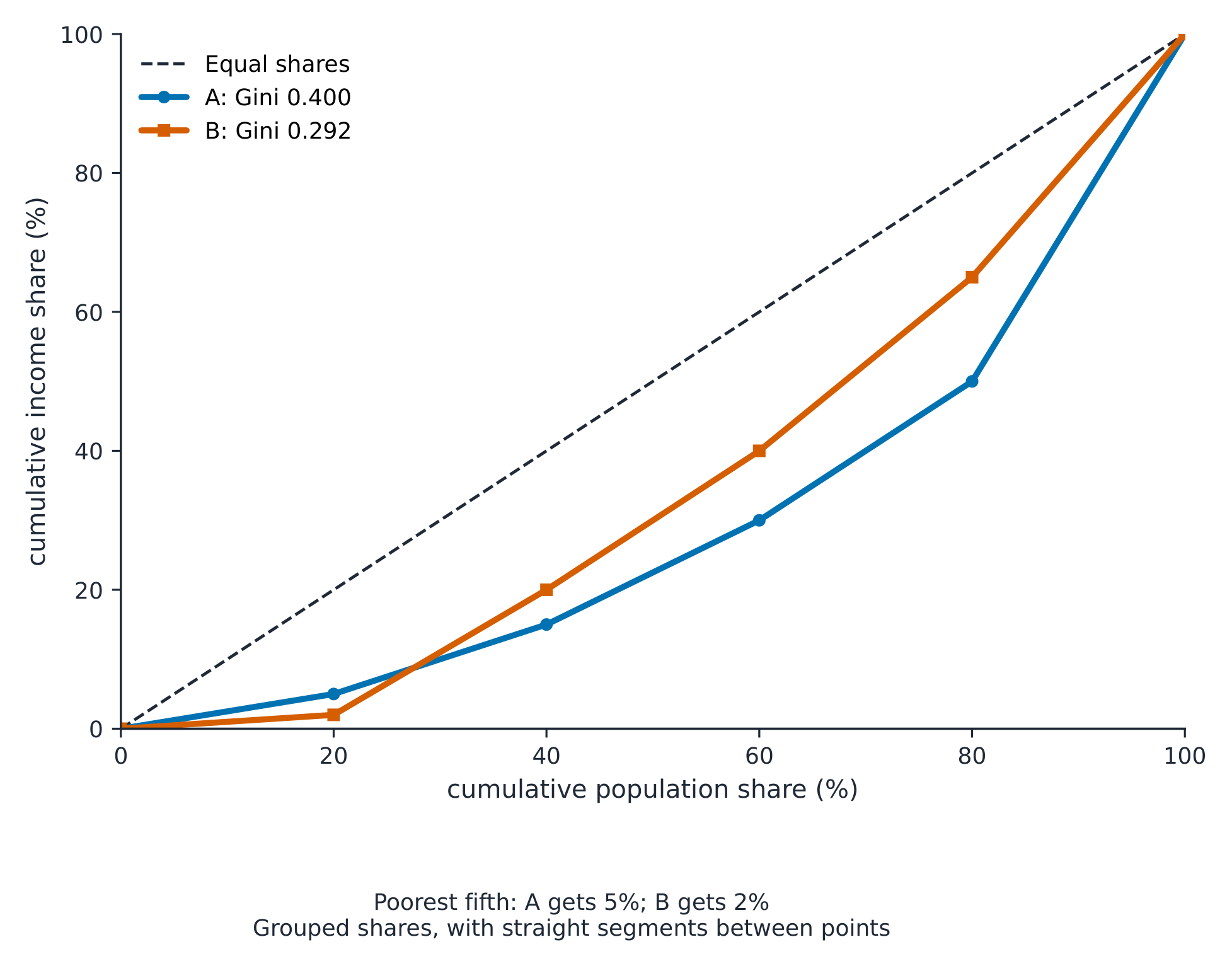
The ranking of the two poorest cumulative groups changes: a Gini ranking does not establish pointwise dominance. Poverty and the poverty trap
Absolute poverty 绝对贫困 means resources fall below a specified basic-needs standard. Relative poverty 相对贫困 means resources fall below a specified standard relative to society, often a fraction of median income. State the measure and household adjustment. A relative threshold may rise as median income rises. A Gini can fall while some people remain unable to afford basic needs.
A poverty trap 贫困陷阱 can arise when extra earnings bring higher taxes and withdrawal of benefits, leaving little extra disposable income and weakening the financial return to work. It is not simply another name for low income.
Worked example, pounds per week. Earnings rise from 100 to 150; tax rises from 0 to 20; benefits fall from 80 to 55.
$$Y_d=Y-T+B$$$$Y_{d0}=100-0+80=\text{£}180\text{ per week}$$$$Y_{d1}=150-20+55=\text{£}185\text{ per week}$$Of £50 extra earnings, only £5 remains. The combined effective marginal withdrawal rate is:
$$m=\frac{\Delta T-\Delta B}{\Delta Y}=\frac{20-(-25)}{50}=0.90=90\%$$Travel or childcare costs may further change the gain. The calculation identifies a financial incentive, not a guarantee about an individual's decision. Education, health and care responsibilities also matter.
Policies to redistribute
A progressive tax 累进税 takes a larger average share of higher incomes. Benefits 福利金 paid without a current production exchange are transfer payments 转移支付. Taxes, transfers and services can change disposable income and opportunity; this is redistribution 再分配. They may also change work, saving and investment incentives. Wealth policies require attention to valuation, liquidity, enforcement and avoidance; income taxes have their own enforcement problems. Which is easier to administer depends on the actual tax base and institutions.

A progressive schedule concerns rates, not merely a larger cash bill. A negative income tax 负所得税 pays a net transfer below a break-even income and collects net tax above it. In an illustrative weekly rule, net tax T = 0.5Y − 80. Negative T means a payment to the household, not a debt it owes.
Earnings Y Net tax T Disposable Y − T 0 −80 80 100 −30 130 160 0 160 200 20 180 For example, $T=0.5(100)-80=-\text{£}30$ and $Y_d=100-(-30)=\text{£}130$ per week. Each extra pound of earnings adds 50p to disposable income in this rule before other taxes, transfers or costs. Assess adequacy, finance, take-up and administration; a smooth withdrawal does not eliminate every barrier to employment.
Universal benefits 普惠福利 go to everyone within a defined eligible category, such as all eligible children. Means-tested benefits 经济状况审查福利 depend on income or assets. A universal basic income 全民基本收入 is a regular unconditional payment to every individual in the defined population. A child benefit is not automatically a UBI.
Comparison task. A category contains 100 households; 40 meet a low-income test. A payment of £80 per household costs £8000 if universal within the category or £3200 if limited to the 40, before administration and tax recovery. The smaller gross payment bill does not prove greater net benefit: check exclusions, take-up, withdrawal incentives and administrative costs. Universal payments may reach households with high incomes but the tax system can recover some cost. Accessible education and health services may improve opportunity, yet places, quality and financing constrain the result. Defend a policy against a feasible alternative, addressing both distribution and efficiency.
ExploreInequality policy route
Follow how policy can change disposable income and opportunity.
ExploreBend the Lorenz curve
Explore this family of generated income shares. The tool does not establish that arbitrary Gini rankings imply pointwise Lorenz dominance; use the handout crossing-curves example.
Vocabulary TrainEnglish equity/ˈekwɪti/ equality/iːˈkwɒlɪti/ inequality/ɪniːˈkwɒlɪti/ income/ˈɪŋkʌm/ wealth/welθ/ Lorenz curve/ˈlɒrənts kɜːv/ Gini coefficient/ˈdʒiːni ˌkəʊɪˈfɪʃənt/ progressive tax/prəˈɡresɪv tæks/ benefits/ˈbenɪfɪts/ transfer payments/ˈtrænsfɜː ˈpeɪmənts/ redistribution/ˌriːˌdɪstrɪˈbjuːʃn/ absolute poverty/ˈæbsəluːt ˈpɒvəti/ relative poverty/ˈrelətɪv ˈpɒvəti/ poverty trap/ˈpɒvəti træp/ negative income tax/ˈneɡətɪv ˈɪŋkʌm tæks/ universal benefits/ˌjuːnɪˈvɜːsl ˈbenɪfɪts/ means-tested benefits/miːnz ˈtestɪd ˈbenɪfɪts/ universal basic income/ˌjuːnɪˈvɜːsl ˈbeɪsɪk ˈɪŋkʌm/ 8.3
Labour markets

Syllabus
- explain the demand for and supply of labour, marginal revenue product (MRP) and wage determination in competitive labour markets
- explain monopsony, trade unions, the national minimum wage, wage differentials and discrimination, and government intervention
Source: Cambridge International syllabus
In a labour market 劳动力市场 workers offer labour and employers hire it. State the occupation, location and period. A wage 工资 is a payment rate, not the number of workers. Distinguish the whole occupation's market from one small employer taking its wage as given.
Product demand, equipment and skills affect hiring; a photograph alone cannot establish an employer's market power. The demand for labour
The demand for labour 劳动力需求 is a derived demand 派生需求: demand for the product affects demand for the workers who make it. The marginal revenue product 边际收益产品, MRP, is the extra revenue from an extra worker-hour:
$$MRP=MPP\times MR$$MPP is marginal physical product; MR is the extra revenue per unit of output. If the firm sells output at a constant competitive price P, MR = P and the shortcut MRP = MPP × P applies. An extra worker producing 3 units per hour sold at a constant £6 per unit brings £18 extra revenue per hour. If relevant marginal revenue is £4 instead, MRP is £12, not £18. Hiring compares MRP with marginal employment cost; only a wage-taking employer with no extra employment costs can use the wage directly.
Whole-worker decision. Extra hourly revenues from workers 1–5 are £28, £24, £18, £12 and £8. With a fixed hourly wage of £14 and no other changing costs, hire three: worker 3 adds £4 net revenue, worker 4 subtracts £2. Exact MRP = wage equality need not occur with whole workers. In a smooth divisible-labour model, an interior maximum uses MRP = marginal employment cost.
Market and firm supply are different
The supply of labour 劳动力供给 to an occupation depends on wages, training, population, migration, mobility, working conditions and alternatives. A wage change gives a movement along the given curve; training or migration can shift it. An individual worker's hours need not rise at every wage: income and substitution effects can pull in different directions. The upward market curve below is an explicit model assumption.
Market illustration. In pounds per hour and worker-hours per period, demand is $w=30-L$ and supply $w=6+0.5L$. At equilibrium:
$$D=S\quad\Rightarrow\quad30-L=6+0.5L$$$$L^*=\frac{30-6}{1.5}=16\text{ worker-hours per period}$$$$w^*=6+0.5L^*=6+0.5(16)=\text{£}14\text{ per hour}$$Separate small-firm illustration. One wage-taking firm has $MRP=30-2l$ and can hire at £14 per hour without changing that market wage. Its supply curve is horizontal at 14 even though market supply slopes upward.
$$\begin{aligned} MRP=w&\quad\Rightarrow\quad30-2l=14\\ l^*&=\frac{30-14}{2}=8\text{ firm worker-hours per period} \end{aligned}$$These are separate illustrations, not an exact aggregation of identical firms. A productivity increase at this firm alone shifts its MRP to $34-2l$, giving $l=(34-14)/2=10$ with wage still 14. A separate market-wide demand shift to $w=36-L$, holding market supply fixed, gives $L=(36-6)/1.5=20$ and wage $6+0.5(20)=16$. A perfectly elastic supply to a firm does not mean the market wage can never change.
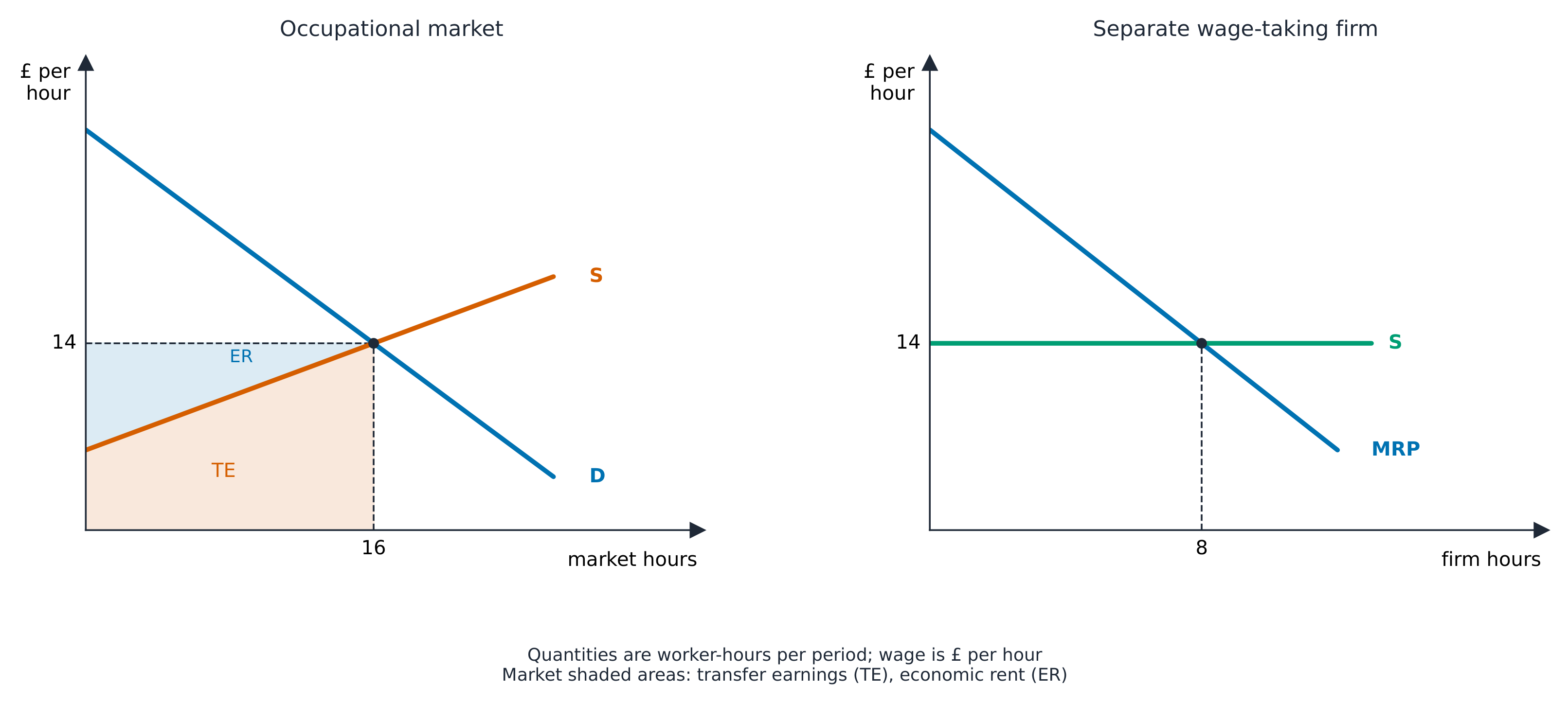
Market supply determines the wage with market demand; the small firm faces that wage and chooses its own hiring. Labour-saving machinery can substitute for labour but lower costs and expand output. Evaluate the net demand change rather than treating any new machine as a certain fall in employment. Better working conditions or easier qualification may attract workers at a given wage; increased product demand shifts MRP, while a change in wage alone moves along the given demand curve.
When the market is not competitive
A monopsony 买方垄断 employer faces upward-sloping labour supply. In a uniform-wage model, hiring more workers requires raising the wage for existing workers too, so marginal employment cost ME exceeds the wage. Use a separate local-market example with MRP = 30 − L and wage supply w = 6 + 0.5L. Total wage cost is $TC_L=wL=6L+0.5L^2$, so $ME=6+L$.
$$\begin{aligned} MRP=ME&\quad\Rightarrow\quad30-L=6+L\\ L_m&=\frac{30-6}{2}=12\text{ worker-hours per period}\\ w_m&=6+0.5L_m=6+0.5(12)=\text{£}12\text{ per hour}\\ ME_m&=6+L_m=6+12=\text{£}18\text{ per extra worker-hour} \end{aligned}$$Choose quantity using MRP = ME, then read wage from supply. Paying 18 to everyone would be the wrong wage. Holding the same MRP and supply curves fixed, the competitive benchmark is L = 16 and w = 14. This comparison depends on the uniform-wage model and the stated curves.
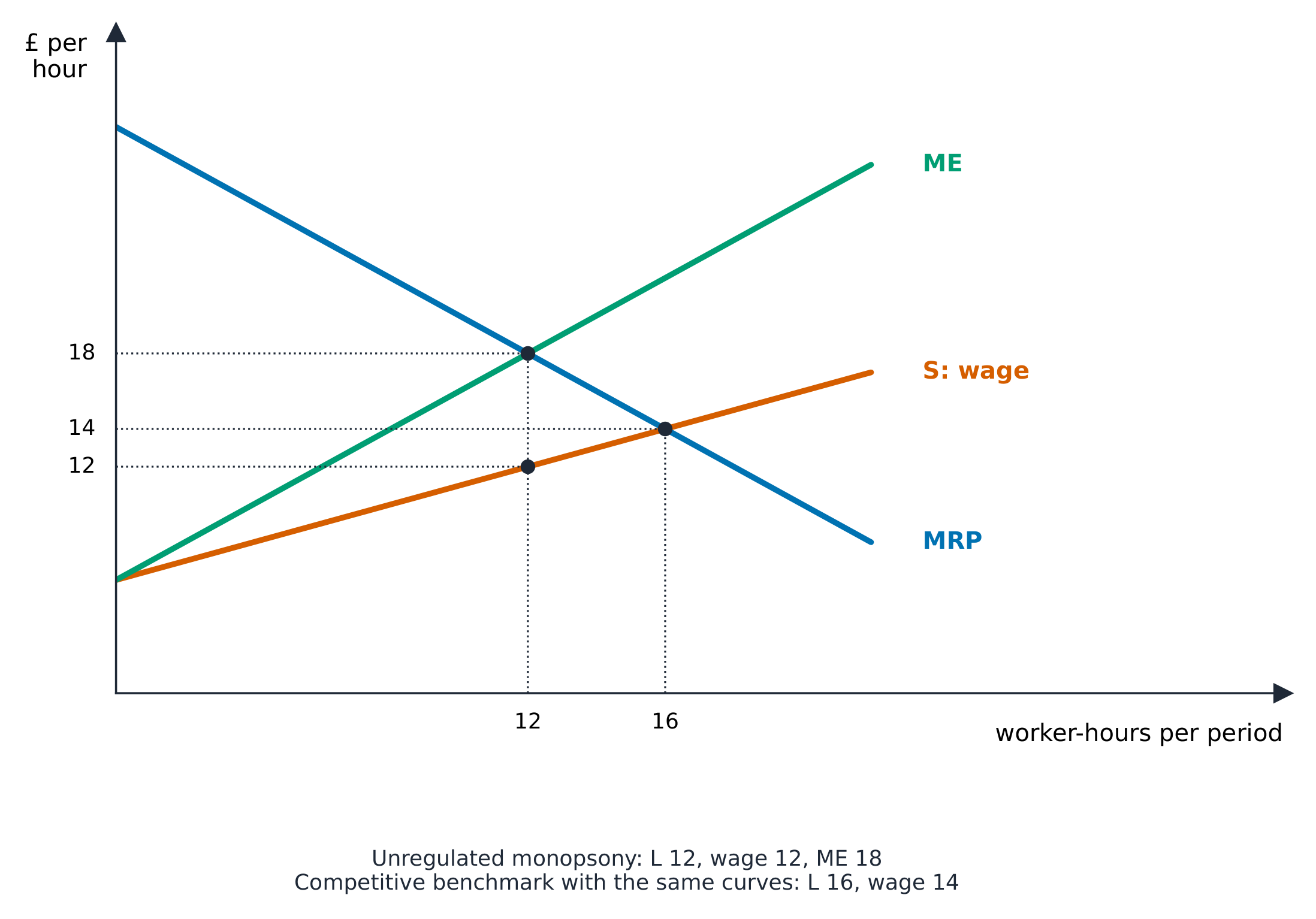
The wage is £12 although marginal employment cost at the chosen quantity is £18. A national minimum wage 全国最低工资 is a legal floor for covered workers. In the competitive market above, floor 20 gives labour demand 10 and supply 28: excess supply 18 worker-hours, with employment 10 in the simple model. A floor below 14 is not binding there. Compliance, coverage, hours, productivity, enforcement and demand elasticity affect actual outcomes. Excess supply in the model is not a complete measure of a country's recorded unemployment.
Monopsony floors. In the monopsony example, a floor of 14 makes marginal employment cost 14 while up to 16 worker-hours are available at that wage. Hiring expands to 16, where MRP = 14. Above 16 the employer must raise the uniform wage and marginal cost jumps above 14. A higher floor of 20 instead gives demand 10 and available supply 28, so the employer hires 10, below its original 12. A wage floor can raise both wage and employment in monopsony, but its level matters; the result does not automatically flip for every floor.
A trade union 工会 bargains collectively. In a competitive model, a higher negotiated wage along unchanged labour demand may lower employment. With employer buying power, bargaining may raise wages and employment towards the competitive benchmark. Productivity improvements, training, a negotiated employment agreement, union coverage and firms' responses can change the result. Analyse the structure and agreement rather than asserting that unions always destroy or create jobs.
Wage differentials and discrimination
A wage differential 工资差异 is a difference in pay between workers or jobs. Explain both demand and supply: product revenue and productivity affect MRP, while qualifications, training time, risks, location and alternatives affect available labour. A high wage does not prove that an executive personally produces that many times another worker's output. Team production makes individual contribution hard to measure; bargaining, pay-setting institutions and employer power also matter.
Discrimination 歧视 can affect pay, hiring, promotion or access to training because of characteristics unrelated to the relevant job contribution. A raw average pay gap alone does not prove its size or cause: compare hours, occupation, experience, opportunity and pay-setting evidence. Equal-pay enforcement and better access may improve fairness and allocation; assess implementation rather than assuming a law removes the gap immediately.
Transfer earnings and economic rent
Transfer earnings 转移收入 are the minimum payment needed to keep a resource in its current use; economic rent 经济租金 is payment above that amount. A worker earning £20 per hour whose best feasible alternative pays £16 has transfer earnings 16 and rent 4 in this simplified comparison. Economic rent does not mean house rent and is not automatically profit or evidence of discrimination.
For the competitive occupational market with L = 16, wage 14 and supply $w=6+0.5L$, total payment is the rectangle wL. The area below supply gives transfer earnings; the area above supply up to the wage gives rent.
$$\text{total payment}=wL=14(16)=224\text{ £ per period}$$$$TE=\tfrac12(w_0+w^*)L=\tfrac12(6+14)(16)=160\text{ £ per period}$$$$ER=wL-TE=224-160=64\text{ £ per period}$$More elastic occupational supply tends to mean a smaller rent share for a given payment diagram; perfectly elastic supply gives all transfer earnings, perfectly inelastic supply gives all rent in the limiting model. Training, mobility and the time allowed change alternatives and elasticity. Be clear whether the alternative is another employer or leaving the occupation: that choice changes the relevant transfer earnings.
ExploreThe labour market
Explore an illustrative competitive occupational market. This display does not show the separate wage-taking firm, monopsony marginal cost or rent areas.
Vocabulary TrainEnglish labour market/ˈleɪbə ˈmɑːkɪt/ demand for labour/dɪˈmænd fɔː ˈleɪbə/ derived demand/dɪˈraɪvd dɪˈmænd/ marginal revenue product/ˈmɑːdʒɪnl ˈrevənjuː ˈprɒdʌkt/ supply of labour/səˈplaɪ ɒv ˈleɪbə/ wage/weɪdʒ/ monopsony/ˈmɒnəʊpsəni/ trade union/treɪd ˈjuːnɪən/ national minimum wage/ˈnæʃənl ˈmɪnɪməm weɪdʒ/ wage differential/weɪdʒ ˌdɪfəˈrenʃl/ discrimination/dɪˌskrɪmɪˈneɪʃn/ transfer earnings/ˈtrænsfɜː ˈɜːnɪŋz/ economic rent/ˌiːkəˈnɒmɪk rent/ 8.3
Exam application
Attempt before reading the reasoning. A proposal sets a wage floor at 20. Compare effects under the competitive and monopsony models above, and decide whether employment must rise. Then explain what a lower Gini would and would not show about the lowest-income group.
Reasoning. At 20, employment is 10 in both stated models. It falls from 16 competitively and from 12 under the unregulated monopsony. The comparison floor of 14 raises monopsony employment to 16, which shows why the floor's level matters. A lower Gini means lower overall measured inequality under comparable definitions; crossing curves show it need not raise every group's income share. An answer should identify the relevant model, work through its mechanism, use the diagram or data and defend a conditional conclusion. List alone does not supply the analysis.
Vocabulary card meanings
nationalisation: Bringing a private firm into ownership by the state. competition policy: Laws that limit collusion and the abuse of a strong market position. equality: People having the same income, or the same chances. supply of labour: The hours people are willing to work at each wage. production quota: A legal cap on how much may be produced. prohibition: A legal ban on making or selling something. licence: Official permission required before an activity may begin. nudge: A small change in how a choice is shown, meant to steer behaviour. absolute poverty: Being unable to buy the basics needed to stay alive. negative income tax: A state top-up that shrinks as a person's earnings rise. universal benefits: State payments given with no test of the recipient's income. means-tested benefits: State payments given only after income and savings are checked. economic rent: Pay above the least amount needed to keep a factor in its present use.
-
9
The macroeconomy (A Level)
Watch lessonThis topic studies the wider economy at A Level depth: how spending multiplies, how growth links to the environment, the jobs–prices link, and money.
9.1
The circular flow and the multiplier

Syllabus
- explain the circular flow of income, injections and leakages, and the multiplier (including the marginal propensities)
- explain the accelerator and the determinants of consumption, saving and investment
Source: Cambridge International syllabus
The multiplier effect The circular flow of income 收入循环流 shows money passing between households and firms. injections 注入 add money to the flow (investment, government spending, exports); leakages 漏出 take it out (saving, taxation, imports).
Income circulates between households and firms, with injections and leakages The multiplier
An injection raises income by more than the first amount. This is the multiplier 乘数. When a firm builds a factory, the builders earn income, and they spend part of it, which becomes someone else's income, and so on.
How much is spent again depends on the marginal propensity to consume 边际消费倾向 (MPC) — the fraction of extra income that people spend on home goods. The rest leaks out. In a simple model:
$$\text{multiplier} = \frac{1}{1 - MPC}$$A bigger MPC (smaller leakages) gives a bigger multiplier. The main leakages are measured by the marginal propensity to save 边际储蓄倾向 (MPS) and the marginal propensity to import 边际进口倾向 (MPM).
Worked example. In an economy the MPC is $0.8$. Find the multiplier, then the effect of a $\text{\pounds} 10$ billion rise in investment.
$$\text{multiplier} = \frac{1}{1 - 0.8} = \frac{1}{0.2} = 5.$$National income therefore rises by $5 \times \text{\pounds} 10\text{ billion} = \text{\pounds} 50\text{ billion}$ — five times the original injection. (Because all income is either spent or saved, $\text{MPC} + \text{MPS} = 1$, so here $\text{MPS} = 0.2$ and the multiplier is also $1/\text{MPS}$.)
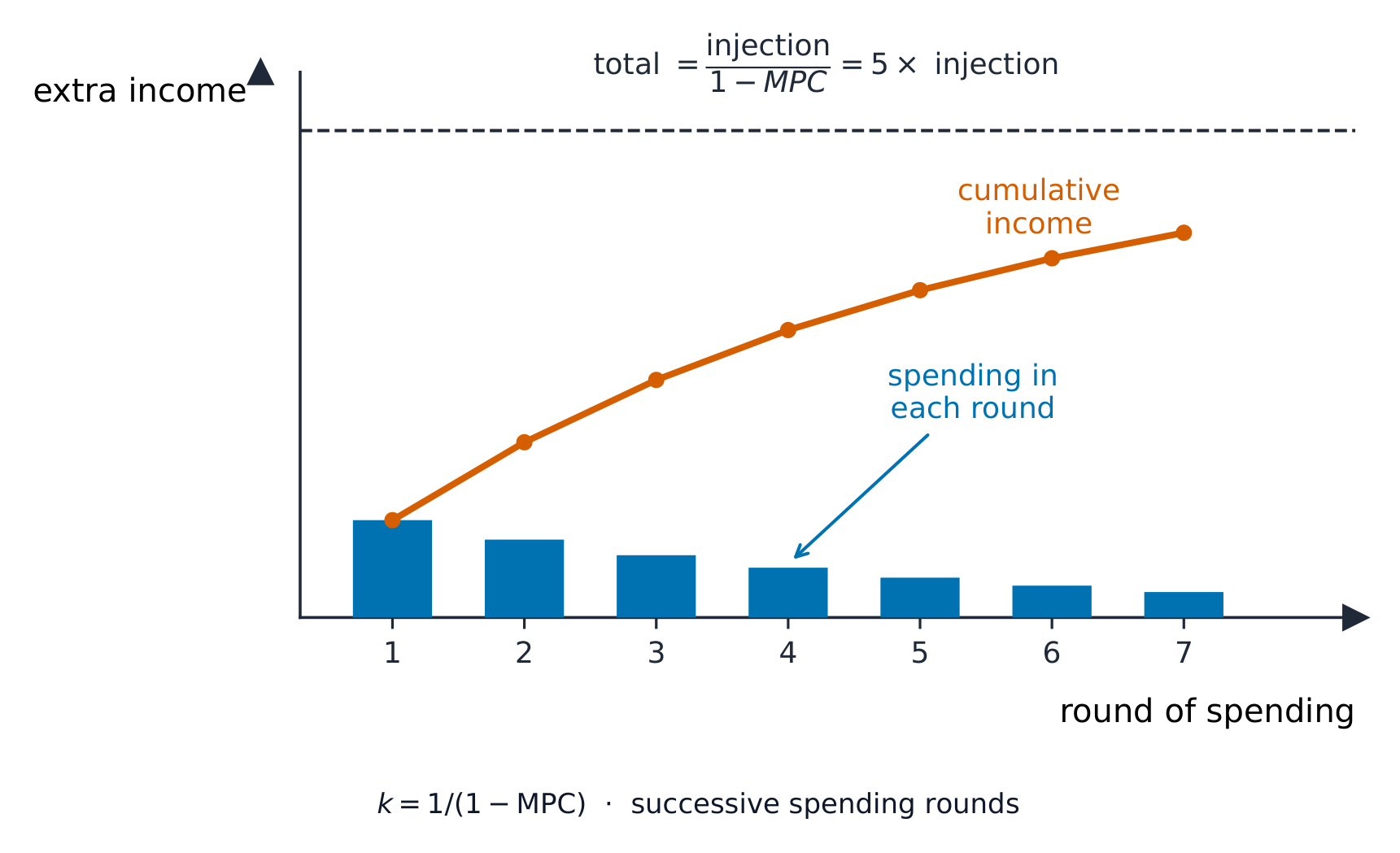
An injection is spent round after round (each smaller by the MPC), so total income rises by a multiple of the first injection. The accelerator
The accelerator 加速数 says that investment 投资 depends on the rate of change of output. When demand is rising quickly, firms need lots of new capital, so investment jumps. When demand merely stays high, investment falls back.
What drives consumption, saving and investment
- consumption 消费 and saving 储蓄 depend on disposable income 可支配收入 (income after tax), wealth, interest rates, and confidence.
- investment depends on interest rates, expected profit, technology, and business confidence.
ExploreThe circular flow and the multiplier
Income circles between households and firms. An injection (e.g. investment) is re-spent again and again — the multiplier effect.
ExploreThe multiplier, round by round
Drag the injection and the MPC, then press Play — each spending round is MPC times the last, and the total settles at k × the injection.
Vocabulary TrainEnglish circular flow of income/ˈsɜːkjʊlə fləʊ ɒv ˈɪŋkʌm/ injections/ɪnˈdʒekʃnz/ leakages/ˈliːkɪdʒɪz/ multiplier/ˌmʌltɪˈplaɪə/ marginal propensity to consume/ˈmɑːdʒɪnl prəˈpensɪti tə kənˈsjuːm/ marginal propensity to save/ˈmɑːdʒɪnl prəˈpensɪti tə seɪv/ marginal propensity to import/ˈmɑːdʒɪnl prəˈpensɪti tʊ ɪmˈpɔːt/ accelerator/əkˈseləreɪtə/ investment/ɪnˈvestmənt/ consumption/kənˈsʌmpʃn/ saving/ˈseɪvɪŋ/ disposable income/dɪˈspəʊzəbl ˈɪŋkʌm/ 9.2
Economic growth and sustainability

Syllabus
- distinguish actual and potential growth, output gaps and sustainable growth
- explain the costs and benefits of growth and the relationship between growth and sustainability
Source: Cambridge International syllabus
economic growth 经济增长 is a rise in real output.
Investment in new buildings and capital is a key driver of economic growth. - actual growth 实际增长 is the real rise in output that happens.
- potential growth 潜在增长 is the rise in the economy's capacity.
The output gap 产出缺口 compares actual real output with potential output: the level sustainable with normal use of resources. A positive gap creates inflationary pressure as spare capacity runs out. A negative gap suggests unused capacity and cyclical unemployment; it does not mean inflation must be zero, or that all unemployment is cyclical. Potential output is estimated and can be revised.
Worked output-gap comparison. Illustrative real GDP figures, all billions at constant prices on the same basis, are A: actual 190, potential 200; B: actual 198, potential 210; C: actual 214, potential 210. Express each gap relative to potential output:
$$\text{Gap (\%)}=\frac{Y-Y^*}{Y^*}\times100.$$$$\text{Gap}_A=\frac{Y_A-Y_A^*}{Y_A^*}\times100=\frac{190-200}{200}\times100=-5\%.$$$$\text{Gap}_B=\frac{Y_B-Y_B^*}{Y_B^*}\times100=\frac{198-210}{210}\times100\approx-5.71\%.$$$$\text{Actual growth}_{A\to B}=\frac{Y_B-Y_A}{Y_A}\times100=\frac{198-190}{190}\times100\approx4.21\%.$$$$\text{Potential growth}_{A\to B}=\frac{Y_B^*-Y_A^*}{Y_A^*}\times100=\frac{210-200}{200}\times100=5\%.$$Actual output grew, but capacity grew faster, so the negative percentage gap widened. Actual growth does not necessarily close a gap.
$$\text{Gap}_C=\frac{Y_C-Y_C^*}{Y_C^*}\times100=\frac{214-210}{210}\times100\approx1.90\%.$$Temporary overtime and intensive equipment use can lift actual output above its estimated sustainable level. The positive gap suggests demand pressure, not a precise inflation forecast. Neither growth nor a gap's sign alone establishes environmental sustainability.

Actual output swings around potential output; above it is a positive (inflationary) gap, below it a negative gap with spare capacity. Sustainability
sustainable growth 可持续增长 is growth that meets today's needs without harming the ability of future generations to meet theirs. Fast growth can use up non-renewable resources and cause pollution, which threatens sustainability 可持续性. So a country must weigh growth today against the environment and resources of tomorrow.

The wind these turbines use is never used up, and they burn no fuel. Switching output from coal and oil to renewables like this lets an economy keep growing without spending the resources — or filling the air with the pollution — that would rob future generations ExploreEconomics case lab
Classify real examples by the economic idea they show.
Vocabulary TrainEnglish economic growth/ˌiːkəˈnɒmɪk ɡrəʊθ/ actual growth/ˈæktʃuːəl ɡrəʊθ/ potential growth/pəˈtenʃl ɡrəʊθ/ output gap/ˈaʊtpʊt ɡæp/ sustainable growth/səˈsteɪnəbl ɡrəʊθ/ sustainability/səˌsteɪnəˈbɪlɪti/ 9.3
Employment and unemployment

Syllabus
- explain the measurement, types and causes of unemployment and the natural rate of unemployment
- explain the relationship between unemployment and inflation (the Phillips curve, short run and long run)
Source: Cambridge International syllabus
unemployment 失业 is measured in two ways: the claimant count 申领救济人数 (people claiming benefits) and the wider labour force survey 劳动力调查 (a sample asked about work).
Four types of unemployment: frictional, structural, cyclical and seasonal Types
- frictional unemployment 摩擦性失业 — short spells between jobs.
- structural unemployment 结构性失业 — skills no longer match the jobs, as industries decline.
- cyclical unemployment 周期性失业 — caused by low demand in a recession.
- seasonal unemployment 季节性失业 — work only at certain times of year.
The natural rate and the Phillips curve
The natural rate of unemployment 自然失业率 is the unemployment left when the labour market is in balance (mainly frictional and structural). It cannot be removed just by raising demand.
The Phillips curve 菲利普斯曲线 relates the inflation rate to the unemployment rate. In a short-run demand expansion, lower unemployment may accompany higher inflation, holding expected inflation and supply conditions constant. This is not a universal relation between employment and the price level.
Worked expectations model. Use the illustrative equation below. Here $\pi$ is actual annual inflation (%), $\pi^e$ is expected inflation (%), $u$ is unemployment (%), and the assumed natural rate is 5%. The coefficient is illustrative, not an estimated law for every economy.
$$\pi=\pi^e-0.5(u-5).$$At unchanged expected inflation of 2%:
$$\pi_A=\pi^e-0.5(u_A-5)=2-0.5(5-5)=2\%.$$$$\pi_B=\pi^e-0.5(u_B-5)=2-0.5(3-5)=3\%.$$A demand expansion may move A to B along the same short-run curve: unemployment falls by 2 percentage points and inflation rises by 1 percentage point. Inflation of 2% still means prices rise; falling inflation is not necessarily falling prices.
When expected inflation rises to 3%, at unemployment of 5%:
$$\pi_C=\pi^e-0.5(u_C-5)=3-0.5(5-5)=3\%.$$The same unemployment now accompanies higher inflation. The short-run curve shifts up (right), rather than showing a movement along the old curve. Holding unemployment at 3% under the new expectations gives:
$$\pi_D=\pi^e-0.5(u_D-5)=3-0.5(3-5)=4\%.$$In this expectations-augmented model, repeated demand stimulus cannot maintain unemployment below an unchanged natural rate without rising inflation as expectations adjust. When actual and expected inflation are equal:
$$\pi=\pi^e-0.5(u-5),\quad\pi=\pi^e\quad\Rightarrow\quad u=5\%.$$Different fully expected inflation rates are compatible with the same natural rate. The long-run curve is vertical at 5% in this example; full employment does not mean zero unemployment. Better matching, training or mobility may change the natural rate and shift the long-run curve. An adverse oil-cost shock can raise inflation while reducing output and employment, shifting the short-run relationship instead of tracing a stable demand trade-off. State what is held constant before predicting the effect of a policy. This model also supports the policy-conflict discussion in Topic 10.
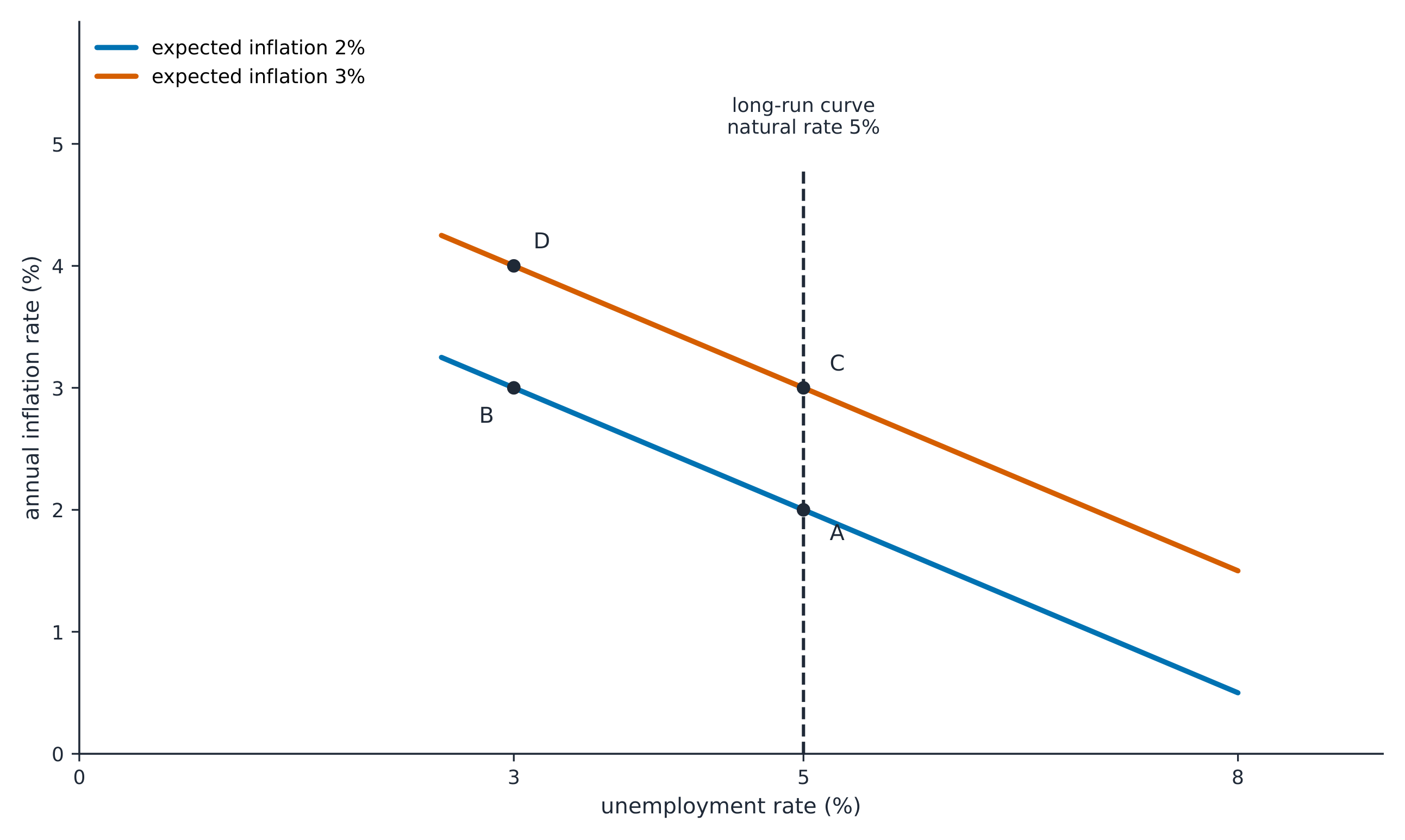
A to B is a movement at unchanged expected inflation; A to C shows higher expected inflation at the same unemployment. The long-run curve assumes the natural rate stays at 5%. ExploreDevelopment chain lab
Follow how policy and resources can change living standards.
Vocabulary TrainEnglish unemployment/ʌnemˈplɔɪmənt/ claimant count/ˈkleɪmənt kaʊnt/ labour force survey/ˈleɪbə fɔːs ˈsɜːveɪ/ frictional unemployment/ˈfrɪkʃənl ʌnemˈplɔɪmənt/ structural unemployment/ˈstrʌktʃərəl ʌnemˈplɔɪmənt/ cyclical unemployment/ˈsaɪklɪkl ʌnemˈplɔɪmənt/ seasonal unemployment/ˈsiːzənl ʌnemˈplɔɪmənt/ natural rate of unemployment/ˈnætʃərəl reɪt ɒv ʌnemˈplɔɪmənt/ Phillips curve/ˈfɪlɪps kɜːv/ 9.4
Money and banking

Syllabus
- explain the functions and characteristics of money and the role of the central bank and commercial banks
- explain the demand for money (liquidity preference), the money supply, and the determination of interest rates, including moral hazard
Source: Cambridge International syllabus
What money does
money 货币 is anything widely accepted in payment. It has four jobs:
- a medium of exchange 交换媒介 — used to buy and sell, avoiding barter.
- a store of value 价值储藏 — it keeps its worth over time, so you can save it.
- a unit of account 记账单位 — a common way to measure and compare prices.
- a standard of deferred payment 延期支付标准 — it lets people borrow and repay later.
Money does four jobs at once — without it, trade would fall back on slow, awkward barter Good money is durable, easy to carry, easy to divide, hard to fake, and limited in supply.
Banks
- the central bank 中央银行 issues notes, runs monetary policy, holds the country's reserves, and acts as lender of last resort 最后贷款人 to banks in trouble.
- commercial banks 商业银行 take deposits and make loans. By lending out most of what is deposited, the banking system creates money.

Commercial banks take deposits and make loans — and by lending, the banking system creates most of the money in the economy. The demand for money and interest rates
People hold money rather than other assets for its liquidity 流动性 (it can be spent at once). The demand for money 货币需求 — also called liquidity preference 流动性偏好 — comes from the need to make everyday payments, to keep a safety buffer, and to be ready to buy assets.
The interest rate 利率 is the price of borrowing money. It is set where the demand for money meets the money supply 货币供给. A larger money supply tends to lower the interest rate.
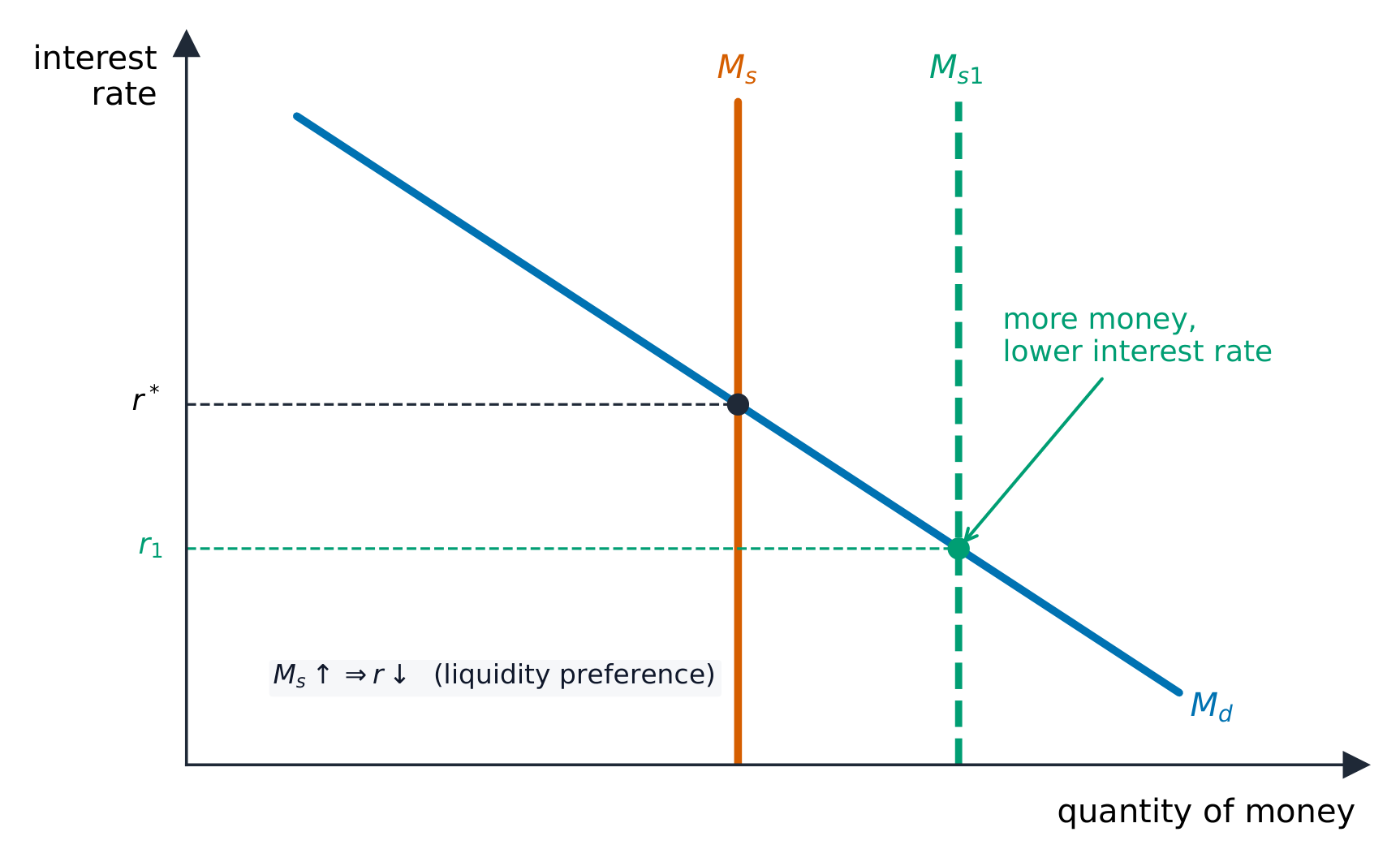
The interest rate is set where the demand for money meets the money supply; a larger money supply lowers it. Moral hazard
moral hazard 道德风险 is the danger that banks take bigger risks because they expect to be rescued if things go wrong. If a bank believes the government will bail it out, it may lend recklessly — knowing it keeps the gains but passes losses to others.
ExploreEconomics case lab
Classify real examples by the economic idea they show.
Vocabulary TrainEnglish money/ˈmʌni/ medium of exchange/ˈmiːdɪəm ɒv eksˈtʃeɪndʒ/ store of value/stɔː ɒv ˈvæljuː/ unit of account/ˈjuːnɪt ɒv əˈkaʊnt/ standard of deferred payment/ˈstændəd ɒv dɪˈfɜːd ˈpeɪmənt/ central bank/ˈsentrəl bæŋk/ lender of last resort/ˈlendə ɒv læst rɪˈzɔːt/ commercial bank/kəˈmɜːʃl bæŋk/ liquidity/lɪˈkwɪdɪti/ demand for money/dɪˈmænd fɔː ˈmʌni/ liquidity preference/lɪˈkwɪdɪti ˈprefrəns/ interest rate/ˈɪntrest reɪt/ money supply/ˈmʌni səˈplaɪ/ moral hazard/ˈmɒrəl ˈhæzəd/ 9.4
Exam tips
- Calculate the multiplier $= 1 \div (1 - MPC) = 1 \div MPS$ and apply it to an injection.
- Distinguish actual from potential growth and link sustainability to long-run capacity.
- Explain the functions of money and the role of banks and the central bank.
- Explain the Phillips curve trade-off (unemployment vs inflation) and why it may not hold in the long run.
Vocabulary card meanings
marginal propensity to import: The fraction of one extra unit of income that is spent on imports. accelerator: The link from a change in the growth of demand to a change in investment, which is not always a larger swing. disposable income: Income left after income tax, free to spend or save. sustainable growth: A rise in output that can continue without exhausting key resources. standard of deferred payment: Money's role in letting a debt be settled at a later date. liquidity preference: The wish to hold wealth as cash rather than as assets that are harder to sell.
-
10
Government macroeconomic intervention (A Level)
Watch lessonThis topic pulls the macroeconomics together: the goals a government has, how they clash, and how well its tools work.
10.1
Objectives and the tools to reach them
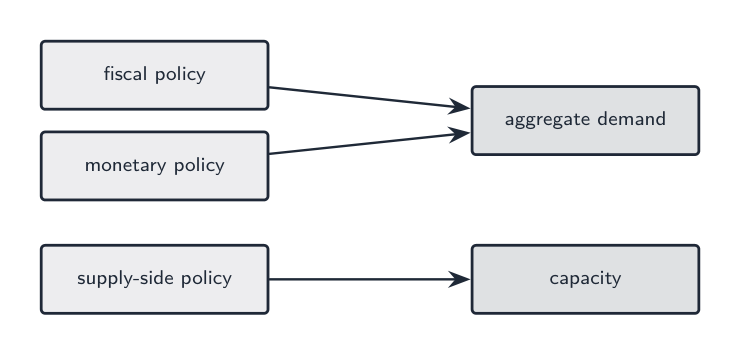
Syllabus
- state and explain the macroeconomic policy objectives and how they are measured
- explain the use of fiscal, monetary and supply-side policy to achieve the objectives
Source: Cambridge International syllabus
Governments aim at several macroeconomic objectives 宏观经济目标 at once:
Fiscal and monetary policy act on demand; supply-side on capacity 
The four macroeconomic objectives Objective How it is measured economic growth 经济增长 the % change in real GDP price stability 物价稳定 (low inflation 通货膨胀) the % change in the consumer price index full employment 充分就业 the unemployment rate balance of payments 国际收支 stability the current account balance To reach these goals, the government uses three sets of tools:
- fiscal policy 财政政策 — changing government spending and taxes.
- monetary policy 货币政策 — changing the interest rate 利率 and the money supply.
- supply-side policy 供给侧政策 — raising the economy's capacity and productivity.
Fiscal and monetary policy can change aggregate demand 总需求, with effects depending on timing, confidence and spare capacity. Supply-side measures aim to improve capacity and productivity, but their speed and effectiveness vary. Public investment can have both demand effects now and capacity effects later.

Central banks, such as the European Central Bank, are a main tool of macroeconomic policy. ExploreMacro objective lab
Classify policy examples by the macroeconomic objective they target.
Vocabulary TrainEnglish macroeconomic objectives/ˌmækrəˌriːkəˈnɒmɪk ɒbˈdʒektɪvz/ economic growth/ˌiːkəˈnɒmɪk ɡrəʊθ/ price stability/praɪs stəˈbɪlɪti/ inflation/ɪnˈfleɪʃn/ full employment/fʊl emˈplɔɪmənt/ balance of payments/ˈbæləns ɒv ˈpeɪmənts/ fiscal policy/ˈfɪskl ˈpɒlɪsi/ monetary policy/ˈmʌnɪtəri ˈpɒlɪsi/ interest rate/ˈɪntrest reɪt/ supply-side policy/səˈplaɪ saɪd ˈpɒlɪsi/ aggregate demand/ˈæɡrɪɡeɪt dɪˈmænd/ 10.2
Links and trade-offs between objectives

Syllabus
- explain the links and trade-offs between macroeconomic problems (e.g. growth and inflation, unemployment and inflation, growth and the balance of payments)
- analyse the interrelatedness of macroeconomic objectives
Source: Cambridge International syllabus
The objectives are interrelated — reaching one can move another. Often there is a trade-off 取舍, a conflict 冲突 where gaining on one goal costs you on another.
- unemployment versus inflation. Raising demand to cut unemployment tends to push prices up. The Phillips curve 菲利普斯曲线 shows this short-run trade-off. (In the long run it may disappear.)
- growth versus inflation. Fast demand-led growth can overheat the economy and cause inflation.
- growth versus the balance of payments. As incomes rise, people buy more imports, so the current account can worsen.
- growth versus the environment. More output often means more pollution and use of resources.
- growth versus equality. Growth does not always reach everyone, so the income gap can widen.
The objectives pull against each other, so a government must trade one off against another — there is rarely a way to win on all of them at once Because the goals are linked, a government must often accept "second best" on one aim to protect another. A clever policy mix tries to ease the trade-offs — for example, productive supply-side measures may raise capacity and ease inflation pressure. Demand expansion with ample spare capacity can also increase output without strong inflation pressure; neither result is guaranteed.
ExploreMacro objective lab
Classify policy examples by the macroeconomic objective they target.
Vocabulary TrainEnglish trade-off/treɪd ɒf/ conflict/ˈkɒnflɪkt/ Phillips curve/ˈfɪlɪps kɜːv/ 10.3
The effectiveness of policy

Syllabus
- evaluate the effectiveness of fiscal, monetary and supply-side policies in achieving the macroeconomic objectives
- explain the limitations of policies (time lags, conflicts, crowding out, the Laffer curve)
Source: Cambridge International syllabus
Each tool has strengths and weaknesses.
Financial markets react quickly to policy, which affects how well a policy works. Fiscal policy
Government purchases can directly add to demand and target particular groups or regions. Their effect depends on subsequent spending, private-sector responses and available resources.
Worked fiscal comparison. An illustrative economy has unused capacity and weak private spending. Government proposes an extra £10 billion of purchases, financed by borrowing. Use a multiplier $k=2.5$; hold taxes, exports and other spending changes constant. In Case A, private investment is unchanged. In Case B, higher interest rates reduce private investment by £4 billion. Let $\Delta A$ be the net autonomous spending change. All spending and income changes in these equations are in £ billions.
$$\Delta A_A=\Delta G+\Delta I=10+0=10.$$$$\Delta Y_A=k\Delta A_A=2.5\times10=25.$$$$\Delta A_B=\Delta G+\Delta I=10+(-4)=6.$$$$\Delta Y_B=k\Delta A_B=2.5\times6=15.$$In this model, crowding out 挤出效应 reduces the income gain by £10 billion; income still rises. Partial crowding out does not mean each pound of government spending replaces a pound of private spending. The multiplier and private investment response are stated assumptions, not forecasts for every economy.
One mechanism is government borrowing increasing demand for loanable funds, raising interest rates and discouraging private investment, other things equal. Its size depends on the supply of finance, central-bank action, confidence and firms' responsiveness to rates. With idle resources or supportive monetary conditions, the interest-rate effect may be small. Productive public infrastructure may instead encourage some private investment. Near capacity, public projects may compete for workers and materials even without a large interest-rate rise; identify that resource constraint separately.
Timing and financing. Time lags 时滞 arise in diagnosis, approval, implementation and spending responses. A construction programme approved during a slump may arrive after recovery, when capacity constraints create more inflationary pressure and less extra real output. Tax cuts need not all be spent. Automatic changes in taxes and benefits can begin without a new budget decision.
A deficit is a flow over a period; the national debt 国债 is an outstanding stock. Additional borrowing tends to add to debt, holding other flows constant. Not every spending increase is borrowed, and public investment can improve future capacity.
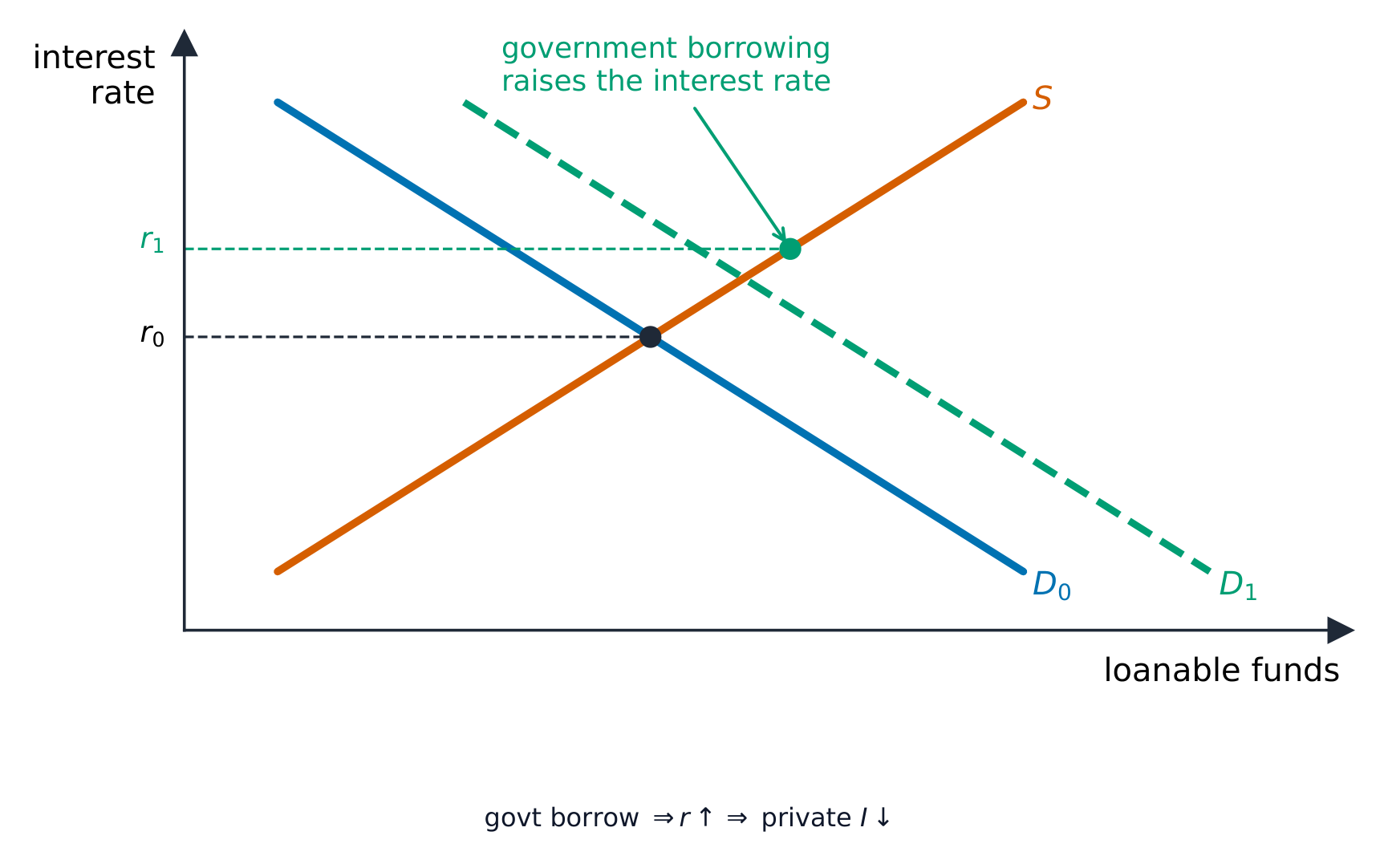
In this loanable-funds diagram, extra borrowing raises interest rates and may reduce private investment, holding the supply of finance and monetary conditions constant. The Laffer curve 拉弗曲线 is a useful warning. It shows that as the tax rate rises, tax revenue 税收收入 first rises but then falls: very high rates discourage work and encourage tax avoidance, so revenue drops. There is a tax rate that raises the most revenue, and going above it is self-defeating.
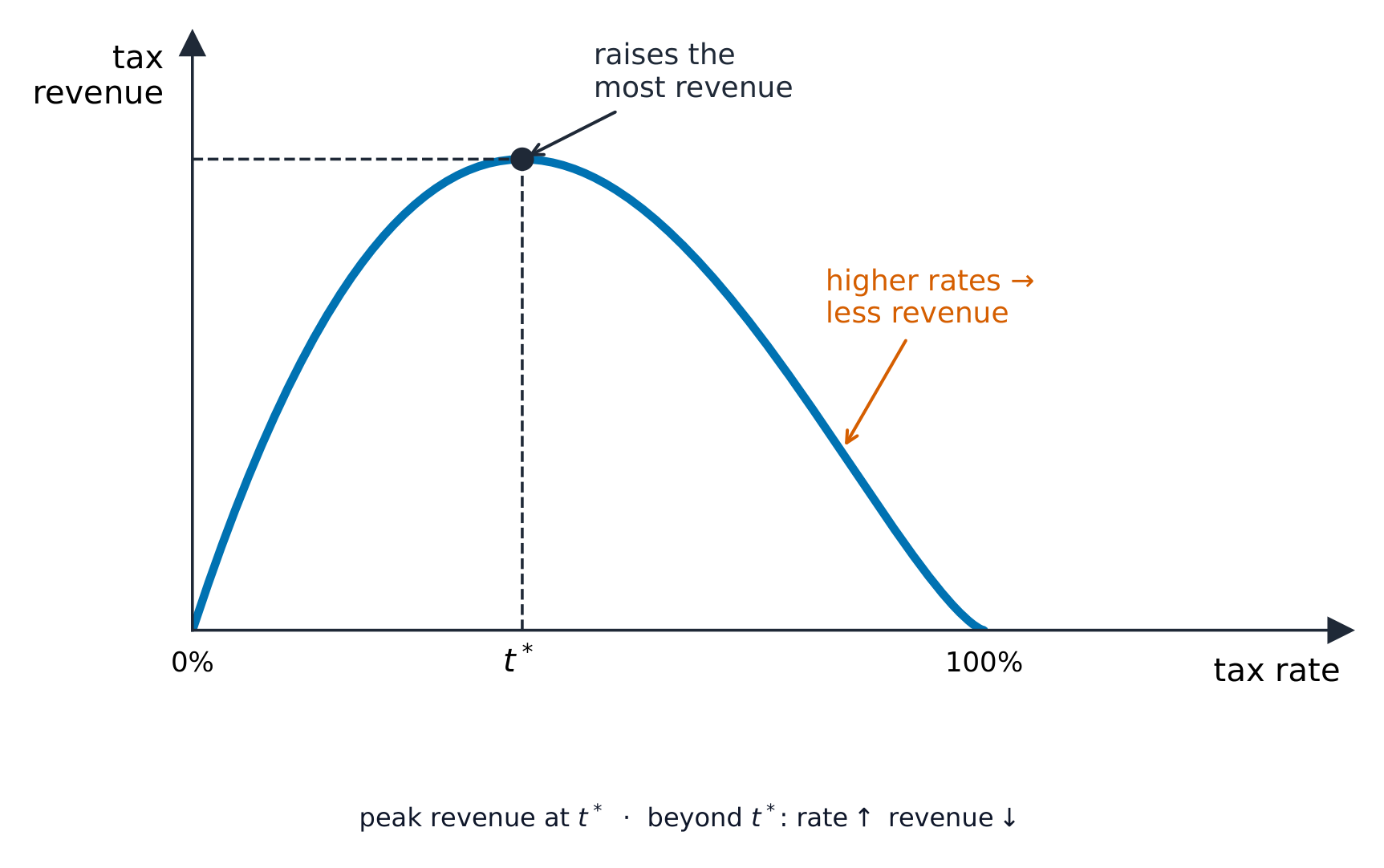
Tax revenue is zero at both a 0% and a 100% tax rate; it peaks at the rate $t^*$, and pushing rates above $t^*$ actually lowers revenue. Monetary policy
It is flexible — the interest rate can be changed at any time. But it also works with a long time lag, and in a deep slump even very low rates may fail to make worried firms and households borrow.
Supply-side policy
Productive measures can raise capacity and ease inflation pressure. They are not free of trade-offs: education and training take time and funding, some measures can widen inequality, and infrastructure can impose environmental costs. Outcomes depend on implementation and on which constraints actually limit production.
Putting it together
No single policy can hit every target. The objectives conflict, the effects come with delays, and the future is uncertain. So governments usually combine demand-side policies 需求侧政策 (fiscal and monetary) for the short term with supply-side policy for the long term, and accept that some goals must be traded against others.
Worked policy judgement. A government cuts interest rates to reduce cyclical unemployment. If households and firms respond by borrowing and spending more, aggregate demand may rise. With spare capacity, firms can expand output and employment; near capacity, more of the response may be inflation. Weak confidence or already-low rates can reduce the response. Imports may rise with income, but the current account depends on exports and other influences too. State the transmission mechanism and conditions before judging the objective at risk. Capacity improvements may ease a conflict, but no policy label guarantees growth with lower inflation and no other cost.
ExploreEconomics case lab
Classify real examples by the economic idea they show.
Vocabulary TrainEnglish time lags/taɪm læɡz/ national debt/ˈnæʃənl det/ crowding out/ˈkraʊdɪŋ aʊt/ Laffer curve/ˈlæfə kɜːv/ tax revenue/tæks ˈrevənjuː/ demand-side policies/dɪˈmænd saɪd ˈpɒlɪsiz/ 10.3
Exam tips
- Show the trade-offs between objectives (for example growth versus inflation, unemployment versus inflation).
- Evaluate policy effectiveness using time lags, expectations and the state of the economy.
- Match the tool (fiscal, monetary, supply-side, exchange rate) to the target, and judge the conflicts.
Vocabulary card meanings
macroeconomic objectives: The main aims for the whole economy, such as jobs and stable prices. tax revenue: Money a government collects through taxation.
-
11
International economic issues (A Level)
Watch lessonThis final topic covers trade imbalances, exchange rates in depth, and how countries develop and connect.
11.1
Correcting a balance of payments imbalance
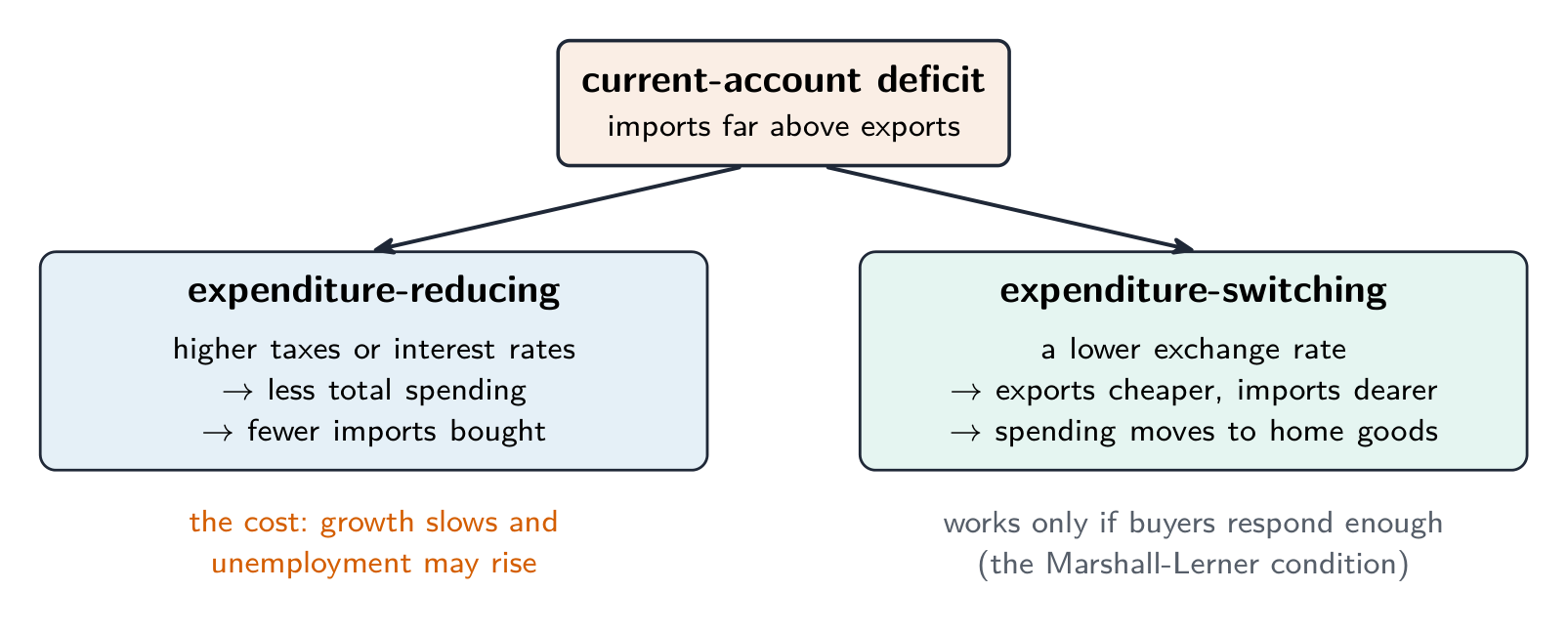
Syllabus
- explain expenditure-switching and expenditure-reducing policies and the Marshall–Lerner condition and J-curve effect
- evaluate policies to correct a current account imbalance
Source: Cambridge International syllabus
A country with a large balance of payments 国际收支 problem — usually a deficit on the current account 经常账户 — can use two kinds of policy.
- expenditure-reducing 支出减少 policies cut total demand (higher taxes or interest rates). With less spending, people buy fewer imports. But growth slows and unemployment may rise.
- expenditure-switching 支出转换 policies move spending away from imports towards home goods. The main tool is a lower exchange rate 汇率 — a depreciation 贬值 under floating rates, or a devaluation 法定贬值 under a fixed system — which makes exports cheaper and imports dearer.
Two routes out of a deficit: spend less overall, or switch spending to home goods The Marshall–Lerner condition and the J-curve
A lower exchange rate only improves the current account if buyers respond enough. The Marshall-Lerner condition 马歇尔勒纳条件 says the sum of the price elasticities of demand for exports and imports must be greater than one:
$$PED_{\text{exports}} + PED_{\text{imports}} > 1$$Worked example. After a depreciation, the demand for a country's exports has $PED = 0.6$ and its demand for imports has $PED = 0.7$. Will the current account improve?
$$0.6 + 0.7 = 1.3 > 1,$$so the Marshall-Lerner condition is met, and the depreciation should improve the current account in the long run. (If the two elasticities had summed to less than $1$ — for example $0.3 + 0.4 = 0.7$ — a depreciation would make the deficit worse.)
Even when this holds, the gain takes time. The J-curve effect J曲线效应 describes what happens: just after a depreciation, the current account first gets worse (imports cost more straight away, but trade volumes are slow to change), then later improves as buyers adjust — tracing the shape of a letter J.
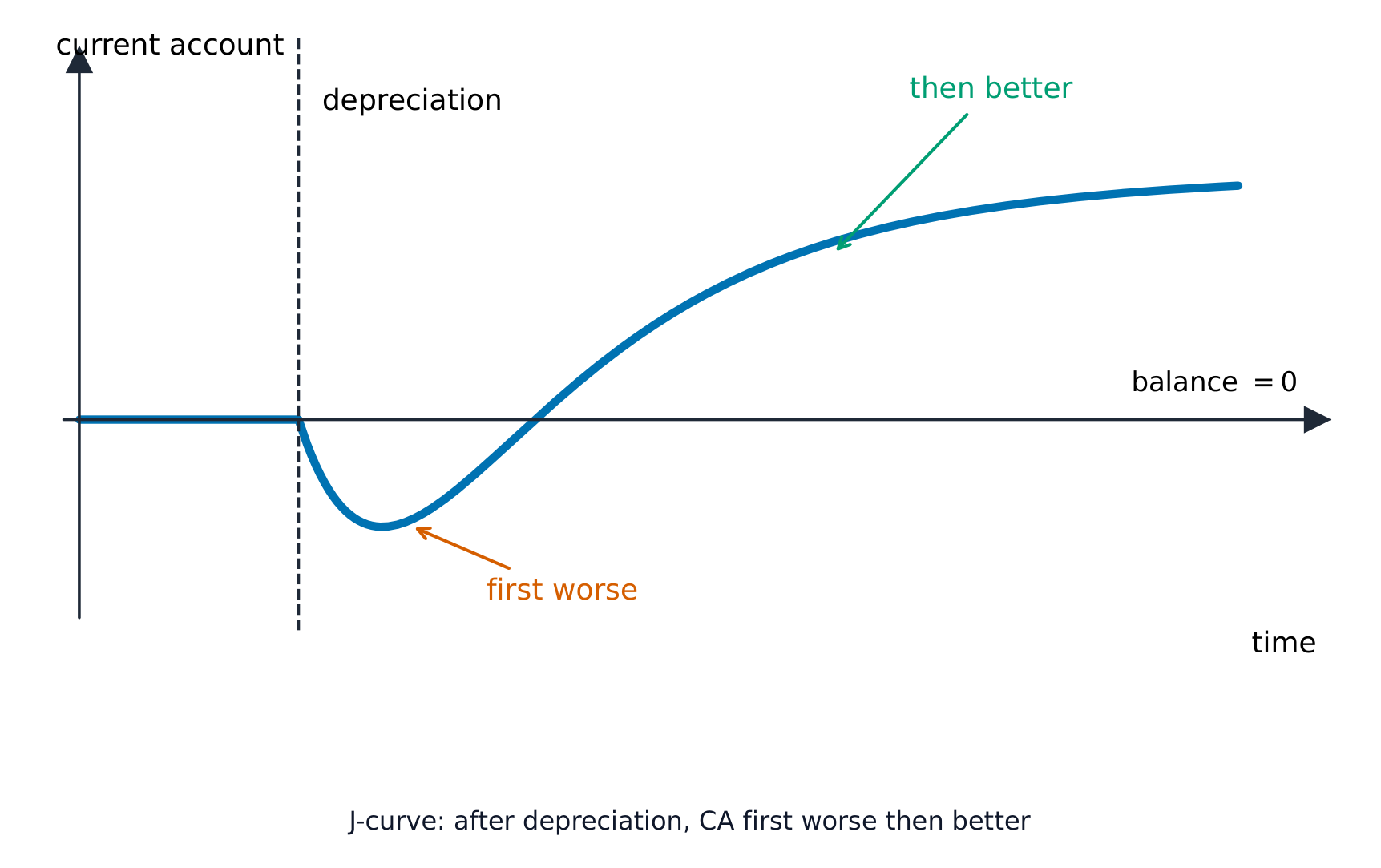
After a depreciation the current account first worsens (imports cost more at once), then improves as trade volumes adjust — tracing a letter J. ExploreEconomics case lab
Classify real examples by the economic idea they show.
Vocabulary TrainEnglish balance of payments/ˈbæləns ɒv ˈpeɪmənts/ current account/ˈkʌrənt əˈkaʊnt/ expenditure-reducing/ekˈspendɪtʃə rɪˈdjuːsɪŋ/ expenditure-switching/ekˈspendɪtʃə ˈswɪtʃɪŋ/ exchange rate/eksˈtʃeɪndʒ reɪt/ depreciation/dɪˌpriːʃɪˈeɪʃn/ devaluation/diːˌvæljuːˈeɪʃn/ Marshall-Lerner condition/ˈmɑːʃl ˈlɜːnə kənˈdɪʃn/ J-curve effect/dʒeɪ kɜːv ɪˈfekt/ 11.2
Exchange rates

Syllabus
- explain nominal, real and trade-weighted (effective) exchange rates and how they are determined
- explain fixed, floating and managed exchange rate systems, devaluation/revaluation and the effects of exchange rate changes
Source: Cambridge International syllabus
Exchange rates: appreciation An exchange rate is the price of one currency in terms of another. There is more than one way to measure it:
- the nominal exchange rate 名义汇率 is the everyday market rate between two currencies.
- the real exchange rate 实际汇率 adjusts the nominal rate for differences in prices between the countries, so it shows true competitiveness.
- the trade-weighted exchange rate 贸易加权汇率, also called the effective exchange rate 有效汇率, is an average of a currency's value against all its trading partners, weighted by how much trade is done with each.
The three systems
- a floating exchange rate 浮动汇率 is set by the demand for and supply of the currency.
- a fixed exchange rate 固定汇率 is held at a set value by the central bank.
- a managed exchange rate 管理浮动汇率 mostly floats, with the central bank stepping in at times.
Under floating rates, a rise in value is an appreciation 升值 and a fall is a depreciation. Under a fixed system, a deliberate rise is a revaluation 法定升值 and a deliberate fall is a devaluation. A weaker currency tends to raise exports and inflation; a stronger currency does the opposite.
The three exchange-rate systems, and the words for a rise or fall in each ExploreExchange rates in the FX market
The exchange rate is set by the demand for and supply of the currency. Shift either to see the rate appreciate or depreciate.
Vocabulary TrainEnglish nominal exchange rate/ˈnɒmɪnl eksˈtʃeɪndʒ reɪt/ real exchange rate/rɪəl eksˈtʃeɪndʒ reɪt/ trade-weighted exchange rate/treɪd ˈweɪtɪd eksˈtʃeɪndʒ reɪt/ effective exchange rate/ɪˈfektɪv eksˈtʃeɪndʒ reɪt/ floating exchange rate/ˈfləʊtɪŋ eksˈtʃeɪndʒ reɪt/ fixed exchange rate/fɪkst eksˈtʃeɪndʒ reɪt/ managed exchange rate/ˈmænɪdʒd eksˈtʃeɪndʒ reɪt/ appreciation/əˌpriːʃɪˈeɪʃn/ revaluation/rɪˌvæljuːˈeɪʃn/ 11.3
Economic development

Syllabus
- distinguish economic growth and economic development and explain the characteristics of development
- explain indicators of development including the Human Development Index (HDI) and other measures
Source: Cambridge International syllabus
It is important not to confuse two ideas:
Growth is more income; development is wider wellbeing too - economic growth 经济增长 is simply a rise in real output.
- economic development 经济发展 is wider. It is about people's standard of living 生活水平 — their health, education, and freedom of choice, not just their income.

Economic development is wider than growth: it is about living standards in a fast-growing developing economy. A country can grow without developing much (if the extra income goes to a few people). Development usually means rising incomes plus better health, more schooling, and less poverty.
Measuring development
The best-known measure is the Human Development Index 人类发展指数 (HDI). It combines three things into one number between 0 and 1:
- income (GNI per person),
- health (life expectancy 预期寿命 at birth),
- education (mean and expected years of schooling 受教育年限).

The HDI rolls income, health and education into one number — so it captures living standards far better than income alone Other useful signs of development include access to clean water, the number of doctors per person, and mobile-phone and internet use.
ExploreDevelopment chain lab
Follow how policy and resources can change living standards.
Vocabulary TrainEnglish economic growth/ˌiːkəˈnɒmɪk ɡrəʊθ/ economic development/ˌiːkəˈnɒmɪk dɪˈveləpmənt/ standard of living/ˈstændəd ɒv ˈlɪvɪŋ/ Human Development Index/ˈhjuːmən dɪˈveləpmənt ˈɪndeks/ life expectancy/laɪf ekˈspektənsi/ years of schooling/jɪəz ɒv ˈskuːlɪŋ/ 11.4
Comparing countries at different levels of development
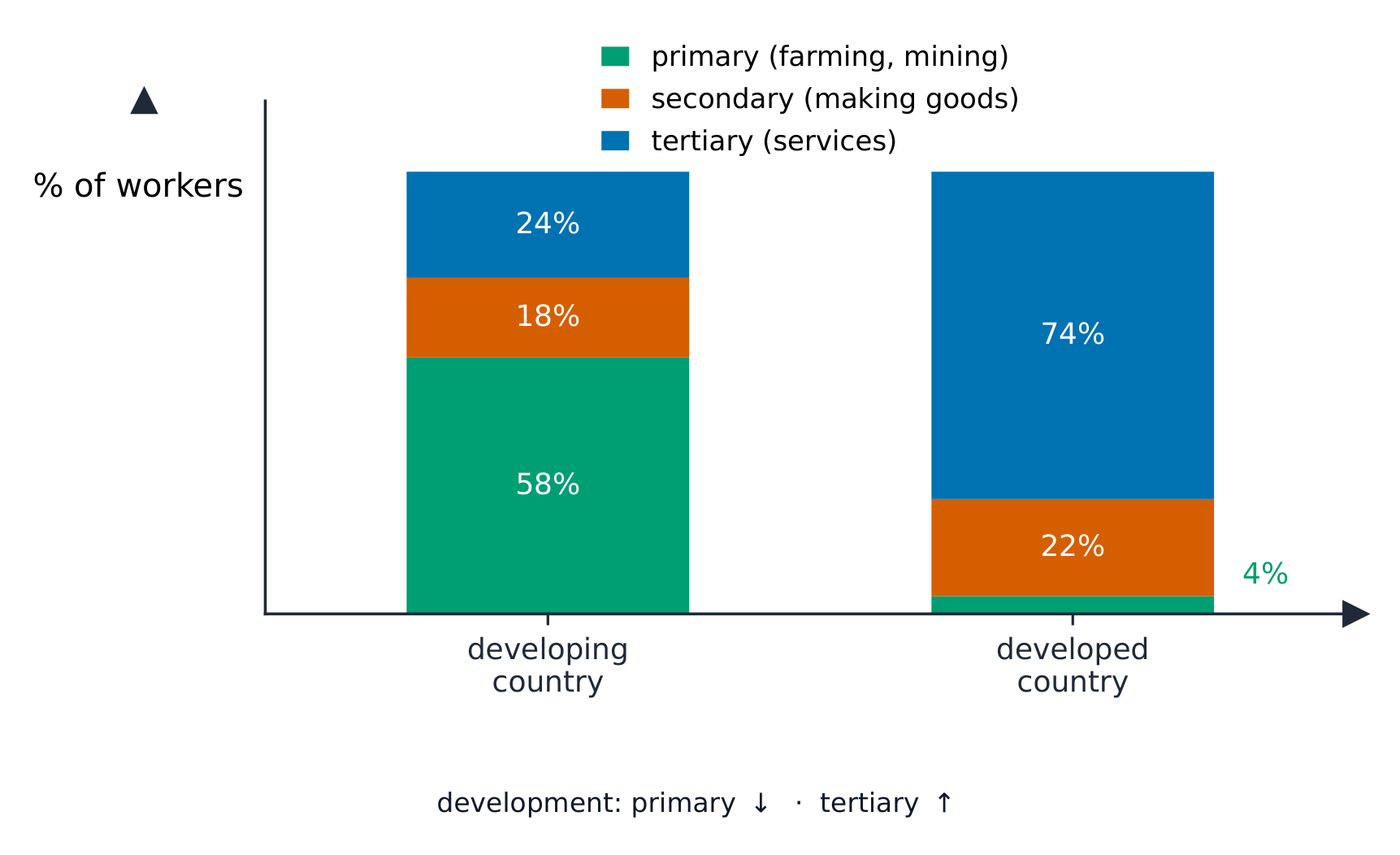
Syllabus
- compare the economic and demographic characteristics of countries at different levels of development (income, population, employment structure, education, health)
- explain the factors that influence the level of development
Source: Cambridge International syllabus
We often compare a developed country 发达国家 (high income, like Germany) with a developing country 发展中国家 (lower income, like Kenya). They differ in clear ways:
Feature Developed Developing income per person high low birth rate 出生率 and population growth low often high life expectancy high lower share of workers in farming small large The employment structure 就业结构 also differs. As a country develops, workers move out of the primary sector 第一产业 (farming and mining), into the secondary sector 第二产业 (making goods), and later into the tertiary sector 第三产业 (services).
As a country develops, workers shift out of the primary sector and into the secondary and then the tertiary (services) sector. Many things shape development: savings and investment, the quality of education and health, infrastructure, stable government and law, and access to world markets.
ExploreEconomics case lab
Classify real examples by the economic idea they show.
Vocabulary TrainEnglish developed country/dɪˈveləpt ˈkʌntri/ developing country/dɪˈveləpɪŋ ˈkʌntri/ birth rate/bɜːθ reɪt/ employment structure/emˈplɔɪmənt ˈstrʌktʃə/ primary sector/ˈpraɪməri ˈsektə/ secondary sector/ˈsekəndəri ˈsektə/ tertiary sector/ˈtɜːʃjəri ˈsektə/ 11.5
Relationships between countries
Syllabus
- explain the relationship between developed and developing countries through trade, aid, debt, foreign direct investment and multinationals, and migration/remittances
- evaluate the impact of these relationships on development
Source: Cambridge International syllabus
Richer and poorer countries are linked in several ways, each with good and bad sides.
- trade can raise incomes, but many developing countries rely on a few primary exports whose prices swing sharply.
- foreign aid 援助 can fund schools and roads, but it may create dependency or be wasted.
- debt 债务 owed to other countries can pay for development, but repaying it can drain a poor country's budget.
- foreign direct investment 外国直接投资 (FDI) by a multinational corporation 跨国公司 brings money, jobs and technology, but profits may flow back abroad and workers may be poorly treated.
- migration 移民 of workers can ease unemployment and bring in remittances 侨汇 (money sent home), but it can also drain a country of its most skilled people.
ExploreEconomics case lab
Classify real examples by the economic idea they show.
Vocabulary TrainEnglish aid/eɪd/ debt/det/ foreign direct investment/ˈfɒrən daɪˈrekt ɪnˈvestmənt/ multinational corporation/ˌmʌltɪˈnæʃənl ˌkɔːpəˈreɪʃn/ migration/maɪˈɡreɪʃn/ remittances/rɪˈmɪtənsɪz/ 11.6
Globalisation

Syllabus
- explain globalisation and its causes and the role of multinational corporations and trade blocs
- evaluate the benefits and costs of globalisation for developed and developing economies
Source: Cambridge International syllabus
globalisation 全球化 is the growing links between countries — in trade, money, technology and people — so that the world acts more like one market. Its causes include cheaper transport and communication, free trade 自由贸易 agreements, and the spread of multinational firms.
Countries often join a trade bloc 贸易集团 — a group that trades freely among themselves (like the European Union).
Globalisation: falling trade and transport costs tie national economies together. Benefits and costs
Benefits Costs lower prices and more choice some industries and jobs are lost to cheaper countries faster growth and technology transfer the gap between rich and poor can widen larger markets for firms more pollution and use of resources poorer countries can industrialise powerful multinationals may avoid tax and dodge protectionism 贸易保护主义 rules Globalisation helps developed and developing economies in different ways, but the gains are not shared evenly, which is why it remains so argued about.
ExploreOpen economy lab
See how trade or exchange-rate pressure changes domestic outcomes.
Vocabulary TrainEnglish globalisation/ˌɡləʊbəlaɪˈzeɪʃn/ free trade/friː treɪd/ trade bloc/treɪd blɒk/ protectionism/prəˈtekʃənɪzəm/ 11.6
Exam tips
- Distinguish expenditure-reducing from expenditure-switching policies for a deficit.
- Explain the Marshall-Lerner condition ($PED_x + PED_m > 1$) and the J-curve (the deficit worsens before it improves).
- Compare development with the HDI (income, education, health), not GDP alone.
- Evaluate globalisation with its winners and losers (growth and choice versus inequality and instability).
Vocabulary card meanings
devaluation: An official reduction in a currency's fixed price. Marshall-Lerner condition: The requirement that trade volumes respond enough for a cheaper currency to improve the trade balance. J-curve effect: The trade balance worsening just after a currency falls, then later improving. real exchange rate: A currency's price after adjusting for prices at home and abroad. trade-weighted exchange rate: An index of a currency's price against its partners' monies, with each partner weighted by its share of trade. effective exchange rate: An average of a currency's price against the currencies that matter for its trade. revaluation: An official increase in a currency's fixed price. years of schooling: How long people stay in education, on average. developed country: A country with high income and established industry. developing country: A country whose income and industry are still catching up. employment structure: How jobs are split among farming, making goods, and services. trade bloc: A group of countries that lower trade barriers among themselves.