- explain absolute and comparative advantage and the gains from specialisation and trade
- explain the terms of trade and the benefits and limitations of trade theory
International economic issues
A-Level Economics · Topic 6
 9:07
9:07
International economic issues
Look at the label on your phone, your shoes, your desk lamp. Almost none of it was made in the country where you are sitting. It arrived in steel boxes, on…
English narration · English + 中文 subtitles burned in
6.1
Why countries trade

Syllabus
Source: Cambridge International syllabus
international trade 国际贸易 lets residents exchange goods and services across borders. To specialise 专业化 means to concentrate on producing particular goods or services. Specialisation and trade can increase consumption choices; calculate the possible gain and then consider costs and adjustment.
Absolute and comparative advantage
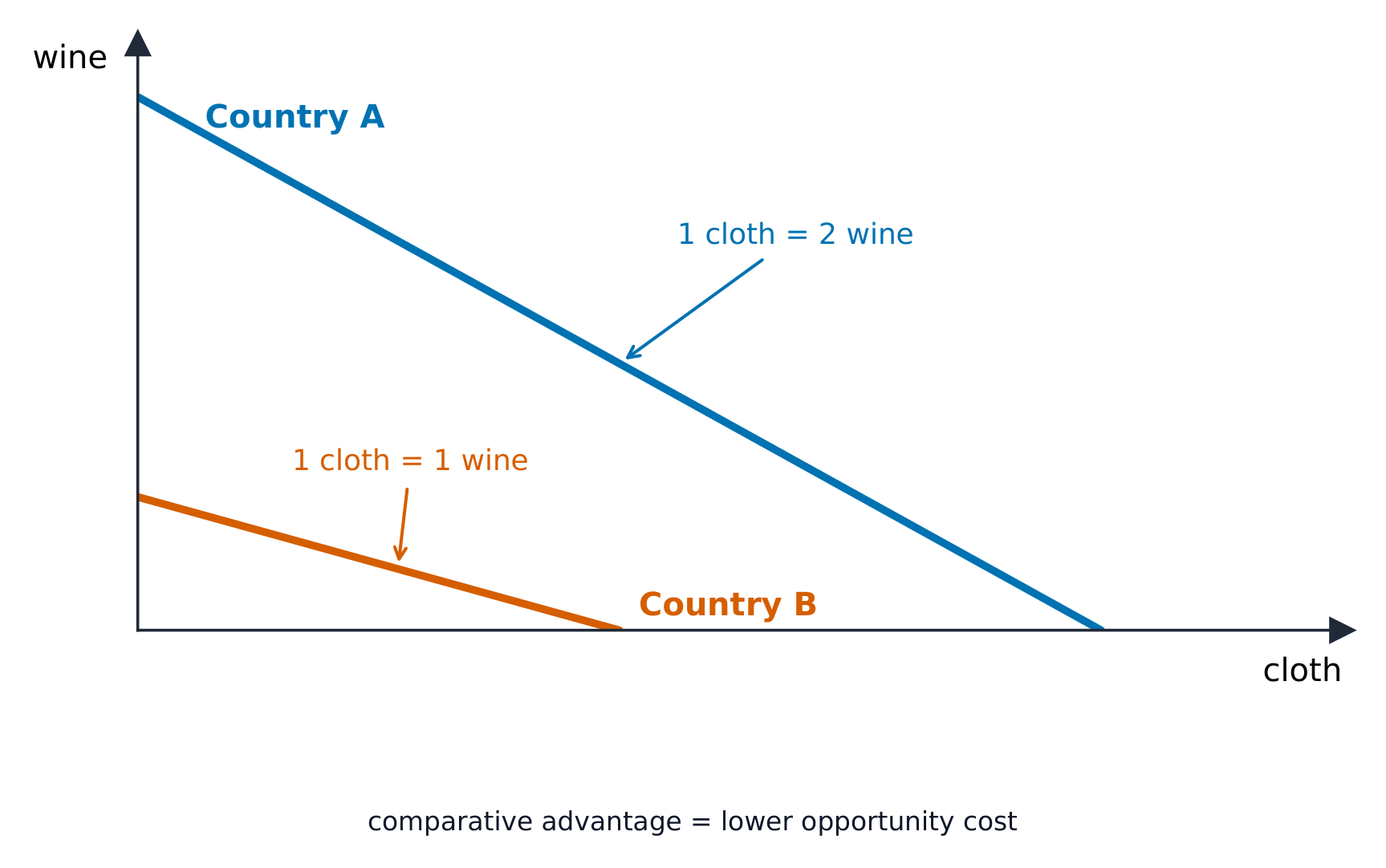
An absolute advantage 绝对优势 means producing more with the same stated resources. A comparative advantage 比较优势 means producing at lower opportunity cost 机会成本. They answer different questions.
Illustrative maximum outputs with the same quantity of resources in each country; assume straight-line PPCs and unchanged technology:
| Country | Wine only | Cloth only |
|---|---|---|
| A | 20 units | 10 units |
| B | 5 units | 5 units |
A has an absolute advantage in both. To find comparative advantage, divide output forgone by output gained:
$$\mathrm{OC}_A(\text{cloth})=\frac{\text{wine forgone}}{\text{cloth gained}}=\frac{20}{10}=2\text{ wine/cloth}.$$
$$\mathrm{OC}_B(\text{cloth})=\frac{\text{wine forgone}}{\text{cloth gained}}=\frac{5}{5}=1\text{ wine/cloth}.$$
$$\mathrm{OC}_A(\text{wine})=\frac{\text{cloth forgone}}{\text{wine gained}}=\frac{10}{20}=0.5\text{ cloth/wine}.$$
$$\mathrm{OC}_B(\text{wine})=\frac{\text{cloth forgone}}{\text{wine gained}}=\frac{5}{5}=1\text{ cloth/wine}.$$
B gives up less wine per cloth, so has comparative advantage in cloth. A gives up less cloth per wine, so has comparative advantage in wine. One country being more productive in both goods does not remove possible gains from trade.
Gains in consumption and the trading possibility curve
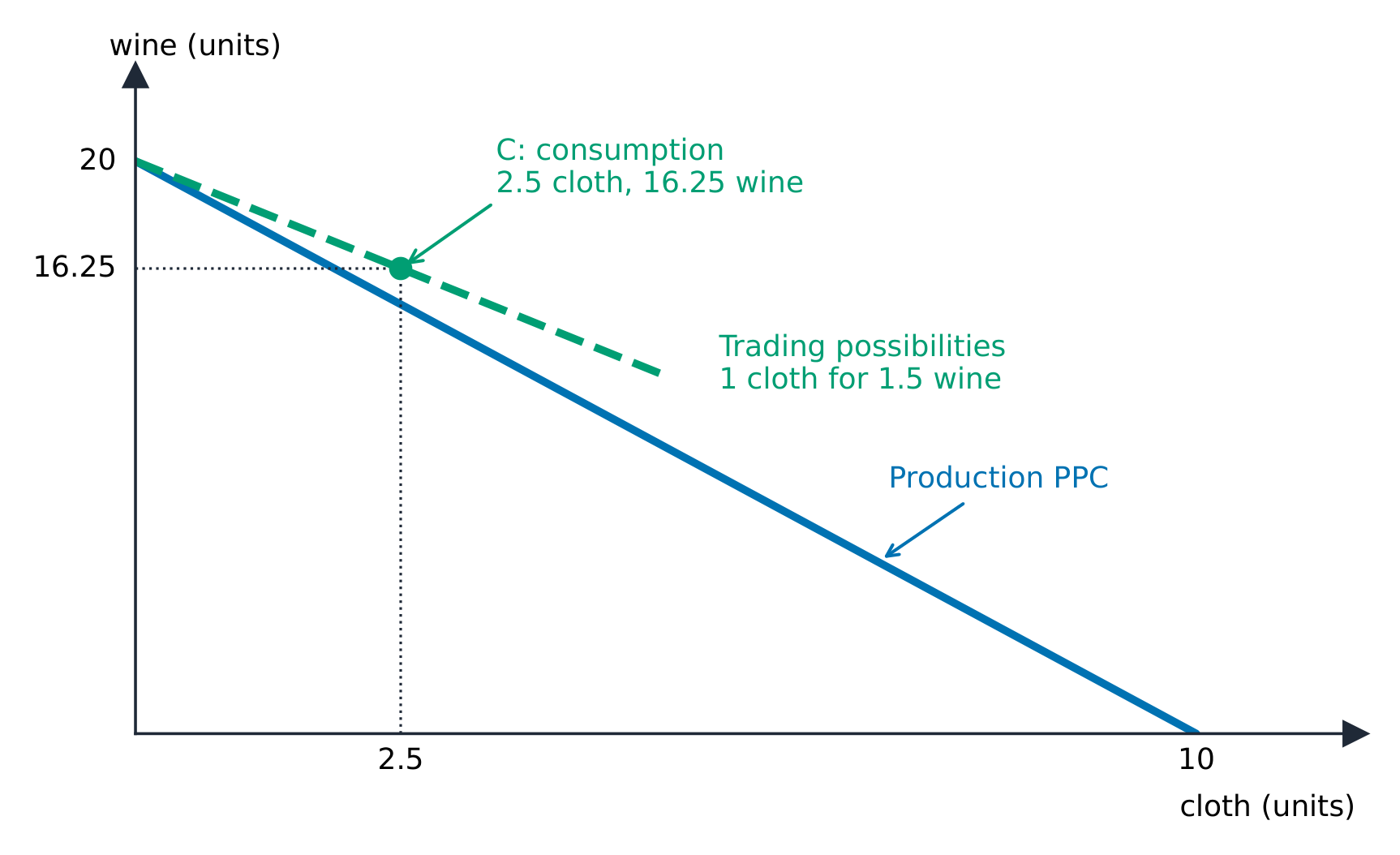
Worked exchange ratio. B gives up 1 wine to make 1 cloth; A gives up 2 wine to make it. At 1 cloth for 1.5 wine, B receives 0.5 wine more than its cost and A saves 0.5 wine compared with making cloth at home. Both strictly gain per traded unit when the wine-per-cloth ratio is between 1 and 2, before trading costs. At an endpoint, one side is indifferent in this model.
Worked consumption bundles. Without trade, A makes 16 wine and 2 cloth; B makes 3 wine and 2 cloth. Both lie on their own PPCs. After specialisation, A makes 20 wine and B makes 5 cloth. B sends 2.5 cloth to A in exchange for 3.75 wine, consistent with 1.5 wine per cloth.
| Country | Wine consumed | Cloth consumed |
|---|---|---|
| A | 20 − 3.75 = 16.25 | 0 + 2.5 = 2.5 |
| B | 0 + 3.75 = 3.75 | 5 − 2.5 = 2.5 |
Both can consume more of both goods than in the stated no-trade bundles. Total consumption equals total production: 20 wine and 5 cloth. The example shows a possible gain, not a promise that all trades or all households gain equally.
A trading possibility curve 贸易可能性曲线 shows consumption combinations available through production and trade at a stated exchange ratio. It can extend beyond a country's production PPC without moving that PPC. The country's technology and resources have not changed; trade changes access to goods. Here B can supply at most 5 cloth, so the shown trading segment is limited to those imports.
Terms of trade: prices, not the trade balance
terms of trade 贸易条件 compare export prices with import prices, using indices with the same base period:
$$\mathrm{ToT}=\frac{P_X}{P_M}\times100.$$
With export-price index 110 and import-price index 105:
$$\mathrm{ToT}=\frac{110}{105}\times100\approx104.8.$$
A fixed export quantity now buys about 4.8% more imports than in the base period. The index does not measure export volumes or the current-account balance. An improvement could reflect higher export prices or lower import prices, with different effects on sales and costs. Commodity demand, supply and production costs influence the ratio. Dearer exports may sell fewer units; improved terms of trade do not automatically mean higher export revenue or welfare.
Transfer task with solution. Terms of trade fall from 95 to 85 while the import-price index stays 120. Find both export-price indices and their change:
$$\mathrm{ToT}=\frac{P_X}{P_M}\times100\quad\Rightarrow\quad P_X=\frac{\mathrm{ToT}\times P_M}{100}.$$
$$P_{X0}=\frac{95\times120}{100}=114.$$
$$P_{X1}=\frac{85\times120}{100}=102.$$
$$\Delta P_X=P_{X1}-P_{X0}=102-114=-12.$$
Export prices fall 12 index points, not 10. Distinguish an index-point change from a percentage change.
Limits and distribution of gains
If the calculated saving is 0.5 wine per cloth but shipping and border costs use resources worth 0.6 wine per cloth, the saving is lost. The simple model holds technology and resources fixed, assumes constant opportunity costs, and omits trading costs and barriers. Moving workers and capital into expanding industries can require time, retraining and investment. Changing costs, product quality and reliance on one export also matter. Trade can widen choice and competition; assess adjustment losses and the distribution of gains instead of assuming everyone benefits equally.
Explore
Why countries trade
Each country specialises where its opportunity cost is lowest, then trades — both can consume beyond their own frontier.
Vocabulary
Train
| English |
|---|
| international trade/ˌɪntəˈnæʃənl treɪd/ |
| specialise/ˈspeʃəlaɪz/ |
| absolute advantage/ˈæbsəluːt ədˈvæntɪdʒ/ |
| comparative advantage/kəmˈpærətɪv ədˈvæntɪdʒ/ |
| opportunity cost/ɒpəˈtjuːnɪti kɒst/ |
| terms of trade/tɜːmz ɒv treɪd/ |
| trading possibility curve/ˈtreɪdɪŋ ˌpɒsəˈbɪlɪti kɜːv/ |
6.2
Protectionism

Syllabus
- describe tools of protection (tariffs, quotas, subsidies, embargoes, administrative barriers)
- explain the arguments for and against protectionism and its effects on stakeholders
Source: Cambridge International syllabus
protectionism 贸易保护主义 shields home producers from foreign competition. Explain each tool's direct mechanism before judging its effects:
- A tariff 关税 taxes imports. In the small-country model below, it raises the domestic price while imports remain available.
- A quota 配额 caps the quantity imported. A quota above existing imports may not bind.
- An export subsidy 补贴 pays exporters, reducing effective costs and potentially expanding foreign sales. It requires public funding; it does not automatically raise every domestic price.
- An embargo 禁运 bans specified trade, potentially increasing the cost of alternatives.
- administrative barriers 行政壁垒 are excessive procedures that hinder imports. Distinguish these from useful safety or environmental standards.
Worked tariff: imports and revenue
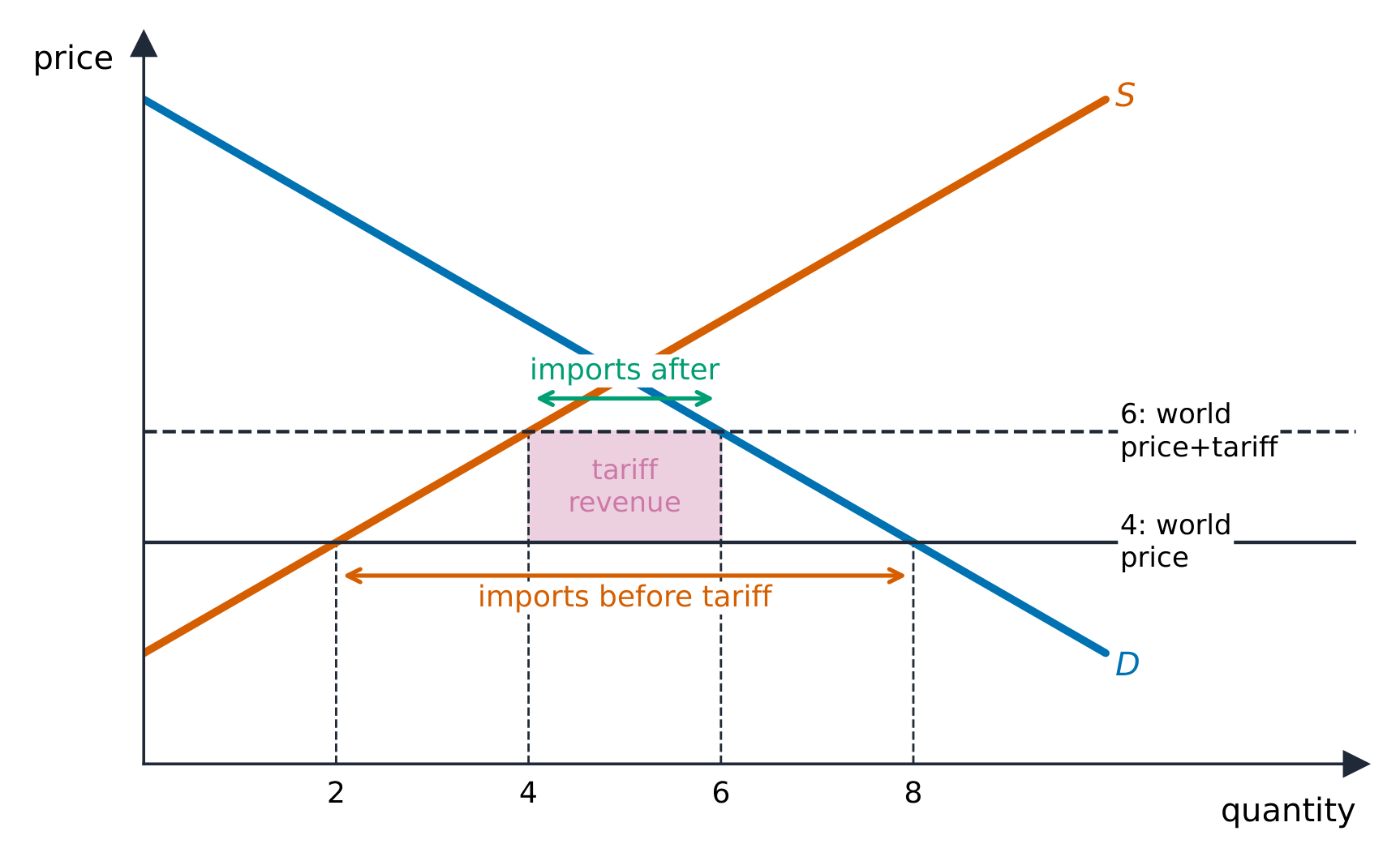
Assume a small country facing an unchanged world price, no evasion and full pass-through of the tariff into the domestic price. Prices are £/unit; quantities are million units/year. At world price 4, domestic supply is 2 and demand 8. A tariff of 2 raises the domestic price to 6: supply rises to 4 and demand falls to 6.
$$M_0=Q_{d0}-Q_{s0}=8-2=6\text{ million units/year}.$$
$$M_1=Q_{d1}-Q_{s1}=6-4=2\text{ million units/year}.$$
$$R=t\times M_1.$$
$$R=\text{\pounds}2/\text{unit}\times2\text{ million units/year}=\text{\pounds}4\text{ million/year}.$$
Use imports after the tariff. Multiplying the tariff by all domestic consumption or the old import quantity gives the wrong revenue.
Effects on stakeholders
A stakeholder 利益相关者 is a person or group affected. Consumers pay 6 rather than 4 and buy 6 rather than 8 million units, reducing purchasing power. Home producers sell 4 rather than 2 million units at the higher price, but higher-cost production may expand. Government receives £4 million/year while taxable imports continue; revenue is a transfer, not evidence of a net national gain. Foreign suppliers sell fewer units in this model. Domestic firms using imported inputs can face higher costs. Compare the gains and losses and wider responses.
A quota need not give gains to the same recipient
Suppose an import quota of 2 million units/year produces the same domestic price 6 while foreign supply remains available at 4. A licence holder buying at 4 and selling at 6 may receive the difference. Government can capture some or all of it by auctioning licences; foreign suppliers may receive gains if they hold licences or market power. Do not claim that every quota generates no government receipts or always benefits domestic importers. A tariff fixes a tax per imported unit; a quota fixes the permitted quantity, so their response to changing demand can differ.
Evaluate arguments for and against protection
An infant industry 幼稚产业 may need time to learn or reach efficient scale. A credible temporary-protection case needs evidence of falling costs, measurable targets and an end date. Protection may instead preserve inefficiency and impose costs on consumers. Strategic capacity and time for workers to adjust may also matter.
dumping 倾销 concerns export prices below normal value, commonly compared with home-market prices or assessed using costs. Cheap imports alone do not prove an intention to destroy competitors. WTO definition.
retaliation 报复 by trading partners can weaken export sales. Judge a specified tool against its objectives, duration, consumer and input costs, possible foreign responses and alternatives. A justified conclusion weighs the actual conditions; it does not simply repeat that protection saves jobs or raises prices.
Explore
Protectionism in the market
A tariff or quota shifts effective supply and raises the domestic price, protecting home producers but costing consumers. Shift the lines to see it.
Vocabulary
Train
| English |
|---|
| protectionism/prəˈtekʃənɪzəm/ |
| tariff/ˈtærɪf/ |
| quota/ˈkwəʊtə/ |
| subsidy/ˈsʌbsɪdi/ |
| embargo/emˈbɑːɡəʊ/ |
| administrative barriers/ədˈmɪnɪstrətɪv ˈbærɪəz/ |
| infant industry/ˈɪnfənt ˈɪndʌstri/ |
| dumping/ˈdʌmpɪŋ/ |
| retaliation/rɪˌtælɪˈeɪʃn/ |
| stakeholder/ˈsteɪkhəʊldə/ |
6.3
The balance of payments

Syllabus
- describe the structure of the balance of payments and the components of the current account (trade in goods and services, primary and secondary income)
- explain the causes and consequences of current account deficits and surpluses
Source: Cambridge International syllabus
The balance of payments 国际收支 records transactions between residents and non-residents during a period. The current account 经常账户 is one part; it records goods, services, primary income and secondary income. A receipt is a credit, and a payment is a debit. Use the same period, currency and sign convention throughout a calculation.
Classify transactions before calculating
- trade in goods 货物贸易: exports and imports of physical products. A resident firm exporting machinery receives a goods credit.
- trade in services 服务贸易: services supplied across the resident/non-resident boundary. A foreign visitor paying a resident hotel creates a service credit.
- primary income 初次收入: income from labour or ownership of assets across borders. Interest received by a resident on a foreign bond is a credit; interest paid abroad is a debit.
- secondary income 二次收入: current transfers without an equivalent item received in return, such as a household gift from abroad.
Buying an existing foreign bond is a financial-asset transaction, not primary income. Its later interest is income. Goods made and consumed domestically are not exports simply because they are valuable.
Worked account: trade surplus but current-account deficit
Illustrative annual flows, all £bn/year:
| Component | Receipts | Payments |
|---|---|---|
| Goods | 80 | 100 |
| Services | 50 | 20 |
| Primary income | 5 | 20 |
| Secondary income | 2 | 5 |
For goods and services, receipts are export earnings and payments are import expenditure. Let $B_g$ and $B_s$ be their balances, $B_t$ the combined trade balance, and $N_p$ and $N_s$ net primary and secondary income. For income, $R$ means receipts and $P$ payments.
$$B_g=X_g-M_g=80-100=-20.$$
$$B_s=X_s-M_s=50-20=+30.$$
$$B_t=B_g+B_s=-20+30=+10.$$
Goods are in deficit, services in surplus, and combined trade in surplus. Income and transfers still matter:
$$\begin{aligned}
N_p&=R_p-P_p=5-20=-15\\
N_s&=R_s-P_s=2-5=-3\\
\mathrm{CAB}&=B_t+N_p+N_s\\
\mathrm{CAB}&=10+(-15)+(-3)=-8\text{ (£bn/year)}.
\end{aligned}$$
A current account deficit 经常账户赤字 means total current-account debits exceed credits. A current account surplus 经常账户盈余 means credits exceed debits. Neither is defined solely by imports and exports. This example has a £10bn trade surplus alongside an £8bn current-account deficit.
Explain the cause before choosing a policy
Transfer task with solution. Starting from CAB $=-8$, compare an extra £12bn/year of service exports with an extra £12bn/year of interest payments abroad. Hold all other flows constant.
$$\mathrm{CAB}_{\mathrm{exports}}=\mathrm{CAB}_0+\Delta X_s=-8+12=+4\text{ (£bn/year)}.$$
$$\mathrm{CAB}_{\mathrm{interest}}=\mathrm{CAB}_0-\Delta P_p=-8-12=-20\text{ (£bn/year)}.$$
Stronger overseas demand can raise exports; stronger domestic spending can raise imports. Exchange rates, relative prices, product quality and capacity influence trade. Income payments and transfers can change CAB even when trade is unchanged. A single balance does not identify its cause.
Assess consequences and financing
Compare two economies with the same deficit. Economy A imports machinery for a viable new export industry. Economy B persistently loses overseas customers while paying more income abroad. A's imports may improve future capacity and earnings if the investment succeeds. B's lost sales may weaken demand and employment, although other expenditure can offset this. Size alone cannot settle the judgement.
A deficit requires counterpart financing or asset/reserve changes in the wider accounts. Borrowing, equity investment and selling assets differ: external debt does not automatically rise by the current-account deficit. Consider persistence, financing terms, future income payments, exchange-rate pressures and productive use of imports. A surplus can reflect strong competitiveness or weak domestic spending; it is not automatically a welfare gain.
Explore
Current account flow
Track exports, imports and income flows into the current account.
Vocabulary
Train
| English |
|---|
| balance of payments/ˈbæləns ɒv ˈpeɪmənts/ |
| current account/ˈkʌrənt əˈkaʊnt/ |
| trade in goods/treɪd ɪn ɡʊdz/ |
| trade in services/treɪd ɪn ˈsɜːvɪsɪz/ |
| primary income/ˈpraɪməri ˈɪŋkʌm/ |
| secondary income/ˈsekəndəri ˈɪŋkʌm/ |
| current account deficit/ˈkʌrənt əˈkaʊnt ˈdefɪsɪt/ |
| current account surplus/ˈkʌrənt əˈkaʊnt ˈsɜːpləs/ |
6.4
Exchange rates

Syllabus
- explain the determination of floating exchange rates by demand and supply of currency, and fixed and managed systems
- explain the causes and effects of appreciation and depreciation on the economy
Source: Cambridge International syllabus
An exchange rate 汇率 is the price of one currency in another. State the quote before describing a rise or fall. For example, US$1.40 per pound means £1 buys US$1.40. If this rises to US$1.60 per pound, the pound buys more dollars: appreciation 升值. A fall in the dollar-per-pound quote is depreciation 贬值. A quote in pounds per dollar moves the opposite way.
The floating currency market
A floating exchange rate 浮动汇率 adjusts where demand for the currency meets supply. In the market for pounds, a buyer exchanging dollars for pounds to pay a UK exporter demands pounds. A UK importer exchanging pounds for dollars supplies pounds. Follow the currency exchanged, not the buyer's nationality.
With currency supply unchanged, stronger demand for pounds raises foreign currency per pound: appreciation. Higher export demand or inward investment may raise demand. With currency demand unchanged, UK residents buying more foreign goods can increase supply of pounds and cause depreciation. Outward investment can also increase supply. Higher relative interest returns may attract funds, but expectations and risk can offset that response.
A change in the pound's own price causes movement along a curve; a change in export demand or investment flows can shift a curve. State other influences held constant.

For context, a fixed exchange rate 固定汇率 is maintained at a stated rate or band using intervention or other policy measures. Maintaining it can require reserves and policy adjustments. A managed exchange rate 管理浮动汇率 combines market forces with intervention to influence the rate. These arrangements describe currency pricing; a current-account surplus describes a different account and does not identify the currency system. The required AS model here focuses on floating rates.
Worked export conversion
A UK machine keeps its £200 price. The rate rises from US$1.40/£ to US$1.60/£. Assume the change is passed through to the US buyer. Let $P_{\mathrm{US}}$ be its dollar price, $P_{\mathrm{UK}}$ its pound price and $e$ dollars per pound. Multiply so pounds cancel:
$$P_{\mathrm{US}}=P_{\mathrm{UK}}\times e.$$
$$P_{\mathrm{US},0}=P_{\mathrm{UK}}\times e_0=\text{\pounds}200\times\text{US\$}1.40/\text{\pounds}=\text{US\$}280.$$
$$P_{\mathrm{US},1}=P_{\mathrm{UK}}\times e_1=\text{\pounds}200\times\text{US\$}1.60/\text{\pounds}=\text{US\$}320.$$
The machine becomes dearer in dollars. Sales may fall, depending on demand, contracts, quality and how firms adjust prices. Conversion arithmetic alone does not establish the quantity response.
Worked import conversion
A UK firm owes a fixed US$700 invoice. Use the same rates. Dividing dollars by dollars per pound gives pounds:
$$P_{\mathrm{UK}}=\frac{P_{\mathrm{US}}}{e}.$$
$$P_{\mathrm{UK},0}=\frac{P_{\mathrm{US}}}{e_0}=\frac{\text{US\$}700}{\text{US\$}1.40/\text{\pounds}}=\text{\pounds}500.$$
$$P_{\mathrm{UK},1}=\frac{P_{\mathrm{US}}}{e_1}=\frac{\text{US\$}700}{\text{US\$}1.60/\text{\pounds}}=\text{\pounds}437.50.$$
Appreciation lowers this invoice's pound cost. Always check the units rather than memorising that imports mean multiplication or division.
Price effects do not settle the trade balance
Transfer task with solution. The pound depreciates from US$1.40/£ to US$1.20/£. A fixed £200 export now costs US$240, while a fixed US$700 import costs about £583.33:
$$P_{\mathrm{US}}=P_{\mathrm{UK}}\times e=\text{\pounds}200\times\text{US\$}1.20/\text{\pounds}=\text{US\$}240.$$
$$P_{\mathrm{UK}}=\frac{P_{\mathrm{US}}}{e}=\frac{\text{US\$}700}{\text{US\$}1.20/\text{\pounds}}\approx\text{\pounds}583.33.$$
Export receipts and import spending equal price times quantity. Buyers may be tied to contracts, essential imports may be hard to replace, and exporters may lack capacity. Cheaper exports do not automatically mean higher receipts; dearer imports do not automatically mean a lower import bill. Assess demand responsiveness, timing and the currency in which values are measured. The whole current account also includes income and transfers. A short technical label alone cannot replace this reasoning.
AD/AS: demand and imported costs
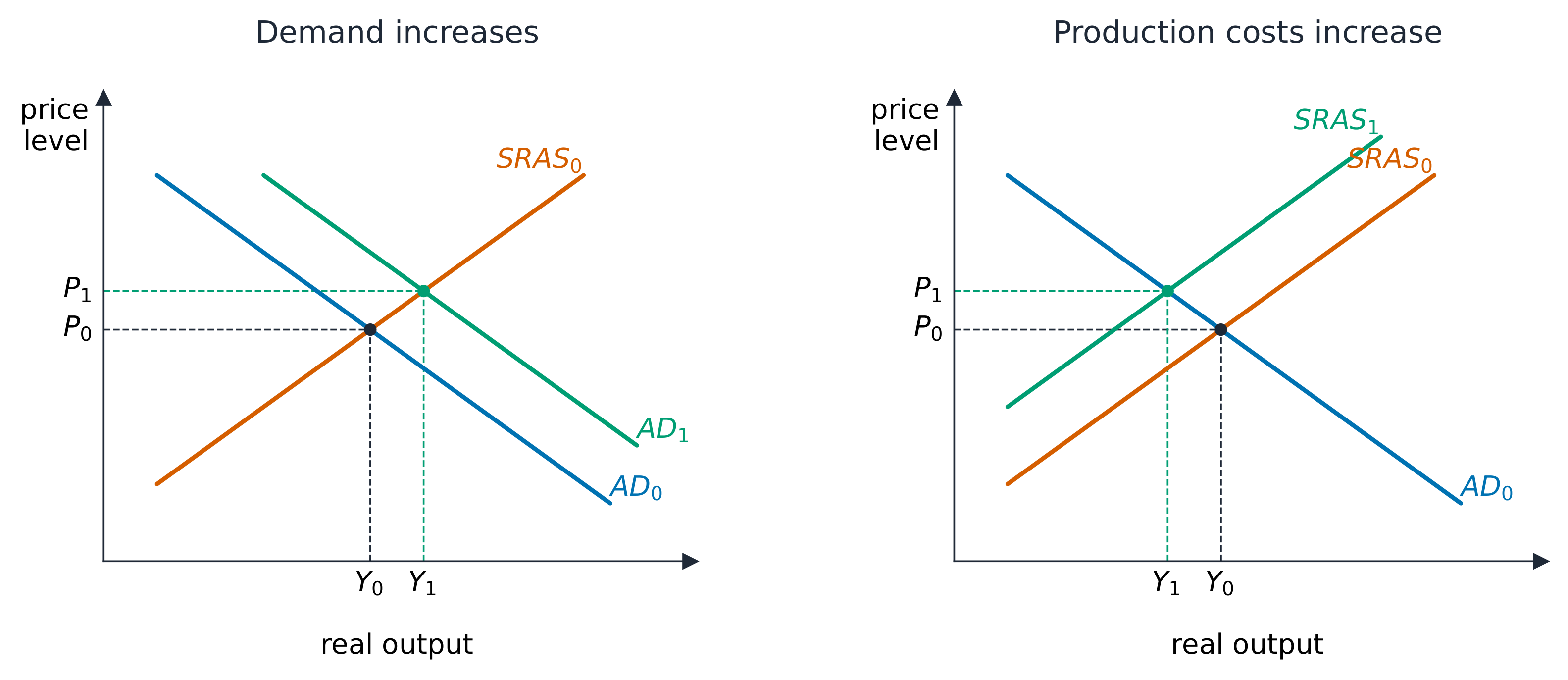
A depreciation can raise net exports if quantities respond, increasing aggregate demand 总需求 (AD). With upward-sloping short-run supply and other influences unchanged, AD shifting right raises real output and the price level. Employment also depends on how firms meet extra demand, including hours and productivity.
Dearer imported fuel, components or machinery can increase production costs. Higher costs shift short-run aggregate supply 短期总供给 (SRAS) left: holding AD unchanged, real output falls and the price level rises. If demand and cost effects occur together, their relative size determines the output change. Depreciation does not automatically remove structural unemployment or guarantee higher output and jobs.
Explore
The foreign-exchange market
A currency has its own market. More demand for £ (or less supply) pushes the exchange rate up — it appreciates.
Vocabulary
Train
| English |
|---|
| exchange rate/eksˈtʃeɪndʒ reɪt/ |
| floating exchange rate/ˈfləʊtɪŋ eksˈtʃeɪndʒ reɪt/ |
| fixed exchange rate/fɪkst eksˈtʃeɪndʒ reɪt/ |
| managed exchange rate/ˈmænɪdʒd eksˈtʃeɪndʒ reɪt/ |
| appreciation/əˌpriːʃɪˈeɪʃn/ |
| depreciation/dɪˌpriːʃɪˈeɪʃn/ |
| aggregate demand/ˈæɡrɪɡeɪt dɪˈmænd/ |
| short-run aggregate supply/ʃɔːt rʌn ˈæɡrɪɡeɪt səˈplaɪ/ |
6.5
Correcting a current account deficit

Syllabus
- explain expenditure-switching and expenditure-reducing policies and supply-side measures to correct a deficit
- evaluate the effectiveness of these policies
Source: Cambridge International syllabus
First identify the component causing the imbalance, its persistence and financing. The aim of stability does not mean forcing a zero balance every year at any cost. Compare outcomes for growth, jobs, inflation and future income payments.
Fiscal and monetary policies: reducing expenditure
expenditure-reducing 支出减少 policies lower domestic demand. Higher income taxes or lower government purchases may reduce spending and imports. If demand is already weak, output and employment can also fall. The import response depends on which spending changes and the availability of domestic alternatives.
Higher interest rates may reduce borrowing and spending, including imports. They may also attract capital and appreciate the currency, making exports dearer abroad and imports cheaper at home. Expectations and risk matter. Explain both channels before claiming that tighter monetary policy must improve CAB.
Protection and relative prices: switching expenditure
expenditure-switching 支出转换 changes relative prices to favour domestic goods. A tariff may reduce imports; an export subsidy may support foreign sales but directly costs public funds. A tariff's receipts and a subsidy's costs have different effects on the government budget. A quota changes permitted quantities and its revenue effects depend on licence arrangements.
Depreciation can also change relative prices, but a floating rate is not simply set lower by government command. Monetary policy can influence it with uncertain responses. Higher import costs, retaliation, weak demand responses and limited capacity can offset gains. Compare a specified policy with feasible alternatives rather than promising all effects from its label.
Supply-side policies: address the actual constraint
Supply-side policy can improve competitiveness 竞争力 through productivity, quality, costs and reliability. Compare two exporters: A cannot deliver reliably because a port is congested; B has spare capacity but foreign buyers no longer want its product. Port investment may address A's constraint; B may need product development or a different market. The same training programme need not solve both.
Skills, infrastructure and technology use resources and may take time. Higher capacity does not guarantee sales. Judge opportunity cost, the actual bottleneck and overseas demand before predicting higher exports.
Diagnose before giving a conclusion
Worked judgement. CAB is −£8bn/year despite a £10bn trade surplus because net primary and secondary income together are −£18bn/year. A tariff targets imports, not the income payments causing the imbalance. It could still change trade, but consumer and input costs, the size of the response and retaliation matter. Recommend a policy using the identified cause and compare benefits with other objectives.
Explore
Current account flow
Track exports, imports and income flows into the current account.
Vocabulary
Train
| English |
|---|
| expenditure-reducing/ekˈspendɪtʃə rɪˈdjuːsɪŋ/ |
| expenditure-switching/ekˈspendɪtʃə ˈswɪtʃɪŋ/ |
| competitiveness/kəmˈpetɪtɪvnəs/ |
6.5
Apply and review
Attempt before checking. Annual balances, in £bn/year: goods−12, services+8, primary income−7, secondary income+1. Find CAB. Then £1 falls from US$1.50 to US$1.20. Find the dollar price of a fixed £150 export. Does the lower foreign price prove that CAB will improve?
Solution. Add all four components:
$$\mathrm{CAB}=B_g+B_s+N_p+N_s=-12+8-7+1=-\text{\pounds}10\text{bn/year}.$$
$$P_{\mathrm{US}}=P_{\mathrm{UK}}\times e=\text{\pounds}150\times\text{US\$}1.20/\text{\pounds}=\text{US\$}180.$$
Previously the export cost US$225. The pound depreciates; export quantities, import costs, income and transfers still determine the overall account.
Improve a judgement. Replace “depreciation will solve the deficit and unemployment, so it is the best policy” with a conditional explanation. A lower foreign price can support export demand if buyers respond and firms can expand. Dearer inputs may increase costs and prices, while essential imports can keep the import bill high. Judge the cause of the imbalance, demand responsiveness, capacity and timing, then compare alternatives that address the problem. A justified conclusion follows those conditions instead of promising that one tool meets every objective.
Vocabulary card meanings
international trade: Buying and selling across national borders. embargo: A government ban on trade with a named country or product. administrative barriers: Paperwork and rules that make imports harder without using a tariff. infant industry: A new home industry not yet able to match foreign rivals. current account deficit: Paying more to other countries for trade and income than is received. current account surplus: Receiving more from other countries for trade and income than is paid. managed exchange rate: A currency price that the central bank steers rather than leaving fully free. trading possibility curve: The combinations of goods a country can enjoy once it specialises and trades.
Interactive lessons on this topic
Work through it step by step, with instant-check exercises.