Governments use taxes, spending and monetary tools to influence activity. Begin with the problem: weak spending, rapidly rising prices and a skills mismatch need different explanations and responses.
Government macroeconomic intervention
A-Level Economics · Topic 5
 8:53
8:53
Government macroeconomic intervention
Prices are rising fast. Jobs are hard to find. Growth has stopped. Who fixes that? Two buildings decide. In one, the government chooses what to spend and what…
English narration · English + 中文 subtitles burned in
5.1
Macroeconomic policy objectives
Syllabus
- state the macroeconomic policy objectives: stable low inflation, full employment, economic growth, balance of payments stability, redistribution of income
- explain potential conflicts between objectives
Source: Cambridge International syllabus
The core AS objectives in this unit are price stability 物价稳定, low unemployment and economic growth 经济增长. Price stability means low, stable inflation 通货膨胀; use the target stated in a question rather than assuming every country has the same numerical target. Growth means rising real output. Check population and distribution before claiming higher output improves everyone's living standards.
Low unemployment means people seeking and available for work can find suitable jobs. full employment 充分就业 does not require zero measured unemployment: workers and vacancies take time to match. Read employment and participation alongside the unemployment rate.
Fiscal and monetary tools are often called demand-side policies 需求侧政策 because they influence aggregate demand 总需求. But policy labels can overlap: the design can also affect aggregate supply 总供给.
Worked explanation. Government purchases of port construction immediately raise $G$, a component of AD. If the finished port reduces transport delays, it can later raise productive capacity. Fiscal spending can therefore have a demand effect now and a supply effect later; the second effect depends on the project's quality and use.
Broader objectives include a sustainable current-account position within the balance of payments 国际收支 and redistribution of income 收入再分配. A possible conflict 冲突 between objectives needs a causal explanation and conditions, not an automatic rule. These broader objectives and policy trade-offs are not required by AS syllabus section 5.1; the core work here is explaining the three policy types and their effects.
Explore
Macro objective lab
Classify policy examples by the macroeconomic objective they target.
Vocabulary
Train
| English |
|---|
| price stability/praɪs stəˈbɪlɪti/ |
| inflation/ɪnˈfleɪʃn/ |
| full employment/fʊl emˈplɔɪmənt/ |
| economic growth/ˌiːkəˈnɒmɪk ɡrəʊθ/ |
| balance of payments/ˈbæləns ɒv ˈpeɪmənts/ |
| redistribution of income/ˌriːˌdɪstrɪˈbjuːʃn ɒv ˈɪŋkʌm/ |
| conflict/ˈkɒnflɪkt/ |
| aggregate demand/ˈæɡrɪɡeɪt dɪˈmænd/ |
| demand-side policies/dɪˈmænd saɪd ˈpɒlɪsiz/ |
| aggregate supply/ˈæɡrɪɡeɪt səˈplaɪ/ |
5.2
Fiscal policy

Syllabus
- explain fiscal policy (government spending and taxation) and the budget balance
- distinguish direct and indirect taxes and progressive, proportional and regressive taxes
- explain the use and effectiveness of fiscal policy
Source: Cambridge International syllabus
fiscal policy 财政政策 uses government taxation and spending. The budget 预算 records planned revenue and expenditure over a period. A budget deficit 预算赤字 means expenditure exceeds revenue; a budget surplus 预算盈余 means revenue exceeds expenditure. national debt 国债 is the outstanding stock of government borrowing, measured at a point in time. The annual deficit is a flow, not the debt itself.
Budget flows and the debt stock
Worked example. Illustrative annual spending is £120bn and revenue £100bn. Debt starts at £500bn. Assume the entire deficit is financed by net borrowing, with no other adjustments.
$$\text{deficit}=\text{spending}-\text{revenue}.$$
$$\text{deficit}=\text{\pounds}120\text{bn/year}-\text{\pounds}100\text{bn/year}=\text{\pounds}20\text{bn/year}.$$
$$D_1=D_0+\text{net borrowing during year}.$$
$$D_1=\text{\pounds}500\text{bn}+\text{\pounds}20\text{bn}=\text{\pounds}520\text{bn}.$$
Next year spending is £118bn and revenue £110bn. Under the same financing assumptions:
$$\text{deficit}=\text{spending}-\text{revenue}=\text{\pounds}118\text{bn}-\text{\pounds}110\text{bn}=\text{\pounds}8\text{bn}.$$
$$D_2=D_1+\text{net borrowing}=\text{\pounds}520\text{bn}+\text{\pounds}8\text{bn}=\text{\pounds}528\text{bn}.$$
The deficit falls from £20bn to £8bn, but debt still rises. Actual debt also depends on financing choices and other adjustments. Debt servicing uses budget resources; whether borrowing is sustainable depends on the cost and capacity to service it, not just the debt's cash size.
Types and reasons for spending
capital spending 资本支出 buys or improves long-lived assets, such as new classroom computers or a new road. current spending 经常性支出 supports ongoing activity, such as teachers' wages and rent for services this year.
A grant to a student is a transfer of income rather than a direct purchase of current output. Government purchases enter $G$; a transfer itself does not, although recipients may later spend it on consumption.
Spending can provide public services and infrastructure, improve access to education or support incomes. It may address market failure and support demand in a downturn. Judge benefits against resource costs and opportunity costs; not every public project automatically raises productivity.
Tax bases and income patterns
A direct tax 直接税 is levied on income or profit, such as income tax or corporation tax. An indirect tax 间接税 is levied on expenditure and collected through suppliers, such as a sales tax. These labels describe the tax base and collection route, not who ultimately bears the burden.
Taxes can raise revenue for services, influence demand, redistribute income or discourage activities with external costs. A tax on a harmful product may discourage consumption, but its effectiveness depends on demand response and alternatives.
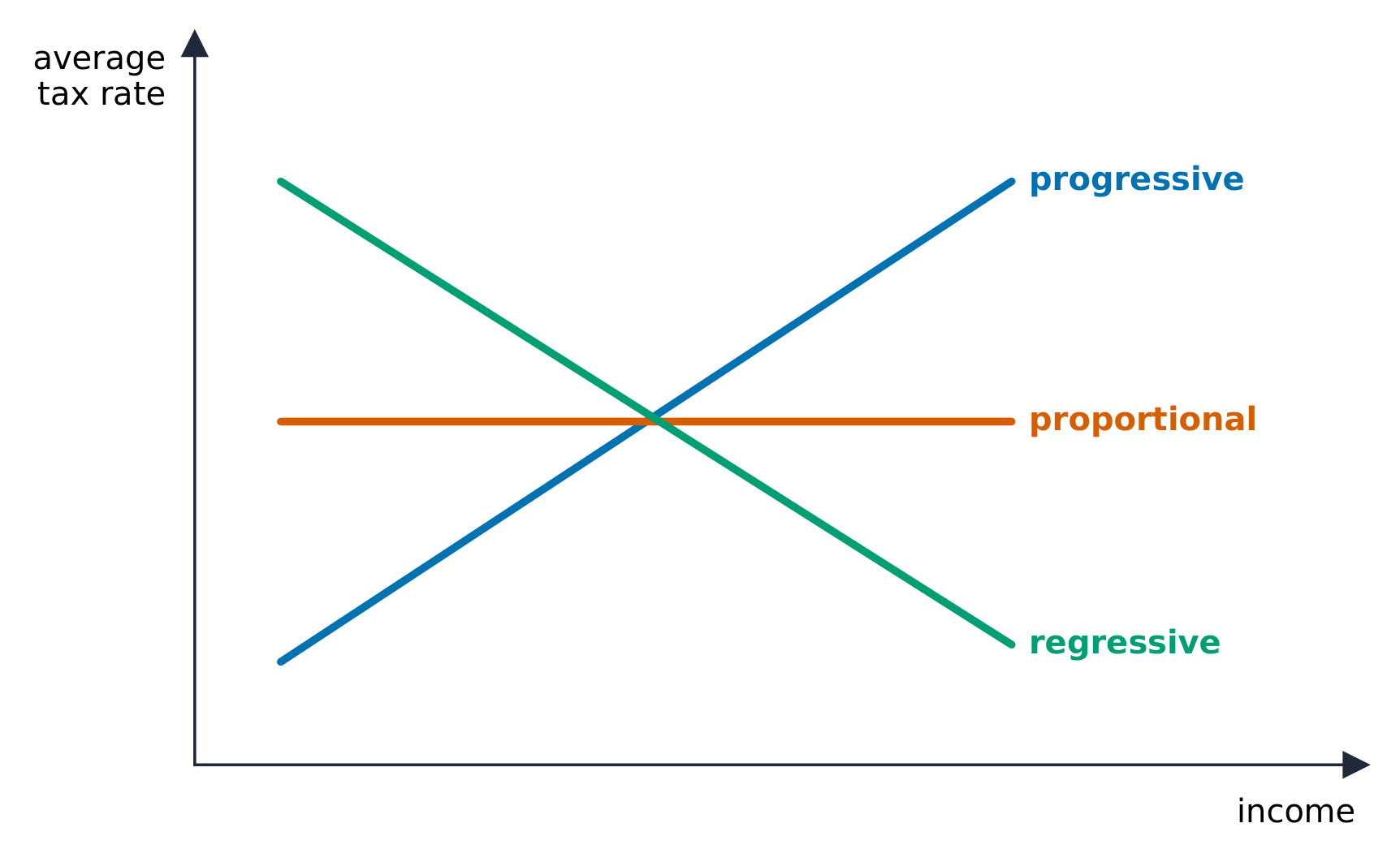
A different classification asks how total tax as a share of income changes when income rises:
- progressive tax 累进税: the average rate rises.
- proportional tax 比例税: the average rate stays constant.
- regressive tax 累退税: the average rate falls.
Worked tax bands: total, average and marginal tax
The following annual tax system is hypothetical, not any country's current rules. There are no deductions. Only income within each band faces that band's rate.
| Annual income band | Rate |
|---|---|
| First £10000 | 0% |
| Next £10000 | 10% |
| Above £20000 | 20% |
At income £25000, the first £10000 faces 0%, the next £10000 faces 10%, and only the remaining £5000 faces 20%.
$$T=\sum_i t_iY_i.$$
$$T=(0\times\text{\pounds}10000)+(0.10\times\text{\pounds}10000)+(0.20\times\text{\pounds}5000)=\text{\pounds}2000.$$
The average tax rate 平均税率 (ATR) is the share of total income paid in tax:
$$\mathrm{ATR}=\frac{T}{Y}\times100\%.$$
$$\mathrm{ATR}=\frac{\text{\pounds}2000}{\text{\pounds}25000}\times100\%=8\%.$$
At income £26000, total tax is £2200. The marginal tax rate 边际税率 (MTR) measures the tax on extra income. This £1000 increment stays inside the 20% band:
$$\mathrm{MTR}=\frac{\Delta T}{\Delta Y}\times100\%.$$
$$\mathrm{MTR}=\frac{\text{\pounds}2200-\text{\pounds}2000}{\text{\pounds}26000-\text{\pounds}25000}\times100\%=20\%.$$
A marginal rate does not apply to all earlier income. If an income increment crosses bands, its extra tax must be calculated across the relevant bands.
Practice with solution. At income £15000, total tax is £500. Compare its ATR with the 8% rate at £25000:
$$\mathrm{ATR}=\frac{T}{Y}\times100\%=\frac{\text{\pounds}500}{\text{\pounds}15000}\times100\%\approx3.33\%.$$
The rising average rate makes this system progressive. A flat 10% income tax is proportional. A fixed £1000 charge per person is regressive: its income share falls from $1000/15000\times100\%\approx6.67\%$ to $1000/25000\times100\%=4\%$. Paying more pounds does not itself show a progressive tax. An indirect tax may be regressive relative to income when lower-income households spend a larger share on taxed goods; check their spending patterns and exemptions.
Fiscal policy through AD and AS
expansionary 扩张性 fiscal policy aims to raise demand through higher government purchases or lower taxes. contractionary 紧缩性 fiscal policy uses the reverse changes. A deficit alone does not prove a new discretionary expansion: weak activity can reduce revenue without a deliberate policy change.
Worked explanation. Compare an additional £10bn of government purchases of domestic services with a £10bn household income-tax cut. Purchases directly raise $G$ in $AD=C+I+G+(X-M)$. The tax cut raises disposable income, but households may save part or buy imports, so extra domestic consumption need not equal £10bn. Identify the route to domestic planned spending instead of assuming equal effects.
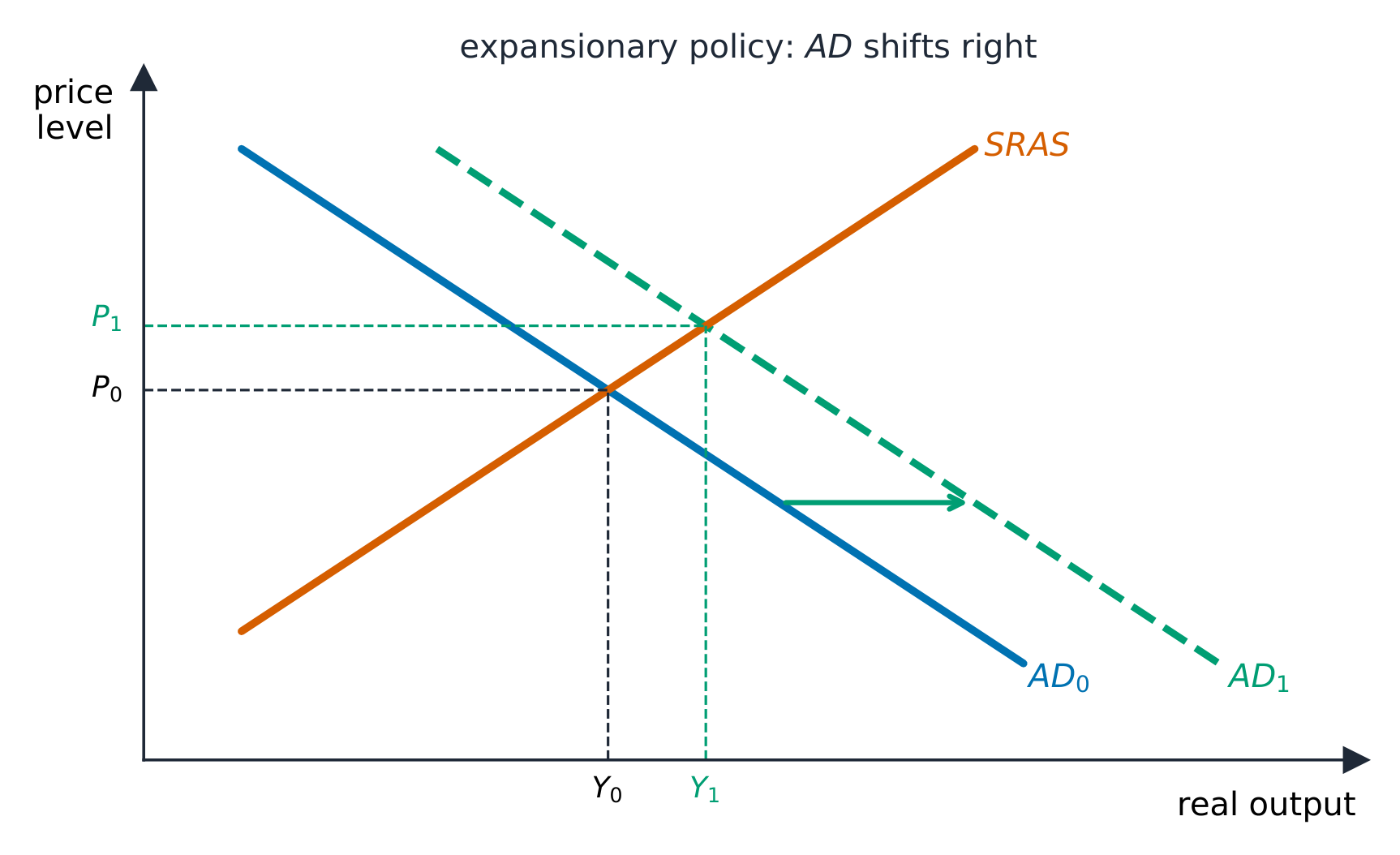
With substantial spare capacity, extra demand can raise production with limited price pressure. Near capacity, demand mainly raises prices. Employment effects depend on how firms meet extra output, including changes in hours and productivity. Fiscal contraction reverses the demand pressure in this model, but it can reduce output and jobs as well as price pressure. Spending on useful infrastructure or education can have supply effects later.
Evaluate the constraint
Purchases can support demand directly, but planning and delivery may delay them. Income-tax cuts may support consumption, but cautious households may save the gain; imports can absorb part. The timing depends on the measure, not a rule that budgets can change only once a year.
Borrowing may add debt-service costs. crowding out 挤出效应 can occur if government borrowing raises financing costs or public demand draws resources away from private activity. Its extent depends on credit conditions, spare resources and the policy response. It is not automatically large or absent. Match the judgement to the problem, financing and expected response rather than treating one policy as always best.
Explore
Fiscal policy shifts AD
Government spending and taxes move aggregate demand (AD). Drag AD to see real output and the price level change.
Vocabulary
Train
| English |
|---|
| fiscal policy/ˈfɪskl ˈpɒlɪsi/ |
| budget/ˈbʌdʒɪt/ |
| budget deficit/ˈbʌdʒɪt ˈdefɪsɪt/ |
| national debt/ˈnæʃənl det/ |
| budget surplus/ˈbʌdʒɪt ˈsɜːpləs/ |
| direct tax/daɪˈrekt tæks/ |
| indirect tax/ɪndaɪˈrekt tæks/ |
| progressive tax/prəˈɡresɪv tæks/ |
| proportional tax/prəˈpɔːʃənl tæks/ |
| regressive tax/rɪˈɡresɪv tæks/ |
| expansionary/ekˈspænʃənəri/ |
| contractionary/kənˈtrækʃənəri/ |
| crowding out/ˈkraʊdɪŋ aʊt/ |
| capital spending/ˈkæpɪtl ˈspendɪŋ/ |
| current spending/ˈkʌrənt ˈspendɪŋ/ |
| average tax rate/ˈævrɪdʒ tæks reɪt/ |
| marginal tax rate/ˈmɑːdʒɪnl tæks reɪt/ |
5.3
Monetary policy

Syllabus
- explain monetary policy (interest rates, money supply, exchange rate) and the role of the central bank
- explain the transmission mechanism and the effectiveness of monetary policy
Source: Cambridge International syllabus
monetary policy 货币政策 influences monetary and credit conditions through the central bank 中央银行. The required tools are the interest rate 利率, money supply 货币供给 and credit regulation 信贷管制 (restrictions on lending).
Lower policy rates, an increased money supply in the simplified model, or easier lending restrictions can support spending. These are expansionary changes; contractionary changes work in the opposite direction. Banks must be willing to lend and customers willing to borrow for credit to support spending. In the simplified money-market model, an increase in money supply lowers interest rates with money demand unchanged; do not treat this as an unconditional prediction for every policy framework.
Worked borrowing and credit examples
An illustrative £10000 variable-rate loan has no repayments or fees during the year. Its annual rate rises from 6% to 7%.
$$\text{annual interest}=\text{principal}\times\text{annual rate}.$$
$$\text{interest}_0=\text{\pounds}10000\times0.06=\text{\pounds}600/\text{year}.$$
$$\text{interest}_1=\text{\pounds}10000\times0.07=\text{\pounds}700/\text{year}.$$
The extra £100 annual cost may make some projects less attractive. An existing fixed-rate loan need not change immediately. Policy-rate changes influence commercial rates, but pass-through depends on contracts and banks.
A hypothetical borrowing limit falls from four times annual income to three times. With income £40000 per year, the maximum loan falls from £160000 to £120000. The income multiple represents a number of years of that annual income:
$$\text{maximum loan}=\text{income multiple}\times\text{annual income}.$$
$$L_0=4\text{ years}\times\text{\pounds}40000/\text{year}=\text{\pounds}160000.$$
$$L_1=3\text{ years}\times\text{\pounds}40000/\text{year}=\text{\pounds}120000.$$
This tighter credit rule can limit spending even if the interest rate is unchanged. A borrower who did not need the extra credit may not change spending. Easing a limit does not force borrowing. These are teaching figures, not an actual country's lending rules.
The transmission mechanism
The transmission mechanism 传导机制 links policy to spending, then to output and prices. A higher interest rate can make borrowing dearer and saving more rewarding. Households may reduce credit-financed consumption and firms may reduce investment, but contracts, confidence and income effects affect the response.
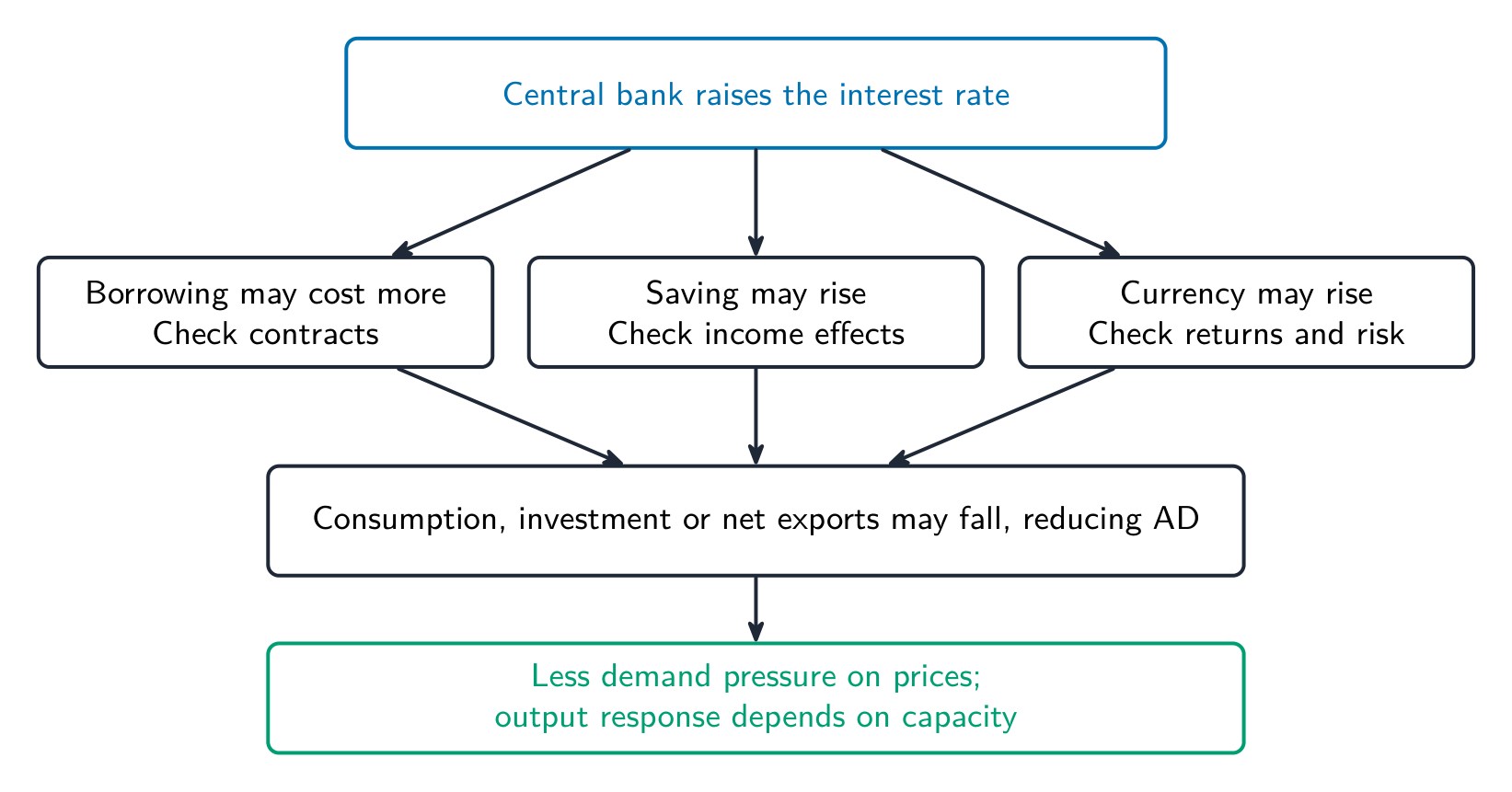
If domestic rates rise relative to foreign rates, higher expected returns may attract funds and increase demand for the currency. A stronger exchange rate 汇率 can make exports dearer to foreign buyers and imports cheaper domestically, weakening net exports and AD. But expectations, risk and changes abroad also affect capital flows. Trade quantities depend on contracts and responsiveness to prices. An interest-rate rise alone does not prove that exports must fall.
Effective monetary expansion may raise $C$ or $I$ and shift AD right, like the fiscal AD increase illustrated earlier. With upward-sloping SRAS, real output and price level rise, other things unchanged. Near capacity, price pressure dominates; with spare capacity, output can respond more. Employment depends on how firms meet extra output, including hours and productivity. Rate decisions can change quickly, but borrowing, spending and production take time; there is no fixed lag for every economy or instrument.
Worked comparison. Factories have idle capacity, confidence is weak and policy rates are near zero. Extra public purchases can support demand directly, but delivery, funding and imports affect their impact. Weak confidence may limit borrowing even when credit is cheap; near-zero rates restrict further conventional rate cuts. This does not prove every monetary tool is exhausted or that fiscal action must succeed. Compare feasible measures, their likely response and timing. A different starting interest rate alone does not determine the best policy.
Explore
Monetary policy shifts AD
Changing interest rates moves aggregate demand. Lower rates → more borrowing and spending → AD shifts right.
Vocabulary
Train
| English |
|---|
| monetary policy/ˈmʌnɪtəri ˈpɒlɪsi/ |
| central bank/ˈsentrəl bæŋk/ |
| interest rate/ˈɪntrest reɪt/ |
| money supply/ˈmʌni səˈplaɪ/ |
| exchange rate/eksˈtʃeɪndʒ reɪt/ |
| transmission mechanism/trænˈsmɪʃn ˈmekənɪzəm/ |
| credit regulation/ˈkredɪt ˌreɡjʊˈleɪʃn/ |
5.4
Supply-side policy
Syllabus
- explain supply-side policies (market-based and interventionist: education and training, incentives, privatisation, deregulation, infrastructure)
- explain the use and effectiveness of supply-side policy
Source: Cambridge International syllabus
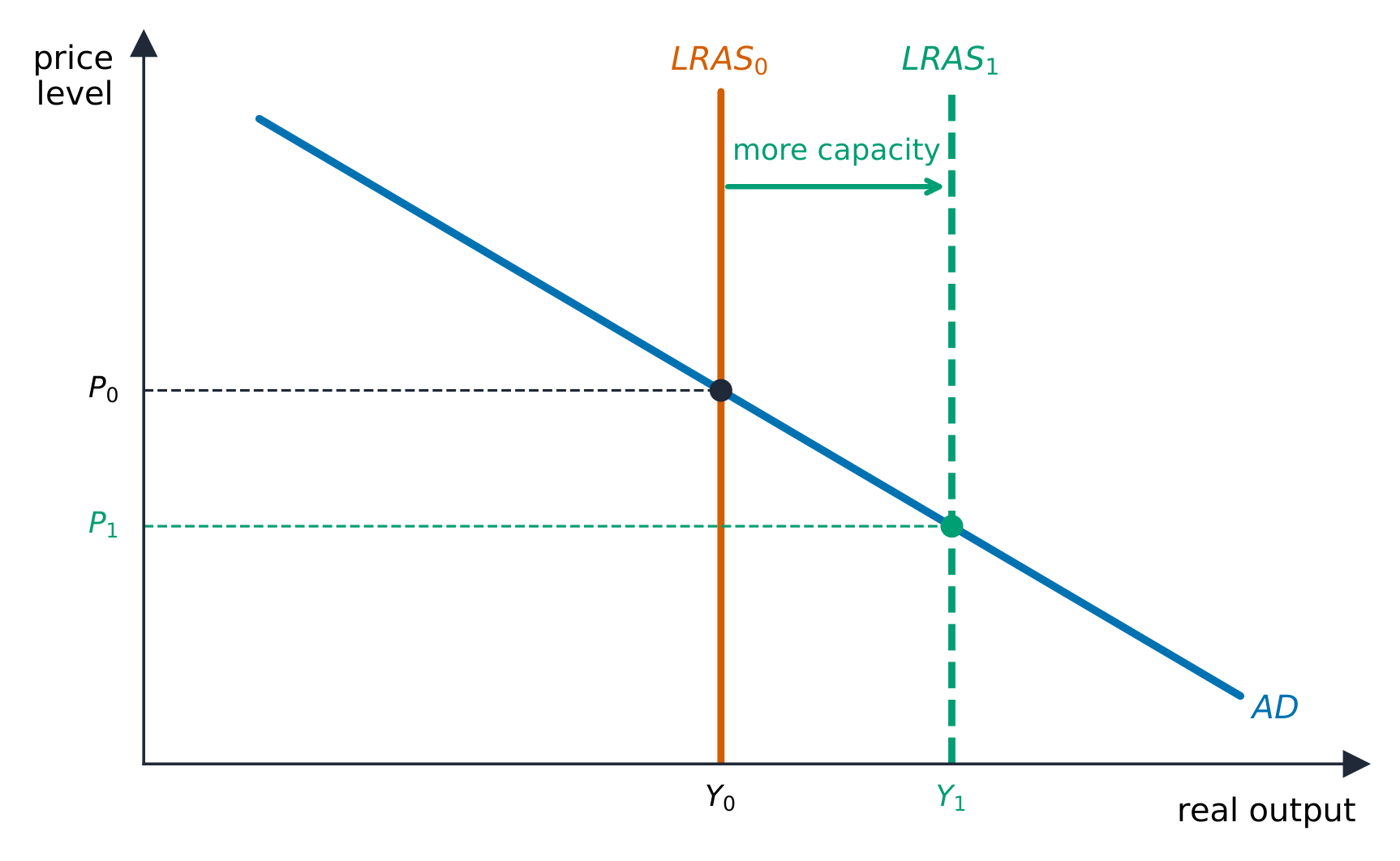
supply-side policy 供给侧政策 aims to raise productivity 生产率 and productive capacity 生产能力, shifting LRAS right. Productivity is useful output per unit of input; raising it need not mean employing more people.
Worked productivity example
In an illustrative factory, 100 workers each work 8 hours per day. Useful training and new machinery raise output per worker-hour from 10 to 12 units, with workers and hours unchanged.
$$\text{daily output}=\text{workers}\times\text{hours per worker-day}\times\text{units per worker-hour}.$$
$$Q_0=100\times8\times10=8000\text{ units/day}.$$
$$Q_1=100\times8\times12=9600\text{ units/day}.$$
Possible output rises by 20%, with no extra workers in this case. Actual output and sales also require demand, inputs and use of the improved process.
Direct provision: skills, infrastructure and technology
training 培训 can improve relevant skills and reduce a mismatch between jobseekers and vacancies. Suppose an industry closes while local technician vacancies remain. Of 140 trainees, 120 qualify and 90 find suitable jobs. Qualifications alone do not create vacancies: location, demand and access matter. Check completion, matching and whether jobs are additional rather than displaced from other applicants. Retraining alone need not restore sales during a general demand slump.
Better infrastructure 基础设施 can reduce transport delays, improve access to suppliers and lower unit costs. Check reliability, use and the value of saved resources against construction costs. Research support can improve production methods, but success and adoption are uncertain. Funding alone does not prove higher productivity. Construction spending can raise AD before supply benefits arrive; time and quality vary by measure.
Market-based approaches
Lower income tax can increase the reward for extra work or investment, changing the incentive 激励. The response depends on available jobs, finance and people's preferences; some may value more leisure. Lower benefits may change job-search incentives but do not create suitable vacancies by themselves. Consider access and hardship as well as incentives.
privatisation 私有化 transfers state enterprises to private ownership. It may strengthen incentives to control costs, but ownership alone does not create competition or better management. deregulation 放松管制 can remove unnecessary entry barriers and encourage competition. Removing useful safety or environmental rules can also impose costs.
Comparing tools and evaluating claims
Worked comparison. Region A has workers with unsuitable skills and poor transport. Region B has qualified workers and efficient transport but few orders. Direct training and infrastructure may address A's gaps if useful and used. Tax incentives and easier entry can encourage work and investment, but do not automatically supply missing skills or transport. B's immediate constraint is weak demand, so extra capacity may remain unused. Compare cause, response, cost and timing; combinations may complement each other.
A useful supply improvement can support higher output with less price pressure in the stated model. It is not a promise of no costs. Funding uses resources, taxes can change spending and incentives, and gains may arrive unevenly or late. Judge quality, opportunity costs, distribution, demand and timing. Distinguish a lower price level in a diagram from a sustained change in the inflation rate.
Explore
Supply-side policy shifts AS
Supply-side policies raise the economy's productive capacity — aggregate supply (AS) shifts right, lowering the price level at higher output.
Vocabulary
Train
| English |
|---|
| supply-side policy/səˈplaɪ saɪd ˈpɒlɪsi/ |
| productive capacity/prəˈdʌktɪv kəˈpæsɪti/ |
| productivity/ˌprɒdəkˈtɪvɪti/ |
| incentive/ɪnˈsentɪv/ |
| privatisation/ˌpraɪvətaɪˈzeɪʃn/ |
| deregulation/diːˌreɡjʊˈleɪʃn/ |
| training/ˈtreɪnɪŋ/ |
| infrastructure/ˈɪnfrəstrʌktʃə/ |
5.4
Policy judgement and retrieval
Diagnose rising prices. Economy A has strong spending near capacity. B has a fuel-cost shock and weak sales. Monetary tightening may restrain demand pressure in A. In B, weaker demand does not directly remove the fuel shortage and may reduce output further. Supply measures may reduce costs but may take time or fail to address the specific shock. Compare source, persistence and feasible response rather than choosing an instrument from inflation alone.
Improve the assessment. "Training reduces unemployment, but there is a time lag" is incomplete. Explain that training can reduce a skills mismatch if vacancies need the new skills. Completion and matching take time, so lost income may persist. If firms lack orders, demand support may address the immediate sales constraint more directly. A judgement compares mechanisms, scale, time and costs; merely naming a lag is not complete evaluation.
Attempt before checking. Spending is £90bn/year and revenue £84bn/year; starting debt is £300bn. Assume the deficit is financed by net borrowing with no other adjustments. Find deficit and closing debt. A worker pays £3000 tax on £30000 income, then £3200 on £31000: find ATR and MTR on the extra income.
$$\text{deficit}=\text{spending}-\text{revenue}=\text{\pounds}90\text{bn/year}-\text{\pounds}84\text{bn/year}=\text{\pounds}6\text{bn/year}.$$
$$D_1=D_0+\text{net borrowing}=\text{\pounds}300\text{bn}+\text{\pounds}6\text{bn}=\text{\pounds}306\text{bn}.$$
$$\mathrm{ATR}=\frac{T}{Y}\times100\%=\frac{\text{\pounds}3000}{\text{\pounds}30000}\times100\%=10\%.$$
$$\mathrm{MTR}=\frac{\Delta T}{\Delta Y}\times100\%=\frac{\text{\pounds}3200-\text{\pounds}3000}{\text{\pounds}31000-\text{\pounds}30000}\times100\%=20\%.$$
Final check. Explain a monetary tool other than interest rates. Explain why training can raise capacity without guaranteeing jobs. Why can a government package that raises income tax and funds apprenticeships be both fiscal and supply-side?
Check after attempting. Easing credit regulation may allow more financed spending if banks and borrowers respond; increased money supply may lower rates in the simplified model with unchanged money demand. Training can improve productivity or matching, but suitable vacancies and demand remain necessary. Tax and purchases are fiscal tools, while useful apprenticeships can also improve skills and capacity. Explain demand and supply effects separately and state their time periods.
Interactive lessons on this topic
Work through it step by step, with instant-check exercises.