This topic pulls the macroeconomics together: the goals a government has, how they clash, and how well its tools work.
Government macroeconomic intervention (A Level)
A-Level Economics · Topic 10
 7:13
7:13
Government macroeconomic intervention (A Level)
Inside a building like this one, a small committee meets and changes a single number: the interest rate. Nothing is built. Nothing is bought. Yet within days…
English narration · English + 中文 subtitles burned in
10.1
Objectives and the tools to reach them
Syllabus
- state and explain the macroeconomic policy objectives and how they are measured
- explain the use of fiscal, monetary and supply-side policy to achieve the objectives
Source: Cambridge International syllabus
Governments aim at several macroeconomic objectives 宏观经济目标 at once:

| Objective | How it is measured |
|---|---|
| economic growth 经济增长 | the % change in real GDP |
| price stability 物价稳定 (low inflation 通货膨胀) | the % change in the consumer price index |
| full employment 充分就业 | the unemployment rate |
| balance of payments 国际收支 stability | the current account balance |
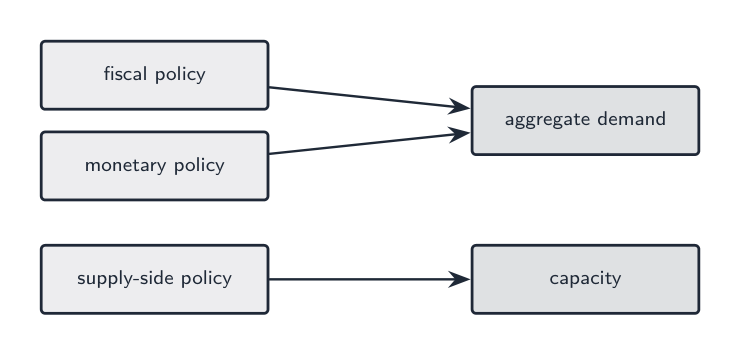
To reach these goals, the government uses three sets of tools:
- fiscal policy 财政政策 — changing government spending and taxes.
- monetary policy 货币政策 — changing the interest rate 利率 and the money supply.
- supply-side policy 供给侧政策 — raising the economy's capacity and productivity.
Fiscal and monetary policy can change aggregate demand 总需求, with effects depending on timing, confidence and spare capacity. Supply-side measures aim to improve capacity and productivity, but their speed and effectiveness vary. Public investment can have both demand effects now and capacity effects later.

Explore
Macro objective lab
Classify policy examples by the macroeconomic objective they target.
Vocabulary
Train
| English |
|---|
| macroeconomic objectives/ˌmækrəˌriːkəˈnɒmɪk ɒbˈdʒektɪvz/ |
| economic growth/ˌiːkəˈnɒmɪk ɡrəʊθ/ |
| price stability/praɪs stəˈbɪlɪti/ |
| inflation/ɪnˈfleɪʃn/ |
| full employment/fʊl emˈplɔɪmənt/ |
| balance of payments/ˈbæləns ɒv ˈpeɪmənts/ |
| fiscal policy/ˈfɪskl ˈpɒlɪsi/ |
| monetary policy/ˈmʌnɪtəri ˈpɒlɪsi/ |
| interest rate/ˈɪntrest reɪt/ |
| supply-side policy/səˈplaɪ saɪd ˈpɒlɪsi/ |
| aggregate demand/ˈæɡrɪɡeɪt dɪˈmænd/ |
10.2
Links and trade-offs between objectives

Syllabus
- explain the links and trade-offs between macroeconomic problems (e.g. growth and inflation, unemployment and inflation, growth and the balance of payments)
- analyse the interrelatedness of macroeconomic objectives
Source: Cambridge International syllabus
The objectives are interrelated — reaching one can move another. Often there is a trade-off 取舍, a conflict 冲突 where gaining on one goal costs you on another.
- unemployment versus inflation. Raising demand to cut unemployment tends to push prices up. The Phillips curve 菲利普斯曲线 shows this short-run trade-off. (In the long run it may disappear.)
- growth versus inflation. Fast demand-led growth can overheat the economy and cause inflation.
- growth versus the balance of payments. As incomes rise, people buy more imports, so the current account can worsen.
- growth versus the environment. More output often means more pollution and use of resources.
- growth versus equality. Growth does not always reach everyone, so the income gap can widen.
Because the goals are linked, a government must often accept "second best" on one aim to protect another. A clever policy mix tries to ease the trade-offs — for example, productive supply-side measures may raise capacity and ease inflation pressure. Demand expansion with ample spare capacity can also increase output without strong inflation pressure; neither result is guaranteed.
Explore
Macro objective lab
Classify policy examples by the macroeconomic objective they target.
Vocabulary
Train
| English |
|---|
| trade-off/treɪd ɒf/ |
| conflict/ˈkɒnflɪkt/ |
| Phillips curve/ˈfɪlɪps kɜːv/ |
10.3
The effectiveness of policy

Syllabus
- evaluate the effectiveness of fiscal, monetary and supply-side policies in achieving the macroeconomic objectives
- explain the limitations of policies (time lags, conflicts, crowding out, the Laffer curve)
Source: Cambridge International syllabus
Each tool has strengths and weaknesses.
Fiscal policy
Government purchases can directly add to demand and target particular groups or regions. Their effect depends on subsequent spending, private-sector responses and available resources.
Worked fiscal comparison. An illustrative economy has unused capacity and weak private spending. Government proposes an extra £10 billion of purchases, financed by borrowing. Use a multiplier $k=2.5$; hold taxes, exports and other spending changes constant. In Case A, private investment is unchanged. In Case B, higher interest rates reduce private investment by £4 billion. Let $\Delta A$ be the net autonomous spending change. All spending and income changes in these equations are in £ billions.
$$\Delta A_A=\Delta G+\Delta I=10+0=10.$$
$$\Delta Y_A=k\Delta A_A=2.5\times10=25.$$
$$\Delta A_B=\Delta G+\Delta I=10+(-4)=6.$$
$$\Delta Y_B=k\Delta A_B=2.5\times6=15.$$
In this model, crowding out 挤出效应 reduces the income gain by £10 billion; income still rises. Partial crowding out does not mean each pound of government spending replaces a pound of private spending. The multiplier and private investment response are stated assumptions, not forecasts for every economy.
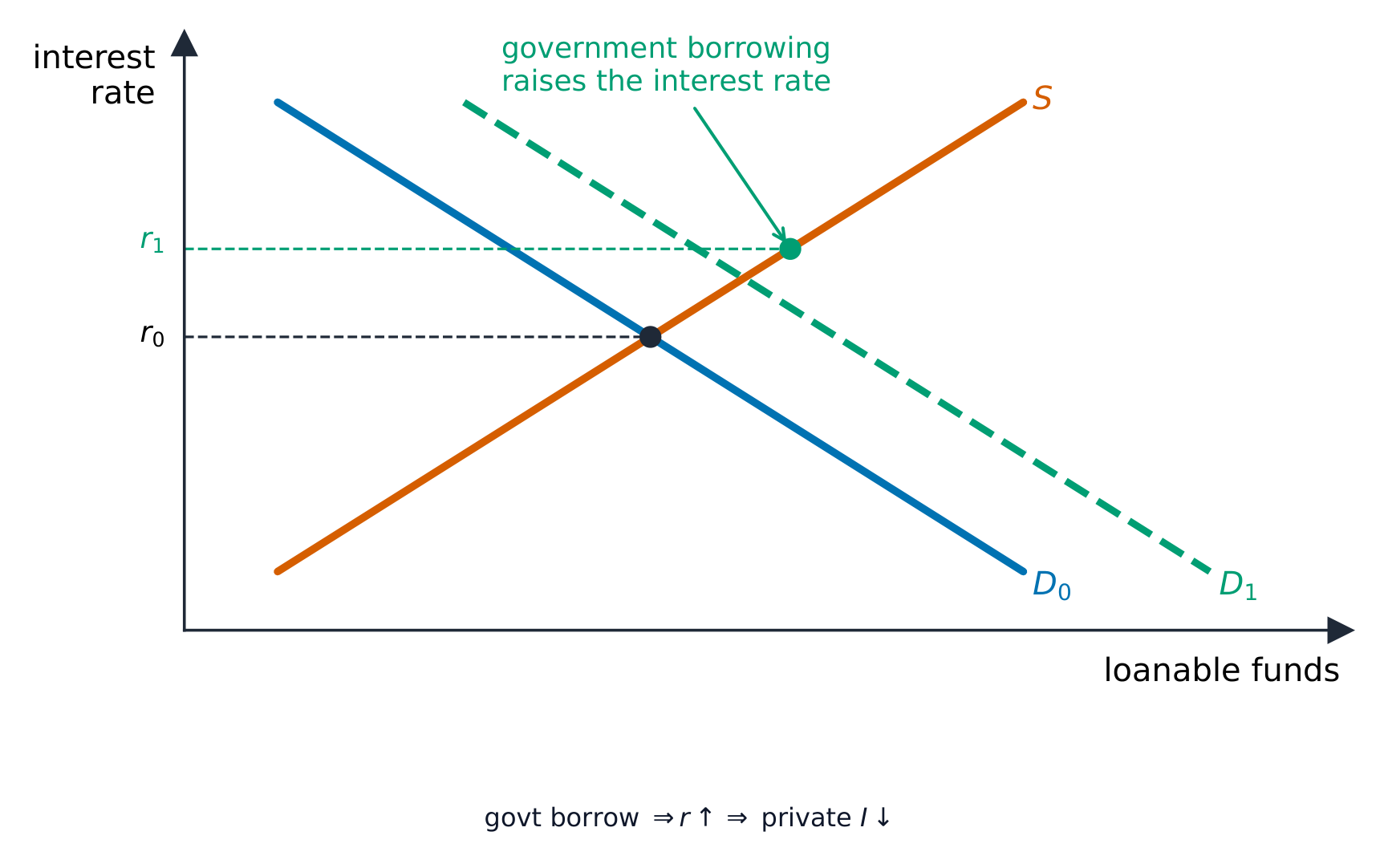
One mechanism is government borrowing increasing demand for loanable funds, raising interest rates and discouraging private investment, other things equal. Its size depends on the supply of finance, central-bank action, confidence and firms' responsiveness to rates. With idle resources or supportive monetary conditions, the interest-rate effect may be small. Productive public infrastructure may instead encourage some private investment. Near capacity, public projects may compete for workers and materials even without a large interest-rate rise; identify that resource constraint separately.
Timing and financing. Time lags 时滞 arise in diagnosis, approval, implementation and spending responses. A construction programme approved during a slump may arrive after recovery, when capacity constraints create more inflationary pressure and less extra real output. Tax cuts need not all be spent. Automatic changes in taxes and benefits can begin without a new budget decision.
A deficit is a flow over a period; the national debt 国债 is an outstanding stock. Additional borrowing tends to add to debt, holding other flows constant. Not every spending increase is borrowed, and public investment can improve future capacity.
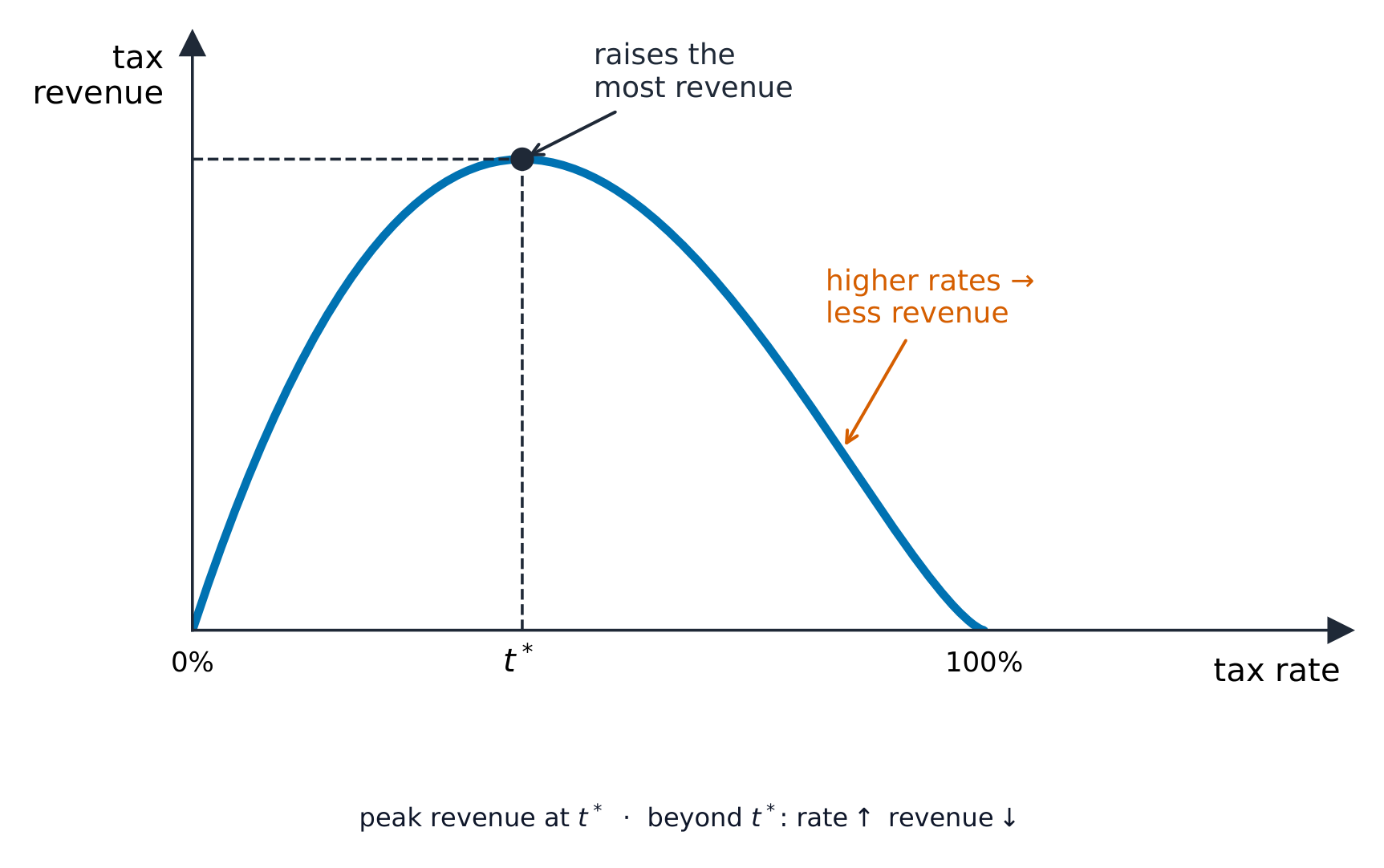
The Laffer curve 拉弗曲线 is a useful warning. It shows that as the tax rate rises, tax revenue 税收收入 first rises but then falls: very high rates discourage work and encourage tax avoidance, so revenue drops. There is a tax rate that raises the most revenue, and going above it is self-defeating.
Monetary policy
It is flexible — the interest rate can be changed at any time. But it also works with a long time lag, and in a deep slump even very low rates may fail to make worried firms and households borrow.
Supply-side policy
Productive measures can raise capacity and ease inflation pressure. They are not free of trade-offs: education and training take time and funding, some measures can widen inequality, and infrastructure can impose environmental costs. Outcomes depend on implementation and on which constraints actually limit production.
Putting it together
No single policy can hit every target. The objectives conflict, the effects come with delays, and the future is uncertain. So governments usually combine demand-side policies 需求侧政策 (fiscal and monetary) for the short term with supply-side policy for the long term, and accept that some goals must be traded against others.
Worked policy judgement. A government cuts interest rates to reduce cyclical unemployment. If households and firms respond by borrowing and spending more, aggregate demand may rise. With spare capacity, firms can expand output and employment; near capacity, more of the response may be inflation. Weak confidence or already-low rates can reduce the response. Imports may rise with income, but the current account depends on exports and other influences too. State the transmission mechanism and conditions before judging the objective at risk. Capacity improvements may ease a conflict, but no policy label guarantees growth with lower inflation and no other cost.
Explore
Economics case lab
Classify real examples by the economic idea they show.
Vocabulary
Train
| English |
|---|
| time lags/taɪm læɡz/ |
| national debt/ˈnæʃənl det/ |
| crowding out/ˈkraʊdɪŋ aʊt/ |
| Laffer curve/ˈlæfə kɜːv/ |
| tax revenue/tæks ˈrevənjuː/ |
| demand-side policies/dɪˈmænd saɪd ˈpɒlɪsiz/ |
10.3
Exam tips
- Show the trade-offs between objectives (for example growth versus inflation, unemployment versus inflation).
- Evaluate policy effectiveness using time lags, expectations and the state of the economy.
- Match the tool (fiscal, monetary, supply-side, exchange rate) to the target, and judge the conflicts.
Interactive lessons on this topic
Work through it step by step, with instant-check exercises.