This final topic covers trade imbalances, exchange rates in depth, and how countries develop and connect.
International economic issues (A Level)
A-Level Economics · Topic 11
 8:57
8:57
International economic issues (A Level)
A country's money loses a fifth of its value overnight. Exports are suddenly cheap, imports suddenly dear, so the trade gap should close at once. It does not.…
English narration · English + 中文 subtitles burned in
11.1
Correcting a balance of payments imbalance
Syllabus
- explain expenditure-switching and expenditure-reducing policies and the Marshall–Lerner condition and J-curve effect
- evaluate policies to correct a current account imbalance
Source: Cambridge International syllabus
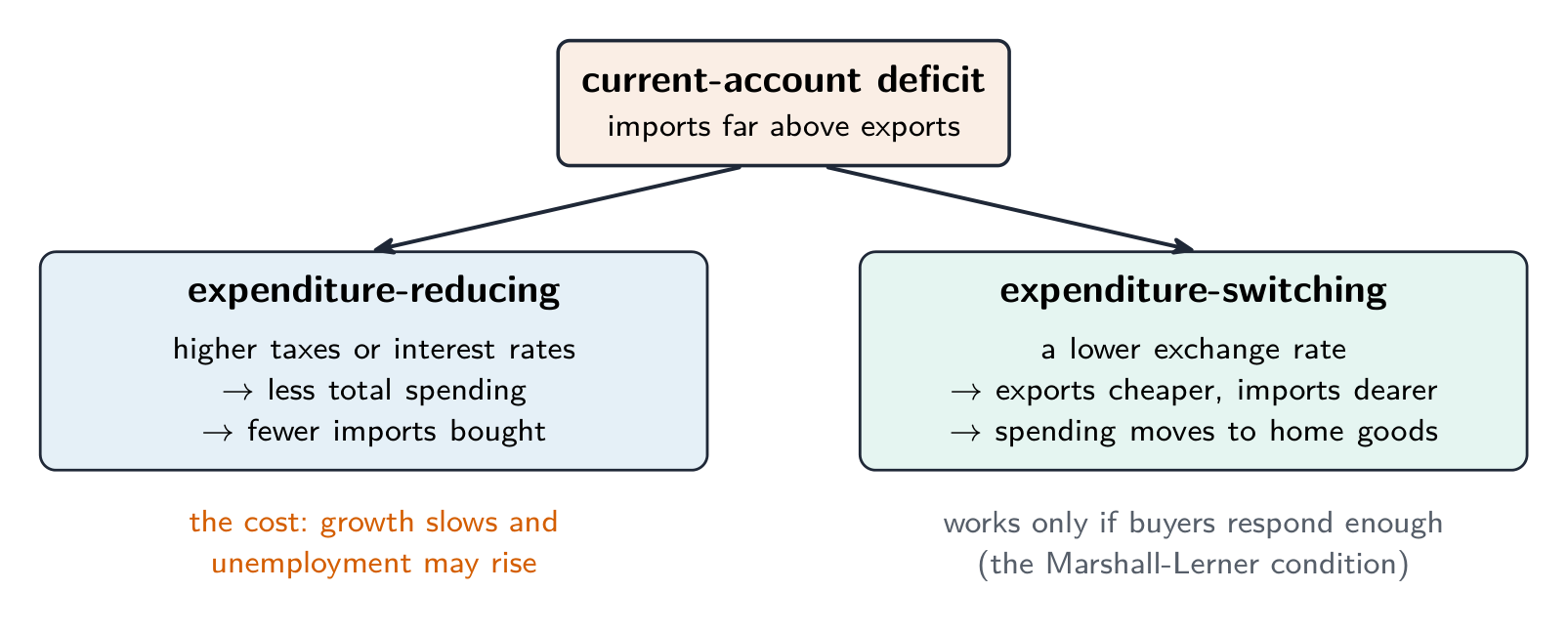
A country with a large balance of payments 国际收支 problem — usually a deficit on the current account 经常账户 — can use two kinds of policy.
- expenditure-reducing 支出减少 policies cut total demand (higher taxes or interest rates). With less spending, people buy fewer imports. But growth slows and unemployment may rise.
- expenditure-switching 支出转换 policies move spending away from imports towards home goods. The main tool is a lower exchange rate 汇率 — a depreciation 贬值 under floating rates, or a devaluation 法定贬值 under a fixed system — which makes exports cheaper and imports dearer.
The Marshall–Lerner condition and the J-curve
A lower exchange rate only improves the current account if buyers respond enough. The Marshall-Lerner condition 马歇尔勒纳条件 says the sum of the price elasticities of demand for exports and imports must be greater than one:
$$PED_{\text{exports}} + PED_{\text{imports}} > 1$$
Worked example. After a depreciation, the demand for a country's exports has $PED = 0.6$ and its demand for imports has $PED = 0.7$. Will the current account improve?
$$0.6 + 0.7 = 1.3 > 1,$$
so the Marshall-Lerner condition is met, and the depreciation should improve the current account in the long run. (If the two elasticities had summed to less than $1$ — for example $0.3 + 0.4 = 0.7$ — a depreciation would make the deficit worse.)
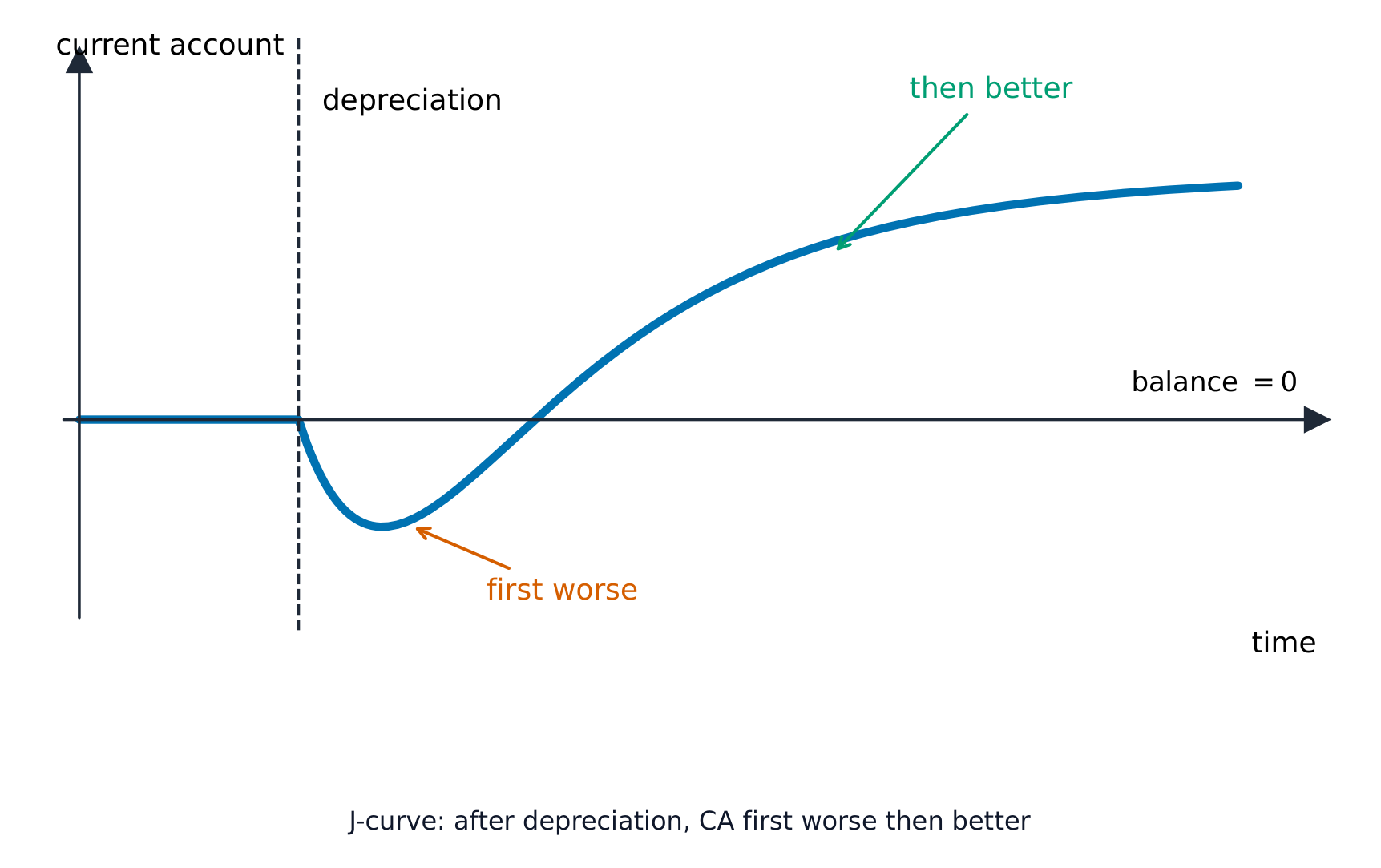
Even when this holds, the gain takes time. The J-curve effect J曲线效应 describes what happens: just after a depreciation, the current account first gets worse (imports cost more straight away, but trade volumes are slow to change), then later improves as buyers adjust — tracing the shape of a letter J.
Explore
Economics case lab
Classify real examples by the economic idea they show.
Vocabulary
Train
| English |
|---|
| balance of payments/ˈbæləns ɒv ˈpeɪmənts/ |
| current account/ˈkʌrənt əˈkaʊnt/ |
| expenditure-reducing/ekˈspendɪtʃə rɪˈdjuːsɪŋ/ |
| expenditure-switching/ekˈspendɪtʃə ˈswɪtʃɪŋ/ |
| exchange rate/eksˈtʃeɪndʒ reɪt/ |
| depreciation/dɪˌpriːʃɪˈeɪʃn/ |
| devaluation/diːˌvæljuːˈeɪʃn/ |
| Marshall-Lerner condition/ˈmɑːʃl ˈlɜːnə kənˈdɪʃn/ |
| J-curve effect/dʒeɪ kɜːv ɪˈfekt/ |
11.2
Exchange rates

Syllabus
- explain nominal, real and trade-weighted (effective) exchange rates and how they are determined
- explain fixed, floating and managed exchange rate systems, devaluation/revaluation and the effects of exchange rate changes
Source: Cambridge International syllabus
An exchange rate is the price of one currency in terms of another. There is more than one way to measure it:
- the nominal exchange rate 名义汇率 is the everyday market rate between two currencies.
- the real exchange rate 实际汇率 adjusts the nominal rate for differences in prices between the countries, so it shows true competitiveness.
- the trade-weighted exchange rate 贸易加权汇率, also called the effective exchange rate 有效汇率, is an average of a currency's value against all its trading partners, weighted by how much trade is done with each.
The three systems
- a floating exchange rate 浮动汇率 is set by the demand for and supply of the currency.
- a fixed exchange rate 固定汇率 is held at a set value by the central bank.
- a managed exchange rate 管理浮动汇率 mostly floats, with the central bank stepping in at times.
Under floating rates, a rise in value is an appreciation 升值 and a fall is a depreciation. Under a fixed system, a deliberate rise is a revaluation 法定升值 and a deliberate fall is a devaluation. A weaker currency tends to raise exports and inflation; a stronger currency does the opposite.
Explore
Exchange rates in the FX market
The exchange rate is set by the demand for and supply of the currency. Shift either to see the rate appreciate or depreciate.
Vocabulary
Train
| English |
|---|
| nominal exchange rate/ˈnɒmɪnl eksˈtʃeɪndʒ reɪt/ |
| real exchange rate/rɪəl eksˈtʃeɪndʒ reɪt/ |
| trade-weighted exchange rate/treɪd ˈweɪtɪd eksˈtʃeɪndʒ reɪt/ |
| effective exchange rate/ɪˈfektɪv eksˈtʃeɪndʒ reɪt/ |
| floating exchange rate/ˈfləʊtɪŋ eksˈtʃeɪndʒ reɪt/ |
| fixed exchange rate/fɪkst eksˈtʃeɪndʒ reɪt/ |
| managed exchange rate/ˈmænɪdʒd eksˈtʃeɪndʒ reɪt/ |
| appreciation/əˌpriːʃɪˈeɪʃn/ |
| revaluation/rɪˌvæljuːˈeɪʃn/ |
11.3
Economic development

Syllabus
- distinguish economic growth and economic development and explain the characteristics of development
- explain indicators of development including the Human Development Index (HDI) and other measures
Source: Cambridge International syllabus
It is important not to confuse two ideas:
- economic growth 经济增长 is simply a rise in real output.
- economic development 经济发展 is wider. It is about people's standard of living 生活水平 — their health, education, and freedom of choice, not just their income.

A country can grow without developing much (if the extra income goes to a few people). Development usually means rising incomes plus better health, more schooling, and less poverty.
Measuring development
The best-known measure is the Human Development Index 人类发展指数 (HDI). It combines three things into one number between 0 and 1:
- income (GNI per person),
- health (life expectancy 预期寿命 at birth),
- education (mean and expected years of schooling 受教育年限).

Other useful signs of development include access to clean water, the number of doctors per person, and mobile-phone and internet use.
Explore
Development chain lab
Follow how policy and resources can change living standards.
Vocabulary
Train
| English |
|---|
| economic growth/ˌiːkəˈnɒmɪk ɡrəʊθ/ |
| economic development/ˌiːkəˈnɒmɪk dɪˈveləpmənt/ |
| standard of living/ˈstændəd ɒv ˈlɪvɪŋ/ |
| Human Development Index/ˈhjuːmən dɪˈveləpmənt ˈɪndeks/ |
| life expectancy/laɪf ekˈspektənsi/ |
| years of schooling/jɪəz ɒv ˈskuːlɪŋ/ |
11.4
Comparing countries at different levels of development
Syllabus
- compare the economic and demographic characteristics of countries at different levels of development (income, population, employment structure, education, health)
- explain the factors that influence the level of development
Source: Cambridge International syllabus
We often compare a developed country 发达国家 (high income, like Germany) with a developing country 发展中国家 (lower income, like Kenya). They differ in clear ways:
| Feature | Developed | Developing |
|---|---|---|
| income per person | high | low |
| birth rate 出生率 and population growth | low | often high |
| life expectancy | high | lower |
| share of workers in farming | small | large |
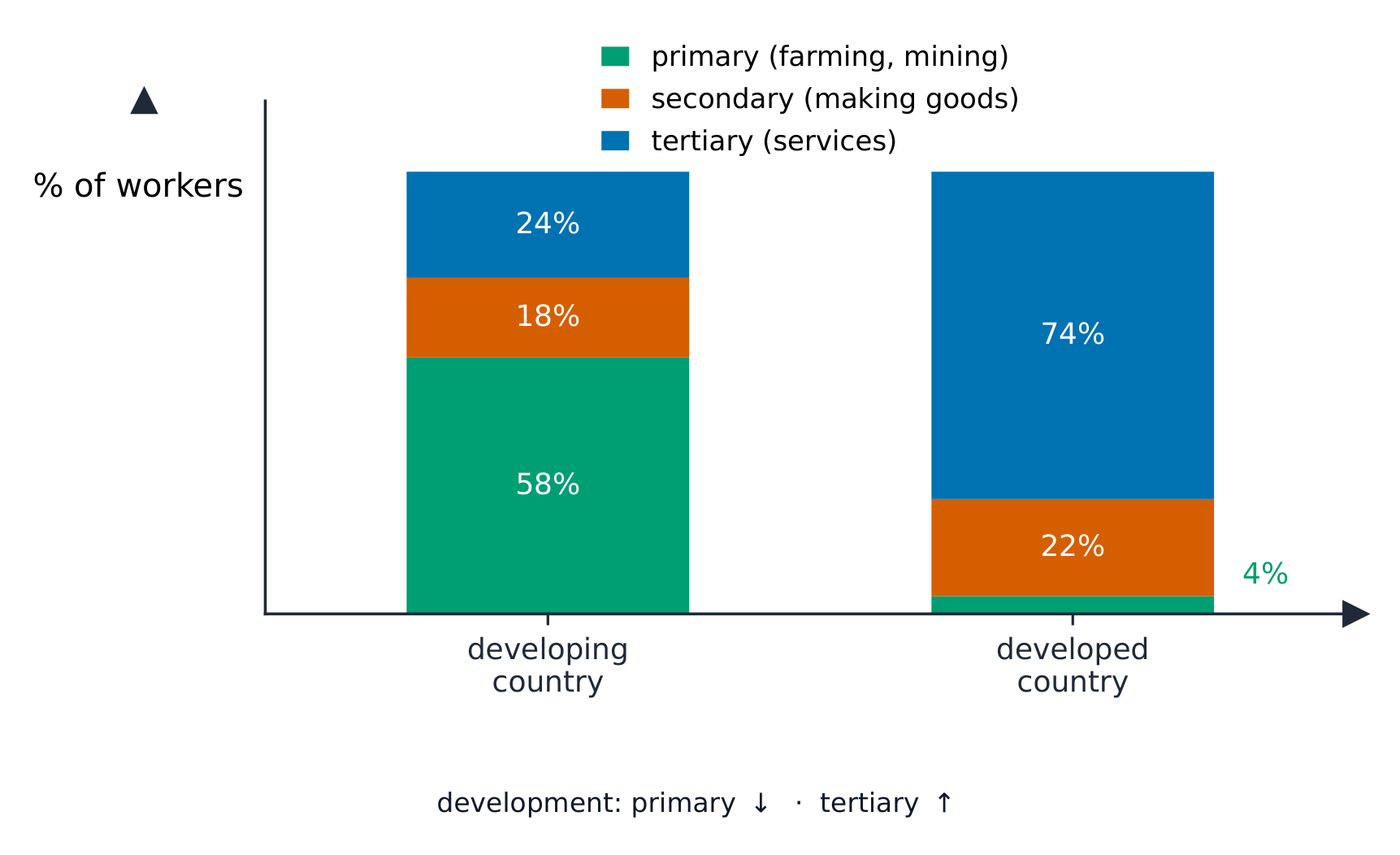
The employment structure 就业结构 also differs. As a country develops, workers move out of the primary sector 第一产业 (farming and mining), into the secondary sector 第二产业 (making goods), and later into the tertiary sector 第三产业 (services).
Many things shape development: savings and investment, the quality of education and health, infrastructure, stable government and law, and access to world markets.
Explore
Economics case lab
Classify real examples by the economic idea they show.
Vocabulary
Train
| English |
|---|
| developed country/dɪˈveləpt ˈkʌntri/ |
| developing country/dɪˈveləpɪŋ ˈkʌntri/ |
| birth rate/bɜːθ reɪt/ |
| employment structure/emˈplɔɪmənt ˈstrʌktʃə/ |
| primary sector/ˈpraɪməri ˈsektə/ |
| secondary sector/ˈsekəndəri ˈsektə/ |
| tertiary sector/ˈtɜːʃjəri ˈsektə/ |
11.5
Relationships between countries
Syllabus
- explain the relationship between developed and developing countries through trade, aid, debt, foreign direct investment and multinationals, and migration/remittances
- evaluate the impact of these relationships on development
Source: Cambridge International syllabus
Richer and poorer countries are linked in several ways, each with good and bad sides.
- trade can raise incomes, but many developing countries rely on a few primary exports whose prices swing sharply.
- foreign aid 援助 can fund schools and roads, but it may create dependency or be wasted.
- debt 债务 owed to other countries can pay for development, but repaying it can drain a poor country's budget.
- foreign direct investment 外国直接投资 (FDI) by a multinational corporation 跨国公司 brings money, jobs and technology, but profits may flow back abroad and workers may be poorly treated.
- migration 移民 of workers can ease unemployment and bring in remittances 侨汇 (money sent home), but it can also drain a country of its most skilled people.
Explore
Economics case lab
Classify real examples by the economic idea they show.
Vocabulary
Train
| English |
|---|
| aid/eɪd/ |
| debt/det/ |
| foreign direct investment/ˈfɒrən daɪˈrekt ɪnˈvestmənt/ |
| multinational corporation/ˌmʌltɪˈnæʃənl ˌkɔːpəˈreɪʃn/ |
| migration/maɪˈɡreɪʃn/ |
| remittances/rɪˈmɪtənsɪz/ |
11.6
Globalisation

Syllabus
- explain globalisation and its causes and the role of multinational corporations and trade blocs
- evaluate the benefits and costs of globalisation for developed and developing economies
Source: Cambridge International syllabus
globalisation 全球化 is the growing links between countries — in trade, money, technology and people — so that the world acts more like one market. Its causes include cheaper transport and communication, free trade 自由贸易 agreements, and the spread of multinational firms.
Countries often join a trade bloc 贸易集团 — a group that trades freely among themselves (like the European Union).
Benefits and costs
| Benefits | Costs |
|---|---|
| lower prices and more choice | some industries and jobs are lost to cheaper countries |
| faster growth and technology transfer | the gap between rich and poor can widen |
| larger markets for firms | more pollution and use of resources |
| poorer countries can industrialise | powerful multinationals may avoid tax and dodge protectionism 贸易保护主义 rules |
Globalisation helps developed and developing economies in different ways, but the gains are not shared evenly, which is why it remains so argued about.
Explore
Open economy lab
See how trade or exchange-rate pressure changes domestic outcomes.
Vocabulary
Train
| English |
|---|
| globalisation/ˌɡləʊbəlaɪˈzeɪʃn/ |
| free trade/friː treɪd/ |
| trade bloc/treɪd blɒk/ |
| protectionism/prəˈtekʃənɪzəm/ |
11.6
Exam tips
- Distinguish expenditure-reducing from expenditure-switching policies for a deficit.
- Explain the Marshall-Lerner condition ($PED_x + PED_m > 1$) and the J-curve (the deficit worsens before it improves).
- Compare development with the HDI (income, education, health), not GDP alone.
- Evaluate globalisation with its winners and losers (growth and choice versus inequality and instability).
Vocabulary card meanings
devaluation: An official reduction in a currency's fixed price. Marshall-Lerner condition: The requirement that trade volumes respond enough for a cheaper currency to improve the trade balance. J-curve effect: The trade balance worsening just after a currency falls, then later improving. real exchange rate: A currency's price after adjusting for prices at home and abroad. trade-weighted exchange rate: An index of a currency's price against its partners' monies, with each partner weighted by its share of trade. effective exchange rate: An average of a currency's price against the currencies that matter for its trade. revaluation: An official increase in a currency's fixed price. years of schooling: How long people stay in education, on average. developed country: A country with high income and established industry. developing country: A country whose income and industry are still catching up. employment structure: How jobs are split among farming, making goods, and services. trade bloc: A group of countries that lower trade barriers among themselves.
Interactive lessons on this topic
Work through it step by step, with instant-check exercises.