- explain the fundamental economic problem of scarcity arising from finite resources and unlimited wants
- explain choice and opportunity cost for consumers, producers and governments
- distinguish positive and normative statements in the context of choice
Basic economic ideas and resource allocation
A-Level Economics · Topic 1
 18:39
18:39
Basic Economic Ideas
Write down everything you want. A phone, a bigger home, travel, a good education. The list never ends. Now look at what the world has: a fixed amount of land…
English narration · English + 中文 subtitles burned in
 20:01
20:01
The Fundamental Economic Problem
Think of everything you want. A better phone. More free time. Now think of what the world actually has: a fixed amount of land, a fixed number of workers, and…
English narration · English + 中文 subtitles burned in
1.1
The fundamental economic problem
Syllabus
Source: Cambridge International syllabus
Economics starts with one big idea: scarcity 稀缺性. We never have enough to give everyone everything they want.
- resources 资源 are the things we use to make goods and services. They are finite 有限的 — there is only a limited amount, so they are scarce 稀缺.
- goods 物品 (things you can touch, like food) and services 服务 (work done for you, like a haircut) are what we make from resources.
- human wants 欲望 are unlimited. People always want more.
Because wants are bigger than resources, this is called the economic problem 经济问题. Every society must answer three questions:
- What to produce?
- How to produce it?
- For whom to produce it?
Choice and opportunity cost
Because resources are scarce, you must choose. Every choice means you give up something else.
opportunity cost 机会成本 — the next best alternative 替代选择 you give up when you make a decision.
Opportunity cost is faced by everyone:
- consumers 消费者 (people who buy and use goods): buy a phone, and you give up the holiday that money could have paid for.
- producers 生产者 and firms 企业 (the businesses that make goods): use a factory to make cars, and you give up the trucks it could have made.
- governments 政府: spend tax money on hospitals, and you give up the schools that money could have built.
Vocabulary
Train
| English |
|---|
| scarcity/ˈskeəsɪti/ |
| resources/rɪˈzɔːsɪz/ |
| finite/ˈfaɪnaɪt/ |
| scarce/skeəs/ |
| goods/ɡʊdz/ |
| services/ˈsɜːvɪsɪz/ |
| wants/wɒnts/ |
| economic problem/ˌiːkəˈnɒmɪk ˈprɒbləm/ |
| opportunity cost/ɒpəˈtjuːnɪti kɒst/ |
| alternative/ɔːlˈtɜːnətɪv/ |
| consumer/kənˈsuːmə/ |
| producer/prəˈdjuːsə/ |
| firm/fɜːm/ |
| government/ˈɡʌvənmənt/ |
1.2
Thinking like an economist

Syllabus
- explain economics as a social science and the use of the ceteris paribus assumption
- distinguish positive and normative statements and the role of value judgements
- distinguish microeconomics and macroeconomics
Source: Cambridge International syllabus
Economics as a social science
Economics is a social science 社会科学. It studies how people behave when they make choices. Like other sciences, it builds models 模型 (simple pictures of the real world) and tests them with data.
The real world is complex, so economists change one thing at a time and keep everything else fixed. This is the idea of ceteris paribus 其他条件不变 — a Latin phrase meaning "all other things stay the same". For example: "if the price of coffee rises, people buy less coffee, ceteris paribus".
Positive and normative statements
- a positive statement 实证表述 is about fact. It can be tested as true or false. Example: "a higher price of petrol reduces the amount people buy."
- a normative statement 规范表述 is about opinion. It says what should happen, and it cannot be tested as true or false. Example: "the government should make petrol cheaper."
Normative statements rest on a value judgement 价值判断 — a personal view about what is good or fair. Two people can agree on the facts and still disagree about what should be done.
Microeconomics and macroeconomics
- microeconomics 微观经济学 studies single parts of the economy: one market, one firm, one consumer.
- macroeconomics 宏观经济学 studies the whole economy together: total output 产出, jobs, and rising prices.
Explore
Economic method lab
Classify statements by the role they play in economic reasoning.
Vocabulary
Train
| English |
|---|
| social science/ˈsəʊʃl ˈsaɪəns/ |
| model/ˈmɒdl/ |
| ceteris paribus/ˈsetərɪs ˈpærɪbəs/ |
| positive statement/ˈpɒzɪtɪv ˈsteɪtmənt/ |
| normative statement/ˈnɔːmətɪv ˈsteɪtmənt/ |
| value judgement/ˈvæljuː ˈdʒʌdʒmənt/ |
| microeconomics/ˌmaɪkrəʊˌiːkəˈnɒmɪks/ |
| macroeconomics/ˌmækrəˌriːkəˈnɒmɪks/ |
| output/ˈaʊtpʊt/ |
1.3
Factors of production
Syllabus
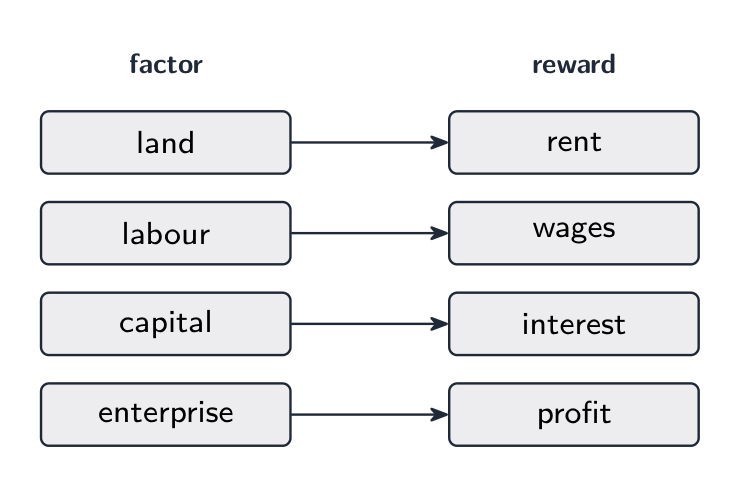
- define land, labour, capital and enterprise and their rewards (rent, wages, interest, profit)
- explain division of labour and specialisation and their advantages and disadvantages
- explain the mobility of factors of production
Source: Cambridge International syllabus
The factors of production 生产要素 are the four kinds of resource used to make goods and services. Each one earns a reward 报酬.
| Factor | What it is | Its reward |
|---|---|---|
| land 土地 | natural resources (fields, water, oil, minerals) | rent 地租 |
| labour 劳动 | human work, both physical and mental | wages 工资 |
| capital 资本 | man-made things used to produce, like machines, tools and factories | interest 利息 |
| enterprise 企业家才能 | the skill of bringing the other three together and taking the risk | profit 利润 |
Land includes some non-renewable resources 不可再生资源 (like oil and coal) that can run out. Enterprise is supplied by the entrepreneur 企业家, the person who has the business idea and risks their own money.

Specialisation and division of labour
specialisation 专业化 is when a worker, firm or country makes only the things it is best at, then trades for the rest.
Inside a workplace, specialisation leads to the division of labour 劳动分工: a big job is split into small tasks, and each worker 工人 does one task again and again.
| Advantages | Disadvantages |
|---|---|
| workers get faster and better at one task | doing one task is boring, so workers may quit |
| less time wasted moving between jobs | if one worker is absent, the whole line can stop |
| output per worker rises, so costs fall | workers learn only one narrow skill |

Mobility of factors
mobility 流动性 means how easily a factor can move to a new use.
- occupational mobility 职业流动性 — how easily a factor moves from one job or use to another. A teacher who retrains as a nurse is occupationally mobile.
- geographical mobility 地理流动性 — how easily a factor moves from one place to another. Land cannot move at all, so it has no geographical mobility.
Labour is often not very mobile. Family ties, the cost of housing, and missing skills all make it hard for workers to move.
Explore
Factors of production lab
Sort real resources by the factor of production they represent.
Vocabulary
Train
| English |
|---|
| factors of production/ˈfæktəz ɒv prəˈdʌkʃn/ |
| reward/rɪˈwɔːd/ |
| land/lænd/ |
| rent/rent/ |
| labour/ˈleɪbə/ |
| wages/ˈweɪdʒɪz/ |
| capital/ˈkæpɪtl/ |
| interest/ˈɪntrest/ |
| enterprise/ˈentəpraɪz/ |
| profit/ˈprɒfɪt/ |
| non-renewable resources/nɒn rɪˈnjuːəbl rɪˈzɔːsɪz/ |
| entrepreneur/ˌɒntrɪprəˈnjʊə/ |
| specialisation/ˌspeʃəlaɪˈzeɪʃn/ |
| division of labour/dɪˈvɪʒn ɒv ˈleɪbə/ |
| worker/ˈwɜːkə/ |
| mobility/məʊˈbɪlɪti/ |
| occupational mobility/ˌɒkjʊˈpeɪʃənl məʊˈbɪlɪti/ |
| geographical mobility/ˌdʒɪəˈɡræfɪkl məʊˈbɪlɪti/ |
1.4
Economic systems

Syllabus
- explain how resources are allocated in market, planned and mixed economic systems
- explain the role of the price mechanism (signalling, incentive, rationing) in allocating resources
- evaluate the advantages and disadvantages of each system
Source: Cambridge International syllabus
An economic system is the way a country decides how to allocate 配置 (share out) its scarce resources. There are three types.
- a market economy 市场经济: decentralised buyers and sellers influence production and allocation through prices and purchasing decisions.
- a planned economy 计划经济 (also called a command economy 指令经济): central decisions determine resource allocation and production, often using quantities and eligibility rules.
- a mixed economy 混合经济 — a blend of the two. The private sector 私营部门 (firms and households) and the public sector 公共部门 (the government) both make decisions. Almost every real country is mixed.
Worked allocation comparison. Three illustrative clinic arrangements provide the same kind of service. Private clinics responding to paying patients illustrate market allocation: prices, demand and expected costs influence what and how much to supply, and ability to pay affects access. A central authority specifying quantities, staffing and eligibility illustrates planning. Public tax-funded appointments alongside privately sold appointments illustrate a mixed arrangement. Public provision of one service does not make the whole economy planned. Planning and tax funding do not remove scarce staff time or the need to choose who receives appointments. Ownership alone does not prove efficiency or fairness.
The price mechanism
In a market economy, resources are guided by the price mechanism 价格机制. Prices do three jobs:
- signalling 信号传递 — a price tells buyers and sellers where resources are wanted. A rising price says "this is wanted — make more".
- incentive 激励 — a higher price rewards producers, so they want to supply more of that good.
- rationing 配给 — when a good is scarce, a higher price shares it out to those who are willing and able to pay.
Comparing the systems
| System | Strengths | Weaknesses |
|---|---|---|
| market | choice, low prices, strong incentive to work and invent | large gap between rich and poor; some goods not supplied |
| planned | smaller gap between rich and poor; key goods provided for all | weak incentive; shortages and surpluses; slow to change |
| mixed | tries to keep the good points of both | the right balance is hard to find |
In practice no country sits at a pure extreme. China's economy, for instance, is officially a socialist market economy, where markets set most prices while the government guides key sectors and owns major enterprises. Every real system mixes the two and sits somewhere on the spectrum below.

Vocabulary
Train
| English |
|---|
| allocate/ˈæləkeɪt/ |
| market economy/ˈmɑːkɪt ɪˈkɒnəmi/ |
| planned economy/plænd ɪˈkɒnəmi/ |
| command economy/kəˈmænd ɪˈkɒnəmi/ |
| mixed economy/mɪkst ɪˈkɒnəmi/ |
| private sector/ˈpraɪvət ˈsektə/ |
| public sector/ˈpʌblɪk ˈsektə/ |
| price mechanism/praɪs ˈmekənɪzəm/ |
| signalling/ˈsɪɡnəlɪŋ/ |
| incentive/ɪnˈsentɪv/ |
| rationing/ˈræʃənɪŋ/ |
| efficiency/ɪˈfɪʃənsi/ |
1.5
Production possibility curves
Syllabus
- draw and interpret PPCs to show opportunity cost, scarcity, choice and efficiency
- explain movements along and shifts of the PPC and constant versus increasing opportunity cost
- relate the PPC to economic growth and the allocation between capital and consumer goods
Source: Cambridge International syllabus
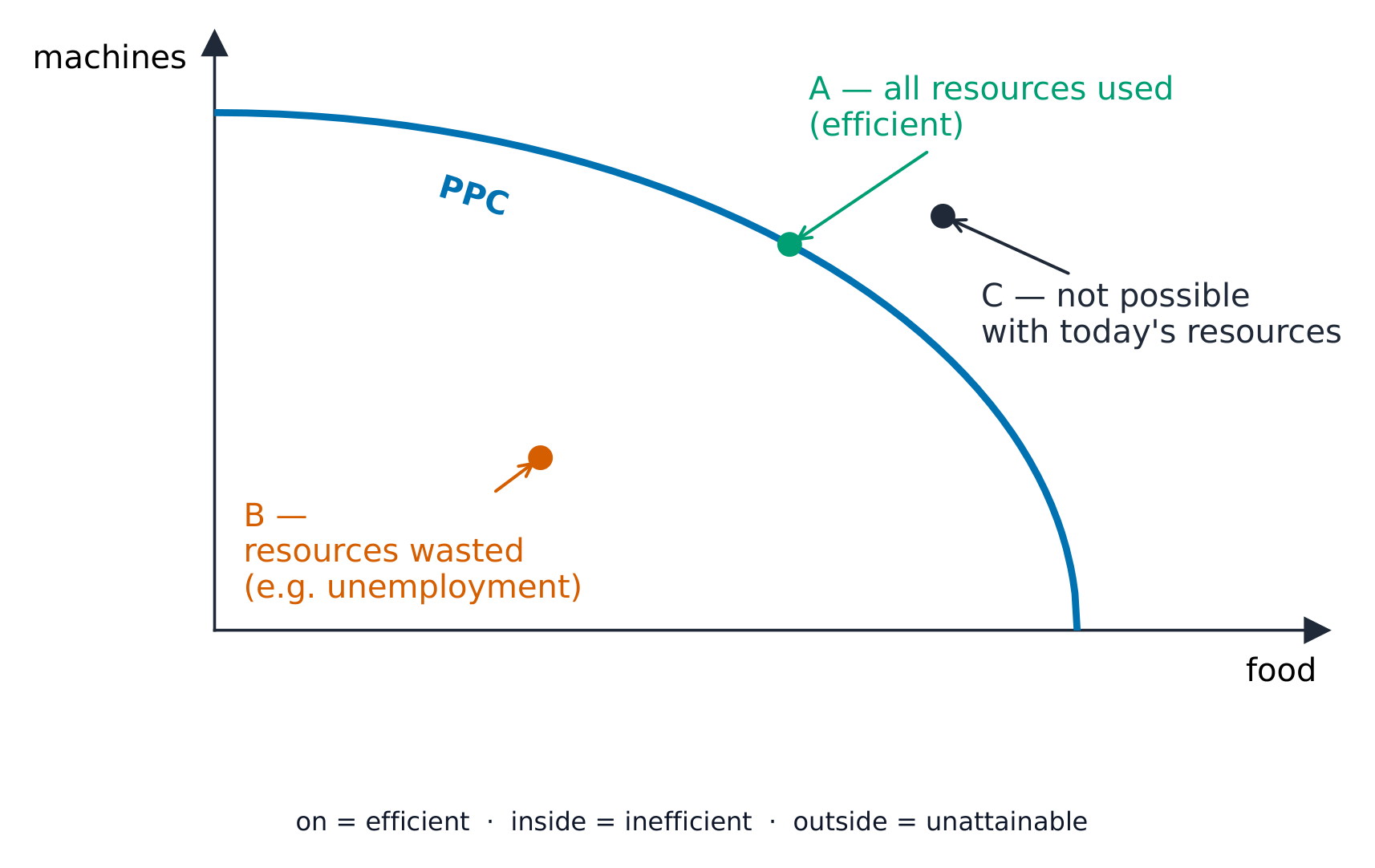
A production possibility curve 生产可能性曲线 (PPC) is a line showing the largest combinations of two goods an economy can make when all its resources are fully and well used.
Imagine an economy that makes only food and machines. The PPC is drawn with food on one axis and machines on the other.
- a point on the curve: production is efficient 效率 for the given resources and technology. This alone does not establish the mix society prefers.
- a point inside the curve: resources are wasted (for example, unemployment 失业 of workers). The economy could do better.
- a point outside the curve: impossible today, because there are not enough resources. This shows scarcity.
Worked frontier classification. An illustrative frontier joins food/machine combinations A=(20,0), B=(16,4), C=(10,8), D=(0,12), with food in tonnes/day and machines in units/day. E=(8,4) is inside: B permits more food at the same machine output. F=(15,8) is outside: at eight machines the maximum food is ten tonnes. C is efficient in production, but the frontier alone cannot show whether society prefers C to B. Moving from B to C gives up six tonnes/day for four extra machines/day, an interval average of 1.5 tonnes per machine. Unused capacity can permit more output without sacrificing the other plotted good; it does not make every use of scarce time, money or staff costless. Opportunity cost is not confined to points on a PPC.
Moving along the curve shows opportunity cost: to make more food, you must move resources away from machines, so you make fewer machines. This is the trade-off 取舍 between the two goods.
The shape of the curve shows how opportunity cost behaves:
- a straight-line PPC means constant opportunity cost — each extra unit of food costs the same number of machines.
- a curve that bows outwards means increasing opportunity cost — each extra unit of food costs more and more machines, because resources are not equally good at making both goods.

Shifts and growth
When the PPC moves outward, productive capacity increases: this is potential economic growth 经济增长. Actual output need not immediately rise to the new frontier. A sector-specific improvement can rotate one part of the frontier rather than shifting both intercepts. It happens when there are more resources, or better ones (new technology 技术, a bigger or more skilled workforce). War or disaster can move the PPC inward — this is economic decline 经济衰退.

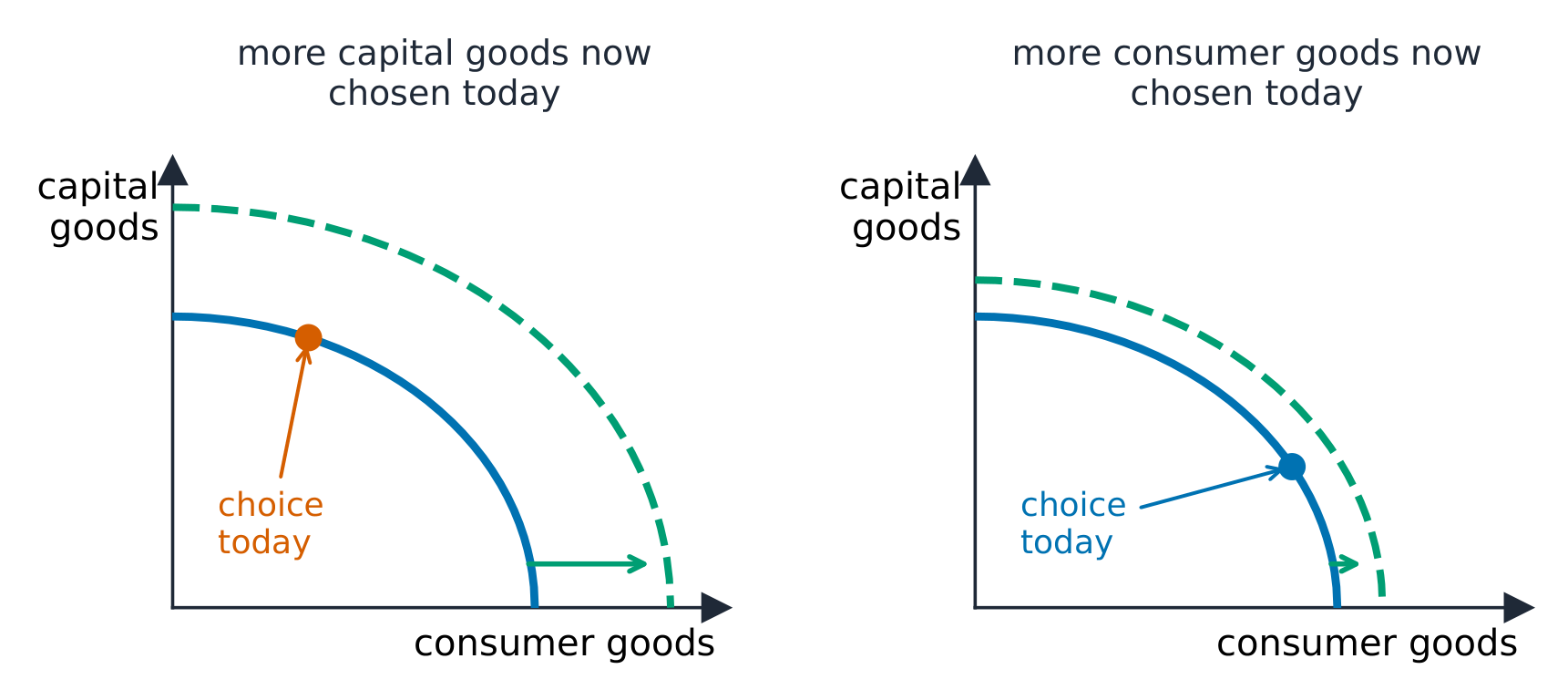
A country must also choose between two kinds of good now:
- capital goods 资本品 — goods used to make other goods (machines, factories).
- consumer goods 消费品 — goods people use directly (food, clothes).
Making more capital goods today means fewer consumer goods today. Productive investment can increase future capacity, provided it adds effective resources after wear and replacement. More capital spending does not guarantee a larger shift: quality, use, skills and other constraints matter.
Worked example. Why is a production possibility curve usually drawn concave (bowed outwards) rather than as a straight line? A straight line would mean the opportunity cost of each extra unit stays constant. The curve bows out because factors of production are not perfectly substitutable - they are specialised. Starting from all-food production, the first factors moved into making cars are the ones least suited to farming, so very little food is given up for a lot of cars. Keep going and you must move factors that are increasingly good at farming and increasingly bad at making cars, so each extra car costs more and more food. That rising cost is increasing opportunity cost, and the bowed shape is simply its picture. A straight-line PPC is not wrong - it just assumes factors are perfectly substitutable, and naming that assumption is what earns the mark.
Explore
The production possibility frontier
Producing more of one good means giving up some of the other — that trade-off is the opportunity cost, shown by the slope of the frontier.
Explore
Allocating scarce resources
An economy can't have more of everything: making more of one good means giving up some of another — the frontier's slope is that opportunity cost.
Explore
The production possibility curve
Move along the curve. Producing more of one good means producing less of the other — the curve shows opportunity cost and scarcity.
Vocabulary
Train
| English |
|---|
| production possibility curve/prəˈdʌkʃn ˌpɒsəˈbɪlɪti kɜːv/ |
| unemployment/ʌnemˈplɔɪmənt/ |
| trade-off/treɪd ɒf/ |
| economic growth/ˌiːkəˈnɒmɪk ɡrəʊθ/ |
| technology/tekˈnɒlədʒi/ |
| economic decline/ˌiːkəˈnɒmɪk dɪˈklaɪn/ |
| capital goods/ˈkæpɪtl ɡʊdz/ |
| consumer goods/kənˈsuːmə ɡʊdz/ |
1.6
Types of goods and services
Syllabus
- distinguish free goods and economic (private) goods
- explain the characteristics of public goods (non-rivalry, non-excludability) and the free-rider problem
- explain merit and demerit goods and the role of information and value judgements
Source: Cambridge International syllabus
Free goods and economic goods
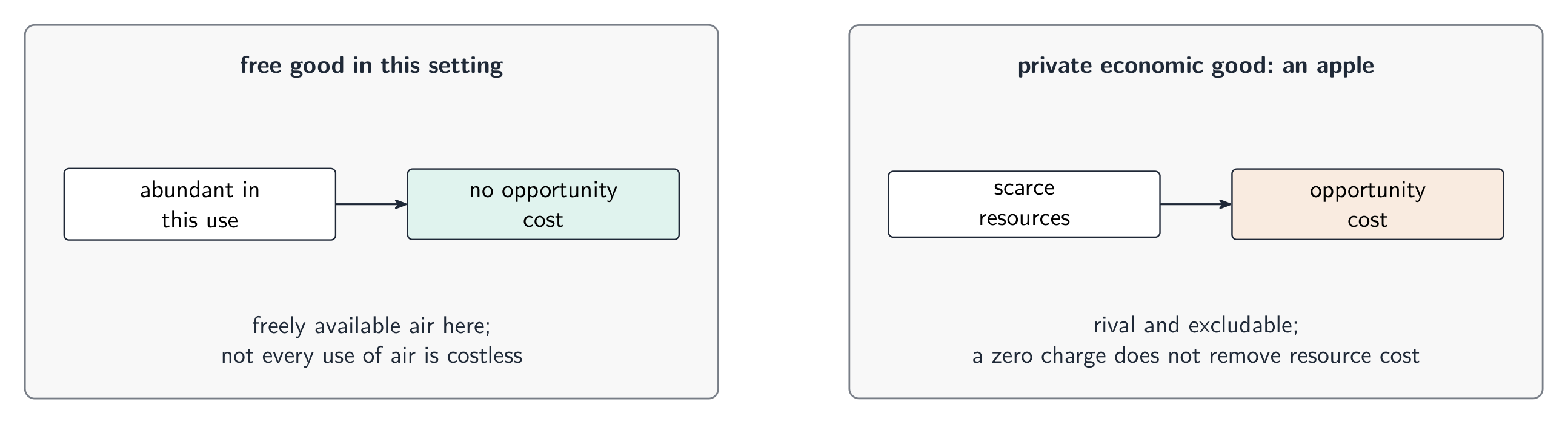
- a free good 免费物品 has no opportunity cost in the relevant use: available supply is sufficient without sacrificing another valued use. Freely available air may qualify in one setting; supplying clean air or oxygen in a hospital can require scarce resources. A zero charge alone does not prove a good is free in this economic sense.
- an economic good 经济物品 uses scarce resources and has opportunity cost. A private good 私人物品 has rivalry and excludability. An apple is an example; economic resources can also be used to provide public services. A good can have opportunity cost even if its user is not directly charged.
A private good has two features. It has rivalry 竞争性 (if I eat the apple, you cannot) and excludability 排他性 (the seller can stop you using it unless you pay).
Public goods
A public good 公共物品 is the opposite of a private good. It has two features:
- non-rivalry 非竞争性 — one person using it does not reduce the amount left for others.
- non-excludability 非排他性 — you cannot stop people who do not pay from using it.
Because of non-excludability, public goods suffer from the free-rider problem 搭便车问题: people enjoy the good without paying for it. This can cause private under-provision because voluntary payments may not cover cost. It does not prove nobody contributes: donations, sponsorship or other funding can support some provision. Government financing is one response; the financing body and the actual provider need not be the same. Street lighting and national defence 国防 are standard examples under the non-rival, non-excludable assumptions.
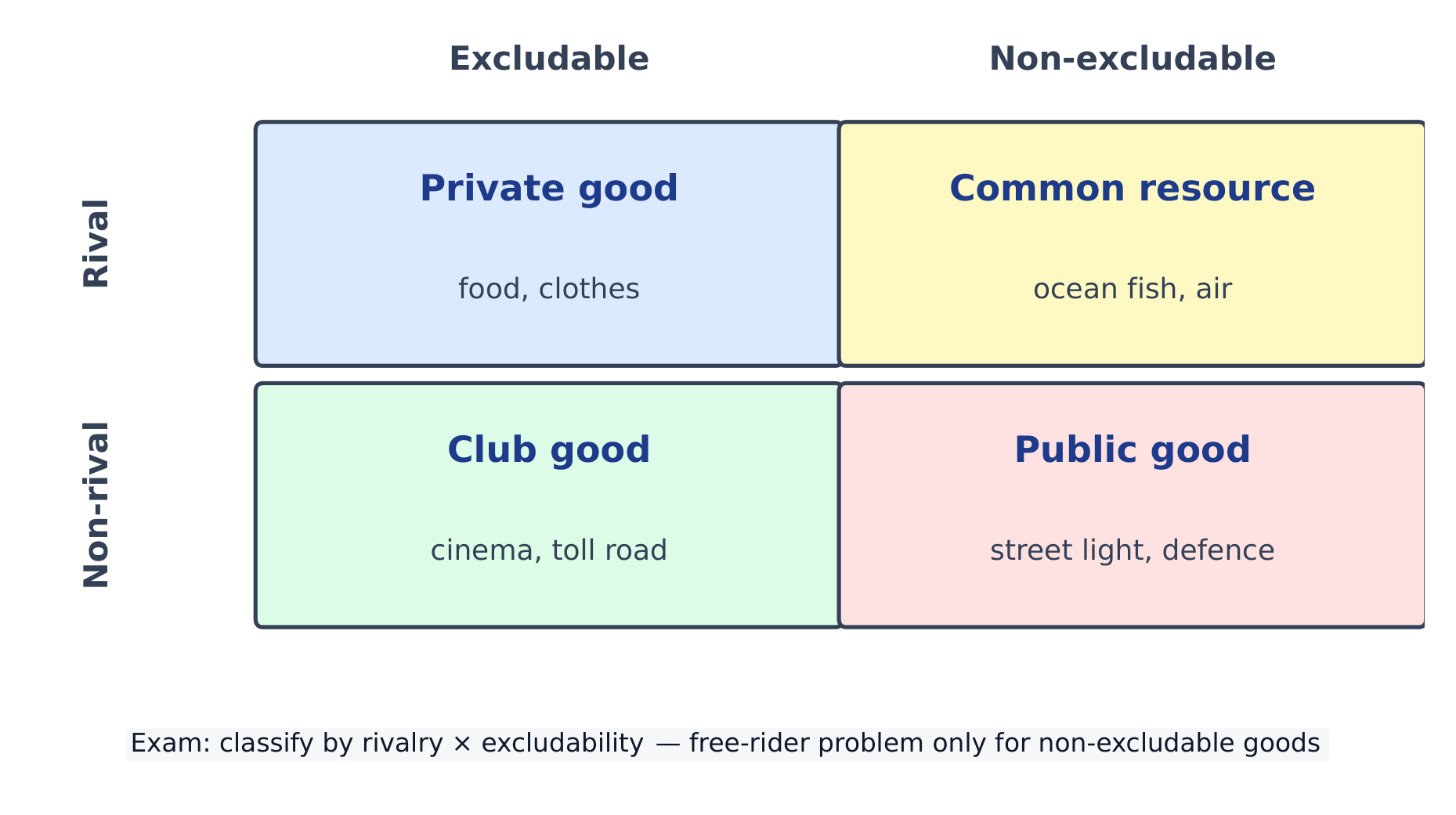
Worked classification. An uncrowded local street light benefits nearby users and cannot readily exclude non-payers, fitting the public-good conditions in that setting. A publicly funded hospital appointment uses a scarce doctor's time even when the patient pays nothing. It can be reserved for a patient and cannot simultaneously serve everyone, so public ownership does not make it a public good. A paid lesson can be private and merit at once if the learner underestimates its benefit; the information test differs from rivalry and exclusion.
Merit and demerit goods
- a merit good 优值品 is better for you (and for society) than you realise, so people buy too little of it. Examples: education and health care.
- a demerit good 劣值品 is worse for you than you realise, so people buy too much of it. Examples: cigarettes and alcohol.

People misjudge these goods because of information failure 信息失灵 — they do not have, or do not use, the full facts about the benefit or harm.
Deciding what counts as a merit or demerit good is partly a value judgement, so people may disagree about which goods belong on each list.
Explore
Goods and services lab
Classify examples by rivalry, excludability or whether they are services.
Vocabulary
Train
| English |
|---|
| free good/friː ɡʊd/ |
| economic good/ˌiːkəˈnɒmɪk ɡʊd/ |
| private good/ˈpraɪvət ɡʊd/ |
| rivalry/ˈraɪvəlri/ |
| excludability/eksˌkluːdəˈbɪlɪti/ |
| public good/ˈpʌblɪk ɡʊd/ |
| non-rivalry/nɒn ˈraɪvəlri/ |
| non-excludability/nɒn eksˌkluːdəˈbɪlɪti/ |
| free-rider problem/friː ˈraɪdə ˈprɒbləm/ |
| national defence/ˈnæʃənl dɪˈfens/ |
| merit good/ˈmerɪt ɡʊd/ |
| demerit good/ˈdemərɪt ɡʊd/ |
| information failure/ˌɪnfəˈmeɪʃn ˈfeɪlɪə/ |
1.6
Exam tips
- Frame answers around scarcity and choice: every choice has an opportunity cost — the next best alternative given up.
- Read a PPC: a point inside means unused resources, on the curve is efficient, outside is unattainable; the slope shows opportunity cost.
- Distinguish positive (a testable fact) from normative ("should", a value judgement) statements.
- Classify goods: free versus economic, and public / merit / demerit goods (non-excludable, non-rival, and so on).
Interactive lessons on this topic
Work through it step by step, with instant-check exercises.