Indifference curves and budget lines
Introduced| English | Meaning |
|---|---|
| indifference curve/ɪnˈdɪfrəns kɜːv/ | A curve joining combinations of goods that give a consumer the same level of satisfaction. |
| convex/kɒnˈveks/ | convex |
| marginal rate of substitution/ˈmɑːdʒɪnl reɪt ɒv ˌsʌbstɪˈtjuːʃn/ | marginal rate of substitution |
| budget line/ˈbʌdʒɪt laɪn/ | The combinations of two goods that use all of a consumer's budget at given prices. |
| optimum/ˈɒptɪməm/ | The condition or value at which a process performs best under the stated criteria. |
| substitution effect/ˌsʌbstɪˈtjuːʃn ɪˈfekt/ | The change in consumption caused by a change in relative prices, considered separately from the change in purchasing power. |
| income effect/ˈɪŋkʌm ɪˈfekt/ | The change in consumption caused by a change in real purchasing power, considered separately from substitution between goods. |
Mapping what you'd trade
- Would you swap two coffees for one cake? Your willingness to trade between goods can be drawn as a map of indifference curves 无差异曲线.
- Combine that map with what you can afford, and you can predict the exact bundle a rational consumer chooses.
An indifference curve joins all consumption bundles that give:
Difficulty 1/5 · 100 coins + a small bonus on first completion today
Every point on one indifference curve yields equal utility.
Indifference curves are usually convex to the origin (the MRS diminishes).
Difficulty 1/5 · 100 coins + a small bonus on first completion today
As you get more X, you'll give up less Y for each extra X — convex shape.
Indifference curves
- An indifference curve joins all bundles giving the same satisfaction.
- They slope downward (give up some X, gain some Y) and are convex 凸的 (the marginal rate of substitution 边际替代率 diminishes).
- Curves further from the origin = higher utility.
An increase in income shifts the budget line:
Difficulty 1/5 · 100 coins + a small bonus on first completion today
More income lets you afford more of both goods → an outward parallel shift.
The budget line 预算线
- The budget line shows all bundles a consumer can afford at given prices and income.
- Its slope is the ratio of the two prices; more income shifts it outward.
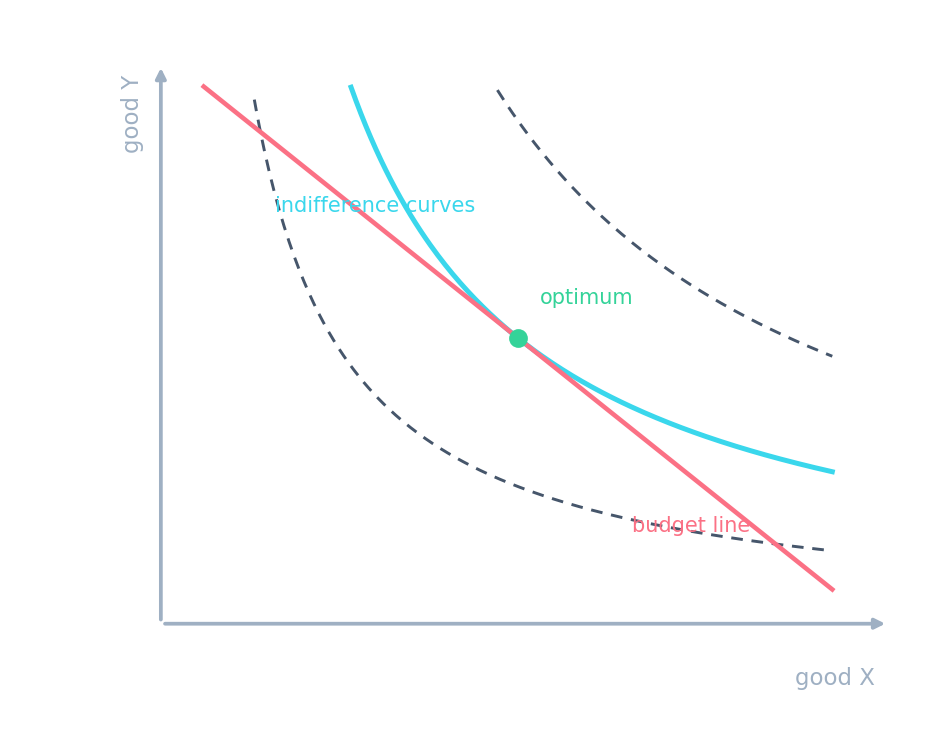
The consumer's optimum 最优 is where the budget line is tangent to the highest reachable indifference curve.
Budget line lab
good B = income / priceB - slope x good A
Move quantity of one good and see the trade-off with the other good.
The consumer's optimum bundle is where:
Difficulty 1/5 · 100 coins + a small bonus on first completion today
Tangency maximises utility subject to the budget constraint.
At the optimum, the budget line is ______ to the highest reachable indifference curve.
Difficulty 1/5 · 100 coins + a small bonus on first completion today
Tangency is the utility-maximising condition.
The optimum
- The consumer maximises utility where the budget line is tangent to the highest reachable indifference curve.
- At that point the slopes match: the rate they're willing to trade (MRS) equals the rate the market lets them (price ratio).
Income vs substitution effect 替代效应. When a price falls, the consumer buys more partly because it's now relatively cheaper (substitution) and partly because real income rose (income effect 收入效应).
You've got it
- indifference curves: equal-satisfaction bundles, downward-sloping and convex; further out = better
- the budget line shows affordable bundles (slope = price ratio)
- the optimum is the tangency of the budget line with the highest reachable curve