Efficiency and market failure
Introduced| English | Meaning |
|---|---|
| allocative efficiency/ˈæləkətɪv ɪˈfɪʃənsi/ | An allocation of resources that maximises total net benefit; at the efficient output, marginal social benefit equals marginal social cost. |
| marginal cost/ˈmɑːdʒɪnl kɒst/ | The additional total cost of producing one more unit of output. |
| productive efficiency/prəˈdʌktɪv ɪˈfɪʃənsi/ | Production at the lowest attainable average total cost for the relevant technology and scale. |
| average cost/ˈævrɪdʒ kɒst/ | Total production cost divided by the quantity produced. |
| Pareto efficiency/pæˈriːtəʊ ɪˈfɪʃənsi/ | Pareto efficiency |
| deadweight loss/ˈdedweɪt lɒs/ | The loss of total economic surplus when a market produces an inefficient quantity. |
What "efficient" really means
- "Efficient" is one of the most-used — and most-misused — words in economics.
- It has two precise meanings, and a market that misses either is failing.
Allocative efficiency occurs where:
Difficulty 1/5 · 100 coins + a small bonus on first completion today
P = MC means the value of the last unit equals its cost — allocatively efficient.
Allocative efficiency is where price equals marginal ______.
Difficulty 1/5 · 100 coins + a small bonus on first completion today
P = MC.
Allocative efficiency 配置效率
- Allocative efficiency: resources go to what society values most — output where price = marginal cost 边际成本 (P = MC).
- At this point, the value of the last unit equals its cost — no reallocation could make society better off.
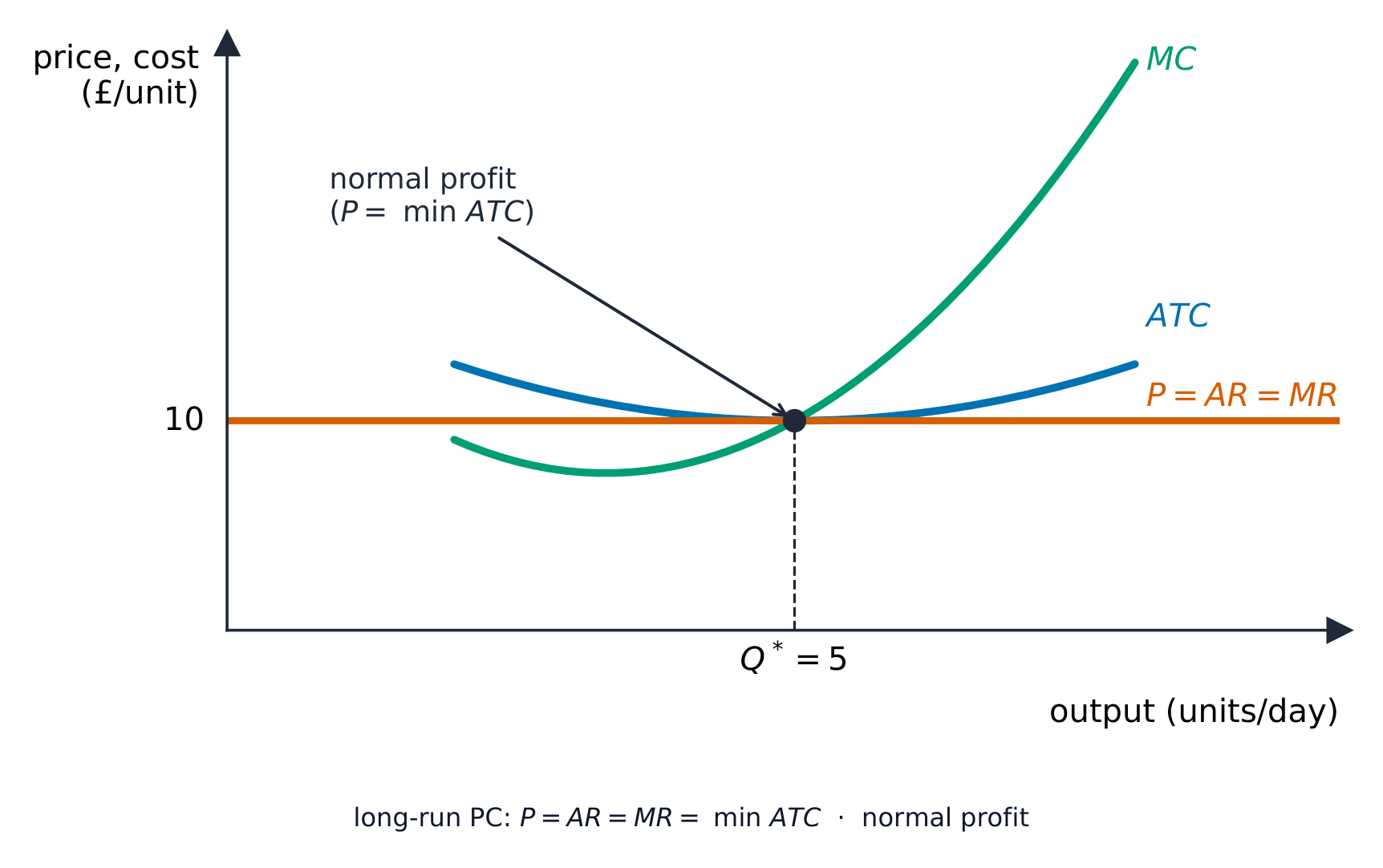
In perfect competition price equals marginal cost (P = MC) — the condition for allocative efficiency
Allocative efficiency
The market is allocatively efficient where supply meets demand — price equals marginal cost. Market failure pushes it away from that point.
Productive efficiency is achieved at the:
Difficulty 1/5 · 100 coins + a small bonus on first completion today
Lowest cost per unit = the minimum point of AC.
A Pareto-efficient allocation is one where no one can be made better off without making someone worse off.
Difficulty 1/5 · 100 coins + a small bonus on first completion today
That is the definition of Pareto efficiency.
On a PPF, efficiency requires producing:
Difficulty 1/5 · 100 coins + a small bonus on first completion today
Producing on the curve uses all resources efficiently; inside is wasteful.
Productive efficiency 生产效率
- Productive efficiency: goods are made at the lowest possible cost — producing at the minimum of the average cost 平均成本 curve.
- On a PPF, both efficiencies require producing on the frontier, not inside it.
Pareto efficiency 帕累托效率. An allocation is Pareto efficient if you can't make anyone better off without making someone else worse off — the benchmark for "no waste".
When markets fail
- Markets fail to reach these efficiencies because of externalities, public goods, market power and information gaps.
- The result: too much or too little produced, and a deadweight loss 无谓损失 of welfare.
You've got it
- allocative efficiency: P = MC (resources match what society values)
- productive efficiency: lowest cost (minimum of AC); both need producing on the PPF
- market failure (externalities, public goods, monopoly, info gaps) breaks efficiency → deadweight loss