Utility
Introduced| English | Meaning |
|---|---|
| diminishing marginal utility/dɪˈmɪnɪʃɪŋ ˈmɑːdʒɪnl juːˈtɪlɪti/ | Each extra unit adds less satisfaction than the unit before it. |
| marginal utility/ˈmɑːdʒɪnl juːˈtɪlɪti/ | marginal utility |
| utility/juːˈtɪlɪti/ | The satisfaction or benefit a consumer obtains from consuming goods or services. |
| total utility/ˈtəʊtl juːˈtɪlɪti/ | The overall satisfaction a consumer obtains from a given amount or combination of goods. |
| equi-marginal principle/ˈekwi ˈmɑːdʒɪnl ˈprɪnsɪpl/ | Allocating a budget so the last unit of money spent on each purchased good gives equal marginal satisfaction. |
Why the second ice cream is never as good
- The first ice cream on a hot day is bliss; the second is nice; the fourth makes you queasy. Each extra one adds less satisfaction.
- That pattern — diminishing marginal utility 边际效用递减 — quietly explains the downward-sloping demand curve.
Diminishing marginal utility lab
total utility rises more slowly as quantity increases
Add units consumed and see why extra satisfaction usually falls.
Total and marginal utility 边际效用
- Utility 效用 is the satisfaction from consuming a good.
- Total utility 总效用 (TU) is the overall satisfaction; marginal utility (MU) is the extra utility from one more unit.
- $MU$ = the change in $TU$ from the next unit.
Worked example. If total utility from 2, 3 ice creams is 18 then 24, the marginal utility of the third is 24 − 18 = 6.
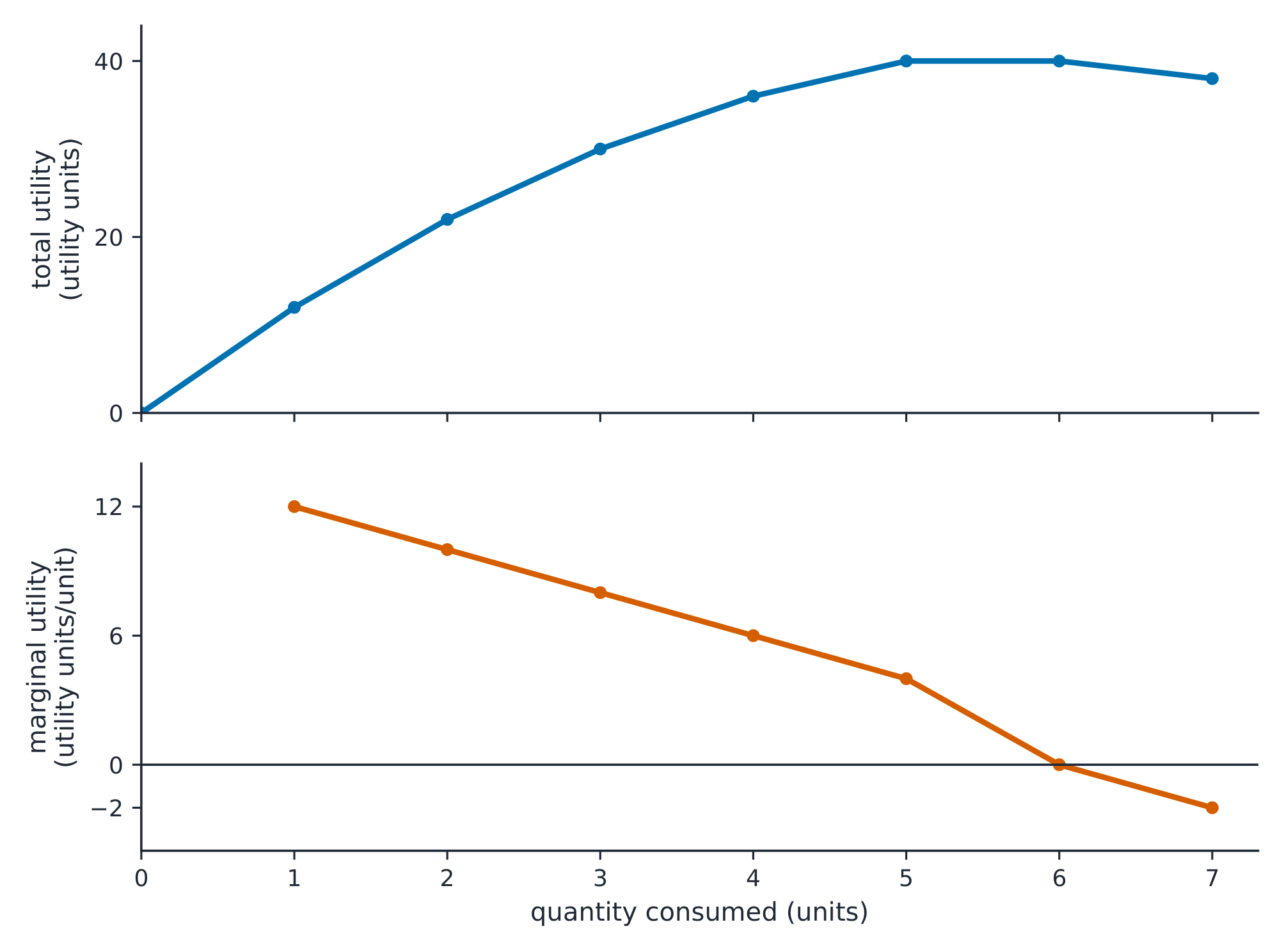
Total utility rises while marginal utility falls
Total utility from 2 then 3 ice creams is 18 then 24. What is the marginal utility of the 3rd?
Difficulty 2/5 · 140 coins + a small bonus on first completion today
MU = change in TU = 24 − 18 = 6.
Marginal utility is the change in ______ utility from one more unit.
Difficulty 1/5 · 100 coins + a small bonus on first completion today
MU = ΔTU.
Diminishing marginal utility
- As you consume more, each extra unit adds less — MU falls.
- That's why you'll only buy more at a lower price — the root of the downward demand curve.

Consumers spend limited income to get the most utility (satisfaction)
Diminishing marginal utility means each extra unit consumed gives:
Difficulty 1/5 · 100 coins + a small bonus on first completion today
MU falls as consumption rises — the basis of the downward demand curve.
Diminishing marginal utility helps explain why the demand curve slopes:
Difficulty 1/5 · 100 coins + a small bonus on first completion today
Since extra units are worth less, buyers will only take more at a lower price.
The equi-marginal principle 等边际原则
- To maximise utility on a budget, spend so the utility per dollar is equal across goods:
- If one good gives more utility per dollar, switch spending to it until they balance.
Utility is maximised when the marginal utility per dollar is equal across all goods.
Difficulty 1/5 · 100 coins + a small bonus on first completion today
MU_A/P_A = MU_B/P_B — otherwise you could gain by switching spending.
You've got it
- utility = satisfaction; MU = extra utility from one more unit (= ΔTU)
- diminishing marginal utility: each extra unit adds less → downward demand
- maximise with $\dfrac{MU_A}{P_A} = \dfrac{MU_B}{P_B}$ (equal utility per dollar)