Costs and production
Introduced| English | Meaning |
|---|---|
| variable costs/ˈveərɪəbl kɒsts/ | Costs that change as the level of output changes. |
| fixed costs/fɪkst kɒsts/ | Costs that do not change with output over the relevant period and production range. |
| total cost/ˈtəʊtl kɒst/ | The sum of all costs of producing a given level of output, including fixed and variable costs. |
| average cost/ˈævrɪdʒ kɒst/ | Total production cost divided by the quantity produced. |
| marginal cost/ˈmɑːdʒɪnl kɒst/ | The additional total cost of producing one more unit of output. |
| diminishing returns/dɪˈmɪnɪʃɪŋ rɪˈtɜːnz/ | diminishing returns |
| economies of scale/ɪˈkɒnəmiz ɒv skeɪl/ | Falls in average production cost as the scale of output increases. |
What it really costs to make something
- Run a factory and some bills arrive whether you make one unit or a million (rent); others rise with every unit (materials).
- Splitting costs the right way — and knowing how they change with output — is the foundation of every firm's decisions.
Which is a fixed cost?
Difficulty 1/5 · 100 coins + a small bonus on first completion today
Rent does not change with output; the others vary with how much is produced.
Match each cost term to its meaning.
Difficulty 2/5 · 140 coins + a small bonus on first completion today
FC constant, VC rises, AC = TC/Q, MC = ΔTC.
Fixed and variable costs 可变成本
- Fixed costs 固定成本 (FC) don't change with output (rent, insurance).
- Variable costs (VC) rise with output (materials, wages).
- Total cost 总成本 (TC) = FC + VC; average cost 平均成本 (AC) = TC ÷ output; marginal cost 边际成本 (MC) = the cost of one more unit.
Worked example. If total cost is 120 to make 10 units, average cost = 120 ÷ 10 = 12 per unit.

Productive efficiency is lowest cost; allocative is making what people want
Costs of production
AC is U-shaped; MC cuts it at the minimum
Average cost falls then rises; marginal cost crosses it exactly at the lowest AC.
Total cost is 120 to make 10 units. What is the average cost per unit?
Difficulty 2/5 · 140 coins + a small bonus on first completion today
AC = TC / Q = 120 / 10 = 12.
Short-run cost curves
- In the short run at least one factor is fixed, so the law of diminishing returns 边际报酬递减 sets in: beyond a point, each extra worker adds less.
- This makes the AC and MC curves U-shaped.
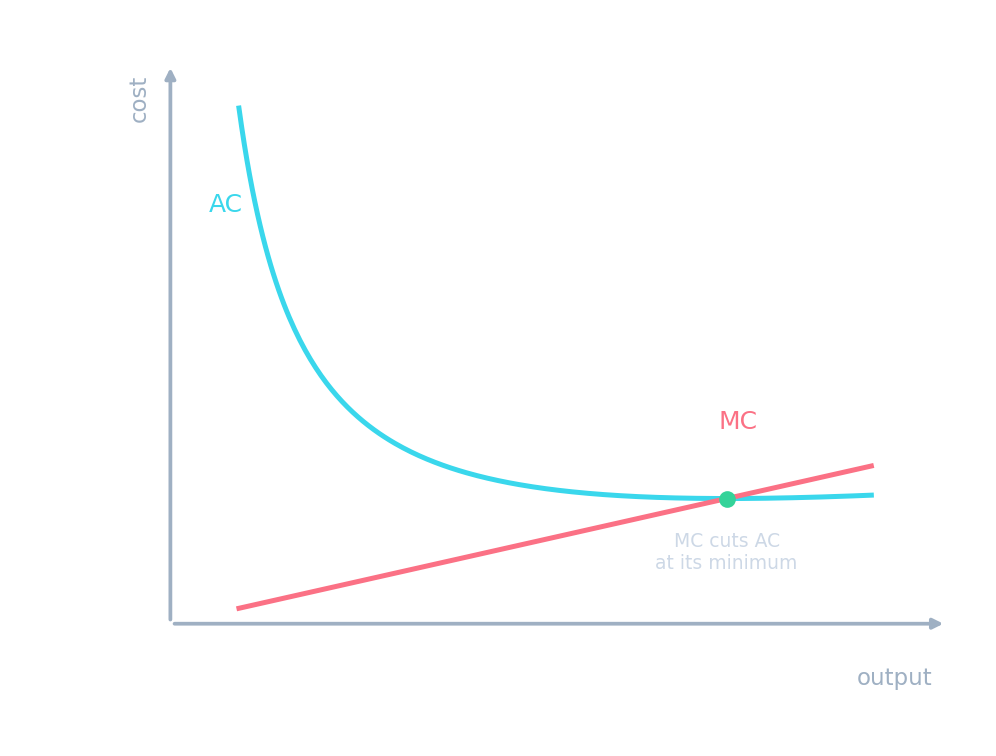
MC always cuts AC at the minimum of AC — a defining feature of the cost diagram.
The marginal cost curve cuts the average cost curve at its minimum point.
Difficulty 1/5 · 100 coins + a small bonus on first completion today
When MC < AC, AC falls; when MC > AC, AC rises — so they cross at AC's minimum.
Short-run cost curves are U-shaped because of the law of diminishing ______.
Difficulty 1/5 · 100 coins + a small bonus on first completion today
With a fixed factor, extra units of a variable factor eventually add less output.
The long run
- In the long run all factors vary; the firm can change scale.
- Spreading fixed costs and specialising bring economies of scale 规模经济 (lower long-run AC) — explored in lesson 09.
You've got it
- FC (constant) + VC (rise with output) = TC; AC = TC ÷ Q; MC = cost of one more unit
- short-run AC and MC are U-shaped (diminishing returns); MC cuts AC at its minimum
- in the long run all factors vary → economies of scale