Market structures
Introduced| English | Meaning |
|---|---|
| market structure/ˈmɑːkɪt ˈstrʌktʃə/ | The features of a market's competition, including firm numbers, entry barriers and product differentiation. |
| perfect competition/ˈpɜːfekt ˌkɒmpəˈtɪʃn/ | A market with many firms, an identical product, and free entry. |
| price-taker/praɪs ˈteɪkə/ | price-taker |
| monopoly/məˈnɒpəli/ | A market structure in which a single seller supplies a good or service with no close substitutes. |
| oligopoly/ˌɒlɪˈɡɒpəli/ | A market dominated by a small number of interdependent large firms. |
| monopolistic competition/məˈnɒpəlɪstɪk ˌkɒmpəˈtɪʃn/ | A market structure with many firms offering differentiated products and relatively easy entry and exit. |
| differentiated/ˌdɪfəˈrenʃɪeɪtɪd/ | differentiated |
| barriers to entry/ˈbærɪəz tʊ ˈentri/ | Obstacles that make it difficult for new firms to enter a market. |
A spectrum of competition
- At one extreme, thousands of identical wheat farmers, none able to budge the price. At the other, a single water company. Most industries sit between.
- Market structure 市场结构 — how many firms, how much power — shapes price, output and profit.
In perfect competition, each firm is a:
Difficulty 1/5 · 100 coins + a small bonus on first completion today
With many firms and an identical product, each must accept the market price.
A firm that must accept the market price, unable to influence it, is a price-______.
Difficulty 1/5 · 100 coins + a small bonus on first completion today
Perfectly competitive firms are price-takers.
Perfect competition 完全竞争
- Perfect competition: many small firms, an identical product, free entry, perfect information.
- Each firm is a price-taker 价格接受者: it faces a horizontal demand at the market price (P = MR = AR).
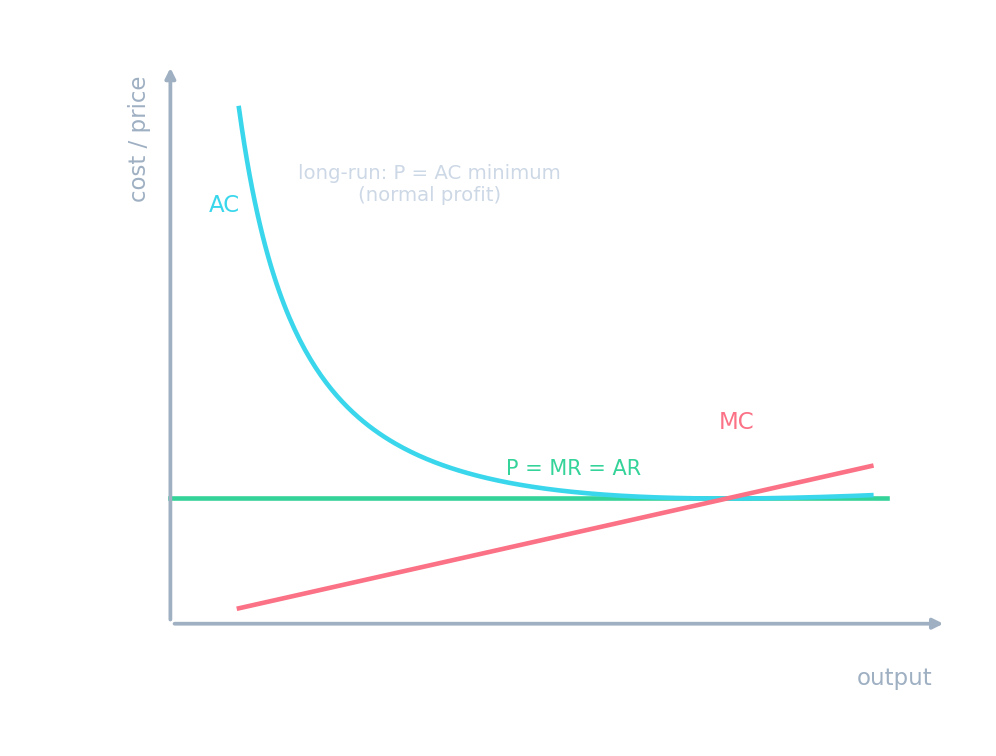
In long-run perfect competition the price line is tangent to AC at its minimum — only normal profit.
Costs and the firm
Average cost is U-shaped; marginal cost cuts it at the minimum. Different market structures price relative to these curves.
Match each market structure to its key feature.
Difficulty 2/5 · 140 coins + a small bonus on first completion today
Number of firms and product differentiation define the structure.
The other structures
- Monopoly 垄断: one dominant firm, high barriers, price-maker (supernormal profit possible).
- Oligopoly 寡头垄断: a few large firms, interdependent (they watch each other), often non-price competition.
- Monopolistic competition 垄断竞争: many firms, differentiated 差异化的 products (branding) — normal profit in the long run.

Market structures form a spectrum, from perfect competition through to monopoly
In long-run perfect competition, firms earn only normal profit.
Difficulty 1/5 · 100 coins + a small bonus on first completion today
Free entry competes away any supernormal profit until P = AC at its minimum.
Which is a barrier to entry that protects market power?
Difficulty 1/5 · 100 coins + a small bonus on first completion today
Patents (and scale, brands, high start-up costs) keep rivals out.
Barriers to entry 进入壁垒
- What protects market power: economies of scale, patents, brand loyalty, high start-up costs, control of a resource.
- The higher the barriers, the closer to monopoly — and the more supernormal profit can persist.
Long-run profits depend on entry. Where entry is free (perfect/monopolistic competition), supernormal profit is competed away to normal. Where barriers are high (monopoly), it can persist.
You've got it
- perfect competition: many firms, identical product, price-takers → normal profit long-run
- monopoly (one firm), oligopoly (few, interdependent), monopolistic competition (many, differentiated)
- barriers to entry (scale, patents, brands) let supernormal profit persist