Competition and price discrimination
Introduced| English | Meaning |
|---|---|
| monopoly/məˈnɒpəli/ | A market structure in which a single seller supplies a good or service with no close substitutes. |
| price discrimination/praɪs dɪˌskrɪmɪˈneɪʃn/ | Charging different buyers different prices for the same product for reasons not explained by corresponding differences in cost. |
| consumer surplus/kənˈsuːmə ˈsɜːpləs/ | The difference between what buyers are willing to pay and what they actually pay, summed across purchases. |
| market power/ˈmɑːkɪt ˈpaʊə/ | The ability of a seller or buyer to influence market prices or trading conditions. |
| allocatively inefficient/ˈæləkətɪvli ɪnɪˈfɪʃənt/ | Describing an allocation where changing output could increase total social benefit net of social cost. |
The power of one seller
- A monopolist doesn't take the price — it sets it, by choosing how much to supply. That power can mean fat profits and higher prices.
- But monopolies can also use a clever trick: charging different customers different prices.
A profit-maximising monopolist sets output where:
Difficulty 1/5 · 100 coins + a small bonus on first completion today
MR = MC gives the profit-maximising quantity; the price comes from demand at that quantity.
The monopolist's choice
- A monopoly 垄断 faces the whole market demand, so to sell more it must lower the price (MR lies below AR).
- It maximises profit where MR = MC, then reads the price up from the demand curve — a higher price and lower output than perfect competition.
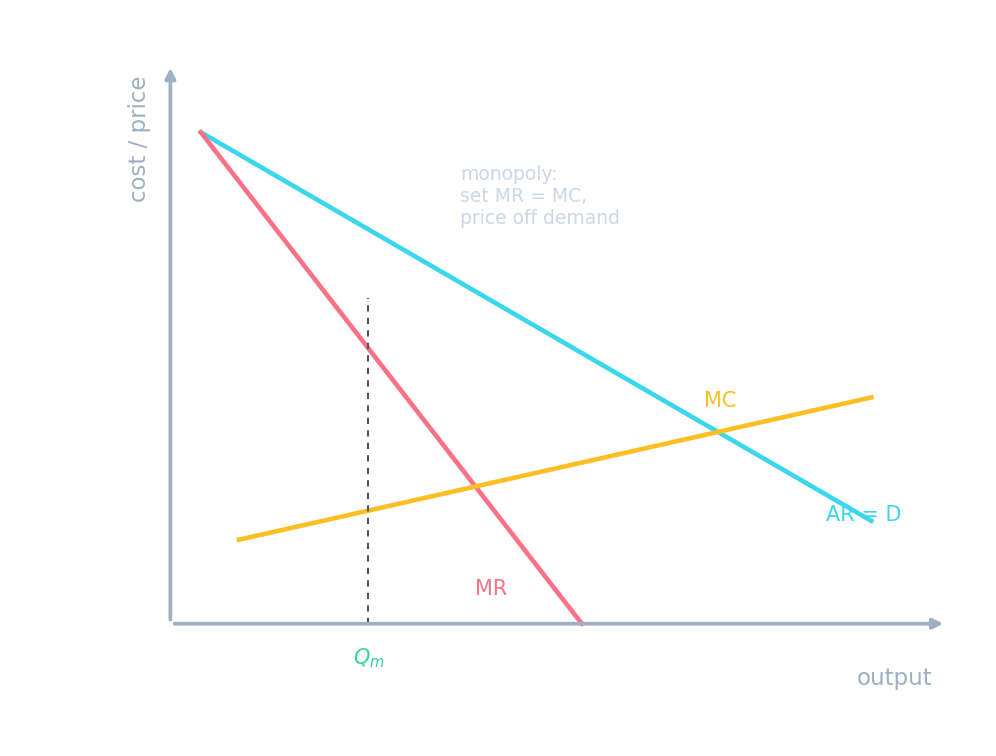
The monopolist picks the output where MR = MC, then charges the highest price demand will bear.
Pricing and competition
How a firm prices depends on demand and supply; with market power it can charge above the competitive level.
Price discrimination requires all of these EXCEPT:
Difficulty 1/5 · 100 coins + a small bonus on first completion today
Discrimination means charging different prices; it needs power, separable groups, and no resale.
Match each type of price discrimination to its example.
Difficulty 2/5 · 140 coins + a small bonus on first completion today
Third-degree splits by group; first-degree extracts each buyer's full willingness to pay.
For price discrimination to work, the firm must prevent ______ between the groups.
Difficulty 1/5 · 100 coins + a small bonus on first completion today
Otherwise the cheap group resells to the expensive group, collapsing the scheme.
Price discrimination 价格歧视
- Price discrimination = charging different prices to different buyers for the same good (to capture more consumer surplus 消费者剩余).
- It needs market power 市场势力, the ability to separate groups, and to stop resale between them.
- Third-degree discrimination: by group (student/adult tickets); first-degree: each buyer's maximum.
Monopoly isn't all bad. It can fund R&D and reap economies of scale (lower costs). But it tends to be allocatively inefficient 配置无效率 (P > MC) and can exploit consumers.
A monopoly is allocatively inefficient because it sets a price above marginal cost (P > MC).
Difficulty 1/5 · 100 coins + a small bonus on first completion today
P > MC means the value of the last unit exceeds its cost — too little is produced.
The costs and benefits of monopoly
- Costs: higher prices, lower output, allocative inefficiency (P > MC).
- Benefits: economies of scale (lower costs) and profits that can fund research and innovation.
You've got it
- a monopoly is a price-maker: set output at MR = MC, price off demand (P > MC)
- this gives higher price, lower output, and possible supernormal profit
- price discrimination charges groups different prices — needs power, separable markets, no resale