1 Describe the characteristics of living organisms by describing: (a) movement as an action by an organism or part of an organism causing a change of position or place (b) respiration as the chemical reactions in cells that break down nutrient molecules and release energy for metabolism (c) sensitivity as the ability to detect and respond to changes in the internal or external environment (d) growth as a permanent increase in size and dry mass (e) reproduction as the processes that make more of the same kind of organism (f) excretion as the removal of the waste products of metabolism and substances in excess of requirements (g) nutrition as the taking in of materials for energy, growth and development
Source: Cambridge International syllabus · 出典: Cambridge International シラバス
English
Every living thing shares the same seven characteristics 特征 — seven life processes 生命过程 that all organisms 生物体 carry out. You can remember them with the letters MRS GREN. The examiner gives marks for the exact wording, so learn each definition.
Movement 运动 — an action by an organism, or part of an organism, that changes its position or place.
Respiration 呼吸作用 — the chemical reactions in cells 细胞 that break down nutrient molecules 营养物质 and release energy 能量 for metabolism 新陈代谢.
Sensitivity 应激性 — the ability to detect and respond to changes in the internal or external environment 环境.
Growth 生长 — a permanent increase in size and dry mass 干重.
Reproduction 生殖 — the processes that make more of the same kind of organism.
Excretion 排泄 — the removal of the waste products 废物 of metabolism, and of substances the body has in excess (more than it needs).
Nutrition 营养 — the taking in of materials for energy, growth and development.
Metabolism means all the chemical reactions that happen inside an organism's cells.
日本語
Every living thing shares the same seven characteristics 特征 — seven life processes 生命过程 that all organisms 生物体 carry out. You can remember them with the letters MRS GREN. The examiner gives marks for the exact wording, so learn each definition.
The seven life processes spell MRS GREN
Movement 运动 — an action by an organism, or part of an organism, that changes its position or place.
Respiration 呼吸作用 — the chemical reactions in cells 细胞 that break down nutrient molecules 营养物质 and release energy 能量 for metabolism 新陈代谢.
Sensitivity 应激性 — the ability to detect and respond to changes in the internal or external environment 环境.
Growth 生长 — a permanent increase in size and dry mass 干重.
Reproduction 生殖 — the processes that make more of the same kind of organism.
Excretion 排泄 — the removal of the waste products 废物 of metabolism, and of substances the body has in excess (more than it needs).
Nutrition 营养 — the taking in of materials for energy, growth and development.
Metabolism means all the chemical reactions that happen inside an organism's cells.
Explore · 探索
Characteristics of life lab · 生命の特徴実験
Classify real observations by the life process they show. · 観察された現象を生命過程に基づいて分類する。
1 State that organisms can be classified into groups by the features that they share
5 Explain that classification systems aim to reflect evolutionary relationships
2 Describe a species as a group of organisms that can reproduce to produce fertile offspring
3 Describe the binomial system of naming species as an internationally agreed system in which the scientific name of an organism is made up of two parts showing the genus and species
4 Construct and use dichotomous keys based on identifiable features
6 Explain that the sequences of bases in DNA are used as a means of classification
7 Explain that groups of organisms which share a more recent ancestor (are more closely related) have base sequences in DNA that are more similar than those that share only a distant ancestor
Source: Cambridge International syllabus · 出典: Cambridge International シラバス
English
There are millions of kinds of living thing. To study them, scientists classify 分类 them — they sort them into groups by the features they share. Organisms in the same group share more features with each other than with organisms in other groups.
Species and the binomial system
The smallest common group is the species 物种. A species is a group of organisms that can reproduce to make fertile offspring 可育后代 ("fertile" means the offspring can themselves go on to have young).
Each species has a two-part scientific name 学名. This way of naming is the binomial system 双名法 — a system agreed all over the world, so every scientist uses the same name.
The first part is the genus 属 (a larger group that the species belongs to). It starts with a capital letter.
The second part is the species. It starts with a small letter.
The whole name is written in italics, for example Homo sapiens (humans). Two rats named Rattus norvegicus and Rattus rattus belong to the same genus but are different species.
Dichotomous keys
A dichotomous key 二歧检索表 is a tool that helps you identify an unknown organism. "Dichotomous" means "splitting into two". At each step the key gives you two choices about a feature. You pick the one that fits your organism, and that choice sends you on to the next pair of choices. You repeat this until you reach the organism's name.
When you build a key, choose clear features you can see — for example "has wings / has no wings" — not features that change, such as size.
Worked example. A key reads: step 1, has wings, go to 2; no wings, go to 3. Step 2, one pair of wings, it is a housefly; two pairs of wings, it is a butterfly. An unknown insect has two pairs of wings. Step 1 only asks "wings or no wings?", so having wings sends you to step 2. At step 2, "two pairs" gives butterfly. Follow the route the key gives you, one step at a time - never jump straight to the name that looks right.
Classification and DNA (Supplement)
Modern classification tries to show evolutionary relationships 进化关系 — how closely different organisms are related. Organisms that are more closely related share a more recent ancestor 祖先.
To measure this, scientists compare the base sequence 碱基序列 of DNA (the order of the chemical "letters" that make up an organism's genes 基因). The rule is simple:
Organisms that share a more recent ancestor (more closely related) have more similar DNA base sequences.
Organisms that share only a distant ancestor have less similar base sequences.
So a DNA base sequence can be used both to classify organisms and to work out how closely two species are related.
日本語
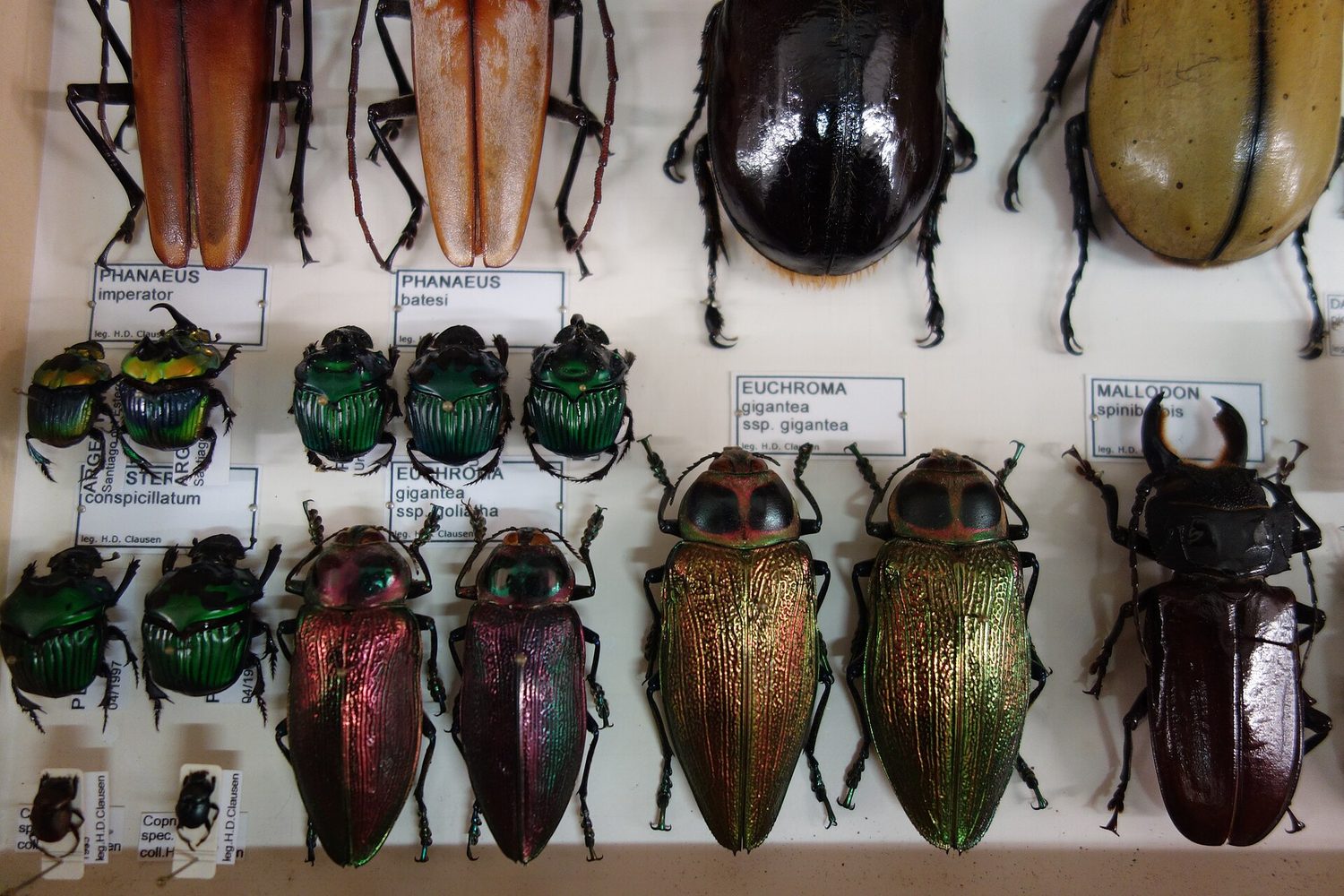
A museum insect drawer: classification groups organisms by the features they share
There are millions of kinds of living thing. To study them, scientists classify 分类 them — they sort them into groups by the features they share. Organisms in the same group share more features with each other than with organisms in other groups.
Species and the binomial system
The smallest common group is the species 物种. A species is a group of organisms that can reproduce to make fertile offspring 可育后代 ("fertile" means the offspring can themselves go on to have young).
A scientific name: a capital-letter genus and a small-letter species
Each species has a two-part scientific name 学名. This way of naming is the binomial system 双名法 — a system agreed all over the world, so every scientist uses the same name.
The first part is the genus 属 (a larger group that the species belongs to). It starts with a capital letter.
The second part is the species. It starts with a small letter.
The whole name is written in italics, for example Homo sapiens (humans). Two rats named Rattus norvegicus and Rattus rattus belong to the same genus but are different species.
Dichotomous keys
A dichotomous key 二歧检索表 is a tool that helps you identify an unknown organism. "Dichotomous" means "splitting into two". At each step the key gives you two choices about a feature. You pick the one that fits your organism, and that choice sends you on to the next pair of choices. You repeat this until you reach the organism's name.
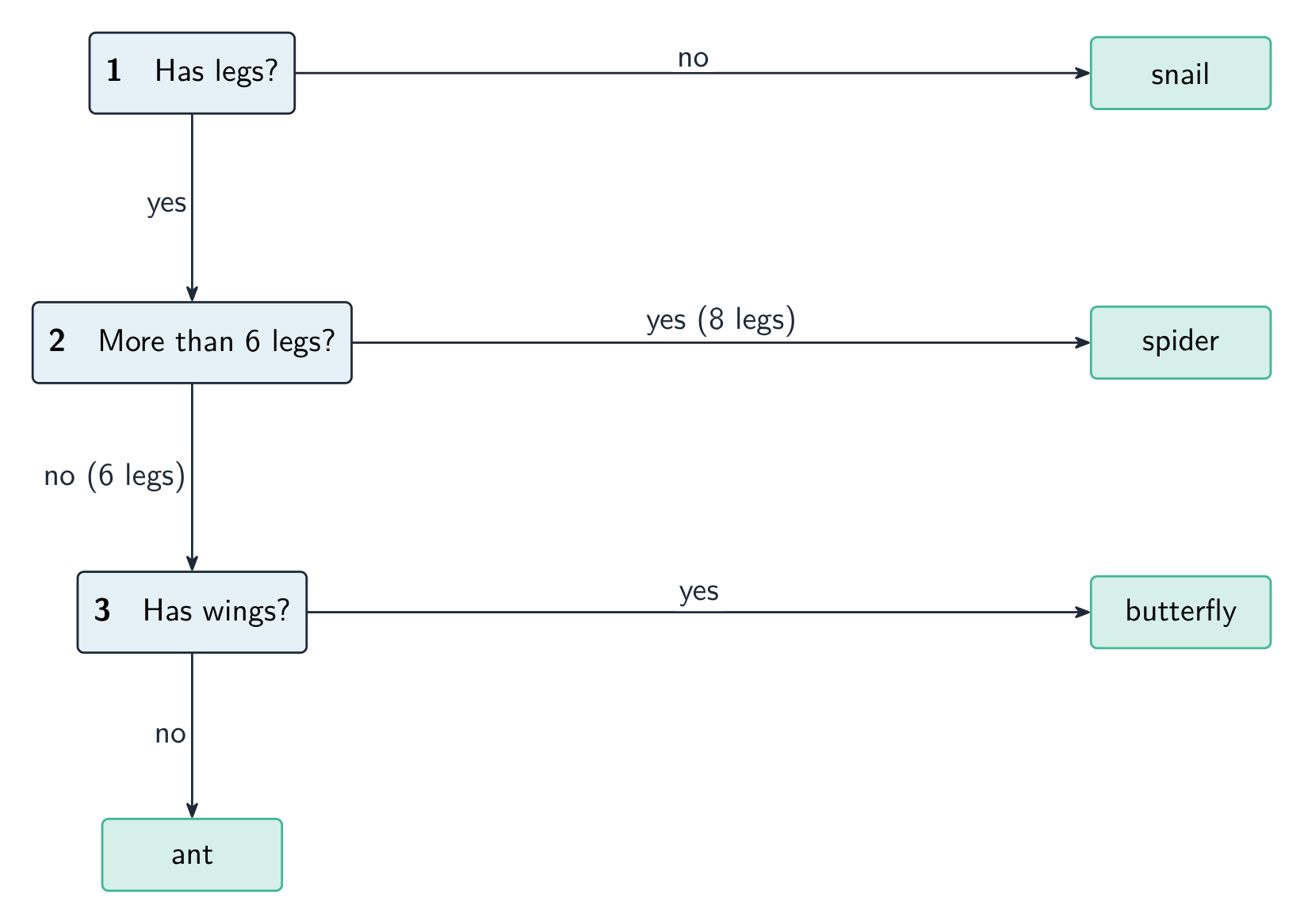
A dichotomous key: each step gives two choices until you reach the organism
When you build a key, choose clear features you can see — for example "has wings / has no wings" — not features that change, such as size.
Worked example. A key reads: step 1, has wings, go to 2; no wings, go to 3. Step 2, one pair of wings, it is a housefly; two pairs of wings, it is a butterfly. An unknown insect has two pairs of wings. Step 1 only asks "wings or no wings?", so having wings sends you to step 2. At step 2, "two pairs" gives butterfly. Follow the route the key gives you, one step at a time - never jump straight to the name that looks right.
Classification and DNA (Supplement)
Modern classification tries to show evolutionary relationships 进化关系 — how closely different organisms are related. Organisms that are more closely related share a more recent ancestor 祖先.
To measure this, scientists compare the base sequence 碱基序列 of DNA (the order of the chemical "letters" that make up an organism's genes 基因). The rule is simple:
Organisms that share a more recent ancestor (more closely related) have more similar DNA base sequences.
Organisms that share only a distant ancestor have less similar base sequences.
So a DNA base sequence can be used both to classify organisms and to work out how closely two species are related.
Explore · 探索
Classification rank lab · 分類階層のラベル
Place examples at the right level in the biological hierarchy. · 生物の階層構造に適切なレベルで例を配置しなさい。
1 State the main features used to place animals and plants into the appropriate kingdoms
4 State the main features used to place all organisms into one of the five kingdoms: animal, plant, fungus, prokaryote, protoctist
2 State the main features used to place organisms into groups within the animal kingdom, limited to: (a) the main groups of vertebrates: mammals, birds, reptiles, amphibians, fish (b) the main groups of arthropods: myriapods, insects, arachnids, crustaceans
5 State the main features used to place organisms into groups within the plant kingdom, limited to ferns and flowering plants (dicotyledons and monocotyledons)
3 Classify organisms using the features identified in 1.3.1 and 1.3.2
6 Classify organisms using the features identified in 1.3.4 and 1.3.5
7 State the features of viruses, limited to a protein coat and genetic material
Source: Cambridge International syllabus · 出典: Cambridge International シラバス
English
The biggest groups that organisms are sorted into are called kingdoms 界. At Core level you place organisms into the first two kingdoms below; for Supplement you need all five kingdoms. You decide where an organism belongs by looking at its main features.
Kingdom
Main features
Animal 动物
made of many cells; cells have no cell wall 细胞壁; cannot make their own food, so they feed on other organisms; most can move their whole body
Plant 植物
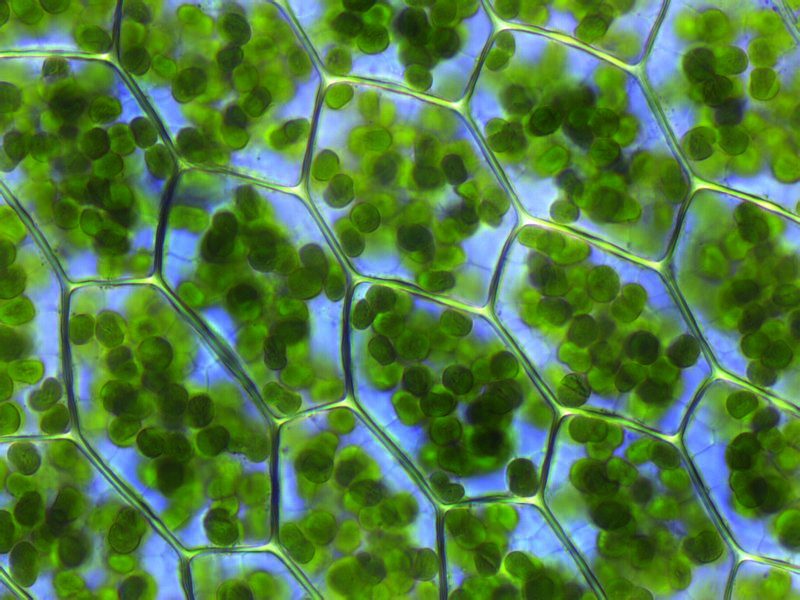
made of many cells; cells have a cell wall; make their own food by photosynthesis 光合作用, so many cells contain chloroplasts 叶绿体
Fungus 真菌
for example moulds 霉菌, mushrooms 蘑菇 and yeast 酵母; have cell walls; cannot photosynthesise; feed on dead or living matter
Prokaryote 原核生物
for example bacteria 细菌; single-celled 单细胞; cells have no nucleus 细胞核
Protoctist 原生生物
for example Amoeba and algae 藻类; usually single-celled; cells do have a nucleus
The fungus, prokaryote and protoctist kingdoms are Supplement only.
Grouping the animal kingdom
The animal kingdom is split first into two: animals with a backbone and animals without one.
Vertebrates 脊椎动物 are animals with a backbone 脊柱. There are five main groups.
Group
Main features
Mammals 哺乳动物
have fur 毛发 or hair; feed their young on milk
Birds 鸟类
have feathers 羽毛 and a beak 喙; lay eggs with hard shells
Reptiles 爬行动物
have dry skin covered with scales 鳞片; lay eggs with leathery shells on land
Amphibians 两栖动物
have moist skin; lay eggs in water; the young live in water
Fish 鱼类
have wet scales and fins 鳍; breathe using gills 鳃; lay eggs in water
Arthropods 节肢动物 are animals with no backbone. They have a hard outer skeleton (an exoskeleton 外骨骼) and legs that bend at joints 关节. There are four main groups.
Group
Main features
Insects 昆虫
body in 3 parts; 3 pairs of legs; usually 2 pairs of wings; 1 pair of antennae 触角
Arachnids 蛛形类
body in 2 parts; 4 pairs of legs; no wings; no antennae
Crustaceans 甲壳类
many pairs of legs; 2 pairs of antennae; most live in water
Myriapods 多足类
long body made of many segments 体节; one or two pairs of legs on each segment
Grouping the plant kingdom (Supplement)
Plants are placed into groups too. You need two of them.
Ferns 蕨类植物 — have roots, stems and leaves, but make no flowers or seeds. They reproduce using tiny spores 孢子.
Flowering plants 开花植物 — make flowers, and form seeds 种子 inside the flower. They split into two groups by their seed-leaves (the first leaves inside a seed, called cotyledons 子叶):
Group
Features
Monocotyledons 单子叶植物
seed has one cotyledon; long narrow leaves; veins 叶脉 run side by side (parallel)
Dicotyledons 双子叶植物
seed has two cotyledons; broad leaves; veins form a branching net
Viruses (Supplement)
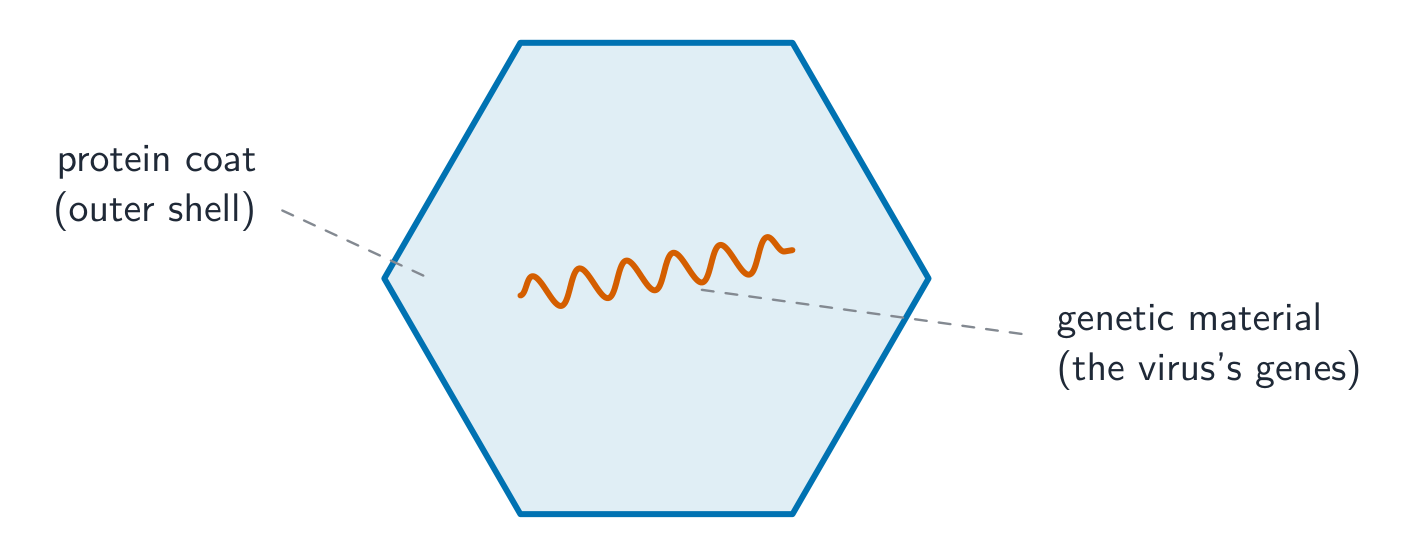
Viruses 病毒 are not placed in any kingdom. They are not made of cells, so many scientists do not count them as living. A virus is very simple, with only two parts:
an outer protein coat 蛋白质外壳, and
genetic material 遗传物质 (its genes) inside.
A virus cannot carry out the life processes on its own. It can only reproduce inside the living cells of a host 宿主 — the organism it infects.
日本語
The biggest groups that organisms are sorted into are called kingdoms 界. At Core level you place organisms into the first two kingdoms below; for Supplement you need all five kingdoms. You decide where an organism belongs by looking at its main features.
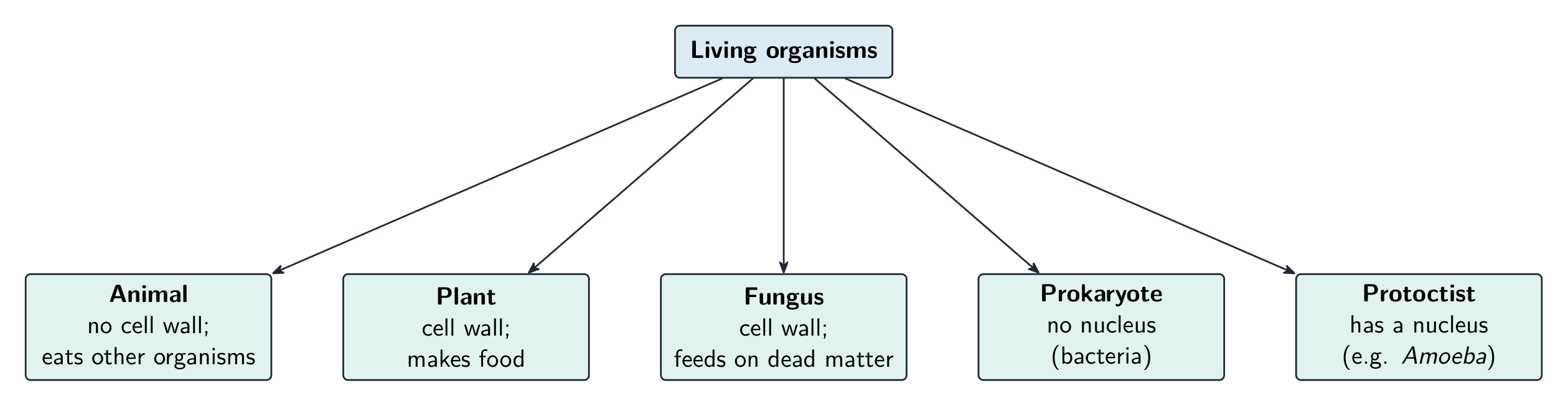
Living organisms are sorted into five kingdoms by their main features
Kingdom
Main features
Animal 动物
made of many cells; cells have no cell wall 细胞壁; cannot make their own food, so they feed on other organisms; most can move their whole body
Plant 植物
made of many cells; cells have a cell wall; make their own food by photosynthesis 光合作用, so many cells contain chloroplasts 叶绿体
Fungus 真菌
for example moulds 霉菌, mushrooms 蘑菇 and yeast 酵母; have cell walls; cannot photosynthesise; feed on dead or living matter
Prokaryote 原核生物
for example bacteria 细菌; single-celled 单细胞; cells have no nucleus 细胞核
Protoctist 原生生物
for example Amoeba and algae 藻类; usually single-celled; cells do have a nucleus
The fungus, prokaryote and protoctist kingdoms are Supplement only.
A fungus: the fly agaric, a mushroomA prokaryote (bacterium): E. coli seen under an electron microscope
Grouping the animal kingdom
The animal kingdom is split first into two: animals with a backbone and animals without one.
The animal kingdom splits into vertebrates (with a backbone) and arthropods (no backbone), each with its main groups
Vertebrates 脊椎动物 are animals with a backbone 脊柱. There are five main groups.
Group
Main features
Mammals 哺乳动物
have fur 毛发 or hair; feed their young on milk
Birds 鸟类
have feathers 羽毛 and a beak 喙; lay eggs with hard shells
Reptiles 爬行动物
have dry skin covered with scales 鳞片; lay eggs with leathery shells on land
Amphibians 两栖动物
have moist skin; lay eggs in water; the young live in water
Fish 鱼类
have wet scales and fins 鳍; breathe using gills 鳃; lay eggs in water
Arthropods 节肢动物 are animals with no backbone. They have a hard outer skeleton (an exoskeleton 外骨骼) and legs that bend at joints 关节. There are four main groups.
Group
Main features
Insects 昆虫
body in 3 parts; 3 pairs of legs; usually 2 pairs of wings; 1 pair of antennae 触角
Arachnids 蛛形类
body in 2 parts; 4 pairs of legs; no wings; no antennae
Crustaceans 甲壳类
many pairs of legs; 2 pairs of antennae; most live in water
Myriapods 多足类
long body made of many segments 体节; one or two pairs of legs on each segment
Grouping the plant kingdom (Supplement)
Plants are placed into groups too. You need two of them.
Ferns 蕨类植物 — have roots, stems and leaves, but make no flowers or seeds. They reproduce using tiny spores 孢子.
Flowering plants 开花植物 — make flowers, and form seeds 种子 inside the flower. They split into two groups by their seed-leaves (the first leaves inside a seed, called cotyledons 子叶):
Group
Features
Monocotyledons 单子叶植物
seed has one cotyledon; long narrow leaves; veins 叶脉 run side by side (parallel)
Dicotyledons 双子叶植物
seed has two cotyledons; broad leaves; veins form a branching net
Monocot leaves have parallel veins; dicot leaves have a net of branching veins
Viruses (Supplement)
Viruses 病毒 are not placed in any kingdom. They are not made of cells, so many scientists do not count them as living. A virus is very simple, with only two parts:
an outer protein coat 蛋白质外壳, and
genetic material 遗传物质 (its genes) inside.
A virus is just a protein coat around its genetic material
A virus cannot carry out the life processes on its own. It can only reproduce inside the living cells of a host 宿主 — the organism it infects.
Explore · 探索
Groups of organisms lab · 生物のグループ実験
Compare organism groups by the feature that identifies them. · 識別特徴に基づいて生物のグループを比較しなさい。
1 Describe and compare the structure of a plant cell with an animal cell, limited to: cell wall, cell membrane, nucleus, cytoplasm, chloroplasts, ribosomes, mitochondria, vacuoles
2 Describe the structure of a bacterial cell, limited to: cell wall, cell membrane, cytoplasm, ribosomes, circular DNA, plasmids
3 Identify the cell structures listed in 2.1.1 and 2.1.2 in diagrams and images of plant, animal and bacterial cells
4 Describe the functions of the structures listed in 2.1.1 and 2.1.2 in plant, animal and bacterial cells
5 State that new cells are produced by division of existing cells
6 State that specialised cells have specific functions, limited to: (a) ciliated cells – movement of mucus in the trachea and bronchi (b) root hair cells – absorption (c) palisade mesophyll cells – photosynthesis (d) neurones – conduction of electrical impulses (e) red blood cells – transport of oxygen (f) sperm and egg cells (gametes) – reproduction
7 Describe the meaning of the terms: cell, tissue, organ, organ system and organism as illustrated by examples given in the syllabus
Source: Cambridge International syllabus · 出典: Cambridge International シラバス
English
Every living thing is made of cells 细胞. A cell is the smallest part that can carry out the life processes. In this topic you compare a plant 植物 cell, an animal 动物 cell and the cell of a bacterium 细菌. All new cells are made by the division 分裂 of cells that already exist.
Which structures are in each cell?
Structure
Animal cell
Plant cell
Bacterial cell
cell membrane 细胞膜
yes
yes
yes
cytoplasm 细胞质
yes
yes
yes
ribosomes 核糖体
yes
yes
yes
nucleus 细胞核
yes
yes
no — has a loop of DNA instead
mitochondria 线粒体
yes
yes
no
cell wall 细胞壁
no
yes
yes (different material)
chloroplasts 叶绿体
no
yes (only in green parts)
no
large vacuole 液泡
no
yes
no
plasmids
no
no
yes
So plant and animal cells share five structures: cell membrane, cytoplasm, ribosomes, nucleus and mitochondria. A plant cell has three extra structures: a cell wall, a large vacuole and (in green parts) chloroplasts.
What each structure does
Cell membrane — controls which substances enter and leave the cell.
Cytoplasm — a jelly-like liquid where many chemical reactions happen.
Nucleus — controls the cell's activities and holds the genetic material 遗传物质.
Ribosomes — where proteins 蛋白质 are made.
Mitochondria — where respiration 呼吸作用 happens to release energy 能量.
Cell wall — made of cellulose 纤维素; it gives a plant cell strength and a fixed shape.
Chloroplasts — contain chlorophyll 叶绿素, a green substance that traps light for photosynthesis 光合作用.
Large vacuole — filled with cell sap 细胞液; it helps keep the plant cell firm.
Bacterial cells
A bacterium is a prokaryote 原核生物 — its cell has no nucleus. Instead its DNA is a single loop (a ring), loose in the cytoplasm. Bacteria also have small extra rings of DNA called plasmids 质粒. A bacterial cell has a cell wall and cell membrane, cytoplasm and ribosomes, but no mitochondria and no chloroplasts.
Tap each part of the cell to see what it does. Some parts (cell wall, chloroplast, vacuole) are found only in plant cells. · 細胞の各部分タップするとその機能が見られます。一部の構造(細胞壁、葉緑体、液胞)は植物細胞にのみ存在します。
1 State and use the formula: magnification = image size ÷ actual size
2 Calculate magnification and size of biological specimens using millimetres as units
3 Convert measurements between millimetres (mm) and micrometres (μm)
日本語
コア
サプリメント
1 倍率=像の大きさ÷実際の大きさ の式を記述して使用せよ
2 生物標本の倍率とサイズをミリメートル単位で計算する
3 ミリメートル(mm)とマイクロメートル(μm)間の測定値の変換を行う
Source: Cambridge International syllabus · 出典: Cambridge International シラバス
English
Cells are tiny, so you look at them under a microscope 显微镜, which makes them appear much larger. How many times larger the image is, is called the magnification 放大倍数.
Worked example. A structure is shown at a magnification of 250. Its image size is 5.00 mm. So the actual size = 5.00 ÷ 250 = 0.02 mm. Always put both sizes in the same unit before you divide.
Changing units (Supplement)
Cells are often measured in micrometres 微米 (μm), which are smaller than millimetres (mm):
So 0.02 mm = 20 μm. To change mm into μm, multiply by 1000. To change μm into mm, divide by 1000.
Worked example. A cell is drawn 60 mm wide, and its real width is 30 μm. Find the magnification. First make the units match: image size = 60 mm = 60 × 1000 = 60,000 μm. Then magnification = image ÷ actual = 60,000 ÷ 30 = ×2000. If you forget to convert and divide 60 ÷ 30, you get ×2 — a thousand times too small. This is the most common mistake in the whole topic.
日本語
細胞は極めて微小なため、顕微鏡の下で見ます。これにより细胞 MUCH larger appears much larger. The image is how many times bigger than the actual object is called the magnification. (Note: This sentence contains mixed language in source, translating fully to Japanese as per instruction.) 画像が実際の物体よりも何倍大きいかを示すのが倍率です。
A plant cell has a cell wall, a large vacuole and chloroplasts; an animal cell has none of these. Both have a nucleus, cytoplasm, cell membrane, mitochondria and ribosomes.
A cell with no nucleus but with plasmids and a loop of DNA is a bacterium.
For magnification, cover the quantity you want: magnification = image ÷ actual; actual = image ÷ magnification.
Always convert to the same unit before you calculate. Remember 1 mm = 1000 μm.
For a specialised cell, link its job to the one feature that suits it (for example a red blood cell has no nucleus, so it can hold more oxygen).
1 Describe diffusion as the net movement of particles from a region of their higher concentration to a region of their lower concentration (i.e. down a concentration gradient), as a result of their random movement
2 State that the energy for diffusion comes from the kinetic energy of random movement of molecules and ions
3 State that some substances move into and out of cells by diffusion through the cell membrane
4 Describe the importance of diffusion of gases and solutes in living organisms
5 Investigate the factors that influence diffusion, limited to: surface area, temperature, concentration gradient and distance
Source: Cambridge International syllabus · 出典: Cambridge International シラバス
English
Diffusion: random motion, one-way flow
Diffusion 扩散 is the net movement 净移动 of particles 粒子 from a region of their higher concentration 浓度 to a region of their lower concentration. We say the particles move down a concentration gradient 浓度梯度.
The particles spread out because of their own random movement 随机运动. The energy 能量 for diffusion comes from the kinetic energy 动能 of the random movement of molecules 分子 and ions 离子 — so diffusion needs no extra energy.
Some substances pass into and out of cells by diffusion through the cell membrane 细胞膜.
Why diffusion matters. Many gases 气体 and dissolved substances (solutes 溶质) move by diffusion in living things. For example, oxygen 氧气 diffuses into cells for respiration, and carbon dioxide 二氧化碳 diffuses out.
The rate of diffusion changes with four factors:
Factor
Diffusion is faster when…
surface area 表面积
the surface is larger
temperature 温度
it is hotter (particles move faster)
concentration gradient
the difference in concentration is bigger
distance
the distance to travel is shorter (a thinner barrier)
1 Describe the role of water as a solvent in organisms with reference to digestion, excretion and transport
7 Describe osmosis as the net movement of water molecules from a region of higher water potential (dilute solution) to a region of lower water potential (concentrated solution), through a partially permeable membrane
2 State that water diffuses through partially permeable membranes by osmosis
3 State that water moves into and out of cells by osmosis through the cell membrane
4 Investigate osmosis using materials such as dialysis tubing
5 Investigate and describe the effects on plant tissues of immersing them in solutions of different concentrations
8 Explain the effects on plant cells of immersing them in solutions of different concentrations by using the terms: turgid, turgor pressure, plasmolysis, flaccid
9 Explain the importance of water potential and osmosis in the uptake and loss of water by organisms
6 State that plants are supported by the pressure of water inside the cells pressing outwards on the cell wall
Source: Cambridge International syllabus · 出典: Cambridge International シラバス
English
Osmosis: water crosses the membrane
Water as a solvent
Water is a very good solvent 溶剂 — many substances dissolve 溶解 in it to make a solution 溶液. This matters for digestion 消化 (food must dissolve before it can be used), excretion 排泄 (wastes are carried away dissolved in water) and transport 运输 (substances travel around the body dissolved in blood and sap).
What osmosis is
Osmosis 渗透 is a special kind of diffusion: the net movement of water across a partially permeable membrane 半透膜. This kind of membrane has tiny holes that let small water molecules through but hold back larger solute particles. Water moves into and out of cells by osmosis through the cell membrane.
A concentrated solution has a lot of dissolved solute and little water. A dilute solution has little solute and a lot of water.
(Supplement) Osmosis is the net movement of water molecules from a region of higher water potential 水势 (a dilute solution — more water) to a region of lower water potential (a concentrated solution — less water), through a partially permeable membrane.
Osmosis and plant cells
When you put plant tissue into different solutions, water moves by osmosis:
In pure water or a dilute solution, water moves into the cells. The cells swell and become firm, or turgid 膨胀. The water presses outward on the cell wall; this outward push is the turgor pressure 膨压. Turgid cells make a plant stand up straight — this is how plants are supported.
In a concentrated solution, water moves out of the cells. The cells lose their firmness and become soft, or flaccid 松软.
(Supplement) If even more water leaves, the cell membrane pulls away from the cell wall. This is plasmolysis 质壁分离.
You can investigate osmosis using dialysis tubing 透析管 (an artificial partially permeable membrane), or using cylinders cut from a potato. Measure their length or mass before and after soaking. Cylinders in pure water or a dilute solution gain length and mass; cylinders in a concentrated solution lose length and mass; in a solution of equal concentration there is no change.
Worked example. A potato cylinder has a mass of 5.0 g before soaking and 5.6 g after soaking in a dilute solution. Find the percentage change in mass.
A positive answer means the cylinder gained water, so the solution was more dilute than the cell contents. Always work out the percentage change, not just the change in grams — it lets you compare cylinders that started at different masses fairly.
1 Describe active transport as the movement of particles through a cell membrane from a region of lower concentration to a region of higher concentration (i.e. against a concentration gradient), using energy from respiration
2 Explain the importance of active transport as a process for movement of molecules or ions across membranes, including ion uptake by root hairs
3 State that protein carriers move molecules or ions across a membrane during active transport
日本語
コア
サプリメント
1 能動輸送とは、呼吸から得たエネルギーを用いて、粒子を濃度の低い領域から濃度の高い領域(すなわち濃度勾配に逆らって)へ細胞膜を通過させる movement であることを説明する
Source: Cambridge International syllabus · 出典: Cambridge International シラバス
English
Active transport vs diffusion
Active transport 主动运输 is the movement of particles through a cell membrane from a region of lower concentration to a region of higher concentration — that is, against the concentration gradient. Because this is "uphill", it needs energy from respiration 呼吸作用.
(Supplement) Active transport lets a cell take in useful molecules or ions even when they are already more concentrated inside the cell. For example, root hairs 根毛 take up mineral ions from the soil by active transport. Protein carriers 载体蛋白 in the membrane pick up the molecules or ions and carry them across, using energy.
Active transport step by step · 能動的輸送のステップバイステップ
Step the carrier protein through its cycle: it uses energy from ATP to move a particle against the gradient, from low to high. · キャリアタンパク質をサイクルを通じて一歩ずつ操作します:ATP由来のエネルギーを使って、粒子を濃度勾配に逆らって、低濃度から高濃度へ移動させます。
Explore · 探索
Active transport — pumping uphill · 能動的輸送 — 上り坂へのポンピング
Unlike diffusion, active transport moves substances AGAINST the concentration gradient, so it needs energy. · 拡散と異なり、能動的輸送は物質を濃度勾配に逆らって移動させるため、エネルギーを必要とする。
1 List the chemical elements that make up: carbohydrates, fats and proteins
2 State that large molecules are made from smaller molecules, limited to: (a) starch, glycogen and cellulose from glucose (b) proteins from amino acids (c) fats and oils from fatty acids and glycerol
3 Describe the use of: (a) iodine solution test for starch (b) Benedict’s solution test for reducing sugars (c) biuret test for proteins (d) ethanol emulsion test for fats and oils (e) DCPIP test for vitamin C
4 Describe the structure of a DNA molecule: (a) two strands coiled together to form a double helix (b) each strand contains chemicals called bases (c) bonds between pairs of bases hold the strands together (d) the bases always pair up in the same way: A with T, and C with G (full names are not required)
Source: Cambridge International syllabus · 出典: Cambridge International シラバス
English
Living things are built from a few kinds of molecule 分子. The most important are carbohydrates, fats and proteins. Each is made from a small number of chemical elements 元素.
Carbohydrates 碳水化合物 and fats 脂肪 contain three elements: carbon 碳 (C), hydrogen 氢 (H) and oxygen (O).
Proteins 蛋白质 contain carbon, hydrogen and oxygen too, plus nitrogen 氮 (N). (Some proteins also contain sulfur, S.)
Building large molecules from small ones · 小さな分子から大きな分子を作る
English
Large molecules are made by joining many small molecules together, like beads on a string.
Large molecule
Built from
starch 淀粉, glycogen 糖原 and cellulose 纤维素
many glucose 葡萄糖 units
proteins
amino acids 氨基酸
fats and oils
fatty acids 脂肪酸 and glycerol 甘油
Starch and glycogen are energy stores; cellulose makes plant cell walls. Proteins are built from about 20 different kinds of amino acid joined in a chain. One fat molecule is made from three fatty acids joined to one glycerol.
You can test a piece of food to find out which substances it contains. Add the test chemical and watch for a colour change.
Food substance
Test
Positive result
starch
add iodine solution 碘液
orange-brown → blue-black
reducing sugars 还原糖 (such as glucose)
add Benedict's solution 本尼迪特试剂 and heat
blue → brick-red / orange
protein
add biuret 双缩脲 solution
blue → purple
fats and oils
ethanol 乙醇emulsion 乳浊液 test
a cloudy white layer forms
vitamin 维生素 C
add to blue DCPIP
blue → colourless
Two things to remember: only the Benedict's test needs heat; and DCPIP loses its colour (goes colourless), while the other tests gain a new colour.
Worked example. A student tests an unknown food. Iodine solution stays orange-brown. Benedict's solution, after heating, turns brick-red. Biuret solution turns purple. What does the food contain? Iodine staying orange-brown is a negative result, so there is no starch. Brick-red is a positive Benedict's result, so reducing sugar is present. Purple is a positive biuret result, so protein is present. The food contains reducing sugar and protein, but no starch. "No colour change" is a real result - it tells you the substance is absent.
** worked example.** ある生徒が未知の食品を検査した。ヨウ素溶液はオレンジ褐色のままだった。ベネディクト溶液を加熱後には砖赤色になった。バイアル溶液は紫色になった。この食品には何が含まれているか?ヨウ素溶液がオレンジ褐色のままなのは陰性結果なので、デンプンは含まれていない。砖赤色はベネディクト試験の陽性結果なので、還元糖が存在する。紫色はバイアル試験の陽性結果なので、タンパク質が存在する。この食品には還元糖とタンパク質が含まれているが、デンプンは含まれていない。「色変化なし」も実際の結果であり、その物質が存在しないことを示している。
Explore · 探索
Food test lab · 食品試験実験室
Follow how the test result reveals the nutrient in a sample. · 試験結果がサンプル中の栄養素をどのように示すかを確認する。
4.1
The structure of DNA (Supplement) · DNAの構造(追加事項)
English
DNA is the genetic material 遗传物质 — it carries the instructions for building and running an organism. Its structure has four key points:
two strands 链 are coiled together to form a double helix 双螺旋 (like a twisted ladder).
each strand carries chemicals called bases 碱基.
bonds 化学键 between pairs of bases hold the two strands together.
the bases always pair in the same way: A with T, and C with G.
1 Describe a catalyst as a substance that increases the rate of a chemical reaction and is not changed by the reaction
2 Describe enzymes as proteins that are involved in all metabolic reactions, where they function as biological catalysts
3 Describe why enzymes are important in all living organisms in terms of a reaction rate necessary to sustain life
4 Describe enzyme action with reference to the shape of the active site of an enzyme being complementary to its substrate and the formation of products
6 Explain enzyme action with reference to: active site, enzyme-substrate complex, substrate and product
7 Explain the specificity of enzymes in terms of the complementary shape and fit of the active site with the substrate
5 Investigate and describe the effect of changes in temperature and pH on enzyme activity with reference to optimum temperature and denaturation
8 Explain the effect of changes in temperature on enzyme activity in terms of kinetic energy, shape and fit, frequency of effective collisions and denaturation
9 Explain the effect of changes in pH on enzyme activity in terms of shape and fit and denaturation
Source: Cambridge International syllabus · 出典: Cambridge International シラバス
English
Enzyme action: lock and key
A catalyst 催化剂 is a substance that speeds up the rate 速率 of a chemical reaction 化学反应 but is not used up or changed by the reaction. The same catalyst can be used again and again.
Enzymes 酶 are biological catalysts — catalysts made by living cells. They are proteins 蛋白质. Enzymes take part in all the reactions of metabolism 新陈代谢, so they control almost every chemical reaction in a living thing.
Enzymes are vital. Without them, the reactions that keep you alive would be far too slow. Enzymes raise the reaction rate enough to keep the organism alive.
More substrate means a faster reaction — until the enzymes can't keep up. · 基質が増えると反応速度が速くなるが、酵素が追いつかなくなるまでである。
5.1
How an enzyme works · 酵素の働き方
English
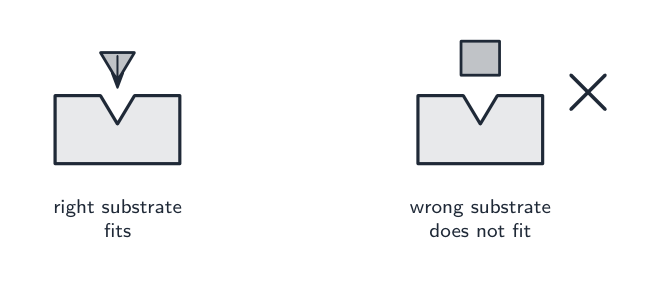
Each enzyme has a special pocket called its active site 活性位点. The molecule 分子 it works on is called the substrate 底物.
The shape of the active site is complementary 互补 to the shape of the substrate — they fit together like a key in a lock.
The substrate slots into the active site. (Supplement) This makes an enzyme-substrate complex 酶底物复合物.
The reaction takes place, and the substrate is changed into one or more products 产物.
The products leave the active site, which is then free to be used again.
Why enzymes are specific (Supplement)
Each enzyme is specific 专一 — it works on only one kind of substrate. This is because only that substrate has the right shape to fit the active site. A substrate of a different shape will not fit, just as the wrong key will not open a lock.
The activity of an enzyme depends on temperature 温度 and pH. You can investigate this by measuring how fast the reaction goes at different temperatures or pH values.
Temperature
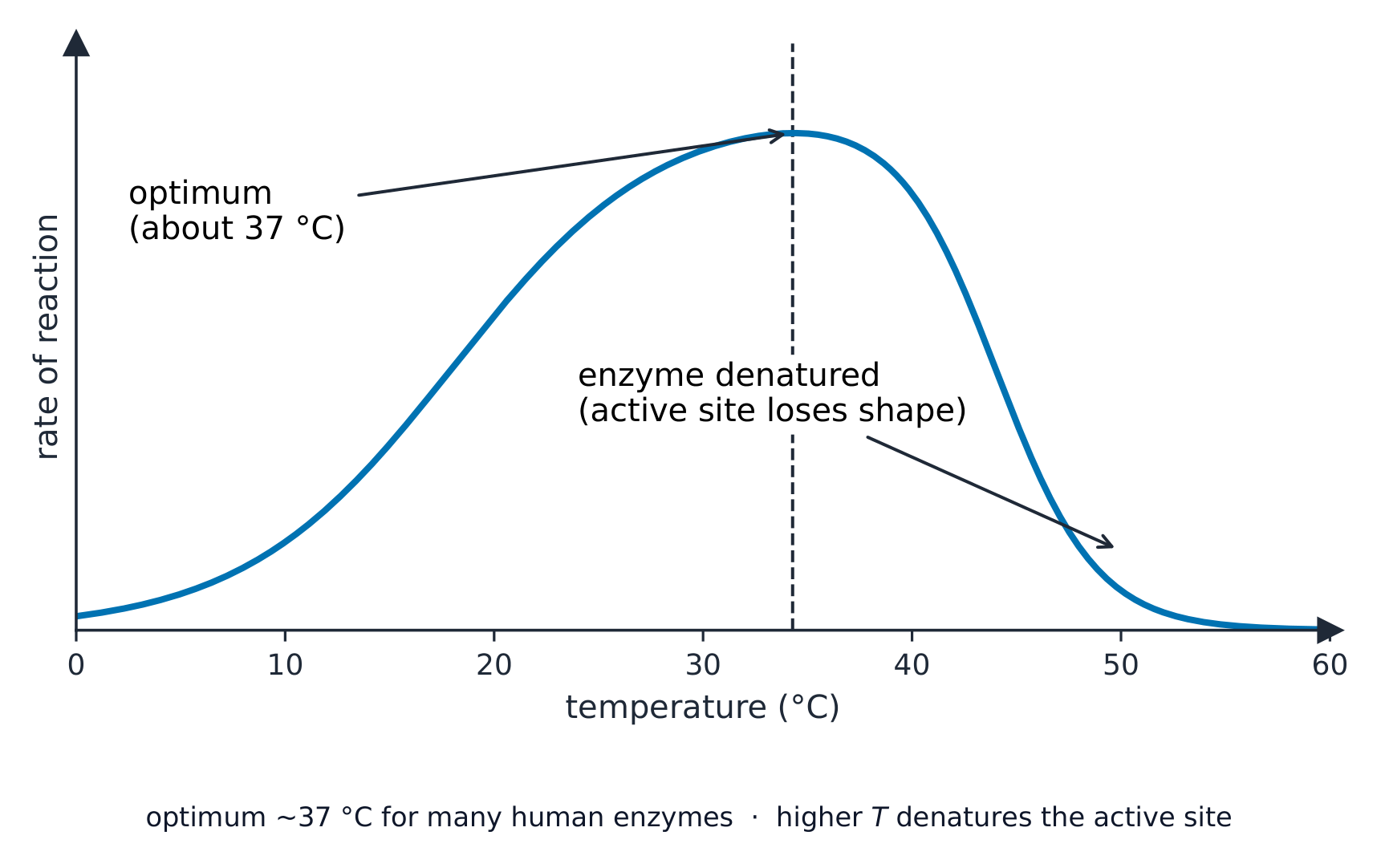
As the temperature rises from cold, enzyme activity speeds up. The enzyme and substrate molecules have more kinetic energy 动能, so they move faster and meet more often. (Supplement) There are more useful collisions 碰撞 each second.
Activity is highest at the optimum temperature 最适温度 (about 37 °C in the human body).
Above the optimum, activity falls fast. The heat changes the shape of the active site, so the substrate no longer fits. The enzyme is denatured 变性. Denaturation is permanent — the enzyme cannot recover.
Worked example. A reaction finishes in 50 s at 20 °C, and in 20 s at 37 °C. Which temperature is faster, and by how much? A shorter time means a faster rate, so work out a rate with rate = 1000 ÷ time. At 20 °C the rate is 1000 ÷ 50 = 20 units; at 37 °C it is 1000 ÷ 20 = 50 units. So 37 °C is 50 ÷ 20 = 2.5 times faster. Do not say the rate "went up by 30 s" - a time is not a rate. Turn the time into a rate first, and remember the bigger rate always goes with the smaller time.
pH
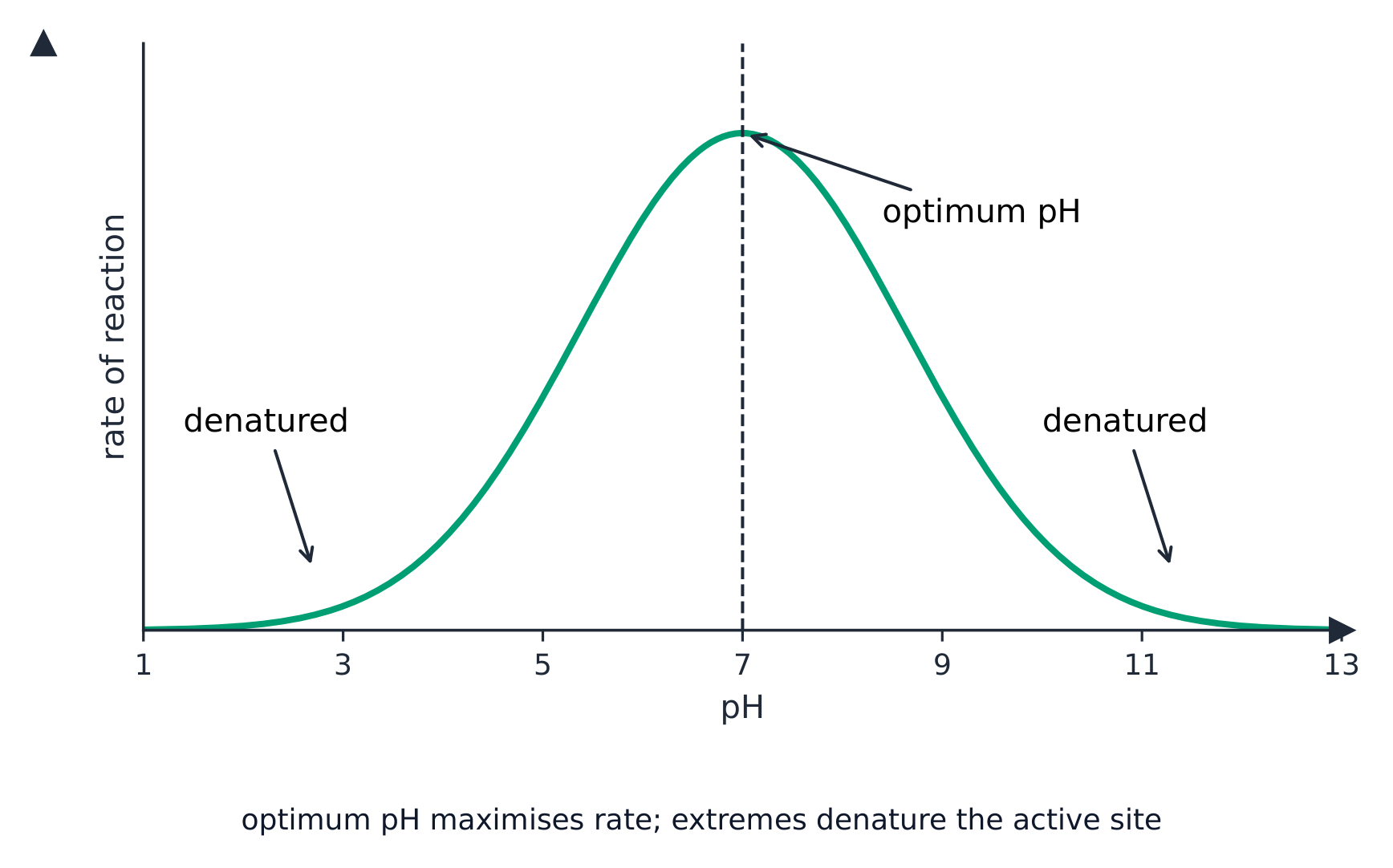
Each enzyme works best at one particular pH.
If the pH is too high or too low, the shape of the active site changes, the substrate stops fitting, and the enzyme is denatured.
1 Describe photosynthesis as the process by which plants synthesise carbohydrates from raw materials using energy from light
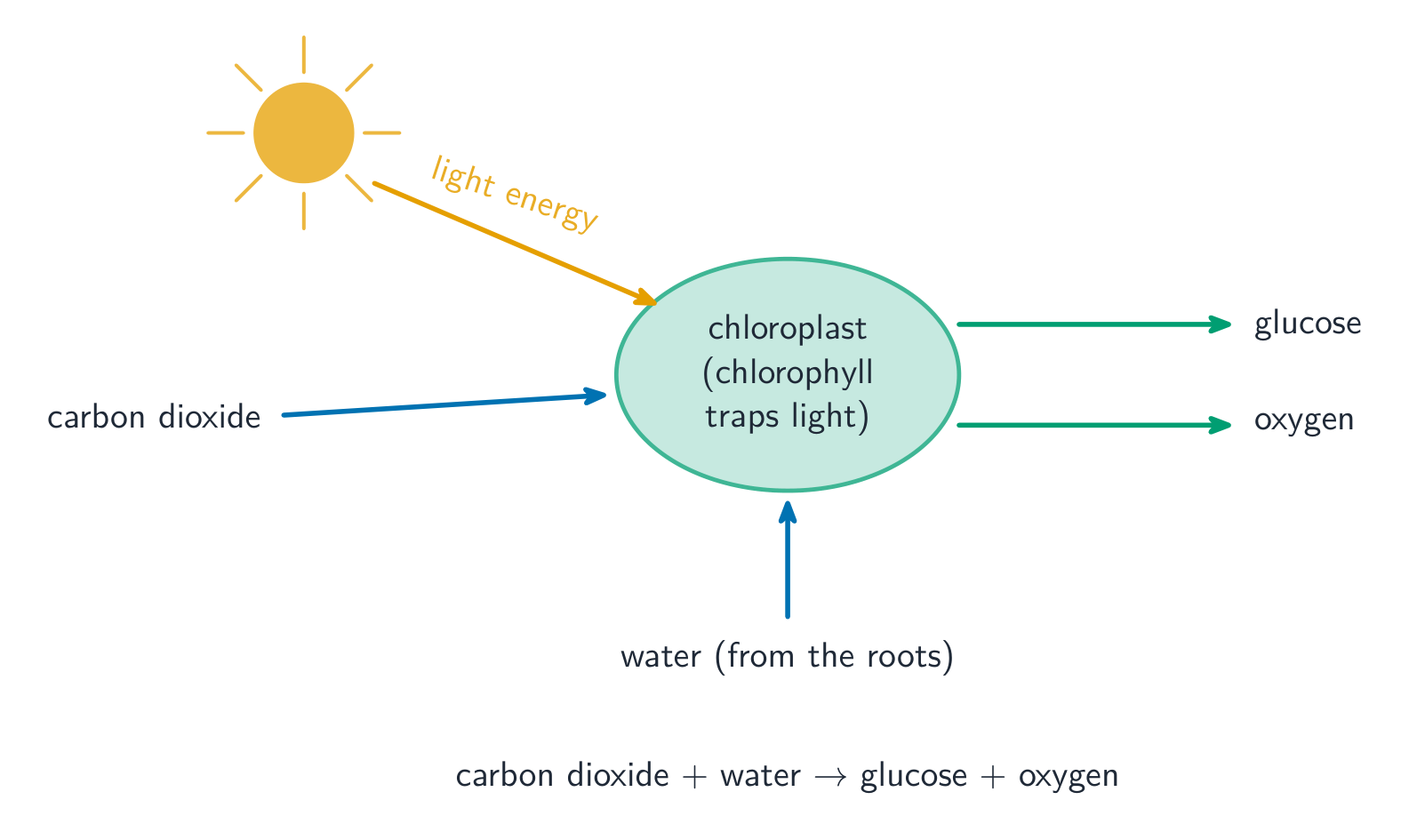
2 State the word equation for photosynthesis as: carbon dioxide + water $\rightarrow$ glucose + oxygen in the presence of light and chlorophyll
10 State the balanced chemical equation for photosynthesis as: $6\text{CO}_2 + 6\text{H}_2\text{O} \rightarrow \text{C}_6\text{H}_{12}\text{O}_6 + 6\text{O}_2$
3 State that chlorophyll is a green pigment that is found in chloroplasts
4 State that chlorophyll transfers energy from light into energy in chemicals, for the synthesis of carbohydrates
5 Outline the subsequent use and storage of the carbohydrates made in photosynthesis, limited to: (a) starch as an energy store (b) cellulose to build cell walls (c) glucose used in respiration to provide energy (d) sucrose for transport in the phloem (e) nectar to attract insects for pollination
6 Explain the importance of: (a) nitrate ions for making amino acids (b) magnesium ions for making chlorophyll
7 Investigate the need for chlorophyll, light and carbon dioxide for photosynthesis, using appropriate controls
8 Investigate and describe the effects of varying light intensity, carbon dioxide concentration and temperature on the rate of photosynthesis
9 Investigate and describe the effect of light and dark conditions on gas exchange in an aquatic plant using hydrogencarbonate indicator solution
11 Identify and explain the limiting factors of photosynthesis in different environmental conditions
Source: Cambridge International syllabus · 出典: Cambridge International シラバス
English
Photosynthesis: inputs and outputs
Photosynthesis 光合作用 is the process by which plants make carbohydrates 碳水化合物 from simple raw materials 原料, using energy 能量 from light. It is how plants feed themselves.
In words: plants take in carbon dioxide 二氧化碳 and water, and make glucose 葡萄糖 and oxygen 氧气. This reaction can only happen in the light, and only where there is chlorophyll 叶绿素.
Chlorophyll is a green pigment 色素 found in the chloroplasts 叶绿体. It traps light and transfers the energy from light into energy stored in chemicals. That chemical energy is then used to build carbohydrates.
What the plant does with the glucose
Use
What happens
store
changed to starch 淀粉, an energy store that does not dissolve
build
made into cellulose 纤维素 to build cell walls 细胞壁
release energy
broken down in respiration 呼吸作用 to release energy
transport
changed to sucrose 蔗糖 and moved around the plant in the phloem 韧皮部
attract animals
made into nectar 花蜜 to attract insects 昆虫 for pollination 传粉
Minerals from the soil
Plants also take up mineral ions 离子 from the soil through their roots:
nitrate ions 硝酸根离子 — needed to make amino acids 氨基酸 (and so proteins).
magnesium ions 镁离子 — needed to make chlorophyll.
A plant short of nitrate grows poorly with weak stems; a plant short of magnesium has yellow leaves (it cannot make enough chlorophyll).
The rate of photosynthesis
The rate 速率 of photosynthesis depends on three things:
light intensity 光照强度 — more light gives a faster rate, up to a point.
carbon dioxide concentration 浓度 — more carbon dioxide gives a faster rate.
temperature 温度 — a warmer temperature is faster, until it gets so hot that the enzymes are denatured.
(Supplement) At any moment, the one factor that is in shortest supply holds back the rate. This is called the limiting factor 限制因素. For example, on a dull day light intensity is usually the limiting factor; on a bright day carbon dioxide may be.
Worked example. On a graph of rate against light intensity, the line rises steeply at first and then levels off flat. Which factor is limiting on each part? On the rising part, adding light raises the rate, so light intensity is the limiting factor there. On the flat part, adding more light changes nothing, so light is no longer limiting - something else is, usually carbon dioxide concentration or temperature. The test is always the same: if adding more of a factor speeds the reaction up, that factor was the one holding it back.
Investigating photosynthesis
To show that a plant needs light, chlorophyll and carbon dioxide, you test a leaf for starch after taking one of them away. A control 对照 keeps every other condition the same, so the test is fair. (First leave the plant in the dark to use up its starch.) A leaf with green and white parts shows starch only in the green parts, which have chlorophyll.
You can also watch gas exchange 气体交换 in a water plant using hydrogencarbonate indicator 指示剂, which changes colour as the carbon dioxide level changes. In the light the plant takes in carbon dioxide for photosynthesis; in the dark it gives out carbon dioxide from respiration.
** worked example.** 光強度に対する速度のグラフにおいて、線は最初は急激に上昇し、その後水平になります。各部分で制限している要因は何ですか?上昇部分では、光を増やすことで速度が上がるため、その部分での制限要因は光強度です。水平部分では、光を増やしても変化がないため、光はもはや制限要因ではなく、他(通常は二酸化炭素濃度または温度)が制限要因となっています。テストの方法は常に同じです。ある要因を増やすことで反応が速くなる場合、その要因が以前は反応を遅らせていました。
1 State that most leaves have a large surface area and are thin, and explain how these features are adaptations for photosynthesis
2 Identify in diagrams and images the following structures in the leaf of a dicotyledonous plant: chloroplasts, cuticle, guard cells and stomata, upper and lower epidermis, palisade mesophyll, spongy mesophyll, air spaces, vascular bundles, xylem and phloem
3 Explain how the structures listed in 6.2.2 adapt leaves for photosynthesis
Source: Cambridge International syllabus · 出典: Cambridge International シラバス
English
A leaf is well adapted 适应 for photosynthesis. Most leaves are broad, with a large surface area 表面积 to catch plenty of light, and thin, so that gases and light quickly reach all the cells.
The middle of the leaf, the mesophyll 叶肉, is where most photosynthesis happens. These are the main parts of a leaf:
Structure
Job / how it helps photosynthesis
cuticle 角质层
a clear waxy layer on top; it reduces water loss but still lets light through
upper epidermis 表皮
a clear layer of cells with no chloroplasts; it lets light pass to the cells below
palisade mesophyll 栅栏叶肉
tall, column-shaped cells packed with chloroplasts, near the top; they do most of the photosynthesis
spongy mesophyll 海绵叶肉
rounded cells with air spaces 气腔 between them, so gases can move easily
stomata 气孔
tiny holes, mostly on the lower surface, that let carbon dioxide in and oxygen out
guard cells 保卫细胞
a pair of cells around each stoma; they open and close it
lower epidermis
a thin layer that holds the stomata
vascular bundles 维管束
contain xylem 木质部 (brings water to the leaf) and phloem (carries sugars away)
Learn the word equation exactly: carbon dioxide + water → glucose + oxygen (in light, with chlorophyll).
Chlorophyll is in the chloroplasts; it does not get used up — it transfers light energy.
Link each factor to the rate: more light, more carbon dioxide, warmer (but not too hot) → faster, until a limiting factor stops further increase.
For leaf structure, always link the part to its job: broad and thin to catch light; palisade cells full of chloroplasts; stomata and air spaces for gas exchange.
2 State the principal dietary sources and describe the importance of: (a) carbohydrates (b) fats and oils (c) proteins (d) vitamins, limited to C and D (e) mineral ions, limited to calcium and iron (f) fibre (roughage) (g) water
Source: Cambridge International syllabus · 出典: Cambridge International シラバス
English
A balanced diet 均衡饮食 gives you all the substances you need, in the right amounts. There are seven parts.
Part of diet
Good sources
Why you need it
carbohydrates 碳水化合物
rice, bread, potatoes
the main source of energy 能量
fats 脂肪 and oils
butter, oil, nuts
an energy store; help keep you warm
proteins 蛋白质
meat, fish, eggs, beans
growth and repair of cells
vitamin 维生素 C
fresh fruit, vegetables
keeps skin and gums healthy
vitamin D
sunlight, oily fish, eggs
helps the body take in calcium 钙
mineral ions 矿物质离子 — calcium
milk, cheese
strong bones and teeth
mineral ions — iron 铁
red meat, leafy greens
needed to make haemoglobin 血红蛋白, the red pigment in red blood cells that carries oxygen
fibre 膳食纤维 (roughage)
vegetables, whole grains
keeps food moving through the gut
water
drinks and food
needed for all reactions; most of the body is water
Two diseases come from missing a vitamin:
too little vitamin C → scurvy 坏血病 (bleeding gums, slow healing).
too little vitamin D → rickets 佝偻病 (soft, bent bones), because the body cannot take in enough calcium.
Worked example. A child eats almost no fresh fruit or vegetables. Their gums bleed and small cuts heal slowly. Which part of the diet is missing, and why does that explain the symptoms? Fresh fruit and vegetables are the main source of vitamin C, and too little vitamin C causes scurvy - whose signs are exactly bleeding gums and slow healing. So the missing part is vitamin C. Name the substance and the disease separately: an answer that says only "a vitamin deficiency" does not earn the mark.
日本語
均衡の取れた食事は、たっぷりの果物と野菜を含みます。
均衡の取れた食事は、必要な物質を適切な量で提供します。7つの要素があります。
均衡の取れた食事の7つの要素と、それぞれが果たす役割
食事の要素
良い供給源
必要な理由
炭水化物
ご飯、パン、ジャガイモ
エネルギーの主な供給源
脂質 と油
バター、油、ナッツ
エネルギー貯蔵;保温に役立つ
タンパク質
肉、魚、卵、豆類
細胞の成長と修復
ビタミン C
新鮮な果物、野菜
皮膚と歯茎の健康維持
ビタミン D
日光、脂質魚、卵
体がカルシウムを取り込むのを助ける
無機イオン — カルシウム
牛乳、チーズ
骨と歯の強さ
無機イオン — 鉄分
赤身肉、葉物野菜
酸素を運ぶ赤血球内の赤色素であるヘモグロビンを作るために必要
食物繊維(粗繊維)
野菜、全粒穀物
腸内での食物の移動を促す
水
飲料・食品
全ての反応に必要;体の大部分は水でできている
ビタミン欠乏による疾病が2つあります:
ビタミンC不足 → 坏血病(歯茎の出血、治癒の遅れ)。
ビタミンD不足 → 軟骨症(柔らかく曲がった骨)、体が十分カルシウムを取り込めないため。
** worked example.** 子供がほぼ新しい果物や野菜を食べていない。歯茎から出血し、小さな傷の治りが遅い。食事から欠けている部分は何か、なぜそれが症状を説明するのか。新しい果物と野菜はビタミンCの主な供給源であり、ビタミンCが不足すると坏血病(スカービ)が起こる——その兆候はまさに歯茎の出血と治りの遅さである。したがって、欠けているのはビタミンCである。物質と疾患を別々に名指して答えること:「ビタミン欠乏症」とだけ答えても得点されない。
Explore · 探索
Balanced diet lab · バランスの取れた食事実験
Match dietary needs to the nutrient that solves the problem. · 問題解決に必要な栄養素と食事の要件を組み合わせる。
1 Identify in diagrams and images the main organs of the digestive system, limited to: (a) alimentary canal: mouth, oesophagus, stomach, small intestine (duodenum and ileum) and large intestine (colon, rectum, anus) (b) associated organs: salivary glands, pancreas, liver and gall bladder
2 Describe the functions of the organs of the digestive system listed in 7.2.1, in relation to: (a) ingestion – the taking of substances, e.g. food and drink, into the body (b) digestion – the breakdown of food (c) absorption – the movement of nutrients from the intestines into the blood (d) assimilation – uptake and use of nutrients by cells (e) egestion – the removal of undigested food from the body as faeces
Source: Cambridge International syllabus · 出典: Cambridge International シラバス
English
The digestive system 消化系统 breaks food down. Food passes along one long tube, the alimentary canal 消化道:
mouth → oesophagus 食道 → stomach 胃 → small intestine 小肠 (the duodenum 十二指肠 then the ileum 回肠) → large intestine 大肠 (the colon 结肠, rectum 直肠 and anus 肛门).
Some organs help with digestion but food does not pass through them: the salivary glands 唾液腺 in the mouth, the pancreas 胰腺, the liver 肝脏 and the gall bladder 胆囊.
Five things happen to food, in order:
Process
What it means
ingestion 摄入
taking food and drink into the body through the mouth
digestion 消化
breaking food down into small molecules
absorption 吸收
nutrients 营养物质 move from the intestine into the blood
assimilation 同化
cells take in and use the nutrients
egestion 排遗
undigested food leaves the body as faeces 粪便
日本語
消化器系は食物を分解する。食物は長い管である消化管を通って移動する:
口 → 食道 → 胃 → 小腸(十二指腸、次に回腸)→ 大腸(結腸、直腸、肛門)。
消化に寄与するが、食物は通らない器官がある:口内の唾液腺、膵臓、肝臓、胆嚢。
食物が通る消化管、および消化液を分泌する臓器
食物に対して以下の5つのことが順序に行われる:
過程
意味
摂取
口を通じて食物や飲料を体内に取り込むこと
消化
食物を微小な分子に分解すること
吸収
栄養素が腸から血液へ移行すること
同化
細胞が栄養素を取り込み利用すること
排泄
未消化の食物が糞便として体外へ排出されること
Explore · 探索
Through the digestive system · 消化系を通過する
Food travels along the gut; each part does a different job to break it down and absorb it. · 食物は腸管内を移動し、各部位が異なる役割を果たして分解・吸収を行う。
1 Describe physical digestion as the breakdown of food into smaller pieces without chemical change to the food molecules
2 State that physical digestion increases the surface area of food for the action of enzymes in chemical digestion
3 Identify in diagrams and images the types of human teeth: incisors, canines, premolars and molars
4 Describe the structure of human teeth, limited to: enamel, dentine, pulp, nerves, blood vessels and cement, and understand that teeth are embedded in bone and the gums
5 Describe the functions of the types of human teeth in physical digestion of food
6 Describe the function of the stomach in physical digestion
7 Outline the role of bile in emulsifying fats and oils to increase the surface area for chemical digestion
Source: Cambridge International syllabus · 出典: Cambridge International シラバス
English
Physical digestion breaks food into smaller pieces without changing the food molecules. This gives a larger surface area 表面积 for the enzymes 酶 to act on later.
Teeth
You have four kinds of teeth 牙齿:
Tooth
Job
incisors 门齿
sharp front teeth for biting and cutting
canines 犬齿
pointed teeth for tearing
premolars 前臼齿
flat teeth for chewing and grinding
molars 臼齿
flat back teeth for chewing and grinding
A tooth is built from these parts:
Part
Description
enamel 牙釉质
hard white outer layer; the hardest material in the body
dentine 牙本质
softer, bone-like layer under the enamel
pulp 牙髓
soft centre with nerves 神经 and blood vessels 血管
cement 牙骨质
fixes the root into the jaw
Teeth are set into the bone of the jaw and held firm by the gums 牙龈.
The stomach
The wall of the stomach is made of muscle 肌肉 that squeezes and mixes the food, breaking it into smaller pieces.
Bile (Supplement)
Bile 胆汁 is made in the liver and stored in the gall bladder. It emulsifies 乳化 fats and oils — it breaks large drops of fat into many tiny droplets. This gives a much larger surface area for the enzyme lipase 脂肪酶 to digest the fat. Bile itself contains no enzymes.
Physical digestion breaks food into smaller pieces WITHOUT changing it chemically — it just increases the surface area for enzymes. · 物理的消化は化学変化を伴わずに食物を小さな破片に分けることである—酵素のための表面積を増やすだけである。
1 Describe chemical digestion as the breakdown of large insoluble molecules into small soluble molecules
2 State the role of chemical digestion in producing small soluble molecules that can be absorbed
3 Describe the functions of enzymes as follows: (a) amylase breaks down starch to simple reducing sugars (b) proteases break down protein to amino acids (c) lipase breaks down fats and oils to fatty acids and glycerol
6 Describe the digestion of starch in the digestive system: (a) amylase breaks down starch to maltose (b) maltase breaks down maltose to glucose on the membranes of the epithelium lining the small intestine
4 State where, in the digestive system, amylase, protease and lipase are secreted and where they act
7 Describe the digestion of protein by proteases in the digestive system: (a) pepsin breaks down protein in the acidic conditions of the stomach (b) trypsin breaks down protein in the alkaline conditions of the small intestine
5 Describe the functions of hydrochloric acid in gastric juice, limited to killing harmful microorganisms in food and providing an acidic pH for optimum enzyme activity
8 Explain that bile is an alkaline mixture that neutralises the acidic mixture of food and gastric juices entering the duodenum from the stomach, to provide a suitable pH for enzyme action
Source: Cambridge International syllabus · 出典: Cambridge International シラバス
English
Chemical digestion breaks large insoluble 不溶性 molecules into small soluble 可溶性 molecules. Only small soluble molecules can be absorbed into the blood. Enzymes carry out this work.
Enzyme
Breaks down
Into
Made in
amylase 淀粉酶
starch 淀粉
reducing sugars 还原糖
salivary glands, pancreas
protease 蛋白酶
protein
amino acids 氨基酸
stomach, pancreas
lipase
fats and oils
fatty acids 脂肪酸 and glycerol 甘油
pancreas
Acid in the stomach
The stomach makes hydrochloric acid 盐酸, which is part of the gastric juice 胃液. This acid:
kills harmful microorganisms 微生物 in the food, and
gives an acidic 酸性 pH, the best pH for the stomach's protease to work.
Digesting starch and protein (Supplement)
Starch is digested in two steps:
amylase breaks starch into maltose 麦芽糖.
maltase 麦芽糖酶, on the membranes of the epithelium 上皮 lining the small intestine, breaks maltose into glucose 葡萄糖.
Protein is digested by two proteases:
pepsin 胃蛋白酶 breaks protein down in the acidic stomach.
trypsin 胰蛋白酶 breaks protein down in the alkaline 碱性 small intestine.
Bile is alkaline. It neutralises 中和 the acidic food and gastric juice as they enter the duodenum, giving a suitable pH for the enzymes there.
Add more substrate and the reaction rate climbs, then levels off as every enzyme is busy — the same way amylase, protease and lipase break down food. · 基質を増やすと反応速度は上昇し、すべての酵素が忙しくなることで頭打ちになる—アミラーゼ、プロテアーゼ、リパーゼが食物を分解する際と同様である。
1 State that the small intestine is the region where nutrients are absorbed
3 Explain the significance of villi and microvilli in increasing the internal surface area of the small intestine
4 Describe the structure of a villus
5 Describe the roles of capillaries and lacteals in villi
2 State that most water is absorbed from the small intestine but that some is also absorbed from the colon
日本語
コア
サプリメント
1 小腸が栄養素が吸収される部位であることを述べる
3 絨毛および微絨毛が小腸の内面積を増加させる意義について説明する
4 絨毛の構造について説明する
5 絨毛内の毛細血管およびラクトールの役割について説明する
2 大部分の水は小腸から吸収されるが、一部は大腸からも吸収されることを述べる
Source: Cambridge International syllabus · 出典: Cambridge International シラバス
English
Digested nutrients are absorbed into the blood in the small intestine. Most water is absorbed here too; the colon absorbs the rest, leaving solid faeces.
Villi (Supplement)
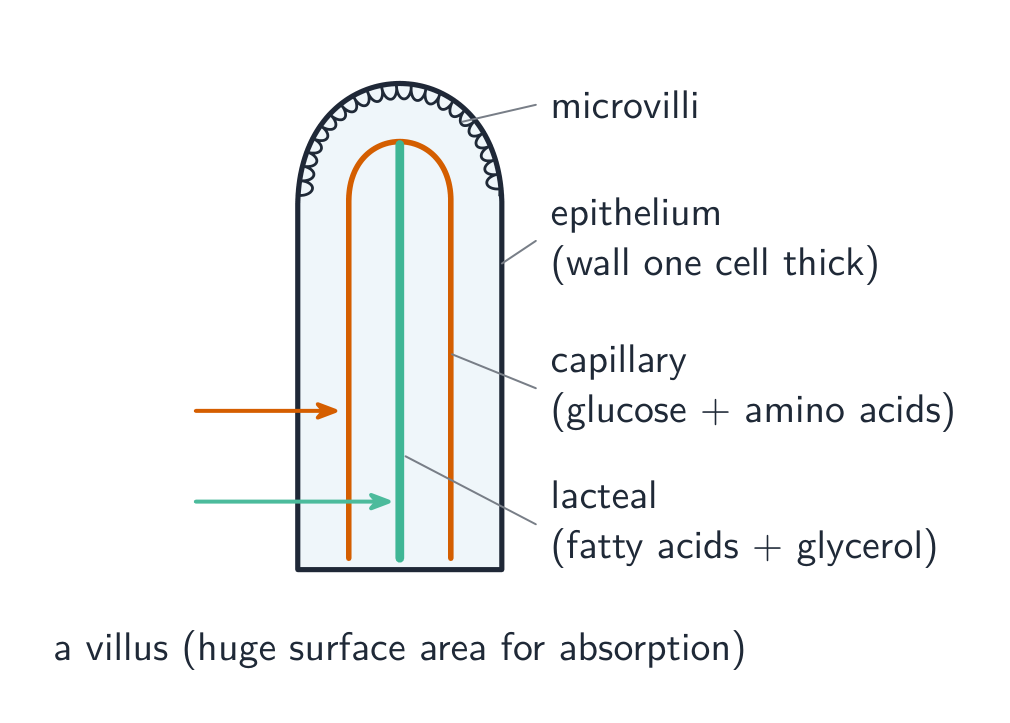
The inside of the small intestine is covered with millions of tiny finger-shaped villi 绒毛. Each villus is itself covered in much smaller microvilli 微绒毛. Together these give a huge surface area, so absorption is fast.
A single villus has:
a wall just one cell thick, so molecules have only a short distance to travel.
a network of capillaries 毛细血管 that carry away absorbed glucose and amino acids.
a lacteal 乳糜管 in the centre that carries away absorbed fatty acids and glycerol.
The small intestine is lined with millions of villi that give a huge surface area for absorbing digested food. · 小腸内壁には数百万個の絨毛があり、消化された食物を吸収するための広大な表面積を提供している。
1 State the functions of xylem and phloem: (a) xylem – transport of water and mineral ions, and support (b) phloem – transport of sucrose and amino acids
3 Relate the structure of xylem vessels to their function, limited to: (a) thick walls with lignin (details of lignification are not required) (b) no cell contents (c) cells joined end to end with no cross walls to form a long continuous tube
2 Identify in diagrams and images the position of xylem and phloem as seen in sections of roots, stems and leaves of non-woody dicotyledonous plants
1 Identify in diagrams and images root hair cells and state their functions
2 State that the large surface area of root hairs increases the uptake of water and mineral ions
3 Outline the pathway taken by water through the root, stem and leaf as: root hair cells, root cortex cells, xylem, mesophyll cells
4 Investigate, using a suitable stain, the pathway of water through the above-ground parts of a plant
日本語
コア
サプリメント
1 図や画像において根毛細胞を識別し、その機能について述べる
2 根毛の大きな表面積が水および無機イオンの取り込みを増加させることを述べる
3 根毛細胞、根皮層細胞、木部、葉肉細胞を経る植物体内での水の移動経路を概説する
4 適切な染色剤を用いて、地上部の植物における水の移動経路を検証する
Source: Cambridge International syllabus · 出典: Cambridge International シラバス
English
Water and mineral ions enter the plant through root hair cells 根毛细胞. The huge number of root hairs 根毛 gives a very large surface area 表面积, which speeds up the uptake of water and mineral ions.
The water then follows this pathway:
root hair cells → root cortex 皮层 cells → xylem → mesophyll 叶肉 cells in the leaf.
You can show this pathway by standing a plant or a white flower in water that contains a coloured stain 染色剂. The stain is carried up the xylem and colours the veins.
Root hair cells take in water by osmosis — water moves from the dilute soil into the more concentrated cell. · 根毛細胞は浸透圧によって水を取り込む — 希薄な土壌から濃度の高い細胞へ水が移動する。
1 Describe transpiration as the loss of water vapour from leaves
2 State that water evaporates from the surfaces of the mesophyll cells into the air spaces and then diffuses out of the leaves through the stomata as water vapour
4 Explain how water vapour loss is related to: the large internal surface area provided by the interconnecting air spaces between mesophyll cells and the size and number of stomata
5 Explain the mechanism by which water moves upwards in the xylem in terms of a transpiration pull that draws up a column of water molecules, held together by forces of attraction between water molecules
3 Investigate and describe the effects of variation of temperature and wind speed on transpiration rate
6 Explain the effects on the rate of transpiration of varying the following factors: temperature, wind speed and humidity
Source: Cambridge International syllabus · 出典: Cambridge International シラバス
English
Transpiration 蒸腾作用 is the loss of water vapour 水蒸气 from the leaves.
Water evaporates 蒸发 from the wet surfaces of the mesophyll cells into the air spaces 气腔 inside the leaf.
The water vapour then diffuses 扩散 out of the leaf through the stomata 气孔.
What changes the rate of transpiration
Factor
Transpiration is faster when…
Why
temperature 温度
it is hotter
water evaporates faster
wind speed 风速
it is windier
wind carries the water vapour away
humidity 湿度 (Supplement)
the air is drier
a bigger difference makes water diffuse out faster
Worked example. In a potometer the air bubble moves 60 mm in 5 minutes. Find the rate of water uptake, and say what happens when a fan is switched on. Rate = distance ÷ time = 60 ÷ 5 = 12 mm per minute. Always give a rate its full unit, "mm per minute", not just "12". A fan raises the wind speed, which carries water vapour away from the leaf, so transpiration speeds up and the bubble moves further in the same 5 minutes.
How water rises up the xylem (Supplement)
As water vapour leaves the leaf, it pulls more water up behind it. This pull is called the transpiration pull 蒸腾拉力. The water molecules stick to one another by forces of attraction 吸引力, so they are drawn up the xylem together as one long column 水柱 of water.
Wilting (Supplement)
If a plant loses water faster than it can take it up, its cells become soft and the plant wilts 萎蔫 — the leaves and stem droop. This often happens on a hot, dry, windy day.
1 Describe translocation as the movement of sucrose and amino acids in phloem from sources to sinks
2 Describe: (a) sources as the parts of plants that release sucrose or amino acids (b) sinks as the parts of plants that use or store sucrose or amino acids
3 Explain why some parts of a plant may act as a source and a sink at different times
Phloem carries dissolved sugars from where they are made (the source) to where they are used or stored (the sink). · 篩管は、生産場所(源)から消費・貯蔵場所( Sink )へと溶解した糖を運ぶ。
Xylem: water and mineral ions, upward only, plus support — its cells are dead, with thick lignin walls. Phloem: sucrose and amino acids, in living cells.
Learn the water pathway: root hair cell → cortex → xylem → mesophyll.
Transpiration = evaporation from the mesophyll, then diffusion out of the stomata. It is faster when hotter, windier or drier.
Water rises by the transpiration pull; the water molecules hold together as a column.
Translocation goes from a source (where sugar is made or stored) to a sink (where it is used). The direction can change with the season.
1 Describe the circulatory system as a system of blood vessels with a pump and valves to ensure one-way flow of blood
2 Describe the single circulation of a fish
3 Describe the double circulation of a mammal
4 Explain the advantages of a double circulation
日本語
コア
サプリメント
1 循環系を、血液の一方向の流れを保証するためのポンプおよび弁を備えた血管の系として説明する
2 魚の単循環について説明する
3 哺乳類の二循環について説明する
4 二循環の利点について説明する
Source: Cambridge International syllabus · 出典: Cambridge International シラバス
English
The circulatory system 循环系统 carries blood around the body. It has three parts: a pump 泵 (the heart 心脏), a network of blood vessels 血管, and valves 瓣膜 that keep the blood flowing one way only.
Single and double circulation (Supplement)
A fish has a single circulation 单循环: the blood passes through the heart once on each trip around the body.
A mammal 哺乳动物 has a double circulation 双循环: the blood passes through the heart twice on each full trip — once on the way to the lungs, and once on the way to the rest of the body.
The advantage of a double circulation: the blood can be pumped again at high pressure 压力 before going to the body, so it travels faster and delivers oxygen 氧气 quickly.
日本語
The circulatory system 循环系统 carries blood around the body. It has three parts: a pump 泵 (the heart 心脏), a network of blood vessels 血管, and valves 瓣膜 that keep the blood flowing one way only.
Single and double circulation (Supplement)
A fish has a single circulation 单循环: the blood passes through the heart once on each trip around the body.
A mammal 哺乳动物 has a double circulation 双循环: the blood passes through the heart twice on each full trip — once on the way to the lungs, and once on the way to the rest of the body.
The advantage of a double circulation: the blood can be pumped again at high pressure 压力 before going to the body, so it travels faster and delivers oxygen 氧气 quickly.
In a double circulation, blood passes through the heart twice on each trip round the body
Explore · 探索
Double circulation
Mammals have a double circulation — blood passes through the heart TWICE on each full trip round the body.
1 Identify in diagrams and images the structures of the mammalian heart, limited to: muscular wall, septum, left and right ventricles, left and right atria, one-way valves and coronary arteries
7 Identify in diagrams and images the atrioventricular and semilunar valves in the mammalian heart
8 Explain the relative thickness of: (a) the muscle walls of the left and right ventricles (b) the muscle walls of the atria compared to those of the ventricles
9 Explain the importance of the septum in separating oxygenated and deoxygenated blood
10 Describe the functioning of the heart in terms of the contraction of muscles of the atria and ventricles and the action of the valves
2 State that blood is pumped away from the heart in arteries and returns to the heart in veins
3 State that the activity of the heart may be monitored by: ECG, pulse rate and listening to sounds of valves closing
4 Investigate and describe the effect of physical activity on the heart rate
11 Explain the effect of physical activity on the heart rate
5 Describe coronary heart disease in terms of the blockage of coronary arteries and state the possible risk factors including: diet, lack of exercise, stress, smoking, genetic predisposition, age and sex
6 Discuss the roles of diet and exercise in reducing the risk of coronary heart disease
Source: Cambridge International syllabus · 出典: Cambridge International シラバス
English
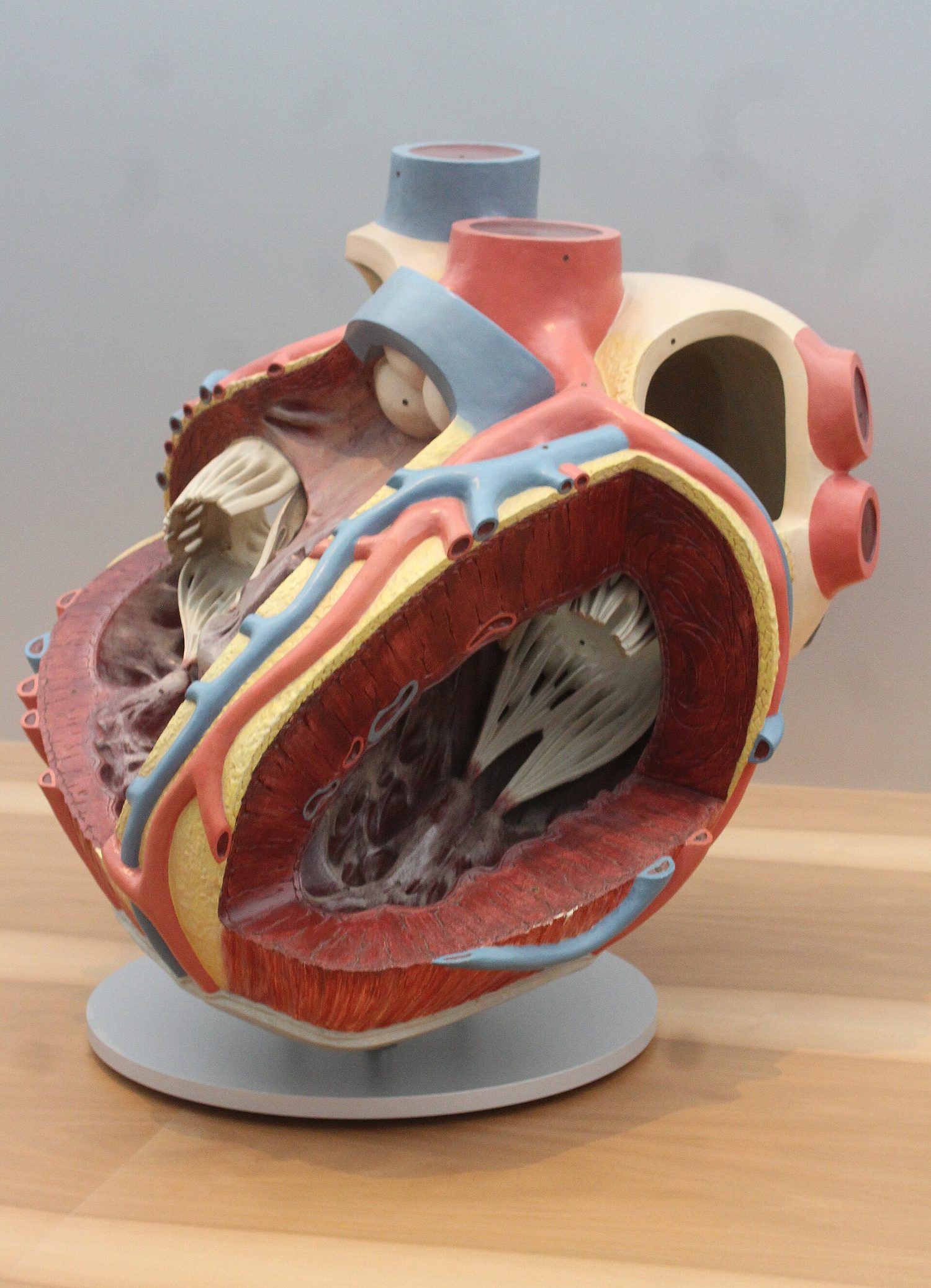
The heart is made of muscle 肌肉. A wall called the septum 隔膜 divides it into a left side and a right side. On each side there is an upper chamber, the atrium 心房, and a lower chamber, the ventricle 心室. Valves between the chambers stop the blood flowing backwards. The heart muscle is fed with blood by the coronary arteries 冠状动脉.
(Supplement) The wall of the left ventricle is thicker than the right, because it must pump blood all the way around the body; the right side only pumps blood to the nearby lungs. The atria have thin walls, as they only push blood into the ventricles just below them.
The septum keeps oxygenated blood 含氧血 on the left side apart from deoxygenated blood 缺氧血 on the right side, so the two never mix.
(Supplement) The valves between each atrium and ventricle are the atrioventricular valves 房室瓣. The valves at the exit of each ventricle are the semilunar valves 半月瓣.
How the heart beats (Supplement)
The atria contract 收缩 and push blood down into the ventricles.
The ventricles contract and force blood out into the arteries; the valves snap shut so blood cannot flow back.
The muscle relaxes and the heart fills with blood again.
Blood is pumped away from the heart in arteries and returns to the heart in veins.
Heart rate and exercise
You can check the heart's activity with an ECG, by feeling the pulse 脉搏 in an artery, or by listening to the valves closing. During exercise the heart rate 心率 goes up, so blood reaches the muscles faster, bringing the extra oxygen and glucose they need.
Worked example. A student counts 18 pulse beats in 15 seconds at rest, and 33 beats in 15 seconds straight after exercise. Give both heart rates in beats per minute. A minute holds 60 ÷ 15 = 4 lots of 15 seconds, so multiply by 4. At rest: 18 × 4 = 72 beats per minute. After exercise: 33 × 4 = 132 beats per minute. The rise delivers more oxygen and glucose to the muscles. Writing the 15-second count straight down as the heart rate is the commonest mistake - always scale it up to a full minute.
Coronary heart disease
Coronary heart disease 冠心病 happens when the coronary arteries become narrow or blocked, so the heart muscle cannot get enough oxygen. Risk factors 风险因素 include a diet high in fat, lack of exercise, stress, smoking, family history (genetics), older age, and being male. A healthy diet and regular exercise lower the risk.
日本語
The heart is made of muscle 肌肉. A wall called the septum 隔膜 divides it into a left side and a right side. On each side there is an upper chamber, the atrium 心房, and a lower chamber, the ventricle 心室. Valves between the chambers stop the blood flowing backwards. The heart muscle is fed with blood by the coronary arteries 冠状动脉.
(Supplement) The wall of the left ventricle is thicker than the right, because it must pump blood all the way around the body; the right side only pumps blood to the nearby lungs. The atria have thin walls, as they only push blood into the ventricles just below them.
The septum keeps oxygenated blood 含氧血 on the left side apart from deoxygenated blood 缺氧血 on the right side, so the two never mix.
(Supplement) The valves between each atrium and ventricle are the atrioventricular valves 房室瓣. The valves at the exit of each ventricle are the semilunar valves 半月瓣.
The heart's four chambers; the left ventricle has the thickest wall, to pump to the whole bodyThe same heart as a museum model: four chambers, and a left ventricle wall you can see is thicker
How the heart beats (Supplement)
The atria contract 收缩 and push blood down into the ventricles.
The ventricles contract and force blood out into the arteries; the valves snap shut so blood cannot flow back.
The muscle relaxes and the heart fills with blood again.
Blood is pumped away from the heart in arteries and returns to the heart in veins.
Heart rate and exercise
You can check the heart's activity with an ECG, by feeling the pulse 脉搏 in an artery, or by listening to the valves closing. During exercise the heart rate 心率 goes up, so blood reaches the muscles faster, bringing the extra oxygen and glucose they need.
During exercise the heart rate rises so blood reaches the muscles faster
Worked example. A student counts 18 pulse beats in 15 seconds at rest, and 33 beats in 15 seconds straight after exercise. Give both heart rates in beats per minute. A minute holds 60 ÷ 15 = 4 lots of 15 seconds, so multiply by 4. At rest: 18 × 4 = 72 beats per minute. After exercise: 33 × 4 = 132 beats per minute. The rise delivers more oxygen and glucose to the muscles. Writing the 15-second count straight down as the heart rate is the commonest mistake - always scale it up to a full minute.
Coronary heart disease
Coronary heart disease 冠心病 happens when the coronary arteries become narrow or blocked, so the heart muscle cannot get enough oxygen. Risk factors 风险因素 include a diet high in fat, lack of exercise, stress, smoking, family history (genetics), older age, and being male. A healthy diet and regular exercise lower the risk.
Coronary heart disease narrows the artery; several risk factors raise it and a healthy lifestyle lowers it
Explore · 探索
Blood flow through the heart
The four chambers and their valves keep blood moving one way — deoxygenated to the lungs, oxygenated to the body.
Explore · 探索
The heart (double circulation)
Follow the blood: blue comes back from the body, the right side pumps it to the lungs (it turns red), and the left side pumps it out to the body — a double circulation.
1 Describe the structure of arteries, veins and capillaries, limited to: relative thickness of wall, diameter of the lumen and the presence of valves in veins
4 Explain how the structure of arteries and veins is related to the pressure of the blood that they transport
2 State the functions of capillaries
5 Explain how the structure of capillaries is related to their functions
3 Identify in diagrams and images the main blood vessels to and from the: (a) heart, limited to: vena cava, aorta, pulmonary artery and pulmonary vein (b) lungs, limited to: pulmonary artery and pulmonary vein (c) kidney, limited to: renal artery and renal vein
6 Identify, in diagrams and images, the main blood vessels to and from the liver as: hepatic artery, hepatic veins and hepatic portal vein
Source: Cambridge International syllabus · 出典: Cambridge International シラバス
English
There are three kinds of blood vessel. The space inside a vessel is its lumen 管腔.
Vessel
Wall
Lumen
Valves?
Job
arteries 动脉
thick, muscular, elastic
narrow
no
carry blood away from the heart, at high pressure
veins 静脉
thin
wide
yes
carry blood back to the heart, at low pressure
capillaries 毛细血管
one cell thick
very narrow
no
let oxygen, glucose and wastes pass between blood and cells
(Supplement) Arteries have thick elastic walls to cope with the high pressure from the heart. Veins have valves because their blood is at low pressure and could otherwise flow backwards. Capillaries are very thin (one cell thick) and very narrow, giving a large surface area 表面积 and a short distance for fast exchange.
Main blood vessels
Connects
Artery (carries blood out)
Vein (carries blood in)
heart ↔ body
aorta 主动脉
vena cava 腔静脉
heart ↔ lungs
pulmonary artery 肺动脉
pulmonary vein 肺静脉
↔ kidney
renal artery 肾动脉
renal vein 肾静脉
(Supplement) The liver is served by the hepatic artery 肝动脉, the hepatic vein 肝静脉, and the hepatic portal vein 肝门静脉, which brings blood from the gut to the liver.
日本語
There are three kinds of blood vessel. The space inside a vessel is its lumen 管腔.
Vessel
Wall
Lumen
Valves?
Job
arteries 动脉
thick, muscular, elastic
narrow
no
carry blood away from the heart, at high pressure
veins 静脉
thin
wide
yes
carry blood back to the heart, at low pressure
capillaries 毛细血管
one cell thick
very narrow
no
let oxygen, glucose and wastes pass between blood and cells
(Supplement) Arteries have thick elastic walls to cope with the high pressure from the heart. Veins have valves because their blood is at low pressure and could otherwise flow backwards. Capillaries are very thin (one cell thick) and very narrow, giving a large surface area 表面积 and a short distance for fast exchange.
Arteries, veins and capillaries are each built for their job
Main blood vessels
Connects
Artery (carries blood out)
Vein (carries blood in)
heart ↔ body
aorta 主动脉
vena cava 腔静脉
heart ↔ lungs
pulmonary artery 肺动脉
pulmonary vein 肺静脉
↔ kidney
renal artery 肾动脉
renal vein 肾静脉
(Supplement) The liver is served by the hepatic artery 肝动脉, the hepatic vein 肝静脉, and the hepatic portal vein 肝门静脉, which brings blood from the gut to the liver.
Explore · 探索
The three blood vessels
Compare an artery, a vein and a capillary — their walls and lumens suit the pressure and job of each.
1 List the components of blood as: red blood cells, white blood cells, platelets and plasma
2 Identify red and white blood cells in photomicrographs and diagrams
5 Identify lymphocytes and phagocytes in photomicrographs and diagrams
3 State the functions of the following components of blood: (a) red blood cells in transporting oxygen, including the role of haemoglobin (b) white blood cells in phagocytosis and antibody production (c) platelets in clotting (details are not required) (d) plasma in the transport of blood cells, ions, nutrients, urea, hormones and carbon dioxide
6 State the functions of: (a) lymphocytes – antibody production (b) phagocytes – engulfing pathogens by phagocytosis
4 State the roles of blood clotting as preventing blood loss and the entry of pathogens
7 Describe the process of clotting as the conversion of fibrinogen to fibrin to form a mesh
Source: Cambridge International syllabus · 出典: Cambridge International シラバス
English
Blood has four parts:
Part
Function
red blood cells 红细胞
carry oxygen, using the red pigment 色素haemoglobin 血红蛋白
white blood cells 白细胞
defend the body against disease
platelets 血小板
help the blood to clot 凝血
plasma 血浆
a liquid that carries blood cells, ions 离子, nutrients 营养物质, urea 尿素, hormones 激素 and carbon dioxide 二氧化碳
Defending the body, and clotting
White blood cells fight pathogens 病原体 (the microbes that cause disease) in two ways:
phagocytes 吞噬细胞 carry out phagocytosis 吞噬作用 — they surround and digest the pathogens.
lymphocytes 淋巴细胞 make antibodies 抗体, which stick to the pathogens and destroy them.
When you cut yourself, the blood clots to seal the wound. This stops blood loss and stops pathogens getting in. (Supplement) During clotting, a soluble protein called fibrinogen 纤维蛋白原 is changed into threads of fibrin 纤维蛋白. The threads form a net that traps blood cells and makes a solid clot.
日本語
Blood has four parts:
Part
Function
red blood cells 红细胞
carry oxygen, using the red pigment 色素 haemoglobin 血红蛋白
white blood cells 白细胞
defend the body against disease
platelets 血小板
help the blood to clot 凝血
plasma 血浆
a liquid that carries blood cells, ions 离子, nutrients 营养物质, urea 尿素, hormones 激素 and carbon dioxide 二氧化碳
Blood is red cells, white cells and platelets carried in liquid plasmaReal blood cells under an electron microscope: red cells (discs), white cells and platelets
Defending the body, and clotting
White blood cells fight pathogens 病原体 (the microbes that cause disease) in two ways:
phagocytes 吞噬细胞 carry out phagocytosis 吞噬作用 — they surround and digest the pathogens.
lymphocytes 淋巴细胞 make antibodies 抗体, which stick to the pathogens and destroy them.
When you cut yourself, the blood clots to seal the wound. This stops blood loss and stops pathogens getting in. (Supplement) During clotting, a soluble protein called fibrinogen 纤维蛋白原 is changed into threads of fibrin 纤维蛋白. The threads form a net that traps blood cells and makes a solid clot.
1 Describe a pathogen as a disease-causing organism
2 Describe a transmissible disease as a disease in which the pathogen can be passed from one host to another
3 State that a pathogen is transmitted: (a) by direct contact, including through blood and other body fluids (b) indirectly, including from contaminated surfaces, food, animals and air
4 Describe the body defences, limited to: skin, hairs in the nose, mucus, stomach acid and white blood cells
6 Describe active immunity as defence against a pathogen by antibody production in the body
5 Explain the importance of the following in controlling the spread of disease: (a) a clean water supply (b) hygienic food preparation (c) good personal hygiene (d) waste disposal (e) sewage treatment (details of the stages of sewage treatment are not required)
7 State that each pathogen has its own antigens, which have specific shapes
8 Describe antibodies as proteins that bind to antigens leading to direct destruction of pathogens or marking of pathogens for destruction by phagocytes
9 State that specific antibodies have complementary shapes which fit specific antigens
10 Explain that active immunity is gained after an infection by a pathogen or by vaccination
11 Outline the process of vaccination: (a) weakened pathogens or their antigens are put into the body (b) the antigens stimulate an immune response by lymphocytes which produce antibodies (c) memory cells are produced that give long-term immunity
12 Explain the role of vaccination in controlling the spread of diseases
13 Explain that passive immunity is a short-term defence against a pathogen by antibodies acquired from another individual, including across the placenta and in breast milk
14 Explain the importance of breast-feeding for the development of passive immunity in infants
15 State that memory cells are not produced in passive immunity
16 Describe cholera as a disease caused by a bacterium which is transmitted in contaminated water
17 Explain that the cholera bacterium produces a toxin that causes secretion of chloride ions into the small intestine, causing osmotic movement of water into the gut, causing diarrhoea, dehydration and loss of ions from the blood
Source: Cambridge International syllabus · 出典: Cambridge International シラバス
English
A pathogen 病原体 is an organism that causes disease 疾病. A transmissible disease 传染病 is one in which the pathogen can pass from one host 宿主 to another.
日本語
A pathogen 病原体 is an organism that causes disease 疾病. A transmissible disease 传染病 is one in which the pathogen can pass from one host 宿主 to another.
Your body has several defences 防御 that keep pathogens out or destroy them:
skin — a barrier that covers and protects the body.
hairs in the nose — trap dust and pathogens in the air you breathe in.
mucus 黏液 — sticky liquid in the airways that traps pathogens.
stomach acid 胃酸 — kills most pathogens in your food.
white blood cells 白细胞 — find and destroy any pathogens that get inside.
日本語
Your body has several defences 防御 that keep pathogens out or destroy them:
skin — a barrier that covers and protects the body.
hairs in the nose — trap dust and pathogens in the air you breathe in.
mucus 黏液 — sticky liquid in the airways that traps pathogens.
stomach acid 胃酸 — kills most pathogens in your food.
white blood cells 白细胞 — find and destroy any pathogens that get inside.
The body keeps most pathogens out; white blood cells deal with any that get inA white blood cell (green) engulfing round bacteria (purple), a key body defence
Explore · 探索
Pathogen defence route · 病原体防御ルート
Follow how the body blocks, detects and removes pathogens. · 体が病原体をブロックし、検知し、除去する様子を追跡する。
Every pathogen carries antigens 抗原 on its surface, and each kind of antigen has its own special shape.
Antibodies 抗体 are proteins 蛋白质 made by lymphocytes 淋巴细胞 (a kind of white blood cell). An antibody has a shape that is complementary 互补 to one antigen, so it fits only that antigen. When antibodies bind to a pathogen's antigens, they either destroy the pathogen directly or mark it so that phagocytes 吞噬细胞 destroy it.
Active immunity and vaccination
Active immunity 主动免疫 is protection made by your own body producing antibodies. You gain it after an infection, or after vaccination 疫苗接种.
Vaccination works like this:
weakened pathogens, or just their antigens, are put into the body; they cannot make you ill.
the antigens make your lymphocytes produce antibodies.
the body also makes memory cells 记忆细胞 that stay for years.
If the real pathogen enters later, the memory cells make antibodies very fast, so you do not become ill. This gives long-term protection. If most people in a group are vaccinated, the disease cannot spread easily.
Worked example. After a first dose of a vaccine, antibody levels rise slowly and stay low. After a second dose of the same vaccine, they rise faster and reach a much higher level. Explain. At the first dose the body has no memory cells for that antigen, so time is lost while the right lymphocyte is found and multiplies - the response is slow and small. The second dose meets the memory cells left over from the first, which recognise the antigen at once, so antibodies are made sooner and in far greater numbers. The marks are for memory cells: "the body is used to it" earns nothing.
Passive immunity
Passive immunity 被动免疫 is protection from antibodies made by another body, not your own. For example, a baby receives antibodies from its mother across the placenta 胎盘 and in breast milk 母乳. This is why breast-feeding 母乳喂养 helps protect infants 婴儿. Passive immunity is only short-term, because no memory cells are made.
日本語
Antigens and antibodies
Every pathogen carries antigens 抗原 on its surface, and each kind of antigen has its own special shape.
Antibodies 抗体 are proteins 蛋白质 made by lymphocytes 淋巴细胞 (a kind of white blood cell). An antibody has a shape that is complementary 互补 to one antigen, so it fits only that antigen. When antibodies bind to a pathogen's antigens, they either destroy the pathogen directly or mark it so that phagocytes 吞噬细胞 destroy it.
An antibody's shape is complementary to one antigen, so it fits only that pathogen
Active immunity and vaccination
Active immunity 主动免疫 is protection made by your own body producing antibodies. You gain it after an infection, or after vaccination 疫苗接种.
Vaccination works like this:
weakened pathogens, or just their antigens, are put into the body; they cannot make you ill.
the antigens make your lymphocytes produce antibodies.
the body also makes memory cells 记忆细胞 that stay for years.
If the real pathogen enters later, the memory cells make antibodies very fast, so you do not become ill. This gives long-term protection. If most people in a group are vaccinated, the disease cannot spread easily.
After vaccination, memory cells give a fast, large response if the real pathogen arrives
Worked example. After a first dose of a vaccine, antibody levels rise slowly and stay low. After a second dose of the same vaccine, they rise faster and reach a much higher level. Explain. At the first dose the body has no memory cells for that antigen, so time is lost while the right lymphocyte is found and multiplies - the response is slow and small. The second dose meets the memory cells left over from the first, which recognise the antigen at once, so antibodies are made sooner and in far greater numbers. The marks are for memory cells: "the body is used to it" earns nothing.
Passive immunity
Passive immunity 被动免疫 is protection from antibodies made by another body, not your own. For example, a baby receives antibodies from its mother across the placenta 胎盘 and in breast milk 母乳. This is why breast-feeding 母乳喂养 helps protect infants 婴儿. Passive immunity is only short-term, because no memory cells are made.
Cholera 霍乱 is a disease caused by a bacterium 细菌 that spreads in contaminated water. The cholera bacterium makes a toxin 毒素. This toxin causes chloride ions 氯离子 to be pumped into the small intestine 小肠. Water then moves into the intestine by osmosis 渗透. The result is diarrhoea 腹泻, dehydration 脱水 (loss of water) and a loss of ions 离子 from the blood.
日本語
Cholera 霍乱 is a disease caused by a bacterium 细菌 that spreads in contaminated water. The cholera bacterium makes a toxin 毒素. This toxin causes chloride ions 氯离子 to be pumped into the small intestine 小肠. Water then moves into the intestine by osmosis 渗透. The result is diarrhoea 腹泻, dehydration 脱水 (loss of water) and a loss of ions 离子 from the blood.
Cholera toxin pulls water into the gut by osmosis, causing diarrhoea and dehydration
Pathogen = organism that causes disease. Transmissible = can pass between hosts, by direct contact or indirectly.
Learn the five body defences: skin, nose hairs, mucus, stomach acid, white blood cells.
An antibody's shape is complementary to one antigen (like an enzyme and its substrate).
Active immunity (from infection or vaccination) makes memory cells → long-term. Passive immunity (placenta, breast milk) makes no memory cells → short-term.
Cholera: toxin → chloride ions into the gut → water in by osmosis → diarrhoea and dehydration.
1 Describe the features of gas exchange surfaces in humans, limited to: large surface area, thin surface, good blood supply and good ventilation with air
2 Identify in diagrams and images the following parts of the breathing system: lungs, diaphragm, ribs, intercostal muscles, larynx, trachea, bronchi, bronchioles, alveoli and associated capillaries
6 Identify in diagrams and images the internal and external intercostal muscles
7 State the function of cartilage in the trachea
8 Explain the role of the ribs, the internal and external intercostal muscles and the diaphragm in producing volume and pressure changes in the thorax leading to the ventilation of the lungs
3 Investigate the differences in composition between inspired and expired air using limewater as a test for carbon dioxide
9 Explain the differences in composition between inspired and expired air
4 Describe the differences in composition between inspired and expired air, limited to: oxygen, carbon dioxide and water vapour
5 Investigate and describe the effects of physical activity on the rate and depth of breathing
10 Explain the link between physical activity and the rate and depth of breathing in terms of: an increased carbon dioxide concentration in the blood, which is detected by the brain, leading to an increased rate and greater depth of breathing
11 Explain the role of goblet cells, mucus and ciliated cells in protecting the breathing system from pathogens and particles
Source: Cambridge International syllabus · 出典: Cambridge International シラバス
English
Gas exchange 气体交换 is how oxygen 氧气 gets into the blood and carbon dioxide 二氧化碳 gets out, by diffusion 扩散. A good gas exchange surface has four features:
a large surface area 表面积 — so more gas can cross at once.
a thin surface — so gases have only a short distance to diffuse.
a good blood supply — to keep a steep difference in concentration.
good ventilation 通气 with air — fresh air keeps the difference steep.
日本語
Gas exchange happens across the huge surface of the lungs.
Gas exchange 气体交换 is how oxygen 氧气 gets into the blood and carbon dioxide 二氧化碳 gets out, by diffusion 扩散. A good gas exchange surface has four features:
a large surface area 表面积 — so more gas can cross at once.
a thin surface — so gases have only a short distance to diffuse.
a good blood supply — to keep a steep difference in concentration.
good ventilation 通气 with air — fresh air keeps the difference steep.
Explore · 探索
A good gas-exchange surface · 良好なガス交換表面
Tap the alveolus to see the four features that make it ideal for exchange: a huge surface area, a thin wall, a moist lining and a good blood supply. · 肺胞をタップすると、交換に最適な4つの特徴を確認できます:広大な表面積、薄い壁、湿った内腔、そして豊富な血液供給です。
tiny air sacs where gas exchange happens; each is wrapped in capillaries 毛细血管
The alveoli make excellent gas exchange surfaces: there are millions of them (a huge surface area), each has a wall only one cell thick (a short distance), and each is surrounded by capillaries (a good blood supply).
The lungs sit in the chest, protected by the ribs 肋骨. Below them is a sheet of muscle, the diaphragm 膈肌. Between the ribs are the intercostal muscles 肋间肌. (Supplement) The trachea is held open by rings of cartilage 软骨, so it cannot collapse when you breathe in.
日本語
The lungs are the gas-exchange organs of the human body.
Air travels in and out through these parts:
Part
Job
larynx 喉
the voice box, at the top of the windpipe
trachea 气管
the windpipe; carries air towards the lungs
bronchi 支气管
two tubes, one going to each lung
bronchioles 细支气管
smaller branching tubes inside the lungs
alveoli 肺泡
tiny air sacs where gas exchange happens; each is wrapped in capillaries 毛细血管
The alveoli make excellent gas exchange surfaces: there are millions of them (a huge surface area), each has a wall only one cell thick (a short distance), and each is surrounded by capillaries (a good blood supply).
At an alveolus, oxygen diffuses into the blood and carbon dioxide diffuses out
The lungs sit in the chest, protected by the ribs 肋骨. Below them is a sheet of muscle, the diaphragm 膈肌. Between the ribs are the intercostal muscles 肋间肌. (Supplement) The trachea is held open by rings of cartilage 软骨, so it cannot collapse when you breathe in.
Air travels from the trachea through the bronchi and bronchioles to the alveoli
Breathing changes the volume and pressure 压力 inside the chest (the thorax 胸腔).
Breathing in (inhaling 吸气):
the external intercostal muscles contract, pulling the ribs up and out.
the diaphragm contracts and flattens (moves down).
the thorax becomes bigger, so the pressure inside drops below the outside air pressure.
air is pushed in.
Breathing out (exhaling 呼气) is the opposite: the muscles relax (and the internal intercostal muscles may contract), the thorax becomes smaller, the pressure rises, and air is pushed out.
日本語
Breathing changes the volume and pressure 压力 inside the chest (the thorax 胸腔).
Breathing in (inhaling 吸气):
the external intercostal muscles contract, pulling the ribs up and out.
the diaphragm contracts and flattens (moves down).
the thorax becomes bigger, so the pressure inside drops below the outside air pressure.
air is pushed in.
Breathing out (exhaling 呼气) is the opposite: the muscles relax (and the internal intercostal muscles may contract), the thorax becomes smaller, the pressure rises, and air is pushed out.
Breathing in makes the thorax bigger (lower pressure); breathing out makes it smaller
Explore · 探索
Breathing in and out · 吸気と呼気
Breathing changes the volume of the chest, which changes the pressure and makes air flow in or out. · 呼吸は胸の容積を変化させ、圧力を変化させて空気の流入・流出を生じさせます。
Explore · 探索
Breathing mechanism · 呼吸メカニズム
Watch a breath — the diaphragm flattens and ribs lift, the chest grows, the pressure drops, and air flows in. Relax and it pushes back out. · 息を吸うと、横隔膜が平たんになり肋骨が上がって胸が大きくなり、圧力が下がり空気が入ります。弛緩すると再び押し出されます。
You can test for carbon dioxide with limewater 石灰水, which turns cloudy. Expired air turns limewater cloudy much faster than inspired air, showing it contains more carbon dioxide.
日本語
Gas
Inspired air (breathed in)
Expired air (breathed out)
oxygen
about 21%
about 16% (less)
carbon dioxide
about 0.04%
about 4% (more)
water vapour 水蒸气
a little
a lot (more)
Expired air has less oxygen and much more carbon dioxide than inspired air
You can test for carbon dioxide with limewater 石灰水, which turns cloudy. Expired air turns limewater cloudy much faster than inspired air, showing it contains more carbon dioxide.
During exercise your muscles respire faster and make more carbon dioxide. This raises the concentration 浓度 of carbon dioxide in the blood. (Supplement) Your brain 大脑 detects the rise and makes you breathe at a faster rate 速率 and a greater depth. This brings in more oxygen and removes the extra carbon dioxide quickly.
Worked example. At rest a person takes 12 breaths per minute, moving 500 cm³ of air per breath. During exercise this becomes 20 breaths per minute at 900 cm³ per breath. How much air passes through the lungs each minute in each case? Multiply the rate by the depth. At rest: 12 × 500 = 6000 cm³ per minute. During exercise: 20 × 900 = 18 000 cm³ per minute, three times as much. Exercise raises both the rate and the depth of breathing - an answer that changes only the rate throws away half the marks.
日本語
During exercise your muscles respire faster and make more carbon dioxide. This raises the concentration 浓度 of carbon dioxide in the blood. (Supplement) Your brain 大脑 detects the rise and makes you breathe at a faster rate 速率 and a greater depth. This brings in more oxygen and removes the extra carbon dioxide quickly.
Worked example. At rest a person takes 12 breaths per minute, moving 500 cm³ of air per breath. During exercise this becomes 20 breaths per minute at 900 cm³ per breath. How much air passes through the lungs each minute in each case? Multiply the rate by the depth. At rest: 12 × 500 = 6000 cm³ per minute. During exercise: 20 × 900 = 18 000 cm³ per minute, three times as much. Exercise raises both the rate and the depth of breathing - an answer that changes only the rate throws away half the marks.
1 State the uses of energy in living organisms, including: muscle contraction, protein synthesis, cell division, active transport, growth, the passage of nerve impulses and the maintenance of a constant body temperature
2 Investigate and describe the effect of temperature on respiration in yeast
Source: Cambridge International syllabus · 出典: Cambridge International シラバス
English
Aerobic respiration
Respiration 呼吸作用 is the release of energy 能量 from food, and it happens in every living cell, all the time. (It is not the same as breathing.) Cells use this energy for many jobs:
muscle 肌肉 contraction (movement).
protein synthesis 蛋白质合成 (building proteins).
cell division 分裂 (making new cells).
active transport 主动运输.
growth.
the passage of nerve impulses 神经冲动.
keeping a constant body temperature 温度.
You can investigate respiration in yeast 酵母: warmer yeast respires faster (up to its best temperature), giving off bubbles of carbon dioxide 二氧化碳.
日本語
Aerobic respiration
Respiration 呼吸作用 is the release of energy 能量 from food, and it happens in every living cell, all the time. (It is not the same as breathing.) Cells use this energy for many jobs:
muscle 肌肉 contraction (movement).
protein synthesis 蛋白质合成 (building proteins).
cell division 分裂 (making new cells).
active transport 主动运输.
growth.
the passage of nerve impulses 神经冲动.
keeping a constant body temperature 温度.
Cells use the energy from respiration for many different jobs
You can investigate respiration in yeast 酵母: warmer yeast respires faster (up to its best temperature), giving off bubbles of carbon dioxide 二氧化碳.
Explore · 探索
Respiration releases energy · 呼吸作用はエネルギーを放出する
Every living cell respires to release energy from glucose for its life processes. · すべての生体細胞は生命活動のためにブドウ糖からエネルギーを得るために呼吸作用を行います。
1 Describe aerobic respiration as the chemical reactions in cells that use oxygen to break down nutrient molecules to release energy
2 State the word equation for aerobic respiration as: glucose + oxygen → carbon dioxide + water
3 State the balanced chemical equation for aerobic respiration as: $\text{C}_6\text{H}_{12}\text{O}_6 + 6\text{O}_2 \rightarrow 6\text{CO}_2 + 6\text{H}_2\text{O}$
1 Describe anaerobic respiration as the chemical reactions in cells that break down nutrient molecules to release energy without using oxygen
2 State that anaerobic respiration releases much less energy per glucose molecule than aerobic respiration
3 State the word equation for anaerobic respiration in yeast as: glucose → alcohol + carbon dioxide
5 State the balanced chemical equation for anaerobic respiration in yeast as: $\text{C}_6\text{H}_{12}\text{O}_6 \rightarrow 2\text{C}_2\text{H}_5\text{OH} + 2\text{CO}_2$
4 State the word equation for anaerobic respiration in muscles during vigorous exercise as: glucose → lactic acid
6 State that lactic acid builds up in muscles and blood during vigorous exercise causing an oxygen debt
7 Outline how the oxygen debt is removed after exercise, limited to: (a) continuation of fast heart rate to transport lactic acid in the blood from the muscles to the liver (b) continuation of deeper and faster breathing to supply oxygen for aerobic respiration of lactic acid (c) aerobic respiration of lactic acid in the liver
Source: Cambridge International syllabus · 出典: Cambridge International シラバス
English
Anaerobic respiration 无氧呼吸 breaks down glucose to release energy without oxygen. It releases much less energy from each glucose molecule than aerobic respiration, because the glucose is not fully broken down.
The alcohol 酒精 made by yeast is used to make bread rise and to brew drinks.
In muscles (Supplement)
During hard exercise your muscles cannot get enough oxygen, so they respire anaerobically:
$$\text{glucose} \rightarrow \text{lactic acid}$$
The lactic acid 乳酸 builds up in the muscles and the blood. This creates an oxygen debt 氧债 — the extra oxygen the body will need later to break that lactic acid down.
After you stop exercising, the oxygen debt is repaid:
your heart rate 心率 stays high, carrying the lactic acid in the blood from the muscles to the liver 肝脏.
you keep breathing deeply and quickly, taking in extra oxygen.
the liver uses this oxygen to break the lactic acid down by aerobic respiration.
Worked example. A runner sprints hard for 20 seconds, then breathes deeply for several minutes after stopping. Explain why. During the sprint the muscles cannot get oxygen fast enough, so they respire anaerobically and lactic acid builds up, creating an oxygen debt. The deep breathing afterwards takes in the extra oxygen the liver needs to break that lactic acid down by aerobic respiration, while a high heart rate carries the acid from the muscles to the liver. The breathing repays a debt built up during the sprint - it is not simply "because the muscles are still working".
日本語
A hard sprint relies on anaerobic respiration, building up lactic acid.
Anaerobic respiration 无氧呼吸 breaks down glucose to release energy without oxygen. It releases much less energy from each glucose molecule than aerobic respiration, because the glucose is not fully broken down.
Aerobic respiration needs oxygen and gives a lot of energy; anaerobic gives much less
The alcohol 酒精 made by yeast is used to make bread rise and to brew drinks.
In muscles (Supplement)
During hard exercise your muscles cannot get enough oxygen, so they respire anaerobically:
$$\text{glucose} \rightarrow \text{lactic acid}$$
The lactic acid 乳酸 builds up in the muscles and the blood. This creates an oxygen debt 氧债 — the extra oxygen the body will need later to break that lactic acid down.
After you stop exercising, the oxygen debt is repaid:
your heart rate 心率 stays high, carrying the lactic acid in the blood from the muscles to the liver 肝脏.
you keep breathing deeply and quickly, taking in extra oxygen.
the liver uses this oxygen to break the lactic acid down by aerobic respiration.
Lactic acid from anaerobic respiration is broken down later, using extra oxygen
Worked example. A runner sprints hard for 20 seconds, then breathes deeply for several minutes after stopping. Explain why. During the sprint the muscles cannot get oxygen fast enough, so they respire anaerobically and lactic acid builds up, creating an oxygen debt. The deep breathing afterwards takes in the extra oxygen the liver needs to break that lactic acid down by aerobic respiration, while a high heart rate carries the acid from the muscles to the liver. The breathing repays a debt built up during the sprint - it is not simply "because the muscles are still working".
Explore · 探索
Anaerobic respiration · 無酸素呼吸
Without oxygen, glucose is only partly broken down — far less energy, and a different waste product. · 酸素がない場合、ブドウ糖は部分的にしか分解されず、遥かに少ないエネルギーと異なる廃棄物が生じます。
1 State that carbon dioxide is excreted through the lungs
2 State that the kidneys excrete urea and excess water and ions
3 Identify in diagrams and images the kidneys, ureters, bladder and urethra
4 Identify in diagrams and images the structure of the kidney, limited to the cortex and medulla
5 Outline the structure and function of a nephron and its associated blood vessels, limited to: (a) the role of the glomerulus in the filtration from the blood of water, glucose, urea and ions (b) the role of the nephron in the reabsorption of all of the glucose, some of the ions and most of the water back into the blood (c) the formation of urine containing urea, excess water and excess ions (details of these processes are not required)
6 Describe the role of the liver in the assimilation of amino acids by converting them to proteins
7 State that urea is formed in the liver from excess amino acids
8 Describe deamination as the removal of the nitrogen-containing part of amino acids to form urea
9 Explain the importance of excretion, limited to toxicity of urea
The kidneys clean the blood, removing urea and adjusting water, and make urine. · 腎臓は血液を清浄化し、尿素を除去して水分を調整し、尿を作る。
13.1
The urinary system · 泌尿器系
English
The kidneys 肾脏 clean the blood and make urine 尿液. The urine then passes through:
the ureters 输尿管 — tubes from the kidneys to the bladder.
the bladder 膀胱 — stores the urine.
the urethra 尿道 — carries the urine out of the body.
If the kidneys stop working, a dialysis 透析 machine can do their job. The patient's blood flows through the machine, where waste and excess water pass out across a thin membrane, and the clean blood returns to the body.
A kidney has two regions: an outer cortex 皮质 and an inner medulla 髓质.
The nephron
Each kidney holds millions of tiny tubes called nephrons 肾单位. A nephron cleans the blood in two steps:
Filtration 过滤: at the glomerulus 肾小球 (a knot of capillaries), high pressure forces water, glucose 葡萄糖, urea and ions out of the blood and into the nephron.
Reabsorption 重吸收: as the liquid flows along the nephron, the blood takes back all of the glucose, some of the ions, and most of the water.
What is left behind — urea, excess water and excess ions — becomes the urine.
Worked example. A healthy person's urine contains urea and ions but no glucose, even though glucose is forced out of the blood at the glomerulus. Explain. Filtration does not choose: high pressure pushes water, glucose, urea and ions into the nephron together. The choosing happens at the next step - during reabsorption the blood takes back all of the glucose, so none is left to reach the urine. Glucose does appear in the urine of someone with untreated diabetes, because there is more of it than the nephron can reabsorb. Filtration removes; reabsorption selects.
** worked example.** 健康な人の尿には、糸球体で血液中から押し出されるにもかかわらず、ブドウ糖が全く含まれず、尿素とイオンのみが含まれている。これを説明せよ。ろ過は選択を行わない:高圧によって水分、ブドウ糖、尿素、イオンが同時に腎単位へ押し出される。選択を行うのは次の段階であり、再吸収の過程で血液はすべてのブドウ糖を取り戻すため、尿に到達するブドウ糖はゼロとなる。治療されていない糖尿病患者的尿にはブドウ糖が現れることがあるが、それは腎単位が再吸収できる量を超えてブドウ糖が存在するためである。ろ過は除去を行い、再吸収は選択を行う。
13.1
The liver, amino acids and urea (Supplement) · 肝臓、アミノ酸、尿素(追加内容)
English
The liver carries out the assimilation 同化 of amino acids 氨基酸: it joins them together into the proteins 蛋白质 that the body needs.
The body cannot store extra amino acids. The liver breaks the excess down by deamination 脱氨基作用 — it removes the nitrogen 氮-containing part of each amino acid. This part is then turned into urea.
Urea must be excreted because it is toxic 有毒 (poisonous) if it is allowed to build up in the blood.
1 State that electrical impulses travel along neurones
2 Describe the mammalian nervous system in terms of: (a) the central nervous system (CNS) consisting of the brain and the spinal cord (b) the peripheral nervous system (PNS) consisting of the nerves outside of the brain and spinal cord
3 Describe the role of the nervous system as coordination and regulation of body functions
4 Identify in diagrams and images sensory, relay and motor neurones
5 Describe a simple reflex arc in terms of: receptor, sensory neurone, relay neurone, motor neurone and effector
6 Describe a reflex action as a means of automatically and rapidly integrating and coordinating stimuli with the responses of effectors (muscles and glands)
7 Describe a synapse as a junction between two neurones
8 Describe the structure of a synapse, including the presence of vesicles containing neurotransmitter molecules, the synaptic gap and receptor proteins
9 Describe the events at a synapse as: (a) an impulse stimulates the release of neurotransmitter molecules from vesicles into the synaptic gap (b) the neurotransmitter molecules diffuse across the gap (c) neurotransmitter molecules bind with receptor proteins on the next neurone (d) an impulse is then stimulated in the next neurone
10 State that synapses ensure that impulses travel in one direction only
Source: Cambridge International syllabus · 出典: Cambridge International シラバス
English
The reflex arc
Your body must coordinate 协调 all its parts and react to changes. The nervous system 神经系统 does this using fast electrical impulses 电脉冲 that travel along neurones 神经元 (nerve cells). It has two parts:
the central nervous system 中枢神经系统 (CNS) — the brain 大脑 and the spinal cord 脊髓.
the peripheral nervous system 周围神经系统 (PNS) — all the nerves outside the brain and spinal cord.
The nervous system coordinates and regulates 调节 the body's functions.
A reflex is a fast, automatic response — the signal takes a short cut through the spinal cord. · 反射とは素早く自動的な反応であり、信号は脊髄を通って近道をする。
14.1
Synapses (Supplement) · シナプス(補充教材)
English
A synapse 突触 is a junction (a tiny gap) between two neurones. At the end of one neurone are vesicles 囊泡 holding neurotransmitter 神经递质 molecules. Across the synaptic gap 突触间隙, the next neurone has receptor proteins 受体蛋白.
Events at a synapse:
an impulse arrives and makes the vesicles release neurotransmitter into the synaptic gap.
the neurotransmitter molecules diffuse 扩散 across the gap.
they bind to the receptor proteins on the next neurone.
this starts a new impulse in the next neurone.
Synapses make impulses travel in one direction only.
1 Describe sense organs as groups of receptor cells responding to specific stimuli: light, sound, touch, temperature and chemicals
2 Identify in diagrams and images the structures of the eye, limited to: cornea, iris, pupil, lens, retina, optic nerve and blind spot
3 Describe the function of each part of the eye, limited to: (a) cornea – refracts light (b) iris – controls how much light enters the pupil (c) lens – focuses light on to the retina (d) retina – contains light receptors, some sensitive to light of different colours (e) optic nerve – carries impulses to the brain
4 Explain the pupil reflex, limited to changes in light intensity and pupil diameter
5 Explain the pupil reflex in terms of the antagonistic action of circular and radial muscles in the iris
6 Explain accommodation to view near and distant objects in terms of the contraction and relaxation of the ciliary muscles, tension in the suspensory ligaments, shape of the lens and refraction of light
7 Describe the distribution of rods and cones in the retina of a human
8 Outline the function of rods and cones, limited to: (a) greater sensitivity of rods for night vision (b) three different kinds of cones, absorbing light of different colours, for colour vision
9 Identify in diagrams and images the position of the fovea and state its function
Source: Cambridge International syllabus · 出典: Cambridge International シラバス
English
Sense organs 感觉器官 are groups of receptor cells that respond to one kind of stimulus — light, sound, touch, temperature or chemicals. The eye responds to light.
Parts of the eye
Part
Function
cornea 角膜
refracts 折射 (bends) the light as it enters
iris 虹膜
controls how much light enters the pupil 瞳孔
lens 晶状体
focuses the light onto the retina
retina 视网膜
contains light receptors, some sensitive to different colours
optic nerve 视神经
carries the impulses to the brain
blind spot 盲点
where the optic nerve leaves the eye; it has no receptors
The pupil reflex
In bright light the pupil gets smaller, to protect the retina. In dim light it gets wider, to let more light in. (Supplement) This is done by two sets of antagonistic 拮抗 muscles in the iris: the circular muscles 环肌 and the radial muscles 辐射肌. In bright light the circular muscles contract and the pupil narrows; in dim light the radial muscles contract and the pupil widens.
Accommodation (Supplement)
Accommodation 视觉调节 is changing the shape of the lens to focus on near or far objects, using the ciliary muscles 睫状肌 and the suspensory ligaments 悬韧带:
near object: the ciliary muscles contract, the ligaments slacken, and the lens becomes fatter — more refraction.
far object: the ciliary muscles relax, the ligaments pull tight, and the lens becomes thinner — less refraction.
Rods and cones (Supplement)
The retina has two kinds of light receptor:
rods 视杆细胞 — very sensitive, good for vision 视觉 in dim light (night vision); they do not detect colour.
cones 视锥细胞 — three kinds, each absorbing a different colour, giving colour vision; they work best in bright light.
Cones are packed most densely at the fovea 中央凹, the part of the retina that gives the sharpest image.
Tap each part to follow light through the eye — from the cornea and lens that focus it to the retina that detects it. · 各部分をクリックして光が眼を通る様子を追跡せよ — 屈折させる角膜とレンズから、それを検知する網膜まで。
Explore · 探索
Accommodation — focusing the eye · 調節 — 目の焦点合わせ
The eye changes the shape of its lens to focus on near or far objects. · 目は近くや遠くの物体に焦点を合わせるためにレンズの形状を変化させます。
1 Describe a hormone as a chemical substance, produced by a gland and carried by the blood, which alters the activity of one or more specific target organs
2 Identify in diagrams and images specific endocrine glands and state the hormones they secrete, limited to: (a) adrenal glands and adrenaline (b) pancreas and insulin (c) testes and testosterone (d) ovaries and oestrogen
5 State that glucagon is secreted by the pancreas
3 Describe adrenaline as the hormone secreted in ‘fight or flight’ situations and its effects, limited to: (a) increased breathing rate (b) increased heart rate (c) increased pupil diameter
6 Describe the role of adrenaline in the control of metabolic activity, limited to: (a) increasing the blood glucose concentration (b) increasing heart rate
4 Compare nervous and hormonal control, limited to speed of action and duration of effect
Source: Cambridge International syllabus · 出典: Cambridge International シラバス
English
A hormone 激素 is a chemical, made by a gland and carried in the blood, that changes the activity of one or more target organs 靶器官. Hormones are made by endocrine glands 内分泌腺, which release them straight into the blood.
Gland
Hormone
Main effect
adrenal glands 肾上腺
adrenaline 肾上腺素
prepares the body for action
pancreas 胰腺
insulin 胰岛素 (and glucagon 胰高血糖素)
control blood glucose 葡萄糖
testes 睾丸
testosterone 睾酮
male development
ovaries 卵巢
oestrogen 雌激素
female development
Adrenaline is released in 'fight or flight' situations, such as fear or danger. It increases the breathing rate, the heart rate 心率, the blood glucose concentration 浓度 and the pupil diameter, getting the body ready to act.
1 Describe homeostasis as the maintenance of a constant internal environment
3 Explain the concept of homeostatic control by negative feedback with reference to a set point
2 State that insulin decreases blood glucose concentration
4 Describe the control of blood glucose concentration by the liver and the roles of insulin and glucagon
5 Outline the treatment of Type 1 diabetes
6 Identify in diagrams and images of the skin: hairs, hair erector muscles, sweat glands, receptors, sensory neurones, blood vessels and fatty tissue
7 Describe the maintenance of a constant internal body temperature in mammals in terms of: insulation, sweating, shivering and the role of the brain
8 Describe the maintenance of a constant internal body temperature in mammals in terms of vasodilation and vasoconstriction of arterioles supplying skin surface capillaries
Source: Cambridge International syllabus · 出典: Cambridge International シラバス
English
Negative feedback: blood glucose
Homeostasis 稳态 is keeping a constant internal environment 环境 inside the body — for example a steady temperature and a steady blood glucose level.
(Supplement) Homeostasis works by negative feedback 负反馈: when a value moves away from its set point 设定点, the body acts to bring it back. The change itself triggers the correction.
Controlling blood glucose
The liver 肝脏 and the pancreas keep blood glucose steady:
insulin lowers blood glucose after a meal — the liver stores the glucose as glycogen 糖原.
(Supplement) glucagon raises blood glucose between meals — the liver releases glucose.
In Type 1 diabetes 糖尿病 the pancreas cannot make insulin, so blood glucose rises too high. It is treated with insulin injections and a carefully planned diet.
Worked example. Blood glucose rises sharply after a meal, then falls back to normal over the next two hours. Name the organs and the hormone involved, and say what they do. The pancreas detects the rise and releases insulin. Insulin makes the liver take glucose out of the blood and store it as glycogen, so the level falls back to normal. Between meals the opposite loop runs: the pancreas releases glucagon and the liver releases glucose again. Keep the two words apart - insulin is the hormone, glycogen is the store. Swapping them is the classic error.
Controlling body temperature (Supplement)
The brain detects the body temperature 温度 and keeps it steady. The skin helps:
Structure
Role
sweat glands 汗腺
make sweat; as it evaporates it cools the skin (sweating 出汗)
hair erector muscles 立毛肌
raise the hairs to trap a layer of air
blood vessels 血管
change how much blood flows near the skin surface
fatty tissue 脂肪组织
gives insulation 隔热 to reduce heat loss
When you are too hot: you sweat, and the arterioles 小动脉 widen (vasodilation 血管舒张) so more blood flows to the skin capillaries 毛细血管 and loses heat.
When you are too cold: you shiver 颤抖 (the muscles make heat), and the arterioles narrow (vasoconstriction 血管收缩) so less blood reaches the surface, keeping heat in.
** worked example.** Blood glucose rises sharply after a meal, then falls back to normal over the next two hours. Name the organs and the hormone involved, and say what they do. The pancreas detects the rise and releases insulin. Insulin makes the liver take glucose out of the blood and store it as glycogen, so the level falls back to normal. Between meals the opposite loop runs: the pancreas releases glucagon and the liver releases glucose again. Keep the two words apart - insulin is the hormone, glycogen is the store. Swapping them is the classic error.
1 Describe gravitropism as a response in which parts of a plant grow towards or away from gravity
4 Explain phototropism and gravitropism of a shoot as examples of the chemical control of plant growth
2 Describe phototropism as a response in which parts of a plant grow towards or away from the direction of the light source
5 Explain the role of auxin in controlling shoot growth, limited to: (a) auxin is made in the shoot tip (b) auxin diffuses through the plant from the shoot tip (c) auxin is unequally distributed in response to light and gravity (d) auxin stimulates cell elongation
3 Investigate and describe gravitropism and phototropism in shoots and roots
1 Describe a drug as any substance taken into the body that modifies or affects chemical reactions in the body
2 Describe the use of antibiotics for the treatment of bacterial infections
3 State that some bacteria are resistant to antibiotics which reduces the effectiveness of antibiotics
5 Explain how using antibiotics only when essential can limit the development of resistant bacteria such as MRSA
4 State that antibiotics kill bacteria but do not affect viruses
日本語
コア
サプリメント
1 薬剤を、体内に取り込まれ、体内の化学反応を変化または影響させるあらゆる物質として説明せよ
2 細菌感染症の治療における抗生物質の使用法を説明せよ
3 一部の細菌は抗生物質に耐性を持ち、これが抗生物質の有効性を低下させることを述べる
5 抗生物質を必要最小限时使用することで、MRSAなどの耐性菌の発生を制限できる理由を説明せよ
4 抗生物質は細菌を殺すが、ウイルスには影響しないことを述べる
Source: Cambridge International syllabus · 出典: Cambridge International シラバス
English
A drug 药物 is any substance taken into the body that changes or affects the chemical reactions 化学反应 in the body. Many drugs are medicines that help to treat illness.
日本語
Cigarettes contain nicotine, an addictive drug.
A drug 药物 is any substance taken into the body that changes or affects the chemical reactions 化学反应 in the body. Many drugs are medicines that help to treat illness.
Antibiotics 抗生素 are drugs used to treat bacterial infections 感染. They kill bacteria 细菌, or stop them growing, but they do not affect viruses 病毒. This is why antibiotics cannot cure a cold or the flu, which are caused by viruses.
To test which antibiotic works best, small paper discs soaked in different antibiotics are placed on a plate covered with bacteria. Where an antibiotic kills the bacteria, a clear ring with no growth appears around the disc. A bigger ring means the antibiotic is more effective.
日本語
Antibiotics 抗生素 are drugs used to treat bacterial infections 感染. They kill bacteria 细菌, or stop them growing, but they do not affect viruses 病毒. This is why antibiotics cannot cure a cold or the flu, which are caused by viruses.
Antibiotics kill bacteria but have no effect on viruses
To test which antibiotic works best, small paper discs soaked in different antibiotics are placed on a plate covered with bacteria. Where an antibiotic kills the bacteria, a clear ring with no growth appears around the disc. A bigger ring means the antibiotic is more effective.
Clear rings show where antibiotics have killed the bacteria on the plate
Explore · 探索
Drug and antibiotic lab · 薬物と抗生物質の実験室
Sort medical examples by what the drug can and cannot do. · 薬物による効果と非効果に基づいて医療事例を分類する。
Some bacteria are resistant 耐药 to an antibiotic — the antibiotic no longer kills them. These bacteria survive and multiply, so the antibiotic slowly becomes less effective for everyone.
(Supplement) To slow this down, antibiotics should be used only when they are really needed, and the full course should always be finished. Using antibiotics too often lets resistant bacteria, such as MRSA, spread.
Worked example. A patient stops taking their antibiotic as soon as they feel better, and the infection comes back worse. Explain using resistance. In the starting population a few bacteria are already resistant, by chance. The antibiotic kills the non-resistant ones, so those few survive, multiply, and come to make up most of the population - and the antibiotic no longer works on it. Stopping early leaves behind exactly the bacteria that are hardest to kill. Say the resistant bacteria already existed and survived: writing that the antibiotic "made them resistant" is wrong and loses every mark.
日本語
Some bacteria are resistant 耐药 to an antibiotic — the antibiotic no longer kills them. These bacteria survive and multiply, so the antibiotic slowly becomes less effective for everyone.
(Supplement) To slow this down, antibiotics should be used only when they are really needed, and the full course should always be finished. Using antibiotics too often lets resistant bacteria, such as MRSA, spread.
Resistant bacteria survive the antibiotic and multiply, so the population becomes resistant
Worked example. A patient stops taking their antibiotic as soon as they feel better, and the infection comes back worse. Explain using resistance. In the starting population a few bacteria are already resistant, by chance. The antibiotic kills the non-resistant ones, so those few survive, multiply, and come to make up most of the population - and the antibiotic no longer works on it. Stopping early leaves behind exactly the bacteria that are hardest to kill. Say the resistant bacteria already existed and survived: writing that the antibiotic "made them resistant" is wrong and loses every mark.
1 Describe sexual reproduction as a process involving the fusion of the nuclei of two gametes to form a zygote and the production of offspring that are genetically different from each other
3 State that nuclei of gametes are haploid and that the nucleus of a zygote is diploid
2 Describe fertilisation as the fusion of the nuclei of gametes
4 Discuss the advantages and disadvantages of sexual reproduction: (a) to a population of a species in the wild (b) to crop production
Source: Cambridge International syllabus · 出典: Cambridge International シラバス
English
Reproduction 生殖 makes new organisms of the same kind. There are two types.
Asexual reproduction
Asexual reproduction 无性生殖 needs only oneparent 亲本. The offspring 后代 have exactly the same genes 基因 as the parent — they are genetically identical (clones).
Advantage: it is fast and needs only one parent — useful when conditions are good and stable.
Disadvantage: all the offspring are identical, so if the environment 环境 changes (for example a new disease) they may all die. (In crops, identical plants give an even harvest, but one disease can wipe out the whole crop.)
Sexual reproduction
Sexual reproduction 有性生殖 needs two parents. It involves the fusion 融合 (joining) of the nuclei 细胞核 of two gametes 配子 (sex cells) to make a zygote 合子. This joining is called fertilisation 受精. The offspring get a mix of genes from both parents, so they show variation 变异 (they are genetically different).
Advantage: variation means some offspring may survive if the environment changes.
Disadvantage: it is slower and needs two parents.
(Supplement) The nuclei of gametes are haploid 单倍体 (one set of chromosomes 染色体); the nucleus of the zygote is diploid 二倍体 (two sets).
1 Identify in diagrams and images and draw the following parts of an insect-pollinated flower: sepals, petals, stamens, filaments, anthers, carpels, style, stigma, ovary and ovules
2 State the functions of the structures listed in 16.3.1
3 Identify in diagrams and images and describe the anthers and stigmas of a wind-pollinated flower
4 Distinguish between the pollen grains of insect-pollinated and wind-pollinated flowers
5 Describe pollination as the transfer of pollen grains from an anther to a stigma
9 Describe self-pollination as the transfer of pollen grains from the anther of a flower to the stigma of the same flower or a different flower on the same plant
10 Describe cross-pollination as the transfer of pollen grains from the anther of a flower to the stigma of a flower on a different plant of the same species
11 Discuss the potential effects of self-pollination and cross-pollination on a population, in terms of variation, capacity to respond to changes in the environment and reliance on pollinators
6 State that fertilisation occurs when a pollen nucleus fuses with a nucleus in an ovule
12 Describe the growth of the pollen tube and its entry into the ovule followed by fertilisation (details of production of endosperm and development are not required)
7 Describe the structural adaptations of insect-pollinated and wind-pollinated flowers
8 Investigate and describe the environmental conditions that affect germination of seeds, limited to the requirement for: water, oxygen and a suitable temperature
Source: Cambridge International syllabus · 出典: Cambridge International シラバス
English
Parts of an insect-pollinated flower
Part
Function
sepals 萼片
protect the flower bud before it opens
petals 花瓣
large and colourful, to attract insects 昆虫
stamens 雄蕊
the male parts; each is a filament 花丝 holding up an anther 花药
anther
makes pollen grains 花粉粒
carpel 雌蕊
the female part; made of a stigma 柱头, a style 花柱 and an ovary 子房
stigma
catches pollen grains
ovary
holds the ovules 胚珠, which become seeds
Pollination
Pollination 传粉 is the transfer of pollen grains from an anther to a stigma.
insect-pollinated flowers have bright petals, scent and nectar, and sticky or spiky pollen, to attract insects and stick to them.
wind-pollinated flowers have small dull petals, anthers and stigmas that hang outside, and light, smooth pollen that blows in the wind.
(Supplement)Self-pollination 自花传粉 is pollen landing on the stigma of the same flower (or another flower on the same plant). Cross-pollination 异花传粉 is pollen carried to a flower on a different plant of the same species. Cross-pollination gives more variation, helping the population cope with change, but it relies on pollinators 传粉者 or wind. Self-pollination is more reliable but gives less variation.
Fertilisation and germination
Fertilisation happens when a pollen nucleus fuses with a nucleus in an ovule. (Supplement) First a pollen tube 花粉管 grows down the style into the ovary, carrying the pollen nucleus to the ovule.
A seed 种子 will only germinate 萌发 (begin to grow) when it has water, oxygen 氧气 and a suitable temperature 温度.
1 Identify on diagrams and state the functions of the following parts of the male reproductive system: testes, scrotum, sperm ducts, prostate gland, urethra and penis
2 Identify on diagrams and state the functions of the following parts of the female reproductive system: ovaries, oviducts, uterus, cervix and vagina
3 Describe fertilisation as the fusion of the nuclei from a male gamete (sperm) and a female gamete (egg cell)
4 Explain the adaptive features of sperm, limited to: flagellum, mitochondria and enzymes in the acrosome
5 Explain the adaptive features of egg cells, limited to: energy stores and the jelly coat that changes at fertilisation
6 Compare male and female gametes in terms of: size, structure, motility and numbers
7 State that in early development, the zygote forms an embryo which is a ball of cells that implants into the lining of the uterus
8 Identify on diagrams and state the functions of the following in the development of the fetus: umbilical cord, placenta, amniotic sac and amniotic fluid
9 Describe the function of the placenta and umbilical cord in relation to the exchange of dissolved nutrients, gases and excretory products between the blood of the mother and the blood of the fetus
10 State that some pathogens and toxins can pass across the placenta and affect the fetus
Source: Cambridge International syllabus · 出典: Cambridge International シラバス
English
The male reproductive system
Part
Function
testes 睾丸
make sperm 精子 and testosterone 睾酮
scrotum 阴囊
holds the testes outside the body, kept slightly cool
sperm ducts 输精管
carry sperm away from the testes
prostate gland 前列腺
adds fluid to make semen
urethra 尿道
carries semen (and urine) out through the penis
penis 阴茎
passes sperm into the female
The female reproductive system
Part
Function
ovaries 卵巢
make egg cells 卵细胞 and oestrogen 雌激素
oviducts 输卵管
carry the egg towards the uterus; fertilisation happens here
uterus 子宫
where the baby develops
cervix 子宫颈
the ring of muscle at the base of the uterus
vagina 阴道
receives the penis; also the birth canal
Gametes and fertilisation
Fertilisation is the fusion of the nuclei of a male gamete (sperm) and a female gamete (egg cell). The two gametes are adapted to their jobs:
Sperm
Egg cell
size
very small
large
number
millions
few (about one a month)
can it move?
yes — swims with a flagellum 鞭毛
no — it is carried along
special features
many mitochondria 线粒体 for energy; enzymes 酶 in the acrosome 顶体 to break into the egg
a store of food; a jelly coat 胶质层 that changes after fertilisation to keep other sperm out
Pregnancy and the fetus
After fertilisation the zygote divides to form an embryo 胚胎 — a ball of cells that implants 植入 into the lining of the uterus. As it grows it becomes a fetus 胎儿. These structures support it:
the placenta 胎盘 — where dissolved nutrients, gases and wastes are exchanged between the mother's blood and the fetus's blood (the two never mix).
the umbilical cord 脐带 — joins the fetus to the placenta.
the amniotic sac 羊膜囊 — a bag around the fetus, filled with amniotic fluid 羊水 that cushions it.
(Supplement) Some pathogens 病原体 and toxins 毒素 can cross the placenta and harm the fetus.
Source: Cambridge International syllabus · 出典: Cambridge International シラバス
English
Puberty
At puberty 青春期, sex hormones 激素 make the body develop secondary sexual characteristics 第二性征 — such as body hair, a deeper voice in boys, and breasts in girls. Testosterone does this in boys; oestrogen does it in girls.
The menstrual cycle
The menstrual cycle 月经周期 (about 28 days) prepares the uterus for a possible pregnancy:
the lining of the uterus thickens.
around day 14 an ovary releases an egg (ovulation 排卵).
if the egg is not fertilised, the lining breaks down and leaves the body (a period), and the cycle starts again.
(Supplement) Four hormones control the cycle: FSH (makes an egg mature and the ovary release oestrogen), LH (triggers ovulation), oestrogen (repairs and thickens the lining), and progesterone 孕酮 (keeps the lining thick). Oestrogen and progesterone are made in the ovaries; during pregnancy 怀孕, progesterone keeps the lining in place.
Worked example. A woman has a regular 28-day cycle, and her period starts on the 1st of the month. On roughly which date is she most likely to conceive? Ovulation happens about day 14, so counting 14 days on from the start of the period points to about the 14th, and the days either side of it are the most fertile. Day 1 is the day the period starts, not the day it ends - counting from the wrong day is what makes most cycle questions go wrong.
** worked example.** 月経周期が規則的な28日間で、月経開始日がその月の1日の女性がいる。最も妊娠しやすいのはおおよそいつか? 排卵は約14日目に行われるため、月経開始日から14日を数えると約14日になり、その前後の数が最も肥沃である。1日目は月経が終わる日ではなく始まる日である;間違った日から数えることが、ほとんどのサイクル関連問題の誤解の原因となる。
Explore · 探索
The menstrual cycle · 月経周期
Hormones control a roughly monthly cycle that prepares the uterus for a possible pregnancy. · ホルモンがほぼ月ごとの周期を制御し、子宮を妊娠の可能性に備える。
1 Describe a sexually transmitted infection (STI) as an infection that is transmitted through sexual contact
2 State that human immunodeficiency virus (HIV) is a pathogen that causes an STI
3 State that HIV infection may lead to AIDS
4 Describe the methods of transmission of HIV
5 Explain how the spread of STIs is controlled
日本語
コア
サプリメント
1 性感染症(STI)を性接触によって伝染する感染として説明すること
2 ヒト免疫欠損ウイルス(HIV)が性感染症を引き起こす病原体であることを述べる
3 HIV感染がエイズにつながる可能性があることを述べる
4 HIVの伝播方法について説明すること
5 性感染症の拡散を抑制する方法について説明すること
Source: Cambridge International syllabus · 出典: Cambridge International シラバス
English
A sexually transmitted infection 性传播感染 (STI) is an infection 感染 spread through sexual contact.
HIV is a virus 病毒 that causes an STI, and it can lead to AIDS, in which the immune system stops working properly. HIV is passed on in infected body fluids — for example by sharing needles, during sex, or from mother to baby (across the placenta or in breast milk).
The spread of STIs is controlled by using condoms, having fewer partners, testing and treating infected people, and not sharing needles.
1 State that chromosomes are made of DNA, which contains genetic information in the form of genes
2 Define a gene as a length of DNA that codes for a protein
3 Define an allele as an alternative form of a gene
4 Describe the inheritance of sex in humans with reference to X and Y chromosomes
5 State that the sequence of bases in a gene determines the sequence of amino acids used to make a specific protein (knowledge of the details of nucleotide structure is not required)
6 Explain that different sequences of amino acids give different shapes to protein molecules
7 Explain that DNA controls cell function by controlling the production of proteins, including enzymes, membrane carriers and receptors for neurotransmitters
8 Explain how a protein is made, limited to: • the gene coding for the protein remains in the nucleus • messenger RNA (mRNA) is a copy of a gene • mRNA molecules are made in the nucleus and move to the cytoplasm • the mRNA passes through ribosomes • the ribosome assembles amino acids into protein molecules • the specific sequence of amino acids is determined by the sequence of bases in the mRNA (knowledge of the details of transcription or translation is not required)
9 Explain that most body cells in an organism contain the same genes, but many genes in a particular cell are not expressed because the cell only makes the specific proteins it needs
10 Describe a haploid nucleus as a nucleus containing a single set of chromosomes
11 Describe a diploid nucleus as a nucleus containing two sets of chromosomes
12 State that in a diploid cell, there is a pair of each type of chromosome and in a human diploid cell there are 23 pairs
Source: Cambridge International syllabus · 出典: Cambridge International シラバス
English
Chromosomes 染色体 are made of DNA, which carries the genetic information in units called genes 基因.
A gene is a length of DNA that codes 编码 for one protein 蛋白质.
An allele 等位基因 is an alternative form of a gene. For example, a gene for eye colour may have a brown allele and a blue allele.
Sex chromosomes
Sex is inherited through the sex chromosomes 性染色体. Females are XX and males are XY. An egg always carries an X; a sperm carries either an X or a Y, so the sperm decides the baby's sex. This gives a 1:1 ratio 比例 of girls to boys.
日本語
DNA carries inherited information in its double-helix structure.
Chromosomes 染色体 are made of DNA, which carries the genetic information in units called genes 基因.
A gene is a length of DNA that codes 编码 for one protein 蛋白质.
An allele 等位基因 is an alternative form of a gene. For example, a gene for eye colour may have a brown allele and a blue allele.
A chromosome is made of DNA and carries genes; a gene is a length of the DNA
Sex chromosomes
Sex is inherited through the sex chromosomes 性染色体. Females are XX and males are XY. An egg always carries an X; a sperm carries either an X or a Y, so the sperm decides the baby's sex. This gives a 1:1 ratio 比例 of girls to boys.
XX × XY gives a 1:1 ratio of girls to boys; the sperm decides the sex
The base sequence 碱基序列 of a gene sets the order of amino acids 氨基酸 in a protein. A different order of amino acids folds the protein into a different shape, and the shape decides its job. So DNA controls the cell by controlling which proteins are made — including enzymes 酶, membrane carriers and receptor proteins 受体蛋白 for neurotransmitters 神经递质.
Most body cells hold the same genes, but each cell only expresses 表达 (switches on) the genes it needs, so it makes only the proteins for its own job.
日本語
The base sequence 碱基序列 of a gene sets the order of amino acids 氨基酸 in a protein. A different order of amino acids folds the protein into a different shape, and the shape decides its job. So DNA controls the cell by controlling which proteins are made — including enzymes 酶, membrane carriers and receptor proteins 受体蛋白 for neurotransmitters 神经递质.
Most body cells hold the same genes, but each cell only expresses 表达 (switches on) the genes it needs, so it makes only the proteins for its own job.
A gene stays in the nucleus 细胞核, but proteins are made in the cytoplasm 细胞质. The link between them is messenger 信使 RNA (mRNA):
mRNA is made in the nucleus as a copy of the gene.
the mRNA moves out into the cytoplasm and passes through a ribosome 核糖体.
the ribosome reads the mRNA's bases 碱基 and joins amino acids in the matching order to build the protein.
日本語
A gene stays in the nucleus 细胞核, but proteins are made in the cytoplasm 细胞质. The link between them is messenger 信使 RNA (mRNA):
mRNA is made in the nucleus as a copy of the gene.
the mRNA moves out into the cytoplasm and passes through a ribosome 核糖体.
the ribosome reads the mRNA's bases 碱基 and joins amino acids in the matching order to build the protein.
mRNA copies a gene, then a ribosome reads it to build a protein from amino acids
Explore · 探索
From gene to protein · 遺伝子からタンパク質へ
Step along the DNA template: each base pairs to an mRNA base, and every three bases (a codon) codes for one amino acid in the protein. · DNAテンプレートに沿って進む:各塩基がmRNAの塩基と対になり、3つの塩基(コドン)ごとにタンパク質中的一个のアミノ酸をコードする。
1 State that meiosis is involved in the production of gametes
2 Describe meiosis as a reduction division in which the chromosome number is halved from diploid to haploid resulting in genetically different cells (details of the stages of meiosis are not required)
Source: Cambridge International syllabus · 出典: Cambridge International シラバス
English
Mitosis: one cell into two
Body cells are diploid 二倍体 (two sets of chromosomes; humans have 23 pairs). Gametes are haploid 单倍体 (one set). Cells make new cells by nuclear division 分裂, of two kinds.
Mitosis 有丝分裂:
makes two cells that are genetically identical to the parent cell.
the chromosomes are copied exactly (replication 复制) before division, so each daughter cell 子细胞 keeps the full chromosome number.
it is used for growth, repair of tissues, replacing old cells, and asexual reproduction 无性生殖.
stem cells 干细胞 are unspecialised cells that divide by mitosis; their daughter cells can then become specialised.
Meiosis 减数分裂:
makes gametes 配子.
it is a reduction division: the chromosome number is halved, from diploid to haploid.
the cells it makes are genetically different from one another.
日本語
Mitosis: one cell into twoA karyotype shows the full set of chromosomes in a human cell.
Body cells are diploid 二倍体 (two sets of chromosomes; humans have 23 pairs). Gametes are haploid 单倍体 (one set). Cells make new cells by nuclear division 分裂, of two kinds.
Mitosis 有丝分裂:
makes two cells that are genetically identical to the parent cell.
the chromosomes are copied exactly (replication 复制) before division, so each daughter cell 子细胞 keeps the full chromosome number.
it is used for growth, repair of tissues, replacing old cells, and asexual reproduction 无性生殖.
stem cells 干细胞 are unspecialised cells that divide by mitosis; their daughter cells can then become specialised.
Meiosis 减数分裂:
makes gametes 配子.
it is a reduction division: the chromosome number is halved, from diploid to haploid.
the cells it makes are genetically different from one another.
Mitosis makes two identical diploid cells; meiosis makes four different haploid gametes
Explore · 探索
Mitosis · 有糸分裂
Mitosis makes two genetically identical cells — for growth, repair and asexual reproduction. · 有糸分裂では、遺伝的に同一な細胞が2つ生成され、成長、修復、無性生殖に使われます。
1 Describe inheritance as the transmission of genetic information from generation to generation
2 Describe genotype as the genetic make-up of an organism and in terms of the alleles present
3 Describe phenotype as the observable features of an organism
4 Describe homozygous as having two identical alleles of a particular gene
5 State that two identical homozygous individuals that breed together will be pure-breeding
6 Describe heterozygous as having two different alleles of a particular gene
7 State that a heterozygous individual will not be pure-breeding
8 Describe a dominant allele as an allele that is expressed if it is present in the genotype
9 Describe a recessive allele as an allele that is only expressed when there is no dominant allele of the gene present in the genotype
10 Interpret pedigree diagrams for the inheritance of a given characteristic
11 Use genetic diagrams to predict the results of monohybrid crosses and calculate phenotypic ratios, limited to 1:1 and 3:1 ratios
13 Explain how to use a test cross to identify an unknown genotype
12 Use Punnett squares in crosses which result in more than one genotype to work out and show the possible different genotypes
14 Describe codominance as a situation in which both alleles in heterozygous organisms contribute to the phenotype
15 Explain the inheritance of ABO blood groups: phenotypes are A, B, AB and O blood groups and alleles are $I^A$, $I^B$ and $I^o$
16 Describe a sex-linked characteristic as a feature in which the gene responsible is located on a sex chromosome and that this makes the characteristic more common in one sex than in the other
17 Describe red-green colour blindness as an example of sex linkage
18 Use genetic diagrams to predict the results of monohybrid crosses involving codominance or sex linkage and calculate phenotypic ratios
To predict the offspring of a cross 杂交 involving one gene, use a genetic diagram or a Punnett square 庞纳特方格:
write each parent's genotype, then the gametes (each gamete carries one allele).
combine them in a grid to find the possible offspring genotypes and phenotypes.
Two heterozygous parents (Bb × Bb) give a 3:1 ratio of dominant to recessive. A heterozygous crossed with a homozygous recessive (Bb × bb) gives a 1:1 ratio. You can also read a pedigree diagram 系谱图 (a family tree) to follow a feature and work out genotypes.
(Supplement) A test cross 测交 finds an unknown genotype: cross the unknown with a homozygous recessive. If any offspring show the recessive feature, the unknown must have been heterozygous.
Worked example. Brown eyes (B) are dominant to blue (b). Two brown-eyed parents have a blue-eyed child. Give the parents' genotypes, and the chance that their next child has blue eyes. Start from the child: blue is recessive, so the child must be bb, and it got one b from each parent. So each parent carries a b. But both parents show brown eyes, so each must also carry a B: both parents are Bb. The Punnett square for Bb × Bb gives BB, Bb, Bb and bb, so the chance of a blue-eyed child is 1 in 4 (25%). Always work backwards from the recessive individual - a recessive phenotype pins a genotype exactly, and the rest follows. The 25% applies to each child on its own: three brown-eyed children do not make the fourth blue.
日本語
To predict the offspring of a cross 杂交 involving one gene, use a genetic diagram or a Punnett square 庞纳特方格:
write each parent's genotype, then the gametes (each gamete carries one allele).
combine them in a grid to find the possible offspring genotypes and phenotypes.
Two heterozygous parents (Bb × Bb) give a 3:1 ratio of dominant to recessive. A heterozygous crossed with a homozygous recessive (Bb × bb) gives a 1:1 ratio. You can also read a pedigree diagram 系谱图 (a family tree) to follow a feature and work out genotypes.
A Punnett square for Bb × Bb gives a 3:1 ratio of dominant to recessive
(Supplement) A test cross 测交 finds an unknown genotype: cross the unknown with a homozygous recessive. If any offspring show the recessive feature, the unknown must have been heterozygous.
Worked example. Brown eyes (B) are dominant to blue (b). Two brown-eyed parents have a blue-eyed child. Give the parents' genotypes, and the chance that their next child has blue eyes. Start from the child: blue is recessive, so the child must be bb, and it got one b from each parent. So each parent carries a b. But both parents show brown eyes, so each must also carry a B: both parents are Bb. The Punnett square for Bb × Bb gives BB, Bb, Bb and bb, so the chance of a blue-eyed child is 1 in 4 (25%). Always work backwards from the recessive individual - a recessive phenotype pins a genotype exactly, and the rest follows. The 25% applies to each child on its own: three brown-eyed children do not make the fourth blue.
Explore · 探索
Predicting a genetic cross · 遺伝組換えの予測
A Punnett square shows the possible combinations of alleles offspring can inherit from two parents. · パネッテ正方形は、2人の親から子孫が受け継げる可能性のあるアルレルの組み合わせを示します。
Explore · 探索
A monohybrid cross · 単一形質交配
Set each parent's genotype and read the offspring. Two heterozygotes (Aa × Aa) give a 3 : 1 ratio. · 各親の遺伝子型を設定し、子孫を読み取れ。ヘテロ接合体2つ(Aa × Aa)から3 : 1の比率が出る。
In codominance 共显性, both alleles in a heterozygous organism show in the phenotype.
The ABO blood groups 血型 are an example. The alleles are $I^A$, $I^B$ and $I^o$. The alleles $I^A$ and $I^B$ are codominant, while $I^o$ is recessive:
$I^A I^A$ or $I^A I^o$ → group A
$I^B I^B$ or $I^B I^o$ → group B
$I^A I^B$ → group AB (both alleles shown)
$I^o I^o$ → group O
日本語
In codominance 共显性, both alleles in a heterozygous organism show in the phenotype.
The ABO blood groups 血型 are an example. The alleles are $I^A$, $I^B$ and $I^o$. The alleles $I^A$ and $I^B$ are codominant, while $I^o$ is recessive:
$I^A I^A$ or $I^A I^o$ → group A
$I^B I^B$ or $I^B I^o$ → group B
$I^A I^B$ → group AB (both alleles shown)
$I^o I^o$ → group O
Explore · 探索
Codominance cross · 共役性の組換え
When both alleles show in the phenotype (codominance), the heterozygote shows BOTH features — work it out with a Punnett square. · 両方のアルレールが表現型に現れる場合(共役性)、複合ヘテロ接合体は BOTH の特徴を示します—パネッテ正方形を使って計算します。
A sex-linked 伴性遗传 characteristic is controlled by a gene on a sex chromosome (usually the X). Because males have only one X chromosome, a recessive allele on it always shows in males, so the feature is more common in males than in females.
Red-green colour blindness 色盲 is an example: the recessive allele is on the X chromosome, so it is much more common in boys than in girls.
日本語
A sex-linked 伴性遗传 characteristic is controlled by a gene on a sex chromosome (usually the X). Because males have only one X chromosome, a recessive allele on it always shows in males, so the feature is more common in males than in females.
Red-green colour blindness 色盲 is an example: the recessive allele is on the X chromosome, so it is much more common in boys than in girls.
1 Describe variation as differences between individuals of the same species
2 State that continuous variation results in a range of phenotypes between two extremes; examples include body length and body mass
3 State that discontinuous variation results in a limited number of phenotypes with no intermediates; examples include ABO blood groups, seed shape in peas and seed colour in peas
4 State that discontinuous variation is usually caused by genes only and continuous variation is caused by both genes and the environment
5 Investigate and describe examples of continuous and discontinuous variation
6 Describe mutation as genetic change
9 Describe gene mutation as a random change in the base sequence of DNA
7 State that mutation is the way in which new alleles are formed
10 State that mutation, meiosis, random mating and random fertilisation are sources of genetic variation in populations
8 State that ionising radiation and some chemicals increase the rate of mutation
Source: Cambridge International syllabus · 出典: Cambridge International シラバス
English
Variation 变异 means the differences between individuals of the same species 物种. There are two types:
continuous variation 连续变异 — a smooth range of phenotypes 表现型 between two extremes (for example body length and body mass).
discontinuous variation 不连续变异 — a few separate phenotypes with nothing in between (for example ABO blood groups 血型, or seed shape in peas).
Discontinuous variation is usually caused by genes 基因 only. Continuous variation is caused by both genes and the environment 环境 — for example, your height depends on your genes and also on your diet.
Mutation
A mutation 突变 is a genetic change. Mutations are the way newalleles 等位基因 are made, so they are the original source of all variation. (Supplement) A gene mutation 基因突变 is a random change in the base sequence 碱基序列 of DNA.
Ionising radiation 电离辐射 (such as X-rays) and some chemicals raise the rate 速率 of mutation. (Supplement) Other sources of genetic variation are meiosis 减数分裂, random mating and random fertilisation 受精.
Source: Cambridge International syllabus · 出典: Cambridge International シラバス
English
An adaptive feature 适应特征 is an inherited 遗传 feature that helps an organism to survive 生存 and reproduce 生殖 in its environment.
(Supplement)
hydrophytes 水生植物 (water plants) have features such as air spaces to help them float, and stomata on the upper leaf surface.
xerophytes 旱生植物 (desert plants) have features such as a thick waxy cuticle, few small stomata, and the ability to store water — all to reduce water loss.
On a dark, sooty tree the better-camouflaged moths survive and breed, so the population shifts — adaptive features arise by natural selection. · 暗く煤けた樹木の上では、擬態に優れたガ mothが生存して繁殖し、集団が変化する — 自然選択によって適応的特徴が生じる。
1 Describe natural selection with reference to: (a) genetic variation within populations (b) production of many offspring (c) struggle for survival, including competition for resources (d) a greater chance of reproduction by individuals that are better adapted to the environment than others (e) these individuals pass on their alleles to the next generation
4 Describe adaptation as the process, resulting from natural selection, by which populations become more suited to their environment over many generations
5 Describe the development of strains of antibiotic resistant bacteria as an example of natural selection
2 Describe selective breeding with reference to: (a) selection by humans of individuals with desirable features (b) crossing these individuals to produce the next generation (c) selection of offspring showing the desirable features
3 Outline how selective breeding by artificial selection is carried out over many generations to improve crop plants and domesticated animals and apply this to given contexts
6 Outline the differences between natural and artificial selection
Source: Cambridge International syllabus · 出典: Cambridge International シラバス
English
Natural selection: the peppered moth
Natural selection 自然选择 explains how a species becomes better suited to its environment:
there is genetic variation in a population (caused by mutation).
organisms produce many offspring 后代 — more than can survive.
there is a struggle to survive, with competition 竞争 for resources 资源 such as food and space.
the individuals that are better adapted 适应 are more likely to survive and reproduce.
they pass on their alleles, so the helpful alleles become more common in the next generation.
(Supplement) Over many generations this makes the population more suited to its environment; this process is called adaptation. A clear example is antibiotic 抗生素-resistant bacteria 细菌: a few bacteria carry a resistant 耐药 allele and survive the antibiotic, then multiply, until the whole population is resistant.
Worked example. A moth species is mostly pale. Soot darkens the tree trunks the moths rest on, and within a few decades most of the moths are dark. Explain by natural selection. Variation is already there: a few dark moths exist by chance, caused by mutation. On sooty bark the dark moths are better camouflaged, so birds eat fewer of them and they are more likely to survive. The survivors reproduce and pass the allele for dark colour to their offspring, so it becomes more common each generation until most moths are dark. Follow the chain: variation, survival, reproduction, the allele becomes more common. The moths did not turn dark in order to hide - the dark ones simply survived more often.
** worked example.** あるガの種は主に淡い色である。煤がガの留まる樹幹を暗くし、数十年のうちにほとんどのガが暗くなった。自然選択によって説明せよ。変異 は既に存在する:偶然に少数の暗いガが存在し、これは突然変異によって生じる。煤で汚れた樹皮では暗いガはより良いカモフラージュとなるため、鳥はそれらを fewer に食べ、それらは生存する確率が高くなる。生存者は繁殖し、暗い色の対立遺伝子を子孫に伝える。したがって、各世代でその頻度が増加し、最終的にほとんどのガが暗くなる。この連鎖を追う:変異、生存、繁殖、対立遺伝子の頻度が上昇する。ガは隠れるために暗くなったわけではない——単に暗い個体の方が多く生存しただけである。
Explore · 探索
Natural selection · 自然選択
Individuals best suited to their environment survive and pass on their genes — so the population changes over time. · 環境に最も適応した個体が生存し、遺伝子を後世に伝える — 結果として集団は時間とともに変化する。
Explore · 探索
Natural selection · 自然選択
Run the generations: birds eat the moths that stand out, so the camouflaged ones survive and breed — the population shifts to match the forest. · 世代を重ねる:鳥が目立つ蛾を食べるため、擬態に優れた蛾が生存・繁殖し — 集団は森の色に合わせる。
1 State that the Sun is the principal source of energy input to biological systems
2 Describe the flow of energy through living organisms, including light energy from the Sun and chemical energy in organisms, and its eventual transfer to the environment
Source: Cambridge International syllabus · 出典: Cambridge International シラバス
English
The Sun is the main source of energy 能量 for almost all life. Plants capture light energy by photosynthesis 光合作用 and store it as chemical energy in food. This energy then passes from organism to organism as they feed. At every step, some energy is lost (mostly as heat from respiration 呼吸作用) to the environment 环境. Energy flows one way — it is not recycled.
日本語
The Sun is the main source of energy 能量 for almost all life. Plants capture light energy by photosynthesis 光合作用 and store it as chemical energy in food. This energy then passes from organism to organism as they feed. At every step, some energy is lost (mostly as heat from respiration 呼吸作用) to the environment 环境. Energy flows one way — it is not recycled.
Explore · 探索
Energy flow through a food chain
Energy from the Sun enters living things through plants, then passes along the food chain — losing a lot at each step.
1 Describe a food chain as showing the transfer of energy from one organism to the next, beginning with a producer
2 Construct and interpret simple food chains
3 Describe a food web as a network of interconnected food chains and interpret food webs
4 Describe a producer as an organism that makes its own organic nutrients, usually using energy from sunlight, through photosynthesis
5 Describe a consumer as an organism that gets its energy by feeding on other organisms
6 State that consumers may be classed as primary, secondary, tertiary and quaternary according to their position in a food chain
7 Describe a herbivore as an animal that gets its energy by eating plants
8 Describe a carnivore as an animal that gets its energy by eating other animals
9 Describe a decomposer as an organism that gets its energy from dead or waste organic material
10 Use food chains and food webs to describe the impact humans have through overharvesting of food species and through introducing foreign species to a habitat
11 Draw, describe and interpret pyramids of numbers and pyramids of biomass
15 Draw, describe and interpret pyramids of energy
12 Discuss the advantages of using a pyramid of biomass rather than a pyramid of numbers to represent a food chain
16 Discuss the advantages of using a pyramid of energy rather than pyramids of numbers or biomass to represent a food chain
13 Describe a trophic level as the position of an organism in a food chain, food web or ecological pyramid
14 Identify the following as the trophic levels in food webs, food chains and ecological pyramids: producers, primary consumers, secondary consumers, tertiary consumers and quaternary consumers
17 Explain why the transfer of energy from one trophic level to another is often not efficient
18 Explain, in terms of energy loss, why food chains usually have fewer than five trophic levels
19 Explain why it is more energy efficient for humans to eat crop plants than to eat livestock that have been fed on crop plants
Source: Cambridge International syllabus · 出典: Cambridge International シラバス
English
A food chain 食物链 shows the transfer of energy from one organism to the next, starting with a producer. Each arrow points in the direction the energy flows:
grass → rabbit → fox
A food web 食物网 is many food chains linked together.
Producers, consumers and decomposers
Type
Meaning
producer 生产者
makes its own food (organic nutrients 营养物质), usually by photosynthesis
consumer 消费者
gets its energy by feeding on other organisms
herbivore 食草动物
a consumer that eats plants
carnivore 食肉动物
a consumer that eats other animals
decomposer 分解者
gets its energy from dead or waste material, causing decomposition 分解
Consumers are named by their position: a primary consumer eats the producer; a secondary consumer eats the primary consumer; then come tertiary and quaternary consumers.
Trophic levels and pyramids
A trophic level 营养级 is the position of an organism in a food chain (producers first, then primary consumers, and so on). You can show a food chain as a pyramid 金字塔:
a pyramid of numbers counts the organisms at each level.
a pyramid of biomass 生物量 shows the total mass at each level — usually a better picture, because it does not depend on how big the organisms are.
(Supplement) a pyramid of energy shows the energy at each level — the most useful picture of all.
Energy loss along a chain (Supplement)
Only about 10% of the energy at one trophic level passes to the next. The rest is lost as heat (from respiration), in movement, and in waste. Because so much energy is lost, food chains usually have fewer than five trophic levels. It is more energy-efficient for people to eat crop plants 农作物 directly than to eat animals that were fed on those crops, because each extra level wastes energy.
Worked example. The producers in a field trap 40 000 kJ of energy. Roughly how much reaches a secondary consumer, and why do food chains stay short? About 10% passes on at each step. Primary consumers receive 10% of 40 000 = 4000 kJ. Secondary consumers receive 10% of 4000 = 400 kJ - only 1% of what the plants trapped. After a few levels too little energy is left to support another one, which is why chains rarely pass five levels. Apply the 10% again at every step, not once for the whole chain.
Human impact
Humans can damage food webs by:
overharvesting 过度捕捞 — taking too many of one species (such as overfishing), so its numbers crash.
introducing a foreign species 外来物种 — a new species may have no predators and may crowd out native species.
日本語
A savanna ecosystem: organisms linked by feeding relationships.
A food chain 食物链 shows the transfer of energy from one organism to the next, starting with a producer. Each arrow points in the direction the energy flows:
grass → rabbit → fox
A food chain: arrows show energy passing from producer to consumers
A food web 食物网 is many food chains linked together.
A food web is several food chains linked together
Producers, consumers and decomposers
Type
Meaning
producer 生产者
makes its own food (organic nutrients 营养物质), usually by photosynthesis
consumer 消费者
gets its energy by feeding on other organisms
herbivore 食草动物
a consumer that eats plants
carnivore 食肉动物
a consumer that eats other animals
decomposer 分解者
gets its energy from dead or waste material, causing decomposition 分解
Consumers are named by their position: a primary consumer eats the producer; a secondary consumer eats the primary consumer; then come tertiary and quaternary consumers.
Trophic levels and pyramids
A trophic level 营养级 is the position of an organism in a food chain (producers first, then primary consumers, and so on). You can show a food chain as a pyramid 金字塔:
a pyramid of numbers counts the organisms at each level.
a pyramid of biomass 生物量 shows the total mass at each level — usually a better picture, because it does not depend on how big the organisms are.
(Supplement) a pyramid of energy shows the energy at each level — the most useful picture of all.
Only about 10% of energy passes up each level, so the levels get smaller
Energy loss along a chain (Supplement)
Only about 10% of the energy at one trophic level passes to the next. The rest is lost as heat (from respiration), in movement, and in waste. Because so much energy is lost, food chains usually have fewer than five trophic levels. It is more energy-efficient for people to eat crop plants 农作物 directly than to eat animals that were fed on those crops, because each extra level wastes energy.
Worked example. The producers in a field trap 40 000 kJ of energy. Roughly how much reaches a secondary consumer, and why do food chains stay short? About 10% passes on at each step. Primary consumers receive 10% of 40 000 = 4000 kJ. Secondary consumers receive 10% of 4000 = 400 kJ - only 1% of what the plants trapped. After a few levels too little energy is left to support another one, which is why chains rarely pass five levels. Apply the 10% again at every step, not once for the whole chain.
Human impact
Humans can damage food webs by:
overharvesting 过度捕捞 — taking too many of one species (such as overfishing), so its numbers crash.
introducing a foreign species 外来物种 — a new species may have no predators and may crowd out native species.
Explore · 探索
Food web energy route
Move energy from producer to consumers and see why each link loses energy.
Explore · 探索
Build the pyramid of energy
Drag the energy the plants capture and watch only a tenth pass up each level — so the top predator is left with almost nothing.
1 Describe the carbon cycle, limited to: photosynthesis, respiration, feeding, decomposition, formation of fossil fuels and combustion
2 Describe the nitrogen cycle with reference to: • decomposition of plant and animal protein to ammonium ions • nitrification • nitrogen fixation by lightning and bacteria • absorption of nitrate ions by plants • production of amino acids and proteins • feeding and digestion of proteins • deamination • denitrification
3 State the roles of microorganisms in the nitrogen cycle, limited to: decomposition, nitrification, nitrogen fixation and denitrification (generic names of individual bacteria, e.g. Rhizobium, are not required)
1 Describe a population as a group of organisms of one species, living in the same area, at the same time
2 Describe a community as all of the populations of different species in an ecosystem
3 Describe an ecosystem as a unit containing the community of organisms and their environment, interacting together
4 Identify and state the factors affecting the rate of population growth for a population of an organism, limited to food supply, competition, predation and disease
5 Identify the lag, exponential (log), stationary and death phases in the sigmoid curve of population growth for a population growing in an environment with limited resources
6 Interpret graphs and diagrams of population growth
7 Explain the factors that lead to each phase in the sigmoid curve of population growth, making reference, where appropriate, to the role of limiting factors
1 Describe how humans have increased food production, limited to: (a) agricultural machinery to use larger areas of land and improve efficiency (b) chemical fertilisers to improve yields (c) insecticides to improve quality and yield (d) herbicides to reduce competition with weeds (e) selective breeding to improve production by crop plants and livestock
2 Describe the advantages and disadvantages of large-scale monocultures of crop plants
3 Describe the advantages and disadvantages of intensive livestock production
Source: Cambridge International syllabus · 出典: Cambridge International シラバス
English
To grow more food, humans use:
agricultural machinery to farm larger areas of land quickly.
chemical fertilisers 化肥 to improve yields 产量.
insecticides 杀虫剂 to kill insect pests.
herbicides 除草剂 to kill weeds 杂草 that compete with the crops.
selective breeding 选择育种 to improve crop plants 农作物 and livestock 牲畜.
A monoculture 单一栽培 (growing one crop over a large area) gives a big, easy harvest, but one pest or disease can destroy the whole crop, and it lowers biodiversity 生物多样性. Intensive livestock farming (many animals in a small space) gives cheap meat, but raises worries about animal welfare and the spread of disease.
日本語
To grow more food, humans use:
Ways farmers increase food production
agricultural machinery to farm larger areas of land quickly.
chemical fertilisers 化肥 to improve yields 产量.
insecticides 杀虫剂 to kill insect pests.
herbicides 除草剂 to kill weeds 杂草 that compete with the crops.
selective breeding 选择育种 to improve crop plants 农作物 and livestock 牲畜.
A monoculture 单一栽培 (growing one crop over a large area) gives a big, easy harvest, but one pest or disease can destroy the whole crop, and it lowers biodiversity 生物多样性. Intensive livestock farming (many animals in a small space) gives cheap meat, but raises worries about animal welfare and the spread of disease.
Explore · 探索
Food supply pressure lab · 食料供給圧力実験室
Follow how demand, farming and waste affect food supply. · 需要、農業、廃棄物が食料供給に与える影響を追跡してください。
1 Describe biodiversity as the number of different species that live in an area
2 Describe the reasons for habitat destruction, including: (a) increased area for housing, crop plant production and livestock production (b) extraction of natural resources (c) freshwater and marine pollution
3 State that through altering food webs and food chains, humans can have a negative impact on habitats
4 Explain the undesirable effects of deforestation as an example of habitat destruction, to include: reducing biodiversity, extinction, loss of soil, flooding and increase of carbon dioxide in the atmosphere
1 Describe the effects of untreated sewage and excess fertiliser on aquatic ecosystems
4 Explain the process of eutrophication of water, limited to: • increased availability of nitrate and other ions • increased growth of producers • increased decomposition after death of producers • increased aerobic respiration by decomposers • reduction in dissolved oxygen • death of organisms requiring dissolved oxygen in water
2 Describe the effects of non-biodegradable plastics, in both aquatic and terrestrial ecosystems
3 Describe the sources and effects of pollution of the air by methane and carbon dioxide, limited to: the enhanced greenhouse effect and climate change
the fertiliser adds nitrate ions 硝酸根离子 and other ions to the water.
producers 生产者 such as algae grow very fast.
they soon die, and decomposition 分解 increases.
decomposers 分解者 use up the oxygen 氧气 in aerobic respiration 有氧呼吸.
the dissolved oxygen falls, so fish and other organisms die.
Worked example. A farmer spreads fertiliser on a field; weeks later the fish in a nearby river die. Put the steps in order and explain. Rain washes nitrate ions off the field into the river. The extra nitrate makes algae grow very fast and cover the surface. The algae block the light, so the plants below die. Decomposers multiply as they feed on the dead algae and plants, and their aerobic respiration uses up the oxygen dissolved in the water. With too little oxygen left, the fish die. The fish are not poisoned by the fertiliser - they suffocate, and it is the decomposers that actually remove the oxygen.
Plastics and air pollution
Non-biodegradable 不可降解plastics 塑料 do not rot away. They build up in the sea and on land, harming wildlife — animals may eat them or get trapped.
Methane 甲烷 and carbon dioxide are greenhouse gases. Too much of them strengthens the greenhouse effect 温室效应 (the enhanced greenhouse effect), which causes climate change 气候变化.
日本語
Plastic pollution is a major human impact on ecosystems.
Water pollution
Untreated sewage 污水 and excess fertiliser washed into rivers and lakes damage water ecosystems 生态系统.
the fertiliser adds nitrate ions 硝酸根离子 and other ions to the water.
producers 生产者 such as algae grow very fast.
they soon die, and decomposition 分解 increases.
decomposers 分解者 use up the oxygen 氧气 in aerobic respiration 有氧呼吸.
the dissolved oxygen falls, so fish and other organisms die.
Eutrophication: extra fertiliser makes algae bloom, then the water loses its oxygen and fish die
Worked example. A farmer spreads fertiliser on a field; weeks later the fish in a nearby river die. Put the steps in order and explain. Rain washes nitrate ions off the field into the river. The extra nitrate makes algae grow very fast and cover the surface. The algae block the light, so the plants below die. Decomposers multiply as they feed on the dead algae and plants, and their aerobic respiration uses up the oxygen dissolved in the water. With too little oxygen left, the fish die. The fish are not poisoned by the fertiliser - they suffocate, and it is the decomposers that actually remove the oxygen.
Plastics and air pollution
Non-biodegradable 不可降解 plastics 塑料 do not rot away. They build up in the sea and on land, harming wildlife — animals may eat them or get trapped.
Methane 甲烷 and carbon dioxide are greenhouse gases. Too much of them strengthens the greenhouse effect 温室效应 (the enhanced greenhouse effect), which causes climate change 气候变化.
Greenhouse gases trap heat leaving the Earth, so the Earth gets warmer
Explore · 探索
Eutrophication sequence · 富栄養化のプロセス
Follow fertiliser runoff from nutrient input to fish death. · 栄養素の投入から魚の死に至るまでの肥料流出を追跡してください。
1 Describe a sustainable resource as one which is produced as rapidly as it is removed from the environment so that it does not run out
2 State that some resources can be conserved and managed sustainably, limited to forests and fish stocks
5 Explain how forests can be conserved using: education, protected areas, quotas and replanting
6 Explain how fish stocks can be conserved using: education, closed seasons, protected areas, controlled net types and mesh size, quotas and monitoring
3 Explain why organisms become endangered or extinct, including: climate change, habitat destruction, hunting, overharvesting, pollution and introduced species
4 Describe how endangered species can be conserved, limited to: (a) monitoring and protecting species and habitats (b) education (c) captive breeding programmes (d) seed banks
7 Describe the reasons for conservation programmes, limited to: (a) maintaining or increasing biodiversity (b) reducing extinction (c) protecting vulnerable ecosystems (d) maintaining ecosystem functions, limited to nutrient cycling and resource provision, including food, drugs, fuel and genes
8 Describe the use of artificial insemination (AI) and in vitro fertilisation (IVF) in captive breeding programmes
9 Explain the risks to a species if its population size decreases, reducing genetic variation (knowledge of genetic drift is not required)
Source: Cambridge International syllabus · 出典: Cambridge International シラバス
English
Sustainable resources
A sustainable 可持续 resource is produced as fast as it is used up, so it never runs out. Forests and fish 鱼类 stocks can both be managed in this way.
(Supplement) Forests are conserved 保护 by education, protected areas, quotas 配额 (limits on how much is taken) and replanting. Fish stocks are conserved by closed seasons 禁渔期, protected areas, controlled net mesh sizes (so young fish can escape), quotas and monitoring.
Saving endangered species
A species becomes endangered 濒危 or extinct when its numbers fall, because of climate change, habitat destruction, hunting 狩猎, overharvesting 过度捕捞, pollution and introduced species 外来物种.
Endangered species can be saved by:
monitoring and protecting the species and its habitat.
education.
captive breeding 圈养繁殖 programmes, which breed animals in zoos. (Supplement) These may use artificial insemination 人工授精 (AI) or in vitro fertilisation 体外受精 (IVF).
seed banks 种子库, which store seeds safely.
(Supplement) We conserve nature to keep up biodiversity, reduce extinction, protect ecosystems, and keep ecosystem functions going — such as recycling nutrients and providing food, drugs 药物, fuel and useful genes 基因. If a population becomes too small, it loses genetic variation 变异, which makes it harder for the species to survive future change.
日本語
Sustainable resources
A sustainable 可持续 resource is produced as fast as it is used up, so it never runs out. Forests and fish 鱼类 stocks can both be managed in this way.
(Supplement) Forests are conserved 保护 by education, protected areas, quotas 配额 (limits on how much is taken) and replanting. Fish stocks are conserved by closed seasons 禁渔期, protected areas, controlled net mesh sizes (so young fish can escape), quotas and monitoring.
Saving endangered species
A species becomes endangered 濒危 or extinct when its numbers fall, because of climate change, habitat destruction, hunting 狩猎, overharvesting 过度捕捞, pollution and introduced species 外来物种.
Endangered species can be saved by:
monitoring and protecting the species and its habitat.
education.
captive breeding 圈养繁殖 programmes, which breed animals in zoos. (Supplement) These may use artificial insemination 人工授精 (AI) or in vitro fertilisation 体外受精 (IVF).
seed banks 种子库, which store seeds safely.
The giant panda was once endangered; protected habitats and captive-breeding programmes have helped its numbers recover
(Supplement) We conserve nature to keep up biodiversity, reduce extinction, protect ecosystems, and keep ecosystem functions going — such as recycling nutrients and providing food, drugs 药物, fuel and useful genes 基因. If a population becomes too small, it loses genetic variation 变异, which makes it harder for the species to survive future change.
Explore · 探索
Conservation action lab · 保全活動実験
Follow how conservation protects a threatened population. · 保護活動が絶滅危惧種の個体数をどのように守っているかを確認してください。
in vitro fertilisation/ɪn ˈvɪtrəʊ ˌfɜːtɪlaɪˈzeɪʃn/
体外受精
seed banks/siːd bæŋks/
種子バンク
drugs/drʌɡz/
薬物
genes/dʒiːnz/
遺伝子
genetic variation/dʒɪˈnetɪk ˌveərɪˈeɪʃn/
遺伝的多様性
20.4
Exam tips
More food: machinery, fertilisers, insecticides, herbicides, selective breeding. Monocultures and intensive farming each have advantages and disadvantages.
Deforestation: less biodiversity, extinction, soil loss, flooding, more carbon dioxide.
Eutrophication (Supplement): fertiliser → more producers → more decomposers → less dissolved oxygen → organisms die.
1 State that bacteria are useful in biotechnology and genetic modification due to their rapid reproduction rate and their ability to make complex molecules
2 Discuss why bacteria are useful in biotechnology and genetic modification, limited to: (a) few ethical concerns over their manipulation and growth (b) the presence of plasmids
1 Describe the role of anaerobic respiration in yeast during the production of ethanol for biofuels
2 Describe the role of anaerobic respiration in yeast during bread-making
3 Describe the use of pectinase in fruit juice production
4 Investigate and describe the use of biological washing powders that contain enzymes
5 Explain the use of lactase to produce lactose-free milk
6 Describe how fermenters can be used for the large-scale production of useful products by bacteria and fungi, including insulin, penicillin and mycoprotein
7 Describe and explain the conditions that need to be controlled in a fermenter, including: temperature, pH, oxygen, nutrient supply and waste products
Source: Cambridge International syllabus · 出典: Cambridge International シラバス
English
Yeast: biofuels and bread
Yeast 酵母 carries out anaerobic respiration 无氧呼吸 (without oxygen), making ethanol 乙醇 and carbon dioxide.
the ethanol can be used as a biofuel 生物燃料.
in bread-making, the carbon dioxide makes the dough rise.
Enzymes in industry
pectinase 果胶酶 breaks down cell walls to release more juice from fruit, giving more and clearer juice.
biological washing powders 洗衣粉 contain enzymes (such as proteases and lipases) that digest stains, even at lower temperatures.
(Supplement)lactase 乳糖酶 breaks down lactose 乳糖 to make lactose-free milk, for people who cannot digest lactose.
Fermenters (Supplement)
A fermenter 发酵罐 is a large tank used to grow bacteria or fungi to make useful products, such as insulin 胰岛素, penicillin 青霉素 and mycoprotein 真菌蛋白. The conditions inside must be carefully controlled: temperature 温度, pH, oxygen 氧气, the supply of nutrients, and the removal of waste products.
1 Describe genetic modification as changing the genetic material of an organism by removing, changing or inserting individual genes
3 Outline the process of genetic modification using bacterial production of a human protein as an example, limited to: (a) isolation of the DNA making up a human gene using restriction enzymes, forming sticky ends (b) cutting of bacterial plasmid DNA with the same restriction enzymes, forming complementary sticky ends (c) insertion of human DNA into bacterial plasmid DNA using DNA ligase to form a recombinant plasmid (d) insertion of recombinant plasmids into bacteria (specific details are not required) (e) multiplication of bacteria containing recombinant plasmids (f) expression in bacteria of the human gene to make the human protein
2 Outline examples of genetic modification: (a) the insertion of human genes into bacteria to produce human proteins (b) the insertion of genes into crop plants to confer resistance to herbicides (c) the insertion of genes into crop plants to confer resistance to insect pests (d) the insertion of genes into crop plants to improve nutritional qualities
4 Discuss the advantages and disadvantages of genetically modifying crops, including soya, maize and rice
Source: Cambridge International syllabus · 出典: Cambridge International シラバス
English
Genetic modification 基因改造 means changing an organism's genetic material 遗传物质 by removing, changing or inserting individual genes 基因.
Making a human protein in bacteria (Supplement)
For example, to make a human protein 蛋白质 (such as insulin) in bacteria:
cut the human gene out of human DNA using restriction enzymes 限制酶, which leave sticky ends 黏性末端.
cut open a bacterial plasmid with the same restriction enzymes, giving matching sticky ends.
join the human gene into the plasmid using DNA ligase 连接酶, making a recombinant plasmid 重组质粒.
put the recombinant plasmid into a bacterium.
the bacteria multiply and express 表达 the human gene, making the human protein.
Worked example. Put the steps of making human insulin in bacteria in order. Restriction enzymes cut the human insulin gene out of human DNA, leaving sticky ends. The same restriction enzyme cuts open a bacterial plasmid, so its sticky ends match the gene's. Ligase joins the gene into the plasmid, making a recombinant plasmid. The plasmid is put into a bacterium, and the bacteria multiply in a fermenter, each one expressing the gene and making human insulin. Two marks hang on precision: the same enzyme must cut both the gene and the plasmid, which is what makes the sticky ends fit; and ligase joins - it does not cut.
Examples of genetic modification
Genetic modification is used to:
put human genes into bacteria to make human proteins (such as insulin).
put genes into crop plants 农作物 to give resistance 抗性 to herbicides 除草剂.
put genes into crops to give resistance to insect pests.
put genes into crops to improve their food value.
(Supplement) GM crops such as soya, maize and rice can give higher yields and better nutrition, but some people worry about effects on health, on wild species, and about the cost of GM seeds.
Fermenters make insulin, penicillin and mycoprotein; control temperature, pH, oxygen, nutrients and waste.
Genetic modification: cut a gene with restriction enzymes (sticky ends) → join it into a plasmid with ligase (a recombinant plasmid) → put into bacteria → express the gene to make the protein.
GM crops can resist herbicides or insect pests, or have better nutrition.
Type to search notes, lessons, code, vocabulary and past-paper questions across every subject. · すべての科目でノートImplemented、Implemented、コード、語彙、過去問問題を検索するために入力してください。