| Core | Supplement |
|---|---|
| 1 Describe the characteristics of living organisms by describing: (a) movement as an action by an organism or part of an organism causing a change of position or place (b) respiration as the chemical reactions in cells that break down nutrient molecules and release energy for metabolism (c) sensitivity as the ability to detect and respond to changes in the internal or external environment (d) growth as a permanent increase in size and dry mass (e) reproduction as the processes that make more of the same kind of organism (f) excretion as the removal of the waste products of metabolism and substances in excess of requirements (g) nutrition as the taking in of materials for energy, growth and development |
Characteristics and classification of living organisms
IGCSE Biology · Topic 1
 15:02
15:02
Characteristics & Classification
A car moves. It uses fuel, gives off waste gases, and responds when you turn the wheel. So is a car alive? No — and biology can tell you exactly why. Living…
English narration · English + 中文 subtitles burned in
1.1
The seven characteristics of living organisms

Syllabus
Source: Cambridge International syllabus
Every living thing shares the same seven characteristics 特征 — seven life processes 生命过程 that all organisms 生物体 carry out. You can remember them with the letters MRS GREN. The examiner gives marks for the exact wording, so learn each definition.
- Movement 运动 — an action by an organism, or part of an organism, that changes its position or place.
- Respiration 呼吸作用 — the chemical reactions in cells 细胞 that break down nutrient molecules 营养物质 and release energy 能量 for metabolism 新陈代谢.
- Sensitivity 应激性 — the ability to detect and respond to changes in the internal or external environment 环境.
- Growth 生长 — a permanent increase in size and dry mass 干重.
- Reproduction 生殖 — the processes that make more of the same kind of organism.
- Excretion 排泄 — the removal of the waste products 废物 of metabolism, and of substances the body has in excess (more than it needs).
- Nutrition 营养 — the taking in of materials for energy, growth and development.
Metabolism means all the chemical reactions that happen inside an organism's cells.
Explore
Characteristics of life lab
Classify real observations by the life process they show.
Vocabulary
Train
| English |
|---|
| characteristics/ˌkærɪktəˈrɪstɪks/ |
| life processes/laɪf ˈprəʊsesɪz/ |
| organisms/ˈɔːɡənɪzəmz/ |
| movement/ˈmuːvmənt/ |
| respiration/ˌrespɪˈreɪʃn/ |
| cells/selz/ |
| nutrient molecules/ˈnjuːtrɪənt ˈmɒlɪkjuːlz/ |
| energy/ˈenədʒi/ |
| metabolism/məˈtæbəlɪzəm/ |
| sensitivity/ˌsensɪˈtɪvɪti/ |
| environment/enˈvaɪrənmənt/ |
| growth/ɡrəʊθ/ |
| dry mass/draɪ mæs/ |
| reproduction/rɪprəˈdʌkʃn/ |
| excretion/ekˈskreʃn/ |
| waste products/weɪst ˈprɒdʌkts/ |
| nutrition/njuːˈtrɪʃn/ |
1.2
Classification: sorting living things into groups
Syllabus
| Core | Supplement |
|---|---|
| 1 State that organisms can be classified into groups by the features that they share | 5 Explain that classification systems aim to reflect evolutionary relationships |
| 2 Describe a species as a group of organisms that can reproduce to produce fertile offspring | |
| 3 Describe the binomial system of naming species as an internationally agreed system in which the scientific name of an organism is made up of two parts showing the genus and species | |
| 4 Construct and use dichotomous keys based on identifiable features | |
| 6 Explain that the sequences of bases in DNA are used as a means of classification | |
| 7 Explain that groups of organisms which share a more recent ancestor (are more closely related) have base sequences in DNA that are more similar than those that share only a distant ancestor |
Source: Cambridge International syllabus
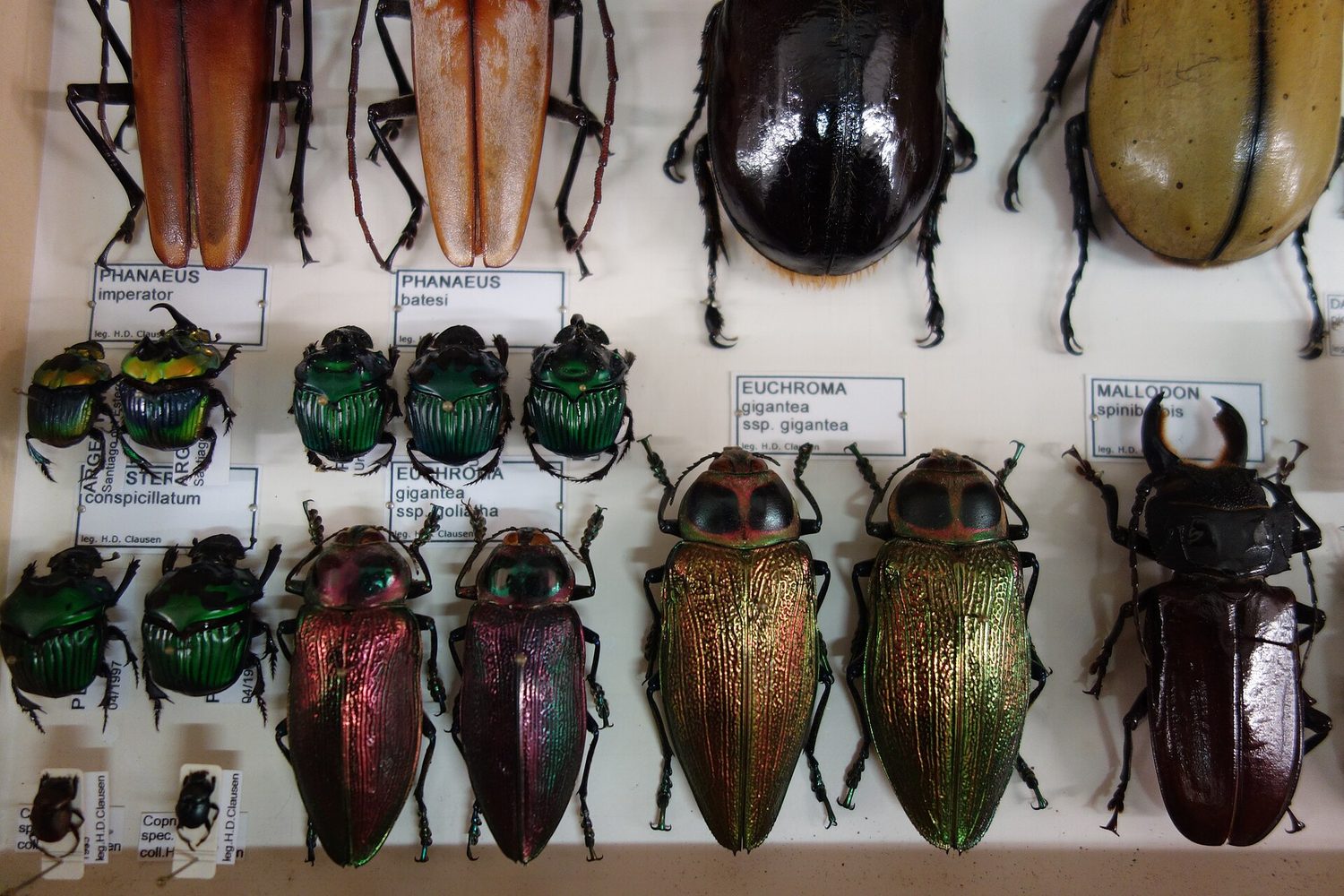
There are millions of kinds of living thing. To study them, scientists classify 分类 them — they sort them into groups by the features they share. Organisms in the same group share more features with each other than with organisms in other groups.
Species and the binomial system
The smallest common group is the species 物种. A species is a group of organisms that can reproduce to make fertile offspring 可育后代 ("fertile" means the offspring can themselves go on to have young).

Each species has a two-part scientific name 学名. This way of naming is the binomial system 双名法 — a system agreed all over the world, so every scientist uses the same name.
- The first part is the genus 属 (a larger group that the species belongs to). It starts with a capital letter.
- The second part is the species. It starts with a small letter.
The whole name is written in italics, for example Homo sapiens (humans). Two rats named Rattus norvegicus and Rattus rattus belong to the same genus but are different species.
Dichotomous keys
A dichotomous key 二歧检索表 is a tool that helps you identify an unknown organism. "Dichotomous" means "splitting into two". At each step the key gives you two choices about a feature. You pick the one that fits your organism, and that choice sends you on to the next pair of choices. You repeat this until you reach the organism's name.
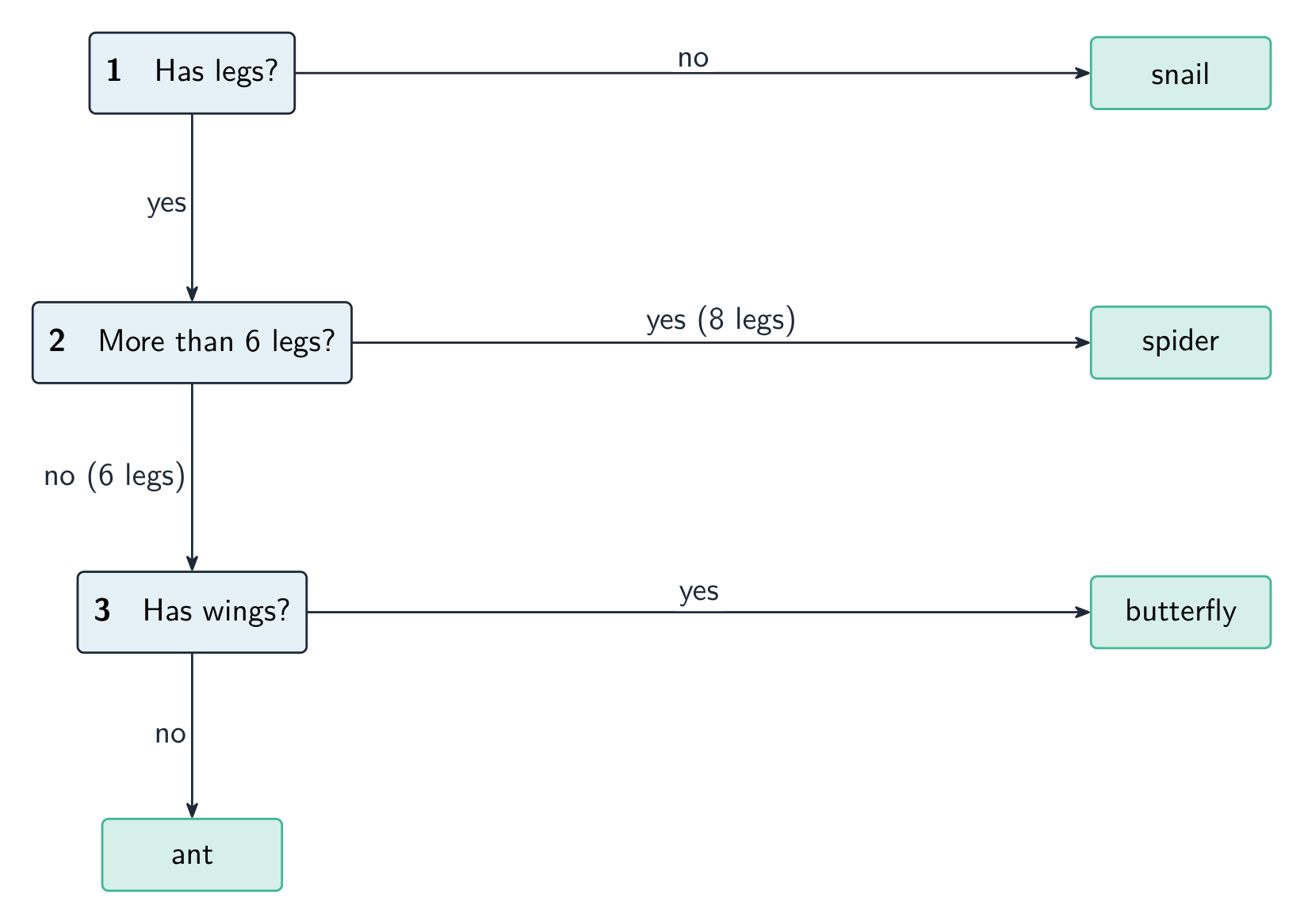
When you build a key, choose clear features you can see — for example "has wings / has no wings" — not features that change, such as size.
Worked example. A key reads: step 1, has wings, go to 2; no wings, go to 3. Step 2, one pair of wings, it is a housefly; two pairs of wings, it is a butterfly. An unknown insect has two pairs of wings. Step 1 only asks "wings or no wings?", so having wings sends you to step 2. At step 2, "two pairs" gives butterfly. Follow the route the key gives you, one step at a time - never jump straight to the name that looks right.
Classification and DNA (Supplement)
Modern classification tries to show evolutionary relationships 进化关系 — how closely different organisms are related. Organisms that are more closely related share a more recent ancestor 祖先.
To measure this, scientists compare the base sequence 碱基序列 of DNA (the order of the chemical "letters" that make up an organism's genes 基因). The rule is simple:
- Organisms that share a more recent ancestor (more closely related) have more similar DNA base sequences.
- Organisms that share only a distant ancestor have less similar base sequences.
So a DNA base sequence can be used both to classify organisms and to work out how closely two species are related.
Explore
Classification rank lab
Place examples at the right level in the biological hierarchy.
Vocabulary
Train
| English |
|---|
| classify/ˈklæsɪfaɪ/ |
| species/ˈspiːsiːz/ |
| fertile offspring/ˈfɜːtaɪl ˈɒfsprɪŋ/ |
| scientific name/saɪənˈtɪfɪk neɪm/ |
| binomial system/baɪˈnəʊmɪəl ˈsɪstəm/ |
| genus/ˈdʒenəs/ |
| dichotomous key/daɪˈkɒtəməs kiː/ |
| evolutionary relationships/ɪvəˈluːʃənəri rɪˈleɪʃənʃɪps/ |
| ancestor/ˈænsestə/ |
| base sequence/beɪs ˈsiːkwəns/ |
| genes/dʒiːnz/ |
1.3
Kingdoms
Syllabus
| Core | Supplement |
|---|---|
| 1 State the main features used to place animals and plants into the appropriate kingdoms | 4 State the main features used to place all organisms into one of the five kingdoms: animal, plant, fungus, prokaryote, protoctist |
| 2 State the main features used to place organisms into groups within the animal kingdom, limited to: (a) the main groups of vertebrates: mammals, birds, reptiles, amphibians, fish (b) the main groups of arthropods: myriapods, insects, arachnids, crustaceans | 5 State the main features used to place organisms into groups within the plant kingdom, limited to ferns and flowering plants (dicotyledons and monocotyledons) |
| 3 Classify organisms using the features identified in 1.3.1 and 1.3.2 | 6 Classify organisms using the features identified in 1.3.4 and 1.3.5 |
| 7 State the features of viruses, limited to a protein coat and genetic material |
Source: Cambridge International syllabus
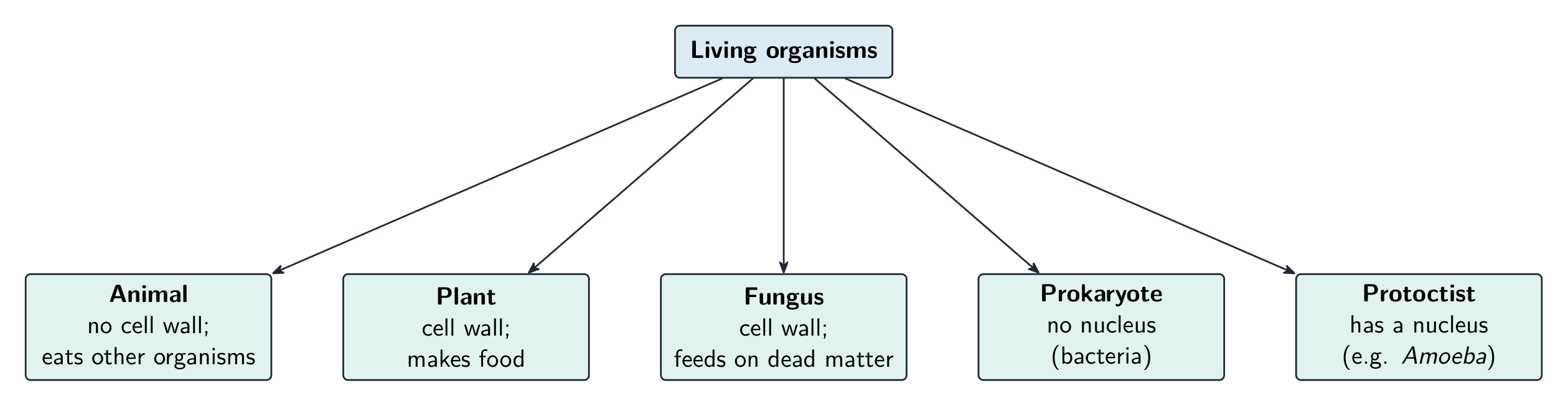
The biggest groups that organisms are sorted into are called kingdoms 界. At Core level you place organisms into the first two kingdoms below; for Supplement you need all five kingdoms. You decide where an organism belongs by looking at its main features.
| Kingdom | Main features |
|---|---|
| Animal 动物 | made of many cells; cells have no cell wall 细胞壁; cannot make their own food, so they feed on other organisms; most can move their whole body |
| Plant 植物 | made of many cells; cells have a cell wall; make their own food by photosynthesis 光合作用, so many cells contain chloroplasts 叶绿体 |
| Fungus 真菌 | for example moulds 霉菌, mushrooms 蘑菇 and yeast 酵母; have cell walls; cannot photosynthesise; feed on dead or living matter |
| Prokaryote 原核生物 | for example bacteria 细菌; single-celled 单细胞; cells have no nucleus 细胞核 |
| Protoctist 原生生物 | for example Amoeba and algae 藻类; usually single-celled; cells do have a nucleus |
The fungus, prokaryote and protoctist kingdoms are Supplement only.


Grouping the animal kingdom
The animal kingdom is split first into two: animals with a backbone and animals without one.

Vertebrates 脊椎动物 are animals with a backbone 脊柱. There are five main groups.
| Group | Main features |
|---|---|
| Mammals 哺乳动物 | have fur 毛发 or hair; feed their young on milk |
| Birds 鸟类 | have feathers 羽毛 and a beak 喙; lay eggs with hard shells |
| Reptiles 爬行动物 | have dry skin covered with scales 鳞片; lay eggs with leathery shells on land |
| Amphibians 两栖动物 | have moist skin; lay eggs in water; the young live in water |
| Fish 鱼类 | have wet scales and fins 鳍; breathe using gills 鳃; lay eggs in water |
Arthropods 节肢动物 are animals with no backbone. They have a hard outer skeleton (an exoskeleton 外骨骼) and legs that bend at joints 关节. There are four main groups.
| Group | Main features |
|---|---|
| Insects 昆虫 | body in 3 parts; 3 pairs of legs; usually 2 pairs of wings; 1 pair of antennae 触角 |
| Arachnids 蛛形类 | body in 2 parts; 4 pairs of legs; no wings; no antennae |
| Crustaceans 甲壳类 | many pairs of legs; 2 pairs of antennae; most live in water |
| Myriapods 多足类 | long body made of many segments 体节; one or two pairs of legs on each segment |
Grouping the plant kingdom (Supplement)
Plants are placed into groups too. You need two of them.
- Ferns 蕨类植物 — have roots, stems and leaves, but make no flowers or seeds. They reproduce using tiny spores 孢子.
- Flowering plants 开花植物 — make flowers, and form seeds 种子 inside the flower. They split into two groups by their seed-leaves (the first leaves inside a seed, called cotyledons 子叶):
| Group | Features |
|---|---|
| Monocotyledons 单子叶植物 | seed has one cotyledon; long narrow leaves; veins 叶脉 run side by side (parallel) |
| Dicotyledons 双子叶植物 | seed has two cotyledons; broad leaves; veins form a branching net |

Viruses (Supplement)
Viruses 病毒 are not placed in any kingdom. They are not made of cells, so many scientists do not count them as living. A virus is very simple, with only two parts:
- an outer protein coat 蛋白质外壳, and
- genetic material 遗传物质 (its genes) inside.
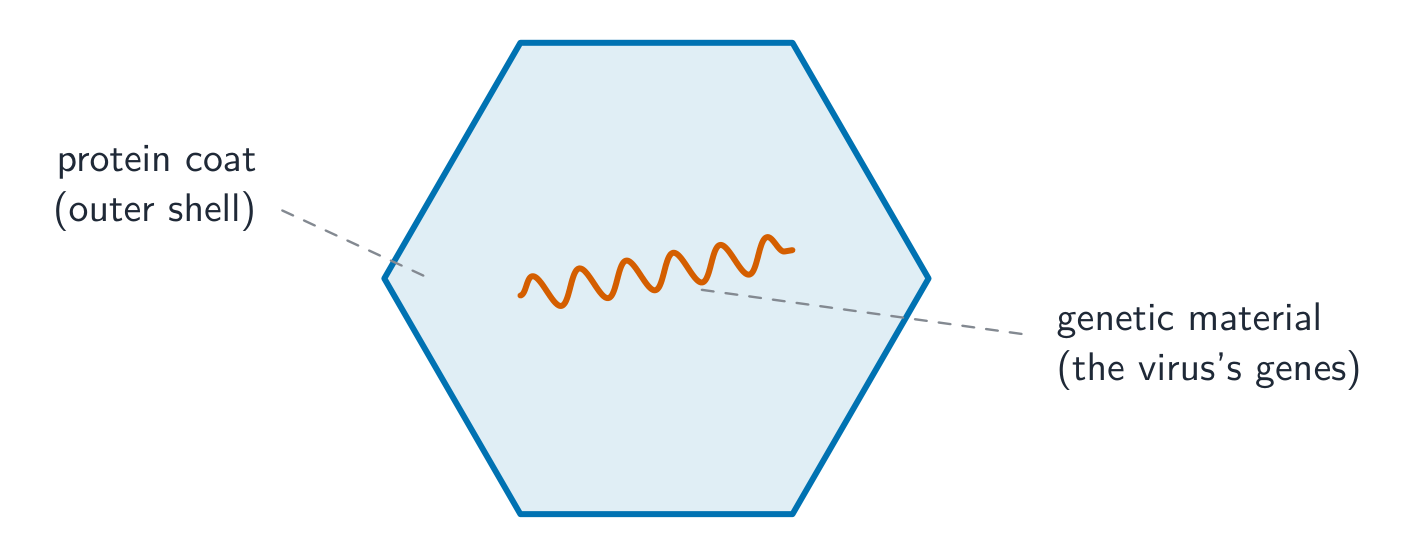
A virus cannot carry out the life processes on its own. It can only reproduce inside the living cells of a host 宿主 — the organism it infects.
Explore
Groups of organisms lab
Compare organism groups by the feature that identifies them.
Vocabulary
Train
| English |
|---|
| kingdoms/ˈkɪŋdəmz/ |
| animal/ˈænɪml/ |
| cell wall/sel wɔːl/ |
| plant/plænt/ |
| photosynthesis/ˌfəʊtəʊˈsɪnθəsɪs/ |
| chloroplasts/ˈklɔːrəʊplæsts/ |
| fungus/ˈfʌŋɡəs/ |
| moulds/məʊldz/ |
| mushrooms/ˈmʌʃruːmz/ |
| yeast/jiːst/ |
| prokaryote/ˈprɒkərɪəʊt/ |
| bacteria/bækˈtɪərɪə/ |
| single-celled/ˈsɪŋɡl seld/ |
| nucleus/ˈnjuːklɪəs/ |
| protoctist/ˈprəʊtəʊktɪst/ |
| algae/ˈælɡiː/ |
| vertebrates/ˈvɜːtɪbreɪts/ |
| backbone/ˈbækbəʊn/ |
| mammals/ˈmæmlz/ |
| fur/fɜː/ |
| birds/bɜːdz/ |
| feathers/ˈfeðəz/ |
| beak/biːk/ |
| reptiles/ˈreptaɪlz/ |
| scales/skeɪlz/ |
| amphibians/æmˈfɪbɪənz/ |
| fish/fɪʃ/ |
| fins/fɪnz/ |
| gills/ɡɪlz/ |
| arthropods/ˈɑːθrəpɒdz/ |
| exoskeleton/ˈeksəʊskelɪtn/ |
| joints/dʒɔɪnts/ |
| insects/ˈɪnsekts/ |
| antennae/ænˈteniː/ |
| arachnids/əˈræknɪdz/ |
| crustaceans/krʌˈsteɪʃnz/ |
| myriapods/ˈmaɪrɪæpɒdz/ |
| segments/ˈseɡmənts/ |
| ferns/fɜːnz/ |
| spores/spɔːz/ |
| flowering plants/ˈflaʊərɪŋ plænts/ |
| seeds/siːdz/ |
| cotyledons/ˌkɒtɪˈliːdnz/ |
| monocotyledons/ˌmɒnəʊˌkɒtɪˈliːdnz/ |
| leaf veins/liːf veɪnz/ |
| dicotyledons/ˌdɪkətɪˈliːdnz/ |
| viruses/ˈvaɪrəsɪz/ |
| protein coat/ˈprəʊtiːn kəʊt/ |
| genetic material/dʒɪˈnetɪk məˈtɪərɪəl/ |
| host/həʊst/ |
1.3
Exam tips
- Learn the seven characteristics by heart, with their exact definitions. Write them as clear, full sentences.
- Digestion 消化 is not one of the seven characteristics — it is just one part of nutrition. "Breathing" is not one of the seven either.
- In a scientific name, the genus starts with a capital letter and the species with a small letter, and both are in italics.
- To use a dichotomous key, start at the first pair of choices and follow the route step by step. Do not jump ahead.
- More similar DNA base sequence → the organisms are more closely related (they share a more recent ancestor).
Vocabulary
Train
| English |
|---|
| digestion/daɪˈdʒestʃn/ |
Interactive lessons on this topic
Work through it step by step, with instant-check exercises.