| Core | Supplement |
|---|---|
| 1 State that electrical impulses travel along neurones | |
| 2 Describe the mammalian nervous system in terms of: (a) the central nervous system (CNS) consisting of the brain and the spinal cord (b) the peripheral nervous system (PNS) consisting of the nerves outside of the brain and spinal cord | |
| 3 Describe the role of the nervous system as coordination and regulation of body functions | |
| 4 Identify in diagrams and images sensory, relay and motor neurones | |
| 5 Describe a simple reflex arc in terms of: receptor, sensory neurone, relay neurone, motor neurone and effector | |
| 6 Describe a reflex action as a means of automatically and rapidly integrating and coordinating stimuli with the responses of effectors (muscles and glands) | |
| 7 Describe a synapse as a junction between two neurones | 8 Describe the structure of a synapse, including the presence of vesicles containing neurotransmitter molecules, the synaptic gap and receptor proteins |
| 9 Describe the events at a synapse as: (a) an impulse stimulates the release of neurotransmitter molecules from vesicles into the synaptic gap (b) the neurotransmitter molecules diffuse across the gap (c) neurotransmitter molecules bind with receptor proteins on the next neurone (d) an impulse is then stimulated in the next neurone | |
| 10 State that synapses ensure that impulses travel in one direction only |
Coordination and response
IGCSE Biology · Topic 14
 18:13
18:13
Coordination and Response
Touch something hot and your hand is already moving before you feel the pain. That is one of your two control systems — the fast one, made of nerves. The other…
English narration · English + 中文 subtitles burned in
14.1
The nervous system

Syllabus
Source: Cambridge International syllabus
Your body must coordinate 协调 all its parts and react to changes. The nervous system 神经系统 does this using fast electrical impulses 电脉冲 that travel along neurones 神经元 (nerve cells). It has two parts:
- the central nervous system 中枢神经系统 (CNS) — the brain 大脑 and the spinal cord 脊髓.
- the peripheral nervous system 周围神经系统 (PNS) — all the nerves outside the brain and spinal cord.
The nervous system coordinates and regulates 调节 the body's functions.
Vocabulary
Train
| English |
|---|
| coordinate/kəʊˈɔːdɪnət/ |
| nervous system/ˈnɜːvəs ˈsɪstəm/ |
| electrical impulses/ɪˈlektrɪkl ˈɪmpʌlsɪz/ |
| neurones/ˈnjuːrəʊnz/ |
| central nervous system/ˈsentrəl ˈnɜːvəs ˈsɪstəm/ |
| brain/breɪn/ |
| spinal cord/ˈspaɪnl kɔːd/ |
| peripheral nervous system/pəˈrɪfərəl ˈnɜːvəs ˈsɪstəm/ |
| regulates/ˈreɡjʊleɪts/ |
14.1
Neurones and the reflex arc

There are three kinds of neurone:
- sensory neurones 感觉神经元 — carry impulses from receptors to the CNS.
- relay neurones 中间神经元 — pass impulses on inside the CNS.
- motor neurones 运动神经元 — carry impulses from the CNS to effectors.
A reflex 反射 action is a fast, automatic response 反应 to a stimulus 刺激 (a change). It follows a fixed path, the reflex arc 反射弧:
receptor 感受器 → sensory neurone → relay neurone → motor neurone → effector 效应器 (a muscle 肌肉 or gland 腺体)

Explore
The reflex arc
A reflex is a fast, automatic response — the signal takes a short cut through the spinal cord.
Vocabulary
Train
| English |
|---|
| sensory neurones/ˈsensəri ˈnjuːrəʊnz/ |
| relay neurones/ˈriːleɪ ˈnjuːrəʊnz/ |
| motor neurones/ˈməʊtə ˈnjuːrəʊnz/ |
| reflex/ˈriːfleks/ |
| response/rɪˈspɒns/ |
| stimulus/ˈstɪmjʊləs/ |
| reflex arc/ˈriːfleks ɑːk/ |
| receptor/rɪˈseptə/ |
| effector/ɪˈfektə/ |
| muscle/ˈmʌsl/ |
| gland/ɡlænd/ |
14.1
Synapses (Supplement)

A synapse 突触 is a junction (a tiny gap) between two neurones. At the end of one neurone are vesicles 囊泡 holding neurotransmitter 神经递质 molecules. Across the synaptic gap 突触间隙, the next neurone has receptor proteins 受体蛋白.
Events at a synapse:
- an impulse arrives and makes the vesicles release neurotransmitter into the synaptic gap.
- the neurotransmitter molecules diffuse 扩散 across the gap.
- they bind to the receptor proteins on the next neurone.
- this starts a new impulse in the next neurone.
Synapses make impulses travel in one direction only.
Explore
Across the synapse
Neurons don't touch — the impulse crosses the tiny gap using a chemical messenger.
Vocabulary
Train
| English |
|---|
| synapse/ˈsɪnæps/ |
| vesicles/ˈvesɪklz/ |
| neurotransmitter/ˈnjuːrətrænsmɪtə/ |
| synaptic gap/sɪˈnæptɪk ɡæp/ |
| receptor proteins/rɪˈseptə ˈprəʊtiːnz/ |
| diffuse/dɪˈfjuːz/ |
14.2
Sense organs and the eye

Syllabus
| Core | Supplement |
|---|---|
| 1 Describe sense organs as groups of receptor cells responding to specific stimuli: light, sound, touch, temperature and chemicals | |
| 2 Identify in diagrams and images the structures of the eye, limited to: cornea, iris, pupil, lens, retina, optic nerve and blind spot | |
| 3 Describe the function of each part of the eye, limited to: (a) cornea – refracts light (b) iris – controls how much light enters the pupil (c) lens – focuses light on to the retina (d) retina – contains light receptors, some sensitive to light of different colours (e) optic nerve – carries impulses to the brain | |
| 4 Explain the pupil reflex, limited to changes in light intensity and pupil diameter | 5 Explain the pupil reflex in terms of the antagonistic action of circular and radial muscles in the iris |
| 6 Explain accommodation to view near and distant objects in terms of the contraction and relaxation of the ciliary muscles, tension in the suspensory ligaments, shape of the lens and refraction of light | |
| 7 Describe the distribution of rods and cones in the retina of a human | |
| 8 Outline the function of rods and cones, limited to: (a) greater sensitivity of rods for night vision (b) three different kinds of cones, absorbing light of different colours, for colour vision | |
| 9 Identify in diagrams and images the position of the fovea and state its function |
Source: Cambridge International syllabus
Sense organs 感觉器官 are groups of receptor cells that respond to one kind of stimulus — light, sound, touch, temperature or chemicals. The eye responds to light.
Parts of the eye
| Part | Function |
|---|---|
| cornea 角膜 | refracts 折射 (bends) the light as it enters |
| iris 虹膜 | controls how much light enters the pupil 瞳孔 |
| lens 晶状体 | focuses the light onto the retina |
| retina 视网膜 | contains light receptors, some sensitive to different colours |
| optic nerve 视神经 | carries the impulses to the brain |
| blind spot 盲点 | where the optic nerve leaves the eye; it has no receptors |

The pupil reflex
In bright light the pupil gets smaller, to protect the retina. In dim light it gets wider, to let more light in. (Supplement) This is done by two sets of antagonistic 拮抗 muscles in the iris: the circular muscles 环肌 and the radial muscles 辐射肌. In bright light the circular muscles contract and the pupil narrows; in dim light the radial muscles contract and the pupil widens.
Accommodation (Supplement)
Accommodation 视觉调节 is changing the shape of the lens to focus on near or far objects, using the ciliary muscles 睫状肌 and the suspensory ligaments 悬韧带:
- near object: the ciliary muscles contract, the ligaments slacken, and the lens becomes fatter — more refraction.
- far object: the ciliary muscles relax, the ligaments pull tight, and the lens becomes thinner — less refraction.
Rods and cones (Supplement)
The retina has two kinds of light receptor:
- rods 视杆细胞 — very sensitive, good for vision 视觉 in dim light (night vision); they do not detect colour.
- cones 视锥细胞 — three kinds, each absorbing a different colour, giving colour vision; they work best in bright light.
Cones are packed most densely at the fovea 中央凹, the part of the retina that gives the sharpest image.
Explore
Explore the eye
Tap each part to follow light through the eye — from the cornea and lens that focus it to the retina that detects it.
Explore
Accommodation — focusing the eye
The eye changes the shape of its lens to focus on near or far objects.
Vocabulary
Train
| English |
|---|
| sense organs/sens ˈɔːɡənz/ |
| cornea/ˈkɔːnɪə/ |
| refracts/rɪˈfrækts/ |
| iris/ˈaɪrɪs/ |
| pupil/ˈpjuːpl/ |
| lens/lenz/ |
| retina/ˈretɪnə/ |
| optic nerve/ˈɒptɪk nɜːv/ |
| blind spot/blaɪnd spɒt/ |
| antagonistic/ænˈtæɡənɪstɪk/ |
| circular muscles/ˈsɜːkjʊlə ˈmʌslz/ |
| radial muscles/ˈreɪdɪəl ˈmʌslz/ |
| accommodation/əˌkɒməˈdeɪʃn/ |
| ciliary muscles/ˈsɪlɪəri ˈmʌslz/ |
| suspensory ligaments/səˈspensəri ˈlɪɡəmənts/ |
| rods/rɒdz/ |
| vision/ˈvɪʒn/ |
| cones/kəʊnz/ |
| fovea/ˈfəʊvɪə/ |
14.3
Hormones

Syllabus
| Core | Supplement |
|---|---|
| 1 Describe a hormone as a chemical substance, produced by a gland and carried by the blood, which alters the activity of one or more specific target organs | |
| 2 Identify in diagrams and images specific endocrine glands and state the hormones they secrete, limited to: (a) adrenal glands and adrenaline (b) pancreas and insulin (c) testes and testosterone (d) ovaries and oestrogen | 5 State that glucagon is secreted by the pancreas |
| 3 Describe adrenaline as the hormone secreted in ‘fight or flight’ situations and its effects, limited to: (a) increased breathing rate (b) increased heart rate (c) increased pupil diameter | 6 Describe the role of adrenaline in the control of metabolic activity, limited to: (a) increasing the blood glucose concentration (b) increasing heart rate |
| 4 Compare nervous and hormonal control, limited to speed of action and duration of effect |
Source: Cambridge International syllabus
A hormone 激素 is a chemical, made by a gland and carried in the blood, that changes the activity of one or more target organs 靶器官. Hormones are made by endocrine glands 内分泌腺, which release them straight into the blood.
| Gland | Hormone | Main effect |
|---|---|---|
| adrenal glands 肾上腺 | adrenaline 肾上腺素 | prepares the body for action |
| pancreas 胰腺 | insulin 胰岛素 (and glucagon 胰高血糖素) | control blood glucose 葡萄糖 |
| testes 睾丸 | testosterone 睾酮 | male development |
| ovaries 卵巢 | oestrogen 雌激素 | female development |
Adrenaline is released in 'fight or flight' situations, such as fear or danger. It increases the breathing rate, the heart rate 心率, the blood glucose concentration 浓度 and the pupil diameter, getting the body ready to act.
Explore
How hormones work
Hormones are chemical messengers carried in the blood — slower than nerves, but longer-lasting.
Vocabulary
Train
| English |
|---|
| hormone/ˈhɔːməʊn/ |
| target organs/ˈtɑːɡɪt ˈɔːɡənz/ |
| endocrine glands/ˈendəʊkraɪn ɡlændz/ |
| adrenal glands/əˈdriːnl ɡlændz/ |
| adrenaline/əˈdrenəlɪn/ |
| pancreas/ˈpæŋkrɪəs/ |
| insulin/ˈɪnsjuːlɪn/ |
| glucagon/ˈɡluːkæɡən/ |
| glucose/ˈɡluːkəʊs/ |
| testes/ˈtestiːz/ |
| testosterone/teˈstɒstərəʊn/ |
| ovaries/ˈəʊvəriz/ |
| oestrogen/ˈiːstrədʒn/ |
| heart rate/hɑːt reɪt/ |
| concentration/ˌkɒnsənˈtreɪʃn/ |
14.3
Nervous control vs hormonal control

| Nervous control | Hormonal control | |
|---|---|---|
| speed | very fast | slower |
| duration 持续时间 | short-lived | longer-lasting |
| how it travels | electrical impulses along neurones | chemicals in the blood |
Vocabulary
Train
| English |
|---|
| duration/djʊəˈreɪʃn/ |
14.4
Homeostasis
Syllabus
| Core | Supplement |
|---|---|
| 1 Describe homeostasis as the maintenance of a constant internal environment | 3 Explain the concept of homeostatic control by negative feedback with reference to a set point |
| 2 State that insulin decreases blood glucose concentration | 4 Describe the control of blood glucose concentration by the liver and the roles of insulin and glucagon |
| 5 Outline the treatment of Type 1 diabetes | |
| 6 Identify in diagrams and images of the skin: hairs, hair erector muscles, sweat glands, receptors, sensory neurones, blood vessels and fatty tissue | |
| 7 Describe the maintenance of a constant internal body temperature in mammals in terms of: insulation, sweating, shivering and the role of the brain | |
| 8 Describe the maintenance of a constant internal body temperature in mammals in terms of vasodilation and vasoconstriction of arterioles supplying skin surface capillaries |
Source: Cambridge International syllabus
Homeostasis 稳态 is keeping a constant internal environment 环境 inside the body — for example a steady temperature and a steady blood glucose level.
(Supplement) Homeostasis works by negative feedback 负反馈: when a value moves away from its set point 设定点, the body acts to bring it back. The change itself triggers the correction.
Controlling blood glucose
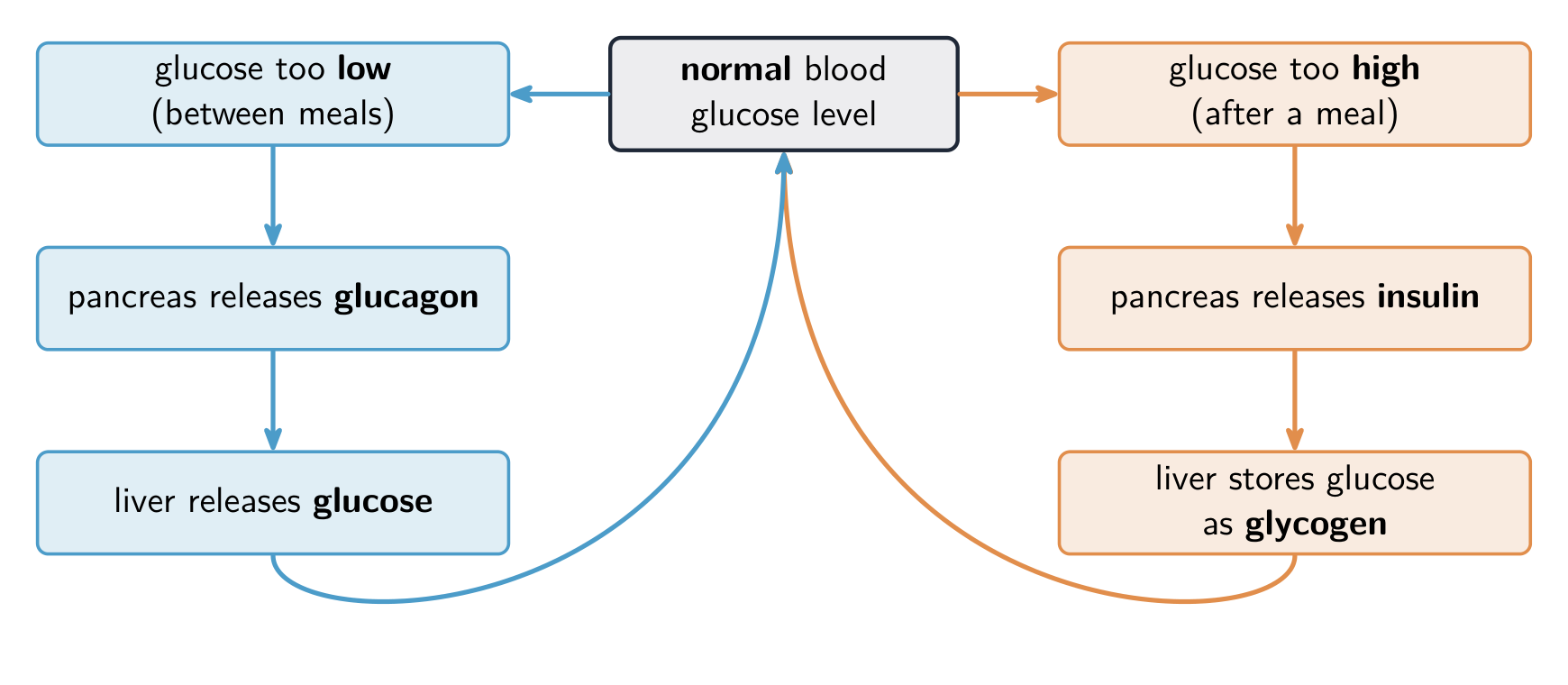
The liver 肝脏 and the pancreas keep blood glucose steady:
- insulin lowers blood glucose after a meal — the liver stores the glucose as glycogen 糖原.
- (Supplement) glucagon raises blood glucose between meals — the liver releases glucose.
In Type 1 diabetes 糖尿病 the pancreas cannot make insulin, so blood glucose rises too high. It is treated with insulin injections and a carefully planned diet.
Worked example. Blood glucose rises sharply after a meal, then falls back to normal over the next two hours. Name the organs and the hormone involved, and say what they do. The pancreas detects the rise and releases insulin. Insulin makes the liver take glucose out of the blood and store it as glycogen, so the level falls back to normal. Between meals the opposite loop runs: the pancreas releases glucagon and the liver releases glucose again. Keep the two words apart - insulin is the hormone, glycogen is the store. Swapping them is the classic error.
Controlling body temperature (Supplement)
The brain detects the body temperature 温度 and keeps it steady. The skin helps:
| Structure | Role |
|---|---|
| sweat glands 汗腺 | make sweat; as it evaporates it cools the skin (sweating 出汗) |
| hair erector muscles 立毛肌 | raise the hairs to trap a layer of air |
| blood vessels 血管 | change how much blood flows near the skin surface |
| fatty tissue 脂肪组织 | gives insulation 隔热 to reduce heat loss |
When you are too hot: you sweat, and the arterioles 小动脉 widen (vasodilation 血管舒张) so more blood flows to the skin capillaries 毛细血管 and loses heat.
When you are too cold: you shiver 颤抖 (the muscles make heat), and the arterioles narrow (vasoconstriction 血管收缩) so less blood reaches the surface, keeping heat in.

Explore
Negative feedback
Push body temperature away from its set point and watch negative feedback bring it back to normal.
Vocabulary
Train
| English |
|---|
| homeostasis/ˌhəʊmiːəˈstɑːsiz/ |
| environment/enˈvaɪrənmənt/ |
| negative feedback/ˈneɡətɪv ˈfiːdbæk/ |
| set point/set pɔɪnt/ |
| liver/ˈlɪvə/ |
| glycogen/ˈɡlaɪkədʒn/ |
| diabetes/ˌdaɪəˈbiːtiːz/ |
| temperature/ˈtemprɪtʃə/ |
| sweat glands/swet ɡlændz/ |
| sweating/ˈswetɪŋ/ |
| hair erector muscles/heə ɪˈrektə ˈmʌslz/ |
| blood vessels/blʌd ˈveslz/ |
| fatty tissue/ˈfæti ˈtɪʃuː/ |
| insulation/ˌɪnsjuːˈleɪʃn/ |
| arterioles/ɑːˈtɪəriəʊlz/ |
| vasodilation/ˌvæsədɪˈleɪʃn/ |
| capillaries/ˈkæpɪləriz/ |
| shiver/ˈʃɪvə/ |
| vasoconstriction/ˌvæsəkənˈstrɪkʃn/ |
14.5
Tropisms

Syllabus
| Core | Supplement |
|---|---|
| 1 Describe gravitropism as a response in which parts of a plant grow towards or away from gravity | 4 Explain phototropism and gravitropism of a shoot as examples of the chemical control of plant growth |
| 2 Describe phototropism as a response in which parts of a plant grow towards or away from the direction of the light source | 5 Explain the role of auxin in controlling shoot growth, limited to: (a) auxin is made in the shoot tip (b) auxin diffuses through the plant from the shoot tip (c) auxin is unequally distributed in response to light and gravity (d) auxin stimulates cell elongation |
| 3 Investigate and describe gravitropism and phototropism in shoots and roots |
Source: Cambridge International syllabus
A tropism 向性 is a plant's growth response to a direction:
- gravitropism 向地性 — growth in response to gravity 重力 (roots grow down, shoots grow up).
- phototropism 向光性 — growth in response to the direction of light (shoots grow towards the light).
(Supplement) These responses are controlled by a chemical called auxin 生长素:
- auxin is made in the shoot 嫩枝 tip.
- it diffuses down through the plant.
- light or gravity makes the auxin spread unequally to one side.
- auxin makes cells elongate 伸长 (grow longer). The side with more auxin grows faster, so the shoot bends.
Explore
Phototropism — bending to light
A shoot grows towards light because a hormone makes one side grow faster than the other.
Vocabulary
Train
| English |
|---|
| tropism/ˈtrəʊpɪzəm/ |
| gravitropism/ˈɡrævɪtrəʊpɪzəm/ |
| gravity/ˈɡrævɪti/ |
| phototropism/ˌfəʊtəʊˈtrəʊpɪzəm/ |
| auxin/ˈɔːksɪn/ |
| shoot/ʃuːt/ |
| elongate/ˈiːlɒŋɡeɪt/ |
14.5
Exam tips
- Nervous system: CNS (brain + spinal cord) and PNS (the nerves). Impulses travel along neurones.
- Learn the reflex arc in order: receptor → sensory → relay → motor → effector.
- At a synapse, neurotransmitter diffuses across the gap — this makes impulses go one way only.
- Eye: cornea and lens refract light; the lens changes shape (accommodation); rods for dim light, cones for colour.
- Hormones are slower but longer-lasting than nerves. Insulin lowers blood glucose; glucagon raises it.
- Too hot → sweating and vasodilation; too cold → shivering and vasoconstriction.
- Auxin from the shoot tip controls phototropism and gravitropism by making cells elongate.
Interactive lessons on this topic
Work through it step by step, with instant-check exercises.