There are only two ways to make a new organism, and they trade off against each other. One is fast, needs a single parent, and makes perfect copies. The other…
English narration · English + 中文 subtitles burned in
16.1 16.2
Two kinds of reproduction
Syllabus
Core
Supplement
1 Describe asexual reproduction as a process resulting in the production of genetically identical offspring from one parent
2 Identify examples of asexual reproduction in diagrams, images and information provided
3 Discuss the advantages and disadvantages of asexual reproduction: (a) to a population of a species in the wild (b) to crop production
Core
Supplement
1 Describe sexual reproduction as a process involving the fusion of the nuclei of two gametes to form a zygote and the production of offspring that are genetically different from each other
3 State that nuclei of gametes are haploid and that the nucleus of a zygote is diploid
2 Describe fertilisation as the fusion of the nuclei of gametes
4 Discuss the advantages and disadvantages of sexual reproduction: (a) to a population of a species in the wild (b) to crop production
Source: Cambridge International syllabus
Reproduction 生殖 makes new organisms of the same kind. There are two types.
Asexual reproduction needs one parent and gives identical clones; sexual reproduction needs two and gives varied offspring
Asexual reproduction
Asexual reproduction 无性生殖 needs only oneparent 亲本. The offspring 后代 have exactly the same genes 基因 as the parent — they are genetically identical (clones).
Advantage: it is fast and needs only one parent — useful when conditions are good and stable.
Disadvantage: all the offspring are identical, so if the environment 环境 changes (for example a new disease) they may all die. (In crops, identical plants give an even harvest, but one disease can wipe out the whole crop.)
Asexual reproduction is fast but gives no variation, so one disease can kill every identical offspring
Sexual reproduction
Sexual reproduction 有性生殖 needs two parents. It involves the fusion 融合 (joining) of the nuclei 细胞核 of two gametes 配子 (sex cells) to make a zygote 合子. This joining is called fertilisation 受精. The offspring get a mix of genes from both parents, so they show variation 变异 (they are genetically different).
Advantage: variation means some offspring may survive if the environment changes.
Disadvantage: it is slower and needs two parents.
(Supplement) The nuclei of gametes are haploid 单倍体 (one set of chromosomes 染色体); the nucleus of the zygote is diploid 二倍体 (two sets).
Explore
Asexual reproduction
One parent makes genetically identical offspring (clones) by mitosis — no gametes needed.
1 Identify in diagrams and images and draw the following parts of an insect-pollinated flower: sepals, petals, stamens, filaments, anthers, carpels, style, stigma, ovary and ovules
2 State the functions of the structures listed in 16.3.1
3 Identify in diagrams and images and describe the anthers and stigmas of a wind-pollinated flower
4 Distinguish between the pollen grains of insect-pollinated and wind-pollinated flowers
5 Describe pollination as the transfer of pollen grains from an anther to a stigma
9 Describe self-pollination as the transfer of pollen grains from the anther of a flower to the stigma of the same flower or a different flower on the same plant
10 Describe cross-pollination as the transfer of pollen grains from the anther of a flower to the stigma of a flower on a different plant of the same species
11 Discuss the potential effects of self-pollination and cross-pollination on a population, in terms of variation, capacity to respond to changes in the environment and reliance on pollinators
6 State that fertilisation occurs when a pollen nucleus fuses with a nucleus in an ovule
12 Describe the growth of the pollen tube and its entry into the ovule followed by fertilisation (details of production of endosperm and development are not required)
7 Describe the structural adaptations of insect-pollinated and wind-pollinated flowers
8 Investigate and describe the environmental conditions that affect germination of seeds, limited to the requirement for: water, oxygen and a suitable temperature
Source: Cambridge International syllabus
Parts of an insect-pollinated flower
Part
Function
sepals 萼片
protect the flower bud before it opens
petals 花瓣
large and colourful, to attract insects 昆虫
stamens 雄蕊
the male parts; each is a filament 花丝 holding up an anther 花药
anther
makes pollen grains 花粉粒
carpel 雌蕊
the female part; made of a stigma 柱头, a style 花柱 and an ovary 子房
stigma
catches pollen grains
ovary
holds the ovules 胚珠, which become seeds
An insect-pollinated flower: the male stamens and the female carpelA real lily: the long stamens make pollen and the central stigma receives it
Pollination
Pollination 传粉 is the transfer of pollen grains from an anther to a stigma.
insect-pollinated flowers have bright petals, scent and nectar, and sticky or spiky pollen, to attract insects and stick to them.
wind-pollinated flowers have small dull petals, anthers and stigmas that hang outside, and light, smooth pollen that blows in the wind.
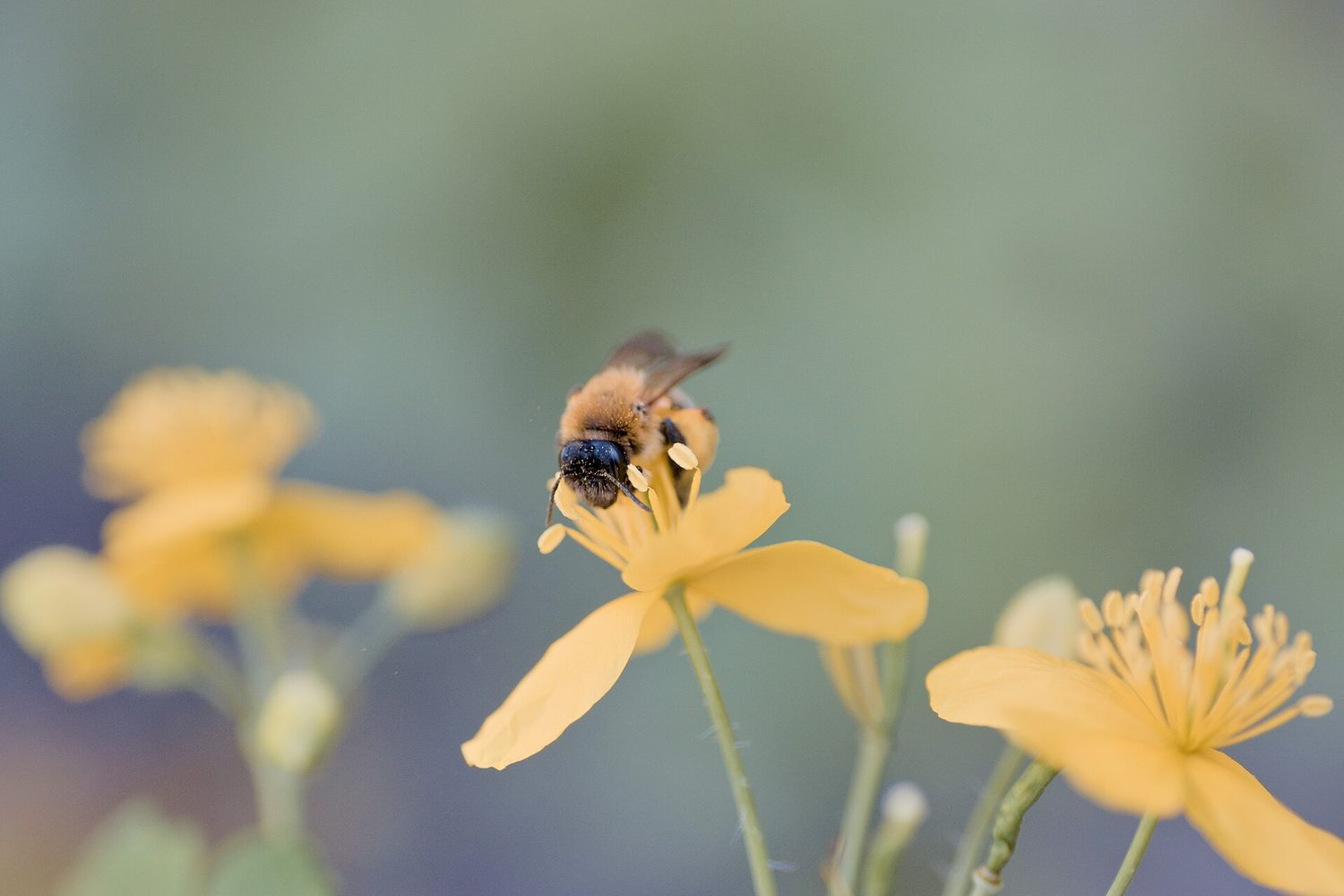
A bee carries pollen from one flower to another — insect pollination in actionInsect-pollinated flowers are showy; wind-pollinated flowers are small with parts hanging outPollen grains seen under an electron microscope (colour added); each plant has its own pattern
(Supplement)Self-pollination 自花传粉 is pollen landing on the stigma of the same flower (or another flower on the same plant). Cross-pollination 异花传粉 is pollen carried to a flower on a different plant of the same species. Cross-pollination gives more variation, helping the population cope with change, but it relies on pollinators 传粉者 or wind. Self-pollination is more reliable but gives less variation.
Fertilisation and germination
Fertilisation happens when a pollen nucleus fuses with a nucleus in an ovule. (Supplement) First a pollen tube 花粉管 grows down the style into the ovary, carrying the pollen nucleus to the ovule.
A seed 种子 will only germinate 萌发 (begin to grow) when it has water, oxygen 氧气 and a suitable temperature 温度.
Explore
Sexual reproduction
Two parents each contribute a gamete; fertilisation combines them, creating variation.
1 Identify on diagrams and state the functions of the following parts of the male reproductive system: testes, scrotum, sperm ducts, prostate gland, urethra and penis
2 Identify on diagrams and state the functions of the following parts of the female reproductive system: ovaries, oviducts, uterus, cervix and vagina
3 Describe fertilisation as the fusion of the nuclei from a male gamete (sperm) and a female gamete (egg cell)
4 Explain the adaptive features of sperm, limited to: flagellum, mitochondria and enzymes in the acrosome
5 Explain the adaptive features of egg cells, limited to: energy stores and the jelly coat that changes at fertilisation
6 Compare male and female gametes in terms of: size, structure, motility and numbers
7 State that in early development, the zygote forms an embryo which is a ball of cells that implants into the lining of the uterus
8 Identify on diagrams and state the functions of the following in the development of the fetus: umbilical cord, placenta, amniotic sac and amniotic fluid
9 Describe the function of the placenta and umbilical cord in relation to the exchange of dissolved nutrients, gases and excretory products between the blood of the mother and the blood of the fetus
10 State that some pathogens and toxins can pass across the placenta and affect the fetus
Source: Cambridge International syllabus
The male reproductive system
Part
Function
testes 睾丸
make sperm 精子 and testosterone 睾酮
scrotum 阴囊
holds the testes outside the body, kept slightly cool
sperm ducts 输精管
carry sperm away from the testes
prostate gland 前列腺
adds fluid to make semen
urethra 尿道
carries semen (and urine) out through the penis
penis 阴茎
passes sperm into the female
The female reproductive system
Part
Function
ovaries 卵巢
make egg cells 卵细胞 and oestrogen 雌激素
oviducts 输卵管
carry the egg towards the uterus; fertilisation happens here
uterus 子宫
where the baby develops
cervix 子宫颈
the ring of muscle at the base of the uterus
vagina 阴道
receives the penis; also the birth canal
Gametes and fertilisation
Fertilisation is the fusion of the nuclei of a male gamete (sperm) and a female gamete (egg cell). The two gametes are adapted to their jobs:
Sperm
Egg cell
size
very small
large
number
millions
few (about one a month)
can it move?
yes — swims with a flagellum 鞭毛
no — it is carried along
special features
many mitochondria 线粒体 for energy; enzymes 酶 in the acrosome 顶体 to break into the egg
a store of food; a jelly coat 胶质层 that changes after fertilisation to keep other sperm out
The sperm is small and swims; the egg cell is large and stores food
Pregnancy and the fetus
After fertilisation the zygote divides to form an embryo 胚胎 — a ball of cells that implants 植入 into the lining of the uterus. As it grows it becomes a fetus 胎儿. These structures support it:
the placenta 胎盘 — where dissolved nutrients, gases and wastes are exchanged between the mother's blood and the fetus's blood (the two never mix).
the umbilical cord 脐带 — joins the fetus to the placenta.
the amniotic sac 羊膜囊 — a bag around the fetus, filled with amniotic fluid 羊水 that cushions it.
The fetus develops in the uterus, supported by the placenta, cord and amniotic sac
(Supplement) Some pathogens 病原体 and toxins 毒素 can cross the placenta and harm the fetus.
Explore
Reproductive organ lab
Match each organ to its role in human reproduction.
1 Describe the roles of testosterone and oestrogen in the development and regulation of secondary sexual characteristics during puberty
2 Describe the menstrual cycle in terms of changes in the ovaries and in the lining of the uterus
3 Describe the sites of production of oestrogen and progesterone in the menstrual cycle and in pregnancy
4 Explain the role of hormones in controlling the menstrual cycle and pregnancy, limited to FSH, LH, progesterone and oestrogen
Source: Cambridge International syllabus
Puberty
At puberty 青春期, sex hormones 激素 make the body develop secondary sexual characteristics 第二性征 — such as body hair, a deeper voice in boys, and breasts in girls. Testosterone does this in boys; oestrogen does it in girls.
The menstrual cycle
The menstrual cycle 月经周期 (about 28 days) prepares the uterus for a possible pregnancy:
the lining of the uterus thickens.
around day 14 an ovary releases an egg (ovulation 排卵).
if the egg is not fertilised, the lining breaks down and leaves the body (a period), and the cycle starts again.
The lining thickens, an egg is released at day 14, and a period follows if there is no pregnancy
(Supplement) Four hormones control the cycle: FSH (makes an egg mature and the ovary release oestrogen), LH (triggers ovulation), oestrogen (repairs and thickens the lining), and progesterone 孕酮 (keeps the lining thick). Oestrogen and progesterone are made in the ovaries; during pregnancy 怀孕, progesterone keeps the lining in place.
Worked example. A woman has a regular 28-day cycle, and her period starts on the 1st of the month. On roughly which date is she most likely to conceive? Ovulation happens about day 14, so counting 14 days on from the start of the period points to about the 14th, and the days either side of it are the most fertile. Day 1 is the day the period starts, not the day it ends - counting from the wrong day is what makes most cycle questions go wrong.
Explore
The menstrual cycle
Hormones control a roughly monthly cycle that prepares the uterus for a possible pregnancy.
secondary sexual characteristics/ˈsekəndəri ˈsekʃuːəl ˌkærɪktəˈrɪstɪks/
menstrual cycle/ˈmenstruːəl ˈsaɪkl/
ovulation/ˌɒvjʊˈleɪʃn/
progesterone/prəʊˈdʒestərəʊn/
pregnancy/ˈpreɡnənsi/
16.6
Sexually transmitted infections
Syllabus
Core
Supplement
1 Describe a sexually transmitted infection (STI) as an infection that is transmitted through sexual contact
2 State that human immunodeficiency virus (HIV) is a pathogen that causes an STI
3 State that HIV infection may lead to AIDS
4 Describe the methods of transmission of HIV
5 Explain how the spread of STIs is controlled
Source: Cambridge International syllabus
A sexually transmitted infection 性传播感染 (STI) is an infection 感染 spread through sexual contact.
HIV is a virus 病毒 that causes an STI, and it can lead to AIDS, in which the immune system stops working properly. HIV is passed on in infected body fluids — for example by sharing needles, during sex, or from mother to baby (across the placenta or in breast milk).
The spread of STIs is controlled by using condoms, having fewer partners, testing and treating infected people, and not sharing needles.