| Core | Supplement |
|---|---|
| 1 State that chromosomes are made of DNA, which contains genetic information in the form of genes | |
| 2 Define a gene as a length of DNA that codes for a protein | |
| 3 Define an allele as an alternative form of a gene | |
| 4 Describe the inheritance of sex in humans with reference to X and Y chromosomes | |
| 5 State that the sequence of bases in a gene determines the sequence of amino acids used to make a specific protein (knowledge of the details of nucleotide structure is not required) | |
| 6 Explain that different sequences of amino acids give different shapes to protein molecules | |
| 7 Explain that DNA controls cell function by controlling the production of proteins, including enzymes, membrane carriers and receptors for neurotransmitters | |
| 8 Explain how a protein is made, limited to: • the gene coding for the protein remains in the nucleus • messenger RNA (mRNA) is a copy of a gene • mRNA molecules are made in the nucleus and move to the cytoplasm • the mRNA passes through ribosomes • the ribosome assembles amino acids into protein molecules • the specific sequence of amino acids is determined by the sequence of bases in the mRNA (knowledge of the details of transcription or translation is not required) | |
| 9 Explain that most body cells in an organism contain the same genes, but many genes in a particular cell are not expressed because the cell only makes the specific proteins it needs | |
| 10 Describe a haploid nucleus as a nucleus containing a single set of chromosomes | |
| 11 Describe a diploid nucleus as a nucleus containing two sets of chromosomes | |
| 12 State that in a diploid cell, there is a pair of each type of chromosome and in a human diploid cell there are 23 pairs |
Inheritance
IGCSE Biology · Topic 17
 8:11
8:11
Inheritance
Two brown-eyed parents can have a blue-eyed child. That is not a mistake, and it is not a surprise once you can read genotypes. By the end of this lesson you…
English narration · English + 中文 subtitles burned in
17.1
Chromosomes, genes and DNA

Syllabus
Source: Cambridge International syllabus
Chromosomes 染色体 are made of DNA, which carries the genetic information in units called genes 基因.
- A gene is a length of DNA that codes 编码 for one protein 蛋白质.
- An allele 等位基因 is an alternative form of a gene. For example, a gene for eye colour may have a brown allele and a blue allele.

Sex chromosomes
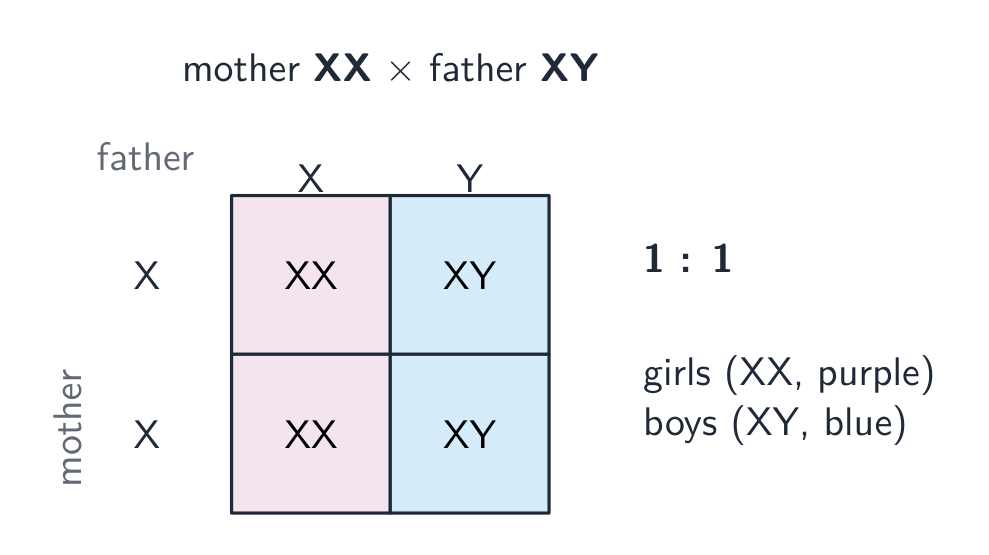
Sex is inherited through the sex chromosomes 性染色体. Females are XX and males are XY. An egg always carries an X; a sperm carries either an X or a Y, so the sperm decides the baby's sex. This gives a 1:1 ratio 比例 of girls to boys.
Vocabulary
Train
| English |
|---|
| chromosomes/ˈkrəʊməsəʊmz/ |
| genes/dʒiːnz/ |
| codes/kəʊdz/ |
| allele/əˈliːl/ |
| sex chromosomes/seks ˈkrəʊməsəʊmz/ |
| ratio/ˈreɪʃɪəʊ/ |
17.1
How DNA controls the cell (Supplement)
The base sequence 碱基序列 of a gene sets the order of amino acids 氨基酸 in a protein. A different order of amino acids folds the protein into a different shape, and the shape decides its job. So DNA controls the cell by controlling which proteins are made — including enzymes 酶, membrane carriers and receptor proteins 受体蛋白 for neurotransmitters 神经递质.
Most body cells hold the same genes, but each cell only expresses 表达 (switches on) the genes it needs, so it makes only the proteins for its own job.
Vocabulary
Train
| English |
|---|
| proteins/ˈprəʊtiːnz/ |
| base sequence/beɪs ˈsiːkwəns/ |
| amino acids/əˈmiːnəʊ ˈæsɪdz/ |
| enzymes/ˈenzaɪmz/ |
| receptor proteins/rɪˈseptə ˈprəʊtiːnz/ |
| neurotransmitters/ˈnjuːrətrænsmɪtəz/ |
| expresses/ekˈspresɪz/ |
17.1
Making a protein (Supplement)

A gene stays in the nucleus 细胞核, but proteins are made in the cytoplasm 细胞质. The link between them is messenger 信使 RNA (mRNA):
- mRNA is made in the nucleus as a copy of the gene.
- the mRNA moves out into the cytoplasm and passes through a ribosome 核糖体.
- the ribosome reads the mRNA's bases 碱基 and joins amino acids in the matching order to build the protein.
Explore
From gene to protein
Step along the DNA template: each base pairs to an mRNA base, and every three bases (a codon) codes for one amino acid in the protein.
Vocabulary
Train
| English |
|---|
| nucleus/ˈnjuːklɪəs/ |
| cytoplasm/ˈsaɪtəplæzəm/ |
| messenger/ˈmesɪndʒə/ |
| ribosome/ˈriːbəʊsəʊm/ |
| bases/ˈbeɪsɪz/ |
17.2 17.3
Cell division (Supplement)

Syllabus
| Core | Supplement |
|---|---|
| 1 Describe mitosis as nuclear division giving rise to genetically identical cells (details of the stages of mitosis are not required) | |
| 2 State the role of mitosis in growth, repair of damaged tissues, replacement of cells and asexual reproduction | |
| 3 State that the exact replication of chromosomes occurs before mitosis | |
| 4 State that during mitosis, the copies of chromosomes separate, maintaining the chromosome number in each daughter cell | |
| 5 Describe stem cells as unspecialised cells that divide by mitosis to produce daughter cells that can become specialised for specific functions |
| Core | Supplement |
|---|---|
| 1 State that meiosis is involved in the production of gametes | |
| 2 Describe meiosis as a reduction division in which the chromosome number is halved from diploid to haploid resulting in genetically different cells (details of the stages of meiosis are not required) |
Source: Cambridge International syllabus
Body cells are diploid 二倍体 (two sets of chromosomes; humans have 23 pairs). Gametes are haploid 单倍体 (one set). Cells make new cells by nuclear division 分裂, of two kinds.
Mitosis 有丝分裂:
- makes two cells that are genetically identical to the parent cell.
- the chromosomes are copied exactly (replication 复制) before division, so each daughter cell 子细胞 keeps the full chromosome number.
- it is used for growth, repair of tissues, replacing old cells, and asexual reproduction 无性生殖.
- stem cells 干细胞 are unspecialised cells that divide by mitosis; their daughter cells can then become specialised.
Meiosis 减数分裂:
- makes gametes 配子.
- it is a reduction division: the chromosome number is halved, from diploid to haploid.
- the cells it makes are genetically different from one another.

Explore
Mitosis
Mitosis makes two genetically identical cells — for growth, repair and asexual reproduction.
Vocabulary
Train
| English |
|---|
| division/dɪˈvɪʒn/ |
| diploid/ˈdɪplɔɪd/ |
| haploid/ˈhæplɔɪd/ |
| mitosis/maɪˈtəʊsɪs/ |
| replication/ˌreplɪˈkeɪʃn/ |
| daughter cell/ˈdɔːtə sel/ |
| asexual reproduction/eɪˈsekʃuːəl rɪprəˈdʌkʃn/ |
| stem cells/stem selz/ |
| meiosis/meɪˈəʊsɪs/ |
| gametes/ˈɡæmiːts/ |
17.4
Inheritance: key words

Syllabus
| Core | Supplement |
|---|---|
| 1 Describe inheritance as the transmission of genetic information from generation to generation | |
| 2 Describe genotype as the genetic make-up of an organism and in terms of the alleles present | |
| 3 Describe phenotype as the observable features of an organism | |
| 4 Describe homozygous as having two identical alleles of a particular gene | |
| 5 State that two identical homozygous individuals that breed together will be pure-breeding | |
| 6 Describe heterozygous as having two different alleles of a particular gene | |
| 7 State that a heterozygous individual will not be pure-breeding | |
| 8 Describe a dominant allele as an allele that is expressed if it is present in the genotype | |
| 9 Describe a recessive allele as an allele that is only expressed when there is no dominant allele of the gene present in the genotype | |
| 10 Interpret pedigree diagrams for the inheritance of a given characteristic | |
| 11 Use genetic diagrams to predict the results of monohybrid crosses and calculate phenotypic ratios, limited to 1:1 and 3:1 ratios | 13 Explain how to use a test cross to identify an unknown genotype |
| 12 Use Punnett squares in crosses which result in more than one genotype to work out and show the possible different genotypes | |
| 14 Describe codominance as a situation in which both alleles in heterozygous organisms contribute to the phenotype | |
| 15 Explain the inheritance of ABO blood groups: phenotypes are A, B, AB and O blood groups and alleles are $I^A$, $I^B$ and $I^o$ | |
| 16 Describe a sex-linked characteristic as a feature in which the gene responsible is located on a sex chromosome and that this makes the characteristic more common in one sex than in the other | |
| 17 Describe red-green colour blindness as an example of sex linkage | |
| 18 Use genetic diagrams to predict the results of monohybrid crosses involving codominance or sex linkage and calculate phenotypic ratios |
Source: Cambridge International syllabus
Inheritance 遗传 is the passing of genetic information from one generation to the next. Learn these words:
| Word | Meaning |
|---|---|
| genotype 基因型 | the alleles an organism has (its genetic make-up) |
| phenotype 表现型 | the features you can observe |
| dominant 显性 allele | shown in the phenotype even if only one copy is present (written as a capital letter, e.g. B) |
| recessive 隐性 allele | shown only when no dominant allele is present (small letter, e.g. b) |
| homozygous 纯合子 | two identical alleles (BB or bb); these breed true, or pure-breeding 纯种 |
| heterozygous 杂合子 | two different alleles (Bb); not pure-breeding |
Vocabulary
Train
| English |
|---|
| inheritance/ɪnˈherɪtəns/ |
| genotype/ˈdʒenətaɪp/ |
| phenotype/ˈfenətaɪp/ |
| dominant/ˈdɒmɪnənt/ |
| recessive/rɪˈsesɪv/ |
| homozygous/ˌhɒməˈzɪɡəs/ |
| pure-breeding/pjʊə ˈbriːdɪŋ/ |
| heterozygous/ˌhetrəˈzɪɡəs/ |
17.4
Monohybrid crosses

To predict the offspring of a cross 杂交 involving one gene, use a genetic diagram or a Punnett square 庞纳特方格:
- write each parent's genotype, then the gametes (each gamete carries one allele).
- combine them in a grid to find the possible offspring genotypes and phenotypes.
Two heterozygous parents (Bb × Bb) give a 3:1 ratio of dominant to recessive. A heterozygous crossed with a homozygous recessive (Bb × bb) gives a 1:1 ratio. You can also read a pedigree diagram 系谱图 (a family tree) to follow a feature and work out genotypes.
(Supplement) A test cross 测交 finds an unknown genotype: cross the unknown with a homozygous recessive. If any offspring show the recessive feature, the unknown must have been heterozygous.
Worked example. Brown eyes (B) are dominant to blue (b). Two brown-eyed parents have a blue-eyed child. Give the parents' genotypes, and the chance that their next child has blue eyes. Start from the child: blue is recessive, so the child must be bb, and it got one b from each parent. So each parent carries a b. But both parents show brown eyes, so each must also carry a B: both parents are Bb. The Punnett square for Bb × Bb gives BB, Bb, Bb and bb, so the chance of a blue-eyed child is 1 in 4 (25%). Always work backwards from the recessive individual - a recessive phenotype pins a genotype exactly, and the rest follows. The 25% applies to each child on its own: three brown-eyed children do not make the fourth blue.
Explore
Predicting a genetic cross
A Punnett square shows the possible combinations of alleles offspring can inherit from two parents.
Explore
A monohybrid cross
Set each parent's genotype and read the offspring. Two heterozygotes (Aa × Aa) give a 3 : 1 ratio.
Vocabulary
Train
| English |
|---|
| cross/krɒs/ |
| Punnett square/ˈpʌnɪt skweə/ |
| pedigree diagram/ˈpedɪɡriː ˈdaɪəɡræm/ |
| test cross/test krɒs/ |
17.4
Codominance and blood groups (Supplement)
In codominance 共显性, both alleles in a heterozygous organism show in the phenotype.
The ABO blood groups 血型 are an example. The alleles are $I^A$, $I^B$ and $I^o$. The alleles $I^A$ and $I^B$ are codominant, while $I^o$ is recessive:
- $I^A I^A$ or $I^A I^o$ → group A
- $I^B I^B$ or $I^B I^o$ → group B
- $I^A I^B$ → group AB (both alleles shown)
- $I^o I^o$ → group O
Explore
Codominance cross
When both alleles show in the phenotype (codominance), the heterozygote shows BOTH features — work it out with a Punnett square.
Vocabulary
Train
| English |
|---|
| codominance/ˈkəʊdəmɪnəns/ |
| blood groups/blʌd ɡruːps/ |
17.4
Sex linkage (Supplement)
A sex-linked 伴性遗传 characteristic is controlled by a gene on a sex chromosome (usually the X). Because males have only one X chromosome, a recessive allele on it always shows in males, so the feature is more common in males than in females.
Red-green colour blindness 色盲 is an example: the recessive allele is on the X chromosome, so it is much more common in boys than in girls.
Vocabulary
Train
| English |
|---|
| sex-linked/seks lɪŋkt/ |
| colour blindness/ˈkʌlə ˈblaɪndnəs/ |
17.4
Exam tips
- Gene = a length of DNA coding for a protein. Allele = one form of a gene.
- Genotype = the alleles present; phenotype = what you see. Homozygous = two same; heterozygous = two different.
- Dominant shows with one copy; recessive needs two copies.
- Learn to draw a Punnett square. Bb × Bb → 3:1; Bb × bb → 1:1.
- (Supplement) Codominance: both alleles show (blood group AB). Sex linkage: a gene on the X, more common in boys (colour blindness).
Interactive lessons on this topic
Work through it step by step, with instant-check exercises.