| Core | Supplement |
|---|---|
| 1 Describe the features of gas exchange surfaces in humans, limited to: large surface area, thin surface, good blood supply and good ventilation with air | |
| 2 Identify in diagrams and images the following parts of the breathing system: lungs, diaphragm, ribs, intercostal muscles, larynx, trachea, bronchi, bronchioles, alveoli and associated capillaries | 6 Identify in diagrams and images the internal and external intercostal muscles |
| 7 State the function of cartilage in the trachea | |
| 8 Explain the role of the ribs, the internal and external intercostal muscles and the diaphragm in producing volume and pressure changes in the thorax leading to the ventilation of the lungs | |
| 3 Investigate the differences in composition between inspired and expired air using limewater as a test for carbon dioxide | 9 Explain the differences in composition between inspired and expired air |
| 4 Describe the differences in composition between inspired and expired air, limited to: oxygen, carbon dioxide and water vapour | |
| 5 Investigate and describe the effects of physical activity on the rate and depth of breathing | 10 Explain the link between physical activity and the rate and depth of breathing in terms of: an increased carbon dioxide concentration in the blood, which is detected by the brain, leading to an increased rate and greater depth of breathing |
| 11 Explain the role of goblet cells, mucus and ciliated cells in protecting the breathing system from pathogens and particles |
Gas exchange in humans
IGCSE Biology · Topic 11
 5:54
5:54
Gas Exchange in Humans
Your lungs would cover half a tennis court if you spread them flat. They are not one big bag — they are millions of tiny sacs, and that is the whole point.…
English narration · English + 中文 subtitles burned in
11.1
Gas exchange surfaces

Syllabus
Source: Cambridge International syllabus
Gas exchange 气体交换 is how oxygen 氧气 gets into the blood and carbon dioxide 二氧化碳 gets out, by diffusion 扩散. A good gas exchange surface has four features:
- a large surface area 表面积 — so more gas can cross at once.
- a thin surface — so gases have only a short distance to diffuse.
- a good blood supply — to keep a steep difference in concentration.
- good ventilation 通气 with air — fresh air keeps the difference steep.
Explore
A good gas-exchange surface
Tap the alveolus to see the four features that make it ideal for exchange: a huge surface area, a thin wall, a moist lining and a good blood supply.
Vocabulary
Train
| English |
|---|
| gas exchange/ɡæs eksˈtʃeɪndʒ/ |
| oxygen/ˈɒksɪdʒn/ |
| carbon dioxide/ˈkɑːbən daɪˈɒksaɪd/ |
| diffusion/dɪˈfjuːʒn/ |
| surface area/ˈsɜːfɪs ˈeərɪə/ |
| ventilation/ˌventɪˈleɪʃn/ |
11.1
The breathing system
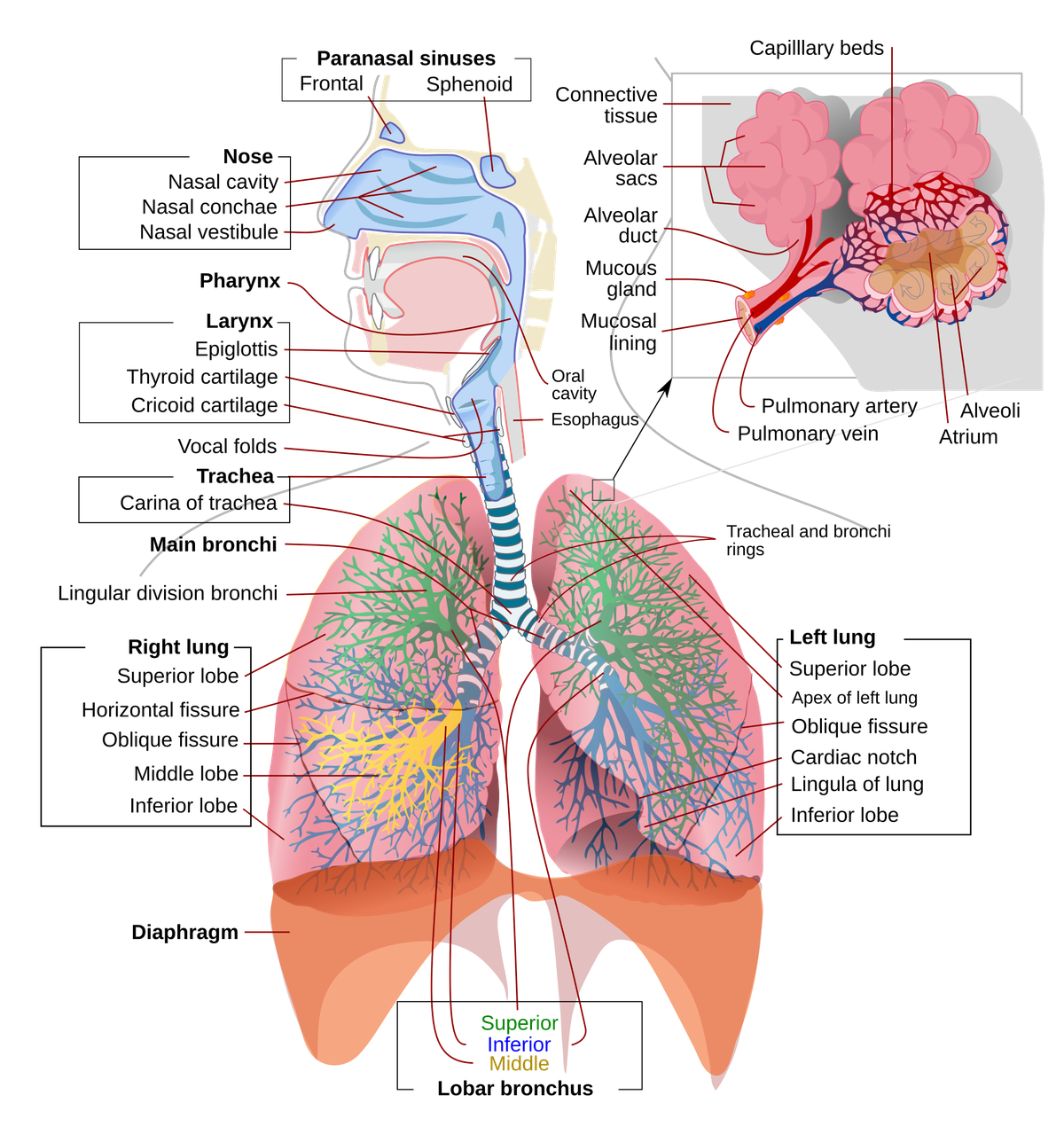
Air travels in and out through these parts:
| Part | Job |
|---|---|
| larynx 喉 | the voice box, at the top of the windpipe |
| trachea 气管 | the windpipe; carries air towards the lungs |
| bronchi 支气管 | two tubes, one going to each lung |
| bronchioles 细支气管 | smaller branching tubes inside the lungs |
| alveoli 肺泡 | tiny air sacs where gas exchange happens; each is wrapped in capillaries 毛细血管 |
The alveoli make excellent gas exchange surfaces: there are millions of them (a huge surface area), each has a wall only one cell thick (a short distance), and each is surrounded by capillaries (a good blood supply).

The lungs sit in the chest, protected by the ribs 肋骨. Below them is a sheet of muscle, the diaphragm 膈肌. Between the ribs are the intercostal muscles 肋间肌. (Supplement) The trachea is held open by rings of cartilage 软骨, so it cannot collapse when you breathe in.

Vocabulary
Train
| English |
|---|
| larynx/ˈlærɪŋks/ |
| trachea/trəˈkɪə/ |
| bronchi/ˈbrɒŋkaɪ/ |
| bronchioles/ˈbrɒŋkɪəʊlz/ |
| alveoli/ˈælvɪɒli/ |
| capillaries/ˈkæpɪləriz/ |
| ribs/rɪbz/ |
| diaphragm/ˈdaɪəfræm/ |
| intercostal muscles/ˌɪntəˈkɒstl ˈmʌslz/ |
| cartilage/ˈkɑːtɪlɪdʒ/ |
11.1
How you breathe (Supplement)

Breathing changes the volume and pressure 压力 inside the chest (the thorax 胸腔).
Breathing in (inhaling 吸气):
- the external intercostal muscles contract, pulling the ribs up and out.
- the diaphragm contracts and flattens (moves down).
- the thorax becomes bigger, so the pressure inside drops below the outside air pressure.
- air is pushed in.
Breathing out (exhaling 呼气) is the opposite: the muscles relax (and the internal intercostal muscles may contract), the thorax becomes smaller, the pressure rises, and air is pushed out.
Explore
Breathing in and out
Breathing changes the volume of the chest, which changes the pressure and makes air flow in or out.
Explore
Breathing mechanism
Watch a breath — the diaphragm flattens and ribs lift, the chest grows, the pressure drops, and air flows in. Relax and it pushes back out.
Vocabulary
Train
| English |
|---|
| pressure/ˈpreʃə/ |
| thorax/ˈθɔːræks/ |
| inhaling/ɪnˈheɪlɪŋ/ |
| exhaling/eksˈheɪlɪŋ/ |
11.1
Inspired and expired air
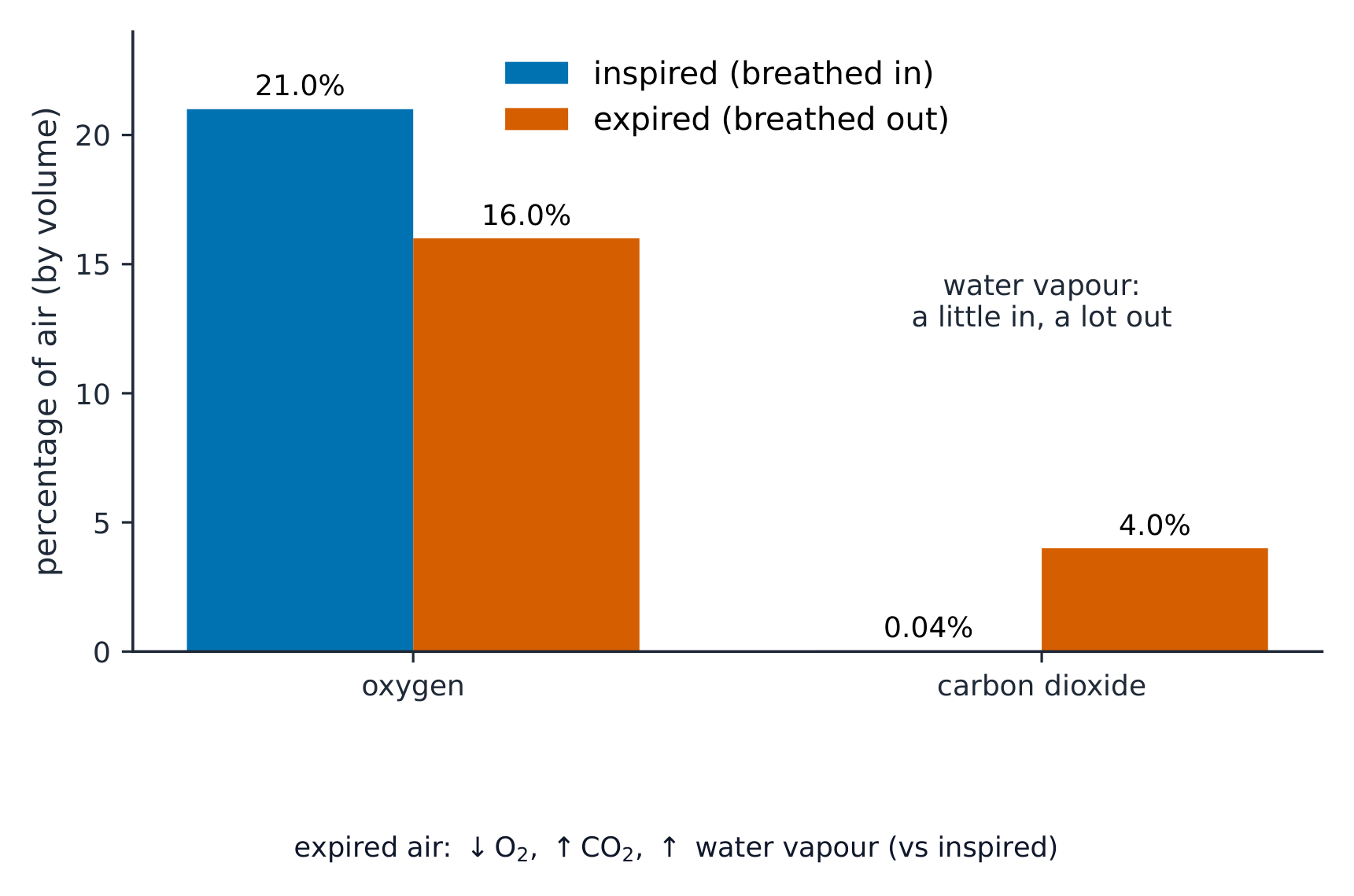
| Gas | Inspired air (breathed in) | Expired air (breathed out) |
|---|---|---|
| oxygen | about 21% | about 16% (less) |
| carbon dioxide | about 0.04% | about 4% (more) |
| water vapour 水蒸气 | a little | a lot (more) |
You can test for carbon dioxide with limewater 石灰水, which turns cloudy. Expired air turns limewater cloudy much faster than inspired air, showing it contains more carbon dioxide.
Vocabulary
Train
| English |
|---|
| water vapour/ˈwɔːtə ˈveɪpə/ |
| limewater/ˈlaɪmwɔːtə/ |
11.1
Breathing and exercise
During exercise your muscles respire faster and make more carbon dioxide. This raises the concentration 浓度 of carbon dioxide in the blood. (Supplement) Your brain 大脑 detects the rise and makes you breathe at a faster rate 速率 and a greater depth. This brings in more oxygen and removes the extra carbon dioxide quickly.
Worked example. At rest a person takes 12 breaths per minute, moving 500 cm³ of air per breath. During exercise this becomes 20 breaths per minute at 900 cm³ per breath. How much air passes through the lungs each minute in each case? Multiply the rate by the depth. At rest: 12 × 500 = 6000 cm³ per minute. During exercise: 20 × 900 = 18 000 cm³ per minute, three times as much. Exercise raises both the rate and the depth of breathing - an answer that changes only the rate throws away half the marks.
Vocabulary
Train
| English |
|---|
| concentration/ˌkɒnsənˈtreɪʃn/ |
| brain/breɪn/ |
| rate/reɪt/ |
11.1
Keeping the airways clean (Supplement)
The airways are lined with two kinds of cell that trap and remove dirt:
- goblet cells 杯状细胞 make mucus 黏液, which traps pathogens 病原体 and dust particles 粒子.
- ciliated cells 纤毛细胞 have tiny hairs that sweep the mucus, with the trapped dirt, up to the throat, where it is swallowed.
Vocabulary
Train
| English |
|---|
| goblet cells/ˈɡɒblət selz/ |
| mucus/ˈmjuːkəs/ |
| pathogens/ˈpæθədʒnz/ |
| particles/ˈpɑːtɪklz/ |
| ciliated cells/ˈsɪlɪeɪtɪd selz/ |
11.1
Exam tips
- A gas exchange surface is large, thin, with a good blood supply and good ventilation.
- Air path: larynx → trachea → bronchi → bronchioles → alveoli.
- Breathing in: external intercostal muscles and diaphragm contract → thorax bigger → pressure lower → air in. Breathing out is the opposite.
- Expired air has less oxygen, more carbon dioxide and more water vapour. Limewater tests for carbon dioxide.
- Exercise → more carbon dioxide in the blood → brain → faster, deeper breathing.
Interactive lessons on this topic
Work through it step by step, with instant-check exercises.