| Core | Supplement |
|---|---|
| 1 State that the Sun is the principal source of energy input to biological systems | |
| 2 Describe the flow of energy through living organisms, including light energy from the Sun and chemical energy in organisms, and its eventual transfer to the environment |
Organisms and their environment
IGCSE Biology · Topic 19
 8:11
8:11
Organisms and their Environment
An African savanna. A coral reef. They look nothing alike, but they run on the same rule. Every living thing here is joined to the others by feeding. Energy…
English narration · English + 中文 subtitles burned in
19.1
Energy flow
Syllabus
Source: Cambridge International syllabus
The Sun is the main source of energy 能量 for almost all life. Plants capture light energy by photosynthesis 光合作用 and store it as chemical energy in food. This energy then passes from organism to organism as they feed. At every step, some energy is lost (mostly as heat from respiration 呼吸作用) to the environment 环境. Energy flows one way — it is not recycled.
Explore
Energy flow through a food chain
Energy from the Sun enters living things through plants, then passes along the food chain — losing a lot at each step.
Vocabulary
Train
| English |
|---|
| energy/ˈenədʒi/ |
| photosynthesis/ˌfəʊtəʊˈsɪnθəsɪs/ |
| respiration/ˌrespɪˈreɪʃn/ |
| environment/enˈvaɪrənmənt/ |
19.2
Food chains and food webs

Syllabus
| Core | Supplement |
|---|---|
| 1 Describe a food chain as showing the transfer of energy from one organism to the next, beginning with a producer | |
| 2 Construct and interpret simple food chains | |
| 3 Describe a food web as a network of interconnected food chains and interpret food webs | |
| 4 Describe a producer as an organism that makes its own organic nutrients, usually using energy from sunlight, through photosynthesis | |
| 5 Describe a consumer as an organism that gets its energy by feeding on other organisms | |
| 6 State that consumers may be classed as primary, secondary, tertiary and quaternary according to their position in a food chain | |
| 7 Describe a herbivore as an animal that gets its energy by eating plants | |
| 8 Describe a carnivore as an animal that gets its energy by eating other animals | |
| 9 Describe a decomposer as an organism that gets its energy from dead or waste organic material | |
| 10 Use food chains and food webs to describe the impact humans have through overharvesting of food species and through introducing foreign species to a habitat | |
| 11 Draw, describe and interpret pyramids of numbers and pyramids of biomass | 15 Draw, describe and interpret pyramids of energy |
| 12 Discuss the advantages of using a pyramid of biomass rather than a pyramid of numbers to represent a food chain | 16 Discuss the advantages of using a pyramid of energy rather than pyramids of numbers or biomass to represent a food chain |
| 13 Describe a trophic level as the position of an organism in a food chain, food web or ecological pyramid | |
| 14 Identify the following as the trophic levels in food webs, food chains and ecological pyramids: producers, primary consumers, secondary consumers, tertiary consumers and quaternary consumers | |
| 17 Explain why the transfer of energy from one trophic level to another is often not efficient | |
| 18 Explain, in terms of energy loss, why food chains usually have fewer than five trophic levels | |
| 19 Explain why it is more energy efficient for humans to eat crop plants than to eat livestock that have been fed on crop plants |
Source: Cambridge International syllabus
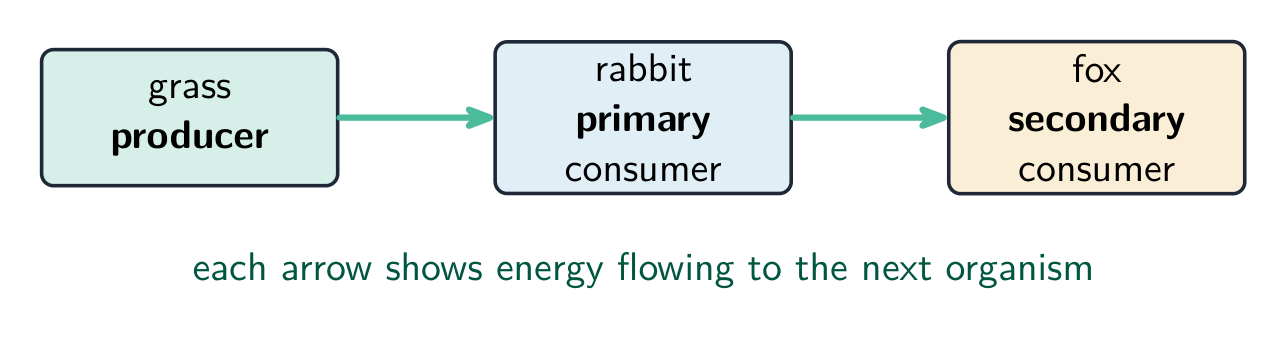
A food chain 食物链 shows the transfer of energy from one organism to the next, starting with a producer. Each arrow points in the direction the energy flows:
grass → rabbit → fox
A food web 食物网 is many food chains linked together.

Producers, consumers and decomposers
| Type | Meaning |
|---|---|
| producer 生产者 | makes its own food (organic nutrients 营养物质), usually by photosynthesis |
| consumer 消费者 | gets its energy by feeding on other organisms |
| herbivore 食草动物 | a consumer that eats plants |
| carnivore 食肉动物 | a consumer that eats other animals |
| decomposer 分解者 | gets its energy from dead or waste material, causing decomposition 分解 |
Consumers are named by their position: a primary consumer eats the producer; a secondary consumer eats the primary consumer; then come tertiary and quaternary consumers.
Trophic levels and pyramids
A trophic level 营养级 is the position of an organism in a food chain (producers first, then primary consumers, and so on). You can show a food chain as a pyramid 金字塔:
- a pyramid of numbers counts the organisms at each level.
- a pyramid of biomass 生物量 shows the total mass at each level — usually a better picture, because it does not depend on how big the organisms are.
- (Supplement) a pyramid of energy shows the energy at each level — the most useful picture of all.

Energy loss along a chain (Supplement)
Only about 10% of the energy at one trophic level passes to the next. The rest is lost as heat (from respiration), in movement, and in waste. Because so much energy is lost, food chains usually have fewer than five trophic levels. It is more energy-efficient for people to eat crop plants 农作物 directly than to eat animals that were fed on those crops, because each extra level wastes energy.
Worked example. The producers in a field trap 40 000 kJ of energy. Roughly how much reaches a secondary consumer, and why do food chains stay short? About 10% passes on at each step. Primary consumers receive 10% of 40 000 = 4000 kJ. Secondary consumers receive 10% of 4000 = 400 kJ - only 1% of what the plants trapped. After a few levels too little energy is left to support another one, which is why chains rarely pass five levels. Apply the 10% again at every step, not once for the whole chain.
Human impact
Humans can damage food webs by:
- overharvesting 过度捕捞 — taking too many of one species (such as overfishing), so its numbers crash.
- introducing a foreign species 外来物种 — a new species may have no predators and may crowd out native species.
Explore
Food web energy route
Move energy from producer to consumers and see why each link loses energy.
Explore
Build the pyramid of energy
Drag the energy the plants capture and watch only a tenth pass up each level — so the top predator is left with almost nothing.
Vocabulary
Train
| English |
|---|
| food chain/fuːd tʃeɪn/ |
| food web/fuːd web/ |
| producer/prəˈdjuːsə/ |
| nutrients/ˈnjuːtrɪənts/ |
| consumer/kənˈsuːmə/ |
| herbivore/ˈhɜːbɪvɔː/ |
| carnivore/ˈkɑːnɪvɔː/ |
| decomposer/ˌdiːkəmˈpəʊzə/ |
| decomposition/ˌdiːkɒmpəˈzɪʃn/ |
| trophic level/ˈtrəʊfɪk ˈlevl/ |
| pyramid/ˈpɪrəmɪd/ |
| biomass/ˌbaɪəʊˈmæs/ |
| crop plants/krɒp plænts/ |
| overharvesting/ˌəʊvəˈhɑːvɪstɪŋ/ |
| foreign species/ˈfɒrən ˈspiːsiːz/ |
19.3
Nutrient cycles

Syllabus
| Core | Supplement |
|---|---|
| 1 Describe the carbon cycle, limited to: photosynthesis, respiration, feeding, decomposition, formation of fossil fuels and combustion | |
| 2 Describe the nitrogen cycle with reference to: • decomposition of plant and animal protein to ammonium ions • nitrification • nitrogen fixation by lightning and bacteria • absorption of nitrate ions by plants • production of amino acids and proteins • feeding and digestion of proteins • deamination • denitrification | |
| 3 State the roles of microorganisms in the nitrogen cycle, limited to: decomposition, nitrification, nitrogen fixation and denitrification (generic names of individual bacteria, e.g. Rhizobium, are not required) |
Source: Cambridge International syllabus
Unlike energy, nutrients are recycled — used again and again.
The carbon cycle
In the carbon cycle 碳循环:
- photosynthesis removes carbon dioxide 二氧化碳 from the air.
- respiration and combustion 燃烧 (burning) return carbon dioxide to the air.
- feeding passes carbon from one organism to the next.
- decomposition returns carbon to the air and soil.
- over millions of years, dead organisms can form fossil fuels 化石燃料 (coal and oil), which release carbon dioxide when they are burned.
The nitrogen cycle (Supplement)
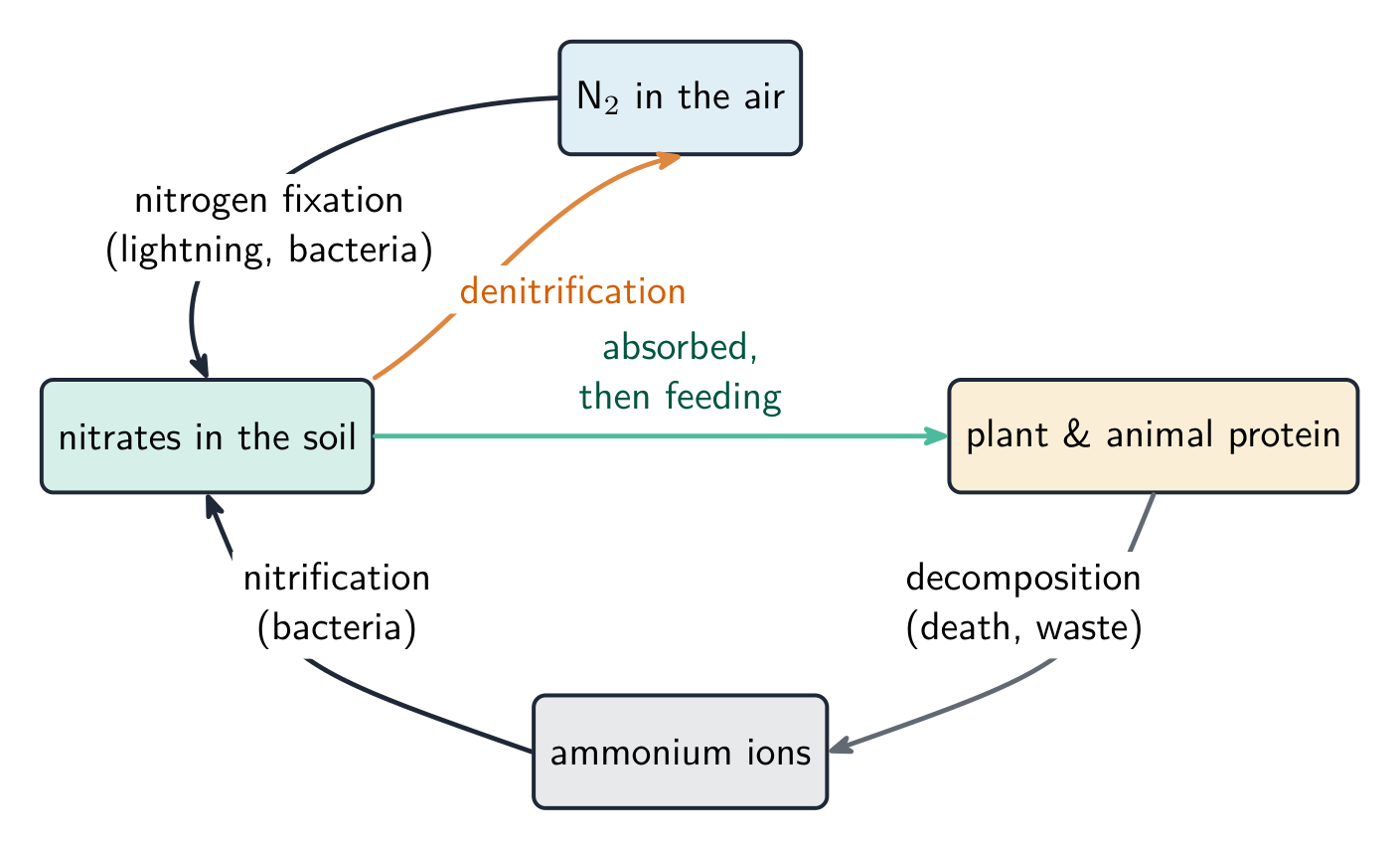
The nitrogen cycle 氮循环 recycles nitrogen for making proteins 蛋白质. Microorganisms 微生物 do most of the work:
- decomposition: decomposers break dead protein down into ammonium ions 铵离子.
- nitrification 硝化作用: bacteria change ammonium ions into nitrate ions 硝酸根离子.
- nitrogen fixation 固氮作用: lightning and some bacteria 细菌 turn nitrogen gas into compounds that plants can use.
- plants absorb nitrate ions to make amino acids 氨基酸 and proteins; animals get them by feeding and digestion 消化.
- deamination 脱氨基作用 (in the liver) and decomposition release nitrogen compounds again.
- denitrification 反硝化作用: some bacteria turn nitrate ions back into nitrogen gas.
Explore
The carbon cycle
Carbon moves between the air, living things and the ground in a never-ending cycle.
Vocabulary
Train
| English |
|---|
| carbon cycle/ˈkɑːbən ˈsaɪkl/ |
| carbon dioxide/ˈkɑːbən daɪˈɒksaɪd/ |
| combustion/kəmˈbʌstʃn/ |
| fossil fuels/ˈfɒsl ˈfjuːəlz/ |
| nitrogen cycle/ˈnaɪtrədʒn ˈsaɪkl/ |
| proteins/ˈprəʊtiːnz/ |
| microorganisms/ˌmaɪkrəʊˈɔːɡənɪzəmz/ |
| ammonium ions/æˈməʊnɪəm ˈaɪɒnz/ |
| nitrification/ˌnaɪtrɪfɪˈkeɪʃn/ |
| nitrate ions/ˈnaɪtreɪt ˈaɪɒnz/ |
| nitrogen fixation/ˈnaɪtrədʒn fɪkˈseɪʃn/ |
| bacteria/bækˈtɪərɪə/ |
| amino acids/əˈmiːnəʊ ˈæsɪdz/ |
| digestion/daɪˈdʒestʃn/ |
| deamination/ˌdiːmɪˈneɪʃn/ |
| denitrification/diːˌnaɪtrɪfɪˈkeɪʃn/ |
19.4
Populations
Syllabus
| Core | Supplement |
|---|---|
| 1 Describe a population as a group of organisms of one species, living in the same area, at the same time | |
| 2 Describe a community as all of the populations of different species in an ecosystem | |
| 3 Describe an ecosystem as a unit containing the community of organisms and their environment, interacting together | |
| 4 Identify and state the factors affecting the rate of population growth for a population of an organism, limited to food supply, competition, predation and disease | |
| 5 Identify the lag, exponential (log), stationary and death phases in the sigmoid curve of population growth for a population growing in an environment with limited resources | |
| 6 Interpret graphs and diagrams of population growth | 7 Explain the factors that lead to each phase in the sigmoid curve of population growth, making reference, where appropriate, to the role of limiting factors |
Source: Cambridge International syllabus
- a population 种群 is a group of organisms of one species 物种, living in the same area at the same time.
- a community 群落 is all the populations of different species in one place.
- an ecosystem 生态系统 is the community together with its environment, all interacting.
Population growth
The growth of a population depends on the food supply, competition 竞争, predation 捕食 (being eaten) and disease.
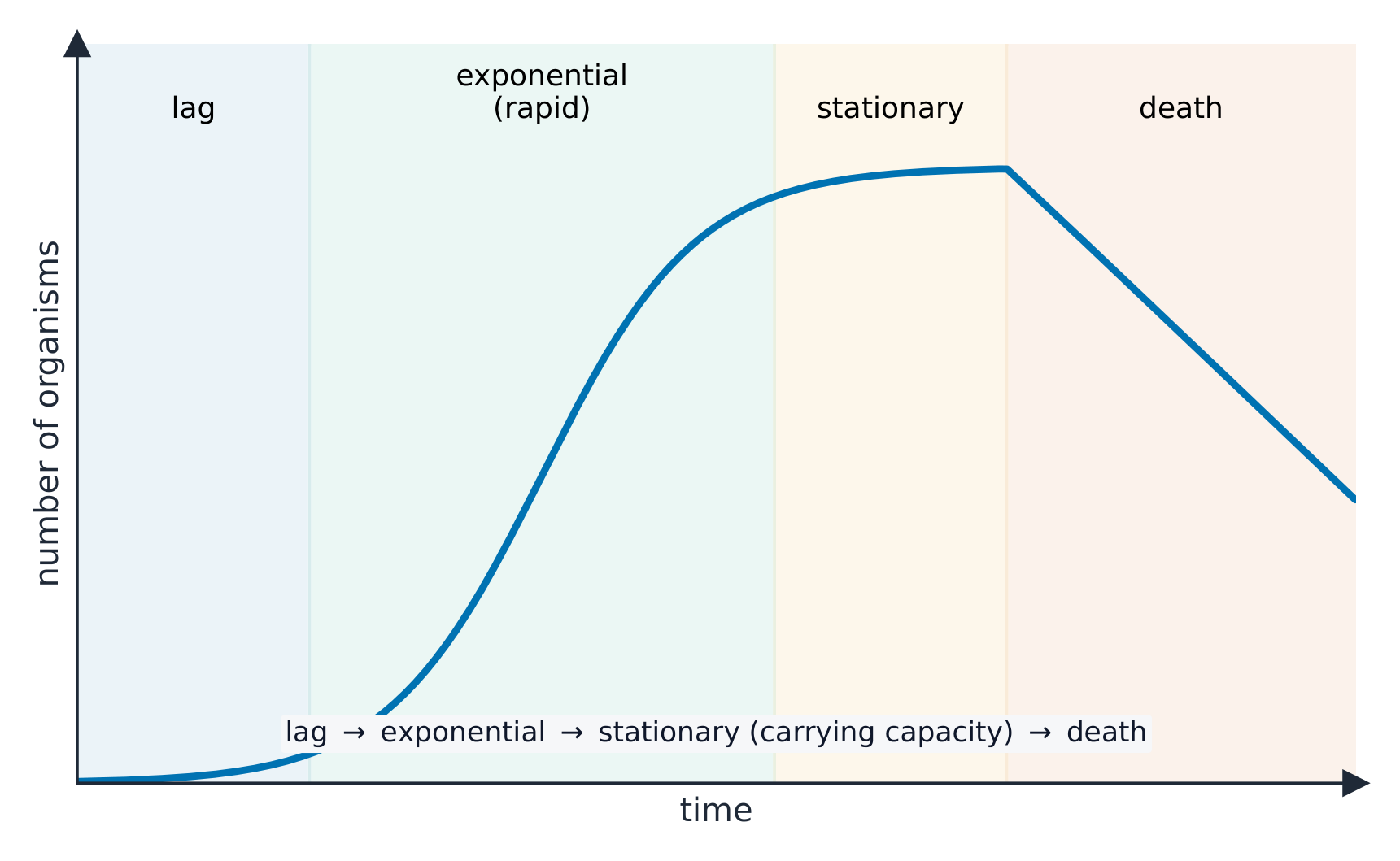
When a population grows in a place with limited resources 资源, its growth follows an S-shaped curve with four phases:
| Phase | What happens |
|---|---|
| lag phase 延迟期 | slow growth at first, while numbers are still small |
| exponential phase 对数期 | very fast growth, with plenty of food and space |
| stationary phase 稳定期 | growth stops; births ≈ deaths (a limiting factor 限制因素 such as food holds it back) |
| death phase 衰亡期 | numbers fall as food runs out, wastes build up, or disease spreads |
Explore
How a population grows
Change the growth rate and the carrying capacity. Growth is fast at first, then levels off as resources run short.
Vocabulary
Train
| English |
|---|
| population/ˌpɒpjʊˈleɪʃn/ |
| species/ˈspiːsiːz/ |
| community/kəˈmjuːnɪti/ |
| ecosystem/ˈiːkəʊsɪstəm/ |
| competition/ˌkɒmpəˈtɪʃn/ |
| predation/prɪˈdeɪʃn/ |
| resources/rɪˈzɔːsɪz/ |
| lag phase/læɡ feɪz/ |
| exponential phase/ˌekspəˈnenʃl feɪz/ |
| stationary phase/ˈsteɪʃənəri feɪz/ |
| limiting factor/ˈlɪmɪtɪŋ ˈfæktə/ |
| death phase/deθ feɪz/ |
19.4
Exam tips
- Energy enters from the Sun, flows one way along the chain, and is lost as heat at each step. Nutrients are recycled.
- Food chain starts with a producer; arrows show energy flow. Learn producer, consumer, herbivore, carnivore, decomposer.
- Only ~10% of energy passes up each trophic level, so chains are short and eating plants is more efficient.
- Carbon cycle: photosynthesis ↔ respiration and combustion; nitrogen cycle (Supplement): fixation, nitrification, denitrification by microorganisms.
- Population: one species, one area, one time. Learn the four phases of the S-shaped growth curve.
Interactive lessons on this topic
Work through it step by step, with instant-check exercises.