| Core | Supplement |
|---|---|
| 1 Describe what is meant by a balanced diet | |
| 2 State the principal dietary sources and describe the importance of: (a) carbohydrates (b) fats and oils (c) proteins (d) vitamins, limited to C and D (e) mineral ions, limited to calcium and iron (f) fibre (roughage) (g) water | |
| 3 State the causes of scurvy and rickets |
Human nutrition
IGCSE Biology · Topic 7
 15:52
15:52
Human Nutrition
The food on your plate is made of molecules far too big to enter your blood. So your body takes it apart — first by crushing it, then by cutting the molecules…
English narration · English + 中文 subtitles burned in
7.1
A balanced diet

Syllabus
Source: Cambridge International syllabus
A balanced diet 均衡饮食 gives you all the substances you need, in the right amounts. There are seven parts.

| Part of diet | Good sources | Why you need it |
|---|---|---|
| carbohydrates 碳水化合物 | rice, bread, potatoes | the main source of energy 能量 |
| fats 脂肪 and oils | butter, oil, nuts | an energy store; help keep you warm |
| proteins 蛋白质 | meat, fish, eggs, beans | growth and repair of cells |
| vitamin 维生素 C | fresh fruit, vegetables | keeps skin and gums healthy |
| vitamin D | sunlight, oily fish, eggs | helps the body take in calcium 钙 |
| mineral ions 矿物质离子 — calcium | milk, cheese | strong bones and teeth |
| mineral ions — iron 铁 | red meat, leafy greens | needed to make haemoglobin 血红蛋白, the red pigment in red blood cells that carries oxygen |
| fibre 膳食纤维 (roughage) | vegetables, whole grains | keeps food moving through the gut |
| water | drinks and food | needed for all reactions; most of the body is water |
Two diseases come from missing a vitamin:
- too little vitamin C → scurvy 坏血病 (bleeding gums, slow healing).
- too little vitamin D → rickets 佝偻病 (soft, bent bones), because the body cannot take in enough calcium.
Worked example. A child eats almost no fresh fruit or vegetables. Their gums bleed and small cuts heal slowly. Which part of the diet is missing, and why does that explain the symptoms? Fresh fruit and vegetables are the main source of vitamin C, and too little vitamin C causes scurvy - whose signs are exactly bleeding gums and slow healing. So the missing part is vitamin C. Name the substance and the disease separately: an answer that says only "a vitamin deficiency" does not earn the mark.
Explore
Balanced diet lab
Match dietary needs to the nutrient that solves the problem.
Vocabulary
Train
| English |
|---|
| balanced diet/ˈbælənst ˈdaɪət/ |
| carbohydrates/ˌkɑːbəʊˈhaɪdreɪts/ |
| energy/ˈenədʒi/ |
| fats/fæts/ |
| proteins/ˈprəʊtiːnz/ |
| vitamin/ˈvɪtəmɪn/ |
| calcium/ˈkælsɪəm/ |
| mineral ions/ˈmɪnərəl ˈaɪɒnz/ |
| iron/ˈaɪən/ |
| haemoglobin/ˌhiːməˈɡləʊbɪn/ |
| fibre/ˈfaɪbə/ |
| scurvy/ˈskɜːvi/ |
| rickets/ˈrɪkɪts/ |
7.2
The digestive system

Syllabus
| Core | Supplement |
|---|---|
| 1 Identify in diagrams and images the main organs of the digestive system, limited to: (a) alimentary canal: mouth, oesophagus, stomach, small intestine (duodenum and ileum) and large intestine (colon, rectum, anus) (b) associated organs: salivary glands, pancreas, liver and gall bladder | |
| 2 Describe the functions of the organs of the digestive system listed in 7.2.1, in relation to: (a) ingestion – the taking of substances, e.g. food and drink, into the body (b) digestion – the breakdown of food (c) absorption – the movement of nutrients from the intestines into the blood (d) assimilation – uptake and use of nutrients by cells (e) egestion – the removal of undigested food from the body as faeces |
Source: Cambridge International syllabus
The digestive system 消化系统 breaks food down. Food passes along one long tube, the alimentary canal 消化道:
mouth → oesophagus 食道 → stomach 胃 → small intestine 小肠 (the duodenum 十二指肠 then the ileum 回肠) → large intestine 大肠 (the colon 结肠, rectum 直肠 and anus 肛门).
Some organs help with digestion but food does not pass through them: the salivary glands 唾液腺 in the mouth, the pancreas 胰腺, the liver 肝脏 and the gall bladder 胆囊.
Five things happen to food, in order:
| Process | What it means |
|---|---|
| ingestion 摄入 | taking food and drink into the body through the mouth |
| digestion 消化 | breaking food down into small molecules |
| absorption 吸收 | nutrients 营养物质 move from the intestine into the blood |
| assimilation 同化 | cells take in and use the nutrients |
| egestion 排遗 | undigested food leaves the body as faeces 粪便 |
Explore
Through the digestive system
Food travels along the gut; each part does a different job to break it down and absorb it.
Vocabulary
Train
| English |
|---|
| digestive system/daɪˈdʒestɪv ˈsɪstəm/ |
| alimentary canal/əlaɪˈmentəri kəˈnæl/ |
| oesophagus/ɪˈsɒfəɡəs/ |
| stomach/ˈstʌmək/ |
| small intestine/smɔːl ɪnˈtestɪn/ |
| duodenum/ˈdjuːəʊdnəm/ |
| ileum/ɪˈliːəm/ |
| large intestine/lɑːdʒ ɪnˈtestɪn/ |
| colon/ˈkəʊlən/ |
| rectum/ˈrektəm/ |
| anus/ˈeɪnʌs/ |
| salivary glands/ˈsælɪvəri ɡlændz/ |
| pancreas/ˈpæŋkrɪəs/ |
| liver/ˈlɪvə/ |
| gall bladder/ɡɔːl ˈblædə/ |
| ingestion/ɪnˈdʒestʃn/ |
| digestion/daɪˈdʒestʃn/ |
| nutrients/ˈnjuːtrɪənts/ |
| absorption/əbˈsɔːpʃn/ |
| assimilation/əˌsɪmɪˈleɪʃn/ |
| egestion/ɪˈdʒestʃn/ |
| faeces/ˈfiːsiːz/ |
7.3
Physical digestion

Syllabus
| Core | Supplement |
|---|---|
| 1 Describe physical digestion as the breakdown of food into smaller pieces without chemical change to the food molecules | |
| 2 State that physical digestion increases the surface area of food for the action of enzymes in chemical digestion | |
| 3 Identify in diagrams and images the types of human teeth: incisors, canines, premolars and molars | |
| 4 Describe the structure of human teeth, limited to: enamel, dentine, pulp, nerves, blood vessels and cement, and understand that teeth are embedded in bone and the gums | |
| 5 Describe the functions of the types of human teeth in physical digestion of food | |
| 6 Describe the function of the stomach in physical digestion | |
| 7 Outline the role of bile in emulsifying fats and oils to increase the surface area for chemical digestion |
Source: Cambridge International syllabus
Physical digestion breaks food into smaller pieces without changing the food molecules. This gives a larger surface area 表面积 for the enzymes 酶 to act on later.
Teeth
You have four kinds of teeth 牙齿:
| Tooth | Job |
|---|---|
| incisors 门齿 | sharp front teeth for biting and cutting |
| canines 犬齿 | pointed teeth for tearing |
| premolars 前臼齿 | flat teeth for chewing and grinding |
| molars 臼齿 | flat back teeth for chewing and grinding |
A tooth is built from these parts:
| Part | Description |
|---|---|
| enamel 牙釉质 | hard white outer layer; the hardest material in the body |
| dentine 牙本质 | softer, bone-like layer under the enamel |
| pulp 牙髓 | soft centre with nerves 神经 and blood vessels 血管 |
| cement 牙骨质 | fixes the root into the jaw |
Teeth are set into the bone of the jaw and held firm by the gums 牙龈.

The stomach
The wall of the stomach is made of muscle 肌肉 that squeezes and mixes the food, breaking it into smaller pieces.
Bile (Supplement)
Bile 胆汁 is made in the liver and stored in the gall bladder. It emulsifies 乳化 fats and oils — it breaks large drops of fat into many tiny droplets. This gives a much larger surface area for the enzyme lipase 脂肪酶 to digest the fat. Bile itself contains no enzymes.
Explore
Physical (mechanical) digestion
Physical digestion breaks food into smaller pieces WITHOUT changing it chemically — it just increases the surface area for enzymes.
Vocabulary
Train
| English |
|---|
| surface area/ˈsɜːfɪs ˈeərɪə/ |
| enzymes/ˈenzaɪmz/ |
| teeth/tiːθ/ |
| incisors/ɪnˈsaɪzəz/ |
| canines/ˈkeɪnaɪnz/ |
| premolars/priːˈməʊləz/ |
| molars/ˈməʊləz/ |
| enamel/ɪˈnæml/ |
| dentine/ˈdentiːn/ |
| pulp/pʌlp/ |
| nerves/nɜːvz/ |
| blood vessels/blʌd ˈveslz/ |
| cement/sɪˈment/ |
| gums/ɡʌmz/ |
| muscle/ˈmʌsl/ |
| bile/baɪl/ |
| emulsifies/ɪˈmʌlsɪfaɪz/ |
| lipase/ˈlɪpeɪs/ |
7.4
Chemical digestion

Syllabus
| Core | Supplement |
|---|---|
| 1 Describe chemical digestion as the breakdown of large insoluble molecules into small soluble molecules | |
| 2 State the role of chemical digestion in producing small soluble molecules that can be absorbed | |
| 3 Describe the functions of enzymes as follows: (a) amylase breaks down starch to simple reducing sugars (b) proteases break down protein to amino acids (c) lipase breaks down fats and oils to fatty acids and glycerol | 6 Describe the digestion of starch in the digestive system: (a) amylase breaks down starch to maltose (b) maltase breaks down maltose to glucose on the membranes of the epithelium lining the small intestine |
| 4 State where, in the digestive system, amylase, protease and lipase are secreted and where they act | 7 Describe the digestion of protein by proteases in the digestive system: (a) pepsin breaks down protein in the acidic conditions of the stomach (b) trypsin breaks down protein in the alkaline conditions of the small intestine |
| 5 Describe the functions of hydrochloric acid in gastric juice, limited to killing harmful microorganisms in food and providing an acidic pH for optimum enzyme activity | 8 Explain that bile is an alkaline mixture that neutralises the acidic mixture of food and gastric juices entering the duodenum from the stomach, to provide a suitable pH for enzyme action |
Source: Cambridge International syllabus
Chemical digestion breaks large insoluble 不溶性 molecules into small soluble 可溶性 molecules. Only small soluble molecules can be absorbed into the blood. Enzymes carry out this work.
| Enzyme | Breaks down | Into | Made in |
|---|---|---|---|
| amylase 淀粉酶 | starch 淀粉 | reducing sugars 还原糖 | salivary glands, pancreas |
| protease 蛋白酶 | protein | amino acids 氨基酸 | stomach, pancreas |
| lipase | fats and oils | fatty acids 脂肪酸 and glycerol 甘油 | pancreas |
Acid in the stomach
The stomach makes hydrochloric acid 盐酸, which is part of the gastric juice 胃液. This acid:
- kills harmful microorganisms 微生物 in the food, and
- gives an acidic 酸性 pH, the best pH for the stomach's protease to work.
Digesting starch and protein (Supplement)
Starch is digested in two steps:
- amylase breaks starch into maltose 麦芽糖.
- maltase 麦芽糖酶, on the membranes of the epithelium 上皮 lining the small intestine, breaks maltose into glucose 葡萄糖.
Protein is digested by two proteases:
- pepsin 胃蛋白酶 breaks protein down in the acidic stomach.
- trypsin 胰蛋白酶 breaks protein down in the alkaline 碱性 small intestine.
Bile is alkaline. It neutralises 中和 the acidic food and gastric juice as they enter the duodenum, giving a suitable pH for the enzymes there.
Explore
How fast a digestive enzyme works
Add more substrate and the reaction rate climbs, then levels off as every enzyme is busy — the same way amylase, protease and lipase break down food.
Vocabulary
Train
| English |
|---|
| insoluble/ɪnˈsɒljuːbl/ |
| soluble/ˈsɒljuːbl/ |
| amylase/ˈæmɪleɪz/ |
| starch/stɑːtʃ/ |
| reducing sugars/rɪˈdjuːsɪŋ ˈʃʊɡəz/ |
| protease/ˈprəʊteɪs/ |
| amino acids/əˈmiːnəʊ ˈæsɪdz/ |
| fatty acids/ˈfæti ˈæsɪdz/ |
| glycerol/ˈɡlɪsərɒl/ |
| hydrochloric acid/ˌhaɪdrəˈklɔːrɪk ˈæsɪd/ |
| gastric juice/ˈɡæstrɪk dʒuːs/ |
| microorganisms/ˌmaɪkrəʊˈɔːɡənɪzəmz/ |
| acidic/əˈsɪdɪk/ |
| maltose/ˈmɒltəʊs/ |
| maltase/ˈmɒlteɪs/ |
| epithelium/ˌepɪˈθiːlɪəm/ |
| glucose/ˈɡluːkəʊs/ |
| pepsin/ˈpepsɪn/ |
| trypsin/ˈtrɪpsɪn/ |
| alkaline/ˈælkəlaɪn/ |
| neutralises/ˈnjuːtrəlaɪzɪz/ |
7.5
Absorption

Syllabus
| Core | Supplement |
|---|---|
| 1 State that the small intestine is the region where nutrients are absorbed | |
| 3 Explain the significance of villi and microvilli in increasing the internal surface area of the small intestine | |
| 4 Describe the structure of a villus | |
| 5 Describe the roles of capillaries and lacteals in villi | |
| 2 State that most water is absorbed from the small intestine but that some is also absorbed from the colon |
Source: Cambridge International syllabus
Digested nutrients are absorbed into the blood in the small intestine. Most water is absorbed here too; the colon absorbs the rest, leaving solid faeces.
Villi (Supplement)
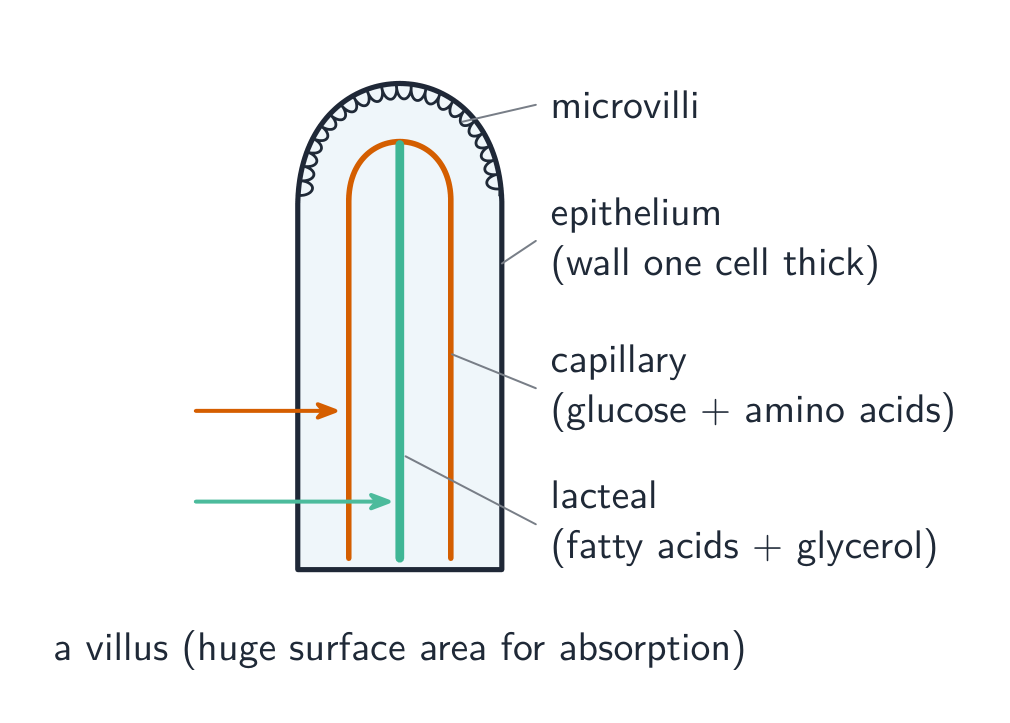
The inside of the small intestine is covered with millions of tiny finger-shaped villi 绒毛. Each villus is itself covered in much smaller microvilli 微绒毛. Together these give a huge surface area, so absorption is fast.
A single villus has:
- a wall just one cell thick, so molecules have only a short distance to travel.
- a network of capillaries 毛细血管 that carry away absorbed glucose and amino acids.
- a lacteal 乳糜管 in the centre that carries away absorbed fatty acids and glycerol.
Explore
Absorption at the villi
The small intestine is lined with millions of villi that give a huge surface area for absorbing digested food.
Vocabulary
Train
| English |
|---|
| villi/ˈvɪlaɪ/ |
| microvilli/ˈmaɪkrəʊvɪlaɪ/ |
| capillaries/ˈkæpɪləriz/ |
| lacteal/ˈlæktɪəl/ |
7.5
Exam tips
- A balanced diet has the right amount of each part. Learn one source and one use for each.
- Vitamin C ↔ scurvy; vitamin D ↔ rickets.
- The five processes in order: ingestion → digestion → absorption → assimilation → egestion. Egestion (faeces) is not excretion.
- Physical digestion makes pieces smaller (more surface area); chemical digestion uses enzymes to make molecules smaller and soluble.
- amylase → sugars, protease → amino acids, lipase → fatty acids + glycerol. Stomach acid kills microorganisms and sets a low pH.
- Villi and microvilli give a large surface area, and a thin wall gives a short distance — both make absorption faster.
Interactive lessons on this topic
Work through it step by step, with instant-check exercises.