| Core | Supplement |
|---|---|
| 1 Describe a catalyst as a substance that increases the rate of a chemical reaction and is not changed by the reaction | |
| 2 Describe enzymes as proteins that are involved in all metabolic reactions, where they function as biological catalysts | |
| 3 Describe why enzymes are important in all living organisms in terms of a reaction rate necessary to sustain life | |
| 4 Describe enzyme action with reference to the shape of the active site of an enzyme being complementary to its substrate and the formation of products | 6 Explain enzyme action with reference to: active site, enzyme-substrate complex, substrate and product |
| 7 Explain the specificity of enzymes in terms of the complementary shape and fit of the active site with the substrate | |
| 5 Investigate and describe the effect of changes in temperature and pH on enzyme activity with reference to optimum temperature and denaturation | 8 Explain the effect of changes in temperature on enzyme activity in terms of kinetic energy, shape and fit, frequency of effective collisions and denaturation |
| 9 Explain the effect of changes in pH on enzyme activity in terms of shape and fit and denaturation |
Enzymes
IGCSE Biology · Topic 5
 5:54
5:54
Enzymes
Every second, thousands of chemical reactions are running inside you. Left to themselves, almost all of them would be far too slow to keep you alive. What…
English narration · English + 中文 subtitles burned in
5.1
What enzymes are

Syllabus
Source: Cambridge International syllabus
A catalyst 催化剂 is a substance that speeds up the rate 速率 of a chemical reaction 化学反应 but is not used up or changed by the reaction. The same catalyst can be used again and again.
Enzymes 酶 are biological catalysts — catalysts made by living cells. They are proteins 蛋白质. Enzymes take part in all the reactions of metabolism 新陈代谢, so they control almost every chemical reaction in a living thing.
Enzymes are vital. Without them, the reactions that keep you alive would be far too slow. Enzymes raise the reaction rate enough to keep the organism alive.
Explore
What enzymes do
rate rises then plateaus
More substrate means a faster reaction — until the enzymes can't keep up.
Vocabulary
Train
| English |
|---|
| catalyst/ˈkætəlɪst/ |
| rate/reɪt/ |
| chemical reaction/ˈkemɪkl rɪˈækʃn/ |
| enzymes/ˈenzaɪmz/ |
| proteins/ˈprəʊtiːnz/ |
| metabolism/məˈtæbəlɪzəm/ |
5.1
How an enzyme works

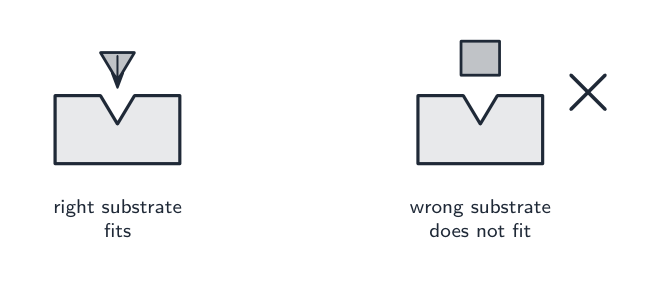
Each enzyme has a special pocket called its active site 活性位点. The molecule 分子 it works on is called the substrate 底物.
- The shape of the active site is complementary 互补 to the shape of the substrate — they fit together like a key in a lock.
- The substrate slots into the active site. (Supplement) This makes an enzyme-substrate complex 酶底物复合物.
- The reaction takes place, and the substrate is changed into one or more products 产物.
- The products leave the active site, which is then free to be used again.

Why enzymes are specific (Supplement)
Each enzyme is specific 专一 — it works on only one kind of substrate. This is because only that substrate has the right shape to fit the active site. A substrate of a different shape will not fit, just as the wrong key will not open a lock.
Vocabulary
Train
| English |
|---|
| active site/ˈæktɪv saɪt/ |
| molecule/ˈmɒlɪkjuːl/ |
| substrate/ˈsʌbstreɪt/ |
| complementary/ˌkɒmplɪˈmentəri/ |
| enzyme-substrate complex/ˈenzaɪm ˈsʌbstreɪt ˈkɒmpleks/ |
| products/ˈprɒdʌkts/ |
| specific/spəˈsɪfɪk/ |
5.1
The effect of temperature and pH
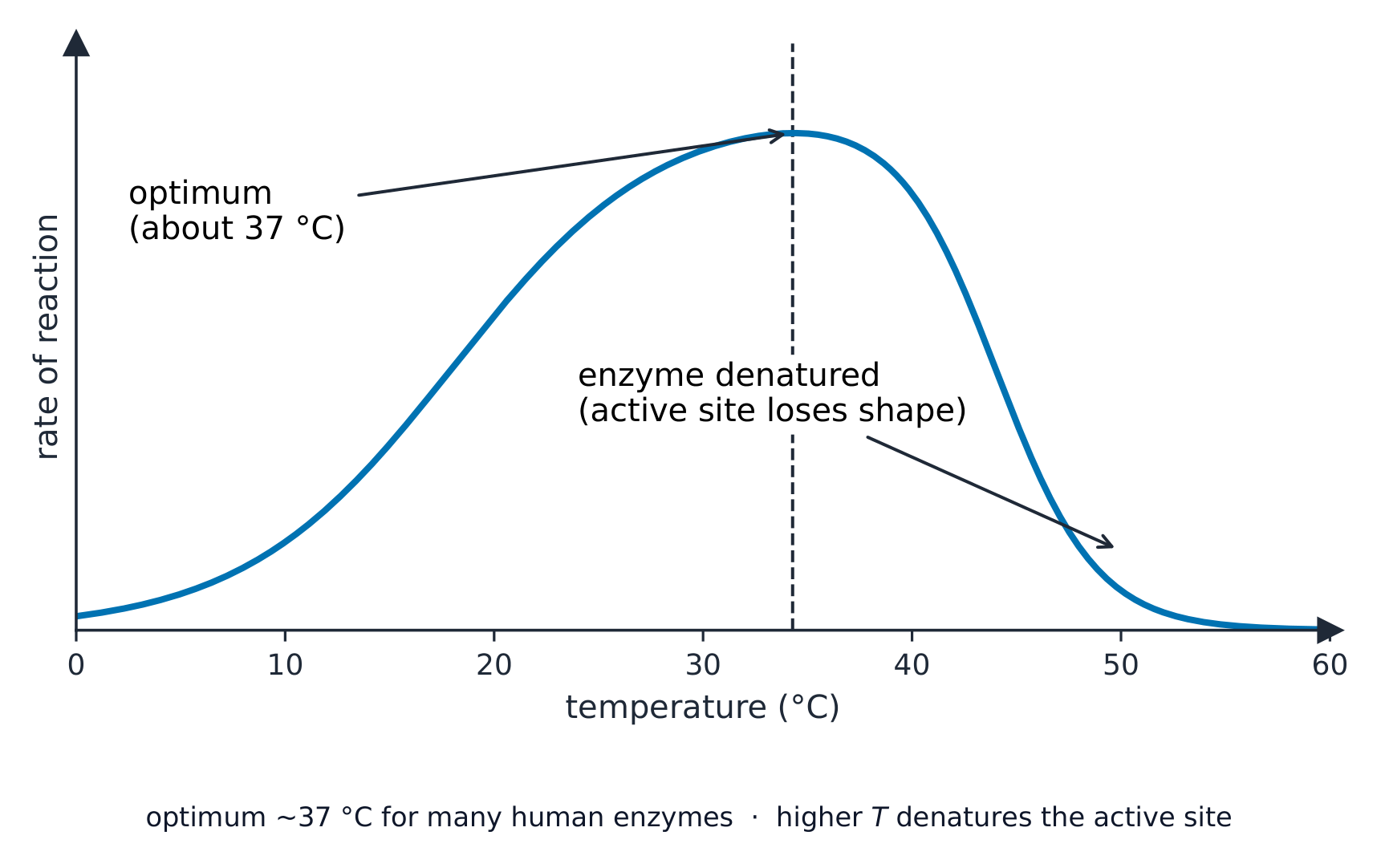
The activity of an enzyme depends on temperature 温度 and pH. You can investigate this by measuring how fast the reaction goes at different temperatures or pH values.
Temperature
- As the temperature rises from cold, enzyme activity speeds up. The enzyme and substrate molecules have more kinetic energy 动能, so they move faster and meet more often. (Supplement) There are more useful collisions 碰撞 each second.
- Activity is highest at the optimum temperature 最适温度 (about 37 °C in the human body).
- Above the optimum, activity falls fast. The heat changes the shape of the active site, so the substrate no longer fits. The enzyme is denatured 变性. Denaturation is permanent — the enzyme cannot recover.
Worked example. A reaction finishes in 50 s at 20 °C, and in 20 s at 37 °C. Which temperature is faster, and by how much? A shorter time means a faster rate, so work out a rate with rate = 1000 ÷ time. At 20 °C the rate is 1000 ÷ 50 = 20 units; at 37 °C it is 1000 ÷ 20 = 50 units. So 37 °C is 50 ÷ 20 = 2.5 times faster. Do not say the rate "went up by 30 s" - a time is not a rate. Turn the time into a rate first, and remember the bigger rate always goes with the smaller time.
pH
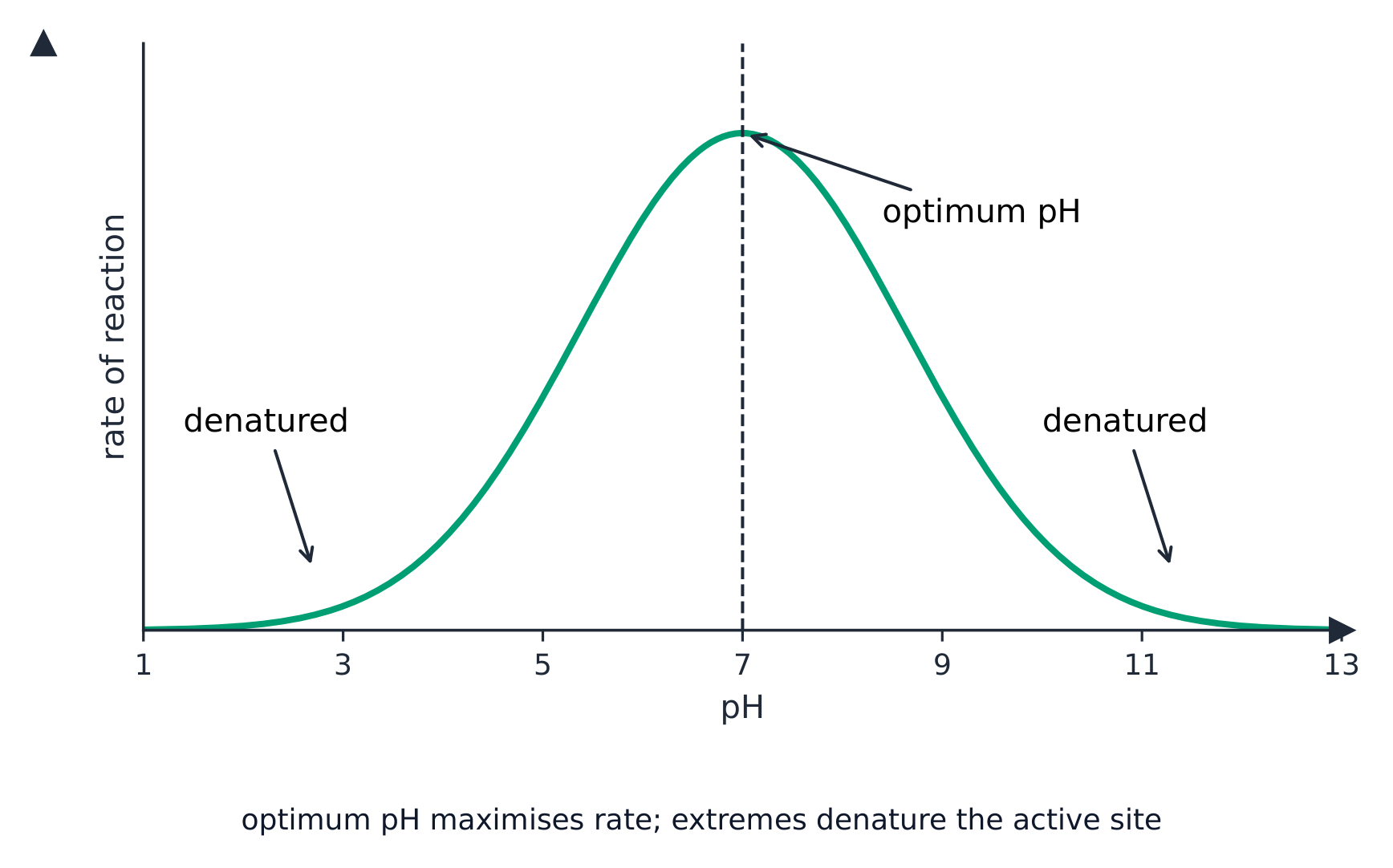
- Each enzyme works best at one particular pH.
- If the pH is too high or too low, the shape of the active site changes, the substrate stops fitting, and the enzyme is denatured.
Explore
Temperature and enzyme activity
Drag the temperature. Activity rises to an optimum, then falls as the enzyme denatures.
Vocabulary
Train
| English |
|---|
| temperature/ˈtemprɪtʃə/ |
| kinetic energy/kɪˈnetɪk ˈenədʒi/ |
| collisions/kəˈlɪʒnz/ |
| optimum temperature/ˈɒptɪməm ˈtemprɪtʃə/ |
| denatured/ˈdenətʃəd/ |
5.1
Exam tips
- An enzyme is both a protein and a biological catalyst: it speeds up a reaction and is not used up.
- Describe the shape: the active site is complementary to the substrate (the lock-and-key idea). Each enzyme is specific to one substrate.
- Low temperature → slow (too little kinetic energy). Optimum → fastest. Too hot → denatured (the active site loses its shape, permanently).
- The wrong pH also denatures the enzyme by changing the shape of the active site.
- "Denatured" does not mean "killed" — enzymes are not alive. Say that the shape of the active site has changed so the substrate no longer fits.
Interactive lessons on this topic
Work through it step by step, with instant-check exercises.