Why it matters. Manchester had about 75,000 people in 1801 and over 300,000 by 1851, most of them working in or around cotton mills. Visitors called it the first industrial city: rich, smoky, crowded and new. Every argument of the nineteenth century, about who should vote, what workers were owed and whether capitalism could be reformed, was in part an argument about places like Manchester.
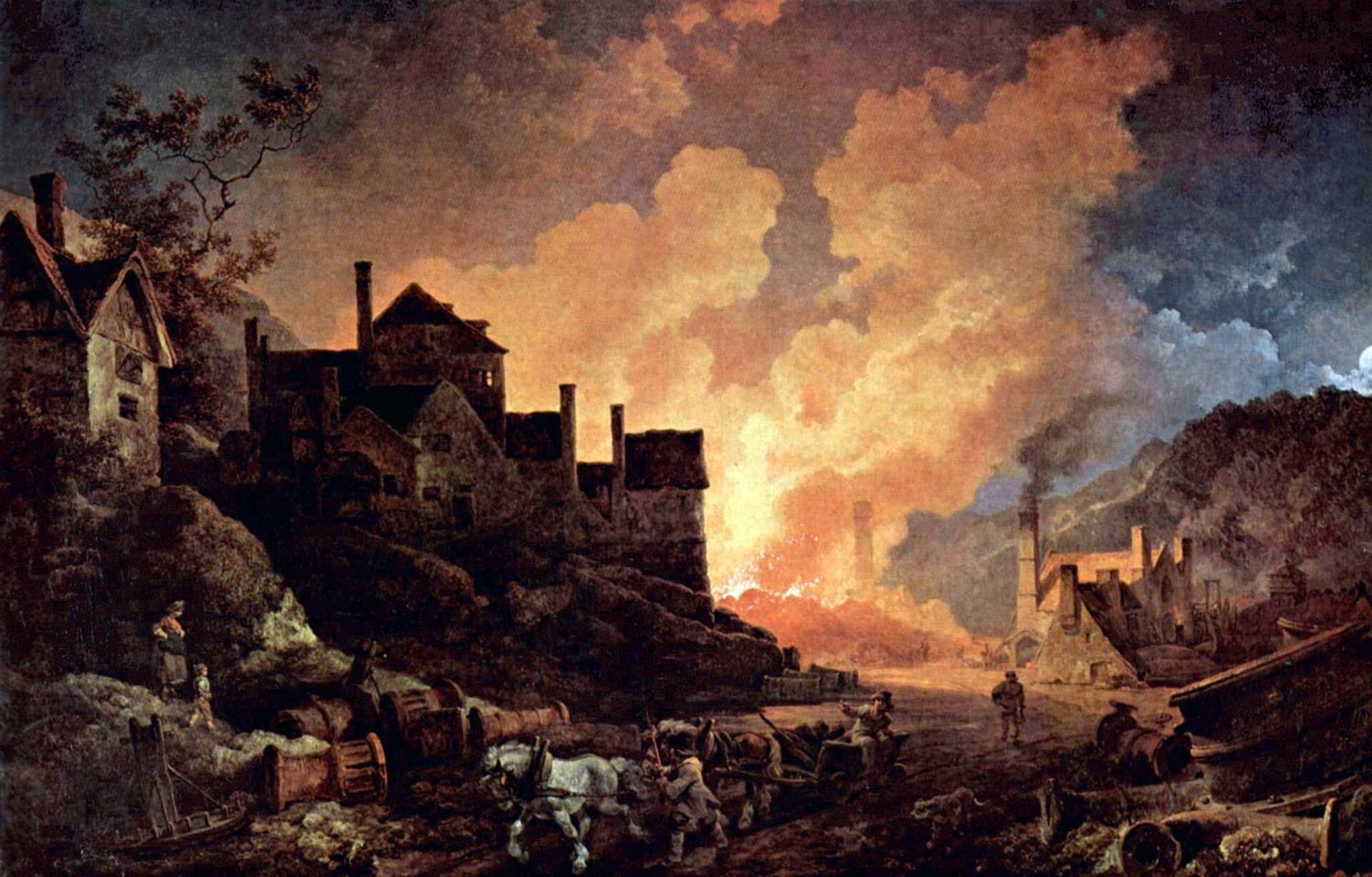
Philip James de Loutherbourg, Coalbrookdale by Night (1801): ironworks furnaces light up the Shropshire valley
Unit 6 covers c. 1815 to c. 1914 and rests on three claims the CED states as key concepts:
The Industrial Revolution 工业革命 spread from Great Britain to the continent, where the state played a greater role in promoting industry.
Everyday experience was shaped by industrialisation depending on the level of industrial development in a particular location - so the answer to "what was life like" is always where, and how far along.
Political revolutions and the complications of industrialisation triggered a range of ideological, governmental, and collective responses.
That third claim is the unit's spine. Industrialisation created problems; the ideologies and reforms of the nineteenth century are the answers people proposed to them.
Britain led, and the CED gives the reasons as a set:
Ready supplies of coal 煤, iron ore 铁矿石, and other raw materials 原材料.
Mechanisation 机械化 of textile 纺织 production, iron and steel, and the development of machine tools.
Economic institutions and human capital 人力资本 - engineers, inventors, and capitalists 资本家.
A parliamentary government 议会政府 that promoted commercial and industrial interests because those interests were represented in Parliament - the political condition, and the one students leave out.
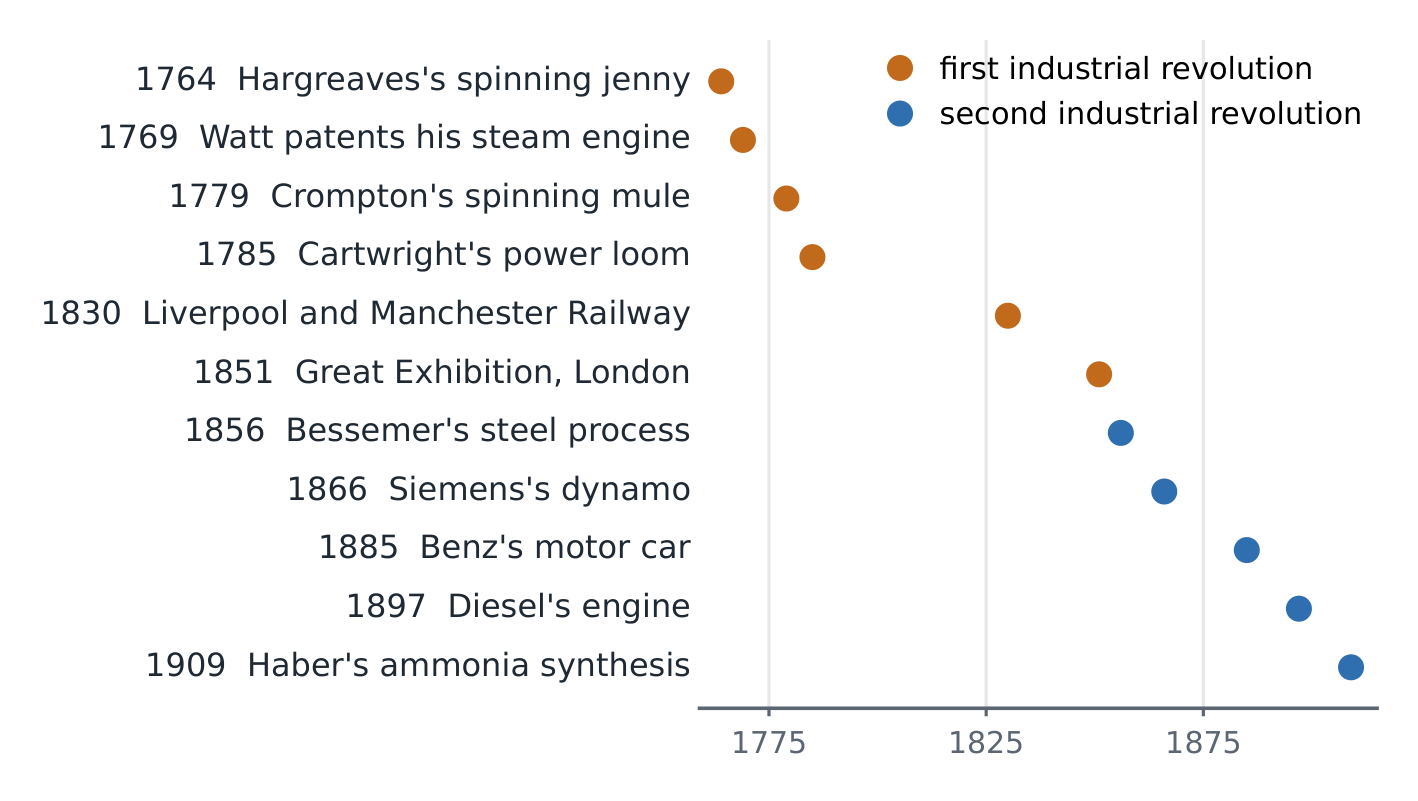
The inventions, in order. Textiles came first: Hargreaves's spinning jenny (1764), Arkwright's water frame (1769), Crompton's mule (1779) and Cartwright's power loom (1785) moved spinning and then weaving out of homes and into factories powered by water and then steam. James Watt's improved steam engine 蒸汽机 (patented 1769) used far less coal than earlier engines and could drive machines anywhere. Coke-smelted iron made machines and rails cheaper. The Liverpool and Manchester Railway (1830), using George Stephenson's locomotives, was the first intercity railway run entirely by steam.
Orange: textiles, steam, iron and rail, led by Britain. Blue: steel, electricity, chemicals and engines, where Germany led as often as Britain.
The continent then diverged, which is the examinable comparison:
France industrialised more gradually, with government support and with less social dislocation 社会失序 than Britain.
Elsewhere, a combination of geography, lack of resources, the dominance of traditional landed elites 精英, and the persistence of serf-like labour relations slowed industrialisation. Belgium, with coal and iron near the British model, industrialised first on the continent. The German states formed a customs union, the Zollverein 关税同盟 (1834), which removed tariffs between them, and their governments built or subsidised railways.
Because more primitive agricultural practices and landholding patterns persisted, some areas of Europe lagged behind entirely.
Both halves of the question: what Britain had, and what held others backA spinning mule - one machine replacing the work of many hand spinners
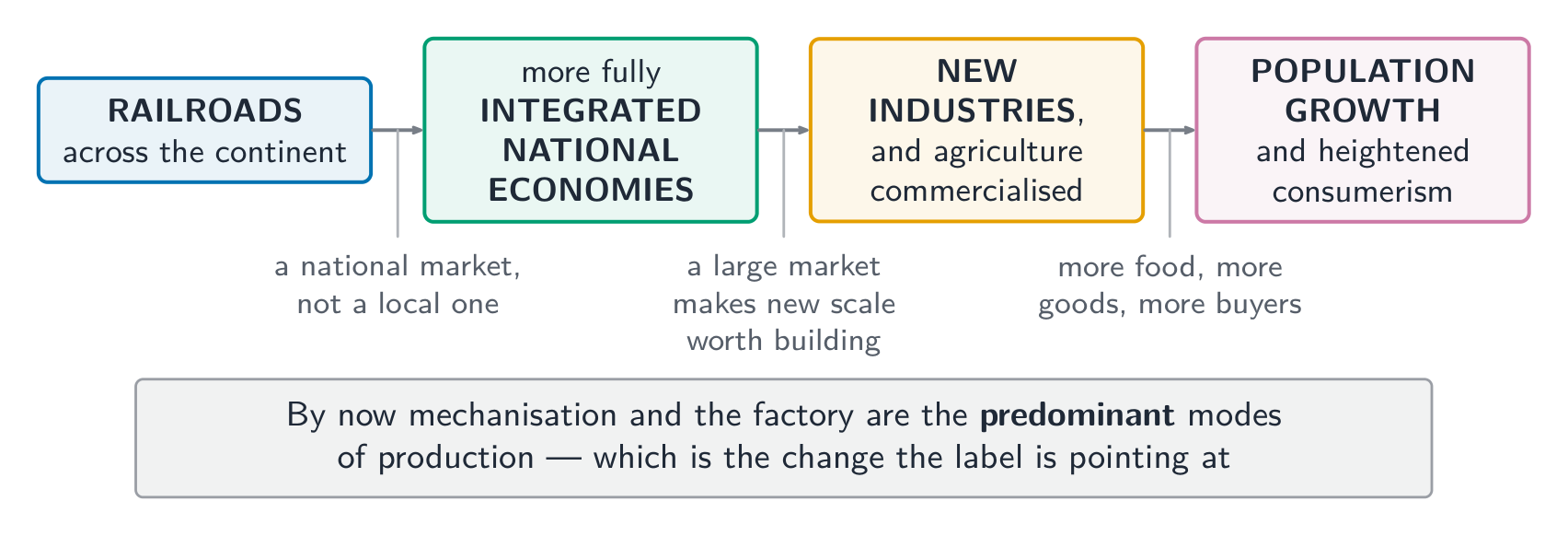
By 1914 mechanisation and the factory system 工厂制度had become the predominant modes of production. During the second industrial revolution 第二次工业革命 (c. 1870-1914) industrial activity spread across more of Europe, and:
New technologies and means of communication and transport - notably railroads 铁路 - produced more fully integrated national economies.
Efficient transport and other innovations created new industries and improved the distribution of goods.
Together with better harvests from the commercialisation of agriculture 农业商业化, industrialisation promoted population growth 人口增长.
A heightened consumerism 消费主义 developed.
What was new in the second wave. Bessemer's process (1856) made steel 钢 cheap enough for railways, ships and buildings. Electricity, from Siemens's dynamo (1866) to power stations and electric trams, gave factories and cities a new energy source. The chemical industry produced dyes, fertilisers and explosives; Fritz Haber's synthesis of ammonia (1909) made artificial fertiliser possible. The internal combustion engine powered Benz's motor car (1885) and Diesel's engine (1897). These industries needed scientific research and huge capital, so they grew in large companies and German cartels 卡特尔, and Germany overtook Britain in steel production by about 1900.
Worked LEQ thesis.Evaluate the most significant difference between the first Industrial Revolution and the second Industrial Revolution.
The most significant difference was the role of science and large organisations: the first Industrial Revolution was driven by practical inventors and small family firms in British textiles, coal and iron, whereas the second depended on laboratory science and massive investment in steel, electricity and chemicals, organised by large corporations, banks and cartels, which allowed newly unified Germany to overtake Britain in key industries.
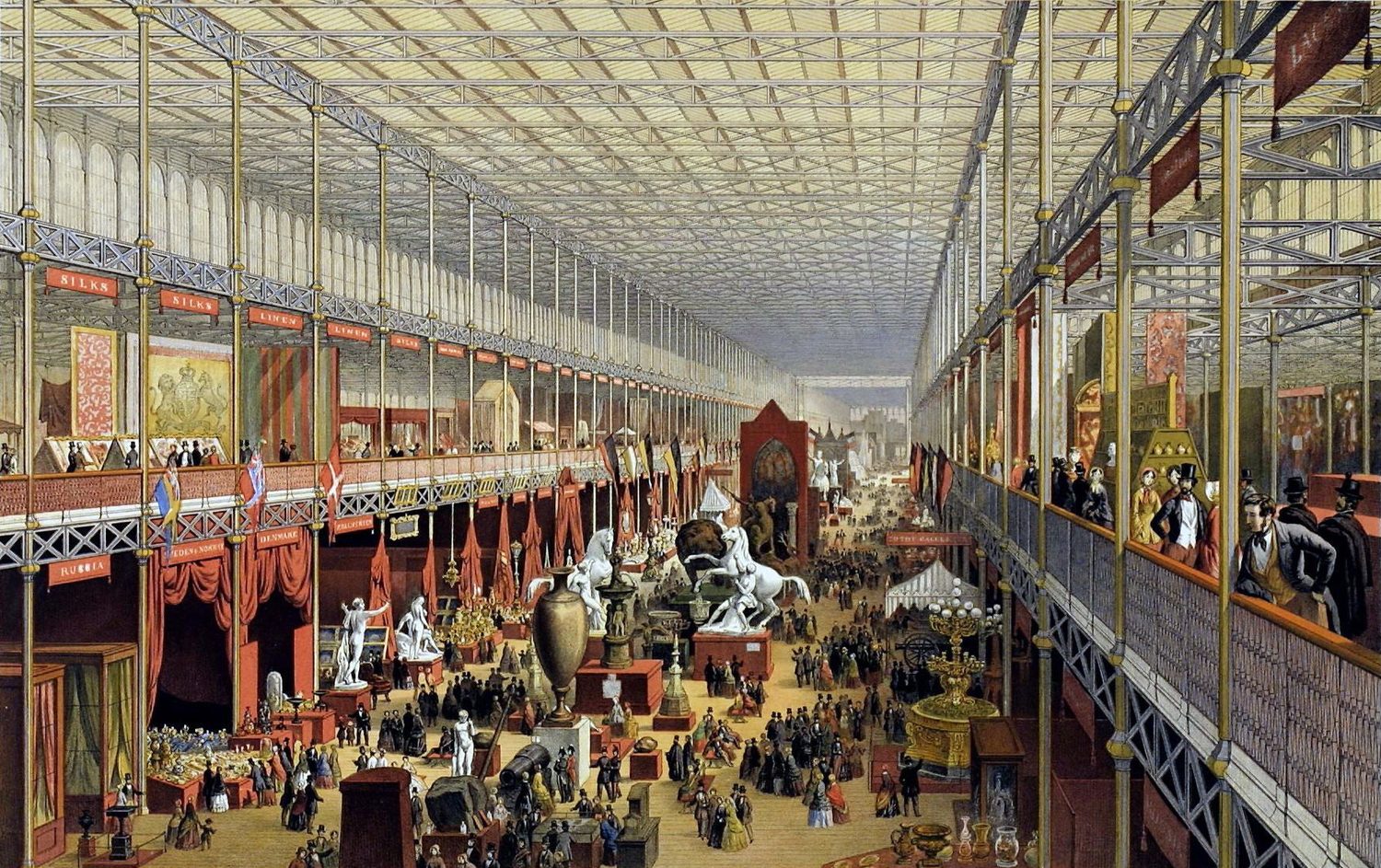
The second wave as a chain: rail integrates markets, and the rest followsThe Crystal Palace, 1851 - iron and glass at a scale only industrial production made possible
In industrialised western and northern Europe, socioeconomic change created divisions of labour 劳动分工 leading to an entrepreneurial 创业的 and professional middle class 中产阶级 and an industrial working class 工人阶级.
In less industrialised areas, the dominance of agricultural elites continued into the twentieth century.
Class identity 阶级认同 developed and was reinforced through participation in philanthropic 慈善的, political, and social associations.
Rural-to-urban migration produced urban overcrowding 城市拥挤 while affected rural areas suffered population loss.
Bourgeois families focused on the nuclear family 核心家庭 and the cult of domesticity 家庭崇拜, with distinct gender roles 性别角色.
By the century's end, higher wages, laws restricting the labour of children and women, social welfare 社会福利 programmes, and improved diet raised living standards.
Economic motives for marriage diminished as the middle-class notion of companionate marriage 伴侣式婚姻 spread.
Leisure time centred increasingly on the family or small groups, with new activities and spaces built for it.
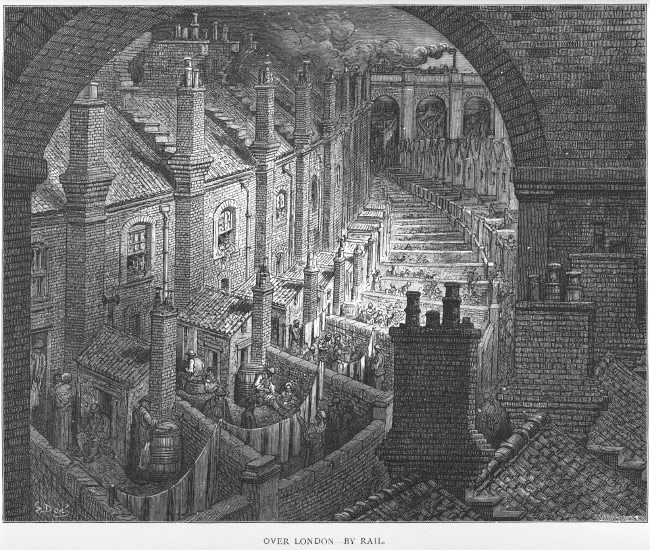
Gustave Doré, Over London by Rail (1872): crowded back-to-back housing beside the railway viaduct
Reforms with dates. Britain's Factory Act (1833) banned work for children under nine in textile mills and limited hours for older children; the Mines Act (1842) banned women and girls, and boys under ten, from underground work. Edwin Chadwick's report on sanitary conditions (1842) led to the Public Health Act (1848). In Paris, Baron Haussmann rebuilt the centre (1853–70) with wide boulevards, sewers and fresh water supply. Bismarck introduced sickness insurance (1883), accident insurance (1884) and old-age pensions (1889), partly to win workers away from the socialists.
Medicine. Edward Jenner's smallpox vaccination (1796), Louis Pasteur's germ theory (1860s), Joseph Lister's antiseptic surgery (1867) and John Snow's tracing of cholera to a London water pump (1854) changed how disease was understood. Their effects: falling death rates and population growth, public investment in sewers and clean water, and, with quinine, European survival in the tropics that made the New Imperialism possible.
The Concert of Europe 欧洲协调, or Congress System, sought to maintain the status quo 现状 through collective action and adherence to conservative principles.
Conservatism 保守主义 in this period is a genuine ideology, not merely resistance: it supported traditional political and religious authorities on the ground that society is an organic whole with a natural hierarchy 等级制度, which cannot be redesigned by abstract reason without harm.
In the first half of the nineteenth century, revolutionaries attempted to destroy the status quo. The revolutions of 1848 1848年革命, triggered by economic hardship and discontent with the political order, challenged conservative power across Europe - and largely failed, which is itself examinable.
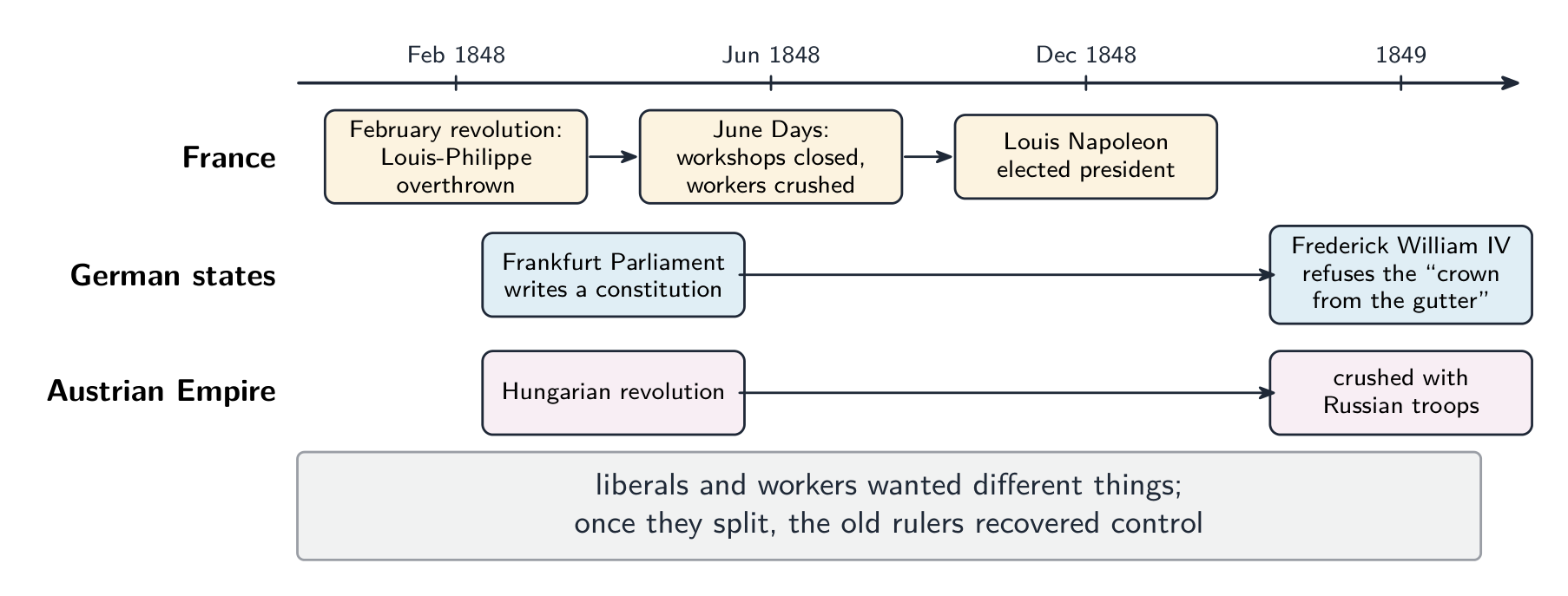
1848 in three places. In France, the February revolution overthrew King Louis-Philippe; the Second Republic introduced universal male suffrage, but when it closed the national workshops for the unemployed, Paris workers rose and were crushed in the June Days, and Louis Napoleon was elected president in December. In the German states, the elected Frankfurt Parliament wrote a constitution and offered the crown of a united Germany to King Frederick William IV of Prussia, who refused a "crown from the gutter" in 1849. In the Austrian Empire, the Hungarian revolution was crushed in 1849 with Russian troops. Liberals and workers wanted different things, and once they split, the old rulers recovered control.
1848 in three places: early success, then a split between liberals and workers that let the old order back in
In Russia, autocratic 专制的 leaders pushed through reform and modernisation from above, including the emancipation of the serfs 农奴解放 - reform used as an alternative to revolution rather than a concession to it. Alexander II freed the serfs in 1861 after defeat in the Crimean War exposed Russia's backwardness, and created elected local councils, the zemstvos (1864). In the 1890s the finance minister Sergei Witte used state money and foreign loans to build heavy industry and the Trans-Siberian Railway.
Questions ask you to distinguish these, so learn them as a set rather than one at a time
The CED names five positions, and they are best learned as answers to one question: who should hold power, and what should the state do?
Liberals 自由主义者 emphasised popular sovereignty 人民主权, individual rights 个人权利, and enlightened self-interest, but debated how far all groups should share political power.
Radicals in Britain and republicans on the continent demanded universal male suffrage 男性普选权 and full citizenship without regard to wealth.
Socialists 社会主义者 called for the redistribution of society's resources and wealth, evolving from utopian 空想的 to Marxist scientific socialism.
Marx's scientific socialism 科学社会主义 provided a systematic critique of capitalism and a deterministic analysis of society and historical change.
Anarchists 无政府主义者 asserted that all forms of governmental authority were unnecessary and should be replaced by a society based on voluntary cooperation.
Names to attach. Conservatism: Edmund Burke, Reflections on the Revolution in France (1790), and Metternich. Liberalism: John Stuart Mill, On Liberty (1859). Utopian socialism: Robert Owen's model mill town at New Lanark and Charles Fourier's planned communities. Marxism: Marx and Engels, The Communist Manifesto (1848), which argued that history is driven by class struggle 阶级斗争 and that workers would overthrow capitalism. Anarchism: Pierre-Joseph Proudhon ("property is theft", 1840) and Mikhail Bakunin. Workers also organised directly: Britain's Chartists (1838–48), trade unions, Germany's Social Democratic Party (1875) and Britain's Labour Party (1900).
Political movements and social organisations responded to the problems of industrialisation. The institutional side is equally examinable:
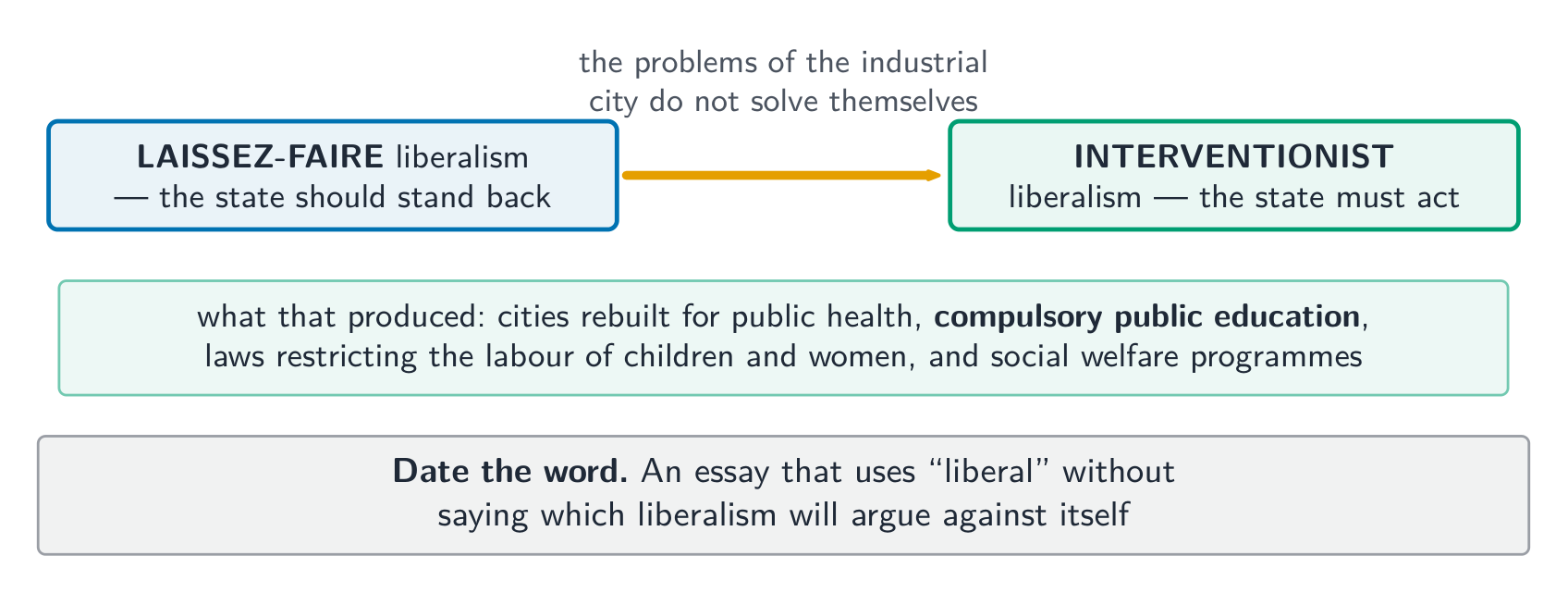
Liberalism 自由主义 shifted from laissez-faire 自由放任 to interventionist 干预主义的 economic and social policies in response to industrialisation's challenges. This is the unit's most important intellectual change - the ideology that began by wanting the state out ended by using it.
Reforms transformed unhealthy and overcrowded cities by modernising infrastructure 基础设施, regulating public health 公共卫生, and reforming prisons.
Reformers promoted compulsory public education 义务教育 to advance public order, nationalism, and economic growth. Note all three motives - the CED lists them, and none is purely benevolent.
The same word, two opposite policies - date the term or the essay contradicts itself
Worked example (an authored exam-style question). Practise the causation skill with this prompt: "Explain one way in which industrialisation contributed to the development of new political ideologies in the nineteenth century." A developed answer traces the link: "Industrialisation created a large urban working class with shared working conditions and limited political power, which gave socialists a constituency and an argument: that the wealth produced by industry was distributed by ownership rather than by labour. Marx's scientific socialism turned that observation into a systematic critique of capitalism, and the concentration of workers in factories and cities made organising around it possible." Notice that the answer explains why the idea found an audience, not only that it existed.
6.10
范例:简答题
English
Each part needs only one or two sentences: answer the question, cite one specific piece of evidence, and explain how it supports the answer.
Answer (a), (b) and (c).
(a) Briefly explain ONE reason industrialisation spread from Britain to continental Europe.
(b) Briefly describe ONE social effect of industrialisation.
(c) Briefly describe ONE response to the problems of industrial society.
Model answer.
(a) Railways and the copying of British machines, often with state support, spread industry to Belgium, France and the German states.
(b) Rapid urban growth led to overcrowded, unhealthy housing for a new industrial working class.
(c) Britain's Factory Act (1833) limited child labour, while Marx and Engels's Communist Manifesto (1848) called for revolution.
6.10
考试技巧
English
Britain's advantages include a political one - industrial interests were represented in Parliament. Most answers list only resources.
France industrialised gradually with state support and less dislocation. That contrast answers many comparison questions.
Learn the five ideologies as a set, distinguished by who holds power and what the state does.
Liberalism's shift from laissez-faire to intervention is the century's key ideological change. Name it.
Compulsory education had three motives - order, nationalism, growth. Give all three.
Living standards rose by the end of the century, after decades of hardship. Timing is the mark.
Romanticism and the Enlightenment. A recurring DBQ asks whether Romanticism maintained a connection to the Enlightenment or challenged it. It did both. It challenged the Enlightenment's trust in reason by valuing emotion, intuition, nature and the individual imagination, as in Wordsworth's poetry and Caspar David Friedrich's paintings. It continued the Enlightenment's belief in individual freedom and human rights: Romantic writers such as Byron supported the Greek war of independence, and Delacroix painted Liberty Leading the People (1830). A strong thesis chooses one side as primary and explains the other as a qualification.
Common mistakes.
Listing Britain's coal and iron but not its political and financial advantages.
Saying the Industrial Revolution made workers' lives better at once. Living standards fell or stagnated for many before rising after about 1850.
Calling every nineteenth-century liberal a democrat. Many liberals wanted the vote limited to property owners.
Treating Marx as the only socialist. Name a utopian socialist too.
Practice.
Describe ONE significant feature of industrialisation in Europe in the period 1750–1800.
Describe ONE significant change in industrialisation in the period 1800–1900.
Explain ONE effect of changes in European medicine in the late 1700s and 1800s.
Explain ONE way industrialisation affected European politics, 1800–1900.
Explain ONE reason why the revolutions of 1848 mostly failed.
Answers.
Mechanised spinning and weaving, using inventions such as the spinning jenny (1764) and water frame (1769), moved textile production from homes into factories in Britain.
The spread of railways after 1830 integrated national markets and spread industry to the continent; after 1870, steel, electricity and chemicals created new industries led by Germany.
Vaccination and germ theory led to public sanitation and lower death rates, which contributed to rapid population growth; quinine also allowed European expansion into tropical Africa.
Industrial workers formed trade unions and socialist parties, and governments responded with reforms such as Britain's Factory Act (1833) and Bismarck's social insurance laws (1883–89).
Liberal middle-class revolutionaries and radical workers wanted different things; after the June Days in Paris and the Frankfurt Parliament's failure, conservative armies restored control.
Vocabulary card meanings
less social dislocation: A claim that some regions suffered less breakdown of community than others.
second industrial revolution: The later wave of industry based on steel, chemicals, and electricity.
promoted population growth: Rising food and jobs that allowed more people to survive and marry.
heightened consumerism: A stronger habit of buying manufactured goods.
Class identity: A sense of belonging based on one's place in the economic order.
urban overcrowding: Too many people packed into industrial cities, with poor housing.
cult of domesticity: An ideal that praised women's moral role inside the home.
companionate marriage: A marriage ideal based on affection and partnership, not only on property.
Concert of Europe: The post-1815 cooperation of great powers to prevent revolution and war.
Conservatism: A politics of throne, altar, and resistance to rapid change after 1815.
revolutions of 1848: A wave of liberal and national uprisings across Europe, mostly defeated.
emancipation of the serfs: The 1861 Russian reform that legally freed unfree peasants.
Liberals: People who wanted constitutions, individual rights, and freer markets.
universal male suffrage: The right of adult men, not only property owners, to vote.
Socialists: People who wanted collective control of production to reduce class inequality.
Marx's scientific socialism: A theory that class struggle would end in a classless society.
Anarchists: People who rejected the state itself, not only a particular government.
compulsory public education: Schooling the state requires and provides for children.