跳到主要内容

冷战与当代欧洲

AP 欧洲历史 · 第 9 主题

训练
讲义 词汇表
9.1

冷战与当代欧洲的时代背景

大纲

9.1 Contextualizing Cold War and Contemporary Europe

Learning ObjectivePreview: Unit 9 Key Concepts

Unit 9.A
Explain the context in which the Cold War developed, spread, and ended in Europe.

  • KC-4.1 Total war and political instability in the first half of the 20th century gave way to a polarized state order during the Cold War and eventually to efforts at transnational union.
    • KC-4.1.IV As World War II ended, a Cold War between the liberal democratic West and the communist East began, lasting nearly half a century.
  • KC-4.2 The stresses of economic collapse and total war engendered internal conflicts within European states and created conflicting conceptions of the relationship between the individual and the state, as demonstrated in the ideological battle between and among democracy, communism, and fascism.
  • KC-4.3 During the 20th century, diverse intellectual and cultural movements questioned the existence of objective knowledge, the ability of reason to arrive at truth, and the role of religion in determining moral standards.
    • KC-4.3.I.ii The experience of war intensified a sense of anxiety that permeated many facets of thought and culture, giving way by the century’s end to a plurality of intellectual frameworks.
  • KC-4.4 Demographic changes, economic growth, total war, disruptions of traditional social patterns, and competing definitions of freedom and justice altered the experiences of everyday life.
    • KC-4.4.III New voices gained prominence in political, intellectual, and social discourse.

来源:美国大学理事会 AP 课程与考试说明

第九单元把欧洲从 1945 年带到当下。适用的仍是第八单元的四项核心概念,但重心发生了转移:两极化的国家秩序、关于个人与国家的相互竞争的构想、对客观知识的持续质疑,以及重塑日常生活的人口与经济变化。

本单元有必须同时把握的两半——1991 年之前的分裂,以及与之并行、并在其后延续的一体化

9.2

重建欧洲

大纲

9.2 Rebuilding Europe

Thematic FocusLearning ObjectiveHistorical Developments

ECD
Economic and Commercial Developments — Economic development, especially the development of capitalism, played an important role in Europe’s history, often having significant social, political, and cultural effects.

Unit 9.B
Explain how economic developments resulted in economic, political, and cultural change in the period after World War II.

  • KC-4.2.IV.A Marshall Plan funds from the United States financed an extensive reconstruction of industry and infrastructure and stimulated an extended period of growth in Western and Central Europe, often referred to as an “economic miracle,” which increased the economic and cultural importance of consumerism.

来源:美国大学理事会 AP 课程与考试说明

来自美国的马歇尔计划(Marshall Plan)资金资助了工业与基础设施的大规模重建,并刺激了西欧的经济复苏。

马歇尔计划在两个方向上同时可考:它重建了西欧;而由于苏联阵营拒绝接受,它也帮助固化了界定本单元其余部分的那道分裂。

词汇表 训练
英文 中文 拼音
Marshall Plan 马歇尔计划 mǎ xiē ěr jì huà
9.3

冷战

大纲

9.3 The Cold War

Thematic FocusLearning ObjectiveHistorical Developments

INT
Interaction of Europe and the World — Motivated by a variety of factors, Europe’s interaction with the world led to political, economic, social, and cultural exchanges that influenced both European and non-European societies.

Unit 9.C
Explain the causes, events, and effects of the Cold War in the period following World War II.

  • KC-4.1.IV.A Despite efforts to maintain international cooperation through the newly created United Nations, deep-seated tensions between the USSR and the West led to the division of Europe, which was referred to in the West as the Iron Curtain.
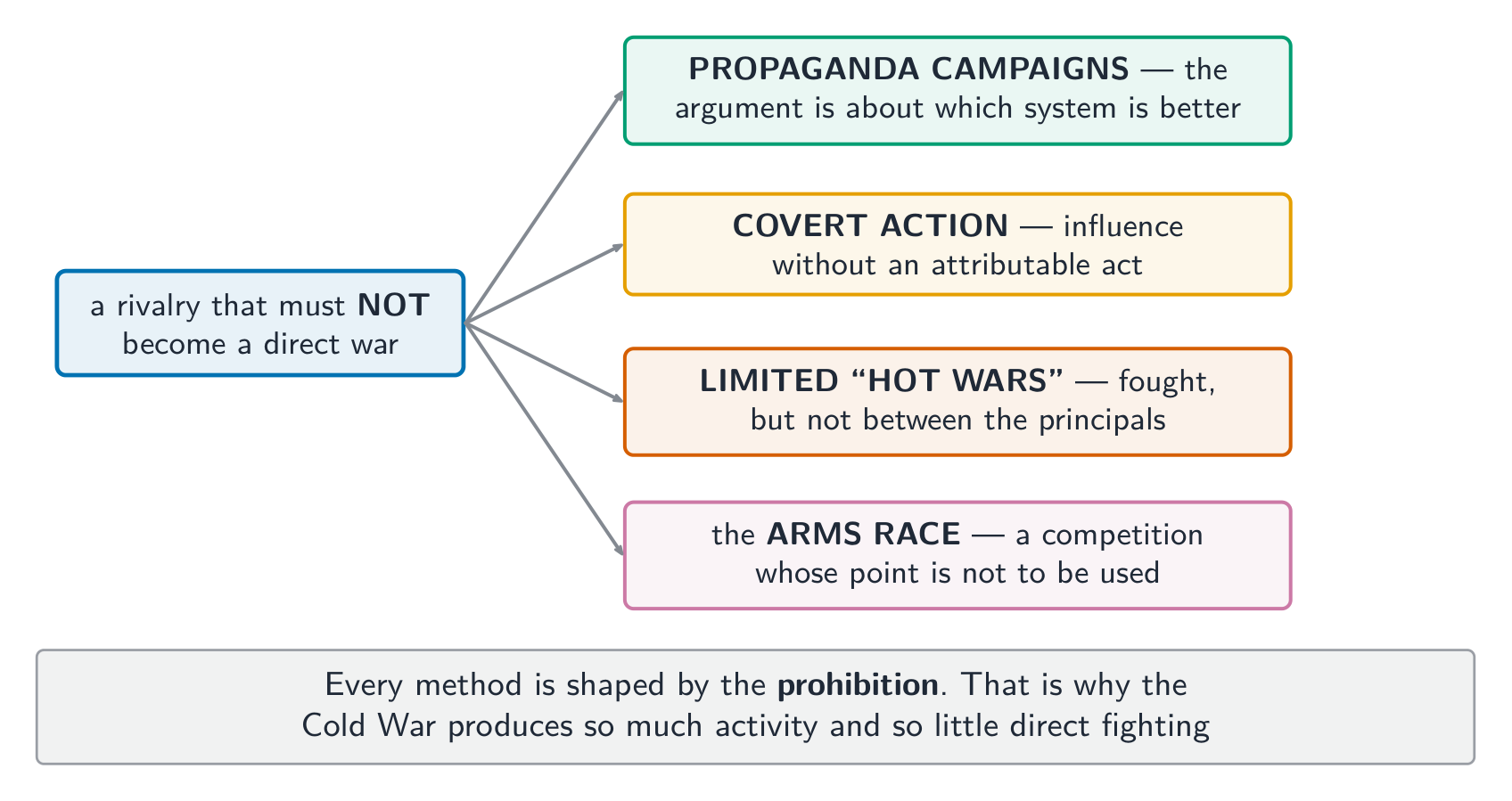
  • KC-4.1.IV.B The Cold War played out on a global stage and involved propaganda campaigns; covert actions; limited “hot wars” in Asia, Africa, Latin America, and the Caribbean; and an arms race, with the threat of a nuclear war.

Illustrative examples:

  • Hot wars outside of Europe in which the United States and the USSR supported opposite sides:
    • Korean War
    • Vietnam War
    • Yom Kippur War
    • Soviet invasion of Afghanistan

来源:美国大学理事会 AP 课程与考试说明

尽管有通过新设立的联合国(United Nations)维持国际合作的努力,两大阵营之间根深蒂固的紧张仍然导致了冷战

CED 列出了冷战实际的进行方式,这份清单值得记住,因为题目会问手段:

  • 宣传战(propaganda campaigns);
  • 秘密行动(covert actions);
  • 在其他地区进行的有限热战(limited "hot wars");
  • 军备竞赛(arms race)。

要注意其中缺席的是什么:两个主角之间没有直接战争。这份手段清单本身就是"如此激烈的对抗为何没有产生直接战争"的答案。

词汇表 训练
英文 中文 拼音
United Nations 联合国 lián hé guó
propaganda campaigns 宣传战 xuān chuán zhàn
covert actions 秘密行动 mì mì xíng dòng
limited "hot wars" 有限热战 yǒu xiàn rè zhàn
arms race 军备竞赛 jūn bèi jìng sài
9.4

两个超级大国的出现

大纲

9.4 Two Super Powers Emerge

Thematic FocusLearning ObjectiveHistorical Developments

ECD
Economic and Commercial Developments — Economic development, especially the development of capitalism, played an important role in Europe’s history, often having significant social, political, and cultural effects.

Unit 9.D
Explain the economic and political consequences of the Cold War for Europe.

  • KC-4.1.IV.C The United States exerted a strong military, political, and economic influence in Western Europe, leading to the creation of world monetary and trade systems and geopolitical alliances, including NATO.
  • KC-4.1.IV.D Countries east of the Iron Curtain came under the military, political, and economic domination of the Soviet Union within the Council for Mutual Economic Assistance (COMECON) and the Warsaw Pact.
  • KC-4.2.V.A Central and Eastern European nations within the Soviet bloc followed an economic model based on central planning, extensive social welfare, and specialized production among bloc members. This brought with it the restriction of individual rights and freedoms, suppression of dissent, and constraint of emigration for the various populations within the Soviet bloc.
  • KC-4.2.V Eastern European nations were bound by their relationships with the Soviet Union, which oscillated between repression and limited reform, until the collapse of communist governments in Eastern Europe and the fall of the Soviet Union.
    • KC-4.2.V.B After 1956, Soviet leader Nikita Khrushchev’s de-Stalinization policies failed to meet their economic goals within the Soviet Union; combined with reactions to existing limitations on individual rights, this prompted revolts in Eastern Europe, which ended with a reimposition of Soviet rule and repressive totalitarian regimes.
  • KC-4.2.V.D.i The rise of new nationalisms in Central and Eastern Europe brought peaceful revolution in most countries but resulted in instability in some former Soviet republics.

Illustrative examples:

  • The world monetary and trade system:
    • International Monetary Fund (IMF)
    • World Bank
    • General Agreement on Tariffs and Trade (GATT)
    • World Trade Organization (WTO)
  • Revolts against Soviet control:
    • Prague Spring
    • Hungarian Revolt

来源:美国大学理事会 AP 课程与考试说明

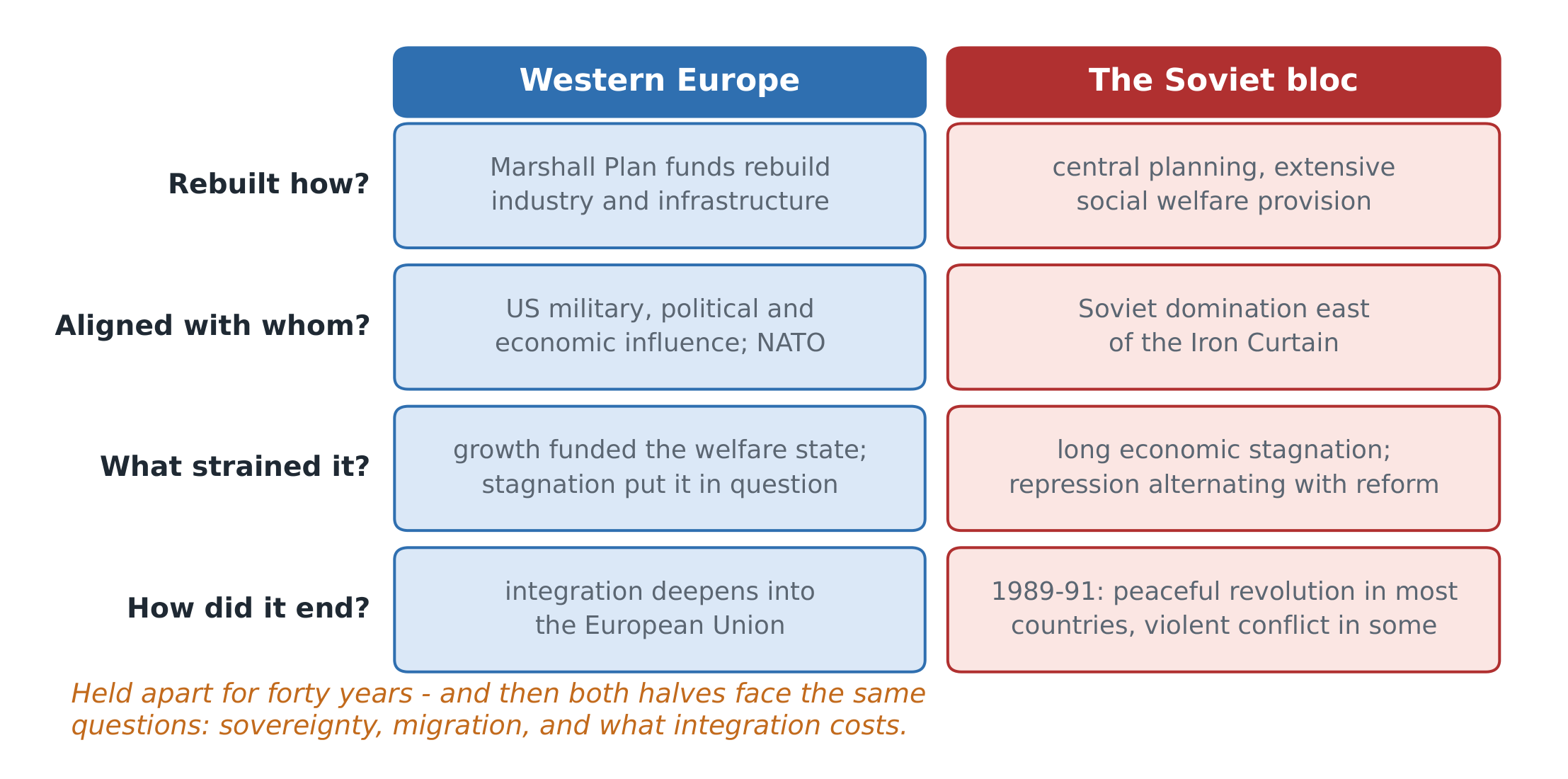
两个欧洲置于同样的行上——这正是本单元为之而设的比较
这一分裂维持了四十年,而后两半面对的是同样的问题
  • 美国在西欧施加了强有力的军事、政治与经济影响,并促成了北约(NATO)的建立。
  • 铁幕(Iron Curtain)以东的国家处于苏联的军事、政治与经济支配之下。
  • 苏联阵营内的中东欧国家采行以中央计划(central planning)与广泛社会福利供给为基础的经济模式。
  • 这些国家与苏联的关系在镇压与改革之间摆动(oscillated between repression and reform)——这是 CED 自身的措辞,比只写其中一面都要好。
  • 中东欧新民族主义的兴起最终在多数国家带来了和平革命,但在某些国家造成了暴力冲突
词汇表 训练
英文 中文 拼音
NATO 北约 běi yuē
Iron Curtain 铁幕 tiě mù
central planning 中央计划 zhōng yāng jì huà
oscillated between repression and reform 镇压与改革之间摆动 zhèn yā yǔ gǎi gé zhī jiān bǎi dòng
ethnic conflict and ethnic cleansing 族群清洗 zú qún qīng xǐ
increase in welfare benefits 福利待遇 fú lì dài yù
9.5

战后民族主义、族群冲突与暴行

大纲

9.5 Postwar Nationalism, Ethnic Conflict, and Atrocities

Thematic FocusLearning ObjectiveHistorical Developments

NEI
National and European Identity — Definitions and perceptions of regional, cultural, national, and European identity have developed and been challenged over time, with varied and often profound effects on the political, social, and cultural order in Europe.

Unit 9.E
Explain the causes and effects of mass atrocities in the period following World War II to the present.

  • KC-4.1.V Nationalist and separatist movements, along with ethnic conflict and ethnic cleansing, periodically disrupted the post-World War II peace.
    • KC-4.2.V.D.ii New nationalisms in central and eastern Europe resulted in war and genocide in the Balkans.

Illustrative examples:

  • Nationalist violence:
    • Ireland
    • Chechnya
  • Separatist movements:
    • Basque (ETA)
    • Flemish
  • Ethnic cleansing: §Bullet Bosnian Muslims
    • Albanian Muslims of Kosovo

来源:美国大学理事会 AP 课程与考试说明

民族主义与分离主义运动,连同族群冲突与族群清洗(ethnic cleansing),不时扰乱战后秩序。可考的要点是:1945 年并没有终结欧洲的民族主义问题;它在某些地方压制了这一问题,在另一些地方则只是推迟了它。

9.6

当代西方民主国家

大纲

9.6 Contemporary Western Democracies

Thematic FocusLearning ObjectiveHistorical Developments

ECD
Economic and Commercial Developments — Economic development, especially the development of capitalism, played an important role in Europe’s history, often having significant social, political, and cultural effects.

Unit 9.F
Explain state-based economic developments following World War II and the responses to these developments.

  • KC-4.2.IV Postwar economic growth supported an increase in welfare benefits; however, subsequent economic stagnation led to criticism and limitation of the welfare state.
    • KC-4.2.IV.B The expansion of cradle-to-grave social welfare programs in the aftermath of World War II, accompanied by high taxes, became a contentious domestic political issue as the budgets of European nations came under pressure in the late 20th century.

来源:美国大学理事会 AP 课程与考试说明

战后经济增长支撑了福利待遇(welfare benefits)的增加;随后的经济停滞(economic stagnation)引发了对福利国家(welfare state)的批评与削减。

两半都要把握。增长供养了福利国家;而增长的终结才是使它陷入争论的原因——这是一项因果论断,而不只是事件的先后。

词汇表 训练
英文 中文 拼音
economic stagnation 经济停滞 jīng jì tíng zhì
welfare state 福利国家 fú lì guó jiā
Mikhail Gorbachev's 戈尔巴乔夫 gē ěr bā qiáo fū
9.7

东欧剧变

大纲

9.7 The Fall of Communism

Thematic FocusLearning ObjectiveHistorical Developments

SOP
States and Other Institutions of Power — European states and nations developed governmental and civil institutions from 1450 to the present to organize society and consolidate political power, with a variety of social, cultural, and economic effects.

Unit 9.G
Explain the causes and effects of the end of the Cold War.

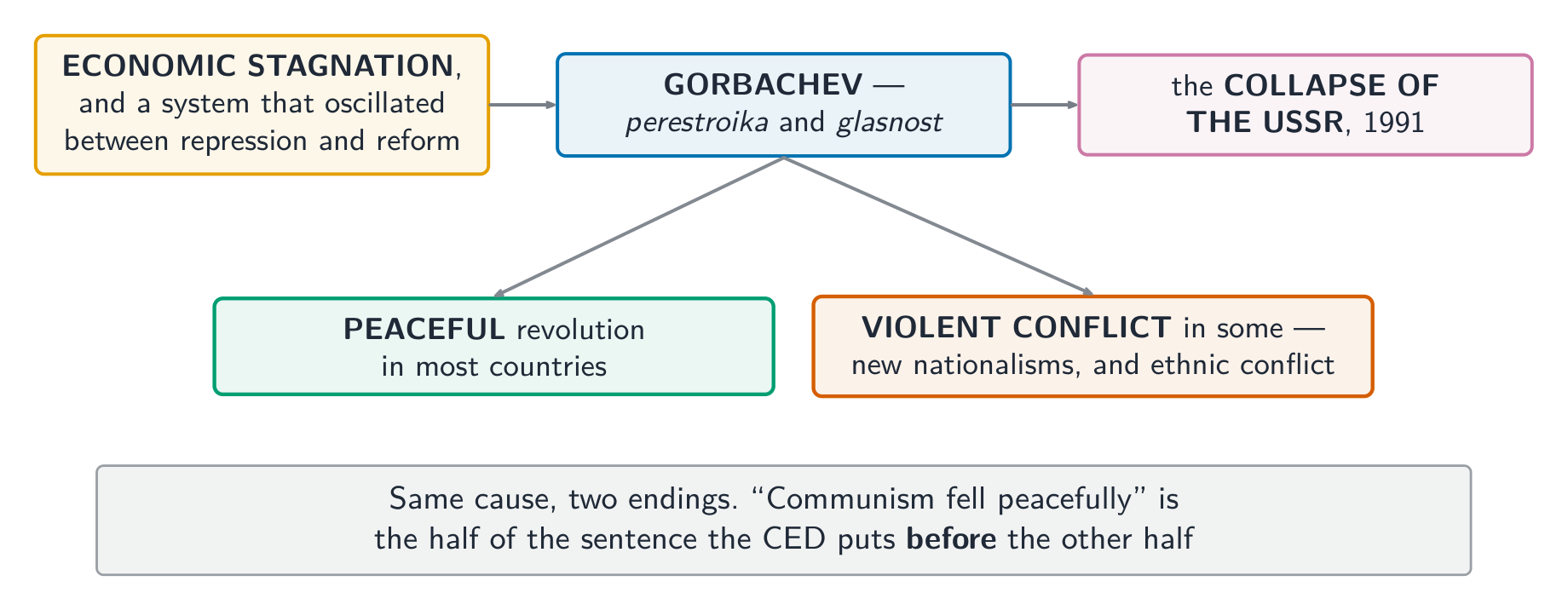
  • KC-4.2.V.C Following a long period of economic stagnation, Mikhail Gorbachev’s internal reforms of perestroika and glasnost, designed to make the Soviet system more flexible, failed to stave off the collapse of the Soviet Union and the end of its hegemonic control over Eastern and Central European satellites.
  • KC-4.1.IV.E The collapse of the USSR in 1991 ended the Cold War and led to the establishment of capitalist economies throughout Eastern Europe. Germany was reunited, the Czechs and the Slovaks parted, Yugoslavia dissolved, and the European Union was enlarged through the admission of former Eastern bloc countries.

Illustrative examples:

  • Collapse of Soviet Union and satellites:
    • Fall of the Berlin Wall
    • Polish elections in 1989

来源:美国大学理事会 AP 课程与考试说明

在长期的经济停滞之后,戈尔巴乔夫(Mikhail Gorbachev)推行的改革(perestroika)与开放(glasnost)——尽管本意是强化这一体制——却促成了它的崩溃。

1991 年苏联解体(collapse of the USSR)结束了冷战,并使资本主义经济在整个东欧建立起来。

论证的形状很重要:意在挽救一个体制的改革,反而帮助终结了它。这正是评价类题目所奖励的那种论断。

词汇表 训练
英文 中文 拼音
perestroika 改革 gǎi gé
glasnost 开放 kāi fàng
collapse of the USSR in 1991 苏联解体 sū lián jiě tǐ
family and work responsibilities, economic changes, and feminism 女性主义 nǚ xìng zhǔ yì
9.8

20世纪的女权主义

大纲

9.8 20th-Century Feminism

Thematic FocusLearning ObjectiveHistorical Developments

SCD
Social Organization and Development — Economic, political, and cultural factors have influenced the form and status of family, class, and social groups in European history, which has, in turn, affected both the individual and society.

Unit 9.H
Explain how women’s roles and status developed and changed throughout the 20th and 21st centuries.

  • KC-4.4.II The lives of women were defined by family and work responsibilities, economic changes, and feminism.
    • KC-4.4.II.B In Western Europe through the efforts of feminists, and in Eastern Europe and the Soviet Union through government policy, women finally gained the vote, greater educational opportunities, and access to professional careers, even while continuing to face social inequalities.
    • KC-4.4.II.D New modes of marriage, partnership, motherhood, divorce, and reproduction gave women more options in their personal lives.
    • KC-4.4.II.E Women attained high political office and increased their representation in legislative bodies in many nations.

Illustrative examples:

  • Feminists and feminism: §Bullet Simone de Beauvoir
    • Second-wave feminism
  • New modes of managing reproduction:
    • Birth control pill
    • Scientific means of fertilization
  • Women who attained high political office:
    • Margaret Thatcher of Great Britain
    • Mary Robinson of Ireland
    • Édith Cresson of France

来源:美国大学理事会 AP 课程与考试说明

女性的生活由家庭与工作责任、经济变化以及女性主义(feminism)所界定。贯穿整个世纪的是:有偿工作参与度的扩大(尤其在两次大战期间);政治权利的扩展;以及在战后数十年间改变了法律与社会预期的有组织运动。

9.9

非殖民化

大纲

9.9 Decolonization

Thematic FocusLearning ObjectiveHistorical Developments

INT
Interaction of Europe and the World — Motivated by a variety of factors, Europe’s interaction with the world led to political, economic, social, and cultural exchanges that influenced both European and non-European societies.

Unit 9.I
Explain the various ways in which colonial groups around the world sought independence from colonizers in the 20th and 21st centuries.

  • KC-4.1.VI The process of decolonization occurred over the course of the century with varying degrees of cooperation, interference, or resistance from European imperialist states.
    • KC-4.1.VI.A At the end of World War I, U.S. President Woodrow Wilson’s principle of national self-determination raised expectations in the non-European world for new policies and freedoms.
    • KC-4.1.VI.C Despite indigenous nationalist movements, independence for many African and Asian territories was delayed until the mid- and even late 20th century by the imperial powers’ reluctance to relinquish control, threats of interference from other nations, unstable economic and political systems, and Cold War strategic alignments.

Illustrative examples:

  • Indigenous nationalist movements:
    • Indian National Congress
    • Algeria’s National Liberation Front (FLN)
    • Ho Chi Minh’s Viet Minh
    • Sukarno and Indonesian nationalism

来源:美国大学理事会 AP 课程与考试说明

去殖民化(decolonisation)在整个世纪中展开,欧洲各帝国的合作、干预或抵抗程度各不相同(varying degrees of cooperation, interference, or resistance)。

对欧洲自身的后果是学生会遗漏的部分:失去帝国改变了欧洲国家的性质,并造成了下面两节所考查的迁移。

词汇表 训练
英文 中文 拼音
decolonisation 去殖民化 qù zhí mín huà
began to set aside nationalist rivalries in favour of economic and political integration 经济与政治一体化 jīng jì yǔ zhèng zhì yī tǐ huà
9.10

欧洲联盟

大纲

9.10 The European Union

Thematic FocusLearning ObjectiveHistorical Developments

NEI
National and European Identity — Definitions and perceptions of regional, cultural, national, and European identity have developed and been challenged over time, with varied and often profound effects on the political, social, and cultural order in Europe.

Unit 9.J
Explain how the formation and existence of the European Union influenced economic developments throughout the period following World War II to the present.

  • KC-4.4.IV European states began to set aside nationalist rivalries in favor of economic and political integration, forming a series of transnational unions that grew in size and scope over the second half of the 20th century.
    • KC-4.4.IV.A As the economic alliance known as the European Coal and Steel Community, envisioned as a means to spur postwar economic recovery, developed into the European Economic Community (EEC or Common Market) and the European Union (EU), Europe experienced increasing economic and political integration and efforts to establish a shared European identity.

Unit 9.K
Explain how the European Union affected national and European identity throughout the period following World War II to the present.

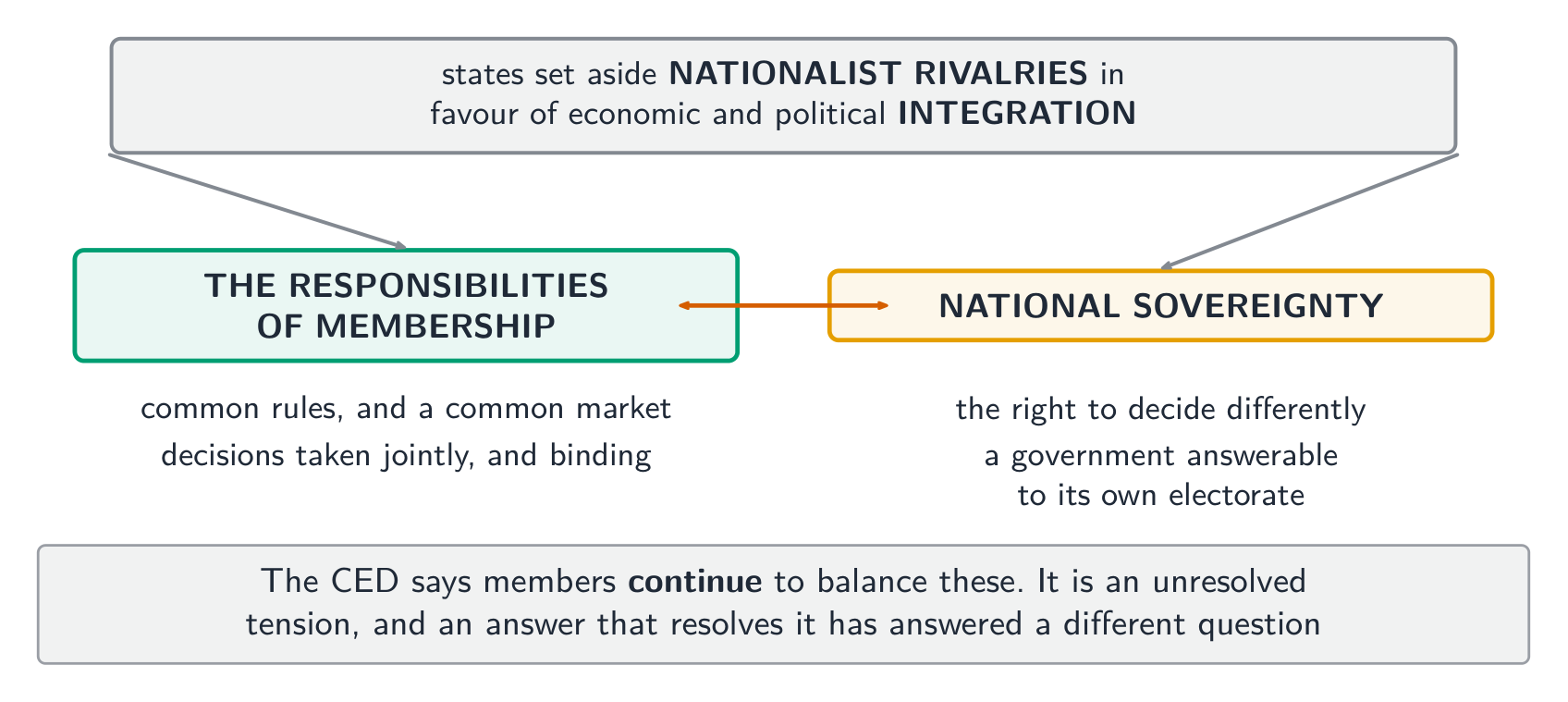
  • KC-4.4.IV.B EU member nations continue to balance questions of national sovereignty with the responsibilities of membership in an economic and political union.

Illustrative examples:

  • Challenges to national sovereignty within the EU:
    • The euro
    • European Parliament
    • Issue of remaining in the EU (e.g., Britain’s “Brexit”)
    • Free movement across borders

来源:美国大学理事会 AP 课程与考试说明

欧洲各国开始搁置民族主义竞争,转向经济与政治一体化(economic and political integration),先后建立起一系列机构,最终成为欧盟(European Union)。

而 CED 明确点出的张力是:欧盟成员国仍在国家主权与作为一个国际机构成员的责任之间寻求平衡。这一平衡才是可考的议题,而不是机构沿革。

词汇表 训练
英文 中文 拼音
European Union 欧盟 ōu méng
9.11

人口迁移与移民

大纲

9.11 Migration and Immigration

Thematic FocusLearning ObjectiveHistorical Developments

SCD
Social Organization and Development — Economic, political, and cultural factors have influenced the form and status of family, class, and social groups in European history, which has, in turn, affected both the individual and society.

Unit 9.L
Explain the causes and effects of changes to migration within and immigration to Europe throughout the period following World War II to the present.

  • KC-4.3.III.C Increased immigration into Europe altered Europe’s religious makeup, causing debate and conflict over the role of religion in social and political life.
  • KC-4.4.III.D Because of the economic growth of the 1950s and 1960s, migrant workers from southern Europe, Asia, and Africa immigrated to western and central Europe; however, after the economic downturn of the 1970s, these workers and their families often became targets of anti-immigrant agitation and extreme nationalist political parties.

Illustrative examples:

  • Anti-immigration, conservative parties:
    • French National Front
    • Austrian Freedom Party

来源:美国大学理事会 AP 课程与考试说明

  • 由于1950 与 1960 年代的经济增长,来自南欧、亚洲与非洲的外来劳工(migrant workers)迁入北欧与西欧。
  • 移民增加改变了欧洲的宗教构成(religious makeup),引发了关于宗教在公共生活中的角色(role of religion in public life)的辩论与冲突。

注意 CED 自身的因果顺序:经济增长造成了劳动力需求,迁移随之而来。各种辩论是后来的事。

词汇表 训练
英文 中文 拼音
migrant workers 外来劳工 wài lái láo gōng
altered Europe's religious makeup 宗教构成 zōng jiào gòu chéng
role of religion in public life 宗教在公共生活中的角色 zōng jiào zài gōng gòng shēng huó zhōng de jué sè
9.12 9.13

技术

大纲

9.12 Technology

Thematic FocusLearning ObjectiveHistorical Developments

TSI
Technological and Scientific Innovation — Scientific and technological innovations have increased efficiency, improved daily life, and shaped human development and interactions, having both intended and unintended consequences.

Unit 9.M
Explain how innovation and advances in technology influenced cultural and intellectual developments in the period 1914 to the present.

  • KC-4.3.II.B Medical theories and technologies extended life but posed social and moral questions that eluded consensus and crossed religious, political, and philosophical perspectives.

Illustrative examples:

  • Medical theories and technologies:
    • Birth control
    • Abortion
    • Fertility treatments
    • Genetic engineering

9.13 Globalization

Thematic FocusLearning ObjectiveHistorical Developments

TSI
Technological and Scientific Innovation — Scientific and technological innovations have increased efficiency, improved daily life, and shaped human development and interactions, having both intended and unintended consequences.

Unit 9.N
Explain the technological and cultural causes and consequences of increasing European globalization in the period from 1914 to the present.

  • KC-4.3.IV.C Increased imports of U.S. technology and popular culture after World War II generated both enthusiasm and criticism.
  • KC-4.4.I.D New communication and transportation technologies multiplied the connections across space and time, transforming daily life and contributing to the proliferation of ideas and to globalization.
  • KC-4.4.III.A Green parties in Western and Central Europe challenged consumerism, urged sustainable development, and, by the late 20th century, cautioned against globalization.

Illustrative examples:

  • New communication technologies:
    • Telephone
    • Radio
    • Television
    • Computer
    • Cell phone
    • Internet

来源:美国大学理事会 AP 课程与考试说明

  • 医学理论与技术延长了寿命,却提出了未能形成共识(eluded consensus)的社会与道德问题。
  • 战后美国技术与流行文化输入的增加既受欢迎也遭批评(both enthusiasm and criticism)。
  • 新的通信与运输技术成倍增加了跨越空间与时间的联系,改变了日常生活。
  • 西欧与中欧的绿党(Green parties)挑战消费主义,倡导可持续发展(sustainable development)。
词汇表 训练
英文 中文 拼音
eluded consensus 未能形成共识 wèi néng xíng chéng gòng shí
both enthusiasm and criticism 既受欢迎也遭批评 jì shòu huān yíng yě zāo pī píng
Green parties 绿党 lǜ dǎng
sustainable development 可持续发展 kě chí xù fā zhǎn
9.14

20与21世纪的文化、艺术与人口趋势

大纲

9.14 20th- and 21st-Century Culture, Arts, and Demographic Trends

Thematic FocusLearning ObjectiveHistorical Developments

CID
Cultural and Intellectual Developments — The creation and transmission of knowledge, including the relationship between traditional sources of authority and the development of differing world views, had significant political, intellectual, economic, cultural, and social effects on European and world societies.

Unit 9.O
Explain how and why European culture changed from the period following World War II to the present.

  • KC-4.3.I.B The effects of world war and economic depression undermined this confidence in science and human reason, giving impetus to existentialism and producing postmodernism in the post-1945 period.
  • KC-4.3.III Organized religion continued to play a role in European social and cultural life despite the challenges of military and ideological conflict, modern secularism, and rapid social changes.
    • KC-4.3.III.A The challenges of totalitarianism and communism in central and eastern Europe brought mixed responses from the Christian churches.
    • KC-4.3.III.B Reform in the Catholic Church found expression in the Second Vatican Council, which redefined the church’s doctrine and practices and started to redefine its relations with other religious communities.
  • KC-4.3.IV During the 20th century, the arts were defined by experimentation, self-expression, subjectivity, and the increasing influence of the United States in both elite and popular culture.
    • KC-4.3.IV.A New movements in the visual arts, architecture, and music radically shifted existing aesthetic standards, explored subconscious and subjective states, and satirized Western society and its values.
    • KC-4.3.IV.B Throughout the century, a number of writers challenged traditional literary conventions, questioned Western values, and addressed controversial social and political issues.
  • KC-4.4.I.C Mass production, new food technologies, and industrial efficiency increased disposable income and created a consumer culture in which greater domestic comforts such as electricity, indoor plumbing, plastics, and synthetic fibers became available.
  • KC-4.4.II.C With economic recovery after World War II, the birth rate increased dramatically (the baby boom), often promoted by government policies.
  • KC-4.4.III.B Various movements, including women’s movements, political and social movements, gay and lesbian movements, and others, worked for expanded civil rights, in some cases obtaining the goals they sought, and in others facing strong opposition.
  • KC-4.4.III.C Intellectuals and youth reacted against perceived bourgeois materialism and decadence, most significantly with the revolts of 1968.

Illustrative examples:

  • Christian responses to totalitarianism:
    • Dietrich Bonhoeffer
    • Martin Niemöller
    • Pope John Paul II
    • Solidarity
  • New movements in the visual arts:
    • Cubism
    • Futurism
    • Dadaism
    • Surrealism
    • Abstract Expressionism
    • Pop Art
  • New architectural movements:
    • Bauhaus
    • Modernism
    • Postmodernism
  • New movements in music:
    • Igor Stravinsky
    • Arnold Schoenberg
    • Richard Strauss
  • Writers:
    • Franz Kafka
    • James Joyce
    • Erich Maria Remarque
    • Virginia Woolf
    • Jean-Paul Sartre
  • Government policies promoting population growth: §Bullet Neonatalism
    • Childcare facilities

来源:美国大学理事会 AP 课程与考试说明

  • 世界大战与经济萧条的影响动摇了对科学与人类理性的信心,推动了新的思想潮流。
  • 尽管面临这些挑战,有组织的宗教仍在欧洲社会与文化生活中发挥作用——这一延续性值得写出,因为答案往往假定了单纯的世俗化。
  • 艺术以实验、自我表达、主观性以及日益增强的全球影响为特征。
  • 大规模生产、新的食品技术与工业效率增加了可支配收入,造就了消费文化(consumer culture)。
  • 随着战后复苏,出生率急剧上升——即婴儿潮(baby boom)——且常常由政府政策推动。
  • 多种运动——女性运动、政治与社会运动、同性恋权利运动——推动了权利与承认。
  • 知识分子与青年反抗他们所认为的资产阶级物质主义,最显著地体现在 1960 年代后期的各种运动中。
词汇表 训练
英文 中文 拼音
consumer culture 消费文化 xiāo fèi wén huà
baby boom 婴儿潮 yīng ér cháo
9.15

20与21世纪的延续与变化

大纲

9.15 Continuity and Change in the 20th and 21st Centuries

Learning ObjectiveReview: Unit 9 Key Concepts

Unit 9.P
Explain how the challenges of the 20th century influenced what it means to be European.

  • KC-4.1 Total war and political instability in the first half of the 20th century gave way to a polarized state order during the Cold War and eventually to efforts at transnational union.
    • KC-4.1.IV As World War II ended, a Cold War between the liberal democratic West and the communist East began, lasting nearly half a century.
    • KC-4.1.V Nationalist and separatist movements, along with ethnic conflict and ethnic cleansing, periodically disrupted the post-World War II peace.
  • KC-4.2 The stresses of economic collapse and total war engendered internal conflicts within European states and created conflicting conceptions of the relationship between the individual and the state, as demonstrated in the ideological battle between and among democracy, communism, and fascism.
  • KC-4.3 During the 20th century, diverse intellectual and cultural movements questioned the existence of objective knowledge, the ability of reason to arrive at truth, and the role of religion in determining moral standards.
    • KC-4.3.I.ii The experience of war intensified a sense of anxiety that permeated many facets of thought and culture, giving way by the century’s end to a plurality of intellectual frameworks.
  • KC-4.4 Demographic changes, economic growth, total war, disruptions of traditional social patterns, and competing definitions of freedom and justice altered the experiences of everyday life.
    • KC-4.4.III New voices gained prominence in political, intellectual, and social discourse.

来源:美国大学理事会 AP 课程与考试说明

本单元考查的推理能力是延续与变化

Worked example(一道真实的 AP 考题)。本单元的 AP 欧洲史简答题会要求,例如「解释 1945 年后的欧洲一体化相较于此前欧洲国际关系体现出变化的一种方式」。满分答案会把变化与它所取代的东西对照陈述:「1945 年之前,欧洲各国通过相互竞争的联盟——并且屡次通过战争——追求国家利益。1945 年之后,各国开始搁置这些竞争,转向共享的机构,接受关于贸易与法律的具有约束力的共同规则——于是成员国之间的争端成为在机构内部谈判的事项,而不再是均势的事项。」*注意变化类论断需要点明此前的状况*。

9.15

考试技巧

  • 本单元有两条同时展开的线索——1991 年之前的分裂,以及贯穿始终的一体化。薄弱的答案只讲一条。
  • 记住冷战的手段:宣传、秘密行动、有限热战、军备竞赛。没有直接战争正是要点所在。
  • **"在镇压与改革之间摆动"**是 CED 对苏联阵营的措辞。它胜过只写其中一半。
  • 戈尔巴乔夫的改革本意是强化这一体制。这一反讽正是评价类题目所要寻找的。
  • 福利国家因增长而扩大,又因增长停止而受到质疑。要写出这一因果联系。
  • 迁移跟随的是战后繁荣所造成的劳动力需求。先把因果顺序写对,再讨论各种辩论。

AP 欧洲历史的更多主题

登录或创建账号

IGCSE, A-Level & AP