| English | 释义 | 拼音 |
|---|---|---|
| perestroika/ˈperɪstrɔɪkə/ | 经济改革 | jīng jì gǎi gé |
| glasnost/ˈɡlæsnɒst/ | 开放政策 | kāi fàng zhèng cè |
The Wall opens, 9 November 1989
- On the evening of 9 November 1989, an East German spokesman told a press conference, by mistake, that new travel rules applied "immediately". Thousands of East Berliners went to the border crossings, and guards, without orders, opened the gates. Within hours, people were standing on the Berlin Wall.
- Between 1985 and 1991, communist rule in Eastern Europe and then the Soviet Union itself came to an end.
Reform meant to save the system
- Mikhail Gorbachev, Soviet leader from 1985, faced a stagnant economy and a costly war in Afghanistan.
- His perestroika 经济改革 (restructuring) allowed some private business, and glasnost 开放政策 (openness) allowed criticism. He meant to make communism work better, not to end it.
What was the aim of Gorbachev's reforms?
难度 1/5 · 今日首次完成可获 100 金币及少量额外奖励
Reform, not abolition.
Match each term to its meaning.
难度 2/5 · 今日首次完成可获 140 金币及少量额外奖励
The language of reform.
Eastern Europe goes its own way
- Gorbachev said the Soviet Union would no longer use force to keep communist governments in power in Eastern Europe.
- In 1989, Poland's Solidarity union won free elections, Hungary opened its border with Austria, the Berlin Wall fell, and Czechoslovakia's peaceful "Velvet Revolution" brought Václav Havel to power.
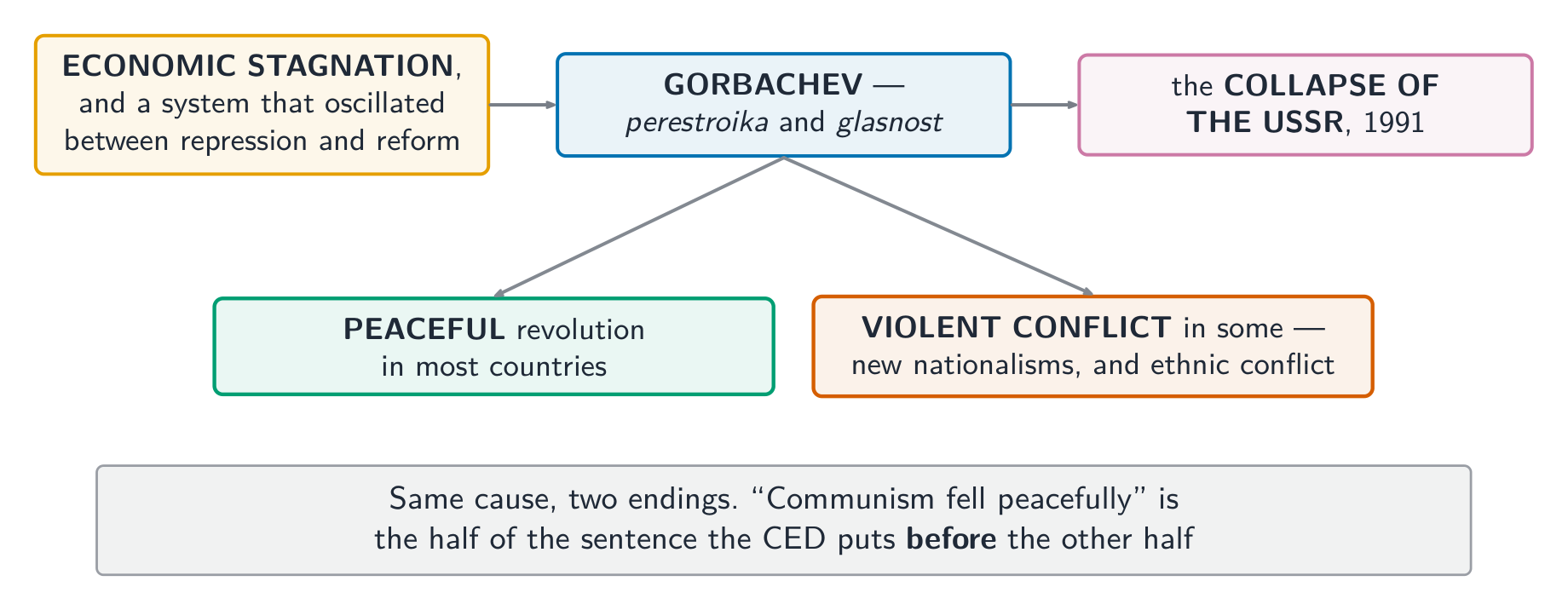
Follow the collapse, and split its ending
'Peaceful revolution in most countries' is paired with 'violent conflict in some', and students drop the second half.
Worked example: peaceful and violent endings
- Peaceful: in Poland, Hungary, East Germany and Czechoslovakia, communist leaders gave up power without large-scale killing.
- Violent: in Romania, the army turned against the dictator Ceaușescu in December 1989; about 1100 people died, and he was executed. In Yugoslavia, the fall of communism led to wars from 1991.
- Why the difference: where rulers accepted that Soviet troops would not save them, they negotiated. Where a dictator or nationalist leaders were ready to use force, blood was shed.
Where did the end of communism involve large-scale violence?
难度 2/5 · 今日首次完成可获 140 金币及少量额外奖励
The others were peaceful.
The Soviet Union breaks up
- Nationalist movements grew in the Baltic states, Ukraine and elsewhere. A coup by hard-line communists in August 1991 failed after Boris Yeltsin led resistance in Moscow.
- In December 1991 the Soviet Union dissolved into 15 independent states.
Put these events in order.
难度 3/5 · 今日首次完成可获 200 金币及少量额外奖励
1985, 1989, 1990, 1991.
Into how many independent states did the Soviet Union dissolve?
难度 2/5 · 今日首次完成可获 140 金币及少量额外奖励
December 1991.
Consequences
- Germany reunified in October 1990, and many Eastern European states later joined NATO and, in 2004, the European Union.
- Russia's quick move to markets in the 1990s brought high inflation and poverty for many.
Gorbachev did not plan to end communism. He tried to reform and save it. His reforms released forces — free speech, nationalism and the end of Soviet force — that he could not control.
Gorbachev planned from the start to end communism.
难度 1/5 · 今日首次完成可获 100 金币及少量额外奖励
He tried to save it.
Gorbachev's reforms aimed to save the Soviet system, but by refusing to use force he let Eastern Europe's revolutions of 1989 succeed — mostly peacefully, but violently in Romania and Yugoslavia. Nationalism and a failed coup broke up the Soviet Union in 1991.
Explain why communist rule ended peacefully in some countries and violently in others in 1989–91.
Comparison.