| English | 释义 | 拼音 |
|---|---|---|
| separate spheres | 男女分工观念 | nán nǚ fēn gōng guān niàn |
| suffragist | 妇女参政运动者 | fù nǚ cān zhèng yùn dòng zhě |
| baby boom/ˈbeɪbi buːm/ | 婴儿潮 | yīng ér cháo |
A book that sold a million, 1949
- In 1949 the French writer Simone de Beauvoir published The Second Sex. "One is not born, but rather becomes, a woman," she wrote: the roles women were given came from society, not from nature. The book was banned by the Vatican and became a founding text of the women's movement.
- From the French Revolution to the end of the twentieth century, women in Europe gained rights step by step, and with setbacks.
What did de Beauvoir argue in The Second Sex?
难度 1/5 · 今日首次完成可获 100 金币及少量额外奖励
"One is not born, but rather becomes, a woman."
The longer story
- In 1791 Olympe de Gouges demanded rights for women; the revolutionaries refused. Nineteenth-century ideas of separate spheres 男女分工观念 placed women in the home and men in public life.
- Campaigns by suffragists 妇女参政运动者 such as Emmeline Pankhurst's suffragettes in Britain demanded the vote.
The idea of separate spheres placed women in the home and men in public life.
难度 1/5 · 今日首次完成可获 100 金币及少量额外奖励
A nineteenth-century ideal.
War changes work
- In both world wars, women worked in munitions factories, on transport and on farms. After 1918, women won the vote in Britain (partly, 1918), Germany (1919) and other countries.
- France gave women the vote only in 1944, and Switzerland not until 1971.
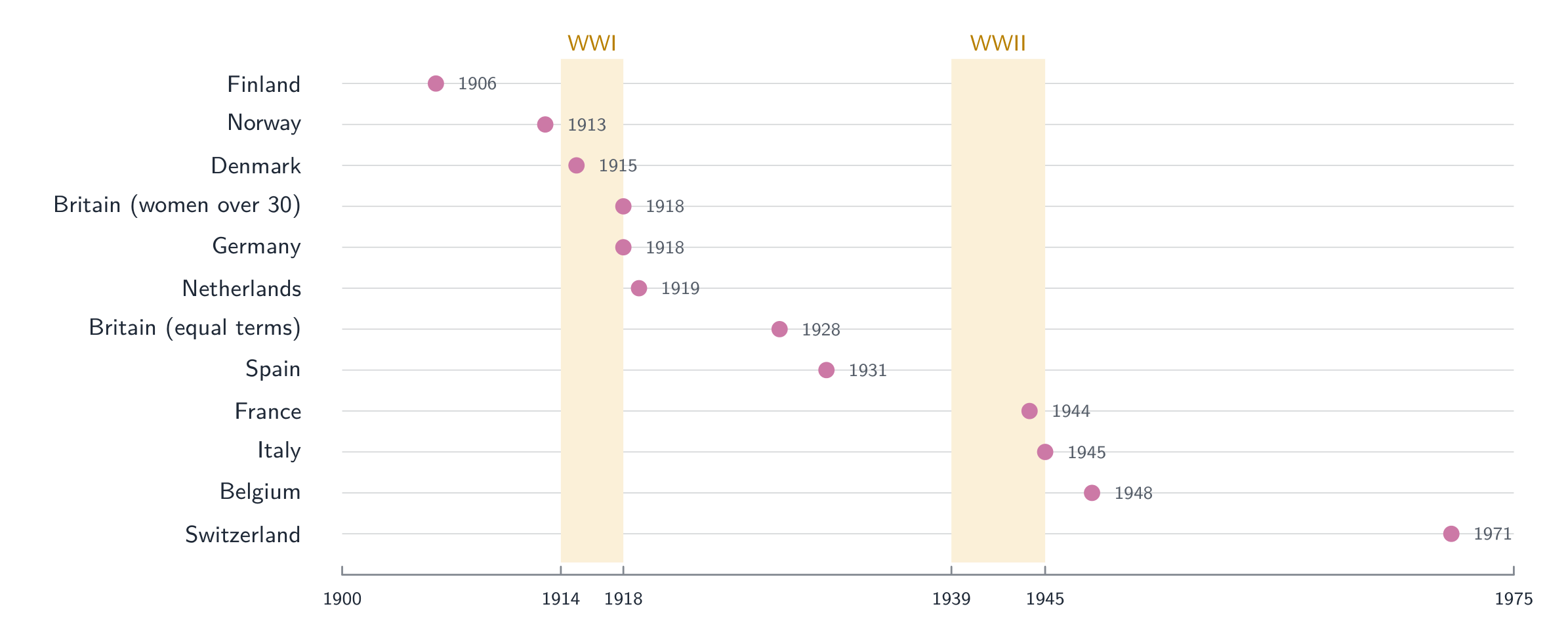
Which stage of the course's longest thread?
Sort each statement by where the CED records it.
Match each country to when women won the vote.
难度 2/5 · 今日首次完成可获 140 金币及少量额外奖励
The vote came at very different times.
Worked example: change and continuity
- Change: the vote, entry to universities and professions, and, after the 1960s, laws on equal pay and divorce.
- Continuity: after both wars, governments encouraged women to return to the home. In the 1950s many governments supported a baby boom 婴儿潮 with family allowances.
- Judgement: rights grew in steps linked to revolution, war and protest — not in a straight line.
Which is an example of continuity rather than change?
难度 1/5 · 今日首次完成可获 100 金币及少量额外奖励
Pressure to return home repeated.
Second-wave feminism
- From the late 1960s, the women's movement campaigned for equal pay, access to contraception and abortion rights. In 1975 Iceland's women went on a one-day strike; about 90% took part.
- Laws changed: France legalized abortion in 1975, and Britain passed the Equal Pay Act in 1970.
About what percentage of Iceland's women took part in the 1975 strike?
难度 2/5 · 今日首次完成可获 140 金币及少量额外奖励
About 90%.
East and West
- In the communist East, most women worked full-time, and childcare was provided. But they usually still did most housework, and few reached top political jobs.
- Women's experience depended on class, country and political system.
Women's rights did not advance in a straight line. Gains during the revolutions and wars were often followed by pressure to return home. Show both progress and setbacks.
Women's rights in Europe advanced steadily without setbacks.
难度 1/5 · 今日首次完成可获 100 金币及少量额外奖励
Progress came with setbacks.
From de Gouges to de Beauvoir, European women campaigned for equal rights. Wars brought women into work and helped win the vote, but postwar governments often pushed them back into the home. Second-wave feminism won new laws from the 1970s, and women's lives still differed between East and West.
Explain how the two world wars affected the status of women in Europe.
Change and continuity.