跳到主要内容
学科

AP 欧洲历史

学习建议

AP 欧洲历史从文艺复兴与大探索时代一直讲到当代欧洲,共九个单元:文艺复兴与探索、宗教改革、专制主义与宪政主义、科学革命与启蒙运动、18 世纪后期的危机、工业化、19 世纪的政治发展、20 世纪的全球冲突,以及冷战与当代欧洲。

在这门课里,思想被视为一种历史力量。人文主义、科学方法、自然权利、民族主义、自由主义与社会主义并不是背景板,它们是原因,而题目要问的是它们改变了什么。

注意那条关于权力的反复出现的争论。谁来统治、依据什么权威、受到哪些限制——从新君主国到专制主义与宪政政府,再到 20 世纪的各种政体与欧洲联盟,每个单元都在争论这个问题。

文化史与思想史都在考查范围内。艺术、文学与哲学贯穿整个课程框架,因为它们承载着人们如何理解自身世界的证据。

下面的笔记按 College Board 的课程框架逐单元展开,并标明每个专题的主题线索与关键概念。

训练全部词汇
  • 1

    文艺复兴与探索时代

    讲义 词汇表
    1.1

    文艺复兴与大发现的时代背景

    大纲

    1.1 Contextualizing Renaissance and Discovery

    Learning ObjectivePreview: Unit 1 Key Concepts

    Unit 1.A
    Explain the context in which the Renaissance and Age of Discovery developed.

    • KC-1.1 The rediscovery of works from ancient Greece and Rome and observation of the natural world changed many Europeans’ view of their world.
      • KC-1.1.I A revival of classical texts led to new methods of scholarship and new values in both society and religion.
      • KC-1.1.III The visual arts incorporated the new ideas of the Renaissance and were used to promote personal, political, and religious goals.
    • KC-1.3 Europeans explored and settled overseas territories, encountering and interacting with indigenous populations.
      • KC-1.3.I European nations were driven by commercial and religious motives to explore overseas territories and establish colonies.
    • KC-1.4 European society and the experiences of everyday life were increasingly shaped by commercial and agricultural capitalism, notwithstanding the continued existence of medieval social and economic structures.
      • KC-1.4.I Economic change produced new social patterns, while traditions of hierarchy and status continued.
      • KC-1.4.II Most Europeans derived their livelihood from agriculture and oriented their lives around the seasons, the village, or the manor, although economic changes began to alter rural production and power.
    • KC-1.5 The struggle for sovereignty within and among states resulted in varying degrees of political centralization.
      • KC-1.5.I The new concept of the sovereign state and secular systems of law played a central role in the creation of new political institutions.

    来源:美国大学理事会 AP 课程与考试说明

    第一单元大致讲述 1450 至 1648 年,其中有四项变化同时展开。CED 把它们列为本单元的核心概念,而几乎每道题目都会用到其中至少两项:

    • 对古希腊罗马古典著作(classical works)的重新发现,以及对自然世界的观察,改变了许多欧洲人看待世界的方式
    • 欧洲人探索并殖民海外领地,与原住民(Indigenous populations)相遇并互动。
    • 欧洲社会与日常生活日益受商业与农业资本主义(commercial and agricultural capitalism)塑造,尽管更古老的传统仍与之并存。
    • 国家内部与国家之间的主权(sovereignty)争夺,造成了程度不一的政治集权(political centralisation)。

    最后那个说法——程度不一——是贯穿整门课程的一条准则。欧洲史奖励能说清某项变化在一地比另一地走得多远的答案。

    词汇表 训练
    英文 中文 拼音
    rediscovery of classical works 古典著作 gǔ diǎn zhù zuò
    Indigenous populations 原住民 yuán zhù mín
    commercial and agricultural capitalism 商业与农业资本主义 shāng yè yǔ nóng yè zī běn zhǔ yì
    struggle for sovereignty 主权 zhǔ quán
    varying degrees of political centralisation 政治集权 zhèng zhì jí quán
    Italian Renaissance humanists 人文主义者 rén wén zhǔ yì zhě
    1.2

    意大利文艺复兴

    大纲

    1.2 Italian Renaissance

    Thematic FocusLearning ObjectiveHistorical Developments

    CID
    Cultural and Intellectual Developments — The creation and transmission of knowledge, including the relationship between traditional sources of authority and the development of differing world views, had significant political, intellectual, economic, cultural, and social effects on European and world societies.

    Unit 1.B
    Explain how the revival of classical texts contributed to the development of the Renaissance in Italy.

    • KC-1.1.I.A Italian Renaissance humanists, including Petrarch, promoted a revival in classical literature and created new philological approaches to ancient texts. Some Renaissance humanists furthered the values of secularism and individualism.

    Unit 1.C
    Explain the political, intellectual, and cultural effects of the Italian Renaissance.

    • KC-1.1.I.B Humanist revival of Greek and Roman texts, spread by the printing press, challenged the institutional power of universities and the Catholic Church. This shifted education away from a primary focus on theological writings toward classical texts and new methods of scientific inquiry.
    • KC-1.1.I.C Admiration for Greek and Roman political institutions supported a revival of civic humanist culture in the Italian city-states and produced secular models for individual and political behavior.
    • KC-1.1.III.A In the Italian Renaissance, rulers and popes concerned with enhancing their prestige commissioned paintings and architectural works based on classical styles, the developing “naturalism” in the artistic world, and often the newly invented technique of geometric perspective.

    Illustrative examples:

    • Italian Renaissance humanists:
      • Petrarch (pre-1450)
      • Lorenzo Valla
      • Marsilio Ficino
      • Pico della Mirandola
    • Individuals promoting secular models for individual and political behavior:
      • Niccolò Machiavelli
      • Baldassare Castiglione
      • Francesco Guicciardini
    • Individuals promoting a revival of Greek and Roman texts:
      • Leonardo Bruni
      • Leon Battista Alberti
      • Niccolò Machiavelli
    • Painters and architects:
      • Michelangelo
      • Donatello
      • Raphael
      • Andrea Palladio
      • Leon Battista Alberti
      • Filippo Brunelleschi

    来源:美国大学理事会 AP 课程与考试说明

    意大利文艺复兴的人文主义者(humanists),包括彼特拉克(Petrarch),推动了古典文学的复兴,并创立了处理古代文本的新语文学(philological)方法——以原文批判性地阅读它们,视之为历史文献。

    这一复兴产生了 CED 分别点明的三项影响:

    • 经由印刷机(printing press)传播,人文主义者对希腊罗马文本的重新发掘挑战了大学与天主教会的制度性权威
    • 对希腊罗马政治制度的推崇,在意大利各城邦促成了公民人文主义(civic humanism)的复兴,并产生了新的政治思想著作。
    • 意在提升声望(enhancing prestige)的统治者与教皇,委托创作以古典为范本的绘画与建筑。

    第三点是学生用得最少的。文艺复兴艺术可以作为政治证据来考:赞助是一种正当性主张,而不只是绘画趣味。

    词汇表 训练
    英文 中文 拼音
    Petrarch 彼特拉克 bǐ tè lā kè
    philological 语文学 yǔ wén xué
    printing press 印刷机 yìn shuā jī
    civic humanism 公民人文主义 gōng mín rén wén zhǔ yì
    enhancing their prestige 提升声望 tí shēng shēng wàng
    1.3

    北方文艺复兴

    大纲

    1.3 Northern Renaissance

    Thematic FocusLearning ObjectiveHistorical Developments

    CID
    Cultural and Intellectual Developments — The creation and transmission of knowledge, including the relationship between traditional sources of authority and the development of differing world views, had significant political, intellectual, economic, cultural, and social effects on European and world societies.

    Unit 1.D
    Explain how Renaissance ideas were developed, maintained, and changed as the Renaissance spread to northern Europe.

    • KC-1.1.III.B The Northern Renaissance retained a more religious focus, which resulted in more human-centered naturalism that considered individuals and everyday life appropriate objects of artistic representation.
    • KC-1.2.I.A Christian humanism, embodied in the writings of Erasmus, employed Renaissance learning in the service of religious reform.

    Illustrative examples:

    • Artists who employed naturalism:
      • Pieter Bruegel the Elder
      • Rembrandt

    来源:美国大学理事会 AP 课程与考试说明

    文艺复兴的观念北传时发生了变化。北方文艺复兴保留了更强的宗教关切,产生了一种以人为中心的自然主义(human-centred naturalism),把个人与日常生活视为艺术的正当题材。

    在思想上,关键发展是基督教人文主义(Christian humanism),以伊拉斯谟(Erasmus)的著作为代表,把文艺复兴的学识用于宗教改革(religious reform)。把握这一联系会让第二单元容易得多:宗教改革并非凭空而来。

    词汇表 训练
    英文 中文 拼音
    human-centred naturalism 以人为中心的自然主义 yǐ rén wéi zhōng xīn de zì rán zhǔ yì
    Christian humanism 基督教人文主义 jī dū jiào rén wén zhǔ yì
    Erasmus 伊拉斯谟 yī lā sī mó
    religious reform 宗教改革 zōng jiào gǎi gé
    the invention of printing promoted the dissemination of new ideas 新思想的传播 xīn sī xiǎng de chuán bō
    1.4

    印刷术

    大纲

    1.4 Printing

    Thematic FocusLearning ObjectiveHistorical Developments

    TSI
    Technological and Scientific Innovation — Scientific and technological innovations have increased efficiency, improved daily life, and shaped human development and interactions, having both intended and unintended consequences.

    Unit 1.E
    Explain the influence of the printing press on cultural and intellectual developments in modern European history.

    • KC-1.1.II The invention of printing promoted the dissemination of new ideas.
      • KC-1.1.II.A The invention of the printing press in the 1450s helped spread the Renaissance beyond Italy and encouraged the growth of vernacular literature, which would eventually contribute to the development of national cultures.

    来源:美国大学理事会 AP 课程与考试说明

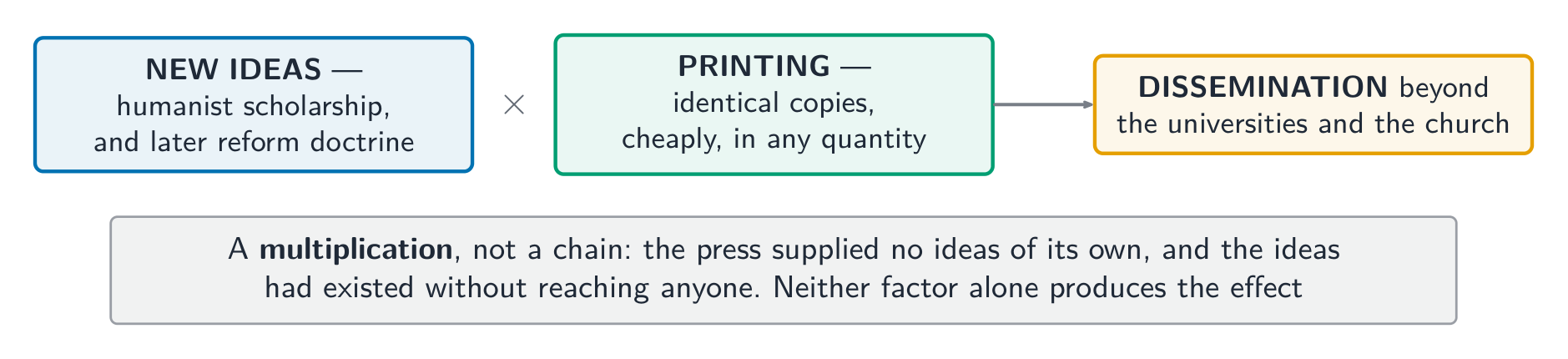
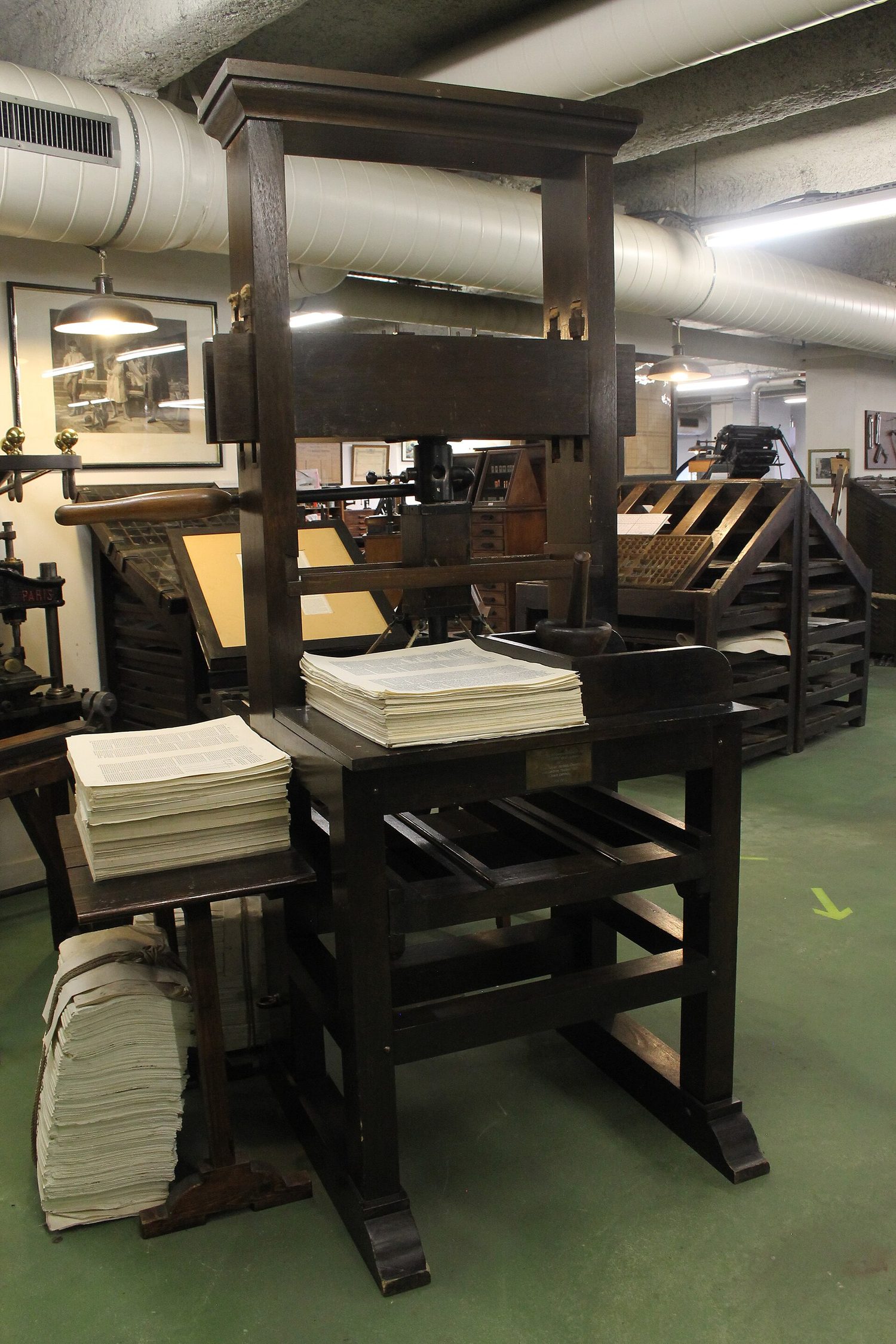
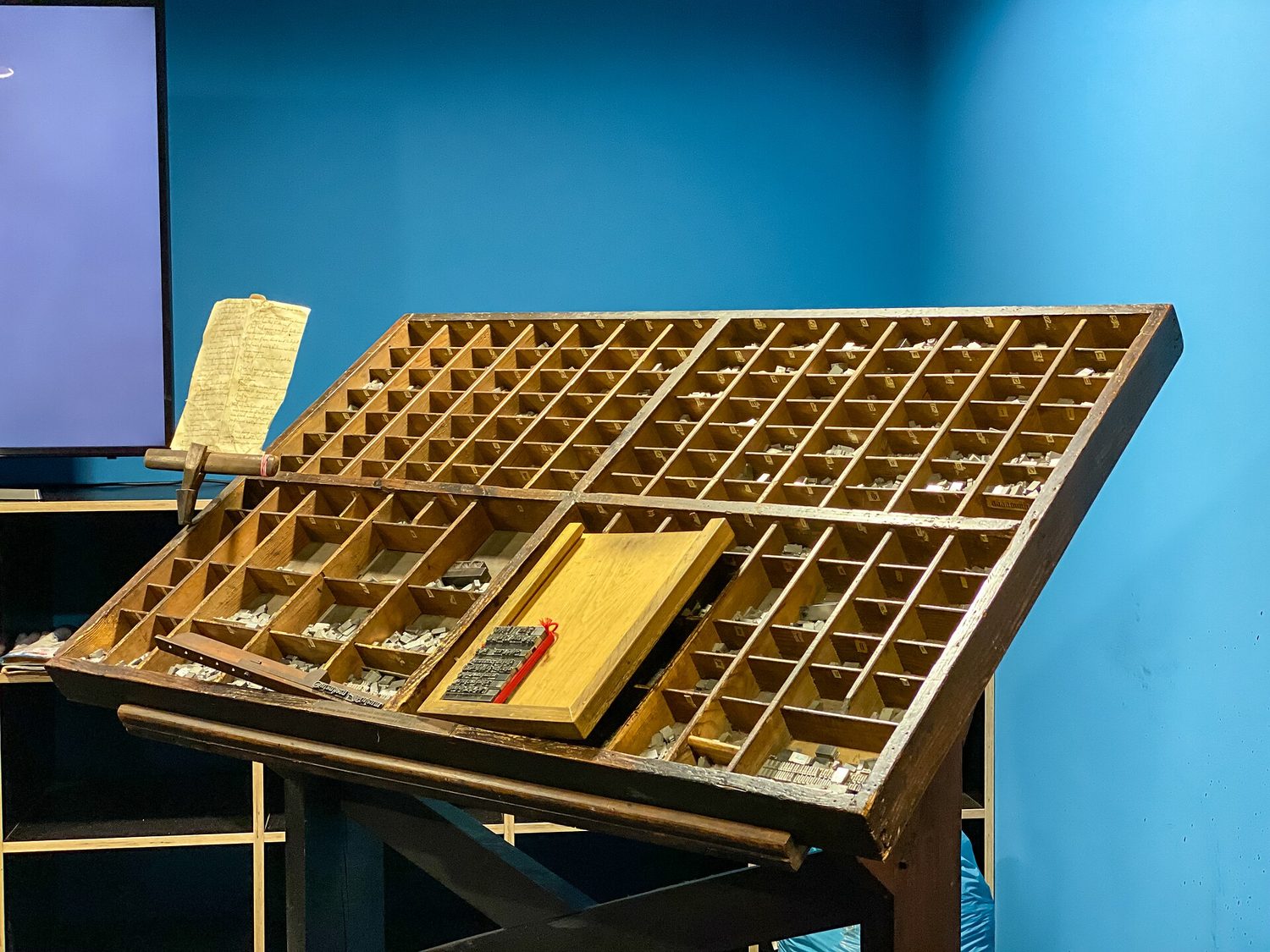
    CED 为印刷单列一节自有其道理:印刷术的发明促进了新思想的传播(dissemination of new ideas)。

    理解印刷术最好的方式是把它看作放大器而非起因。它并没有创造人文主义、宗教异见或政治论争——但它改变了这些事物的速度、范围与成本,而这正是观念得以摆脱既有机构对文本流通的控制的原因。

    1.5

    新君主国

    大纲

    1.5 New Monarchies

    Thematic FocusLearning ObjectiveHistorical Developments

    SOP
    States and Other Institutions of Power — European states and nations developed governmental and civil institutions from 1450 to the present to organize society and consolidate political power, with a variety of social, cultural, and economic effects.

    Unit 1.F
    Explain the causes and effects of the development of political institutions from 1450 to 1648.

    • KC-1.2.II.A Monarchs and princes, including the English rulers Henry VIII and Elizabeth I, initiated religious reform from the top down in an effort to exercise greater control over religious life and morality.
    • KC-1.5.I.A New monarchies laid the foundation for the centralized modern state by establishing monopolies on tax collection, employing military force, dispensing justice, and gaining the right to determine the religion of their subjects.
    • KC-1.5.I.C Across Europe, commercial and professional groups gained in power and played a greater role in political affairs.
    • KC-1.5.I.D Continued political fragmentation in Renaissance Italy provided a background for the development of new concepts of the secular state.

    Illustrative examples:

    • State actions to control religion and morality:
      • Spanish Inquisition
      • Concordat of Bologna
      • Book of Common Prayer
      • Peace of Augsburg
    • Monarchical control:
      • Ferdinand and Isabella of Spain consolidating control of the military
      • Star Chamber
      • Concordat of Bologna
      • Peace of Augsburg
      • Edict of Nantes
    • Commercial and professional groups that gained in power:
      • Merchants and financiers in Renaissance Italy and northern Europe
      • Nobles of the robe in France
    • Secular political theorists:
      • Jean Bodin
      • Hugo Grotius
      • Niccolò Machiavelli

    来源:美国大学理事会 AP 课程与考试说明

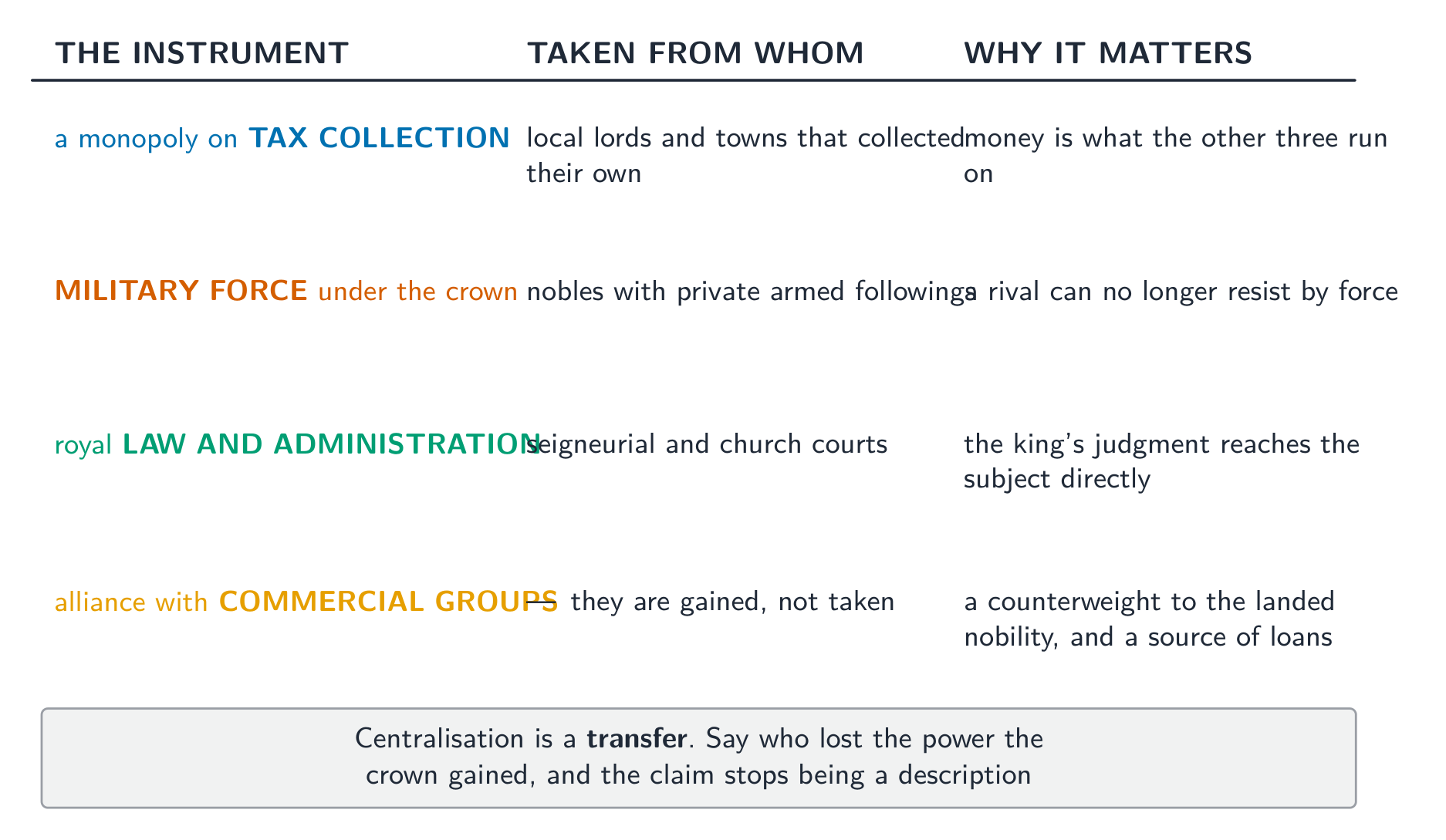
    新君主国(new monarchies)通过以下方式为中央集权的现代国家奠定基础:

    • 确立征税垄断权(monopolies on tax collection);
    • 掌握受王权支配的军事力量(military force);
    • 并日益控制法律与行政

    还有两股制衡力量也在考查范围内。商业与专业群体在欧洲各地取得权力,在政治事务中扮演更大角色。而意大利在文艺复兴时期持续的政治分裂,则为世俗国家(secular state)新观念的形成提供了背景——理论出自集权失败之处,而非成功之处。

    一些君主,包括亨利八世伊丽莎白一世,也自上而下发起宗教改革以强化王权控制——这一点同时属于本单元与下一单元。

    词汇表 训练
    英文 中文 拼音
    new monarchies 新君主国 xīn jūn zhǔ guó
    monopolies on tax collection 征税垄断权 zhēng shuì lǒng duàn quán
    employing military force 军事力量 jūn shì lì liàng
    secular state 世俗国家 shì sú guó jiā
    Advances in navigation, cartography, and military technology 航海、制图与军事技术 háng hǎi 、 zhì tú yǔ jūn shì jì shù
    1.6

    技术进步与大探索时代

    大纲

    1.6 Technological Advances and the Age of Exploration

    Thematic FocusLearning ObjectiveHistorical Developments

    TSI
    Technological and Scientific Innovation — Scientific and technological innovations have increased efficiency, improved daily life, and shaped human development and interactions, having both intended and unintended consequences.

    Unit 1.G
    Explain the technological factors that facilitated European exploration and expansion from 1450 to 1648. THEMATIC FOCUS Interaction of Europe and the World INT Motivated by a variety of factors, Europe’s interaction with the world led to political, economic, social, and cultural exchanges that influenced both European and non-European societies. LEARNING OBJECTIVE

    • KC-1.3.II Advances in navigation, cartography, and military technology enabled Europeans to establish overseas colonies and empires. HISTORICAL DEVELOPMENTS

    Unit 1.H
    Explain the motivations for and effects of European exploration and expansion from 1450 to 1648.

    • KC-1.3.I.A European states sought direct access to gold, spices, and luxury goods to enhance personal wealth and state power.
    • KC-1.3.I.B The rise of mercantilism gave the state a new role in promoting commercial development and the acquisition of colonies overseas.
    • KC-1.3.I.C Christianity was a stimulus for exploration as governments and religious authorities sought to spread the faith, and for some it served as a justification for the subjugation of indigenous civilizations.

    Illustrative examples:

    • Navigational technology:
      • Compass
      • Sternpost rudder
      • Portolani
      • Quadrant and astrolabe
      • Lateen rig
    • Military technology:
      • Guns and gunpowder
    • States seeking access to luxury goods:
      • Spanish in the New World
      • Portuguese in the Indian Ocean World
      • Dutch in the East Indies/Asia
    • Mercantilist policies employed by the state:
      • Jean-Baptiste Colbert
    • Religion and exploration:
      • Jesuit activities

    来源:美国大学理事会 AP 课程与考试说明

    航海、制图与军事技术(navigation, cartography, and military technology)的进步,使欧洲人得以建立海外殖民地与帝国。技术是使之成为可能的条件;CED 随后单独给出了动机:

    • 欧洲各国寻求直接获取黄金、香料与奢侈品,以增进个人财富与国家权力。
    • 重商主义(mercantilism)的兴起赋予国家推动商业发展与获取殖民地的新角色。
    • 基督教是一项动因(religious stimulus):政府与宗教当局意图传播信仰——对一些人而言它也充当了辩护理由。

    要把使之可能的条件与动机分作两类。问"为什么"的题目要的是动机;问"如何成为可能"的题目要的是技术。

    词汇表 训练
    英文 中文 拼音
    mercantilism 重商主义 zhòng shāng zhǔ yì
    Christianity was a stimulus 宗教动因 zōng jiào dòng yīn
    through coercion and negotiation 强制与谈判 qiáng zhì yǔ tán pàn
    1.7

    世界舞台上的竞争者

    大纲

    1.7 Rivals on the World Stage

    Thematic FocusLearning ObjectiveHistorical Developments

    ECD
    Economic and Commercial Developments — Economic development, especially the development of capitalism, played an important role in Europe’s history, often having significant social, political, and cultural effects.

    Unit 1.I
    Explain how and why trading networks and colonial expansion affected relations between and among European states.

    • KC-1.3.III Europeans established overseas empires and trade networks through coercion and negotiation.
      • KC-1.3.III.B The Spanish established colonies across the Americas, the Caribbean, and the Pacific, which made Spain a dominant state in Europe in the 16th century.
      • KC-1.3.III.C The Atlantic nations of France, England, and the Netherlands followed by establishing their own colonies and trading networks to compete with Portuguese and Spanish dominance in the 17th century.
      • KC-1.3.III.D The competition for trade led to conflicts and rivalries among European powers in the 17th and 18th centuries.

    Illustrative examples:

    • Colonial conflicts and rivalries:
      • Asiento
      • War of the Spanish Succession
      • Seven Years’ War
      • Treaty of Tordesillas

    来源:美国大学理事会 AP 课程与考试说明

    欧洲人通过强制与谈判(coercion and negotiation)建立海外帝国与贸易网络——两者兼有,而非其一。当地国家强大之处,欧洲人为贸易权而谈判;不强大之处,强制随之而来。

    欧洲各国为争夺这些网络而展开的竞争,也重塑了欧洲内部的关系。商业竞争成为欧洲战争的长期根源,这一延续性一直贯穿到第七单元。

    1.8

    殖民扩张与哥伦布大交换

    大纲

    1.8 Colonial Expansion and Columbian Exchange

    Thematic FocusLearning ObjectiveHistorical Developments

    INT
    Interaction of Europe and the World — Motivated by a variety of factors, Europe’s interaction with the world led to political, economic, social, and cultural exchanges that influenced both European and non-European societies.

    Unit 1.J
    Explain the economic impact of European colonial expansion and development of trade networks.

    • KC-1.3.III.A The Portuguese established a commercial network along the African coast, in South and East Asia, and in South America in the late 15th and throughout the 16th centuries.
    • KC-1.3.IV.i Europe’s colonial expansion led to a global exchange of goods, flora, and fauna; a shift toward European dominance; and the expansion of the trade in enslaved persons.
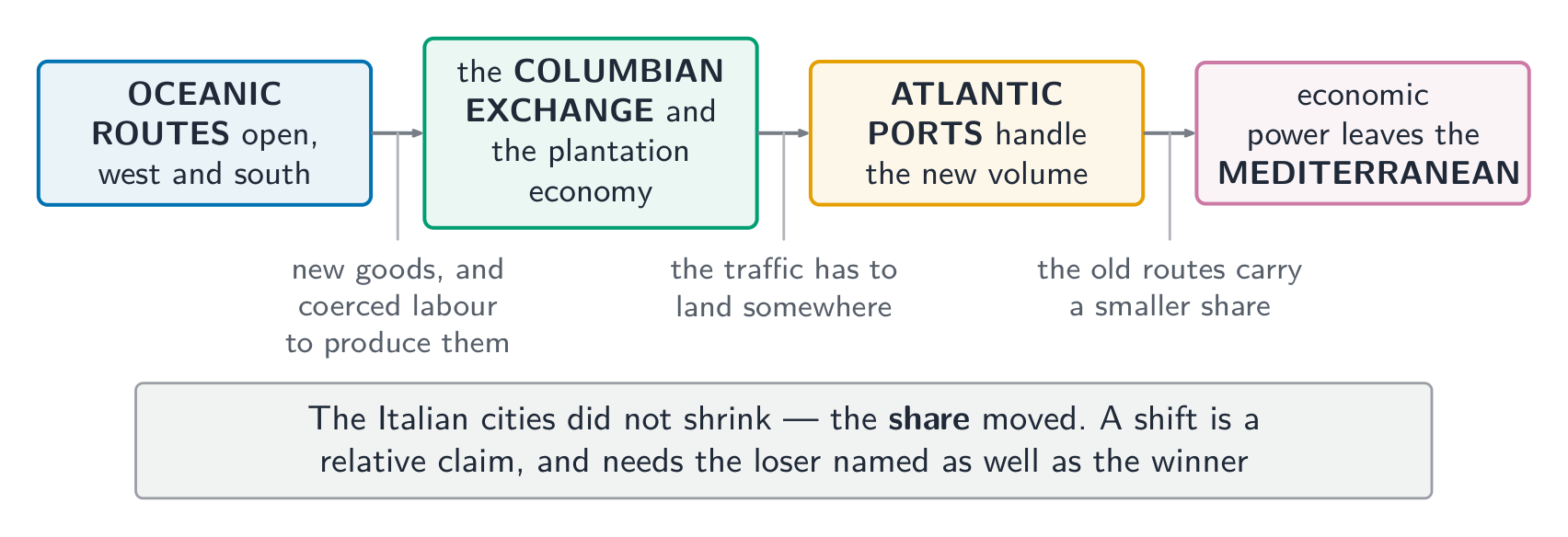
    • KC-1.3.IV.A The exchange of goods shifted the center of economic power in Europe from the Mediterranean to the Atlantic states and brought the latter into an expanding world economy.
    • KC-1.3.IV.B.i The exchange of new plants, animals, and diseases—the Columbian Exchange—created economic opportunities for Europeans.

    Unit 1.K
    Explain the social and cultural impact of European colonial expansion and development of trade networks.

    • KC-1.3.IV.ii Europe’s colonial expansion led to a global exchange of goods, flora, fauna, cultural practices, and diseases, resulting in the destruction of some indigenous civilizations, a shift toward European dominance, and the expansion of the trade in enslaved persons.
    • KC-1.3.IV.B.ii The exchange of new plants, animals, and diseases—the Columbian Exchange—in some cases facilitated European subjugation and destruction of indigenous peoples, particularly in the Americas.

    Illustrative examples:

    • Important Atlantic port cities:
      • London
      • Bristol
      • Amsterdam
      • Antwerp
    • New plants, animals, and diseases (from Europe to the Americas):
      • Wheat
      • Cattle
      • Horses
      • Pigs
      • Sheep
      • Smallpox
      • Measles
    • New plants, animals, and diseases (from the Americas to Europe):
      • Tomatoes
      • Potatoes
      • Squash
      • Corn
      • Tobacco
      • Turkeys

    来源:美国大学理事会 AP 课程与考试说明

    葡萄牙人在十五世纪末与十六世纪沿非洲海岸以及在南亚、东亚建立了商业网络;其他国家随后跟进。

    哥伦布大交换(Columbian Exchange)——新植物、动物与疾病的交换——被 CED 有意以双重视角呈现,两面都在考查范围内:

    • 为欧洲人创造了经济机会
    • 便利了欧洲人的征服以及对原住民社会的摧毁,主要通过疾病。

    在经济上,货物交换使欧洲经济重心从地中海转向大西洋沿岸国家(from the Mediterranean to the Atlantic states)。这一转移解释了为何第三单元的强国不是第一单元的强国。

    词汇表 训练
    英文 中文 拼音
    Columbian Exchange 哥伦布大交换 gē lún bù dà jiāo huàn
    shifted the centre of economic power in Europe from the Mediterranean to the Atlantic states 从地中海转向大西洋 cóng dì zhōng hǎi zhuǎn xiàng dà xī yáng
    expanded the trade of enslaved Africans 奴隶贸易 nú lì mào yì
    1.9

    奴隶贸易

    大纲

    1.9 The Slave Trade

    Thematic FocusLearning ObjectiveHistorical Developments

    INT
    Interaction of Europe and the World — Motivated by a variety of factors, Europe’s interaction with the world led to political, economic, social, and cultural exchanges that influenced both European and non-European societies.

    Unit 1.L
    Explain the causes for and the development of the slave trade.

    • KC-1.3.IV.C Europeans expanded the trade of enslaved Africans in response to the establishment of a plantation economy in the Americas and demographic catastrophes among indigenous peoples.

    Illustrative examples:

    • Slave trade developments:
      • Middle Passage
      • Planter society

    来源:美国大学理事会 AP 课程与考试说明

    欧洲人扩大了对被奴役非洲人的贸易(slave trade),以回应美洲种植园经济(plantation economy)的建立与原住民人口的锐减。

    这一因果链在 CED 中是明确的,应当作为链条来复述:种植园农业所需的劳动力规模,是人口遭到摧毁的美洲无法供给的,而这一需求由扩大的大西洋人口贩运来满足。

    词汇表 训练
    英文 中文 拼音
    plantation economy 种植园经济 zhòng zhí yuán jīng jì
    Innovations in banking and finance 银行与金融 yín háng yǔ jīn róng
    1.10

    商业革命

    大纲

    1.10 The Commercial Revolution

    Thematic FocusLearning ObjectiveHistorical Developments

    SCD
    Social Organization and Development — Economic, political, and cultural factors have influenced the form and status of family, class, and social groups in European history, which has, in turn, affected both the individual and society.

    Unit 1.M
    Explain European commercial and agricultural developments and their economic effects from 1450 to 1648.

    • KC-1.4.I.A Innovations in banking and finance promoted the growth of urban financial centers and a money economy.
    • KC-1.4.II Most Europeans derived their livelihood from agriculture and oriented their lives around the seasons, the village, or the manor, although economic changes began to alter rural production and power.
      • KC-1.4.II.A Subsistence agriculture was the rule in most areas, with three-crop field rotation in the north and two-crop rotation in the Mediterranean; in many cases, farmers paid rent and labor services for their lands.
      • KC-1.4.II.B The price revolution contributed to the accumulation of capital and the expansion of the market economy through the commercialization of agriculture, which benefited large landowners in western Europe.
      • KC-1.4.III.A Population recovered to its pre-Great Plague level in the 16th century, and continuing population pressures contributed to uneven price increases; agricultural commodities increased more sharply than wages, reducing living standards for some.

    Unit 1.N
    Explain European commercial and agricultural developments and their social effects from 1450 to 1648.

    • KC-1.4.I Economic change produced new social patterns, while traditions of hierarchy and status continued.
      • KC-1.4.I.B The growth of commerce produced a new economic elite, which related to traditional land-holding elites in different ways in Europe’s various geographic regions.
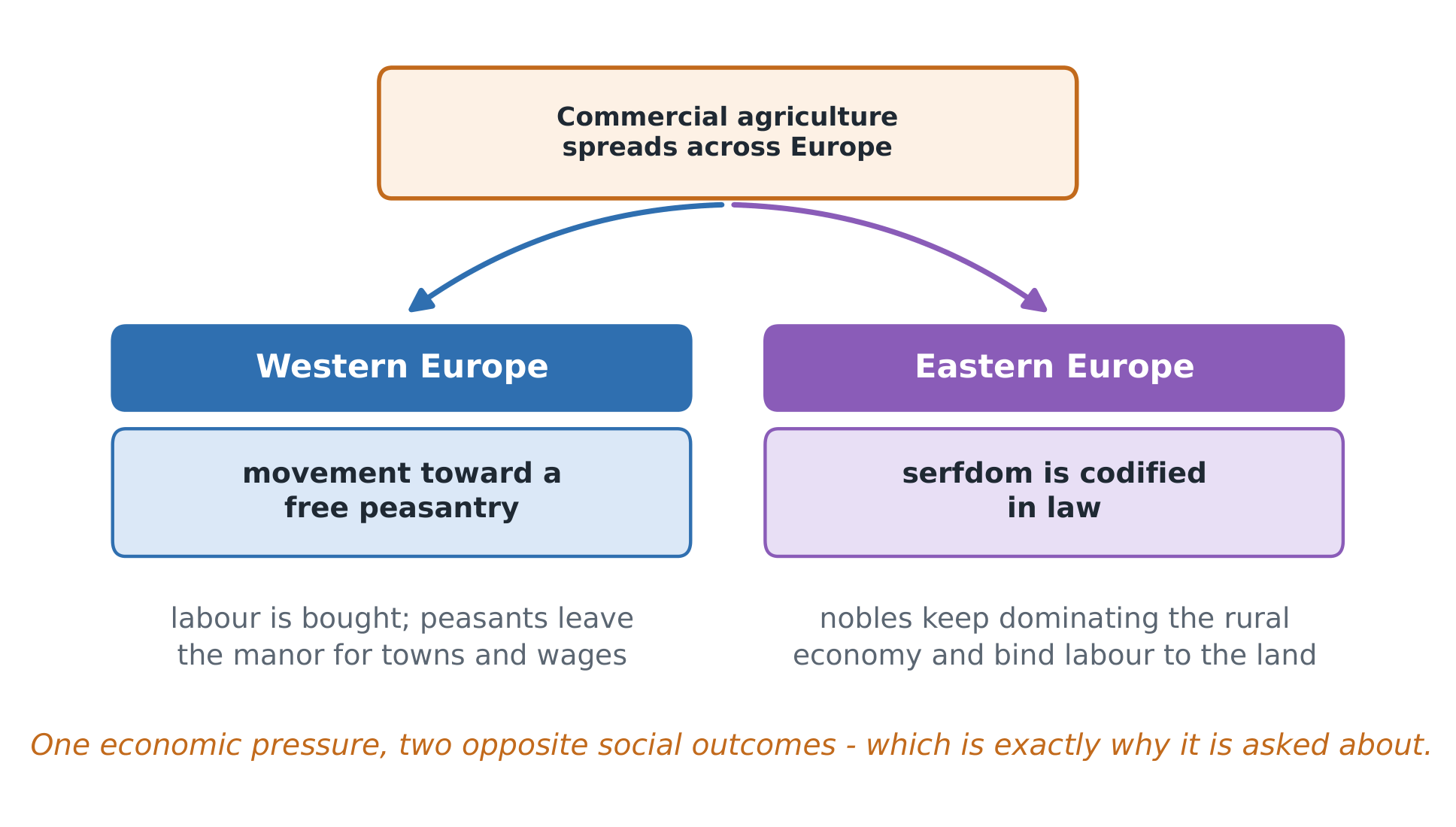
    • KC-1.4.II.C As western Europe moved toward a free peasantry and commercial agriculture, serfdom was codified in the east, where nobles continued to dominate economic life on large estates.
    • KC-1.4.II.D The attempts of landlords to increase their revenues by restricting or abolishing the traditional rights of peasants led to revolt.
    • KC-1.4.III.B Migrants to the cities challenged the ability of merchant elites and craft guilds to govern, and strained resources.
    • KC-1.4.IV.C From the late 16th century on, Europeans responded to economic and environmental challenges, such as the Little Ice Age, by delaying marriage and childbearing. This European marriage pattern restrained population growth and ultimately improved the economic condition of families.

    Illustrative examples:

    • Innovations in banking and finance:
      • Double-entry bookkeeping
      • Bank of Amsterdam
      • The Dutch East India Company
      • The British East India Company
    • The commercialization of agriculture:
      • Enclosure movement
      • Restricted use of the village common
      • Freehold tenure
    • New economic elites:
      • Italian merchant princes
      • Nobles of the robe in France
    • The way new migrants challenged urban elites:
      • Sanitation problems caused by overpopulation
      • Employment
      • Poverty
      • Crime

    来源:美国大学理事会 AP 课程与考试说明

    同一个世纪把西欧与东欧推向相反方向——而 CED 就此发问
    商业化农业在西方解放了农民,在东方却束缚了农民

    银行与金融(banking and finance)的创新推动了城市金融中心与货币经济(money economy)的成长。经济变化产生了新的社会模式,而等级与身份的传统仍在延续——两者并存,这正是 CED 自身的表述。

    多数欧洲人仍以农业为生,围绕季节、村庄或庄园安排生活。而在其中,一道明显的分野出现了:

    • 西欧走向自由农民(free peasantry)与商业化农业。
    • 在东方,随着贵族继续支配乡村经济,农奴制被法典化(serfdom was codified)。

    同一种商业压力产生了相反的结果,这恰恰是它可考的原因。另有两项相关后果:地主试图通过限制农民传统权利来增加收入,引发了反抗(revolt);而迁入城市的移民使资源紧张,并挑战了商人精英与行会的治理能力。

    最后,自十六世纪后期起,欧洲人以推迟婚育回应经济与环境压力——包括小冰期(Little Ice Age)——这是一项值得掌握的人口适应,因为它是不常见的证据。

    词汇表 训练
    英文 中文 拼音
    money economy 货币经济 huò bì jīng jì
    free peasantry 自由农民 zì yóu nóng mín
    serfdom was codified 农奴制被法典化 nóng nú zhì bèi fǎ diǎn huà
    revolt 反抗 fǎn kàng
    Little Ice Age 小冰期 xiǎo bīng qī
    1.11

    文艺复兴与大发现时代的因果关系

    大纲

    1.11 Causation in the Renaissance and Age of Discovery

    Learning ObjectiveReview: Unit 1 Key Concepts

    Unit 1.O
    Explain the causes and consequences of the Renaissance and Age of Discovery.

    • KC-1.1 The rediscovery of works from ancient Greece and Rome and observation of the natural world changed many Europeans’ view of their world.
      • KC-1.1.I A revival of classical texts led to new methods of scholarship and new values in both society and religion.
      • KC-1.1.III The visual arts incorporated the new ideas of the Renaissance and were used to promote personal, political, and religious goals.
    • KC-1.3 Europeans explored and settled overseas territories, encountering and interacting with indigenous populations.
      • KC-1.3.I European nations were driven by commercial and religious motives to explore overseas territories and establish colonies.
    • KC-1.4 European society and the experiences of everyday life were increasingly shaped by commercial and agricultural capitalism, notwithstanding the continued existence of medieval social and economic structures.
      • KC-1.4.I Economic change produced new social patterns, while traditions of hierarchy and status continued.
      • KC-1.4.II Most Europeans derived their livelihood from agriculture and oriented their lives around the seasons, the village, or the manor, although economic changes began to alter rural production and power.
    • KC-1.5 The struggle for sovereignty within and among states resulted in varying degrees of political centralization.
      • KC-1.5.I The new concept of the sovereign state and secular systems of law played a central role in the creation of new political institutions.

    来源:美国大学理事会 AP 课程与考试说明

    本单元考查的推理能力是因果关系

    **Worked example(一道真实的 AP 考题)。*本单元的 AP 欧洲史简答题会要求,例如「解释 1450 至 1648 年间印刷术的发展影响欧洲思想生活的一种方式」。满分答案给出的是机制,而不是事实:「印刷术使希腊罗马文本的人文主义校订本得以廉价而一致地复制,因此全欧洲的学者都能阅读并比对同样的校勘本。这削弱了大学与教会对文本流通的控制,也使一项论点一旦付印便极难压制。」*注意其结构:影响要求把后果经由一个过程追溯出来。

    1.11

    考试技巧

    • "程度不一"是 CED 自己对集权的用词。要比较走了多远,而不只是有没有
    • 文艺复兴艺术是政治证据。赞助是对声望与正当性的主张。
    • 把印刷术当作放大器,而不是首要起因。这一框架能回答多数印刷术题目。
    • 把探索的技术条件动机分开。题目问的是其中之一。
    • 哥伦布大交换有两面——欧洲人的机会与原住民的毁灭。两面都要写。
    • 农奴制上的东西分野价值高且常被遗漏。一个起因,两个相反的结果。
  • 2

    宗教改革时代

    讲义 词汇表
    2.1

    16与17世纪挑战与发展的时代背景

    大纲

    2.1 Contextualizing 16th- and 17th-Century Challenges and Developments

    Learning ObjectivePreview: Unit 2 Key Concepts

    Unit 2.A
    Explain the context in which the religious, political, and cultural developments of the 16th and 17th centuries took place.

    • KC-1.2 Religious pluralism challenged the concept of a unified Europe.
      • KC-1.2.I The Protestant and Catholic reformations fundamentally changed theology, religious institutions, culture, and attitudes toward wealth and prosperity.
      • KC-1.2.II Religious reform both increased state control of religious institutions and provided justifications for challenging state authority.
      • KC-1.2.III Conflicts among religious groups overlapped with political and economic competition within and among states.
    • KC-1.4 European society and the experiences of everyday life were increasingly shaped by commercial and agricultural capitalism, notwithstanding the continued existence of medieval social and economic structures.
      • KC-1.4.III Population shifts and growing commerce caused the expansion of cities, which often placed stress on their traditional political and social structures.
      • KC-1.4.IV The family remained the primary social and economic institution of early modern Europe and took several forms, including the nuclear family.
      • KC-1.4.V Popular culture, leisure activities, and rituals reflecting the continued popularity of folk ideas reinforced and sometimes challenged communal ties and norms.
    • KC-1.5 The struggle for sovereignty within and among states resulted in varying degrees of political centralization.
      • KC-1.5.I The new concept of the sovereign state and secular systems of law played a central role in the creation of new political institutions.

    来源:美国大学理事会 AP 课程与考试说明

    第二单元讲述宗教改革与宗教战争,CED 把整个时期围绕一项论断展开:宗教多元(religious pluralism)挑战了统一欧洲的观念

    另有两条线索与之并行,并与宗教一同受到考查——日常生活被商业与农业资本主义重塑,以及主权争夺造成程度不一的政治集权。本单元的典型题目会问宗教变化与政治变化如何相互作用,因此把两者放在彼此隔离的心理格子里,正是学生在这里失分的主要方式。

    2.2

    路德与新教改革

    大纲

    2.2 Luther and the Protestant Reformation

    Thematic FocusLearning ObjectiveHistorical Developments

    CID
    Cultural and Intellectual Developments — The creation and transmission of knowledge, including the relationship between traditional sources of authority and the development of differing world views, had significant political, intellectual, economic, cultural, and social effects on European and world societies.

    Unit 2.B
    Explain how and why religious belief and practices changed from 1450 to 1648.

    • KC-1.2.I.B Reformers Martin Luther and John Calvin criticized Catholic abuses and established new interpretations of Christian doctrine and practice. Responses to Luther and Calvin included religious radicals, including the Anabaptists, and other groups, such as German peasants.
    • KC-1.2.I.C Some Protestant groups sanctioned the notion that wealth accumulation was a sign of God’s favor and a reward for hard work.

    Illustrative examples:

    • New Protestant interpretations of Christian doctrine and practice:
      • Priesthood of all believers
      • Primacy of scripture §Bullet Predestination §Bullet Salvation by faith alone
    • Protestants who viewed wealth as signs of God’s favor: §Bullet Calvinists

    来源:美国大学理事会 AP 课程与考试说明

    改革者马丁·路德(Martin Luther)与加尔文(John Calvin)批评天主教的弊端,并确立了对基督教教义(doctrine)与实践的新诠释。CED 强调的是诠释:改变的不只是行为,还有关于救赎如何实现、宗教权威何在的整套说法。

    第二项更具社会性的论断也在考查范围内,却常被遗忘:一些新教团体认可财富积累(accumulation of wealth)是上帝眷顾的标志,是勤勉的回报。这是宗教改革与第一单元商业发展之间的联系,值得为经济类题目备好。

    词汇表 训练
    英文 中文 拼音
    religious pluralism challenged the concept of a unified Europe 宗教多元 zōng jiào duō yuán
    Martin Luther 马丁·路德 mǎ dīng · lù dé
    John Calvin 加尔文 jiā ěr wén
    new interpretations of Christian doctrine 教义 jiào yì
    sanctioned the notion that the accumulation of wealth was a sign of God's favour 财富积累 cái fù jī lěi
    used the printing press 印刷机 yìn shuā jī
    Calvin and the Anabaptists 再洗礼派 zài xǐ lǐ pài
    refused to recognise the subordination of the church to the secular state 教会从属于世俗国家 jiào huì cóng shǔ yú shì sú guó jiā
    expanded Ottoman Empire 奥斯曼帝国 ào sī màn dì guó
    promote political and economic interests 政治与经济利益 zhèng zhì yǔ jīng jì lì yì
    2.3

    新教改革的延续

    大纲

    2.3 Protestant Reform Continues

    Thematic FocusLearning ObjectiveHistorical Developments

    CID
    Cultural and Intellectual Developments — The creation and transmission of knowledge, including the relationship between traditional sources of authority and the development of differing world views, had significant political, intellectual, economic, cultural, and social effects on European and world societies.

    Unit 2.B
    Explain how and why religious belief and practices changed from 1450 to 1648.

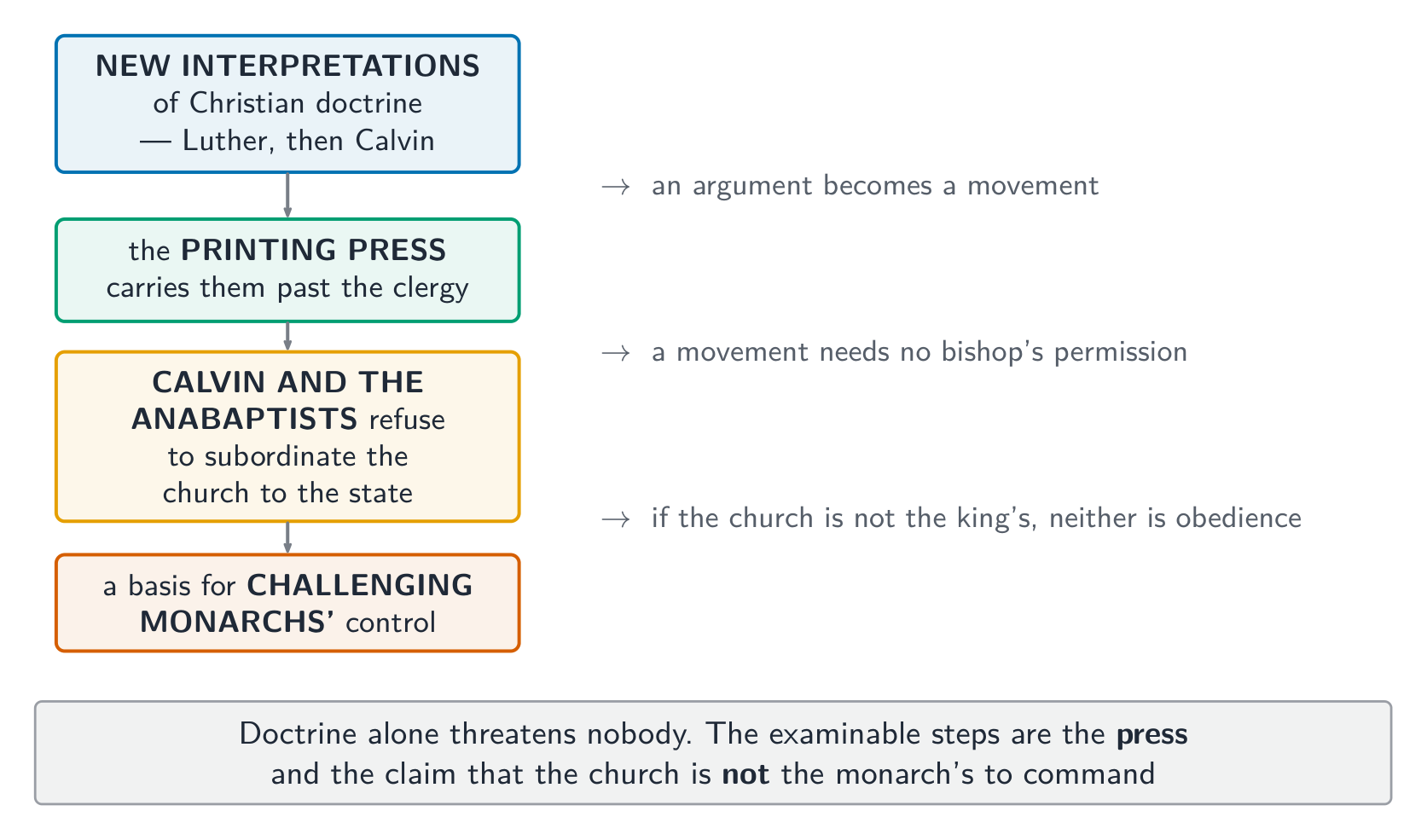
    • KC-1.1.II.B Protestant reformers used the printing press to disseminate their ideas, which spurred religious reform and helped it to become widely established.
    • KC-1.2.II.B Some Protestants, including Calvin and the Anabaptists, refused to recognize the subordination of the church to the secular state.
    • KC-1.2.II.C Religious conflicts became a basis for challenging the monarchs’ control of religious institutions.

    Illustrative examples:

    • Reformers using press to disseminate ideas: §Bullet Martin Luther §Bullet Vernacular Bibles Religious conflicts caused by groups challenging the monarch’s control of religious institutions:
      • Huguenots
      • Puritans
      • Nobles in Poland

    来源:美国大学理事会 AP 课程与考试说明

    有三项发展使宗教改革越过了第一代人:

    • 新教改革者利用印刷机(printing press)传播其思想,推动了改革并使之得以长久。印刷术再次充当放大器——这正是这场运动没有像先前那些一样收场的原因。
    • 一些新教徒,包括加尔文与再洗礼派(Anabaptists),拒不承认教会从属于世俗国家(subordination of the church to the secular state)。
    • 宗教冲突成为挑战君主控制宗教机构的依据。

    后两项是披着宗教语言的政治主张,CED 也正是这样处理它们的。一旦宗教权威可被争夺,那么声称控制它的人的权威同样可被争夺。

    2.4

    宗教战争

    大纲

    2.4 Wars of Religion

    Thematic FocusLearning ObjectiveHistorical Developments

    SOP
    States and Other Institutions of Power — European states and nations developed governmental and civil institutions from 1450 to the present to organize society and consolidate political power, with a variety of social, cultural, and economic effects.

    Unit 2.C
    Explain how matters of religion influenced and were influenced by political factors from 1450 to 1648.

    • KC-1.2.III.A Issues of religious reform exacerbated conflicts between the monarchy and the nobility, as in the French wars of religion.
    • KC-1.2.III.B Habsburg rulers confronted an expanded Ottoman Empire while attempting unsuccessfully to restore Catholic unity across Europe.
    • KC-1.2.III.C States exploited religious conflicts to promote political and economic interests.
    • KC-1.2.III.D A few states, such as France with the Edict of Nantes, allowed religious pluralism in order to maintain domestic peace.
    • KC-1.5.I.B The Peace of Westphalia (1648), which marked the effective end of the medieval ideal of universal Christendom, accelerated the decline of the Holy Roman Empire by granting princes, bishops, and other local leaders control over religion.

    Illustrative examples:

    • Key factors in the French wars of religion:
      • Catherine de’ Medici
      • St. Bartholomew’s Day massacre
      • War of the Three Henrys
      • Henry IV
    • Habsburg rulers: §Bullet Charles V State exploitation of religious conflicts:
      • Catholic Spain and Protestant England
      • France, Sweden, and Denmark in the Thirty Years’ War
    • States allowing religious pluralism:
      • Poland
      • The Netherlands

    来源:美国大学理事会 AP 课程与考试说明

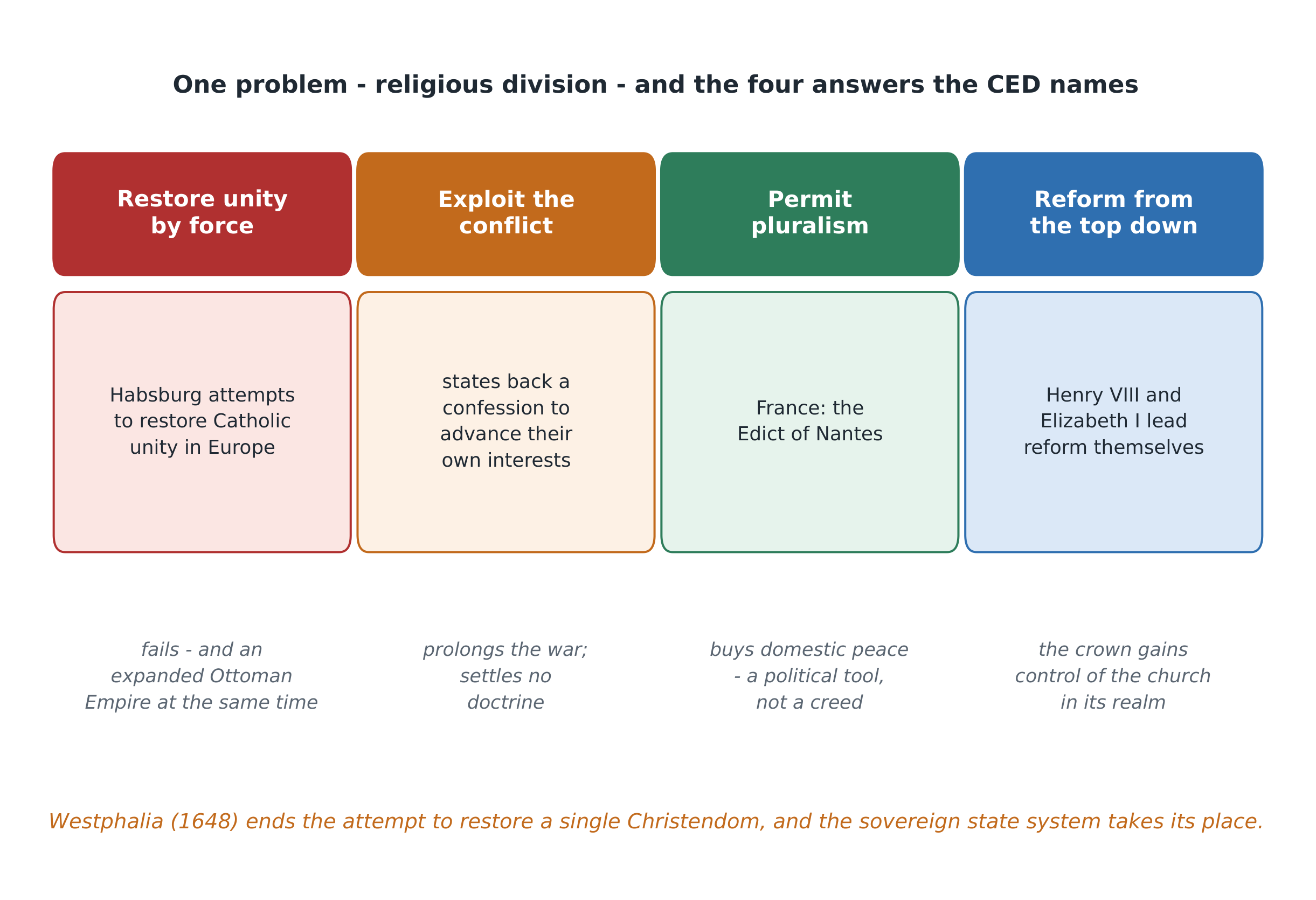
    十六世纪的国家面对宗教分裂的四种应对方式——CED 把四种都点了名
    其中只有一种能终结冲突,而它并不是多数统治者最先尝试的那一种

    CED 给出了国家面对宗教分裂的四种应对,有力的答案会把它们作为一组来处理:

    • 以武力恢复统一——哈布斯堡统治者试图在全欧洲恢复天主教统一并告失败,同时还要面对扩张中的奥斯曼帝国(Ottoman Empire)。
    • 利用冲突——各国利用宗教争端来促进自身的政治与经济利益(political and economic interests),而非为了裁定教义。
    • 容许多元——少数国家,如颁布南特敕令(Edict of Nantes)的法国,为维持国内和平(domestic peace)而容许宗教多元。
    • 自上而下改革——包括亨利八世伊丽莎白一世在内的君主亲自发起宗教改革,以加强对本国教会的控制。

    宗教改革还加剧了君主与贵族之间的冲突,如法国宗教战争——宗教提供了语言,既有的政治对立提供了力量。

    和约与战争同等重要:威斯特伐利亚和约(Peace of Westphalia,1648)标志着中世纪普世基督教世界(universal Christendom)理想的实际终结,并加速了神圣罗马帝国的衰落。第三单元正是由这一枢纽开启的。

    词汇表 训练
    英文 中文 拼音
    Edict of Nantes 南特敕令 nán tè chì lìng
    in order to maintain domestic peace 国内和平 guó nèi hé píng
    Peace of Westphalia (1648) 威斯特伐利亚和约 wēi sī tè fá lì yà hé yuē
    universal Christendom 普世基督教世界 pǔ shì jī dū jiào shì jiè
    2.5

    天主教改革

    大纲

    2.5 The Catholic Reformation

    Thematic FocusLearning ObjectiveHistorical Developments

    CID
    Cultural and Intellectual Developments — The creation and transmission of knowledge, including the relationship between traditional sources of authority and the development of differing world views, had significant political, intellectual, economic, cultural, and social effects on European and world societies.

    Unit 2.D
    Explain the continuities and changes in the role of the Catholic Church from 1450 to 1648.

    • KC-1.2.I.D The Catholic Reformation, exemplified by the Jesuit Order and the Council of Trent, revived the church but cemented division within Christianity.

    Illustrative examples:

    • The Catholic Reformation:
      • St. Teresa of Avila
      • Ursulines
      • Roman Inquisition
      • Index of Prohibited Books

    来源:美国大学理事会 AP 课程与考试说明

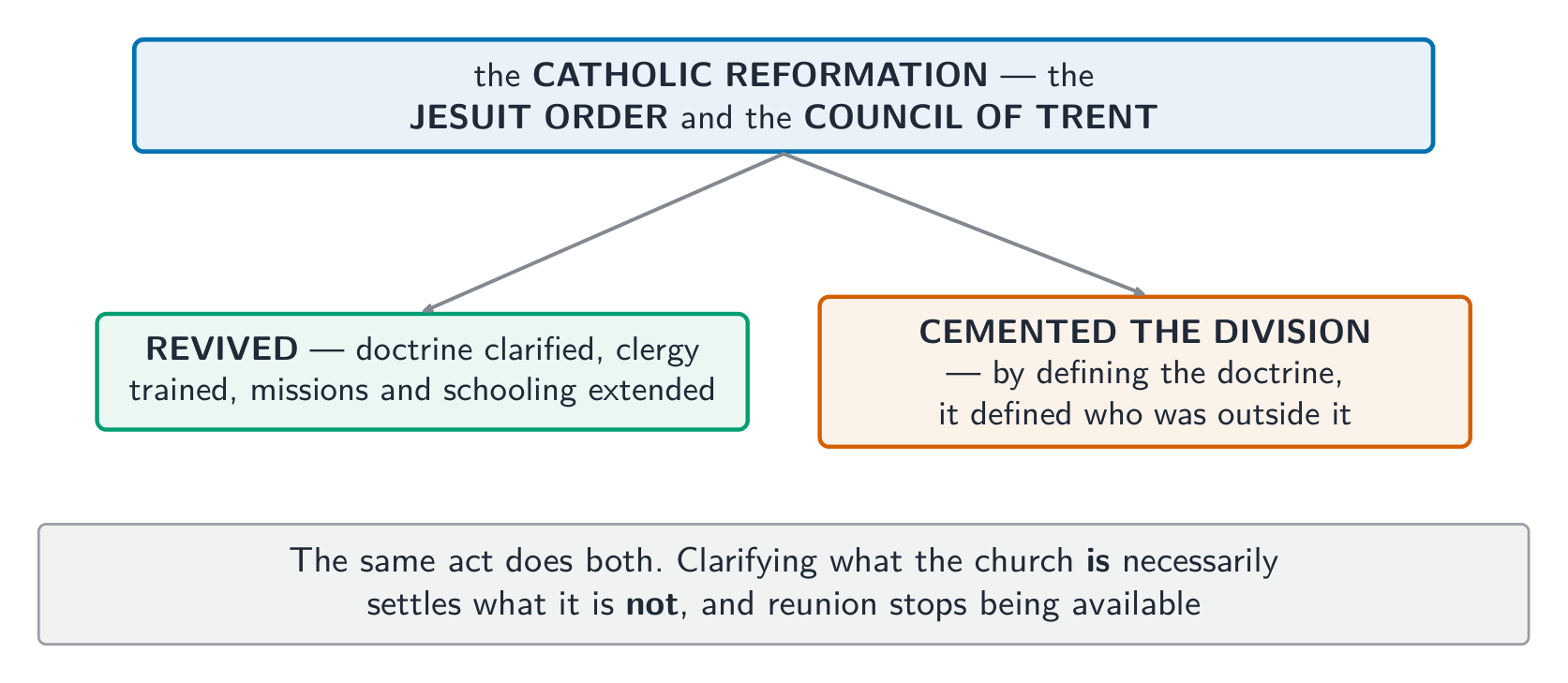
    耶稣会(Jesuit Order)与特伦特会议(Council of Trent)为代表的天主教改革(Catholic Reformation)复兴了教会,却也固化了基督教内部的分裂

    这句话的两半正是延续与变化类题目的答案。教会更新了自身的制度、教义、教育与传教范围——而在精确界定教义的同时,它也使重新合一成为不可能。复兴与永久分裂是同一个行动。

    词汇表 训练
    英文 中文 拼音
    Catholic Reformation 天主教改革 tiān zhǔ jiào gǎi gé
    Jesuit Order 耶稣会 yē sū huì
    Council of Trent 特伦特会议 tè lún tè huì yì
    Established hierarchies of class, religion, and gender 阶级、宗教与性别等级 jiē jí 、 zōng jiào yǔ xìng bié děng jí
    separate but complementary tasks 分工互补 fēn gōng hù bǔ
    raised debates about female education 女性教育 nǚ xìng jiào yù
    2.6

    16世纪的社会与政治

    大纲

    2.6 16th-Century Society and Politics

    Thematic FocusLearning ObjectiveHistorical Developments

    SCD
    Social Organization and Development — Economic, political, and cultural factors have influenced the form and status of family, class, and social groups in European history, which has, in turn, affected both the individual and society.

    Unit 2.E
    Explain how economic and intellectual developments from 1450 to 1648 affected social norms and hierarchies.

    • KC-1.4.I.C Established hierarchies of class, religion, and gender continued to define social status and perceptions in rural and urban settings.
    • KC-1.4.IV.A Rural and urban households worked as units, with men and women engaged in separate but complementary tasks.
    • KC-1.4.IV.B The Renaissance and Reformation raised debates about female education and women’s roles in the family, church, and society.
    • KC-1.4.III.C Social dislocation, coupled with the shifting authority of religious institutions during the Reformation, left city governments with the task of regulating public morals.
    • KC-1.4.V.A Leisure activities continued to be organized according to the religious calendar and the agricultural cycle, and remained communal in nature.
    • KC-1.4.V.B Local and church authorities continued to enforce communal norms through rituals of public humiliation.
    • KC-1.4.V.C Reflecting folk ideas and social and economic upheaval, accusations of witchcraft peaked between 1580 and 1650.

    Illustrative examples:

    • Continued social hierarchies:
      • Prestige of land ownership
      • Aristocratic privileges regarding taxes, fees for services, and legal protections
      • Political exclusion of women
    • Debates about female roles:
      • Women’s intellect and education
      • Women as preachers
      • La Querelle des Femmes
    • Regulating public morals:
      • New secular laws regulating private life
      • Stricter codes on prostitution and begging
      • Abolishing or restricting Carnival
    • Communal leisure activities:
      • Saint’s day festivities
      • Carnival
      • Blood sports
    • Rituals of public humiliation:
      • Charivari
      • Stocks
      • Public whipping and branding
    • Factors in witchcraft accusations:
      • Prominence of women
      • Regional variation
      • Social upheaval

    来源:美国大学理事会 AP 课程与考试说明

    这是本单元的社会史一节,其中可考内容密集,论述题却很少用到:

    • 既有的阶级、宗教与性别等级(hierarchies of class, religion, and gender)在乡村与城市继续界定社会身份。
    • 乡村与城市的家户作为生产单位运作,男女从事分工互补(separate but complementary)的工作。
    • 文艺复兴与宗教改革引发了关于女性教育(female education)以及女性在家庭、教会与社会中角色的辩论。
    • 社会失序(social dislocation)加上宗教机构权威的变动,把由此产生的问题留给了城市当局处理。
    • 闲暇仍按宗教历法与农业周期安排,并保持其共同体性质。
    • 地方与教会当局通过公开羞辱(public humiliation)的仪式来执行共同体规范。
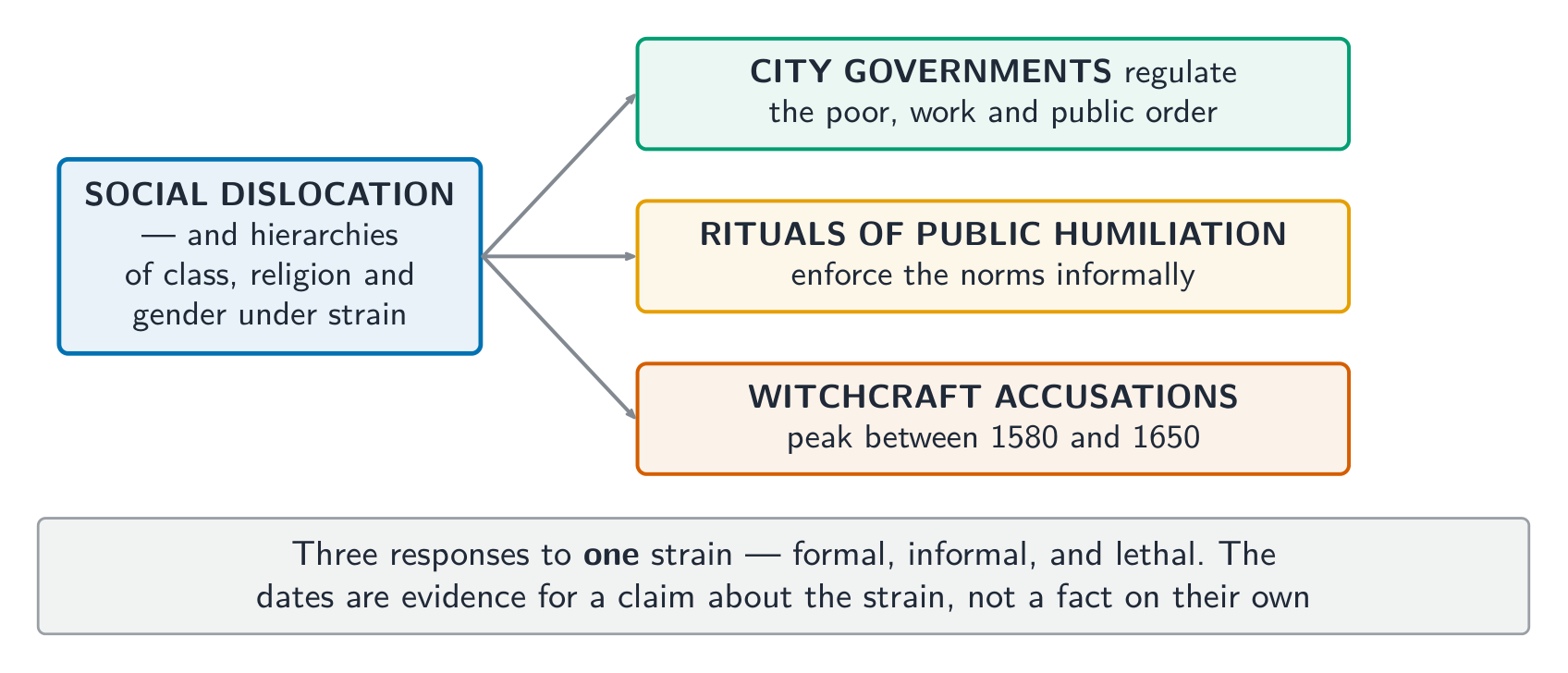
    • 反映民间观念与社会经济动荡的巫术指控(accusations of witchcraft)在 1580 至 1650 年间达到顶峰

    巫术指控的顶峰之所以值得记住,恰恰在于它的年代:它与宗教冲突和经济压力最剧烈的时期重合,而这正是它能作为证据而非轶事使用的原因。

    词汇表 训练
    英文 中文 拼音
    Social dislocation 社会失序 shè huì shī xù
    rituals of public humiliation 公开羞辱 gōng kāi xiū rǔ
    accusations of witchcraft peaked between 1580 and 1650 巫术指控 wū shù zhǐ kòng
    2.7

    16世纪的艺术:风格主义与巴洛克艺术

    大纲

    2.7 Art of the 16th Century: Mannerism and Baroque Art

    Thematic FocusLearning ObjectiveHistorical Developments

    CID
    Cultural and Intellectual Developments — The creation and transmission of knowledge, including the relationship between traditional sources of authority and the development of differing world views, had significant political, intellectual, economic, cultural, and social effects on European and world societies.

    Unit 2.F
    Explain how and why artistic expression changed from 1450 to 1648.

    • KC-1.1.III.C Mannerist and Baroque artists employed distortion, drama, and illusion in their work. Monarchies, city-states, and the church commissioned these works as a means of promoting their own stature and power.

    Illustrative examples:

    • Mannerist and Baroque artists whose art was used in new public buildings:
      • El Greco
      • Artemisia Gentileschi
      • Gian Bernini
      • Peter Paul Rubens

    来源:美国大学理事会 AP 课程与考试说明

    手法主义与巴洛克(Mannerist and Baroque)艺术家运用变形、戏剧性与幻觉(distortion, drama, and illusion)。君主国、城邦与教会委托创作了这些作品。

    可考的要点与第一单元相同,只是更进一步:艺术是为说服而受托创作的。天主教堂中的巴洛克戏剧性与王室宫廷中的巴洛克恢弘,是在不同方向上做同一件事——在权威受到争夺的时代宣示赞助人的权威。

    词汇表 训练
    英文 中文 拼音
    Mannerist and Baroque 手法主义与巴洛克 shǒu fǎ zhǔ yì yǔ bā luò kè
    distortion, drama, and illusion 变形、戏剧性与幻觉 biàn xíng 、 xì jù xìng yǔ huàn jué
    2.8

    宗教改革与宗教战争时代的因果关系

    大纲

    2.8 Causation in the Age of Reformation and the Wars of Religion

    Learning ObjectiveReview: Unit 2 Key Concepts

    Unit 2.G
    Explain how the religious, political, and cultural developments of the 16th and 17th centuries affected European society from 1450 to 1648.

    • KC-1.2 Religious pluralism challenged the concept of a unified Europe.
      • KC-1.2.I The Protestant and Catholic reformations fundamentally changed theology, religious institutions, culture, and attitudes toward wealth and prosperity.
      • KC-1.2.II Religious reform both increased state control of religious institutions and provided justifications for challenging state authority.
      • KC-1.2.III Conflicts among religious groups overlapped with political and economic competition within and among states.
    • KC-1.4 European society and the experiences of everyday life were increasingly shaped by commercial and agricultural capitalism, notwithstanding the continued existence of medieval social and economic structures.
      • KC-1.4.III Population shifts and growing commerce caused the expansion of cities, which often placed stress on their traditional political and social structures.
      • KC-1.4.IV The family remained the primary social and economic institution of early modern Europe and took several forms, including the nuclear family.
      • KC-1.4.V Popular culture, leisure activities, and rituals reflecting the continued popularity of folk ideas reinforced and sometimes challenged communal ties and norms.
    • KC-1.5 The struggle for sovereignty within and among states resulted in varying degrees of political centralization.
      • KC-1.5.I The new concept of the sovereign state and secular systems of law played a central role in the creation of new political institutions.

    来源:美国大学理事会 AP 课程与考试说明

    本单元考查的推理能力是因果关系

    **Worked example(一道真实的 AP 考题)。*本单元的 AP 欧洲史简答题会要求,例如「解释十六世纪政治发展受宗教变化影响的一种方式」。满分答案会点出这一影响的两个方向:「宗教改革为贵族提供了抵抗王权的语言与理由,如在法国宗教战争中,贵族家族以教派归属来组织对王室的反对。因此君主的回应——最终是南特敕令——是对一场宗教争端的政治解决:以容忍换取王权控制的恢复。」*注意答案在两个方向上都作了推进,因为 CED 自身的框架就是如此。

    2.8

    考试技巧

    • 在本单元绝不要把宗教与政治分开。几乎每道题目考查的都是二者的互动。
    • 四种国家应对——武力、利用、容忍、自上而下改革——为任何宗教战争题目提供了极好的答案骨架。
    • 威斯特伐利亚是枢纽:普世基督教世界的终结,主权国家体系的开端。
    • 天主教改革同时复兴并分裂。两半都能得分。
    • 容忍是一种政治手段,而非道德立场。南特敕令买来的是国内和平。
    • 把**巫术指控的顶峰(1580-1650)**当作有年代的社会与宗教压力证据,而不是点缀。
  • 3

    专制主义与宪政主义

    讲义 词汇表
    3.1

    国家建构的时代背景

    大纲

    3.1 Contextualizing State Building

    Learning ObjectivePreview: Unit 3 Key Concepts

    Unit 3.A
    Explain the context in which different forms of political power developed from 1648 to 1815.

    • KC-1.5 The struggle for sovereignty within and among states resulted in varying degrees of political centralization.
      • KC-1.5.I The new concept of the sovereign state and secular systems of law played a central role in the creation of new political institutions.
      • KC-1.5.III The competition for power between monarchs and corporate and minority language groups produced different distributions of governmental authority in European states.
      • KC-1.5.III.B Monarchies seeking enhanced power faced challenges from nobles who wished to retain traditional forms of shared governance and regional autonomy.
      • KC-1.5.III.C Within states, minority local and regional identities based on language and culture led to resistance against the dominant national group.
    • KC-2.1 Different models of political sovereignty affected the relationship among states and between states and individuals.
      • KC-2.1.I In much of Europe, absolute monarchy was established over the course of the 17th and 18th centuries.
      • KC-2.1.II Challenges to absolutism resulted in alternative political systems.

    Illustrative examples:

    • Competition between monarchs and nobles:
      • Louis XIII and Cardinal Richelieu §Bullet
      • The Fronde in France
      • The Catalan Revolts in Spain
    • Competition between minority and dominant national groups:
      • Celtic regions of Scotland, Ireland, and France
      • Dutch resistance in the Spanish Netherlands
      • Czech identity in the Holy Roman Empire/ Jan Hus/Defenestration

    来源:美国大学理事会 AP 课程与考试说明

    第三单元讲述 1648 至 1815 年,其统领性论断是:不同的政治主权(political sovereignty)模式影响了国家之间的关系,以及国家与个人之间的关系。

    主权争夺继续造成程度不一的政治集权——但在威斯特伐利亚之后,这场竞争发生在彼此承认为主权者的国家之间,这与第一、第二单元中的博弈已是两回事。本单元的一切都由此而来:国家如今必须在与同样如此行事的对手的长期竞争中筹措财政、供养军队并管理经济。

    3.2

    英国内战与光荣革命

    大纲

    3.2 The English Civil War and the Glorious Revolution

    Thematic FocusLearning ObjectiveHistorical Developments

    SOP
    States and Other Institutions of Power — European states and nations developed governmental and civil institutions from 1450 to the present to organize society and consolidate political power, with a variety of social, cultural, and economic effects.

    Unit 3.B
    Explain the causes and consequences of the English Civil War.

    • KC-1.5.III.A The English Civil War—a conflict among the monarchy, Parliament, and other elites over their respective roles in the political structure— exemplified the competition for power among monarchs and competing groups.
    • KC-2.1.II.A The outcome of the English Civil War and the Glorious Revolution protected the rights of gentry and aristocracy from absolutism through assertions of the rights of Parliament.

    Illustrative examples:

    • Competitors for power in the English Civil War:
      • James I
      • Charles I
      • Oliver Cromwell
    • Outcomes of the English Civil War and the Glorious Revolution:
      • English Bill of Rights
      • Parliamentary sovereignty

    来源:美国大学理事会 AP 课程与考试说明

    英国内战(English Civil War)是君主、议会与其他精英之间就各自在政治结构中的角色而展开的冲突——而不是王室与人民之间的冲突。

    其结果连同光荣革命(Glorious Revolution),通过确立议会(Parliament)的权利,保护了乡绅与贵族的权利不受绝对主义(absolutism)侵夺

    这句话要仔细读,因为很容易被夸大。这一安排保护的是有产精英的权利不受王权侵夺,它并没有创造民众政府;把 1688 年当作民主的答案,是误读了 CED。

    词汇表 训练
    英文 中文 拼音
    different models of political sovereignty 政治主权 zhèng zhì zhǔ quán
    English Civil War 英国内战 yīng guó nèi zhàn
    Glorious Revolution 光荣革命 guāng róng gé mìng
    protected the rights of the gentry and aristocracy from absolutism 绝对主义 jué duì zhǔ yì
    Parliament 议会 yì huì
    3.3

    经济实践与发展的延续与变化

    大纲

    3.3 Continuities and Changes to Economic Practice and Development

    Thematic FocusLearning ObjectiveHistorical Developments

    ECD
    Economic and Commercial Developments — Economic development, especially the development of capitalism, played an important role in Europe’s history, often having significant social, political, and cultural effects.

    Unit 3.C
    Explain the continuities and changes in commercial and economic developments from 1648 to 1815.

    • KC-2.2.I.B The Agricultural Revolution raised productivity and increased the supply of food and other agricultural products.
    • KC-2.2.II.D The importation and transplantation of agricultural products from the Americas contributed to an increase in the food supply in Europe.
    • KC-2.2.I.A Labor and trade in commodities were increasingly freed from traditional restrictions imposed by governments and corporate entities.
    • KC-2.2.I.C The putting-out system, or cottage industry, expanded as increasing numbers of laborers in homes or workshops produced for markets through merchant intermediaries or workshop owners.
    • KC-2.2.I.D The development of the market economy led to new financial practices and institutions.
    • KC-2.2.I Early modern Europe developed a market economy that provided the foundation for its global role.

    Illustrative examples:

    • New financial practices and institutions: § Insurance § Banking institutions for turning private savings into venture capital § New definitions of property rights and protections against confiscation § Bank of England

    来源:美国大学理事会 AP 课程与考试说明

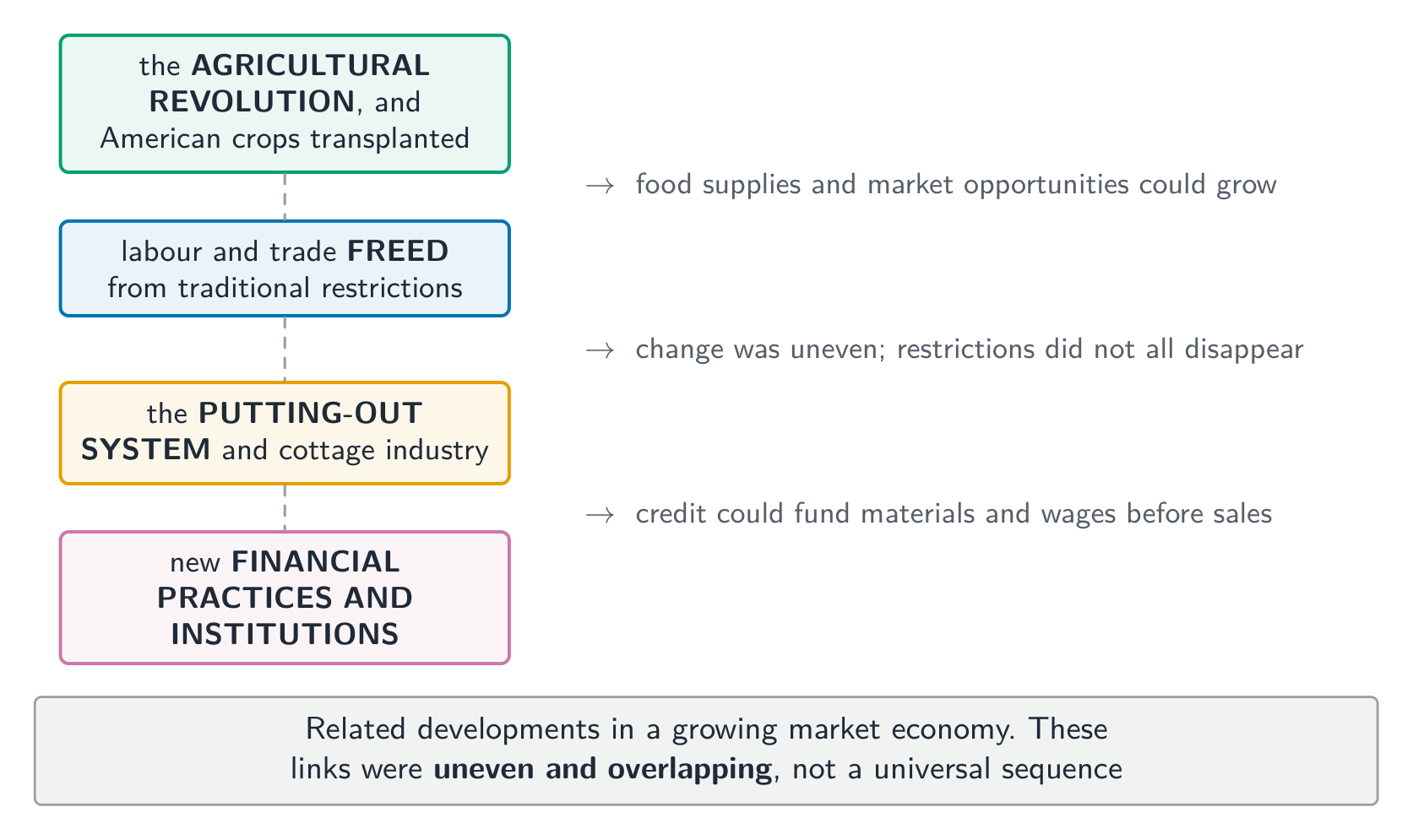
    近代早期欧洲发展出一种市场经济,为其全球角色奠定了基础。CED 列出了其构成要素,而题目奖励能点出多项的答案:

    • 农业革命(Agricultural Revolution)提高了生产率,增加了粮食与其他农产品的供应。
    • 美洲作物的引进与移植进一步增加了粮食供给。
    • 劳动与商品贸易日益摆脱政府与行会等团体施加的传统限制(traditional restrictions)。
    • 包买制,即家庭手工业(cottage industry),随着更多劳动者在家中与作坊里为市场生产而扩张。
    • 市场经济催生了新的金融实践与金融制度(financial institutions)。

    值得把握的链条是:更多粮食供养更多人口,被解放的劳动力与家庭手工业让这些人为市场生产,而新的金融把由此产生的资本调动起来。每一环都可单独考查,合起来则是第六单元工业化赖以建立的基础。

    词汇表 训练
    英文 中文 拼音
    Agricultural Revolution 农业革命 nóng yè gé mìng
    freed from traditional restrictions 传统限制 chuán tǒng xiàn zhì
    cottage industry 家庭手工业 jiā tíng shǒu gōng yè
    new financial practices and institutions 金融制度 jīn róng zhì dù
    agricultural, industrial, and consumer revolutions 消费革命 xiāo fèi gé mìng
    3.4

    经济发展与重商主义

    大纲

    3.4 Economic Development and Mercantilism

    Thematic FocusLearning ObjectiveHistorical Developments

    ECD
    Economic and Commercial Developments — Economic development, especially the development of capitalism, played an important role in Europe’s history, often having significant social, political, and cultural effects.

    Unit 3.C
    Explain the continuities and changes in commercial and economic developments from 1648 to 1815.

    • KC-2.2.II The European-dominated worldwide economic network contributed to the agricultural, industrial, and consumer revolutions in Europe.
      • KC-2.2.II.A European states followed mercantilist policies by drawing resources from colonies in the New World and elsewhere.
      • KC-2.2.II.B The transatlantic slave-labor system expanded in the 17th and 18th centuries as demand for New World products increased.
      • KC-2.2.II.C Overseas products and influences contributed to the development of a consumer culture in Europe.
      • KC-2.2.II.D The importation and transplantation of agricultural products from the Americas contributed to an increase in the food supply in Europe.
      • KC-2.2.II.E Foreign lands provided raw materials, finished goods, laborers, and markets for the commercial and industrial enterprises in Europe.

    Illustrative examples:

    • Transatlantic slave-labor systems:
      • Middle Passage
      • Triangle trade
    • Overseas products:
      • Sugar
      • Tea
      • Silks and other fabrics
      • Tobacco
      • Rum
      • Coffee

    来源:美国大学理事会 AP 课程与考试说明

    由欧洲主导的全球经济网络促成了欧洲的农业、工业与消费革命(consumer revolutions)。

    重商主义(mercantilism)是其政策框架:国家鼓励出口、限制进口,并获取殖民地以提供原料并购买制成品。要注意 CED 主张的因果方向——是全球网络滋养了欧洲的这些转变,因此把答案局限于欧洲内部发展是不完整的。

    词汇表 训练
    英文 中文 拼音
    Mercantilism 重商主义 zhòng shāng zhǔ yì
    3.5

    荷兰黄金时代

    大纲

    3.5 The Dutch Golden Age

    Thematic FocusLearning ObjectiveHistorical Developments

    SOP
    States and Other Institutions of Power — European states and nations developed governmental and civil institutions from 1450 to the present to organize society and consolidate political power, with a variety of social, cultural, and economic effects.

    Unit 3.D
    Explain the factors that contributed to the development of the Dutch Republic.

    • KC-2.1.II.B The Dutch Republic, established by a Protestant revolt against the Habsburg monarchy, developed an oligarchy of urban gentry and rural landholders to promote trade and protect traditional rights.

    来源:美国大学理事会 AP 课程与考试说明

    荷兰共和国(Dutch Republic)由反抗哈布斯堡王朝的新教起义建立,发展出城市士绅与乡村地主的寡头(oligarchy of urban gentry and rural landholders)统治,以促进贸易与宗教宽容。

    荷兰这一案例之所以重要,是因为它既非绝对主义,也非英国式立宪主义——它是第三种模式,在商业上居于支配地位,表明政治形式与经济成就并未被绑定在一条公式上。

    词汇表 训练
    英文 中文 拼音
    Dutch Republic 荷兰共和国 hé lán gòng hé guó
    oligarchy of urban gentry and rural landholders 城市士绅与乡村地主寡头 chéng shì shì shēn yǔ xiāng cūn dì zhǔ guǎ tóu
    3.6

    势力均衡

    大纲

    3.6 Balance of Power

    Thematic FocusLearning ObjectiveHistorical Developments

    SOP
    States and Other Institutions of Power — European states and nations developed governmental and civil institutions from 1450 to the present to organize society and consolidate political power, with a variety of social, cultural, and economic effects.

    Unit 3.E
    Explain how European states attempted to establish and maintain a balance of power on the continent throughout the period from 1648 to 1815.

    • KC-1.5.II The competitive state system led to new patterns of diplomacy and new forms of warfare.
      • KC-1.5.II.A Following the Peace of Westphalia, religion declined in importance as a cause for warfare among European states; the concept of the balance of power played an important role in structuring diplomatic and military objectives.
    • KC-2.1.I.D The inability of the Polish monarchy to consolidate its authority over the nobility led to Poland’s partition by Prussia, Russia, and Austria, and its disappearance from the map of Europe.
    • KC-2.1.III After 1648, dynastic and state interests, along with Europe’s expanding colonial empires, influenced the diplomacy of European states and frequently led to war.
      • KC-2.1.III.B After the Austrian defeat of the Turks in 1683 at the Battle of Vienna, the Ottomans ceased their westward expansion.
      • KC-2.1.III.C Louis XIV’s nearly continuous wars, pursuing both dynastic and state interests, provoked a coalition of European powers opposing him. HISTORICAL DEVELOPMENTS

    Unit 3.F
    Explain how advances in technology contributed to a developing balance of power on the continent throughout the period from 1648 to 1815.

    • KC-1.5.II.B Advances in military technology led to new forms of warfare, including greater reliance on infantry, firearms, mobile cannon, and more elaborate fortifications, all financed by heavier taxation and requiring a larger bureaucracy. New military techniques and institutions (i.e., the military revolution) tipped the balance of power toward states able to marshal sufficient resources for the new military environment.

    Illustrative examples:

    • Louis XIV’s nearly continuous wars:
      • Dutch War
      • Nine Years’ War
      • War of the Spanish Succession
    • States that benefited from the military revolution:
      • Spain under the Habsburgs §Bullet Sweden under Gustavus Adolphus §Bullet France

    来源:美国大学理事会 AP 课程与考试说明

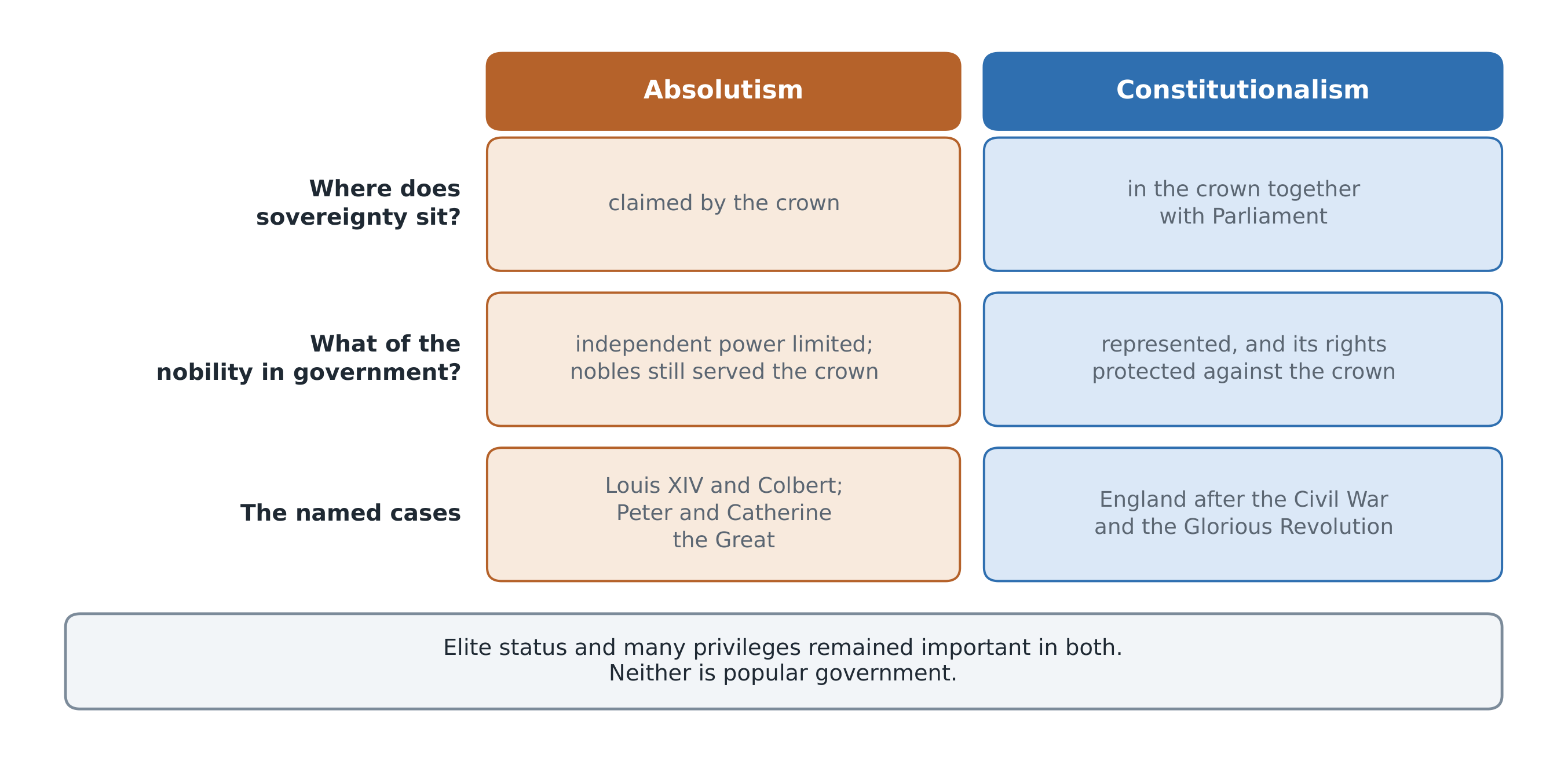
    本单元的整个比较尽在一图——而 CED 自身的推理任务正是比较它们
    两种模式都保留了贵族的地位;它们的分歧在于主权归属何处

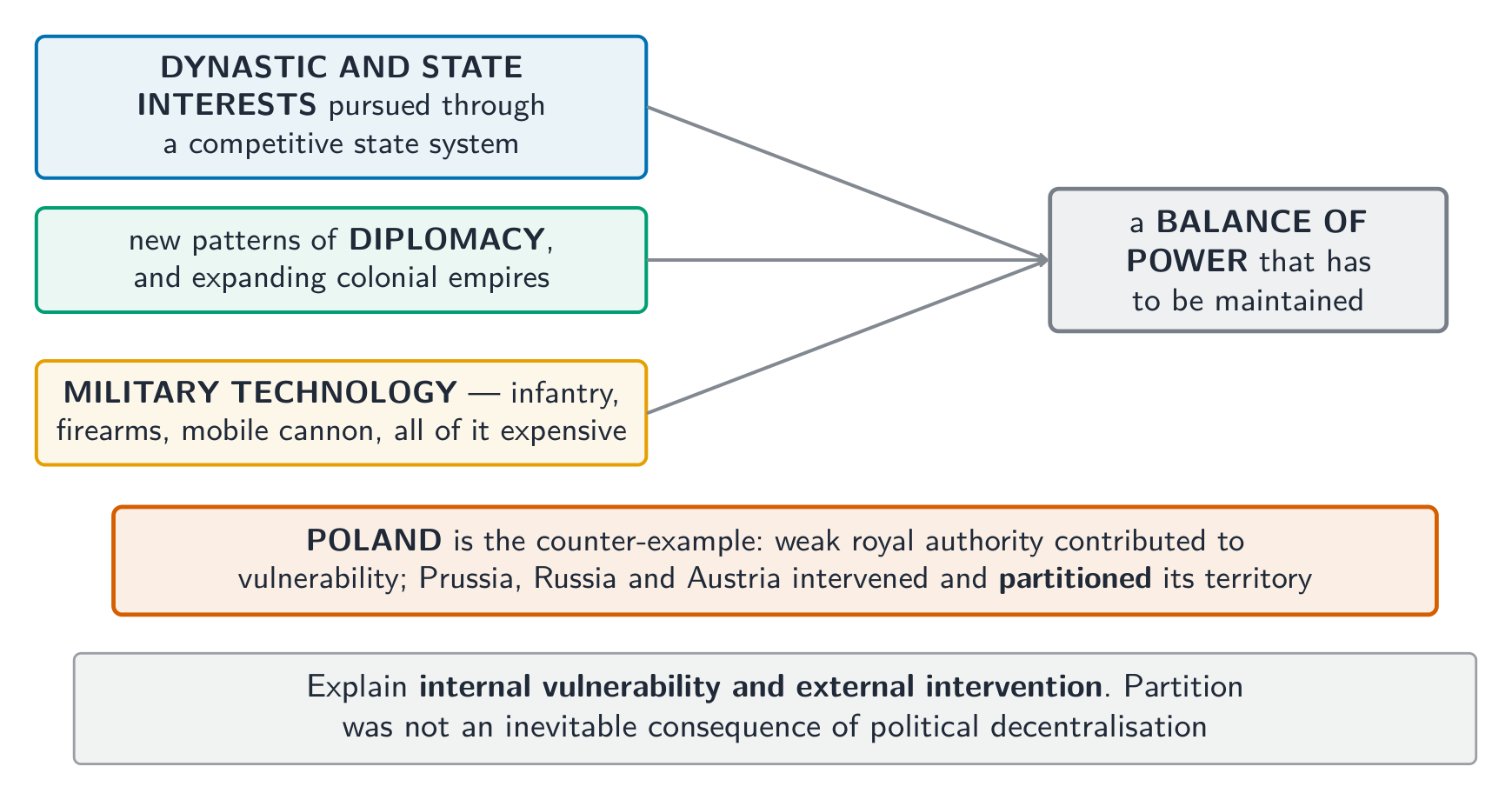
    竞争性国家体系(competitive state system)带来了新的外交模式与新的战争形式。1648 年之后,王朝与国家利益,连同不断扩张的殖民帝国,共同驱动着欧洲外交。

    有两项具体内容在考查范围内。军事技术的进步造就了新的战争形式——更加倚重步兵、火器与机动火炮,以及只有走向集权的国家才供养得起的常备军。而波兰君主制无法巩固对贵族的权威,导致波兰被普鲁士、俄国与奥地利瓜分(partition)——这是整门课程中最清楚的例证:未能集权是有代价的。

    词汇表 训练
    英文 中文 拼音
    competitive state system 竞争性国家体系 jìng zhēng xìng guó jiā tǐ xì
    Poland's partition 波兰被瓜分 bō lán bèi guā fēn
    Absolute monarchies limited the nobility's participation in governance but preserved the aristocracy's social position and legal privileges 社会地位与法律特权 shè huì dì wèi yǔ fǎ lǜ tè quán
    3.7

    专制主义的权力路径

    大纲

    3.7 Absolutist Approaches to Power

    Thematic FocusLearning ObjectiveHistorical Developments

    SOP
    States and Other Institutions of Power — European states and nations developed governmental and civil institutions from 1450 to the present to organize society and consolidate political power, with a variety of social, cultural, and economic effects.

    Unit 3.G
    Explain how absolutist forms of rule affected social and political development from 1648 to 1815.

    • KC-2.1.I.A Absolute monarchies limited the nobility’s participation in governance but preserved the aristocracy’s social position and legal privileges.
    • KC-2.1.I.B Louis XIV and his finance minister, Jean-Baptiste Colbert, extended the administrative, financial, military, and religious control of the central state over the French population.
    • KC-2.1.I.E Peter the Great “westernized” the Russian state and society, transforming political, religious, and cultural institutions; Catherine the Great continued this process.

    Illustrative examples:

    • Absolute monarchs:
      • James I of England
      • Peter the Great of Russia
      • Philip II, III, and IV of Spain
    • Extended power of the state: §Bullet Intendants §Bullet Modernized, state-controlled military Russian westernization: §Bullet Russian Academy of Sciences §Bullet Education §Bullet Western fashion §Bullet Expanded military

    来源:美国大学理事会 AP 课程与考试说明

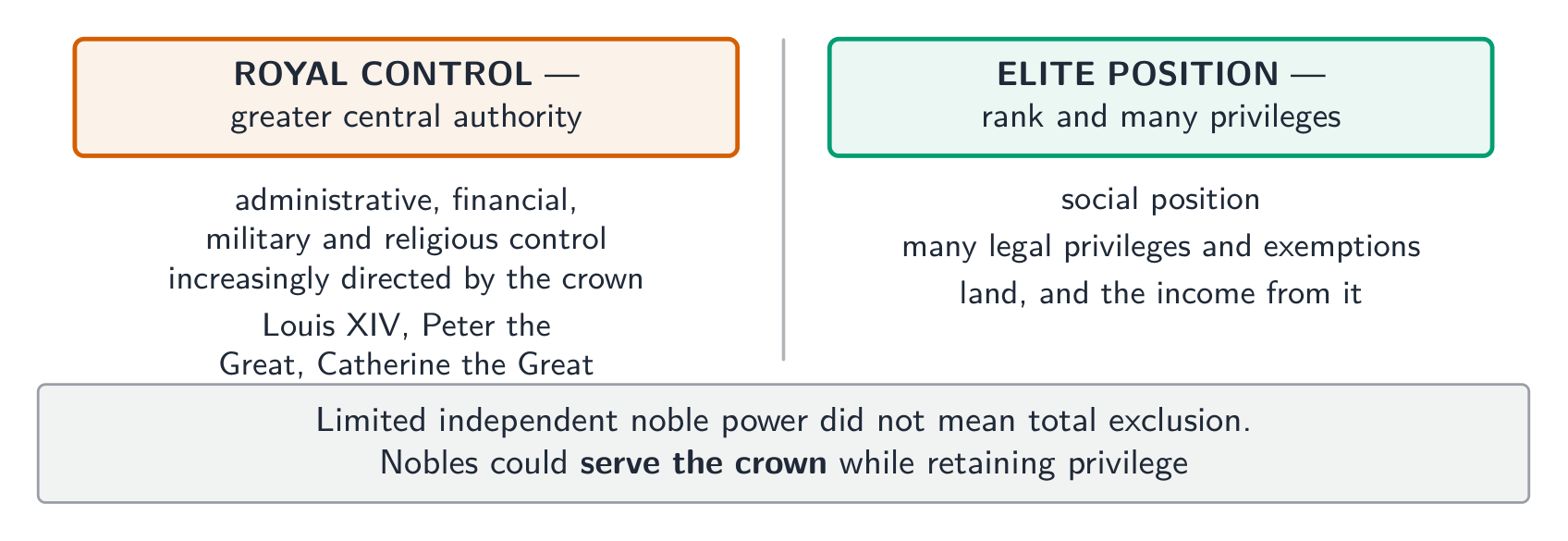
    绝对君主制限制了贵族参与治理,却保留了贵族的社会地位与法律特权(social position and legal privileges)。这一交换是本单元最有用的一句话:绝对主义以不触动社会等级为代价,换取了政治上的服从。

    CED 点名的案例:

    • 路易十四(Louis XIV)与其财政大臣柯尔贝尔(Jean-Baptiste Colbert)扩大了对法国国家的行政、财政、军事与宗教控制
    • 彼得大帝(Peter the Great)使俄国国家与社会"西化",改造了政治、宗教与文化制度;叶卡捷琳娜大帝(Catherine the Great)延续了这一方案。
    词汇表 训练
    英文 中文 拼音
    Louis XIV 路易十四 lù yì shí sì
    Jean-Baptiste Colbert 柯尔贝尔 kē ěr bèi ěr
    Peter the Great 彼得大帝 bǐ dé dà dì
    Catherine the Great 叶卡捷琳娜大帝 yè kǎ jié lín nà dà dì
    3.8

    专制主义与宪政主义时代的比较分析

    大纲

    3.8 Comparison in the Age of Absolutism and Constitutionalism

    Learning ObjectiveReview: Unit 3 Key Concepts

    Unit 3.H
    Compare the different forms of political power that developed in Europe from 1648 to 1815.

    • KC-1.5 The struggle for sovereignty within and among states resulted in varying degrees of political centralization.
      • KC-1.5.I The new concept of the sovereign state and secular systems of law played a central role in the creation of new political institutions.
      • KC-1.5.III The competition for power between monarchs and corporate and minority language groups produced different distributions of governmental authority in European states.
      • KC-1.5.III.B Monarchies seeking enhanced power faced challenges from nobles who wished to retain traditional forms of shared governance and regional autonomy.
      • KC-1.5.III.C Within states, minority local and regional identities based on language and culture led to resistance against the dominant national group.
    • KC-2.1 Different models of political sovereignty affected the relationship among states and between states and individuals.
      • KC-2.1.I In much of Europe, absolute monarchy was established over the course of the 17th and 18th centuries.
      • KC-2.1.II Challenges to absolutism resulted in alternative political systems.
    • KC-2.2 The expansion of European commerce accelerated the growth of a worldwide economic network.
      • KC-2.2.I Early modern Europe developed a market economy that provided the foundation for its global role.
      • KC-2.2.II The European-dominated worldwide economic network contributed to the agricultural, industrial, and consumer revolutions in Europe.

    来源:美国大学理事会 AP 课程与考试说明

    本单元考查的推理能力是比较——CED 自身的任务就是比较 1648 至 1815 年间形成的不同政治权力形式。

    **Worked example(一道真实的 AP 考题)。*本单元的 AP 欧洲史简答题会要求,例如「解释 1648 至 1815 年间绝对主义与立宪主义政府形式之间的一项差异」。满分答案会以对两者都适用的措辞陈述这一差异:「两者的差异在于主权所在。在绝对主义的法国,路易十四把行政、财政与军事权威集中于王权,并把贵族排除在治理之外。在立宪主义的英国,内战与光荣革命的结果把主权定位于国王与议会共同之处,因此征税与立法都需要议会所代表的有产精英的同意。」*注意其结构:先确立一条比较轴,再在这条轴上衡量两个案例。

    3.8

    考试技巧

    • 英国内战是精英之间关于各自角色的冲突。不要把 1688 年写成民主。
    • 绝对主义限制政治参与却保留社会特权。这一交换能回答许多题目。
    • 备好一个第三种模式——荷兰共和国。它打破了简单的两分比较,并向阅卷人显示你了解这一时期。
    • 波兰被瓜分是未能集权的代价。它正是其他案例所需要的反例。
    • 经济各节是一条链条:农业、被解放的劳动力、家庭手工业、金融。要点出多个环节,而不是一个。
    • 回答比较题时,选定一条轴并在其上衡量两个案例。两段各自的描述并不构成比较。
  • 4

    科学、哲学与政治的发展

    讲义 词汇表
    4.1

    科学革命与启蒙运动的时代背景

    大纲

    4.1 Contextualizing the Scientific Revolution and the Enlightenment

    Learning ObjectivePreview: Unit 4 Key Concepts

    Unit 4.A
    Explain the context in which the Scientific Revolution and Enlightenment developed in Europe.

    • KC-1.1 The rediscovery of works from ancient Greece and Rome and observation of the natural world changed many Europeans’ view of their world.
      • KC-1.1.IV New ideas in science based on observation, experimentation, and mathematics challenged classical views of the cosmos, nature, and the human body, although existing traditions of knowledge and the universe continued.
    • KC-2.3 The spread of Scientific Revolution concepts and practices and the Enlightenment’s application of these concepts and practices to political, social, and ethical issues led to an increased but not unchallenged emphasis on reason in European culture.
      • KC-2.3.I Enlightenment thought, which focused on concepts such as empiricism, skepticism, human reason, rationalism, and classical sources of knowledge, challenged the prevailing patterns of thought with respect to social order, institutions of government, and the role of faith.
      • KC-2.3.II New public venues and print media popularized Enlightenment ideas.
      • KC-2.3.III New political and economic theories challenged absolutism and mercantilism.
      • KC-2.3.IV During the Enlightenment, the rational analysis of religious practices led to natural religion and the demand for religious toleration.
    • KC-2.4 The experiences of everyday life were shaped by demographic, environmental, medical, and technological changes.
      • KC-2.4.III By the 18th century, family and private life reflected new demographic patterns and the effects of the commercial revolution.

    来源:美国大学理事会 AP 课程与考试说明

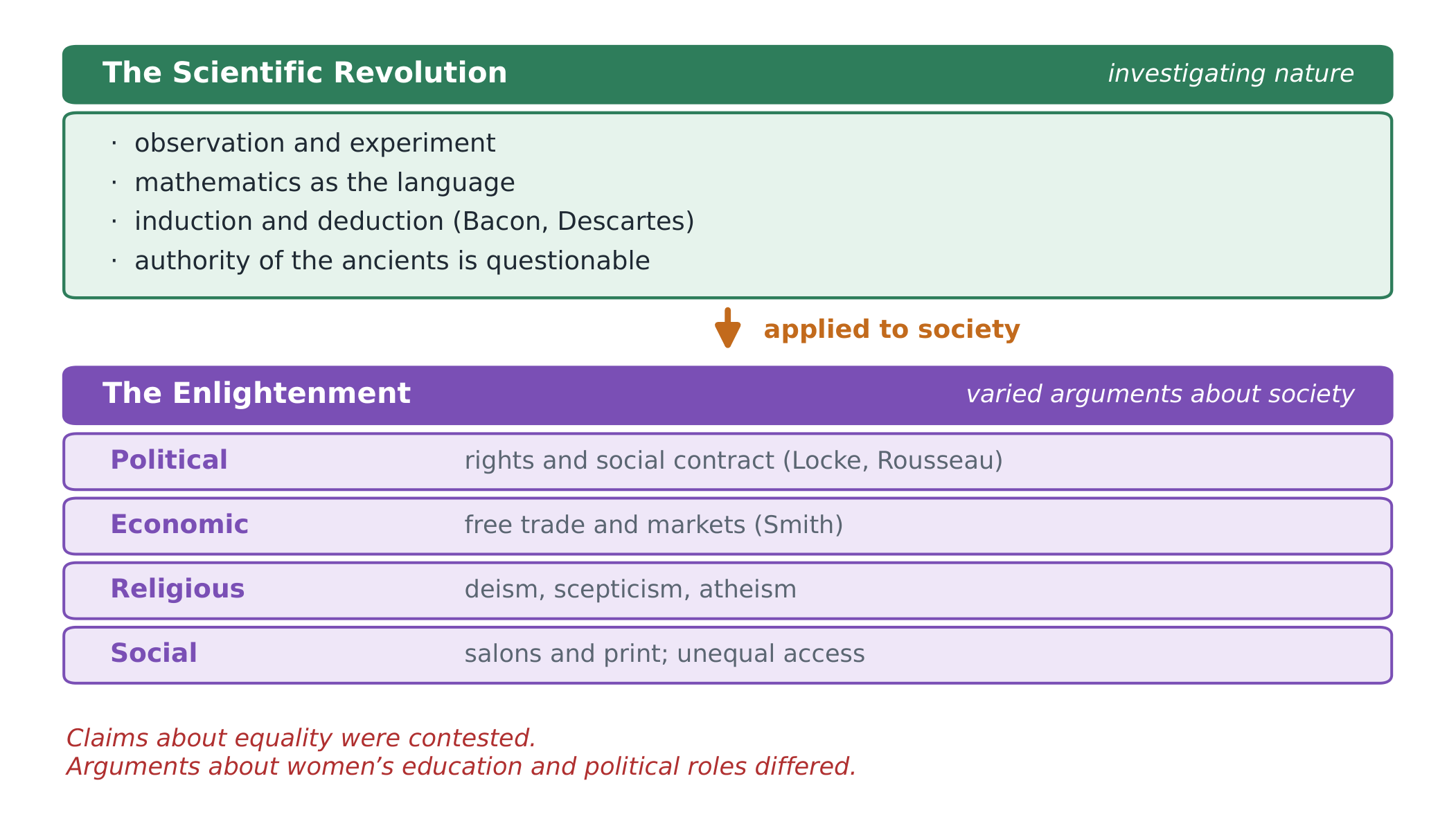
    第四单元建立在一项论断之上,值得按 CED 自己的措辞来记:科学革命(Scientific Revolution)的概念与实践的传播,以及启蒙运动把这些概念与实践应用于政治、社会与伦理问题(political, social, and ethical issues),促成了关于个人相对于国家与社会之角色的辩论

    这句话包含了整个单元。一种为研究自然而发展出来的方法被转用于人类制度,其结果是一整套关于政府对其治下人民负有何种义务的论证。

    与之并行的是:日常经验受到人口、环境、医学与技术变化的塑造——这正是本单元把高深的思想史与人口统计、消费品并置的原因。

    词汇表 训练
    英文 中文 拼音
    Scientific Revolution 科学革命 kē xué gé mìng
    Enlightenment's application of those concepts and practices to political, social, and ethical issues 政治、社会与伦理问题 zhèng zhì 、 shè huì yǔ lún lǐ wèn tí
    4.2

    科学革命

    大纲

    4.2 The Scientific Revolution

    Thematic FocusLearning ObjectiveHistorical Developments

    TSI
    Technological and Scientific Innovation — Scientific and technological innovations have increased efficiency, improved daily life, and shaped human development and interactions, having both intended and unintended consequences.

    Unit 4.B
    Explain how understanding of the natural world developed and changed during the Scientific Revolution and Enlightenment.

    • KC-1.1.IV.A New ideas and methods in astronomy led individuals, including Copernicus, Galileo, and Newton, to question the authority of the ancients and traditional knowledge, and to develop a heliocentric view of the cosmos.
    • KC-1.1.IV.B Anatomical and medical discoveries by physicians, including William Harvey, presented the body as an integrated system, challenging the traditional humoral theory of the body and of disease espoused by Galen.
    • KC-1.1.IV.C Francis Bacon and René Descartes defined inductive and deductive reasoning and promoted experimentation and the use of mathematics, which would ultimately shape the scientific method.
    • KC-1.1.IV.D Alchemy and astrology continued to appeal to elites and some natural philosophers, in part because they shared with the new science the notion of a predictable and knowable universe. At the same time, many people continued to believe that the cosmos was governed by spiritual forces.

    Illustrative examples:

    • Additional physicians who challenged Galen:
      • Paracelsus
      • Andreas Vesalius
    • Natural philosophers who continued to hold traditional views of alchemy and astrology:
      • Paracelsus
      • Johannes Kepler
      • Sir Isaac Newton

    来源:美国大学理事会 AP 课程与考试说明

    天文学中的新观念与新方法,使哥白尼(Copernicus)、伽利略(Galileo)与牛顿(Newton)质疑古人的权威(authority of the ancients),并发展出日心宇宙观。

    与天文学并行的还有:

    • 包括哈维(William Harvey)在内的医师所作的解剖学与医学发现,把身体呈现为一个整体系统(integrated system),挑战了沿袭的医学理论。
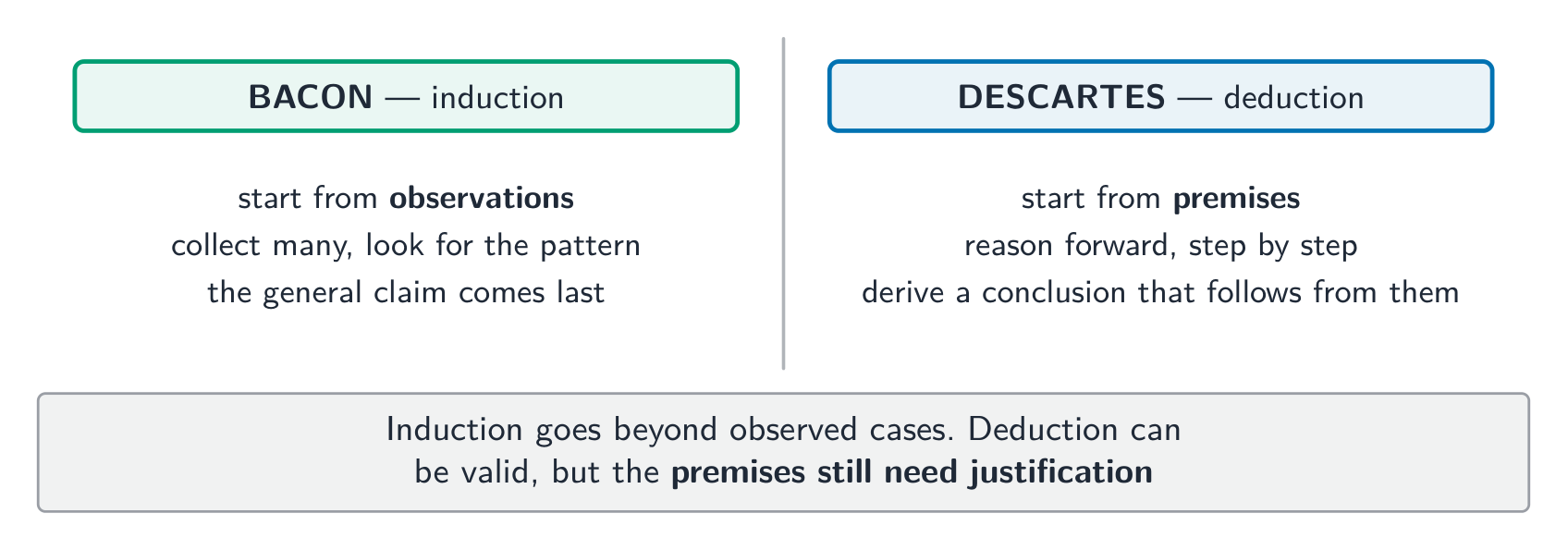
    • 培根(Francis Bacon)与笛卡尔(René Descartes)界定了归纳与演绎推理(inductive and deductive reasoning),并倡导实验与数学的运用。

    CED 随后补充了一点,学生会觉得意外而阅卷人很看重:炼金术与占星术仍然吸引着精英与某些自然哲学家,部分原因在于它们与新科学共享一个假设——自然世界受可被发现的规则支配。科学革命并不是一次干净的断裂,写出这一点能体现对延续性的真正理解。

    词汇表 训练
    英文 中文 拼音
    Copernicus 哥白尼 gē bái ní
    Galileo 伽利略 jiā lì lüè
    Newton 牛顿 niú dùn
    question the authority of the ancients 古人的权威 gǔ rén de quán wēi
    William Harvey 哈维 hā wéi
    integrated system 整体系统 zhěng tǐ xì tǒng
    Francis Bacon 培根 péi gēn
    René Descartes 笛卡尔 dí kǎ ěr
    inductive and deductive reasoning 归纳与演绎推理 guī nà yǔ yǎn yì tuī lǐ
    4.3

    启蒙运动

    大纲

    4.3 The Enlightenment

    Thematic FocusLearning ObjectiveHistorical Developments

    CID
    Cultural and Intellectual Developments — The creation and transmission of knowledge, including the relationship between traditional sources of authority and the development of differing world views, had significant political, intellectual, economic, cultural, and social effects on European and world societies.

    Unit 4.C
    Explain the causes and consequences of Enlightenment thought on European society from 1648 to 1815.

    • KC-2.3.I.A Intellectuals, including Voltaire and Diderot, began to apply the principles of the Scientific Revolution to society and human institutions.
    • KC-2.3.I.B Locke and Rousseau developed new political models based on the concept of natural rights and the social contract.
    • KC-2.3.I.C Despite the principles of equality espoused by the Enlightenment and the French Revolution, intellectuals such as Rousseau offered controversial arguments for the exclusion of women from political life.

    Unit 4.D
    Explain the influence of Enlightenment thought on European intellectual development from 1648 to 1815.

    • KC-2.3.II.A A variety of institutions, including salons, explored and disseminated Enlightenment culture.
    • KC-2.3.III.A Political theories, including John Locke’s, conceived of society as composed of individuals driven by self-interest and argued that the state originated in the consent of the governed (i.e., a social contract) rather than in divine right or tradition.
    • KC-2.3.III.B Mercantilist theory and practice were challenged by new economic ideas, including Adam Smith’s, which espoused free trade and a free market.
    • KC-2.3.I Enlightenment thought, which focused on concepts such as empiricism, skepticism, human reason, rationalism, and classical sources of knowledge, challenged the prevailing patterns of thought with respect to social order, institutions of government, and the role of faith.
    • KC-2.3.IV.A Intellectuals, including Voltaire and Diderot, developed new philosophies of deism, skepticism, and atheism.
    • KC-2.3.IV.B Religion was viewed increasingly as a matter of private rather than public concern.

    Illustrative examples:

    • Works applying scientific principles to society:
      • Montesquieu’s The Spirit of the Laws
      • Cesare Beccaria’s On Crimes and Punishments
    • Individuals who challenged Rousseau’s position on women:
      • Mary Wollstonecraft
      • Marquis de Condorcet
    • Institutions that broadened the audience for new ideas:
      • Coffeehouses Academies Bullet Bullet Lending libraries
      • Masonic lodges
    • Proponents of new economic ideas:
      • Physiocrats
      • Francois Quesnay
      • Anne Robert Jacques Turgot
    • Intellectuals: §Bullet David Hume
      • Baron d’Holbach
    • Religious developments:
      • Revival of German Pietism

    来源:美国大学理事会 AP 课程与考试说明

    本单元的核心动作:一种为自然而建的方法被转用于社会
    这正是 CED 所说的启蒙运动把科学革命应用于人类制度

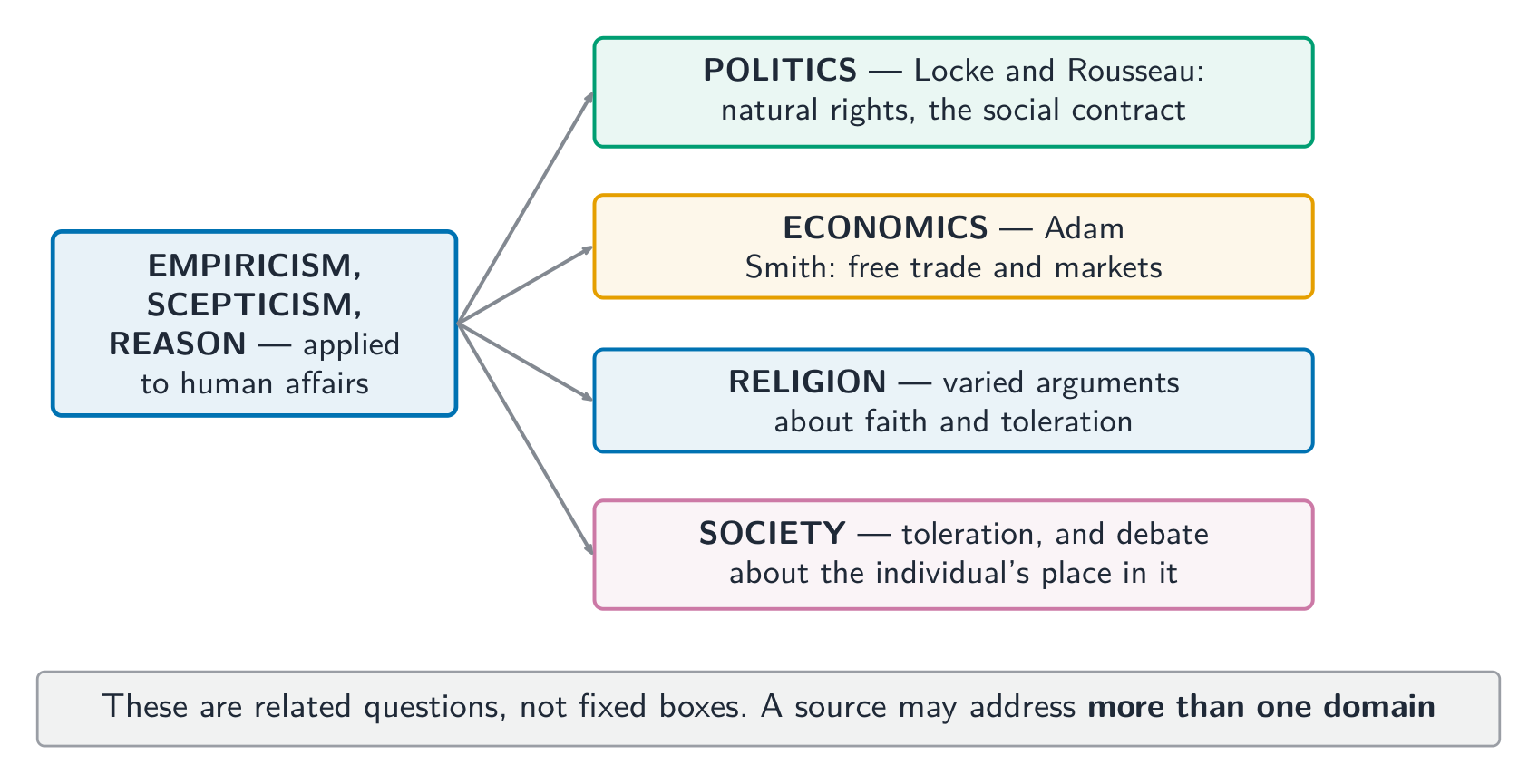
    启蒙运动(Enlightenment)思想聚焦于经验主义、怀疑主义、人类理性、理性主义(empiricism, scepticism, human reason, rationalism)与古典知识来源。其产出可归为四类:

    • 政治:洛克(Locke)与卢梭(Rousseau)基于天赋权利(natural rights)与社会契约(social contract)发展出新的政治模型。洛克的理论把社会设想为由受自利驱动的个人构成,并主张国家的作用是保护他们的权利。
    • 经济:重商主义的理论与实践受到新观念的挑战,包括亚当·斯密(Adam Smith)所主张的自由贸易(free trade)与国家在经济中的有限角色
    • 宗教:包括伏尔泰(Voltaire)与狄德罗(Diderot)在内的知识分子发展出自然神论、怀疑主义与无神论(deism, scepticism, and atheism),宗教日益被视为私人而非公共事务(private rather than a public concern)。
    • 社会:多种机构,尤其是沙龙(salons),探索并传播了启蒙文化。

    有一项限度在考查范围内,绝不可略去:尽管启蒙运动倡导平等原则,卢梭等知识分子却就女性的适当角色提出了有争议的论证。把启蒙运动呈现为一律平等主义的答案,不是 CED 所要的答案。

    词汇表 训练
    英文 中文 拼音
    Enlightenment 启蒙运动 qǐ méng yùn dòng
    empiricism, scepticism, human reason, rationalism 经验主义、怀疑主义、人类理性、理性主义 jīng yàn zhǔ yì 、 huái yí zhǔ yì 、 rén lèi lǐ xìng 、 lǐ xìng zhǔ yì
    Locke 洛克 luò kè
    Rousseau 卢梭 lú suō
    natural rights 天赋权利 tiān fù quán lì
    social contract 社会契约 shè huì qì yuē
    Adam Smith's 亚当·斯密 yà dāng · sī mì
    free trade 自由贸易 zì yóu mào yì
    Voltaire 伏尔泰 fú ěr tài
    Diderot 狄德罗 dí dé luó
    deism, scepticism, and atheism 自然神论、怀疑主义与无神论 zì rán shén lùn 、 huái yí zhǔ yì yǔ wú shén lùn
    private rather than a public concern 私人事务 sī rén shì wù
    salons 沙龙 shā lóng
    small landholdings, low-productivity agriculture, poor transportation, and adverse weather 不利天气 bù lì tiān qì
    4.4

    18世纪的社会与人口

    大纲

    4.4 18th-Century Society and Demographics

    Thematic FocusLearning ObjectiveHistorical Developments

    SCD
    Social Organization and Development — Economic, political, and cultural factors have influenced the form and status of family, class, and social groups in European history, which has, in turn, affected both the individual and society.

    Unit 4.E
    Explain the factors contributing to and the consequences of demographic changes from 1648 to 1815.

    • KC-2.4.I In the 17th century, small landholdings, low-productivity agricultural practices, poor transportation, and adverse weather limited and disrupted the food supply, causing periodic famines. By the 18th century, the balance between population and the food supply stabilized, resulting in steady population growth.
      • KC-2.4.I.A By the middle of the 18th century, higher agricultural productivity and improved transportation increased the food supply, allowing populations to grow and reducing the number of demographic crises (a process known as the Agricultural Revolution).
      • KC-2.4.I.B In the 18th century, plague disappeared as a major epidemic disease, and inoculation reduced smallpox mortality.
    • KC-2.4.III.A Although the rate of illegitimate births increased in the 18th century, population growth was limited by the European marriage pattern, and in some areas by various birth control methods.
    • KC-2.4.III.B As infant and child mortality decreased, and commercial wealth increased, families dedicated more space and resources to children and child-rearing, as well as private life and comfort.
    • KC-2.4.IV Cities offered economic opportunities, which attracted increasing migration from rural areas, transforming urban life and creating challenges for the new urbanites and their families.
      • KC-2.4.IV.A The Agricultural Revolution produced more food using fewer workers; as a result, people migrated from rural areas to the cities in search of work.
      • KC-2.4.IV.B The growth of cities eroded traditional communal values, and city governments strained to provide protection and a healthy environment.
      • KC-2.4.IV.C The concentration of the poor in cities led to a greater awareness of poverty, crime, and prostitution as social problems, and prompted increased efforts to police marginal groups.

    Illustrative examples:

    • Inoculation and disease control:
      • Lady Mary Wortley Montagu
    • Increased emphasis on childhood: §Bullet Jean-Jacques Rousseau
      • Education in Napoleonic France and Austria
      • Painting and portraiture

    来源:美国大学理事会 AP 课程与考试说明

    人口这条线索有清楚的前后之别:

    • 在十七世纪,小块土地持有、低生产率的农业、糟糕的交通与不利天气(adverse weather)限制了人口增长,并造成周期性的生计危机。
    • 尽管十八世纪非婚生育率上升,增长仍受欧洲婚姻模式(European marriage pattern)限制——晚婚,且有相当比例的人终身不婚。
    • 随着婴幼儿死亡率(infant and child mortality)下降与商业财富增加,家庭为子女及其教育投入了更多空间与资源。
    • 城市提供了经济机会,吸引来自乡村的迁移,改变了城市生活并造成新的社会问题。
    词汇表 训练
    英文 中文 拼音
    European marriage pattern 欧洲婚姻模式 ōu zhōu hūn yīn mó shì
    infant and child mortality decreased 婴幼儿死亡率 yīng yòu ér sǐ wáng lǜ
    4.5

    18世纪的文化与艺术

    大纲

    4.5 18th-Century Culture and Arts

    Thematic FocusLearning ObjectiveHistorical Developments

    CID
    Cultural and Intellectual Developments — The creation and transmission of knowledge, including the relationship between traditional sources of authority and the development of differing world views, had significant political, intellectual, economic, cultural, and social effects on European and world societies.

    Unit 4.F
    Explain how European cultural and intellectual life was maintained and changed throughout the period from 1648 to 1815.

    • KC-2.3.II.B Despite censorship, increasingly numerous and varied printed materials served a growing literate public and led to the development of public opinion.
    • KC-2.3.II.C Natural sciences, literature, and popular culture increasingly exposed Europeans to representations of peoples outside Europe and, on occasion, challenges to accepted social norms.
    • KC-2.3.V The arts moved from the celebration of religious themes and royal power to an emphasis on private life and the public good.
      • KC-2.3.V.A Until about 1750, Baroque art and music promoted religious feeling and was employed by monarchs to illustrate state power.
      • KC-2.3.V.B 18th-century art and literature increasingly reflected the outlook and values of commercial and bourgeois society. Neoclassicism expressed new Enlightenment ideals of citizenship and political participation.
    • KC-2.4.II The consumer revolution of the 18th century was shaped by a new concern for privacy, encouraged the purchase of new goods for homes, and created new venues for leisure activities.

    Illustrative examples:

    • Printed materials:
      • Newspapers
      • Periodicals
      • Books
      • Pamphlets
      • The Encyclopédie
    • Baroque artists and musicians who promoted religion or glorified monarchy:
      • Diego Velásquez
      • Gian Bernini
      • George Frideric Handel
      • J. S. Bach
    • Artistic movements that reflected commercial society or Enlightenment ideals:
      • Dutch painting
      • Rembrandt
      • Jan Vermeer
      • Jacques-Louis David
      • Pantheon in Paris
    • Literature that reflected commercial society or Enlightenment ideals:
      • Daniel Defoe
      • Samuel Richardson
      • Henry Fielding
      • Johann Wolfgang von Goethe
      • Jane Austen (CONT’D) A new concern for privacy:
      • Homes built to include private retreats, such as the boudoir §Bullet Novels that encouraged a reflection on private emotion New consumer goods for homes: §Bullet Porcelain dishes
      • Cotton and linens for home décor §Bullet Mirrors
      • Prints New leisure venues: §Bullet Coffeehouses §Bullet Taverns §Bullet Theaters and opera houses

    来源:美国大学理事会 AP 课程与考试说明

    • 尽管有审查(censorship),日益增多且多样的印刷品服务于不断扩大的识字公众(literate public),并催生了一个可以在国家之外形成舆论的公共领域
    • 自然科学、文学与流行文化日益使欧洲人接触到对欧洲之外民族的表现
    • 艺术从颂扬宗教题材与王权转向强调私人生活与公共福祉(private life and the public good)——题材的转移与权威的转移同步。
    • 十八世纪的消费革命(consumer revolution)受一种新的隐私(privacy)关切塑造,鼓励了为家庭购置新物品。
    词汇表 训练
    英文 中文 拼音
    censorship 审查 shěn chá
    literate public 识字公众 shí zì gōng zhòng
    from the celebration of religious themes and royal power to an emphasis on private life and the public good 私人生活与公共福祉 sī rén shēng huó yǔ gōng gòng fú zhǐ
    consumer revolution 消费革命 xiāo fèi gé mìng
    privacy 隐私 yǐn sī
    4.6

    开明专制及其他权力路径

    大纲

    4.6 Enlightened and Other Approaches to Power

    Thematic FocusLearning ObjectiveHistorical Developments

    SOP
    States and Other Institutions of Power — European states and nations developed governmental and civil institutions from 1450 to the present to organize society and consolidate political power, with a variety of social, cultural, and economic effects.

    Unit 4.G
    Explain how different forms of political power were influenced by Enlightenment thought from 1648 to 1815. THEMATIC FOCUS National and European Identity NEI Definitions and perceptions of regional, cultural, national, and European identity have developed and been challenged over time, with varied and often profound effects on the political, social, and cultural order in Europe. LEARNING OBJECTIVE

    • KC-2.1.I.C In the 18th century, a number of states in eastern and central Europe experimented with enlightened absolutism.
    • KC-2.3.IV.C By 1800, most governments in western and central Europe had extended toleration to Christian minorities and, in some states, civil equality to Jews. HISTORICAL DEVELOPMENTS

    Unit 4.H
    Explain how and why political and religious developments challenged or reinforced the idea of a unified Europe from 1648 to 1815.

    • KC-2.1.III.A As a result of the Holy Roman Empire’s limitation of sovereignty in the Peace of Westphalia, Prussia rose to power, and the Habsburgs, centered in Austria, shifted their empire eastward.

    Illustrative examples:

    • Enlightened monarchs: §Bullet Frederick II of Prussia §Bullet Joseph II of Austria Prussian and Habsburg rulers:
      • Maria Theresa of Austria
      • Frederick William I of Prussia
      • Frederick II of Prussia

    来源:美国大学理事会 AP 课程与考试说明

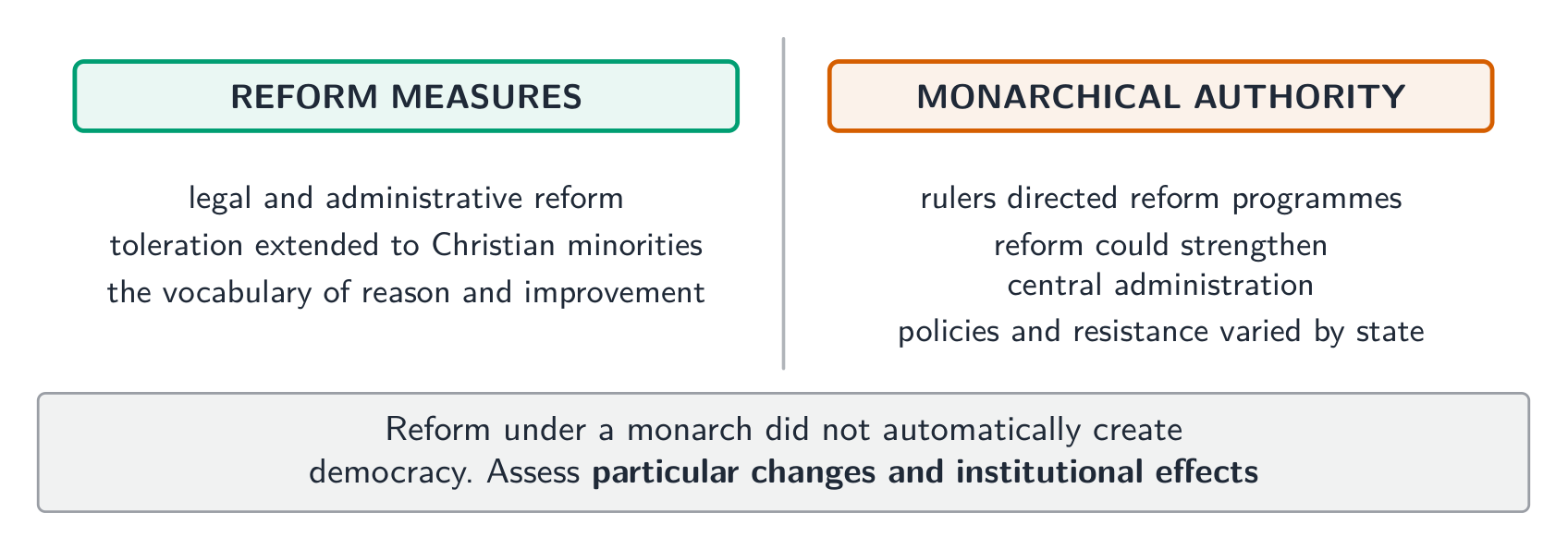
    十八世纪,东欧与中欧的若干国家尝试了开明专制(enlightened absolutism)——统治者在法律、教育与行政中采纳受启蒙启发的改革,同时保留绝对权威。这一表述中的张力正是可考的要点。

    到 1800 年,西欧与中欧多数政府已将宽容扩及基督教少数派,在某些国家还扩及公民权利。

    而由于神圣罗马帝国在威斯特伐利亚被限制了主权,普鲁士(Prussia)崛起,哈布斯堡则转向其东部领地——这是第二单元的和约在一个世纪后到来的结构性后果。

    词汇表 训练
    英文 中文 拼音
    enlightened absolutism 开明专制 kāi míng zhuān zhì
    Prussia rose to power 普鲁士 pǔ lǔ shì
    4.7

    科学革命与启蒙运动时代的因果关系

    大纲

    4.7 Causation in the Age of the Scientific Revolution and the Enlightenment

    Learning ObjectiveReview: Unit 4 Key Concepts

    Unit 4.I
    Explain how and why the Scientific Revolution and Enlightenment challenged the existing European order and understanding of the world.

    • KC-1.1 The rediscovery of works from ancient Greece and Rome and observation of the natural world changed many Europeans’ view of their world.
      • KC-1.1.IV New ideas in science based on observation, experimentation, and mathematics challenged classical views of the cosmos, nature, and the human body, although existing traditions of knowledge and the universe continued.
    • KC-2.3 The spread of Scientific Revolution concepts and practices and the Enlightenment’s application of these concepts and practices to political, social, and ethical issues led to an increased but not unchallenged emphasis on reason in European culture.
      • KC-2.3.I Enlightenment thought, which focused on concepts such as empiricism, skepticism, human reason, rationalism, and classical sources of knowledge, challenged the prevailing patterns of thought with respect to social order, institutions of government, and the role of faith.
      • KC-2.3.II New public venues and print media popularized Enlightenment ideas.
      • KC-2.3.III New political and economic theories challenged absolutism and mercantilism.
      • KC-2.3.IV During the Enlightenment, the rational analysis of religious practices led to natural religion and the demand for religious toleration.
    • KC-2.4 The experiences of everyday life were shaped by demographic, environmental, medical, and technological changes.
      • KC-2.4.III By the 18th century, family and private life reflected new demographic patterns and the effects of the commercial revolution.

    来源:美国大学理事会 AP 课程与考试说明

    本单元考查的推理能力是因果关系,并应用于这些运动如何挑战既有的欧洲世界观

    **Worked example(一道真实的 AP 考题)。*本单元的 AP 欧洲史简答题会要求,例如「解释十八世纪启蒙思想挑战既有政治权威的一种方式」。满分答案会指认这一挑战并加以追溯:「洛克的天赋权利与社会契约理论主张,政府之存在是为了保护个人权利,其权威来自这些个人的同意。这直接动摇了君权神授的主张,因为它使服从取决于统治者的表现,而非无条件。」注意其中的机制:答案展示的是一种论证如何*取代另一种,而不是罗列思想家。

    4.7

    考试技巧

    • 记住 CED 自己的那句话:启蒙运动把科学革命的方法应用于政治、社会与伦理问题。许多题目靠拆解这句话就能作答。
    • 科学革命不是干净的断裂——炼金术与占星术仍在延续。延续性要点能得分。
    • 把启蒙运动的产出归为政治、经济、宗教、社会四类。四个有标签的类别胜过一串人名。
    • 始终点出平等的限度,尤其是就女性而言。CED 明确提到了它们。
    • 开明专制是一种张力,而不是矛盾:进行改革却不交出权威。
    • 公共领域——印刷、识字、沙龙——是观念得以政治化的机制。用它来解释,而不只是描述。
  • 5

    18世纪后期的冲突、危机与反应

    讲义 词汇表
    5.1

    18世纪各国的时代背景

    大纲

    5.1 Contextualizing 18th-Century States

    Learning ObjectivePreview: Unit 5 Key Concepts

    Unit 5.A
    Explain the context in which the European states experienced crisis and conflict from 1648 to 1815.

    • KC-2.1 Different models of political sovereignty affected the relationship among states and between states and individuals.
      • KC-2.1.IV The French Revolution posed a fundamental challenge to Europe’s existing political and social order.
      • KC-2.1.V Claiming to defend the ideals of the French Revolution, Napoleon Bonaparte imposed French control over much of the European continent, which eventually provoked a nationalistic reaction.
    • KC-2.2 The expansion of European commerce accelerated the growth of a worldwide economic network.
      • KC-2.2.III Commercial rivalries influenced diplomacy and warfare among European states in the early modern era.
    • KC-2.3 The spread of Scientific Revolution concepts and practices and the Enlightenment’s application of these concepts and practices to political, social, and ethical issues led to an increased but not unchallenged emphasis on reason in European culture.
      • KC-2.3.VI While Enlightenment values dominated the world of European ideas and culture, they were challenged by the revival of public expression of emotions and feeling.
      • KC-2.3.VI.D Revolution, war and rebellion demonstrated the emotional power of mass politics and nationalism.

    来源:美国大学理事会 AP 课程与考试说明

    第五单元讲述旧秩序的危机:全球商业竞争、法国大革命、拿破仑,以及随后的和约安排。本课程的三项核心概念在此汇合——政治主权的各种模式、欧洲商业扩张为全球网络,以及启蒙观念的传播。

    把整个单元当作一条论证来把握最为有效:商业竞争使国家财政紧张,启蒙观念提供了挑战权威的语言,而两者相遇之处便发生了革命。

    5.2

    全球市场的兴起

    大纲

    5.2 The Rise of Global Markets

    Thematic FocusLearning ObjectiveHistorical Developments

    ECD
    Economic and Commercial Developments — Economic development, especially the development of capitalism, played an important role in Europe’s history, often having significant social, political, and cultural effects.

    Unit 5.B
    Explain the causes and consequences of European maritime competition from 1648 to 1815.

    • KC-2.2 The expansion of European commerce accelerated the growth of a worldwide economic network.
      • KC-2.2.III Commercial rivalries influenced diplomacy and warfare among European states in the early modern era.
      • KC-2.2.III.A European sea powers vied for Atlantic influence throughout the 18th century.
      • KC-2.2.III.B Portuguese, Dutch, French, and British rivalries in Asia culminated in British domination in India and Dutch control of the East Indies.

    来源:美国大学理事会 AP 课程与考试说明

    欧洲商业的扩张加速了全球经济网络(worldwide economic network)的成长。欧洲各国之间的海上竞争不再是欧洲政治的余兴——海外贸易与殖民地如今是欧洲权力得失之所在。

    5.3

    英国的崛起

    大纲

    5.3 Britain’s Ascendency

    Thematic FocusLearning ObjectiveHistorical Developments

    SOP
    States and Other Institutions of Power — European states and nations developed governmental and civil institutions from 1450 to the present to organize society and consolidate political power, with a variety of social, cultural, and economic effects.

    Unit 5.C
    Explain the economic and political consequences of the rivalry between Britain and France from 1648 to 1815.

    • KC-2.1.III.D Rivalry between Britain and France resulted in world wars fought both in Europe and in the colonies, with Britain supplanting France as the greatest European power.

    Illustrative examples:

    • Conflict between the French and the British: §Bullet Seven Years’ War §Bullet American Revolution

    来源:美国大学理事会 AP 课程与考试说明

    英法之间的竞争导致了在欧洲与殖民地同时进行的世界性战争,其结果是英国取代法国成为欧洲最强国(supplanting France)。

    由此产生两项后果,两者都在考查范围内。英国获得了塑造下一个世纪的商业与海军优势。而法国在这些战争中耗费巨大,进入 1780 年代时便面临财政危机(fiscal crisis)——这正是本节与下一节之间的直接联系。

    词汇表 训练
    英文 中文 拼音
    accelerated the growth of a worldwide economic network 全球经济网络 quán qiú jīng jì wǎng luò
    Britain supplanting France as the greatest European power 取代法国 qǔ dài fǎ guó
    fiscal crisis 财政危机 cái zhèng wēi jī
    resulted from a combination of long-term social and political causes, as well as Enlightenment ideas, exacerbated by short-term fiscal and economic crises 短期财政与经济危机 duǎn qī cái zhèng yǔ jīng jì wēi jī
    first, or liberal, phase 自由派阶段 zì yóu pài jiē duàn
    5.4

    法国大革命

    大纲

    5.4 The French Revolution

    Thematic FocusLearning ObjectiveHistorical Developments

    SOP
    States and Other Institutions of Power — European states and nations developed governmental and civil institutions from 1450 to the present to organize society and consolidate political power, with a variety of social, cultural, and economic effects.

    Unit 5.D
    Explain the causes, events, and consequences of the French Revolution.

    • KC-2.1.IV.A The French Revolution resulted from a combination of long-term social and political causes, as well as Enlightenment ideas, exacerbated by short-term fiscal and economic crises.
    • KC-2.1.IV.B The first, or liberal, phase of the French Revolution established a constitutional monarchy, increased popular participation, nationalized the Catholic Church, and abolished hereditary privileges.
    • KC-2.1.IV.C After the execution of Louis XVI, the radical Jacobin republic led by Robespierre responded to opposition at home and war abroad by instituting the Reign of Terror, fixing prices and wages, and pursuing a policy of de-Christianization.
    • KC-2.1.IV.D Revolutionary armies, raised by mass conscription, sought to bring the changes initiated in France to the rest of Europe.
    • KC-2.1.IV.E Women enthusiastically participated in the early phases of the revolution; however, while there were brief improvements in the legal status of women, citizenship in the republic was soon restricted to men.

    Illustrative examples:

    • Causes of the French Revolution: §Bullet Peasant and bourgeois grievances §Bullet Bread shortages §Bullet French involvement in American Revolution Actions taken during the moderate phase of the French Revolution: §Bullet Declaration of the Rights of Man and Citizen §Bullet Civil Constitution of the Clergy §Bullet Constitution of 1791 §Bullet Abolition of provinces and division of France into departments Radical Jacobin leaders and institutions: §Bullet Georges Danton §Bullet Jean-Paul Marat §Bullet Committee of Public Safety Mass conscription: §Bullet Levée en masse Female involvement in the revolution: §Bullet October March on Versailles §Bullet Olympe de Gouges §Bullet Society of Republican Revolutionary Women

    来源:美国大学理事会 AP 课程与考试说明

    大革命的四个阶段,以及每个阶段各自改变了什么——这是整个单元的骨干
    题目几乎总会点名某一阶段;弄清问的是哪一个,答案就完成了一半

    大革命源于长期的社会与政治原因以及启蒙观念的结合,并被短期的财政与经济危机(short-term fiscal and economic crises)所激化。这一公式——长期原因加观念加短期触发——出自 CED 自身,几乎适用于任何起因类题目。

    CED 随后把大革命划分为若干阶段,而区分它们能得分:

    • 第一阶段,即自由派阶段(liberal phase),确立了君主立宪(constitutional monarchy),扩大了民众参与,把天主教会收归国有,并废除了世袭特权(hereditary privileges)。
    • 路易十六被处决之后,由罗伯斯庇尔(Robespierre)领导的激进的雅各宾共和国(radical Jacobin republic)以实行恐怖统治(Reign of Terror)、限定物价与工资并推行去基督教化(de-Christianisation)来回应国内的反对与国外的战争。
    • 大规模征兵(mass conscription)组建的革命军队,试图把法国已开始的变革带到欧洲其余地方。

    女性的参与是可考的,而且很具体:女性在早期阶段热情参与,其法律地位曾短暂改善,但后来被排除在政治参与之外。这句话的两半都必须写到。

    词汇表 训练
    英文 中文 拼音
    constitutional monarchy 君主立宪 jūn zhǔ lì xiàn
    hereditary privileges 世袭特权 shì xí tè quán
    radical Jacobin republic 雅各宾共和国 yǎ gè bīn gòng hé guó
    Robespierre 罗伯斯庇尔 luó bó sī bì ěr
    Reign of Terror 恐怖统治 kǒng bù tǒng zhì
    de-Christianisation 去基督教化 qù jī dū jiào huà
    mass conscription 大规模征兵 dà guī mó zhēng bīng
    revolt of enslaved people led by Toussaint L'Ouverture 杜桑·卢维杜尔 dù sāng · lú wéi dù ěr
    5.5

    法国大革命的影响

    大纲

    5.5 The French Revolution’s Effects

    Thematic FocusLearning ObjectiveHistorical Developments

    SCD
    Social Organization and Development — Economic, political, and cultural factors have influenced the form and status of family, class, and social groups in European history, which has, in turn, affected both the individual and society.

    Unit 5.E
    Explain how the events and developments of the French Revolution influenced political and social ideas from 1648 to 1815.

    • KC-2.1.IV.F Revolutionary ideals inspired a revolt of enslaved people led by Toussaint L’Ouverture in the French colony of Saint-Domingue, which became the independent nation of Haiti in 1804.
    • KC-2.1.IV.G While many were inspired by the revolution’s emphasis on equality and human rights, others condemned its violence and disregard for traditional authority.

    Illustrative examples:

    • Opponents of the revolution: §Bullet Edmund Burke

    来源:美国大学理事会 AP 课程与考试说明

    • 革命理想激发了法国殖民地圣多明各由杜桑·卢维杜尔(Toussaint L'Ouverture)领导的被奴役者起义,该地后来成为独立的海地。这是 CED 的例证:革命原则一旦以普世的方式表述,便无法被限定在欧洲之内。
    • 许多人受到革命对平等与人权的强调的鼓舞,另一些人则谴责其暴力及其对传统权威的漠视——这正是作为一种政治立场的现代保守主义的起点。
    5.6

    拿破仑的崛起、称霸与失败

    大纲

    5.6 Napoleon’s Rise, Dominance, and Defeat

    Thematic FocusLearning ObjectiveHistorical Developments

    SOP
    States and Other Institutions of Power — European states and nations developed governmental and civil institutions from 1450 to the present to organize society and consolidate political power, with a variety of social, cultural, and economic effects.

    Unit 5.F
    Explain the effects of Napoleon’s rule on European social, economic, and political life. THEMATIC FOCUS National and European Identity NEI Definitions and perceptions of regional, cultural, national, and European identity have developed and been challenged over time, with varied and often profound effects on the political, social, and cultural order in Europe. LEARNING OBJECTIVE

    • KC-2.1.V.A As first consul and emperor, Napoleon undertook a number of enduring domestic reforms while often curtailing some rights and manipulating popular impulses behind a façade of representative institutions.
    • KC-2.1.V.B Napoleon’s new military tactics allowed him to exert direct or indirect control over much of the European continent, spreading the ideals of the French Revolution across Europe. HISTORICAL DEVELOPMENTS

    Unit 5.G
    Explain the nationalist responses to Napoleon’s rule in Europe.

    • KC-2.1.V.C Napoleon’s expanding empire created nationalist responses throughout Europe.

    Illustrative examples:

    • Reforms under Napoleon: §Bullet Careers open to talent §Bullet Educational system §Bullet Centralized bureaucracy §Bullet Civil Code §Bullet Concordat of 1801 Curtailment of rights under Napoleon: §Bullet Secret police §Bullet Censorship §Bullet Limitation of women’s rights Nationalist responses to Napoleon: §Bullet Student protest in German states §Bullet Guerilla war in Spain §Bullet Russian scorched earth policy

    来源:美国大学理事会 AP 课程与考试说明

    作为第一执政与皇帝,拿破仑(Napoleon)推行了持久的国内改革(enduring domestic reforms)——法典编纂、行政与财政重组、宗教安排——同时也常常限制各项权利并操纵民意。

    他的新式军事战术使他得以对欧洲大陆的大部分实行直接或间接控制,并把革命的各项改革推广到他所统治的地区。

    而他不断扩张的帝国在整个欧洲激起了民族主义回应(nationalist responses)——各地人民以对抗法国统治来界定自身,革命自身的民族原则由此被反过来用于对付法国。这一反讽是本节最好的论述题素材。

    词汇表 训练
    英文 中文 拼音
    Napoleon 拿破仑 ná pò lún
    enduring domestic reforms 持久的国内改革 chí jiǔ de guó nèi gǎi gé
    created nationalist responses throughout Europe 民族主义回应 mín zú zhǔ yì huí yìng
    5.7

    维也纳会议

    大纲

    5.7 The Congress of Vienna

    Thematic FocusLearning ObjectiveHistorical Developments

    SOP
    States and Other Institutions of Power — European states and nations developed governmental and civil institutions from 1450 to the present to organize society and consolidate political power, with a variety of social, cultural, and economic effects.

    Unit 5.H
    Explain how states responded to Napoleonic rule in Europe and the consequences of the response.

    • KC-2.1.V.D After the defeat of Napoleon by a coalition of European powers, the Congress of Vienna (1814–1815) attempted to restore the balance of power in Europe and contain the danger of revolutionary or nationalistic upheavals in the future.

    来源:美国大学理事会 AP 课程与考试说明

    在拿破仑被欧洲各国联盟击败之后,维也纳会议(Congress of Vienna,1814-1815)试图恢复均势(balance of power),并遏制未来革命或民族主义动荡的危险

    要注意这是两个不同的目标:一个是国家之间的安排,另一个是对某一类政治的防范。第七单元在很大程度上就是第二个目标失败的故事。

    词汇表 训练
    英文 中文 拼音
    Congress of Vienna (1814-1815) 维也纳会议 wéi yě nà huì yì
    restore the balance of power 均势 jūn shì
    5.8

    浪漫主义

    大纲

    5.8 Romanticism

    Thematic FocusLearning ObjectiveHistorical Developments

    CID
    Cultural and Intellectual Developments — The creation and transmission of knowledge, including the relationship between traditional sources of authority and the development of differing world views, had significant political, intellectual, economic, cultural, and social effects on European and world societies.

    Unit 5.I
    Explain how and why the Romantic Movement and religious revival challenged Enlightenment thought from 1648 to 1815.

    • KC-2.3.VI.A Rousseau questioned the exclusive reliance on reason and emphasized the role of emotions in the moral improvement of self and society.
    • KC-2.3.VI.B Romanticism emerged as a challenge to Enlightenment rationality.
    • KC-2.3.VI.C Consistent with the Romantic Movement, religious revival occurred in Europe and included notable movements such as Methodism, founded by John Wesley.
    • KC-2.3.VI.D Revolution, war, and rebellion demonstrated the emotional power of mass politics and nationalism.

    来源:美国大学理事会 AP 课程与考试说明

    浪漫主义(Romanticism)作为对启蒙理性的挑战(challenge to Enlightenment rationality)而兴起。CED 给出了精确的依据:

    • 卢梭质疑对理性的独尊,强调情感(emotions)在自我与社会的道德改善中的作用——因此这一挑战始于启蒙运动内部。
    • 与浪漫主义相一致,欧洲出现了宗教复兴(religious revival),包括循道宗(Methodism)等运动。
    • 革命、战争与叛乱展示了群众政治与民族主义的情感力量(emotional power of mass politics and nationalism)。

    最后这一点正是浪漫主义属于本单元而非艺术章节的原因:这一时期刚刚证明,政治运动既靠论证运转,也靠情感运转。

    词汇表 训练
    英文 中文 拼音
    Romanticism 浪漫主义 làng màn zhǔ yì
    challenge to Enlightenment rationality 对启蒙理性的挑战 duì qǐ méng lǐ xìng de tiǎo zhàn
    emotions 情感 qíng gǎn
    religious revival 宗教复兴 zōng jiào fù xīng
    Methodism 循道宗 xún dào zōng
    Revolution, war, and rebellion demonstrated the emotional power of mass politics and nationalism 群众政治与民族主义的情感力量 qún zhòng zhèng zhì yǔ mín zú zhǔ yì de qíng gǎn lì liàng
    5.9

    18世纪各国的延续与变化

    大纲

    5.9 Continuity and Change in 18th-Century States

    Learning ObjectiveReview: Unit 5 Key Concepts

    Unit 5.J
    Explain how the developments and challenges to the political order resulted in change in the period from 1648 to 1815.

    • KC-2.1 Different models of political sovereignty affected the relationship among states and between states and individuals.
      • KC-2.1.IV The French Revolution posed a fundamental challenge to Europe’s existing political and social order.
      • KC-2.1.V Claiming to defend the ideals of the French Revolution, Napoleon Bonaparte imposed French control over much of the European continent, which eventually provoked a nationalistic reaction.
    • KC-2.2 The expansion of European commerce accelerated the growth of a worldwide economic network.
      • KC-2.2.III Commercial rivalries influenced diplomacy and warfare among European states in the early modern era.
    • KC-2.3 The spread of Scientific Revolution concepts and practices and the Enlightenment’s application of these concepts and practices to political, social, and ethical issues led to an increased but not unchallenged emphasis on reason in European culture.
      • KC-2.3.VI While Enlightenment values dominated the world of European ideas and culture, they were challenged by the revival of public expression of emotions and feeling.
      • KC-2.3.VI.D Revolution, war and rebellion demonstrated the emotional power of mass politics and nationalism.

    来源:美国大学理事会 AP 课程与考试说明

    本单元考查的推理能力是延续与变化

    **Worked example(一道真实的 AP 考题)。*本单元的 AP 欧洲史简答题会要求,例如「解释 1789 至 1815 年间法国大革命改变欧洲政治生活的一种方式」。满分答案会点出这一变化并追溯其机制:「大革命确立了主权属于民族而非君主的原则,而由大规模征兵组建的革命军队把这一原则带到了全欧洲。即使在法国统治不受欢迎的地方,当地人也开始把自身界定为有权自我治理的民族,因此这一观念比拿破仑的失败更为持久。」*注意答案越过了 1815 年:变化类题目要的是延续下来的东西。

    5.9

    考试技巧

    • 使用 CED 的起因公式:长期原因 + 启蒙观念 + 短期财政危机
    • 弄清题目问的是哪个阶段。自由派阶段、激进阶段、拿破仑时期与维也纳安排所做的事截然不同。
    • 谈女性时要写两半——早期的热情参与,后来的被排除。
    • 海地表明革命原则逸出了欧洲。它价值很高却常被略去。
    • 拿破仑是兼而有之:持久的改革被限制的权利。任何一面单独出现都不是答案。
    • 浪漫主义的挑战始于启蒙运动内部,始于卢梭。这一联系比把它当作简单的反动要成熟得多。
  • 6

    工业化及其影响,约1815年至约1914年

    讲义 词汇表
    6.1

    工业化及其起源与影响的时代背景

    大纲

    6.1 Contextualizing Industrialization and Its Origins and Effects

    Learning ObjectivePreview: Unit 6 Key Concepts

    Unit 6.A
    Explain the context in which industrialization originated, developed, and spread in Europe.

    • KC-3.1 The Industrial Revolution spread from Great Britain to the continent, where the state played a greater role in promoting industry.
      • KC-3.1.I Great Britain established its industrial dominance through the mechanization of textile production, iron and steel production, and new transportation systems in conjunction with uniquely favorable political and social climates.
      • KC-3.1.II Following the British example, industrialization took root in continental Europe, sometimes with state sponsorship.
    • KC-3.2 The experiences of everyday life were shaped by industrialization, depending on the level of industrial development in a particular location.
      • KC-3.2.I Industrialization promoted the development of new classes in the industrial regions of Europe.
      • KC-3.2.II Europe experienced rapid population growth and urbanization, leading to social dislocations.
      • KC-3.2.III Over time, the Industrial Revolution altered the family structure and relations for bourgeois and working-class families.
    • KC-3.3 Political revolutions and the complications resulting from industrialization triggered a range of ideological, governmental, and collective responses.
      • KC-3.3.I Ideologies developed and took root throughout society as a response to industrial and political revolutions.
      • KC-3.3.II Governments, at times based on the pressure of political or social organizations, responded to problems created or exacerbated by industrialization.

    来源:美国大学理事会 AP 课程与考试说明

    第六单元讲述约 1815 至 1914 年,建立在 CED 列为核心概念的三项论断之上:

    • 工业革命从英国扩散到欧洲大陆,而在大陆上国家在推动工业方面扮演了更大的角色
    • 日常经验受工业化塑造的方式取决于某地的工业化程度——因此"生活是什么样的"这一问题的答案永远是在哪里、进展到何种阶段
    • 政治革命与工业化带来的种种复杂后果,引发了一系列意识形态、政府与集体回应(ideological, governmental, and collective responses)。

    第三项论断是本单元的骨干。工业化制造了问题;十九世纪的各种意识形态与改革,就是人们为这些问题提出的答案。

    6.2

    工业在欧洲的扩散

    大纲

    6.2 The Spread of Industry Throughout Europe

    Thematic FocusLearning ObjectiveHistorical Developments

    ECD
    Economic and Commercial Developments — Economic development, especially the development of capitalism, played an important role in Europe’s history, often having significant social, political, and cultural effects.

    Unit 6.B
    Explain the factors that influenced the development of industrialization in Europe from 1815 to 1914.

    • KC-3.1.I.A Britain’s ready supplies of coal, iron ore, and other essential raw materials promoted industrial growth.
    • KC-3.1.I Great Britain established its industrial dominance through the mechanization of textile production, iron and steel production, and new transportation systems in conjunction with uniquely favorable political and social climates.
    • KC-3.1.I.B Economic institutions and human capital such as engineers, inventors, and capitalists helped Britain lead the process of industrialization, largely through private initiative.
    • KC-3.1.I.C Britain’s parliamentary government promoted commercial and industrial interests because those interests were represented in Parliament.
    • KC-3.1.II.A France moved toward industrialization at a more gradual pace than Great Britain, with government support and with less dislocation of traditional methods of production.
    • KC-3.1.II.C A combination of factors, including geography, lack of resources, the dominance of traditional landed elites, the persistence of serfdom in some areas, and inadequate government sponsorship, accounted for eastern and southern Europe’s lag in industrial development.
    • KC-3.2.V Because of the continued existence of more primitive agricultural practices and land-owning patterns, some areas of Europe lagged in industrialization while facing famine, debt, and land shortages.

    Illustrative examples:

    • Britain’s leadership: §Bullet The Crystal Palace at the Great Exhibition of 1851 §Bullet Banks §Bullet Government financial awards to inventors Commercial interest in government: §Bullet Repeal of the Corn Laws Government support of industrialization: §Bullet Canals §Bullet Railroads §Bullet Trade agreements Geographic factors in eastern and southern Europe: §Bullet Lack of resources §Bullet Lack of adequate transportation Primitive agricultural practices and famines: §Bullet The “Hungry ’40s” §Bullet Irish potato famine §Bullet Russian serfdom

    来源:美国大学理事会 AP 课程与考试说明

    英国领先,CED 把原因作为一组给出:

    • 现成的煤、铁矿石与其他原料供应。
    • 纺织生产、钢铁与机床制造的机械化。
    • 经济制度与人力资本(human capital)——工程师、发明家与资本家。
    • 一个推动商业与工业利益的议会制政府,因为这些利益在议会中有代表——这是政治条件,也是学生最常漏掉的一项。

    大陆随后出现分化,而这正是可考的比较:

    • 法国的工业化更为渐进,有政府支持,且比英国造成的社会失序(social dislocation)更少。
    • 在别处,地理条件、资源匮乏、传统地主精英的支配地位以及类似农奴的劳动关系的延续,减缓了工业化
    • 由于更为原始的农业方式与土地占有形态延续下来,欧洲某些地区完全落在了后面
    6.3

    第二次工业化浪潮及其影响

    大纲

    6.3 Second Wave Industrialization and Its Effects

    Thematic FocusLearning ObjectiveHistorical Developments

    ECD
    Economic and Commercial Developments — Economic development, especially the development of capitalism, played an important role in Europe’s history, often having significant social, political, and cultural effects.

    Unit 6.C
    Explain how innovations and advances in technology during the Industrial Revolutions led to economic and social change.

    • KC-3.1.III.A Mechanization and the factory system became the predominant modes of production by 1914.
    • KC-3.1.III.B New technologies and means of communication and transportation—including railroads— resulted in more fully integrated national economies, a higher level of urbanization, and a truly global economic network.
    • KC-3.2.IV.B New, efficient methods of transportation and other innovations created new industries, improved the distribution of goods, increased consumerism, and enhanced quality of life.

    Unit 6.D
    Explain how industrialization influenced economic and political development throughout the period from 1815 to 1914.

    • KC-3.1.III During the second industrial revolution (c. 1870–1914), more areas of Europe experienced industrial activity, and industrial processes increased in scale and complexity.
      • KC-3.1.III.C Volatile business cycles in the last quarter of the 19th century led corporations and governments to try to manage the market through a variety of methods, including monopolies, banking practices, and tariffs.
    • KC-3.2.II.A Along with better harvests caused in part by the commercialization of agriculture, industrialization promoted population growth, longer life expectancy, and lowered infant mortality.
    • KC-3.2.IV A heightened consumerism developed as a result of the second industrial revolution.
      • KC-3.2.IV.A Industrialization and mass marketing increased both the production and demand for a new range of consumer goods— including clothing, processed foods, and labor-saving devices—and created more leisure opportunities.
      • KC-3.2.IV.A Industrialization in Prussia allowed that state to become the leader of a unified Germany, which subsequently underwent rapid industrialization under government sponsorship.

    Illustrative examples:

    • Factory production: §Bullet Manchester, England §Bullet The Krupp family (Essen, Germany) New technologies: §Bullet Bessemer process §Bullet Mass production §Bullet Electricity §Bullet Chemicals Developments in communication and transportation: §Bullet Telegraph §Bullet Steamship §Bullet Streetcars or trolley cars §Bullet Telephones §Bullet Internal combustion engine §Bullet Airplane §Bullet Radio New, efficient methods of transportation and other innovations: §Bullet Steamships §Bullet Railroads §Bullet Refrigerated rail cars §Bullet Ice boxes §Bullet Streetcars §Bullet Bicycles New industries: §Bullet Chemical industry §Bullet Electricity and utilities §Bullet Automobile §Bullet Leisure travel §Bullet Professional and leisure sport (CONT’D) Mass marketing: §Bullet Advertising §Bullet Department stores §Bullet Catalogs Industrialization in Prussia: §Bullet Zollverein §Bullet Investment in transportation network §Bullet Adoption of improved methods of manufacturing §Bullet Friedrich List’s National System

    来源:美国大学理事会 AP 课程与考试说明

    到 1914 年,机械化与工厂制度已成为主导的生产方式。在第二次工业革命(second industrial revolution,约 1870-1914)期间,工业活动扩展到欧洲更多地区,并且:

    • 新技术与新的通信、运输方式——尤其是铁路(railroads)——造就了更加一体化的国民经济(integrated national economies)。
    • 高效运输与其他创新催生了新产业,并改善了商品分销。
    • 农业商业化带来的更好收成一道,工业化推动了人口增长(population growth)。
    • 消费主义(consumerism)显著增强。
    词汇表 训练
    英文 中文 拼音
    triggered a range of ideological, governmental, and collective responses 意识形态、政府与集体回应 yì shí xíng tài 、 zhèng fǔ yǔ jí tǐ huí yìng
    Economic institutions and human capital 人力资本 rén lì zī běn
    less social dislocation 社会失序 shè huì shī xù
    second industrial revolution 第二次工业革命 dì èr cì gōng yè gé mìng
    railroads 铁路 tiě lù
    more fully integrated national economies 一体化的国民经济 yī tǐ huà de guó mín jīng jì
    promoted population growth 人口增长 rén kǒu zēng zhǎng
    heightened consumerism 消费主义 xiāo fèi zhǔ yì
    6.4

    工业化的社会影响

    大纲

    6.4 Social Effects of Industrialization

    Thematic FocusLearning ObjectiveHistorical Developments

    SCD
    Social Organization and Development — Economic, political, and cultural factors have influenced the form and status of family, class, and social groups in European history, which has, in turn, affected both the individual and society.

    Unit 6.E
    Explain the causes and consequences of social developments resulting from industrialization.

    • KC-3.2.I.A In industrialized areas of Europe (i.e., western and northern Europe), socioeconomic changes created divisions of labor that led to the development of self-conscious classes, including the proletariat and the bourgeoisie.
    • KC-3.2.I.B In some of the less industrialized areas of Europe, the dominance of agricultural elites continued into the 20th century.
    • KC-3.2.I.C Class identity developed and was reinforced through participation in philanthropic, political, and social associations among the middle classes, and in mutual aid societies and trade unions among the working classes.
    • KC-3.2.II.B With migration from rural to urban areas in industrialized regions, cities experienced overcrowding, while affected rural areas suffered declines in available labor as well as weakened communities.
    • KC-3.2.III.A Bourgeois families became focused on the nuclear family and the cult of domesticity, with distinct gender roles for men and women.
    • KC-3.2.III.B By the end of the century, higher wages, laws restricting the labor of children and women, social welfare programs, improved diet, and increased access to birth control affected the quality of life for the working class.
    • KC-3.2.III.C Economic motivations for marriage, while still important for all classes, diminished as the middle-class notion of companionate marriage began to be adopted by the working classes.
    • KC-3.2.III.D Leisure time centered increasingly on the family or small groups, concurrent with the development of activities and spaces to use that time.

    Illustrative examples:

    • Laws restricting the labor of children and women: §Bullet Factory Act of 1833 §Bullet Mines Act of 1842 §Bullet Ten Hours Act of 1847 Leisure time activities and spaces: §Bullet Parks §Bullet Sports clubs and arenas §Bullet Beaches §Bullet Department stores §Bullet Museums §Bullet Theaters §Bullet Opera houses

    来源:美国大学理事会 AP 课程与考试说明

    • 在已工业化的西欧与北欧,社会经济变化造就了劳动分工,由此形成企业家与专业人士的中产阶级以及工业工人阶级
    • 在工业化程度较低的地区,农业精英的支配地位延续到二十世纪
    • 阶级认同(class identity)通过参与慈善、政治与社会团体而形成并得到强化。
    • 由乡入城的迁移造成城市拥挤(urban overcrowding),而受影响的乡村地区则人口流失。
    • 资产阶级家庭核心家庭家庭崇拜(cult of domesticity)为中心,性别角色分明。
    • 到世纪末,更高的工资、限制童工与女工的法律、社会福利方案与改善的饮食提高了生活水平
    • 随着中产阶级伴侣式婚姻(companionate marriage)观念的传播,婚姻的经济动机有所减弱。
    • 闲暇时间日益以家庭或小群体为中心,并出现了为此而建的活动与场所。
    词汇表 训练
    英文 中文 拼音
    Class identity 阶级认同 jiē jí rèn tóng
    urban overcrowding 城市拥挤 chéng shì yōng jǐ
    cult of domesticity 家庭崇拜 jiā tíng chóng bài
    companionate marriage 伴侣式婚姻 bàn lǚ shì hūn yīn
    6.5

    欧洲协调体系与欧洲保守主义

    大纲

    6.5 The Concert of Europe and European Conservatism

    Thematic FocusLearning ObjectiveHistorical Developments

    SOP
    States and Other Institutions of Power — European states and nations developed governmental and civil institutions from 1450 to the present to organize society and consolidate political power, with a variety of social, cultural, and economic effects.

    Unit 6.F
    Explain how the European political order was maintained and challenged from 1815 to 1914.

    • KC-3.3.I.C Conservatives developed a new ideology in support of traditional political and religious authorities, which was based on the idea that human nature was not perfectible.
    • KC-3.4.I The Concert of Europe (or Congress System) sought to maintain the status quo through collective action and adherence to conservatism.
      • KC-3.4.I.A Metternich, architect of the Concert of Europe, used it to suppress nationalist and liberal revolutions.
      • KC-3.4.I.B Conservatives reestablished control in many European states and attempted to suppress movements for change and, in some areas, to strengthen adherence to religious authorities.

    Illustrative examples:

    • Influential conservative influences: §Bullet Edmund Burke §Bullet Joseph de Maistre §Bullet Klemens von Metternich

    来源:美国大学理事会 AP 课程与考试说明

    欧洲协调(Concert of Europe),又称会议体系,试图通过集体行动与遵循保守原则来维持现状

    这一时期的保守主义(conservatism)是一种真正的意识形态,而不只是抗拒:它支持传统的政治与宗教权威,理由是社会是一个具有自然等级的有机整体,不可能凭抽象理性重新设计而不造成损害。

    词汇表 训练
    英文 中文 拼音
    Concert of Europe 欧洲协调 ōu zhōu xié tiáo
    Conservatism 保守主义 bǎo shǒu zhǔ yì
    6.6

    反应与革命

    大纲

    6.6 Reactions and Revolutions

    Thematic FocusLearning ObjectiveHistorical Developments

    SOP
    States and Other Institutions of Power — European states and nations developed governmental and civil institutions from 1450 to the present to organize society and consolidate political power, with a variety of social, cultural, and economic effects.

    Unit 6.G
    Explain how and why various groups reacted against the existing order from 1815 to 1914.

    • KC-3.4.I.C In the first half of the 19th century, revolutionaries attempted to destroy the status quo.
    • KC-3.4.I.D The revolutions of 1848, triggered by economic hardship and discontent with the political status quo, challenged conservative politicians and governments and led to the breakdown of the Concert of Europe.
    • KC-3.4.II.D In Russia, autocratic leaders pushed through a program of reform and modernization, including the emancipation of the serfs, which gave rise to revolutionary movements and eventually the Russian Revolution of 1905.

    Illustrative examples:

    • Early 19th-century political revolts: §Bullet War of Greek Independence §Bullet Decembrist revolt in Russia §Bullet Polish rebellion §Bullet July Revolution in France Reformers in Russia: §Bullet Alexander II §Bullet Sergei Witte §Bullet Peter Stolypin

    来源:美国大学理事会 AP 课程与考试说明

    十九世纪上半叶,革命者试图摧毁现状。由经济困难与对政治秩序的不满引发的1848 年革命(revolutions of 1848)挑战了全欧洲的保守势力——并且大体失败,而这本身也在考查范围内。

    俄国,专制统治者自上而下推行改革与现代化,包括农奴解放(emancipation of the serfs)——改革在这里是革命的替代方案,而不是对革命的让步。

    词汇表 训练
    英文 中文 拼音
    revolutions of 1848 1848年革命 1848 nián gé mìng
    emancipation of the serfs 农奴解放 nóng nú jiě fàng
    6.7

    变革思潮与改革运动

    大纲

    6.7 Ideologies of Change and Reform Movements

    Thematic FocusLearning ObjectiveHistorical Developments

    CID
    Cultural and Intellectual Developments — The creation and transmission of knowledge, including the relationship between traditional sources of authority and the development of differing world views, had significant political, intellectual, economic, cultural, and social effects on European and world societies.

    Unit 6.H
    Explain how and why different intellectual developments challenged the political and social order from 1815 to 1914.

    • KC-3.3.I.A Liberals emphasized popular sovereignty, individual rights, and enlightened self-interest but debated the extent to which all groups in society should actively participate in its governance.
    • KC-3.3.I.B Radicals in Britain and republicans on the continent demanded universal male suffrage and full citizenship without regard to wealth and property ownership; some argued that such rights should be extended to women.
    • KC-3.3.I.D Socialists called for the redistribution of society’s resources and wealth and evolved from a utopian to a Marxist scientific critique of capitalism.
    • KC-3.6.II.C Marx’s scientific socialism provided a systematic critique of capitalism and a deterministic analysis of society and historical evolution.
    • KC-3.3.I.E Anarchists asserted that all forms of governmental authority were unnecessary and should be overthrown and replaced with a society based on voluntary cooperation.

    Illustrative examples:

    • Liberals: §Bullet Jeremy Bentham §Bullet Anti-Corn Law League §Bullet John Stuart Mill Advocates of suffrage: §Bullet Chartists §Bullet Flora Tristan Utopian socialists: §Bullet Henri de Saint-Simon §Bullet Charles Fourier §Bullet Robert Owen Marxists: §Bullet Friedrich Engels §Bullet Clara Zetkin §Bullet Rosa Luxemburg Anarchists: §Bullet Mikhail Bakunin §Bullet Georges Sorel

    来源:美国大学理事会 AP 课程与考试说明

    这个世纪的争论,一览无余——每种意识形态都在以不同方式回答同一个问题
    题目要求你区分它们,所以要把它们作为一组来学,而不是一次学一个

    CED 点名了五种立场,最好把它们当作对同一个问题的回答来记:权力应当归谁,国家应当做什么?

    • 自由主义者(liberals)强调人民主权、个人权利与开明的自利,但就政治权力应在多大范围内共享存在争论。
    • 英国的激进派(radicals)与大陆的共和派(republicans)要求男性普选权(universal male suffrage)与不问财产的完整公民权。
    • 社会主义者(socialists)呼吁重新分配社会的资源与财富,从空想社会主义演进为马克思的科学社会主义
    • 马克思的科学社会主义(scientific socialism)提供了对资本主义的系统批判,以及对社会与历史变迁的决定论分析。
    • 无政府主义者(anarchists)主张一切形式的政府权威都无必要,应以基于自愿合作的社会取而代之。
    词汇表 训练
    英文 中文 拼音
    Liberals 自由主义者 zì yóu zhǔ yì zhě
    universal male suffrage 男性普选权 nán xìng pǔ xuǎn quán
    Socialists 社会主义者 shè huì zhǔ yì zhě
    Marx's scientific socialism 科学社会主义 kē xué shè huì zhǔ yì
    Anarchists 无政府主义者 wú zhèng fǔ zhǔ yì zhě
    Liberalism shifted from laissez-faire to interventionist 从自由放任转向干预 cóng zì yóu fàng rèn zhuǎn xiàng gān yù
    6.8 6.9

    19世纪的社会改革

    大纲

    6.8 19th-Century Social Reform

    Thematic FocusLearning ObjectiveHistorical Developments

    SCD
    Social Organization and Development — Economic, political, and cultural factors have influenced the form and status of family, class, and social groups in European history, which has, in turn, affected both the individual and society.

    Unit 6.I
    Explain the various movements and calls for social reform that resulted from intellectual developments from 1815 to 1914.

    • KC-3.3.III Political movements and social organizations responded to problems of industrialization.
      • KC-3.3.III.A Mass-based political parties emerged as sophisticated vehicles for social, economic, and political reform.
      • KC-3.3.III.B Workers established labor unions and movements promoting social and economic reforms that also developed into political parties.
      • KC-3.3.III.C Feminists pressed for legal, economic, and political rights for women as well as improved working conditions.
      • KC-3.3.III.D Various nongovernmental reform movements, many of them religious, assisted the poor and worked to end serfdom and slavery.

    Illustrative examples:

    • Mass-based political parties: §Bullet Conservatives and Liberals in Great Britain §Bullet Conservatives and Socialists in France §Bullet Social Democratic Party in Germany Political parties representing workers: §Bullet German Social Democratic Party §Bullet British Labour Party §Bullet Russian Social Democratic Party Feminists and feminist movements: §Bullet Flora Tristan §Bullet British Women’s Social and Political Union §Bullet Pankhurst family §Bullet Barbara Smith Bodichon Reform movements and social reformers: §Bullet The Sunday School movement §Bullet The temperance movement §Bullet British abolitionist movement §Bullet Josephine Butler

    6.9 Institutional Responses and Reform

    Thematic FocusLearning ObjectiveHistorical Developments

    SOP
    States and Other Institutions of Power — European states and nations developed governmental and civil institutions from 1450 to the present to organize society and consolidate political power, with a variety of social, cultural, and economic effects.

    Unit 6.J
    Explain how and why governments and other institutions responded to challenges resulting from industrialization.

    • KC-3.3.II.A Liberalism shifted from laissez-faire to interventionist economic and social policies in response to the challenges of industrialization.
    • KC-3.3.II.B Reforms transformed unhealthy and overcrowded cities by modernizing infrastructure, regulating public health, reforming prisons, and establishing modern police forces. The reforms were enacted by governments motivated by such forces as public opinion, prominent individuals, and charity organizations.
    • KC-3.3.II.C Reformers promoted compulsory public education to advance the goals of public order, nationalism, and economic growth.

    Illustrative examples:

    • Modernizing infrastructure: §Bullet Sewage and water systems §Bullet Public lighting §Bullet Public housing §Bullet Urban redesign §Bullet Parks §Bullet Public transportation §Bullet Edwin Chadwick §Bullet Georges Haussmann

    来源:美国大学理事会 AP 课程与考试说明

    **政治运动与社会组织回应了工业化的问题。**制度层面的回应同样可考:

    • 自由主义从自由放任转向干预(from laissez-faire to interventionist)的经济与社会政策,以应对工业化的挑战。这是本单元最重要的思想变化——那个起初主张国家退出的意识形态,最终开始运用国家。
    • 各项改革通过现代化基础设施、监管公共卫生与改革监狱,改变了不卫生且过度拥挤的城市
    • 改革者推动义务教育(compulsory public education),以促进公共秩序、民族主义与经济增长。要注意这三项动机——CED 都列出来了,没有一项是纯粹出于善意。
    词汇表 训练
    英文 中文 拼音
    compulsory public education 义务教育 yì wù jiào yù
    6.10

    工业化时代的因果关系

    大纲

    6.10 Causation in the Age of Industrialization

    Learning ObjectiveReview: Unit 6 Key Concepts

    Unit 6.K
    Explain the influence of innovations and technological developments in Europe from 1815 to 1914.

    • KC-3.1 The Industrial Revolution spread from Great Britain to the continent, where the state played a greater role in promoting industry.
      • KC-3.1.I Great Britain established its industrial dominance through the mechanization of textile production, iron and steel production, and new transportation systems in conjunction with uniquely favorable political and social climates.
      • KC-3.1.II Following the British example, industrialization took root in continental Europe, sometimes with state sponsorship.
    • KC-3.2 The experiences of everyday life were shaped by industrialization, depending on the level of industrial development in a particular location.
      • KC-3.2.I Industrialization promoted the development of new classes in the industrial regions of Europe.
      • KC-3.2.II Europe experienced rapid population growth and urbanization, leading to social dislocations.
      • KC-3.2.III Over time, the Industrial Revolution altered the family structure and relations for bourgeois and working-class families.
    • KC-3.3 Political revolutions and the complications resulting from industrialization triggered a range of ideological, governmental, and collective responses.
      • KC-3.3.I Ideologies developed and took root throughout society as a response to industrial and political revolutions.
      • KC-3.3.II Governments, at times based on the pressure of political or social organizations, responded to problems created or exacerbated by industrialization.

    来源:美国大学理事会 AP 课程与考试说明

    本单元考查的推理能力是因果关系

    Worked example(一道真实的 AP 考题)。本单元的 AP 欧洲史简答题会要求,例如「解释十九世纪工业化促成新政治意识形态的一种方式」。满分答案会追溯这一联系:「工业化造就了一个境遇相同却没有政治代表的庞大城市工人阶级,这为社会主义者提供了受众与论据:工业所生产的财富是按所有权而非按劳动来分配的。马克思的科学社会主义把这一观察变成对资本主义的系统批判,而工人在工厂与城市中的集中,又使围绕它的组织成为可能。」*注意答案解释的是这一观念为何找到了受众*,而不只是它存在过。

    6.10

    考试技巧

    • 英国的优势包括一项政治优势——工业利益在议会中有代表。多数答案只罗列资源。
    • **法国在国家支持下渐进工业化,社会失序较少。**这一对比能回答许多比较题。
    • 五种意识形态作为一组来学,以"权力归谁、国家做什么"来区分。
    • 自由主义从自由放任转向干预是这个世纪关键的意识形态变化。要点出它。
    • 义务教育有三项动机——秩序、民族主义、增长。三项都要写。
    • 生活水平是在世纪末、经历数十年艰难之后才提高的。时间点就是得分点。
  • 7

    19世纪的思想观念与政治发展,约1815年至约1914年

    讲义 词汇表
    7.1

    19世纪思想观念与政治发展的时代背景

    大纲

    7.1 Contextualizing 19th-Century Perspectives and Political Developments

    Learning ObjectivePreview: Unit 7 Key Concepts

    Unit 7.A
    Explain the context in which nationalistic and imperialistic sentiments developed in Europe from 1815 to 1914.

    • KC-3.4 European states struggled to maintain international stability in an age of nationalism and revolutions.
      • KC-3.4.II The breakdown of the Concert of Europe opened the door for movements of national unification in Italy and Germany as well as liberal reforms elsewhere.
      • KC-3.4.III The unification of Italy and Germany transformed the European balance of power and led to efforts to construct a new diplomatic order.
    • KC-3.5 A variety of motives and methods led to the intensification of European global control and increased tensions among the Great Powers.
      • KC-3.5.II Industrial and technological developments (e.g., the second industrial revolution) facilitated European control of global empires.
    • KC-3.6 European ideas and culture expressed a tension between objectivity and scientific realism on one hand, and subjectivity and individual expression on the other.
      • KC-3.6.II Following the revolutions of 1848, Europe turned toward a realist and materialist worldview.

    来源:美国大学理事会 AP 课程与考试说明

    第七单元与第六单元覆盖同样的年代——约 1815 至 1914 年——但追踪的是政治、帝国与思想,而非工业。三项核心概念构成其框架:

    • 欧洲各国在民族主义与革命的时代竭力维持国际稳定
    • 多种动机与手段导致欧洲全球控制的强化,以及列强(Great Powers)之间紧张关系的加剧
    • 欧洲的思想与文化表现出一种张力:一端是客观性与科学现实主义,另一端是主观性与个人表达(subjectivity and individual expression)。

    第三项张力是本单元的文化线索,它解释了为何浪漫主义、现实主义、实证主义与现代艺术都属于同一个单元,而不是被放进单独的艺术史。

    词汇表 训练
    英文 中文 拼音
    increased tensions among the Great Powers 列强 liè qiáng
    subjectivity and individual expression 主观性与个人表达 zhǔ guān xìng yǔ gè rén biǎo dá
    7.2

    民族主义

    大纲

    7.2 Nationalism

    Thematic FocusLearning ObjectiveHistorical Developments

    NEI
    National and European Identity — Definitions and perceptions of regional, cultural, national, and European identity have developed and been challenged over time, with varied and often profound effects on the political, social, and cultural order in Europe.

    Unit 7.B
    Explain how the development and spread of nationalism affected Europe from 1815 to 1914.

    • KC-3.3.I.F Nationalists encouraged loyalty to the nation in a variety of ways, including romantic idealism, liberal reform, political unification, racialism with a concomitant anti-Semitism, and chauvinism justifying national aggrandizement.
    • KC-3.3.I.G While during the 19th century western European Jews became more socially and politically acculturated, Zionism, a form of Jewish nationalism, developed late in the century as a response to growing anti-Semitism throughout Europe.
    • KC-3.4.II.B A new generation of conservative leaders, including Napoleon III, Cavour, and Bismarck, used popular nationalism to create or strengthen the state.
    • KC-3.4.II.C The creation of the dual monarchy of Austria-Hungary, which recognized the political power of the largest ethnic minority, was an attempt to stabilize the state by reconfiguring national unity.

    Illustrative examples:

    • Nationalists: §Bullet J. G. Fichte §Bullet Grimm Brothers §Bullet Giuseppe Mazzini §Bullet Pan-Slavists Anti-Semitism: §Bullet Dreyfus affair §Bullet Christian Social Party in Germany §Bullet Karl Lueger, mayor of Vienna Zionists: §Bullet Theodor Herzl

    来源:美国大学理事会 AP 课程与考试说明

    界定本单元的转折:同一种力量,被对立的一方所用
    1848 年之前民族主义威胁着既有秩序;1848 年之后保守派用它来建国

    民族主义者以多种方式鼓励对民族的忠诚,包括浪漫主义理想(romantic idealism)、自由主义改革、政治统一与种族主义——因此民族主义并无单一的政治色彩,可以依附于极为不同的纲领。

    最重要的转折是:新一代保守派领袖,包括拿破仑三世(Napoleon III)、加富尔(Cavour)与俾斯麦(Bismarck),借助民众民族主义来创建或强化国家(used popular nationalism to create or strengthen states)。1848 年之前,民族主义主要是对维也纳安排的革命性威胁;1848 年之后,它成为保守派手中建国的工具。如果本单元只记住一件事,那就记住这一逆转。

    另有两点在考查范围内:

    • 十九世纪西欧犹太人在社会与政治上日益融入,而作为犹太民族主义形式的犹太复国主义(Zionism)则因持续的排斥而兴起。
    • 奥匈二元帝国(dual monarchy of Austria-Hungary)的建立承认了最大族群少数派的政治权力,这是在多民族帝国内部管理而非压制民族主义的尝试。
    词汇表 训练
    英文 中文 拼音
    romantic idealism 浪漫主义理想 làng màn zhǔ yì lǐ xiǎng
    Napoleon III 拿破仑三世 ná pò lún sān shì
    Cavour 加富尔 jiā fù ěr
    Bismarck 俾斯麦 bǐ sī mài
    used popular nationalism to create or strengthen states 借助民众民族主义建国 jiè zhù mín zhòng mín zú zhǔ yì jiàn guó
    Zionism 犹太复国主义 yóu tài fù guó zhǔ yì
    dual monarchy of Austria-Hungary 奥匈二元帝国 ào xiōng èr yuán dì guó
    7.3

    民族统一与外交紧张

    大纲

    7.3 National Unification and Diplomatic Tensions

    Thematic FocusLearning ObjectiveHistorical Developments

    SOP
    States and Other Institutions of Power — European states and nations developed governmental and civil institutions from 1450 to the present to organize society and consolidate political power, with a variety of social, cultural, and economic effects.

    Unit 7.C
    Explain the factors that resulted in Italian unification and German unification.

    • KC-3.4.II.A The Crimean War demonstrated the weakness of the Ottoman Empire and contributed to the breakdown of the Concert of Europe, thereby creating the conditions in which Italy and Germany could be unified after centuries of fragmentation.
    • KC-3.4.III.A Cavour’s diplomatic strategies, combined with the popular Garibaldi’s military campaigns, led to the unification of Italy.
    • KC-3.4.III.B Bismarck used Realpolitik, employing diplomacy, industrialized warfare, weaponry, and the manipulation of democratic mechanisms to unify Germany.

    Unit 7.D
    Explain how nationalist sentiment and political alliances led to tension between and among European powers from 1815 to 1914.

    • KC-3.4.III.C After 1871, Bismarck attempted to maintain the balance of power through a complex system of alliances directed at isolating France.
    • KC-3.4.III.D Bismarck’s dismissal in 1890 eventually led to a system of mutually antagonistic alliances and heightened international tensions.
    • KC-3.4.III.E Nationalist tensions in the Balkans drew the Great Powers into a series of crises, leading up to World War I.

    Illustrative examples:

    • Bismarck’s alliances: §Bullet Three Emperors’ League §Bullet Triple Alliance §Bullet Reinsurance Treaty Nationalist tensions in the Balkans: §Bullet Congress of Berlin in 1878 §Bullet Growing influence of Serbia §Bullet Bosnia-Herzegovina annexation crisis (1908) §Bullet First Balkan War §Bullet Second Balkan War

    来源:美国大学理事会 AP 课程与考试说明

    克里米亚战争(Crimean War)暴露了奥斯曼帝国的虚弱,并促成了欧洲协调的瓦解(breakdown of the Concert of Europe)——正是这一瓦解使统一成为可能,因为那个为阻止领土变更而设计的体系已不再运转。

    • 意大利:加富尔的外交策略加上加里波第(Garibaldi)广受拥戴的军事行动,促成了统一。外交加民众运动——两种机制,CED 把两者都点了名。
    • 德国:俾斯麦运用现实政治(Realpolitik),以外交、工业化战争与武器以及对民主机制的操纵,实现了普鲁士主导下的统一。

    随后的外交后果直接通向第八单元:

    • 1871 年后,俾斯麦试图通过旨在孤立法国的复杂联盟体系(system of alliances)维持均势。
    • 俾斯麦 1890 年被免职,最终造成了彼此敌对的联盟(mutually antagonistic alliances)体系与国际紧张的加剧。
    • 巴尔干(Balkans)的民族主义紧张把列强卷入一连串危机,直至第一次世界大战。
    词汇表 训练
    英文 中文 拼音
    Crimean War 克里米亚战争 kè lǐ mǐ yà zhàn zhēng
    breakdown of the Concert of Europe 欧洲协调的瓦解 ōu zhōu xié tiáo de wǎ jiě
    Garibaldi's 加里波第 jiā lǐ bō dì
    Bismarck used Realpolitik 现实政治 xiàn shí zhèng zhì
    complex system of alliances 联盟体系 lián méng tǐ xì
    mutually antagonistic alliances 彼此敌对的联盟 bǐ cǐ dí duì de lián méng
    Nationalist tensions in the Balkans 巴尔干 bā ěr gàn
    7.4

    达尔文主义与社会达尔文主义

    大纲

    7.4 Darwinism, Social Darwinism

    Thematic FocusLearning ObjectiveHistorical Developments

    TSI
    Technological and Scientific Innovation — Scientific and technological innovations have increased efficiency, improved daily life, and shaped human development and interactions, having both intended and unintended consequences.

    Unit 7.E
    Explain how Darwin’s theories influenced scientific and social developments from 1815 to 1914.

    • KC-3.6.II.B Charles Darwin provided a scientific and material account of biological change and the development of human beings as a species, and inadvertently, a justification for racialist theories that became known as Social Darwinism.

    来源:美国大学理事会 AP 课程与考试说明

    达尔文(Charles Darwin)提供了关于生物变化以及人类作为一个物种之发展的科学与唯物的解释

    他的理论随后被远远应用到生物学之外。社会达尔文主义(Social Darwinism)取用竞争与选择的语言,用以为种族、民族与阶级等级辩护——在下一节中,也为帝国扩张辩护。在论述题中要把这一区分保持清晰:达尔文的生物学与社会达尔文主义并非同一主张,后者也并不由前者推出。

    词汇表 训练
    英文 中文 拼音
    Charles Darwin 达尔文 dá ěr wén
    Social Darwinism 社会达尔文主义 shè huì dá ěr wén zhǔ yì
    7.5

    进步与现代性的时代

    大纲

    7.5 The Age of Progress and Modernity

    Thematic FocusLearning ObjectiveHistorical Developments

    TSI
    Technological and Scientific Innovation — Scientific and technological innovations have increased efficiency, improved daily life, and shaped human development and interactions, having both intended and unintended consequences.

    Unit 7.F
    Explain how science and other intellectual disciplines developed and changed throughout the period from 1815 to 1914.

    • KC-3.6.II.A Positivism, or the philosophy that science alone provides knowledge, emphasized the rational and scientific analysis of nature and human affairs.
    • KC-3.6.III In the later 19th century, a new relativism in values and the loss of confidence in the objectivity of knowledge led to modernism in intellectual and cultural life.
      • KC-3.6.III.A Philosophy largely moved from rational interpretations of nature and human society to an emphasis on irrationality and impulse, a view that contributed to the belief that conflict and struggle led to progress.
      • KC-3.6.III.B Freudian psychology offered a new account of human nature that emphasized the role of the irrational and the struggle between the conscious and subconscious.
      • KC-3.6.III.C Developments in the natural sciences, such as quantum mechanics and Einstein’s theory of relativity, undermined the primacy of Newtonian physics as an objective description of nature.

    Illustrative examples:

    • Philosophers who emphasized the irrational: §Bullet Friedrich Nietzsche §Bullet Georges Sorel §Bullet Henri Bergson Scientists who undermined the notion that Newtonian physics provided an objective knowledge of nature: §Bullet Max Planck

    来源:美国大学理事会 AP 课程与考试说明

    实证主义(positivism)——即认为唯有科学提供知识的哲学——强调对自然与人事的理性与科学分析,代表着这个世纪思想中自信的一极。

    随后,在十九世纪后期,一种新的价值相对主义(relativism in values)与对知识客观性的信心丧失,导向了现代主义(modernism)。两者合起来正是 7.1 中所说的张力:同一种文化既产生了科学将解释一切的信念,也产生了客观性本身或许只是幻象的怀疑。

    词汇表 训练
    英文 中文 拼音
    Positivism 实证主义 shí zhèng zhǔ yì
    new relativism in values 价值相对主义 jià zhí xiāng duì zhǔ yì
    modernism 现代主义 xiàn dài zhǔ yì
    7.6

    新帝国主义:动机与手段

    大纲

    7.6 New Imperialism: Motivations and Methods

    Thematic FocusLearning ObjectiveHistorical Developments

    TSI
    Technological and Scientific Innovation — Scientific and technological innovations have increased efficiency, improved daily life, and shaped human development and interactions, having both intended and unintended consequences.

    Unit 7.G
    Explain the motivations that led to European imperialism in the period from 1815 to 1914.

    • KC-3.5.I European nations were driven by economic, political, and cultural motivations in their new imperial ventures in Asia and Africa.
      • KC-3.5.I.A European national rivalries and strategic concerns fostered imperial expansion and competition for colonies.
      • KC-3.5.I.B The search for raw materials and markets for manufactured goods, as well as strategic and nationalistic considerations, drove Europeans to colonize Africa and Asia, even as European colonies in the Americas broke free politically, if not economically.
      • IKC-3.5.I.C European imperialists justified overseas expansion and rule by claiming cultural and racial superiority.

    Unit 7.H
    Explain how technological advances enabled European imperialism from 1815 to 1914.

    • KC-3.5.II.A The development of advanced weaponry ensured the military advantage of Europeans over colonized areas.
    • KC-3.5.II.B Communication and transportation technologies facilitated the creation and expansion of European empires.
    • KC-3.5.II.C Advances in medicine enabled European survival in Africa and Asia.

    Illustrative examples:

    • Ideas of cultural and racial superiority: §Bullet “The White Man’s Burden” §Bullet Mission civilisatrice §Bullet Social Darwinism Advanced weaponry: §Bullet Minié ball (bullet) §Bullet Breech-loading rifle §Bullet Machine gun Communication and transportation technologies: §Bullet Steamships
      • Telegraph
      • Photography
    • Advances in medicine: §Bullet Louis Pasteur’s germ theory of disease §Bullet Anesthesia and antiseptics §Bullet Public health projects §Bullet Quinine

    来源:美国大学理事会 AP 课程与考试说明

    欧洲各国在亚洲与非洲的新帝国事业中受经济、政治与文化动机(economic, political, and cultural motivations)驱动。

    CED 随后单独给出了使之成为可能的技术,恰好三项:

    • 先进武器确保了欧洲对被殖民地区的军事优势。
    • 通信与运输技术(communication and transportation technologies)使帝国得以建立与治理。
    • 医学进步(advances in medicine)使欧洲人得以在非洲与亚洲生存——这是学生最常遗忘的一项,而它往往是决定性的。
    词汇表 训练
    英文 中文 拼音
    economic, political, and cultural motivations 经济、政治与文化动机 jīng jì 、 zhèng zhì yǔ wén huà dòng jī
    Communication and transportation technologies 通信与运输技术 tōng xìn yǔ yùn shū jì shù
    Advances in medicine 医学进步 yī xué jìn bù
    7.7

    帝国主义的全球影响

    大纲

    7.7 Imperialism’s Global Effects

    Thematic FocusLearning ObjectiveHistorical Developments

    INT
    Interaction of Europe and the World — Motivated by a variety of factors, Europe’s interaction with the world led to political, economic, social, and cultural exchanges that influenced both European and non-European societies.

    Unit 7.I
    Explain how European imperialism affected both European and non-European societies.

    • KC-3.5.III Imperial endeavors significantly affected society, diplomacy, and culture in Europe and created resistance to foreign control abroad.
      • KC-3.5.III.A Imperialism created diplomatic tensions among European states that strained alliance systems.
      • KC-3.5.III.B Imperial encounters with non-European peoples influenced the styles and subject matter of artists and writers and provoked debate over the acquisition of colonies.
      • KC-3.5.III.C Especially as non-Europeans became educated in Western values, they challenged European imperialism through nationalist movements and by modernizing local economies and societies.

    Illustrative examples:

    • Diplomatic tensions: §Bullet Berlin Conference (1884–1885) §Bullet Fashoda crisis (1898) §Bullet Moroccan crises (1905, 1911) Participants in the imperialism debate: §Bullet Pan-German League §Bullet J. A. Hobson’s and Vladimir Lenin’s anti-imperialism §Bullet Congo Reform Association Responses to European imperialism: §Bullet Indian Congress Party §Bullet Zulu Resistance §Bullet India’s Sepoy Mutiny §Bullet China’s Boxer Rebellion §Bullet Japan’s Meiji Restoration

    来源:美国大学理事会 AP 课程与考试说明

    帝国事业显著影响了欧洲的社会、外交与文化,并在海外造成了对外来控制的抵抗

    两个方向都重要。在欧洲,帝国助长了民族主义,塑造了大众文化,并把殖民地争端变成了列强危机。在海外,它引发了有组织的抵抗。把帝国主义写成欧洲单方面施加于他处、既无回流影响也无回应的答案,在这两点上都不完整。

    7.8

    19世纪的文化与艺术

    大纲

    7.8 19th-Century Culture and Arts

    Thematic FocusLearning ObjectiveHistorical Developments

    CID
    Cultural and Intellectual Developments — The creation and transmission of knowledge, including the relationship between traditional sources of authority and the development of differing world views, had significant political, intellectual, economic, cultural, and social effects on European and world societies.

    Unit 7.J
    Explain the continuities and changes in European artistic expression from 1815 to 1914.

    • KC-3.6.I Romanticism broke with Neoclassical forms of artistic representation and with rationalism, placing more emphasis on intuition and emotion.
    • KC-3.6.I.A Romantic artists and composers broke from classical artistic forms to emphasize emotion, nature, individuality, intuition, the supernatural, and national histories in their works.
    • KC-3.6.I.B Romantic writers expressed similar themes while responding to the Industrial Revolution and to various political revolutions.
    • KC-3.6.II.D Realist and materialist themes and attitudes influenced art and literature as painters and writers depicted the lives of ordinary people and drew attention to social problems.
    • KC-3.6.III.D Modern art, including Impressionism, Post-Impressionism, and Cubism, moved beyond the representational to the subjective, abstract, and expressive and often provoked audiences that believed that art should reflect shared and idealized values, including beauty and patriotism.

    Illustrative examples:

    • Romantic artists: §Bullet Francisco Goya §Bullet Caspar David Friedrich §Bullet J. M. W. Turner §Bullet John Constable §Bullet Eugène Delacroix Romantic composers: §Bullet Ludwig van Beethoven §Bullet Frédéric Chopin §Bullet Richard Wagner §Bullet Pyotr Ilyich Tchaikovsky Romantic writers: §Bullet Johann Wolfgang von Goethe §Bullet William Wordsworth §Bullet Lord Byron §Bullet Percy Shelley §Bullet John Keats §Bullet Mary Shelley §Bullet Victor Hugo Realist artists and authors: §Bullet Honoré de Balzac §Bullet Honoré Daumier §Bullet Charles Dickens §Bullet George Eliot (Mary Ann Evans) §Bullet Gustave Courbet §Bullet Fyodor Dostoevsky §Bullet Jean-François Millet §Bullet Leo Tolstoy §Bullet Émile Zola §Bullet Thomas Hardy (CONT’D) Modern artists: §Bullet Claude Monet §Bullet Paul Cézanne §Bullet Henri Matisse §Bullet Edgar Degas §Bullet Pablo Picasso §Bullet Vincent Van Gogh

    来源:美国大学理事会 AP 课程与考试说明

    这个世纪的艺术精确地对应着它的思想张力:

    • 浪漫主义打破了新古典的形式与理性主义,强调直觉、情感、自然、个体性与超自然;浪漫主义作家在回应工业革命与政治革命的同时表达了同样的主题。
    • 现实主义与唯物主义(realist and materialist)的主题影响了艺术与文学,画家与作家开始描绘普通人的生活
    • 现代艺术——印象派、后印象派与立体主义(Impressionism, Post-Impressionism, and Cubism)——越出再现,走向主观、抽象与表现
    词汇表 训练
    英文 中文 拼音
    Realist and materialist 现实主义与唯物主义 xiàn shí zhǔ yì yǔ wéi wù zhǔ yì
    Impressionism, Post-Impressionism, and Cubism 印象派、后印象派与立体主义 yìn xiàng pài 、 hòu yìn xiàng pài yǔ lì tǐ zhǔ yì
    7.9

    19世纪思想观念与政治发展中的因果关系

    大纲

    7.9 Causation in 19th-Century Perspectives and Political Developments

    Learning ObjectiveReview: Unit 7 Key Concepts

    Unit 7.K
    Explain the influence of nationalist and imperialist movements on European and global stability.

    • KC-3.4 European states struggled to maintain international stability in an age of nationalism and revolutions.
      • KC-3.4.II The breakdown of the Concert of Europe opened the door for movements of national unification in Italy and Germany as well as liberal reforms elsewhere.
      • KC-3.4.III The unification of Italy and Germany transformed the European balance of power and led to efforts to construct a new diplomatic order.
    • KC-3.5 A variety of motives and methods led to the intensification of European global control and increased tensions among the Great Powers.
      • KC-3.5.II Industrial and technological developments (e.g., the second industrial revolution) facilitated European control of global empires.
    • KC-3.6 European ideas and culture expressed a tension between objectivity and scientific realism on one hand, and subjectivity and individual expression on the other.
      • KC-3.6.II Following the revolutions of 1848, Europe turned toward a realist and materialist worldview.

    来源:美国大学理事会 AP 课程与考试说明

    本单元考查的推理能力是因果关系

    **Worked example(一道真实的 AP 考题)。本单元的 AP 欧洲史简答题会要求,例如「解释十九世纪民族主义促成德国或意大利统一的一种方式」。满分答案给出的是机制而非情绪:「俾斯麦把民众的民族主义情感用作普鲁士建国的工具:通过把对丹麦、奥地利与法国的战争呈现为民族事业,他使较小的德意志邦国的统治者在政治上无法抵制普鲁士主导的统一,从而把一次王朝扩张变成了一次民族统一。」注意其结构:要展示民族主义在做某件事,而不只是它存在着。

    7.9

    考试技巧

    • 这一逆转就是本单元:1848 年之前民族主义威胁秩序;1848 年之后保守派用它来建国
    • 克里米亚战争之后欧洲协调的瓦解是统一得以可能的原因。要把它点出为使之成为可能的条件。
    • 意大利同时需要加富尔的外交与加里波第的行动。德国需要俾斯麦的现实政治。机制不同,结果相同。
    • 给出帝国主义的三项使能技术——武器、运输与通信,以及医学
    • 达尔文社会达尔文主义分开。后者是对前者的一种使用,而不是它的结论。
    • 帝国主义既作用于海外也作用于欧洲,并且引发了抵抗。两者都在考查范围内。
  • 8

    20世纪的全球冲突,约1914年至今

    讲义 词汇表
    8.1

    20世纪全球冲突的时代背景

    大纲

    8.1 Contextualizing 20th-Century Global Conflicts

    Learning ObjectivePreview: Unit 8 Key Concepts

    Unit 8.A
    Explain the context in which global conflict developed in the 20th century.

    • KC-4.1 Total war and political instability in the first half of the 20th century gave way to a polarized state order during the Cold War and eventually to efforts at transnational union.
      • KC-4.1.I World War I, caused by a complex interaction of long- and short-term factors, resulted in immense losses and disruptions for both victors and vanquished.
      • KC-4.1.II The conflicting goals of the peace negotiators in Paris pitted diplomatic idealism against the desire to punish Germany, producing a settlement that satisfied few.
      • KC-4.1.III In the interwar period, fascism, extreme nationalism, racist ideologies, and the failure of appeasement resulted in the catastrophe of World War II, presenting a grave challenge to European civilization.
    • KC-4.2 The stresses of economic collapse and total war engendered internal conflicts within European states and created conflicting conceptions of the relationship between the individual and the state, as demonstrated in the ideological battle between and among democracy, communism, and fascism.
    • KC-4.3 During the 20th century, diverse intellectual and cultural movements questioned the existence of objective knowledge, the ability of reason to arrive at truth, and the role of religion in determining moral standards.
      • KC-4.3.II Science and technology yielded impressive material benefits but also caused immense destruction and posed challenges to objective knowledge.
    • KC-4.4 Demographic changes, economic growth, total war, disruptions of traditional social patterns, and competing definitions of freedom and justice altered the experiences of everyday life.
      • KC-4.4.I The 20th century was characterized by large-scale suffering brought on by warfare and genocide, but also by tremendous improvements in the standard of living.

    来源:美国大学理事会 AP 课程与考试说明

    第八单元把约 1914 年至今作为一部冲突史来讲述,由四项核心概念构成框架:

    • 二十世纪上半叶的总体战与政治不稳定,让位于冷战时期的两极化国家秩序
    • 经济崩溃与总体战的压力在欧洲各国内部造成了内部冲突,并产生了关于个人与国家的关系(relationship between the individual and the state)的相互冲突的构想
    • 多种思想与文化运动质疑客观知识的存在,以及建立于其上的权威。
    • 人口变化、经济增长、总体战,以及关于自由与正义的相互竞争的界定,改变了日常生活的经验。
    8.2

    第一次世界大战

    大纲

    8.2 World War I

    Thematic FocusLearning ObjectiveHistorical Developments

    TSI
    Technological and Scientific Innovation — Scientific and technological innovations have increased efficiency, improved daily life, and shaped human development and interactions, having both intended and unintended consequences.

    Unit 8.B
    Explain the causes and effects of World War I.

    • KC-4.1.I World War I, caused by a complex interaction of long- and short-term factors, resulted in immense losses and disruptions for both victors and vanquished.
      • KC-4.1.I.A A variety of factors—including nationalism, military plans, the alliance system, and imperial competition—turned a regional dispute in the Balkans into World War I.

    Unit 8.C
    Explain how new technology altered the conduct of World War I. THEMATIC FOCUS Interaction of Europe and the World INT Motivated by a variety of factors, Europe’s interaction with the world led to political, economic, social, and cultural exchanges that influenced both European and non-European societies. LEARNING OBJECTIVE

    • KC-4.1.I.B New technologies confounded traditional military strategies and led to trench warfare and massive troop losses. HISTORICAL DEVELOPMENTS

    Unit 8.D
    Explain how the developments of World War I changed political and diplomatic interactions between and among nations.

    • KC-4.1.I.C The effects of military stalemate, national mobilization, and total war led to protest and insurrection in the belligerent nations and eventually to revolutions that changed the international balance of power.
    • KC-4.1.I.D The war in Europe quickly spread to non-European theaters, transforming the war into a global conflict.
    • KC-4.1.I.E The relationship of Europe to the world shifted significantly with the globalization of the conflict, the emergence of the United States as a world power, and the overthrow of European empires.

    Illustrative examples:

    • New technologies: §Bullet Machine gun §Bullet Barbed wire §Bullet Submarine §Bullet Airplane §Bullet Poison gas §Bullet Tank Discontent and revolution: §Bullet Mutinies in armies §Bullet Easter Rebellion in Ireland §Bullet Russian Revolution Non-European theaters of conflict: §Bullet Armenian Genocide §Bullet Arab revolt against the Turks §Bullet Japanese aggression in the Pacific and on the Chinese mainland Collapse of European empires: §Bullet Mandate system §Bullet Creation of modern Turkey §Bullet Dissolution of Austro-Hungarian Empire

    来源:美国大学理事会 AP 课程与考试说明

    这场战争由长期与短期因素的复杂互动所致,造成了巨大的损失与破坏。CED 的具体论断是:

    • 新技术使传统军事战略失效,导致堑壕战(trench warfare)与巨大的兵员损失。
    • 军事僵局、全民动员与总体战的后果,在各交战国引发了抗议与起义(protest and insurrection)——战争转而作用于进行战争的社会本身。
    • 战争迅速蔓延至非欧洲战场,成为一场全球冲突
    • 随着这一全球化以及新兴强国的出现,欧洲与世界的关系发生了显著转变
    词汇表 训练
    英文 中文 拼音
    conflicting conceptions of the relationship between the individual and the state 个人与国家的关系 gè rén yǔ guó jiā de guān xì
    trench warfare 堑壕战 qiàn háo zhàn
    protest and insurrection 抗议与起义 kàng yì yǔ qǐ yì
    8.3

    俄国革命及其影响

    大纲

    8.3 The Russian Revolution and Its Effects

    Thematic FocusLearning ObjectiveHistorical Developments

    SOP
    States and Other Institutions of Power — European states and nations developed governmental and civil institutions from 1450 to the present to organize society and consolidate political power, with a variety of social, cultural, and economic effects.

    Unit 8.E
    Explain the causes and effects of the Russian Revolution.

    • KC-4.2.I The Russian Revolution created a regime based on Marxist–Leninist theory.
      • KC-4.2.I.A In Russia, World War I exacerbated long-term problems of political stagnation, social inequality, incomplete industrialization, and food and land distribution, all while creating support for revolutionary change.
      • KC-4.2.I.B Military and worker insurrections, aided by the revived Soviets, undermined the Provisional Government and set the stage for Lenin’s long-planned Bolshevik Revolution and establishment of a communist state.
      • KC-4.2.I.C The Bolshevik takeover prompted a protracted civil war between communist forces and their opponents, who were aided by foreign powers.
      • KC-4.2.I.D.i In order to improve economic performance, Lenin compromised communist principles and employed some free-market principles under the New Economic Policy.

    Illustrative examples:

    • Revolutionary change in Russia:
      • February/March Revolution
      • Petrograd Soviet

    来源:美国大学理事会 AP 课程与考试说明

    俄国革命(Russian Revolution)创立了一个以马克思列宁主义(Marxist-Leninist theory)为基础的政权——这是第一个明确建立在该纲领之上的国家,这正是它成为转折点而非一国事件的原因。

    词汇表 训练
    英文 中文 拼音
    Russian Revolution 俄国革命 é guó gé mìng
    Marxist-Leninist theory 马克思列宁主义 mǎ kè sī liè níng zhǔ yì
    diplomatic idealism against the desire to punish Germany 理想主义与惩罚德国的意愿 lǐ xiǎng zhǔ yì yǔ chéng fá dé guó de yì yuàn
    8.4

    凡尔赛会议与和平安排

    大纲

    8.4 Versailles Conference and Peace Settlement

    Thematic FocusLearning ObjectiveHistorical Developments

    SOP
    States and Other Institutions of Power — European states and nations developed governmental and civil institutions from 1450 to the present to organize society and consolidate political power, with a variety of social, cultural, and economic effects.

    Unit 8.F
    Explain how and why the settlement of World War I failed to effectively resolve the political, economic, and diplomatic challenges of the early 20th century.

    • KC-4.1.II The conflicting goals of the peace negotiators in Paris pitted diplomatic idealism against the desire to punish Germany, producing a settlement that satisfied few.
      • KC-4.1.II.A Wilsonian idealism clashed with postwar realities in both the victorious and the defeated states. Democratic successor states emerged from former empires and eventually succumbed to significant political, economic, and diplomatic crises.
      • KC-4.1.II.B The League of Nations, created to prevent future wars, was weakened from the outset by the nonparticipation of major powers, including the U.S., Germany, and the Soviet Union.
      • KC-4.1.II.C The Versailles settlement, particularly its provisions on the assignment of guilt and reparations for the war, hindered the German Weimar Republic’s ability to establish a stable and legitimate political and economic system.
    • KC-4.1.VI.B The League of Nations distributed former German and Ottoman possessions to France and Great Britain through the mandate system, thereby altering the imperial balance of power and creating a strategic interest in the Middle East and its oil.

    Illustrative examples:

    • Democratic successor states:
      • Poland §Bullet Czechoslovakia §Bullet Hungary
      • Yugoslavia
    • Mandate territories:
      • Lebanon and Syria
      • Iraq
      • Palestine

    来源:美国大学理事会 AP 课程与考试说明

    本单元赖以建立的链条——每一环都是一项独立可考的论断
    题目问的是其中一环;最有力的答案会显示这一环在链条中的位置

    巴黎和会上谈判者相互冲突的目标,使外交理想主义与惩罚德国的意愿(idealism against the desire to punish Germany)相互对立,由此形成的和约两个目标都未能充分实现。

    国际联盟(League of Nations)通过委任统治(mandate system)把原德国与奥斯曼的属地分配给法国与英国,这实际上是以新名义延续帝国控制——这一点值得写出,因为它把和约与课程后面的去殖民化连接了起来。

    词汇表 训练
    英文 中文 拼音
    League of Nations 国际联盟 guó jì lián méng
    mandate system 委任统治 wěi rèn tǒng zhì
    8.5

    全球经济危机

    大纲

    8.5 Global Economic Crisis

    Thematic FocusLearning ObjectiveHistorical Developments

    ECD
    Economic and Commercial Developments — Economic development, especially the development of capitalism, played an important role in Europe’s history, often having significant social, political, and cultural effects.

    Unit 8.G
    Explain the causes and effects of the global economic crisis in the 1920s and 1930s.

    • KC-4.2.III The Great Depression, caused by weaknesses in international trade and monetary theories and practices, undermined Western European democracies and fomented radical political responses throughout Europe.
      • KC-4.2.III.A World War I debt, nationalistic tariff policies, overproduction, depreciated currencies, disrupted trade patterns, and speculation created weaknesses in economies worldwide.
      • KC-4.2.III.B Dependence on post-World War I American investment capital led to financial collapse when, following the 1929 stock market crash, the United States cut off capital flows to Europe.
      • KC-4.2.III.C Despite attempts to rethink economic theories and policies and forge political alliances, Western democracies failed to overcome the Great Depression and were weakened by extremist movements.

    Illustrative examples:

    • New economic theories and policies:
      • Keynesianism in Britain
      • Cooperative social action in Scandinavia
      • Popular Front policies in France
    • Political alliance:
      • National government in Britain
      • Popular Fronts in France and Spain

    来源:美国大学理事会 AP 课程与考试说明

    由国际贸易以及货币理论与实践中的弱点所致的大萧条(Great Depression),削弱了西欧民主国家(undermined Western European democracies),并在全欧洲催生了激进的政治回应

    这是本单元的枢纽。大萧条把战间期的怨愤变成了那些运动的政治机会——这些运动早在 1914 年之前就已存在,但此前从未能够取得政权。

    词汇表 训练
    英文 中文 拼音
    Great Depression 大萧条 dà xiāo tiáo
    undermined Western European democracies 削弱西欧民主国家 xuē ruò xī ōu mín zhǔ guó jiā
    8.6

    法西斯主义与极权主义

    大纲

    8.6 Fascism and Totalitarianism

    Thematic FocusLearning ObjectiveHistorical Developments

    SOP
    States and Other Institutions of Power — European states and nations developed governmental and civil institutions from 1450 to the present to organize society and consolidate political power, with a variety of social, cultural, and economic effects.

    Unit 8.H
    Explain the factors that led to the development of fascist and totalitarian regimes in the aftermath of World War I.

    • KC-4.2.II The ideology of fascism, with roots in the pre-World War I era, gained popularity in an environment of postwar bitterness, the rise of communism, uncertain transitions to democracy, and economic instability.
      • KC-4.2.II.A Fascist dictatorships used modern technology and propaganda that rejected democratic institutions, promoted charismatic leaders, and glorified war and nationalism to attract the disillusioned.
      • KC-4.2.II.B Mussolini and Hitler rose to power by exploiting postwar bitterness and economic instability, using terror, and manipulating the fledgling and unpopular democracies in their countries.
      • KC-4.2.II.C Franco’s alliance with Italian and German fascists in the Spanish Civil War—in which the Western democracies did not intervene—represented a testing ground for World War II and resulted in authoritarian rule in Spain from 1936 to the mid-1970s.
      • KC-4.2.II.D After failures to establish functioning democracies, authoritarian dictatorships took power in central and eastern Europe during the interwar period. HISTORICAL DEVELOPMENTS

    Unit 8.I
    Explain the consequences of Stalin’s economic policies and totalitarian rule in the Soviet Union.

    • KC-4.2.I.D.ii After Lenin’s death, Stalin undertook a centralized program of rapid economic modernization, often with severe repercussions for the population.
    • KC-4.2.I.E Stalin’s economic modernization of the Soviet Union came at a high price, including the liquidation of the kulaks (the land-owning peasantry) and other perceived enemies of the state, devastating famine in the Ukraine, purges of political rivals, and, ultimately, the creation of an oppressive political system.

    Illustrative examples:

    • Fascist propaganda: §Bullet §Bullet Joseph Goebbels
      • Leni Riefenstahl §Bullet Architecture §Bullet
    • Authoritarian dictatorship in central and eastern Europe: §Bullet Poland
      • Hungary
      • Romania
    • The Soviet Union’s rapid economic modernization:
      • Collectivization §Bullet Five Year Plan
    • The Soviet Union’s oppressive political system: §Bullet Great purges §Bullet
      • Secret police

    来源:美国大学理事会 AP 课程与考试说明

    根源可追溯至战前的法西斯主义(fascism)意识形态,在战后的怨愤、共产主义的兴起、向民主的不稳定过渡与经济动荡的环境中获得了民众支持。这四重环境是 CED 自身对"为何在此时"的回答,它优于任何单一原因。

    在苏联一侧,列宁去世后斯大林(Stalin)推行了集中的快速经济现代化方案,常伴以严厉的镇压。CED 明确指出了代价:现代化付出了高昂的代价,包括消灭富农(kulaks)与一场灾难性的饥荒(famine)。

    本单元所引出的比较是结构性的而非意识形态性的:两个政权都主张对个人与国家的关系拥有全面权威,这正是第二项核心概念在发挥作用。
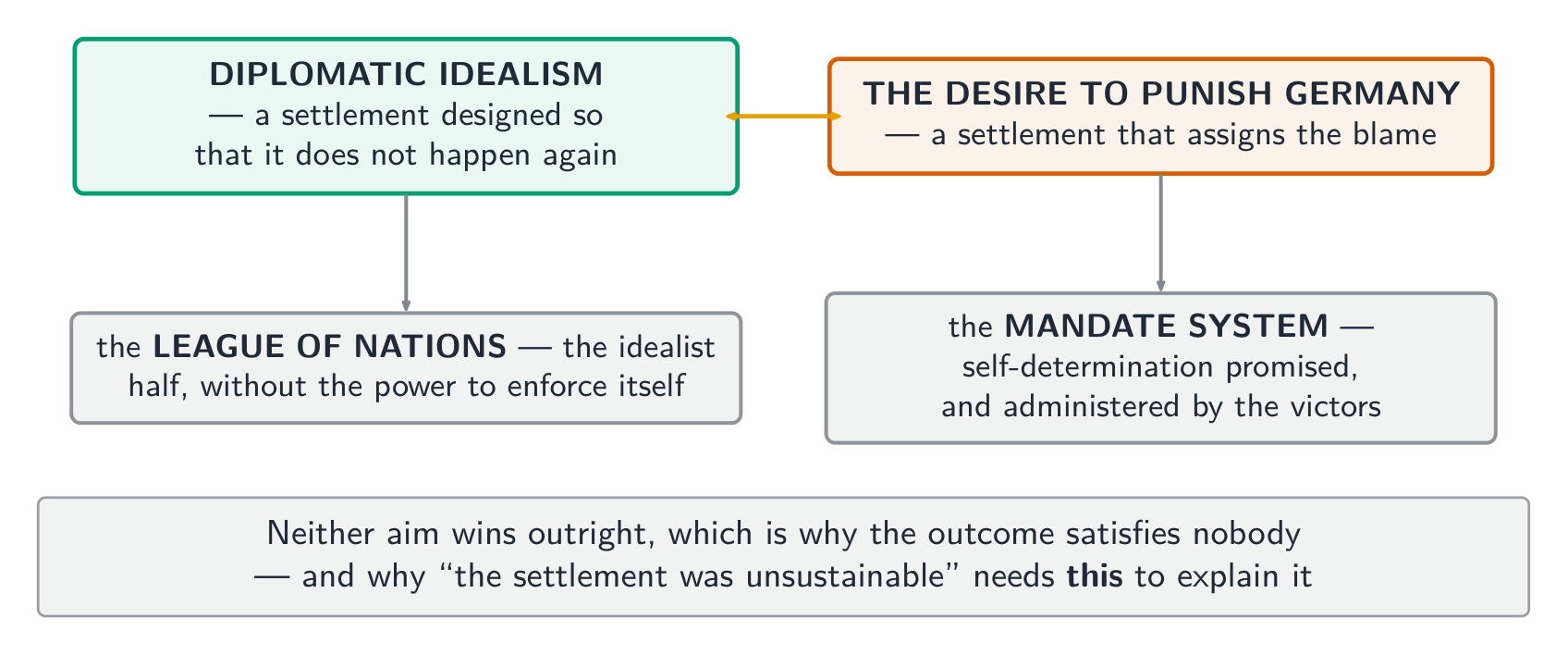
    词汇表 训练
    英文 中文 拼音
    fascism 法西斯主义 fǎ xī sī zhǔ yì
    Stalin 斯大林 sī dà lín
    liquidation of the kulaks 富农 fù nóng
    catastrophic famine 饥荒 jī huāng
    8.7

    两次大战之间的欧洲

    大纲

    8.7 Europe During the Interwar Period

    Thematic FocusLearning ObjectiveHistorical Developments

    SOP
    States and Other Institutions of Power — European states and nations developed governmental and civil institutions from 1450 to the present to organize society and consolidate political power, with a variety of social, cultural, and economic effects.

    Unit 8.J
    Explain how and why various political and ideological factors resulted in the catastrophe of World War II.

    • KC-4.1.III.A French and British fears of another war, American isolationism, and deep distrust between Western democratic, capitalist nations and the authoritarian, communist Soviet Union allowed fascist states to rearm and expand their territory.
    • KC-4.1.III In the interwar period, fascism, extreme nationalism, racist ideologies, and the failure of appeasement resulted in the catastrophe of World War II, presenting a grave challenge to European civilization.

    Illustrative examples:

    • Fascist states’ expansion allowed by European powers:
      • Remilitarization of the Rhineland
      • Italian invasion of Ethiopia
      • Annexation of Austria
      • Munich Agreement and its violation
      • Nazi–Soviet Non-Aggression Pact

    来源:美国大学理事会 AP 课程与考试说明

    未能阻止第二场战争,其原因是被点名的:

    • 英法对再次开战的恐惧美国孤立主义(American isolationism),以及西方民主资本主义国家与苏联共产主义政权之间的深度互不信任,阻碍了有效的回应。
    • 法西斯主义、极端民族主义、种族主义意识形态与绥靖政策的失败(failure of appeasement)导致了第二次世界大战。
    词汇表 训练
    英文 中文 拼音
    American isolationism 美国孤立主义 měi guó gū lì zhǔ yì
    Fascism, extreme nationalism, racist ideologies, and the failure of appeasement 绥靖政策的失败 suí jìng zhèng cè de shī bài
    8.8

    第二次世界大战

    大纲

    8.8 World War II

    Thematic FocusLearning ObjectiveHistorical Developments

    TSI
    Technological and Scientific Innovation — Scientific and technological innovations have increased efficiency, improved daily life, and shaped human development and interactions, having both intended and unintended consequences.

    Unit 8.K
    Explain how technology and innovation affected the course of World War II and the 20th century.

    • KC-4.1.III.B Germany’s Blitzkrieg warfare in Europe, combined with Japan’s attacks in Asia and the Pacific, brought the Axis powers early victories.
    • KC-4.1.III.C American and British industrial, scientific, and technological power, cooperative military efforts under the strong leadership of individuals such as Winston Churchill, the resistance of civilians, and the all-out military commitment of the USSR contributed critically to the Allied victories.
    • KC-4.3.II.C Military technologies made possible industrialized warfare, genocide, nuclear proliferation, and the risk of global nuclear war.

    Illustrative examples:

    • Blitzkrieg:
      • Polish campaign of 1939
      • Operation Barbarossa
      • Surrender of France

    来源:美国大学理事会 AP 课程与考试说明

    • 德国在欧洲的闪电战(Blitzkrieg),加上日本在亚洲与太平洋的进攻,使轴心国取得了早期胜利。
    • 美英的工业、科学与技术力量,强有力领导下的军事协作,以及苏联庞大的人力与资源,最终击败了轴心国。
    • 军事技术使工业化战争、种族灭绝、核扩散(nuclear proliferation)与全球核战争的风险成为可能
    词汇表 训练
    英文 中文 拼音
    Blitzkrieg 闪电战 shǎn diàn zhàn
    Military technologies made possible industrialised warfare, genocide, nuclear proliferation 核扩散 hé kuò sàn
    8.9

    犹太人大屠杀

    大纲

    8.9 The Holocaust

    Thematic FocusLearning ObjectiveHistorical Developments

    NEI
    National and European Identity — Definitions and perceptions of regional, cultural, national, and European identity have developed and been challenged over time, with varied and often profound effects on the political, social, and cultural order in Europe.

    Unit 8.L
    Explain how and why cultural and national identities were affected by war and the rise of fascist/totalitarian powers in the period from 1914 to the present.

    • KC-4.1.III.D Fueled by racism and anti-Semitism, Nazi Germany—with the cooperation of some of the other Axis powers and collaborationist governments—sought to establish a “new racial order” in Europe, which culminated with the Holocaust.
    • KC-4.4.I.B World War II decimated a generation of Russian and German men; virtually destroyed European Jewry; resulted in the murder of millions in other groups targeted by the Nazis including Roma, homosexuals, people with disabilities, and others; forced large-scale migrations; and undermined prewar class hierarchies.

    Illustrative examples:

    • Nazi establishment of a new racial order: §Bullet Nuremberg Laws
      • Wannsee Conference
      • Auschwitz and other death camps

    来源:美国大学理事会 AP 课程与考试说明

    种族主义与反犹主义(racism and anti-Semitism)的驱动下,纳粹德国——在部分其他轴心国与合作者的配合下——利用工业技术与官僚机构对欧洲犹太人及其他被针对群体实施了系统性屠杀

    CED 的表述是精确的,应当照其复述:与早先的大规模暴力相区别之处,在于它把现代国家自身的工具——工业、官僚体系、交通、档案管理——用作手段。这正是本节属于技术与总体战主题、而非独立成篇的原因。

    人口后果被直接陈述:第二次世界大战使一代俄国与德国男性大量丧生,几乎摧毁了欧洲的犹太社群,并造成数以百万计的其他死亡。

    词汇表 训练
    英文 中文 拼音
    racism and anti-Semitism 种族主义与反犹主义 zhǒng zú zhǔ yì yǔ fǎn yóu zhǔ yì
    "lost generation" 迷惘的一代 mí wǎng de yí dài
    8.10

    20世纪文化、思想与艺术的发展

    大纲

    8.10 20th-Century Cultural, Intellectual, and Artistic Developments

    Thematic FocusLearning ObjectiveHistorical Developments

    CID
    Cultural and Intellectual Developments — The creation and transmission of knowledge, including the relationship between traditional sources of authority and the development of differing world views, had significant political, intellectual, economic, cultural, and social effects on European and world societies.

    Unit 8.M
    Explain how the events of the first half of the 20th century challenged existing social, cultural, and intellectual understandings.

    • KC-4.3.I.i The widely held belief in progress characteristic of much of 19th-century thought began to break down before World War I.
    • KC-4.3.I.A When World War I began, Europeans were generally confident in the ability of science and technology to address human needs and problems despite the uncertainty created by the new scientific theories and psychology.
    • KC-4.3.II.A The challenge to the certainties of the Newtonian universe in physics opened the door to uncertainty in other fields by undermining faith in objective knowledge while also providing the knowledge necessary for the development of nuclear weapons and power.
    • KC-4.4.I.A World War I created a “lost generation” and fostered disillusionment and cynicism, while it transformed the lives of women, and democratized societies.
    • KC-4.4.II.A During the world wars, women became increasingly involved in military and political mobilization, as well as in economic production.

    Illustrative examples:

    • Physicists: §Bullet Albert Einstein §Bullet Werner Heisenberg §Bullet Erwin Schrödinger §Bullet Enrico Fermi
      • Niels Bohr

    来源:美国大学理事会 AP 课程与考试说明

    • 十九世纪思想中普遍存在的进步信念,在第一次世界大战之前就已开始瓦解,并在战后崩塌。
    • 战争开始时,欧洲人普遍相信科学与技术有能力满足人类需要;战争继而大萧条动摇了这一信心
    • 物理学中对牛顿式宇宙确定性的挑战,为其他领域的不确定性打开了大门
    • 战争造就了**"迷惘的一代"(lost generation),并助长了幻灭与犬儒**(disillusionment and cynicism)。
    • 在两次大战期间,女性日益参与军事与政治动员以及经济生产。
    词汇表 训练
    英文 中文 拼音
    disillusionment and cynicism 幻灭与犬儒 huàn miè yǔ quǎn rú
    8.11

    全球冲突时代的延续与变化

    大纲

    8.11 Continuity and Changes in an Age of Global Conflict

    Learning ObjectiveReview: Unit 8 Key Concepts

    Unit 8.N
    Explain how economic challenges and ideological beliefs influenced prior conceptions about the relationship between the individual and the state.

    • KC-4.1 Total war and political instability in the first half of the 20th century gave way to a polarized state order during the Cold War and eventually to efforts at transnational union.
      • KC-4.1.I World War I, caused by a complex interaction of long- and short-term factors, resulted in immense losses and disruptions for both victors and vanquished.
      • KC-4.1.II The conflicting goals of the peace negotiators in Paris pitted diplomatic idealism against the desire to punish Germany, producing a settlement that satisfied few.
      • KC-4.1.III In the interwar period, fascism, extreme nationalism, racist ideologies, and the failure of appeasement resulted in the catastrophe of World War II, presenting a grave challenge to European civilization.
    • KC-4.2 The stresses of economic collapse and total war engendered internal conflicts within European states and created conflicting conceptions of the relationship between the individual and the state, as demonstrated in the ideological battle between and among democracy, communism, and fascism.
    • KC-4.3 During the 20th century, diverse intellectual and cultural movements questioned the existence of objective knowledge, the ability of reason to arrive at truth, and the role of religion in determining moral standards.
      • KC-4.3.II Science and technology yielded impressive material benefits but also caused immense destruction and posed challenges to objective knowledge.
    • KC-4.4 Demographic changes, economic growth, total war, disruptions of traditional social patterns, and competing definitions of freedom and justice altered the experiences of everyday life.
      • KC-4.4.I The 20th century was characterized by large-scale suffering brought on by warfare and genocide, but also by tremendous improvements in the standard of living.

    来源:美国大学理事会 AP 课程与考试说明

    本单元考查的推理能力是延续与变化

    **Worked example(一道真实的 AP 考题)。*本单元的 AP 欧洲史简答题会要求,例如「解释 1919 年的和约在 1920 与 1930 年代造成欧洲政治不稳定的一种方式」。满分答案会追溯一条机制:「和约把对德国的惩罚性条款与它无法一贯兑现的民族自决诉求结合在一起。这留下了一个背负赔款、又因接受赔款而被指责的德国共和国,从而给了民族主义与法西斯运动一个可资利用的怨愤,而 1929 年的经济崩溃把这一怨愤转化为群众支持。」*注意答案把链条向前推进到了题目所问的时点。

    8.11

    考试技巧

    • 记住这条链条:战争、和约、经济崩溃、激进运动、绥靖失败、再度开战。多数题目问的是其中一环。
    • CED 为法西斯主义给出了四重环境——战后怨愤、对共产主义的恐惧、不稳定的民主、经济动荡。四项都要用。
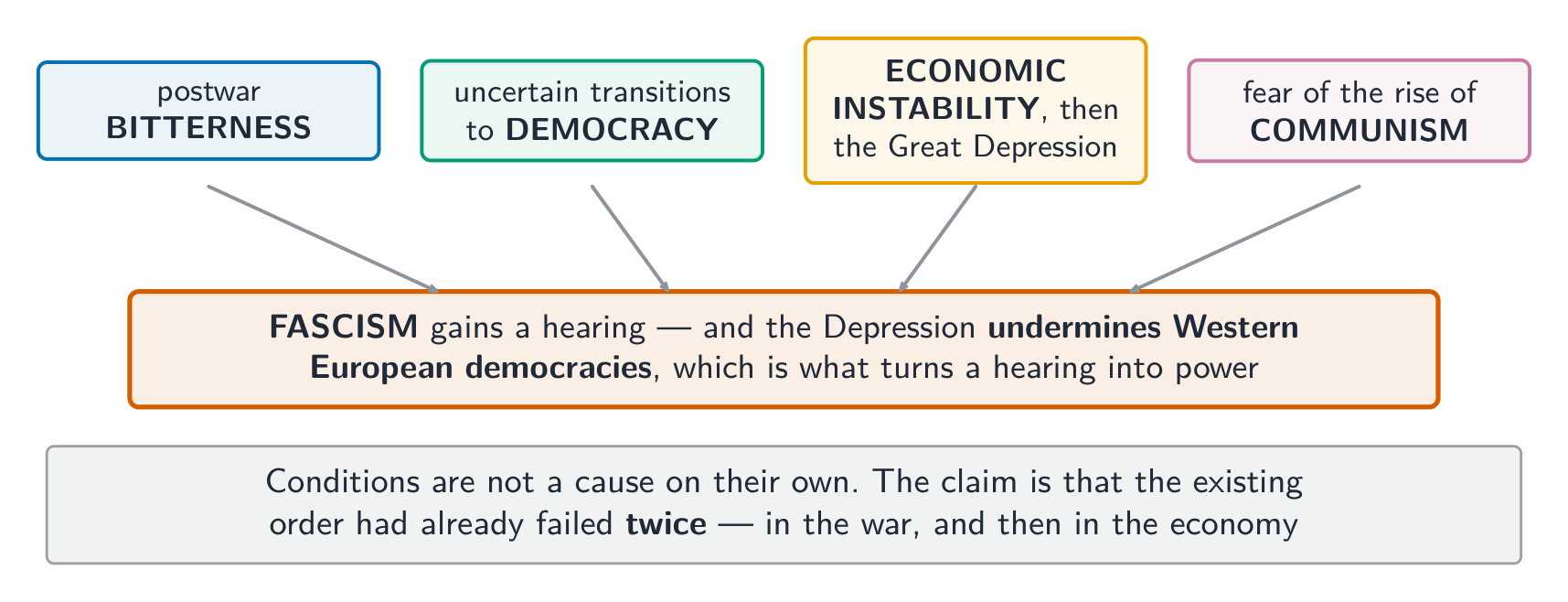
    • 大萧条是枢纽。这些运动在 1929 年之前就已存在,但直到它发生才得以取得政权。
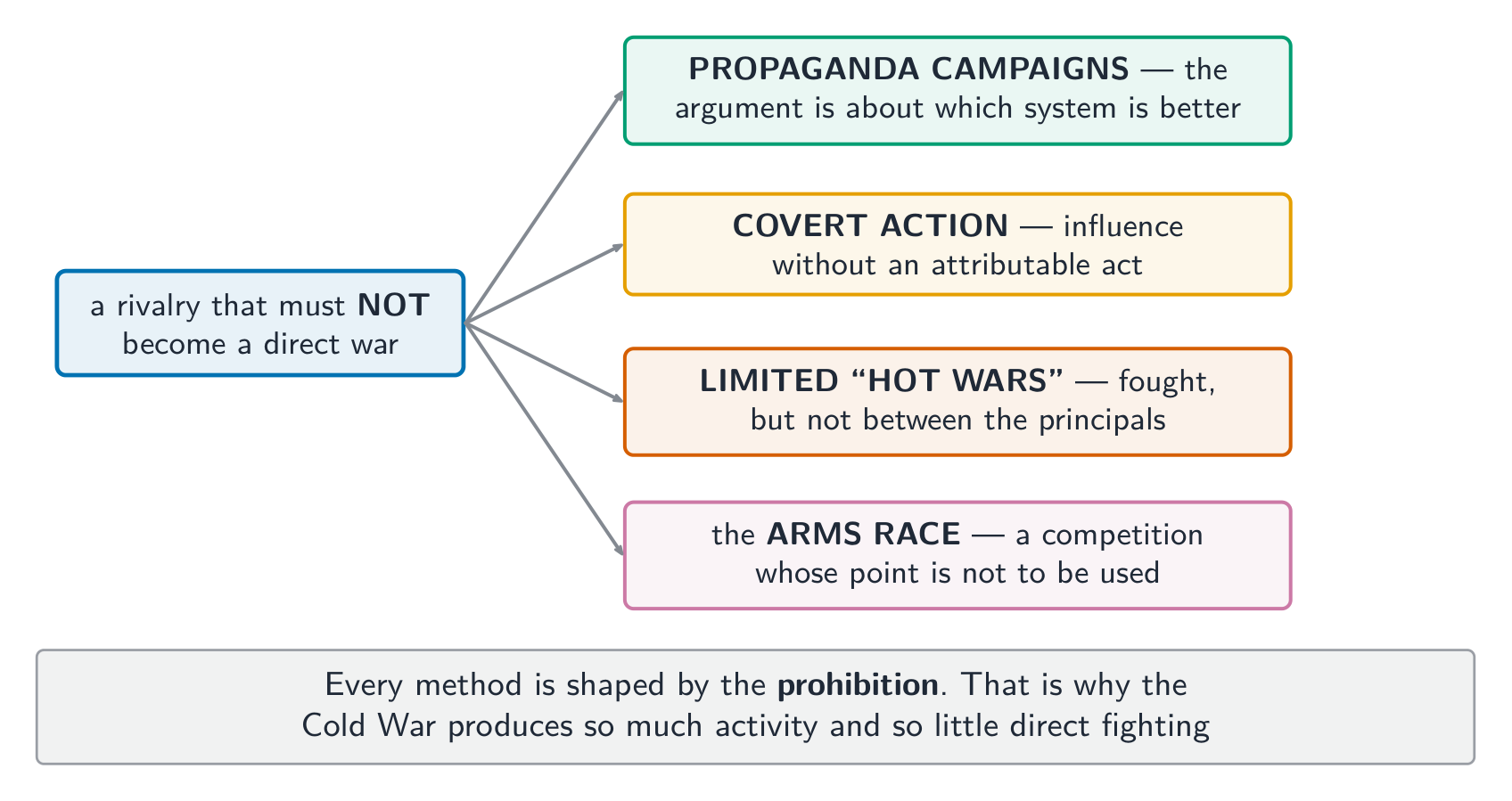
    • 谈大屠杀时,可考的要点是对现代国家自身工具的使用。要精确陈述这一点。
    • 委任统治是换了名义的帝国控制。写出这一点能把和约与去殖民化连接起来。
    • 进步与客观性信心的崩塌,把本单元的政治与文化两半连接起来。阅卷人很看重这一联系。
  • 9

    冷战与当代欧洲

    讲义 词汇表
    9.1

    冷战与当代欧洲的时代背景

    大纲

    9.1 Contextualizing Cold War and Contemporary Europe

    Learning ObjectivePreview: Unit 9 Key Concepts

    Unit 9.A
    Explain the context in which the Cold War developed, spread, and ended in Europe.

    • KC-4.1 Total war and political instability in the first half of the 20th century gave way to a polarized state order during the Cold War and eventually to efforts at transnational union.
      • KC-4.1.IV As World War II ended, a Cold War between the liberal democratic West and the communist East began, lasting nearly half a century.
    • KC-4.2 The stresses of economic collapse and total war engendered internal conflicts within European states and created conflicting conceptions of the relationship between the individual and the state, as demonstrated in the ideological battle between and among democracy, communism, and fascism.
    • KC-4.3 During the 20th century, diverse intellectual and cultural movements questioned the existence of objective knowledge, the ability of reason to arrive at truth, and the role of religion in determining moral standards.
      • KC-4.3.I.ii The experience of war intensified a sense of anxiety that permeated many facets of thought and culture, giving way by the century’s end to a plurality of intellectual frameworks.
    • KC-4.4 Demographic changes, economic growth, total war, disruptions of traditional social patterns, and competing definitions of freedom and justice altered the experiences of everyday life.
      • KC-4.4.III New voices gained prominence in political, intellectual, and social discourse.

    来源:美国大学理事会 AP 课程与考试说明

    第九单元把欧洲从 1945 年带到当下。适用的仍是第八单元的四项核心概念,但重心发生了转移:两极化的国家秩序、关于个人与国家的相互竞争的构想、对客观知识的持续质疑,以及重塑日常生活的人口与经济变化。

    本单元有必须同时把握的两半——1991 年之前的分裂,以及与之并行、并在其后延续的一体化

    9.2

    重建欧洲

    大纲

    9.2 Rebuilding Europe

    Thematic FocusLearning ObjectiveHistorical Developments

    ECD
    Economic and Commercial Developments — Economic development, especially the development of capitalism, played an important role in Europe’s history, often having significant social, political, and cultural effects.

    Unit 9.B
    Explain how economic developments resulted in economic, political, and cultural change in the period after World War II.

    • KC-4.2.IV.A Marshall Plan funds from the United States financed an extensive reconstruction of industry and infrastructure and stimulated an extended period of growth in Western and Central Europe, often referred to as an “economic miracle,” which increased the economic and cultural importance of consumerism.

    来源:美国大学理事会 AP 课程与考试说明

    来自美国的马歇尔计划(Marshall Plan)资金资助了工业与基础设施的大规模重建,并刺激了西欧的经济复苏。

    马歇尔计划在两个方向上同时可考:它重建了西欧;而由于苏联阵营拒绝接受,它也帮助固化了界定本单元其余部分的那道分裂。

    词汇表 训练
    英文 中文 拼音
    Marshall Plan 马歇尔计划 mǎ xiē ěr jì huà
    9.3

    冷战

    大纲

    9.3 The Cold War

    Thematic FocusLearning ObjectiveHistorical Developments

    INT
    Interaction of Europe and the World — Motivated by a variety of factors, Europe’s interaction with the world led to political, economic, social, and cultural exchanges that influenced both European and non-European societies.

    Unit 9.C
    Explain the causes, events, and effects of the Cold War in the period following World War II.

    • KC-4.1.IV.A Despite efforts to maintain international cooperation through the newly created United Nations, deep-seated tensions between the USSR and the West led to the division of Europe, which was referred to in the West as the Iron Curtain.
    • KC-4.1.IV.B The Cold War played out on a global stage and involved propaganda campaigns; covert actions; limited “hot wars” in Asia, Africa, Latin America, and the Caribbean; and an arms race, with the threat of a nuclear war.

    Illustrative examples:

    • Hot wars outside of Europe in which the United States and the USSR supported opposite sides:
      • Korean War
      • Vietnam War
      • Yom Kippur War
      • Soviet invasion of Afghanistan

    来源:美国大学理事会 AP 课程与考试说明

    尽管有通过新设立的联合国(United Nations)维持国际合作的努力,两大阵营之间根深蒂固的紧张仍然导致了冷战

    CED 列出了冷战实际的进行方式,这份清单值得记住,因为题目会问手段:

    • 宣传战(propaganda campaigns);
    • 秘密行动(covert actions);
    • 在其他地区进行的有限热战(limited "hot wars");
    • 军备竞赛(arms race)。

    要注意其中缺席的是什么:两个主角之间没有直接战争。这份手段清单本身就是"如此激烈的对抗为何没有产生直接战争"的答案。

    词汇表 训练
    英文 中文 拼音
    United Nations 联合国 lián hé guó
    propaganda campaigns 宣传战 xuān chuán zhàn
    covert actions 秘密行动 mì mì xíng dòng
    limited "hot wars" 有限热战 yǒu xiàn rè zhàn
    arms race 军备竞赛 jūn bèi jìng sài
    9.4

    两个超级大国的出现

    大纲

    9.4 Two Super Powers Emerge

    Thematic FocusLearning ObjectiveHistorical Developments

    ECD
    Economic and Commercial Developments — Economic development, especially the development of capitalism, played an important role in Europe’s history, often having significant social, political, and cultural effects.

    Unit 9.D
    Explain the economic and political consequences of the Cold War for Europe.

    • KC-4.1.IV.C The United States exerted a strong military, political, and economic influence in Western Europe, leading to the creation of world monetary and trade systems and geopolitical alliances, including NATO.
    • KC-4.1.IV.D Countries east of the Iron Curtain came under the military, political, and economic domination of the Soviet Union within the Council for Mutual Economic Assistance (COMECON) and the Warsaw Pact.
    • KC-4.2.V.A Central and Eastern European nations within the Soviet bloc followed an economic model based on central planning, extensive social welfare, and specialized production among bloc members. This brought with it the restriction of individual rights and freedoms, suppression of dissent, and constraint of emigration for the various populations within the Soviet bloc.
    • KC-4.2.V Eastern European nations were bound by their relationships with the Soviet Union, which oscillated between repression and limited reform, until the collapse of communist governments in Eastern Europe and the fall of the Soviet Union.
      • KC-4.2.V.B After 1956, Soviet leader Nikita Khrushchev’s de-Stalinization policies failed to meet their economic goals within the Soviet Union; combined with reactions to existing limitations on individual rights, this prompted revolts in Eastern Europe, which ended with a reimposition of Soviet rule and repressive totalitarian regimes.
    • KC-4.2.V.D.i The rise of new nationalisms in Central and Eastern Europe brought peaceful revolution in most countries but resulted in instability in some former Soviet republics.

    Illustrative examples:

    • The world monetary and trade system:
      • International Monetary Fund (IMF)
      • World Bank
      • General Agreement on Tariffs and Trade (GATT)
      • World Trade Organization (WTO)
    • Revolts against Soviet control:
      • Prague Spring
      • Hungarian Revolt

    来源:美国大学理事会 AP 课程与考试说明

    两个欧洲置于同样的行上——这正是本单元为之而设的比较
    这一分裂维持了四十年,而后两半面对的是同样的问题
    • 美国在西欧施加了强有力的军事、政治与经济影响,并促成了北约(NATO)的建立。
    • 铁幕(Iron Curtain)以东的国家处于苏联的军事、政治与经济支配之下。
    • 苏联阵营内的中东欧国家采行以中央计划(central planning)与广泛社会福利供给为基础的经济模式。
    • 这些国家与苏联的关系在镇压与改革之间摆动(oscillated between repression and reform)——这是 CED 自身的措辞,比只写其中一面都要好。
    • 中东欧新民族主义的兴起最终在多数国家带来了和平革命,但在某些国家造成了暴力冲突
    词汇表 训练
    英文 中文 拼音
    NATO 北约 běi yuē
    Iron Curtain 铁幕 tiě mù
    central planning 中央计划 zhōng yāng jì huà
    oscillated between repression and reform 镇压与改革之间摆动 zhèn yā yǔ gǎi gé zhī jiān bǎi dòng
    ethnic conflict and ethnic cleansing 族群清洗 zú qún qīng xǐ
    increase in welfare benefits 福利待遇 fú lì dài yù
    9.5

    战后民族主义、族群冲突与暴行

    大纲

    9.5 Postwar Nationalism, Ethnic Conflict, and Atrocities

    Thematic FocusLearning ObjectiveHistorical Developments

    NEI
    National and European Identity — Definitions and perceptions of regional, cultural, national, and European identity have developed and been challenged over time, with varied and often profound effects on the political, social, and cultural order in Europe.

    Unit 9.E
    Explain the causes and effects of mass atrocities in the period following World War II to the present.

    • KC-4.1.V Nationalist and separatist movements, along with ethnic conflict and ethnic cleansing, periodically disrupted the post-World War II peace.
      • KC-4.2.V.D.ii New nationalisms in central and eastern Europe resulted in war and genocide in the Balkans.

    Illustrative examples:

    • Nationalist violence:
      • Ireland
      • Chechnya
    • Separatist movements:
      • Basque (ETA)
      • Flemish
    • Ethnic cleansing: §Bullet Bosnian Muslims
      • Albanian Muslims of Kosovo

    来源:美国大学理事会 AP 课程与考试说明

    民族主义与分离主义运动,连同族群冲突与族群清洗(ethnic cleansing),不时扰乱战后秩序。可考的要点是:1945 年并没有终结欧洲的民族主义问题;它在某些地方压制了这一问题,在另一些地方则只是推迟了它。

    9.6

    当代西方民主国家

    大纲

    9.6 Contemporary Western Democracies

    Thematic FocusLearning ObjectiveHistorical Developments

    ECD
    Economic and Commercial Developments — Economic development, especially the development of capitalism, played an important role in Europe’s history, often having significant social, political, and cultural effects.

    Unit 9.F
    Explain state-based economic developments following World War II and the responses to these developments.

    • KC-4.2.IV Postwar economic growth supported an increase in welfare benefits; however, subsequent economic stagnation led to criticism and limitation of the welfare state.
      • KC-4.2.IV.B The expansion of cradle-to-grave social welfare programs in the aftermath of World War II, accompanied by high taxes, became a contentious domestic political issue as the budgets of European nations came under pressure in the late 20th century.

    来源:美国大学理事会 AP 课程与考试说明

    战后经济增长支撑了福利待遇(welfare benefits)的增加;随后的经济停滞(economic stagnation)引发了对福利国家(welfare state)的批评与削减。

    两半都要把握。增长供养了福利国家;而增长的终结才是使它陷入争论的原因——这是一项因果论断,而不只是事件的先后。

    词汇表 训练
    英文 中文 拼音
    economic stagnation 经济停滞 jīng jì tíng zhì
    welfare state 福利国家 fú lì guó jiā
    Mikhail Gorbachev's 戈尔巴乔夫 gē ěr bā qiáo fū
    9.7

    东欧剧变

    大纲

    9.7 The Fall of Communism

    Thematic FocusLearning ObjectiveHistorical Developments

    SOP
    States and Other Institutions of Power — European states and nations developed governmental and civil institutions from 1450 to the present to organize society and consolidate political power, with a variety of social, cultural, and economic effects.

    Unit 9.G
    Explain the causes and effects of the end of the Cold War.

    • KC-4.2.V.C Following a long period of economic stagnation, Mikhail Gorbachev’s internal reforms of perestroika and glasnost, designed to make the Soviet system more flexible, failed to stave off the collapse of the Soviet Union and the end of its hegemonic control over Eastern and Central European satellites.
    • KC-4.1.IV.E The collapse of the USSR in 1991 ended the Cold War and led to the establishment of capitalist economies throughout Eastern Europe. Germany was reunited, the Czechs and the Slovaks parted, Yugoslavia dissolved, and the European Union was enlarged through the admission of former Eastern bloc countries.

    Illustrative examples:

    • Collapse of Soviet Union and satellites:
      • Fall of the Berlin Wall
      • Polish elections in 1989

    来源:美国大学理事会 AP 课程与考试说明

    在长期的经济停滞之后,戈尔巴乔夫(Mikhail Gorbachev)推行的改革(perestroika)与开放(glasnost)——尽管本意是强化这一体制——却促成了它的崩溃。

    1991 年苏联解体(collapse of the USSR)结束了冷战,并使资本主义经济在整个东欧建立起来。

    论证的形状很重要:意在挽救一个体制的改革,反而帮助终结了它。这正是评价类题目所奖励的那种论断。

    词汇表 训练
    英文 中文 拼音
    perestroika 改革 gǎi gé
    glasnost 开放 kāi fàng
    collapse of the USSR in 1991 苏联解体 sū lián jiě tǐ
    family and work responsibilities, economic changes, and feminism 女性主义 nǚ xìng zhǔ yì
    9.8

    20世纪的女权主义

    大纲

    9.8 20th-Century Feminism

    Thematic FocusLearning ObjectiveHistorical Developments

    SCD
    Social Organization and Development — Economic, political, and cultural factors have influenced the form and status of family, class, and social groups in European history, which has, in turn, affected both the individual and society.

    Unit 9.H
    Explain how women’s roles and status developed and changed throughout the 20th and 21st centuries.

    • KC-4.4.II The lives of women were defined by family and work responsibilities, economic changes, and feminism.
      • KC-4.4.II.B In Western Europe through the efforts of feminists, and in Eastern Europe and the Soviet Union through government policy, women finally gained the vote, greater educational opportunities, and access to professional careers, even while continuing to face social inequalities.
      • KC-4.4.II.D New modes of marriage, partnership, motherhood, divorce, and reproduction gave women more options in their personal lives.
      • KC-4.4.II.E Women attained high political office and increased their representation in legislative bodies in many nations.

    Illustrative examples:

    • Feminists and feminism: §Bullet Simone de Beauvoir
      • Second-wave feminism
    • New modes of managing reproduction:
      • Birth control pill
      • Scientific means of fertilization
    • Women who attained high political office:
      • Margaret Thatcher of Great Britain
      • Mary Robinson of Ireland
      • Édith Cresson of France

    来源:美国大学理事会 AP 课程与考试说明

    女性的生活由家庭与工作责任、经济变化以及女性主义(feminism)所界定。贯穿整个世纪的是:有偿工作参与度的扩大(尤其在两次大战期间);政治权利的扩展;以及在战后数十年间改变了法律与社会预期的有组织运动。

    9.9

    非殖民化

    大纲

    9.9 Decolonization

    Thematic FocusLearning ObjectiveHistorical Developments

    INT
    Interaction of Europe and the World — Motivated by a variety of factors, Europe’s interaction with the world led to political, economic, social, and cultural exchanges that influenced both European and non-European societies.

    Unit 9.I
    Explain the various ways in which colonial groups around the world sought independence from colonizers in the 20th and 21st centuries.

    • KC-4.1.VI The process of decolonization occurred over the course of the century with varying degrees of cooperation, interference, or resistance from European imperialist states.
      • KC-4.1.VI.A At the end of World War I, U.S. President Woodrow Wilson’s principle of national self-determination raised expectations in the non-European world for new policies and freedoms.
      • KC-4.1.VI.C Despite indigenous nationalist movements, independence for many African and Asian territories was delayed until the mid- and even late 20th century by the imperial powers’ reluctance to relinquish control, threats of interference from other nations, unstable economic and political systems, and Cold War strategic alignments.

    Illustrative examples:

    • Indigenous nationalist movements:
      • Indian National Congress
      • Algeria’s National Liberation Front (FLN)
      • Ho Chi Minh’s Viet Minh
      • Sukarno and Indonesian nationalism

    来源:美国大学理事会 AP 课程与考试说明

    去殖民化(decolonisation)在整个世纪中展开,欧洲各帝国的合作、干预或抵抗程度各不相同(varying degrees of cooperation, interference, or resistance)。

    对欧洲自身的后果是学生会遗漏的部分:失去帝国改变了欧洲国家的性质,并造成了下面两节所考查的迁移。

    词汇表 训练
    英文 中文 拼音
    decolonisation 去殖民化 qù zhí mín huà
    began to set aside nationalist rivalries in favour of economic and political integration 经济与政治一体化 jīng jì yǔ zhèng zhì yī tǐ huà
    9.10

    欧洲联盟

    大纲

    9.10 The European Union

    Thematic FocusLearning ObjectiveHistorical Developments

    NEI
    National and European Identity — Definitions and perceptions of regional, cultural, national, and European identity have developed and been challenged over time, with varied and often profound effects on the political, social, and cultural order in Europe.

    Unit 9.J
    Explain how the formation and existence of the European Union influenced economic developments throughout the period following World War II to the present.

    • KC-4.4.IV European states began to set aside nationalist rivalries in favor of economic and political integration, forming a series of transnational unions that grew in size and scope over the second half of the 20th century.
      • KC-4.4.IV.A As the economic alliance known as the European Coal and Steel Community, envisioned as a means to spur postwar economic recovery, developed into the European Economic Community (EEC or Common Market) and the European Union (EU), Europe experienced increasing economic and political integration and efforts to establish a shared European identity.

    Unit 9.K
    Explain how the European Union affected national and European identity throughout the period following World War II to the present.

    • KC-4.4.IV.B EU member nations continue to balance questions of national sovereignty with the responsibilities of membership in an economic and political union.

    Illustrative examples:

    • Challenges to national sovereignty within the EU:
      • The euro
      • European Parliament
      • Issue of remaining in the EU (e.g., Britain’s “Brexit”)
      • Free movement across borders

    来源:美国大学理事会 AP 课程与考试说明

    欧洲各国开始搁置民族主义竞争,转向经济与政治一体化(economic and political integration),先后建立起一系列机构,最终成为欧盟(European Union)。

    而 CED 明确点出的张力是:欧盟成员国仍在国家主权与作为一个国际机构成员的责任之间寻求平衡。这一平衡才是可考的议题,而不是机构沿革。

    词汇表 训练
    英文 中文 拼音
    European Union 欧盟 ōu méng
    9.11

    人口迁移与移民

    大纲

    9.11 Migration and Immigration

    Thematic FocusLearning ObjectiveHistorical Developments

    SCD
    Social Organization and Development — Economic, political, and cultural factors have influenced the form and status of family, class, and social groups in European history, which has, in turn, affected both the individual and society.

    Unit 9.L
    Explain the causes and effects of changes to migration within and immigration to Europe throughout the period following World War II to the present.

    • KC-4.3.III.C Increased immigration into Europe altered Europe’s religious makeup, causing debate and conflict over the role of religion in social and political life.
    • KC-4.4.III.D Because of the economic growth of the 1950s and 1960s, migrant workers from southern Europe, Asia, and Africa immigrated to western and central Europe; however, after the economic downturn of the 1970s, these workers and their families often became targets of anti-immigrant agitation and extreme nationalist political parties.

    Illustrative examples:

    • Anti-immigration, conservative parties:
      • French National Front
      • Austrian Freedom Party

    来源:美国大学理事会 AP 课程与考试说明

    • 由于1950 与 1960 年代的经济增长,来自南欧、亚洲与非洲的外来劳工(migrant workers)迁入北欧与西欧。
    • 移民增加改变了欧洲的宗教构成(religious makeup),引发了关于宗教在公共生活中的角色(role of religion in public life)的辩论与冲突。

    注意 CED 自身的因果顺序:经济增长造成了劳动力需求,迁移随之而来。各种辩论是后来的事。

    词汇表 训练
    英文 中文 拼音
    migrant workers 外来劳工 wài lái láo gōng
    altered Europe's religious makeup 宗教构成 zōng jiào gòu chéng
    role of religion in public life 宗教在公共生活中的角色 zōng jiào zài gōng gòng shēng huó zhōng de jué sè
    9.12 9.13

    技术

    大纲

    9.12 Technology

    Thematic FocusLearning ObjectiveHistorical Developments

    TSI
    Technological and Scientific Innovation — Scientific and technological innovations have increased efficiency, improved daily life, and shaped human development and interactions, having both intended and unintended consequences.

    Unit 9.M
    Explain how innovation and advances in technology influenced cultural and intellectual developments in the period 1914 to the present.

    • KC-4.3.II.B Medical theories and technologies extended life but posed social and moral questions that eluded consensus and crossed religious, political, and philosophical perspectives.

    Illustrative examples:

    • Medical theories and technologies:
      • Birth control
      • Abortion
      • Fertility treatments
      • Genetic engineering

    9.13 Globalization

    Thematic FocusLearning ObjectiveHistorical Developments

    TSI
    Technological and Scientific Innovation — Scientific and technological innovations have increased efficiency, improved daily life, and shaped human development and interactions, having both intended and unintended consequences.

    Unit 9.N
    Explain the technological and cultural causes and consequences of increasing European globalization in the period from 1914 to the present.

    • KC-4.3.IV.C Increased imports of U.S. technology and popular culture after World War II generated both enthusiasm and criticism.
    • KC-4.4.I.D New communication and transportation technologies multiplied the connections across space and time, transforming daily life and contributing to the proliferation of ideas and to globalization.
    • KC-4.4.III.A Green parties in Western and Central Europe challenged consumerism, urged sustainable development, and, by the late 20th century, cautioned against globalization.

    Illustrative examples:

    • New communication technologies:
      • Telephone
      • Radio
      • Television
      • Computer
      • Cell phone
      • Internet

    来源:美国大学理事会 AP 课程与考试说明

    • 医学理论与技术延长了寿命,却提出了未能形成共识(eluded consensus)的社会与道德问题。
    • 战后美国技术与流行文化输入的增加既受欢迎也遭批评(both enthusiasm and criticism)。
    • 新的通信与运输技术成倍增加了跨越空间与时间的联系,改变了日常生活。
    • 西欧与中欧的绿党(Green parties)挑战消费主义,倡导可持续发展(sustainable development)。
    词汇表 训练
    英文 中文 拼音
    eluded consensus 未能形成共识 wèi néng xíng chéng gòng shí
    both enthusiasm and criticism 既受欢迎也遭批评 jì shòu huān yíng yě zāo pī píng
    Green parties 绿党 lǜ dǎng
    sustainable development 可持续发展 kě chí xù fā zhǎn
    9.14

    20与21世纪的文化、艺术与人口趋势

    大纲

    9.14 20th- and 21st-Century Culture, Arts, and Demographic Trends

    Thematic FocusLearning ObjectiveHistorical Developments

    CID
    Cultural and Intellectual Developments — The creation and transmission of knowledge, including the relationship between traditional sources of authority and the development of differing world views, had significant political, intellectual, economic, cultural, and social effects on European and world societies.

    Unit 9.O
    Explain how and why European culture changed from the period following World War II to the present.

    • KC-4.3.I.B The effects of world war and economic depression undermined this confidence in science and human reason, giving impetus to existentialism and producing postmodernism in the post-1945 period.
    • KC-4.3.III Organized religion continued to play a role in European social and cultural life despite the challenges of military and ideological conflict, modern secularism, and rapid social changes.
      • KC-4.3.III.A The challenges of totalitarianism and communism in central and eastern Europe brought mixed responses from the Christian churches.
      • KC-4.3.III.B Reform in the Catholic Church found expression in the Second Vatican Council, which redefined the church’s doctrine and practices and started to redefine its relations with other religious communities.
    • KC-4.3.IV During the 20th century, the arts were defined by experimentation, self-expression, subjectivity, and the increasing influence of the United States in both elite and popular culture.
      • KC-4.3.IV.A New movements in the visual arts, architecture, and music radically shifted existing aesthetic standards, explored subconscious and subjective states, and satirized Western society and its values.
      • KC-4.3.IV.B Throughout the century, a number of writers challenged traditional literary conventions, questioned Western values, and addressed controversial social and political issues.
    • KC-4.4.I.C Mass production, new food technologies, and industrial efficiency increased disposable income and created a consumer culture in which greater domestic comforts such as electricity, indoor plumbing, plastics, and synthetic fibers became available.
    • KC-4.4.II.C With economic recovery after World War II, the birth rate increased dramatically (the baby boom), often promoted by government policies.
    • KC-4.4.III.B Various movements, including women’s movements, political and social movements, gay and lesbian movements, and others, worked for expanded civil rights, in some cases obtaining the goals they sought, and in others facing strong opposition.
    • KC-4.4.III.C Intellectuals and youth reacted against perceived bourgeois materialism and decadence, most significantly with the revolts of 1968.

    Illustrative examples:

    • Christian responses to totalitarianism:
      • Dietrich Bonhoeffer
      • Martin Niemöller
      • Pope John Paul II
      • Solidarity
    • New movements in the visual arts:
      • Cubism
      • Futurism
      • Dadaism
      • Surrealism
      • Abstract Expressionism
      • Pop Art
    • New architectural movements:
      • Bauhaus
      • Modernism
      • Postmodernism
    • New movements in music:
      • Igor Stravinsky
      • Arnold Schoenberg
      • Richard Strauss
    • Writers:
      • Franz Kafka
      • James Joyce
      • Erich Maria Remarque
      • Virginia Woolf
      • Jean-Paul Sartre
    • Government policies promoting population growth: §Bullet Neonatalism
      • Childcare facilities

    来源:美国大学理事会 AP 课程与考试说明

    • 世界大战与经济萧条的影响动摇了对科学与人类理性的信心,推动了新的思想潮流。
    • 尽管面临这些挑战,有组织的宗教仍在欧洲社会与文化生活中发挥作用——这一延续性值得写出,因为答案往往假定了单纯的世俗化。
    • 艺术以实验、自我表达、主观性以及日益增强的全球影响为特征。
    • 大规模生产、新的食品技术与工业效率增加了可支配收入,造就了消费文化(consumer culture)。
    • 随着战后复苏,出生率急剧上升——即婴儿潮(baby boom)——且常常由政府政策推动。
    • 多种运动——女性运动、政治与社会运动、同性恋权利运动——推动了权利与承认。
    • 知识分子与青年反抗他们所认为的资产阶级物质主义,最显著地体现在 1960 年代后期的各种运动中。
    词汇表 训练
    英文 中文 拼音
    consumer culture 消费文化 xiāo fèi wén huà
    baby boom 婴儿潮 yīng ér cháo
    9.15

    20与21世纪的延续与变化

    大纲

    9.15 Continuity and Change in the 20th and 21st Centuries

    Learning ObjectiveReview: Unit 9 Key Concepts

    Unit 9.P
    Explain how the challenges of the 20th century influenced what it means to be European.

    • KC-4.1 Total war and political instability in the first half of the 20th century gave way to a polarized state order during the Cold War and eventually to efforts at transnational union.
      • KC-4.1.IV As World War II ended, a Cold War between the liberal democratic West and the communist East began, lasting nearly half a century.
      • KC-4.1.V Nationalist and separatist movements, along with ethnic conflict and ethnic cleansing, periodically disrupted the post-World War II peace.
    • KC-4.2 The stresses of economic collapse and total war engendered internal conflicts within European states and created conflicting conceptions of the relationship between the individual and the state, as demonstrated in the ideological battle between and among democracy, communism, and fascism.
    • KC-4.3 During the 20th century, diverse intellectual and cultural movements questioned the existence of objective knowledge, the ability of reason to arrive at truth, and the role of religion in determining moral standards.
      • KC-4.3.I.ii The experience of war intensified a sense of anxiety that permeated many facets of thought and culture, giving way by the century’s end to a plurality of intellectual frameworks.
    • KC-4.4 Demographic changes, economic growth, total war, disruptions of traditional social patterns, and competing definitions of freedom and justice altered the experiences of everyday life.
      • KC-4.4.III New voices gained prominence in political, intellectual, and social discourse.

    来源:美国大学理事会 AP 课程与考试说明

    本单元考查的推理能力是延续与变化

    Worked example(一道真实的 AP 考题)。本单元的 AP 欧洲史简答题会要求,例如「解释 1945 年后的欧洲一体化相较于此前欧洲国际关系体现出变化的一种方式」。满分答案会把变化与它所取代的东西对照陈述:「1945 年之前,欧洲各国通过相互竞争的联盟——并且屡次通过战争——追求国家利益。1945 年之后,各国开始搁置这些竞争,转向共享的机构,接受关于贸易与法律的具有约束力的共同规则——于是成员国之间的争端成为在机构内部谈判的事项,而不再是均势的事项。」*注意变化类论断需要点明此前的状况*。

    9.15

    考试技巧

    • 本单元有两条同时展开的线索——1991 年之前的分裂,以及贯穿始终的一体化。薄弱的答案只讲一条。
    • 记住冷战的手段:宣传、秘密行动、有限热战、军备竞赛。没有直接战争正是要点所在。
    • **"在镇压与改革之间摆动"**是 CED 对苏联阵营的措辞。它胜过只写其中一半。
    • 戈尔巴乔夫的改革本意是强化这一体制。这一反讽正是评价类题目所要寻找的。
    • 福利国家因增长而扩大,又因增长停止而受到质疑。要写出这一因果联系。
    • 迁移跟随的是战后繁荣所造成的劳动力需求。先把因果顺序写对,再讨论各种辩论。

登录或创建账号

IGCSE, A-Level & AP