跳到主要内容

19世纪的思想观念与政治发展,约1815年至约1914年

AP 欧洲历史 · 第 7 主题

训练
讲义 词汇表
7.1

19世纪思想观念与政治发展的时代背景

大纲

7.1 Contextualizing 19th-Century Perspectives and Political Developments

Learning ObjectivePreview: Unit 7 Key Concepts

Unit 7.A
Explain the context in which nationalistic and imperialistic sentiments developed in Europe from 1815 to 1914.

  • KC-3.4 European states struggled to maintain international stability in an age of nationalism and revolutions.
    • KC-3.4.II The breakdown of the Concert of Europe opened the door for movements of national unification in Italy and Germany as well as liberal reforms elsewhere.
    • KC-3.4.III The unification of Italy and Germany transformed the European balance of power and led to efforts to construct a new diplomatic order.
  • KC-3.5 A variety of motives and methods led to the intensification of European global control and increased tensions among the Great Powers.
    • KC-3.5.II Industrial and technological developments (e.g., the second industrial revolution) facilitated European control of global empires.
  • KC-3.6 European ideas and culture expressed a tension between objectivity and scientific realism on one hand, and subjectivity and individual expression on the other.
    • KC-3.6.II Following the revolutions of 1848, Europe turned toward a realist and materialist worldview.

来源:美国大学理事会 AP 课程与考试说明

第七单元与第六单元覆盖同样的年代——约 1815 至 1914 年——但追踪的是政治、帝国与思想,而非工业。三项核心概念构成其框架:

  • 欧洲各国在民族主义与革命的时代竭力维持国际稳定
  • 多种动机与手段导致欧洲全球控制的强化,以及列强(Great Powers)之间紧张关系的加剧
  • 欧洲的思想与文化表现出一种张力:一端是客观性与科学现实主义,另一端是主观性与个人表达(subjectivity and individual expression)。

第三项张力是本单元的文化线索,它解释了为何浪漫主义、现实主义、实证主义与现代艺术都属于同一个单元,而不是被放进单独的艺术史。

词汇表 训练
英文 中文 拼音
increased tensions among the Great Powers 列强 liè qiáng
subjectivity and individual expression 主观性与个人表达 zhǔ guān xìng yǔ gè rén biǎo dá
7.2

民族主义

大纲

7.2 Nationalism

Thematic FocusLearning ObjectiveHistorical Developments

NEI
National and European Identity — Definitions and perceptions of regional, cultural, national, and European identity have developed and been challenged over time, with varied and often profound effects on the political, social, and cultural order in Europe.

Unit 7.B
Explain how the development and spread of nationalism affected Europe from 1815 to 1914.

  • KC-3.3.I.F Nationalists encouraged loyalty to the nation in a variety of ways, including romantic idealism, liberal reform, political unification, racialism with a concomitant anti-Semitism, and chauvinism justifying national aggrandizement.
  • KC-3.3.I.G While during the 19th century western European Jews became more socially and politically acculturated, Zionism, a form of Jewish nationalism, developed late in the century as a response to growing anti-Semitism throughout Europe.
  • KC-3.4.II.B A new generation of conservative leaders, including Napoleon III, Cavour, and Bismarck, used popular nationalism to create or strengthen the state.
  • KC-3.4.II.C The creation of the dual monarchy of Austria-Hungary, which recognized the political power of the largest ethnic minority, was an attempt to stabilize the state by reconfiguring national unity.

Illustrative examples:

  • Nationalists: §Bullet J. G. Fichte §Bullet Grimm Brothers §Bullet Giuseppe Mazzini §Bullet Pan-Slavists Anti-Semitism: §Bullet Dreyfus affair §Bullet Christian Social Party in Germany §Bullet Karl Lueger, mayor of Vienna Zionists: §Bullet Theodor Herzl

来源:美国大学理事会 AP 课程与考试说明

界定本单元的转折:同一种力量,被对立的一方所用
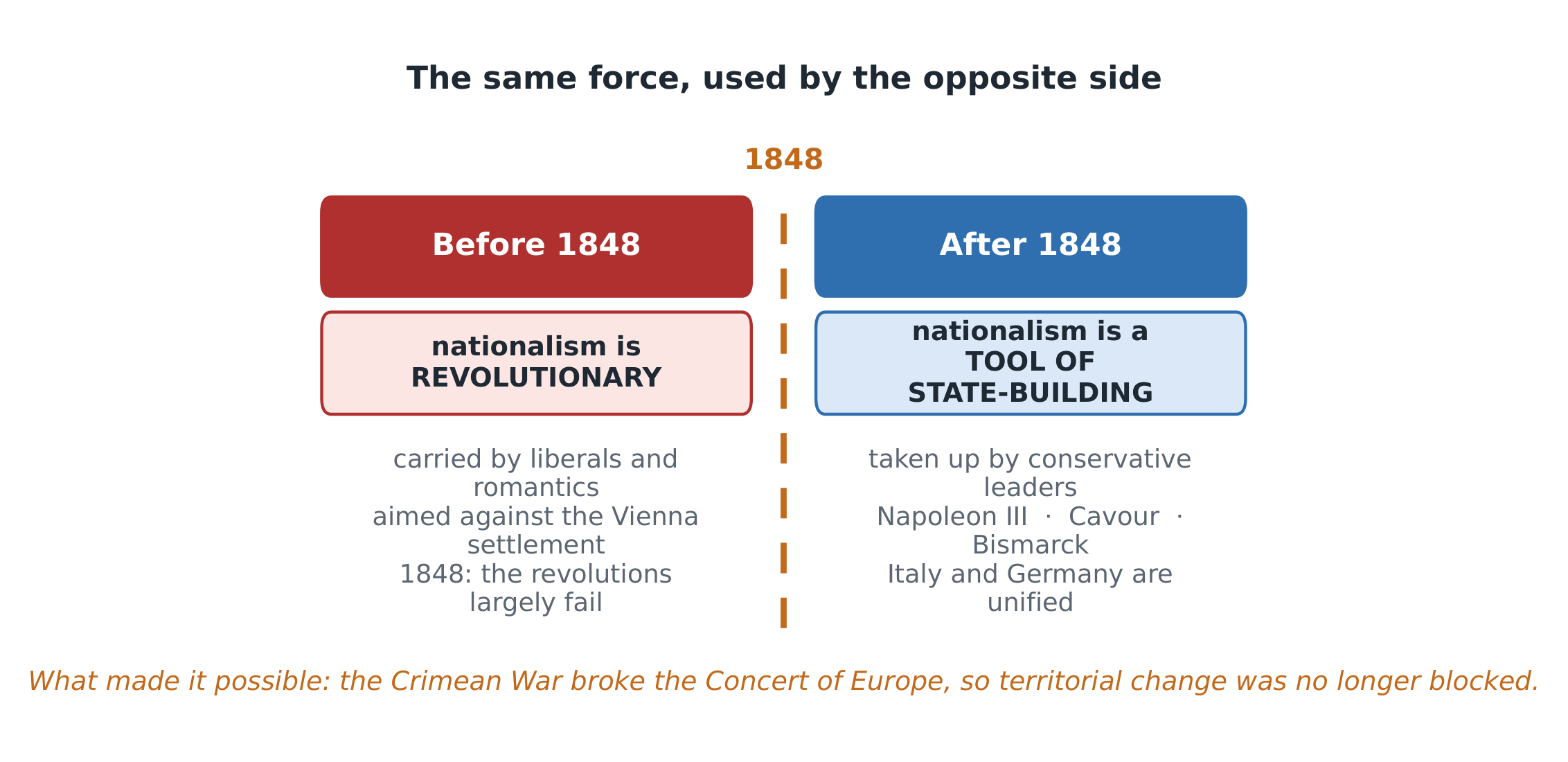
1848 年之前民族主义威胁着既有秩序;1848 年之后保守派用它来建国

民族主义者以多种方式鼓励对民族的忠诚,包括浪漫主义理想(romantic idealism)、自由主义改革、政治统一与种族主义——因此民族主义并无单一的政治色彩,可以依附于极为不同的纲领。

最重要的转折是:新一代保守派领袖,包括拿破仑三世(Napoleon III)、加富尔(Cavour)与俾斯麦(Bismarck),借助民众民族主义来创建或强化国家(used popular nationalism to create or strengthen states)。1848 年之前,民族主义主要是对维也纳安排的革命性威胁;1848 年之后,它成为保守派手中建国的工具。如果本单元只记住一件事,那就记住这一逆转。

另有两点在考查范围内:

  • 十九世纪西欧犹太人在社会与政治上日益融入,而作为犹太民族主义形式的犹太复国主义(Zionism)则因持续的排斥而兴起。
  • 奥匈二元帝国(dual monarchy of Austria-Hungary)的建立承认了最大族群少数派的政治权力,这是在多民族帝国内部管理而非压制民族主义的尝试。
词汇表 训练
英文 中文 拼音
romantic idealism 浪漫主义理想 làng màn zhǔ yì lǐ xiǎng
Napoleon III 拿破仑三世 ná pò lún sān shì
Cavour 加富尔 jiā fù ěr
Bismarck 俾斯麦 bǐ sī mài
used popular nationalism to create or strengthen states 借助民众民族主义建国 jiè zhù mín zhòng mín zú zhǔ yì jiàn guó
Zionism 犹太复国主义 yóu tài fù guó zhǔ yì
dual monarchy of Austria-Hungary 奥匈二元帝国 ào xiōng èr yuán dì guó
7.3

民族统一与外交紧张

大纲

7.3 National Unification and Diplomatic Tensions

Thematic FocusLearning ObjectiveHistorical Developments

SOP
States and Other Institutions of Power — European states and nations developed governmental and civil institutions from 1450 to the present to organize society and consolidate political power, with a variety of social, cultural, and economic effects.

Unit 7.C
Explain the factors that resulted in Italian unification and German unification.

  • KC-3.4.II.A The Crimean War demonstrated the weakness of the Ottoman Empire and contributed to the breakdown of the Concert of Europe, thereby creating the conditions in which Italy and Germany could be unified after centuries of fragmentation.
  • KC-3.4.III.A Cavour’s diplomatic strategies, combined with the popular Garibaldi’s military campaigns, led to the unification of Italy.
  • KC-3.4.III.B Bismarck used Realpolitik, employing diplomacy, industrialized warfare, weaponry, and the manipulation of democratic mechanisms to unify Germany.

Unit 7.D
Explain how nationalist sentiment and political alliances led to tension between and among European powers from 1815 to 1914.

  • KC-3.4.III.C After 1871, Bismarck attempted to maintain the balance of power through a complex system of alliances directed at isolating France.
  • KC-3.4.III.D Bismarck’s dismissal in 1890 eventually led to a system of mutually antagonistic alliances and heightened international tensions.
  • KC-3.4.III.E Nationalist tensions in the Balkans drew the Great Powers into a series of crises, leading up to World War I.

Illustrative examples:

  • Bismarck’s alliances: §Bullet Three Emperors’ League §Bullet Triple Alliance §Bullet Reinsurance Treaty Nationalist tensions in the Balkans: §Bullet Congress of Berlin in 1878 §Bullet Growing influence of Serbia §Bullet Bosnia-Herzegovina annexation crisis (1908) §Bullet First Balkan War §Bullet Second Balkan War

来源:美国大学理事会 AP 课程与考试说明

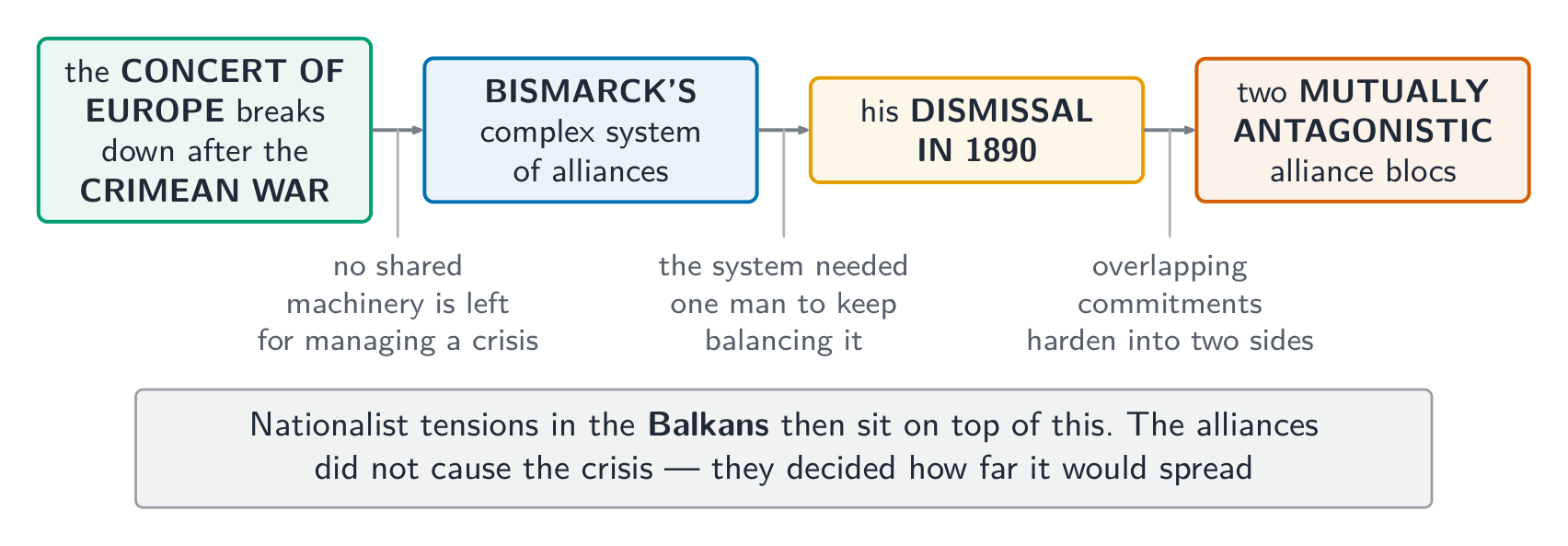
克里米亚战争(Crimean War)暴露了奥斯曼帝国的虚弱,并促成了欧洲协调的瓦解(breakdown of the Concert of Europe)——正是这一瓦解使统一成为可能,因为那个为阻止领土变更而设计的体系已不再运转。

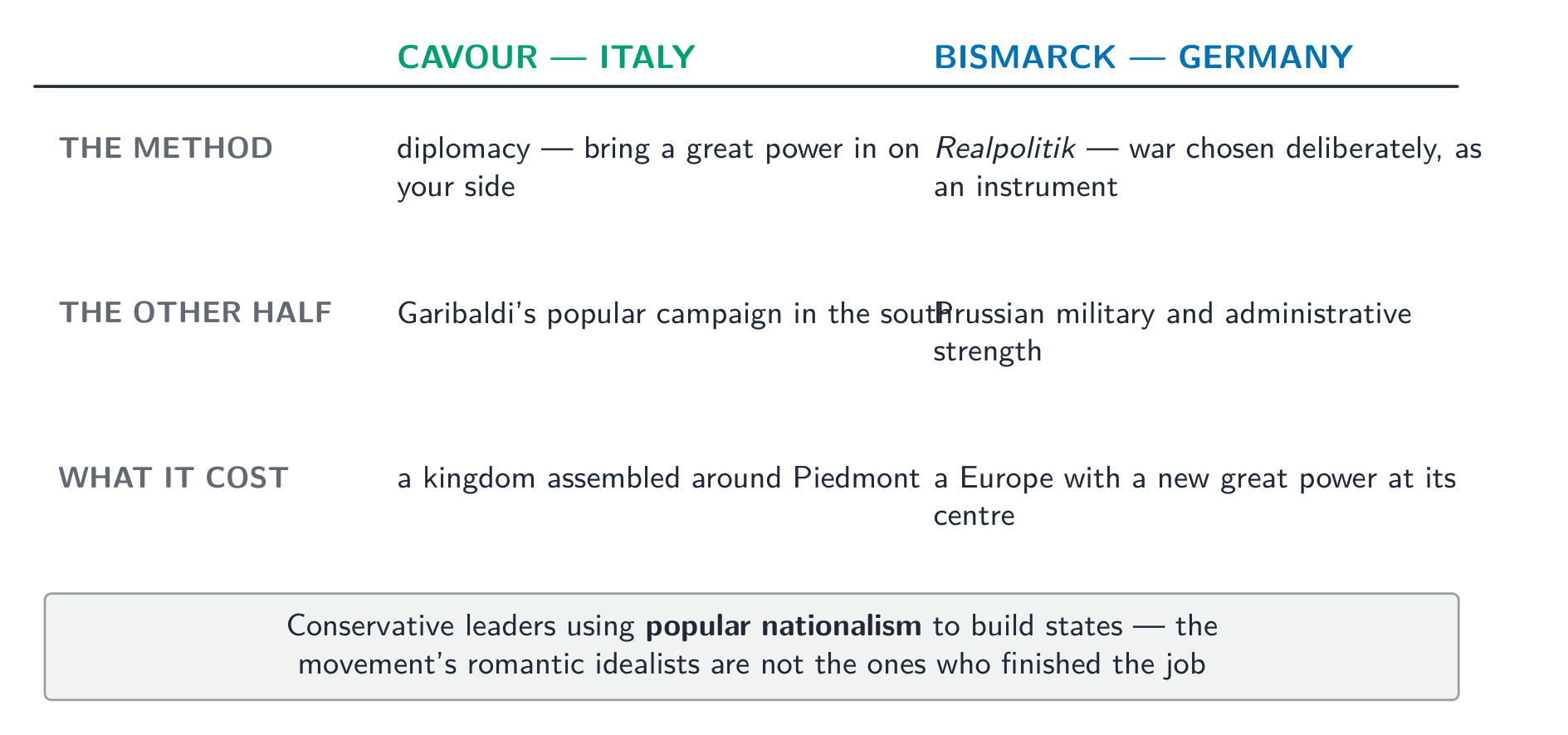
  • 意大利:加富尔的外交策略加上加里波第(Garibaldi)广受拥戴的军事行动,促成了统一。外交加民众运动——两种机制,CED 把两者都点了名。
  • 德国:俾斯麦运用现实政治(Realpolitik),以外交、工业化战争与武器以及对民主机制的操纵,实现了普鲁士主导下的统一。

随后的外交后果直接通向第八单元:

  • 1871 年后,俾斯麦试图通过旨在孤立法国的复杂联盟体系(system of alliances)维持均势。
  • 俾斯麦 1890 年被免职,最终造成了彼此敌对的联盟(mutually antagonistic alliances)体系与国际紧张的加剧。
  • 巴尔干(Balkans)的民族主义紧张把列强卷入一连串危机,直至第一次世界大战。
词汇表 训练
英文 中文 拼音
Crimean War 克里米亚战争 kè lǐ mǐ yà zhàn zhēng
breakdown of the Concert of Europe 欧洲协调的瓦解 ōu zhōu xié tiáo de wǎ jiě
Garibaldi's 加里波第 jiā lǐ bō dì
Bismarck used Realpolitik 现实政治 xiàn shí zhèng zhì
complex system of alliances 联盟体系 lián méng tǐ xì
mutually antagonistic alliances 彼此敌对的联盟 bǐ cǐ dí duì de lián méng
Nationalist tensions in the Balkans 巴尔干 bā ěr gàn
7.4

达尔文主义与社会达尔文主义

大纲

7.4 Darwinism, Social Darwinism

Thematic FocusLearning ObjectiveHistorical Developments

TSI
Technological and Scientific Innovation — Scientific and technological innovations have increased efficiency, improved daily life, and shaped human development and interactions, having both intended and unintended consequences.

Unit 7.E
Explain how Darwin’s theories influenced scientific and social developments from 1815 to 1914.

  • KC-3.6.II.B Charles Darwin provided a scientific and material account of biological change and the development of human beings as a species, and inadvertently, a justification for racialist theories that became known as Social Darwinism.

来源:美国大学理事会 AP 课程与考试说明

达尔文(Charles Darwin)提供了关于生物变化以及人类作为一个物种之发展的科学与唯物的解释

他的理论随后被远远应用到生物学之外。社会达尔文主义(Social Darwinism)取用竞争与选择的语言,用以为种族、民族与阶级等级辩护——在下一节中,也为帝国扩张辩护。在论述题中要把这一区分保持清晰:达尔文的生物学与社会达尔文主义并非同一主张,后者也并不由前者推出。

词汇表 训练
英文 中文 拼音
Charles Darwin 达尔文 dá ěr wén
Social Darwinism 社会达尔文主义 shè huì dá ěr wén zhǔ yì
7.5

进步与现代性的时代

大纲

7.5 The Age of Progress and Modernity

Thematic FocusLearning ObjectiveHistorical Developments

TSI
Technological and Scientific Innovation — Scientific and technological innovations have increased efficiency, improved daily life, and shaped human development and interactions, having both intended and unintended consequences.

Unit 7.F
Explain how science and other intellectual disciplines developed and changed throughout the period from 1815 to 1914.

  • KC-3.6.II.A Positivism, or the philosophy that science alone provides knowledge, emphasized the rational and scientific analysis of nature and human affairs.
  • KC-3.6.III In the later 19th century, a new relativism in values and the loss of confidence in the objectivity of knowledge led to modernism in intellectual and cultural life.
    • KC-3.6.III.A Philosophy largely moved from rational interpretations of nature and human society to an emphasis on irrationality and impulse, a view that contributed to the belief that conflict and struggle led to progress.
    • KC-3.6.III.B Freudian psychology offered a new account of human nature that emphasized the role of the irrational and the struggle between the conscious and subconscious.
    • KC-3.6.III.C Developments in the natural sciences, such as quantum mechanics and Einstein’s theory of relativity, undermined the primacy of Newtonian physics as an objective description of nature.

Illustrative examples:

  • Philosophers who emphasized the irrational: §Bullet Friedrich Nietzsche §Bullet Georges Sorel §Bullet Henri Bergson Scientists who undermined the notion that Newtonian physics provided an objective knowledge of nature: §Bullet Max Planck

来源:美国大学理事会 AP 课程与考试说明

实证主义(positivism)——即认为唯有科学提供知识的哲学——强调对自然与人事的理性与科学分析,代表着这个世纪思想中自信的一极。

随后,在十九世纪后期,一种新的价值相对主义(relativism in values)与对知识客观性的信心丧失,导向了现代主义(modernism)。两者合起来正是 7.1 中所说的张力:同一种文化既产生了科学将解释一切的信念,也产生了客观性本身或许只是幻象的怀疑。

词汇表 训练
英文 中文 拼音
Positivism 实证主义 shí zhèng zhǔ yì
new relativism in values 价值相对主义 jià zhí xiāng duì zhǔ yì
modernism 现代主义 xiàn dài zhǔ yì
7.6

新帝国主义:动机与手段

大纲

7.6 New Imperialism: Motivations and Methods

Thematic FocusLearning ObjectiveHistorical Developments

TSI
Technological and Scientific Innovation — Scientific and technological innovations have increased efficiency, improved daily life, and shaped human development and interactions, having both intended and unintended consequences.

Unit 7.G
Explain the motivations that led to European imperialism in the period from 1815 to 1914.

  • KC-3.5.I European nations were driven by economic, political, and cultural motivations in their new imperial ventures in Asia and Africa.
    • KC-3.5.I.A European national rivalries and strategic concerns fostered imperial expansion and competition for colonies.
    • KC-3.5.I.B The search for raw materials and markets for manufactured goods, as well as strategic and nationalistic considerations, drove Europeans to colonize Africa and Asia, even as European colonies in the Americas broke free politically, if not economically.
    • IKC-3.5.I.C European imperialists justified overseas expansion and rule by claiming cultural and racial superiority.

Unit 7.H
Explain how technological advances enabled European imperialism from 1815 to 1914.

  • KC-3.5.II.A The development of advanced weaponry ensured the military advantage of Europeans over colonized areas.
  • KC-3.5.II.B Communication and transportation technologies facilitated the creation and expansion of European empires.
  • KC-3.5.II.C Advances in medicine enabled European survival in Africa and Asia.

Illustrative examples:

  • Ideas of cultural and racial superiority: §Bullet “The White Man’s Burden” §Bullet Mission civilisatrice §Bullet Social Darwinism Advanced weaponry: §Bullet Minié ball (bullet) §Bullet Breech-loading rifle §Bullet Machine gun Communication and transportation technologies: §Bullet Steamships
    • Telegraph
    • Photography
  • Advances in medicine: §Bullet Louis Pasteur’s germ theory of disease §Bullet Anesthesia and antiseptics §Bullet Public health projects §Bullet Quinine

来源:美国大学理事会 AP 课程与考试说明

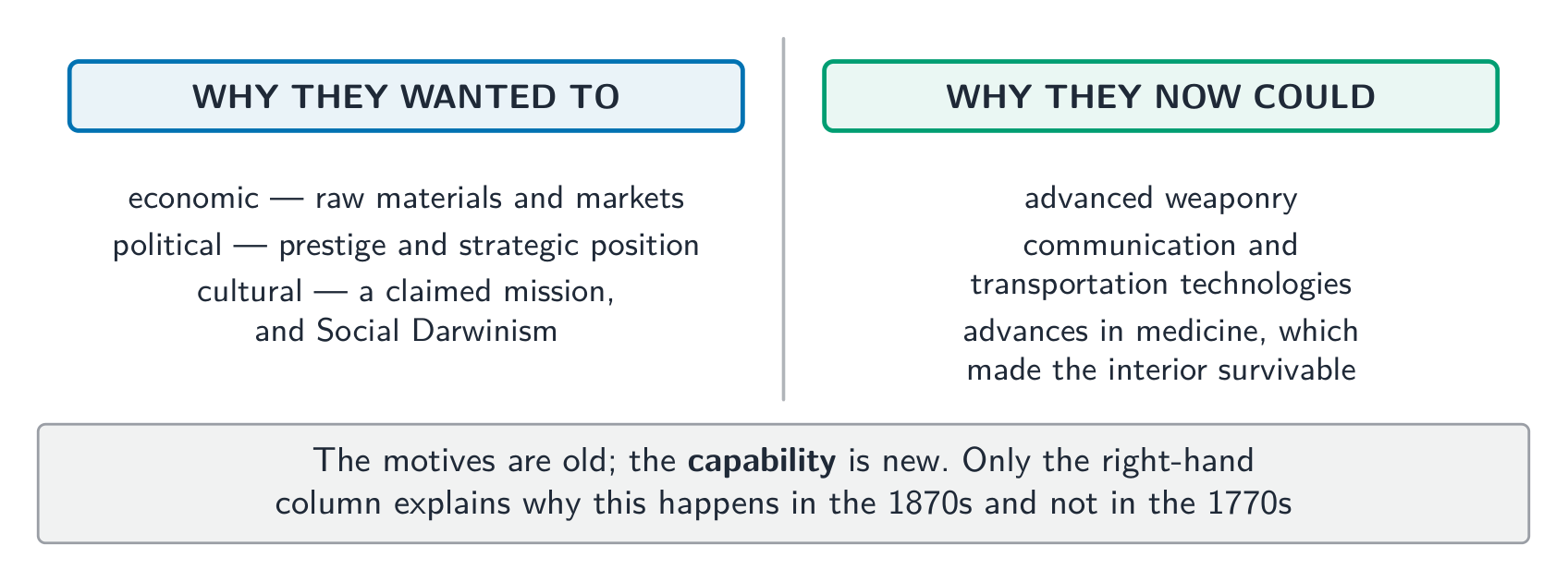
欧洲各国在亚洲与非洲的新帝国事业中受经济、政治与文化动机(economic, political, and cultural motivations)驱动。

CED 随后单独给出了使之成为可能的技术,恰好三项:

  • 先进武器确保了欧洲对被殖民地区的军事优势。
  • 通信与运输技术(communication and transportation technologies)使帝国得以建立与治理。
  • 医学进步(advances in medicine)使欧洲人得以在非洲与亚洲生存——这是学生最常遗忘的一项,而它往往是决定性的。
词汇表 训练
英文 中文 拼音
economic, political, and cultural motivations 经济、政治与文化动机 jīng jì 、 zhèng zhì yǔ wén huà dòng jī
Communication and transportation technologies 通信与运输技术 tōng xìn yǔ yùn shū jì shù
Advances in medicine 医学进步 yī xué jìn bù
7.7

帝国主义的全球影响

大纲

7.7 Imperialism’s Global Effects

Thematic FocusLearning ObjectiveHistorical Developments

INT
Interaction of Europe and the World — Motivated by a variety of factors, Europe’s interaction with the world led to political, economic, social, and cultural exchanges that influenced both European and non-European societies.

Unit 7.I
Explain how European imperialism affected both European and non-European societies.

  • KC-3.5.III Imperial endeavors significantly affected society, diplomacy, and culture in Europe and created resistance to foreign control abroad.
    • KC-3.5.III.A Imperialism created diplomatic tensions among European states that strained alliance systems.
    • KC-3.5.III.B Imperial encounters with non-European peoples influenced the styles and subject matter of artists and writers and provoked debate over the acquisition of colonies.
    • KC-3.5.III.C Especially as non-Europeans became educated in Western values, they challenged European imperialism through nationalist movements and by modernizing local economies and societies.

Illustrative examples:

  • Diplomatic tensions: §Bullet Berlin Conference (1884–1885) §Bullet Fashoda crisis (1898) §Bullet Moroccan crises (1905, 1911) Participants in the imperialism debate: §Bullet Pan-German League §Bullet J. A. Hobson’s and Vladimir Lenin’s anti-imperialism §Bullet Congo Reform Association Responses to European imperialism: §Bullet Indian Congress Party §Bullet Zulu Resistance §Bullet India’s Sepoy Mutiny §Bullet China’s Boxer Rebellion §Bullet Japan’s Meiji Restoration

来源:美国大学理事会 AP 课程与考试说明

帝国事业显著影响了欧洲的社会、外交与文化,并在海外造成了对外来控制的抵抗

两个方向都重要。在欧洲,帝国助长了民族主义,塑造了大众文化,并把殖民地争端变成了列强危机。在海外,它引发了有组织的抵抗。把帝国主义写成欧洲单方面施加于他处、既无回流影响也无回应的答案,在这两点上都不完整。

7.8

19世纪的文化与艺术

大纲

7.8 19th-Century Culture and Arts

Thematic FocusLearning ObjectiveHistorical Developments

CID
Cultural and Intellectual Developments — The creation and transmission of knowledge, including the relationship between traditional sources of authority and the development of differing world views, had significant political, intellectual, economic, cultural, and social effects on European and world societies.

Unit 7.J
Explain the continuities and changes in European artistic expression from 1815 to 1914.

  • KC-3.6.I Romanticism broke with Neoclassical forms of artistic representation and with rationalism, placing more emphasis on intuition and emotion.
  • KC-3.6.I.A Romantic artists and composers broke from classical artistic forms to emphasize emotion, nature, individuality, intuition, the supernatural, and national histories in their works.
  • KC-3.6.I.B Romantic writers expressed similar themes while responding to the Industrial Revolution and to various political revolutions.
  • KC-3.6.II.D Realist and materialist themes and attitudes influenced art and literature as painters and writers depicted the lives of ordinary people and drew attention to social problems.
  • KC-3.6.III.D Modern art, including Impressionism, Post-Impressionism, and Cubism, moved beyond the representational to the subjective, abstract, and expressive and often provoked audiences that believed that art should reflect shared and idealized values, including beauty and patriotism.

Illustrative examples:

  • Romantic artists: §Bullet Francisco Goya §Bullet Caspar David Friedrich §Bullet J. M. W. Turner §Bullet John Constable §Bullet Eugène Delacroix Romantic composers: §Bullet Ludwig van Beethoven §Bullet Frédéric Chopin §Bullet Richard Wagner §Bullet Pyotr Ilyich Tchaikovsky Romantic writers: §Bullet Johann Wolfgang von Goethe §Bullet William Wordsworth §Bullet Lord Byron §Bullet Percy Shelley §Bullet John Keats §Bullet Mary Shelley §Bullet Victor Hugo Realist artists and authors: §Bullet Honoré de Balzac §Bullet Honoré Daumier §Bullet Charles Dickens §Bullet George Eliot (Mary Ann Evans) §Bullet Gustave Courbet §Bullet Fyodor Dostoevsky §Bullet Jean-François Millet §Bullet Leo Tolstoy §Bullet Émile Zola §Bullet Thomas Hardy (CONT’D) Modern artists: §Bullet Claude Monet §Bullet Paul Cézanne §Bullet Henri Matisse §Bullet Edgar Degas §Bullet Pablo Picasso §Bullet Vincent Van Gogh

来源:美国大学理事会 AP 课程与考试说明

这个世纪的艺术精确地对应着它的思想张力:

  • 浪漫主义打破了新古典的形式与理性主义,强调直觉、情感、自然、个体性与超自然;浪漫主义作家在回应工业革命与政治革命的同时表达了同样的主题。
  • 现实主义与唯物主义(realist and materialist)的主题影响了艺术与文学,画家与作家开始描绘普通人的生活
  • 现代艺术——印象派、后印象派与立体主义(Impressionism, Post-Impressionism, and Cubism)——越出再现,走向主观、抽象与表现
词汇表 训练
英文 中文 拼音
Realist and materialist 现实主义与唯物主义 xiàn shí zhǔ yì yǔ wéi wù zhǔ yì
Impressionism, Post-Impressionism, and Cubism 印象派、后印象派与立体主义 yìn xiàng pài 、 hòu yìn xiàng pài yǔ lì tǐ zhǔ yì
7.9

19世纪思想观念与政治发展中的因果关系

大纲

7.9 Causation in 19th-Century Perspectives and Political Developments

Learning ObjectiveReview: Unit 7 Key Concepts

Unit 7.K
Explain the influence of nationalist and imperialist movements on European and global stability.

  • KC-3.4 European states struggled to maintain international stability in an age of nationalism and revolutions.
    • KC-3.4.II The breakdown of the Concert of Europe opened the door for movements of national unification in Italy and Germany as well as liberal reforms elsewhere.
    • KC-3.4.III The unification of Italy and Germany transformed the European balance of power and led to efforts to construct a new diplomatic order.
  • KC-3.5 A variety of motives and methods led to the intensification of European global control and increased tensions among the Great Powers.
    • KC-3.5.II Industrial and technological developments (e.g., the second industrial revolution) facilitated European control of global empires.
  • KC-3.6 European ideas and culture expressed a tension between objectivity and scientific realism on one hand, and subjectivity and individual expression on the other.
    • KC-3.6.II Following the revolutions of 1848, Europe turned toward a realist and materialist worldview.

来源:美国大学理事会 AP 课程与考试说明

本单元考查的推理能力是因果关系

**Worked example(一道真实的 AP 考题)。本单元的 AP 欧洲史简答题会要求,例如「解释十九世纪民族主义促成德国或意大利统一的一种方式」。满分答案给出的是机制而非情绪:「俾斯麦把民众的民族主义情感用作普鲁士建国的工具:通过把对丹麦、奥地利与法国的战争呈现为民族事业,他使较小的德意志邦国的统治者在政治上无法抵制普鲁士主导的统一,从而把一次王朝扩张变成了一次民族统一。」注意其结构:要展示民族主义在做某件事,而不只是它存在着。

7.9

考试技巧

  • 这一逆转就是本单元:1848 年之前民族主义威胁秩序;1848 年之后保守派用它来建国
  • 克里米亚战争之后欧洲协调的瓦解是统一得以可能的原因。要把它点出为使之成为可能的条件。
  • 意大利同时需要加富尔的外交与加里波第的行动。德国需要俾斯麦的现实政治。机制不同,结果相同。
  • 给出帝国主义的三项使能技术——武器、运输与通信,以及医学
  • 达尔文社会达尔文主义分开。后者是对前者的一种使用,而不是它的结论。
  • 帝国主义既作用于海外也作用于欧洲,并且引发了抵抗。两者都在考查范围内。

本主题的互动课程

逐步学习,并即时检测练习。

AP 欧洲历史的更多主题

登录或创建账号

IGCSE, A-Level & AP