| English | 释义 | 拼音 |
|---|---|---|
| Concert of Europe/ˈkɒnsət ɒv ˈjʊərəp/ | 欧洲协调 | ōu zhōu xié tiáo |
| alliance system/əˈlaɪəns ˈsɪstəm/ | 同盟体系 | tóng méng tǐ xì |
| New Imperialism | 新帝国主义 | xīn dì guó zhǔ yì |
Dividing Africa in Berlin, 1884–85
- From November 1884 to February 1885, diplomats from fourteen countries met in Berlin to agree rules for claiming African territory. No African was invited. In 1880 Europeans controlled about a tenth of Africa; by 1914 they controlled about nine-tenths.
- Between 1815 and 1914, Europe kept peace among its great powers for long periods, built vast empires, and began to doubt its own certainties.
Europeans controlled about one-tenth of Africa in 1880 and about nine-tenths by 1914. By how many percentage points did their share rise?
难度 2/5 · 今日首次完成可获 140 金币及少量额外奖励
90% − 10%.
The Concert of Europe
- After Napoleon, the great powers met in congresses to keep the peace and stop revolutions — the Concert of Europe 欧洲协调.
- It broke down with the Crimean War (1853–56) and the wars that unified Italy and Germany.
What was the Concert of Europe?
难度 1/5 · 今日首次完成可获 100 金币及少量额外奖励
After 1815.
Bismarck's alliances
- After unifying Germany in 1871, Bismarck built an alliance system 同盟体系 to isolate France: the Dual Alliance with Austria-Hungary (1879), the Triple Alliance with Italy (1882) and a treaty with Russia.
- After Wilhelm II dismissed him in 1890, Germany dropped the Russian treaty. France and Russia allied in 1894, and Britain joined them in the Triple Entente (1907).
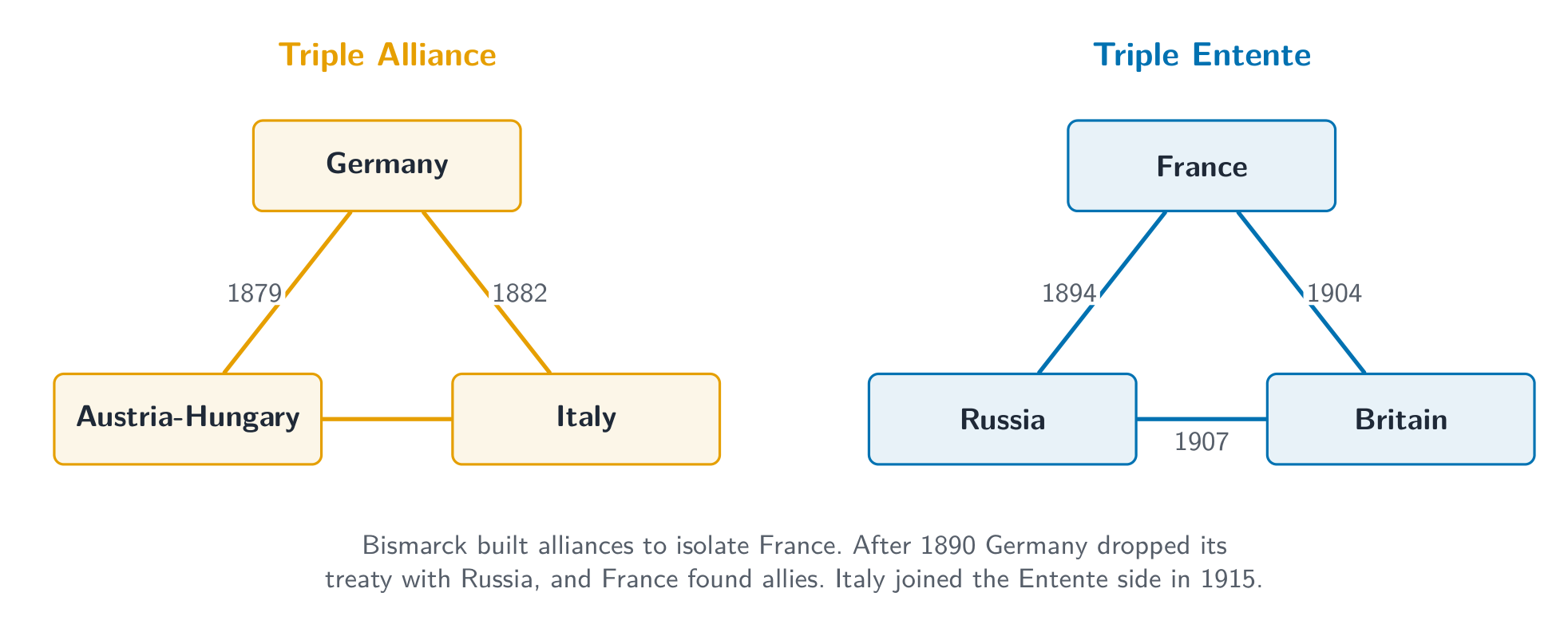
Match each alliance to its year.
难度 2/5 · 今日首次完成可获 140 金币及少量额外奖励
Two blocs formed.
What was the main aim of Bismarck's alliances?
难度 1/5 · 今日首次完成可获 100 金币及少量额外奖励
France wanted revenge after 1871.
Worked example: a contextualization paragraph
Prompt: Explain the context for the outbreak of the First World War.
- Diplomacy: the Concert of Europe had given way to two armed blocs — the Triple Alliance and the Triple Entente.
- Empire: the New Imperialism 新帝国主义 of the 1880s–1900s, from the Berlin Conference to the Moroccan crises of 1905 and 1911, made rivalry global.
- Nationalism: Balkan nationalism threatened Austria-Hungary. In this setting, a single assassination in Sarajevo in 1914 could pull every power into war.
属于第7单元的哪个主线?
Sort each statement into its thread.
Empire
- Europeans took control of most of Africa and much of Asia, using steamships, railways, quinine against malaria and the machine gun.
- Imperial rivalry fed tension between the powers.
Which helped Europeans conquer Africa?
难度 2/5 · 今日首次完成可获 140 金币及少量额外奖励
Tools of empire.
Ideas and doubt
- Many Europeans trusted science and progress: positivists believed science alone gave true knowledge.
- But Darwin (1859), Freud's theories of the unconscious and Einstein's relativity (1905) shook older certainties, and modern artists rejected traditional forms.
The long peace was not one system. Until the 1850s it rested on congresses of the powers; after 1871 it rested on rival alliances. A balance between two blocs failed differently from a concert of all.
Peace in Europe from 1815 to 1914 rested on the same system throughout.
难度 1/5 · 今日首次完成可获 100 金币及少量额外奖励
Concert first, alliances later.
The Concert of Europe kept peace after 1815 but broke down by the 1850s. Bismarck's alliances isolated France until 1890; afterwards Europe split into two armed blocs. The New Imperialism spread European rule over most of Africa and Asia, while new science and art unsettled faith in reason and progress.
Explain how European diplomacy changed between 1815 and 1914.
Change over time.