| English | 释义 | 拼音 |
|---|---|---|
| nationalism/ˈnæʃənəlɪzəm/ | 民族主义 | mín zú zhǔ yì |
| Realpolitik/ˈrɪəlpəlɪtɪk/ | 现实政治 | xiàn shí zhèng zhì |
| Zionism/ˈzaɪənɪzəm/ | 犹太复国主义 | yóu tài fù guó zhǔ yì |
| Dual Monarchy | 二元君主国 | èr yuán jūn zhǔ guó |
An empire proclaimed at Versailles, 1871
- On 18 January 1871, while German armies besieged Paris, the king of Prussia was proclaimed German Emperor in the Hall of Mirrors at Versailles — the palace of the French kings. A single German state now existed for the first time, created not by revolution but by a conservative king, his chief minister Otto von Bismarck and three wars.
- Nationalism 民族主义 — loyalty to a nation — became the most powerful political force of the nineteenth century.
Building loyalty
- Romantic writers celebrated each nation's language, folk tales and history: the Grimm brothers collected German tales (1812); Giuseppe Mazzini founded Young Italy (1831) to unite Italy as a republic.
- Schools, national anthems, flags and newspapers taught people to see themselves as French, German or Italian.
The dangerous end
- Some nationalism turned into chauvinism — belief in one's own nation's superiority — and racism.
- Antisemitism grew: in the Dreyfus Affair (1894–1906), a Jewish French army officer was falsely convicted of spying, dividing France for a decade.
What did the Dreyfus Affair reveal?
难度 1/5 · 今日首次完成可获 100 金币及少量额外奖励
A Jewish officer falsely convicted.
Worked example: how Italy and Germany were unified
- Italy: Count Cavour of Piedmont-Sardinia used alliances with France and war against Austria (1859); Giuseppe Garibaldi's "Thousand" volunteers took Sicily and Naples (1860). The Kingdom of Italy was proclaimed in 1861.
- Germany: Bismarck, practising Realpolitik 现实政治 — politics of power, not ideals — promised to unite Germany by "blood and iron". Wars against Denmark (1864), Austria (1866) and France (1870–71) united the German states under Prussia.
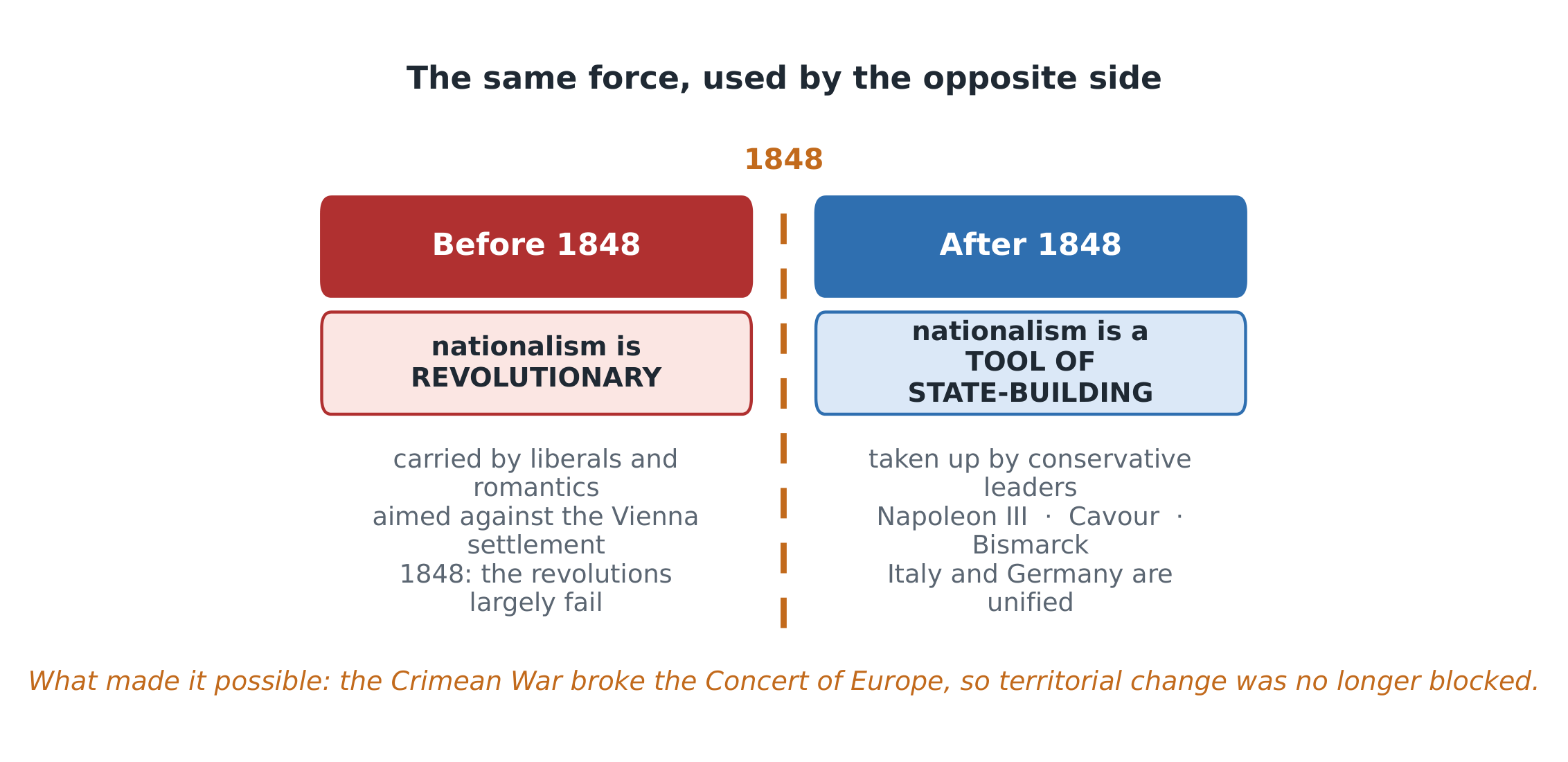
- Comparison: both were led by conservative monarchies using war and diplomacy, not by the liberal revolutionaries of 1848.
A method, a response, or a state strategy?
Sort each element of nineteenth-century nationalism.
Match each leader to his role.
难度 2/5 · 今日首次完成可获 140 金币及少量额外奖励
Two unifications.
Put Bismarck's wars in order.
难度 3/5 · 今日首次完成可获 200 金币及少量额外奖励
1864, 1866, 1870–71.
What is Realpolitik?
难度 1/5 · 今日首次完成可获 100 金币及少量额外奖励
Bismarck's approach.
A Jewish national response
- Facing antisemitism, Theodor Herzl wrote The Jewish State (1896) and organized the First Zionist Congress in Basel (1897).
- Zionism 犹太复国主义 aimed to create a Jewish homeland in Palestine.
Theodor Herzl organized the First Zionist Congress in 1897.
难度 1/5 · 今日首次完成可获 100 金币及少量额外奖励
In Basel.
Reshaping a multinational empire
- The Habsburg Empire contained Germans, Hungarians, Czechs, Poles, Croats and many others.
- After defeat by Prussia, the Compromise of 1867 created the Dual Monarchy 二元君主国 of Austria-Hungary, giving Hungarians control of their half — but not satisfying the Slavic peoples.
Nationalism changed sides during the century. Before 1848 it was a radical, liberal threat to conservative rulers. After 1848, conservatives such as Cavour and Bismarck used it to build and strengthen their states.
Nationalism was always a liberal force opposed by conservatives.
难度 1/5 · 今日首次完成可获 100 金币及少量额外奖励
Conservatives used it after 1848.
Nationalism grew through romantic culture, schools and symbols. Conservative leaders used it to unify Italy (1861) and Germany (1871) through war and diplomacy, while Austria-Hungary reorganized around it. In its extreme forms it fed chauvinism and antisemitism, to which Zionism was one response.
Compare the unifications of Italy and Germany.
Comparison.