| English | 释义 | 拼音 |
|---|---|---|
| Realpolitik/ˈrɪəlpəlɪtɪk/ | 现实政治 | xiàn shí zhèng zhì |
An edited telegram, 13 July 1870
- On 13 July 1870, the King of Prussia sent Bismarck a telegram from the spa town of Ems describing a polite meeting with the French ambassador. Bismarck shortened it so that it seemed the king had insulted the ambassador, and gave it to the press. French newspapers demanded war; France declared war on 19 July. Bismarck had the war he wanted — and France looked like the aggressor.
- Between 1853 and 1914, wars unified Italy and Germany, and new alliances divided Europe into two armed camps.
Why did Bismarck edit the Ems telegram?
难度 1/5 · 今日首次完成可获 100 金币及少量额外奖励
France looked like the aggressor.
A war that cleared the ground
- In the Crimean War (1853–56), Britain, France and Piedmont-Sardinia fought Russia. Austria stayed neutral, which angered Russia.
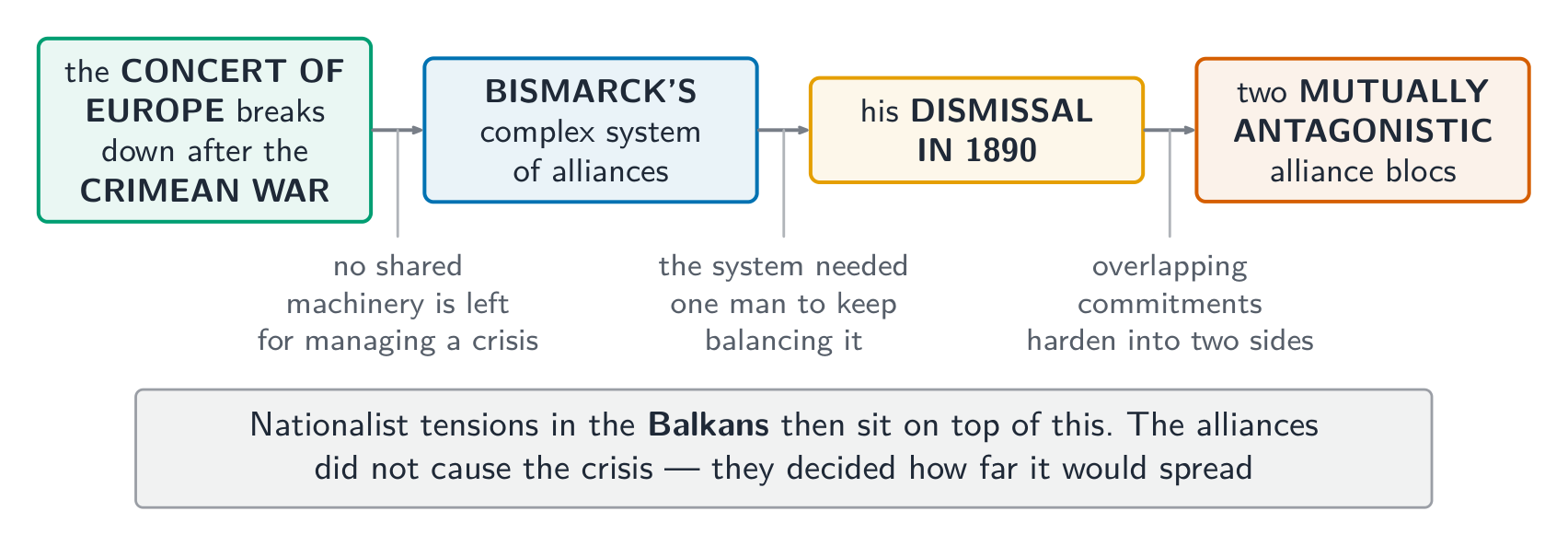
- The Concert of Europe was broken: the conservative powers no longer stood together, which gave Piedmont and Prussia room to act.
The Crimean War broke the unity of the conservative powers.
难度 1/5 · 今日首次完成可获 100 金币及少量额外奖励
Austria's neutrality angered Russia.
Italy: diplomacy and campaigns
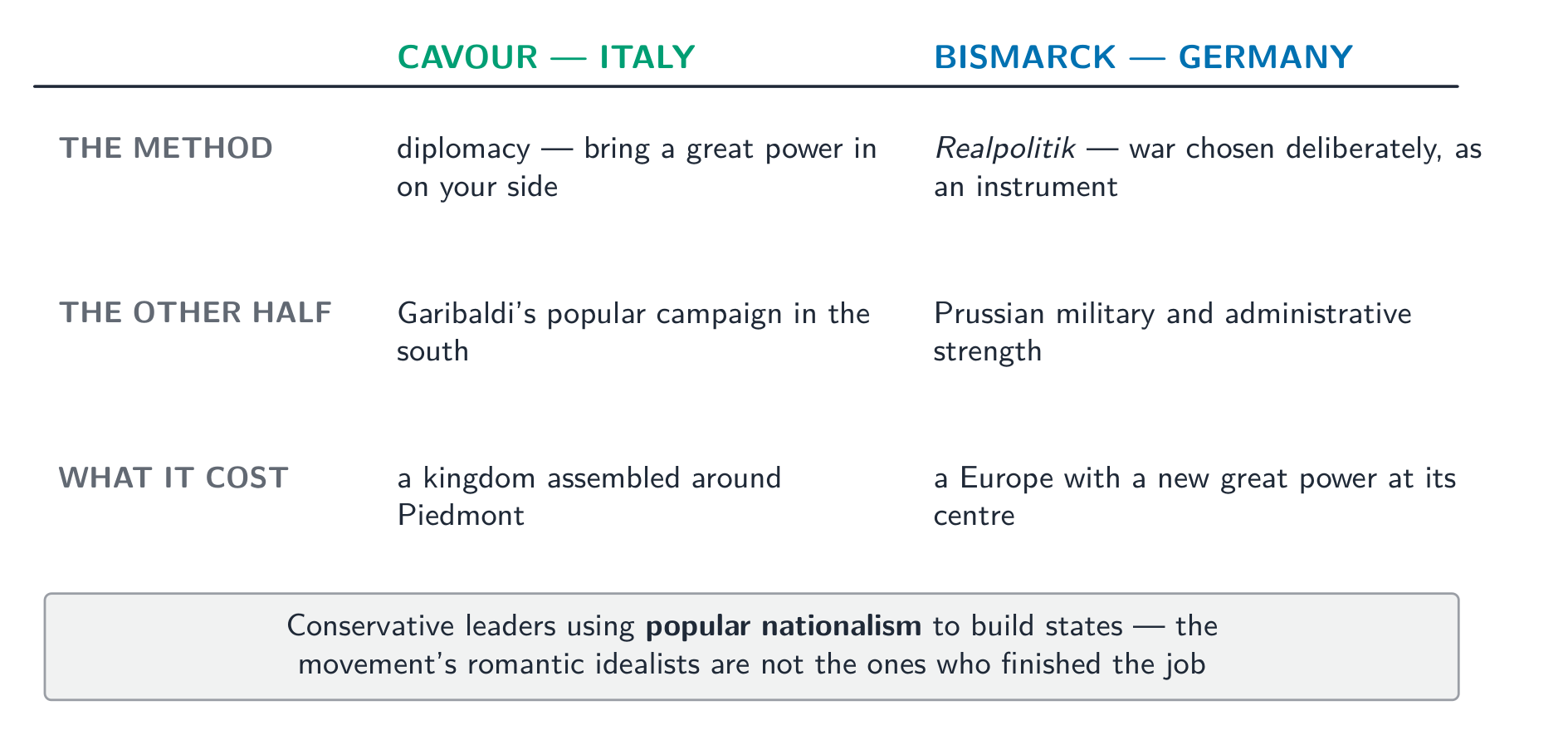
- Piedmont's prime minister Cavour won French help in a secret deal (1858); together they defeated Austria in 1859. In 1860, Garibaldi's 1000 volunteers conquered Sicily and Naples.
- The Kingdom of Italy was proclaimed in 1861; Venetia joined in 1866 and Rome in 1870.
Follow a peace system into two blocs
Bismarck's alliances were built to prevent a general war, and the turning point is a dismissal.
Worked example: Bismarck's Realpolitik
- The idea: Realpolitik 现实政治 — politics based on power and practical interests, not ideals.
- Three wars: against Denmark (1864) for Schleswig-Holstein; against Austria (1866), won at Königgrätz in seven weeks; against France (1870–71), provoked by the Ems telegram.
- The method: each war was short, isolated the enemy diplomatically and ended before other powers could intervene.
Put Bismarck's wars in order.
难度 3/5 · 今日首次完成可获 200 金币及少量额外奖励
1864, 1866, 1870–71.
What is Realpolitik?
难度 1/5 · 今日首次完成可获 100 金币及少量额外奖励
Bismarck's method.
Alliances, and their reversal
- Bismarck kept France isolated with the Dual Alliance with Austria (1879) and the Reinsurance Treaty with Russia (1887).
- After Kaiser Wilhelm II dismissed Bismarck in 1890, the Russian treaty lapsed. France and Russia allied in 1894, and Britain joined them in the Triple Entente (1907).
Match each alliance to its date.
难度 2/5 · 今日首次完成可获 140 金币及少量额外奖励
From Bismarck's system to two blocs.
The Balkans draw everyone in
- As the Ottoman Empire weakened, Austria-Hungary and Russia competed for influence in the Balkans. Austria annexed Bosnia in 1908, angering Serbia and Russia.
- The Balkan Wars of 1912–13 made Serbia larger and more confident — and Austria more afraid.
Bismarck did not plan every step. He took opportunities as they came. But he deliberately made each war look defensive and kept other powers out.
Bismarck planned every step of German unification in advance.
难度 1/5 · 今日首次完成可获 100 金币及少量额外奖励
He took opportunities.
The Crimean War broke the Concert of Europe. Cavour's diplomacy and Garibaldi's campaign unified Italy; Bismarck's Realpolitik and three short wars unified Germany. Bismarck's alliances kept France isolated, but after 1890 Europe split into two blocs, and Balkan rivalries drew them toward war.
Compare how Italy and Germany were unified.
Comparison.