跳到主要内容

科学、哲学与政治的发展

AP 欧洲历史 · 第 4 主题

训练
讲义 词汇表
4.1

科学革命与启蒙运动的时代背景

大纲

4.1 Contextualizing the Scientific Revolution and the Enlightenment

Learning ObjectivePreview: Unit 4 Key Concepts

Unit 4.A
Explain the context in which the Scientific Revolution and Enlightenment developed in Europe.

  • KC-1.1 The rediscovery of works from ancient Greece and Rome and observation of the natural world changed many Europeans’ view of their world.
    • KC-1.1.IV New ideas in science based on observation, experimentation, and mathematics challenged classical views of the cosmos, nature, and the human body, although existing traditions of knowledge and the universe continued.
  • KC-2.3 The spread of Scientific Revolution concepts and practices and the Enlightenment’s application of these concepts and practices to political, social, and ethical issues led to an increased but not unchallenged emphasis on reason in European culture.
    • KC-2.3.I Enlightenment thought, which focused on concepts such as empiricism, skepticism, human reason, rationalism, and classical sources of knowledge, challenged the prevailing patterns of thought with respect to social order, institutions of government, and the role of faith.
    • KC-2.3.II New public venues and print media popularized Enlightenment ideas.
    • KC-2.3.III New political and economic theories challenged absolutism and mercantilism.
    • KC-2.3.IV During the Enlightenment, the rational analysis of religious practices led to natural religion and the demand for religious toleration.
  • KC-2.4 The experiences of everyday life were shaped by demographic, environmental, medical, and technological changes.
    • KC-2.4.III By the 18th century, family and private life reflected new demographic patterns and the effects of the commercial revolution.

来源:美国大学理事会 AP 课程与考试说明

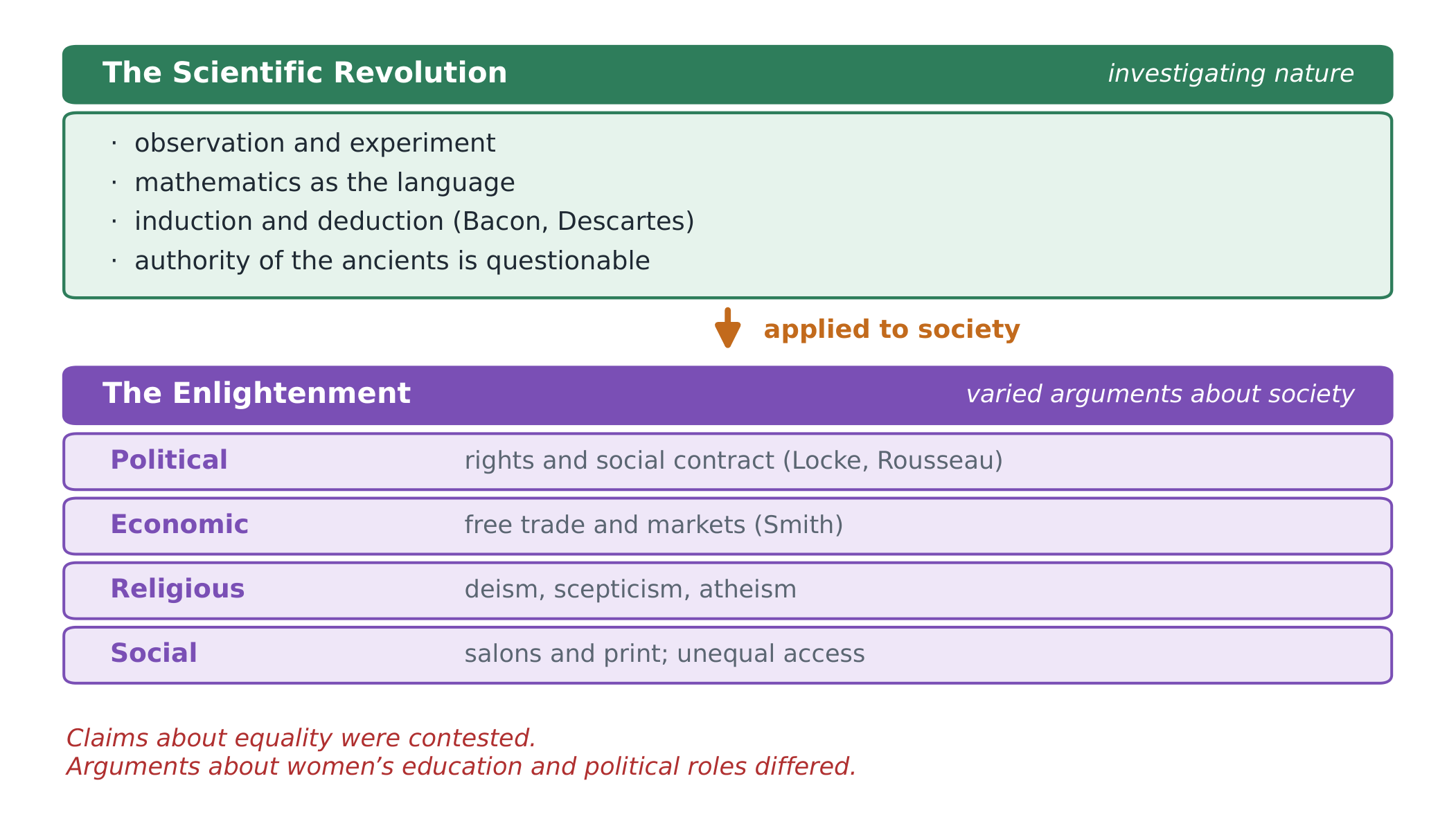
第四单元建立在一项论断之上,值得按 CED 自己的措辞来记:科学革命(Scientific Revolution)的概念与实践的传播,以及启蒙运动把这些概念与实践应用于政治、社会与伦理问题(political, social, and ethical issues),促成了关于个人相对于国家与社会之角色的辩论

这句话包含了整个单元。一种为研究自然而发展出来的方法被转用于人类制度,其结果是一整套关于政府对其治下人民负有何种义务的论证。

与之并行的是:日常经验受到人口、环境、医学与技术变化的塑造——这正是本单元把高深的思想史与人口统计、消费品并置的原因。

词汇表 训练
英文 中文 拼音
Scientific Revolution 科学革命 kē xué gé mìng
Enlightenment's application of those concepts and practices to political, social, and ethical issues 政治、社会与伦理问题 zhèng zhì 、 shè huì yǔ lún lǐ wèn tí
4.2

科学革命

大纲

4.2 The Scientific Revolution

Thematic FocusLearning ObjectiveHistorical Developments

TSI
Technological and Scientific Innovation — Scientific and technological innovations have increased efficiency, improved daily life, and shaped human development and interactions, having both intended and unintended consequences.

Unit 4.B
Explain how understanding of the natural world developed and changed during the Scientific Revolution and Enlightenment.

  • KC-1.1.IV.A New ideas and methods in astronomy led individuals, including Copernicus, Galileo, and Newton, to question the authority of the ancients and traditional knowledge, and to develop a heliocentric view of the cosmos.
  • KC-1.1.IV.B Anatomical and medical discoveries by physicians, including William Harvey, presented the body as an integrated system, challenging the traditional humoral theory of the body and of disease espoused by Galen.
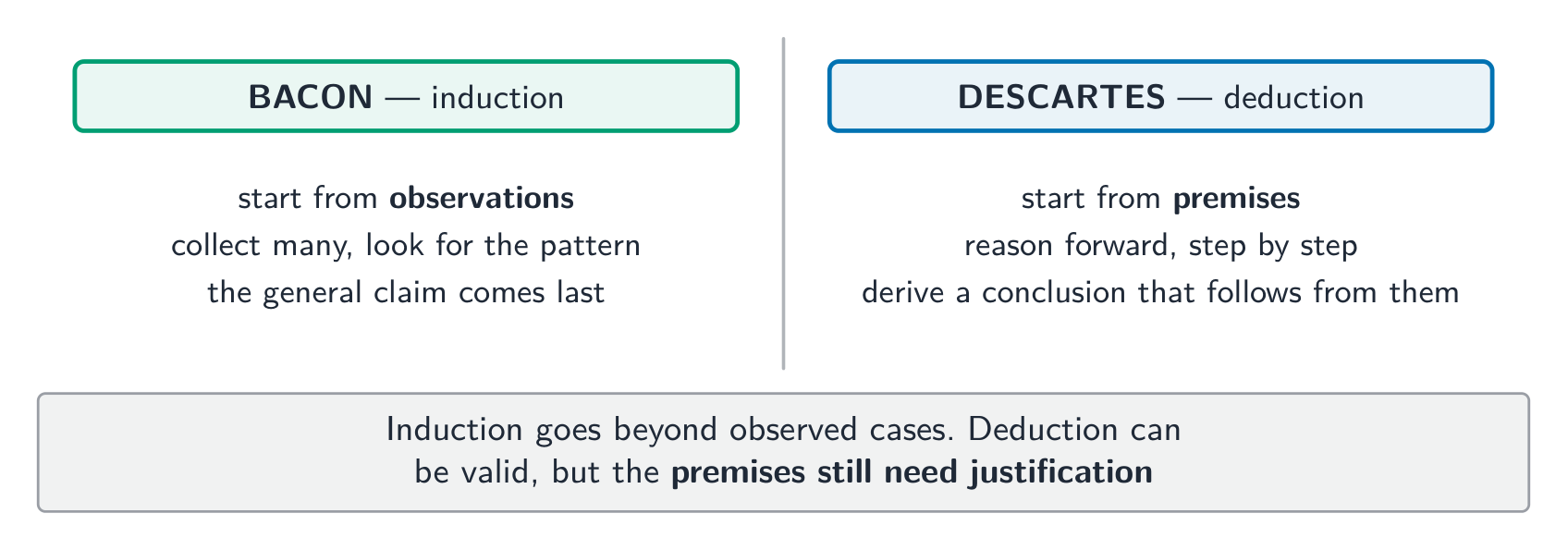
  • KC-1.1.IV.C Francis Bacon and René Descartes defined inductive and deductive reasoning and promoted experimentation and the use of mathematics, which would ultimately shape the scientific method.
  • KC-1.1.IV.D Alchemy and astrology continued to appeal to elites and some natural philosophers, in part because they shared with the new science the notion of a predictable and knowable universe. At the same time, many people continued to believe that the cosmos was governed by spiritual forces.

Illustrative examples:

  • Additional physicians who challenged Galen:
    • Paracelsus
    • Andreas Vesalius
  • Natural philosophers who continued to hold traditional views of alchemy and astrology:
    • Paracelsus
    • Johannes Kepler
    • Sir Isaac Newton

来源:美国大学理事会 AP 课程与考试说明

天文学中的新观念与新方法,使哥白尼(Copernicus)、伽利略(Galileo)与牛顿(Newton)质疑古人的权威(authority of the ancients),并发展出日心宇宙观。

与天文学并行的还有:

  • 包括哈维(William Harvey)在内的医师所作的解剖学与医学发现,把身体呈现为一个整体系统(integrated system),挑战了沿袭的医学理论。
  • 培根(Francis Bacon)与笛卡尔(René Descartes)界定了归纳与演绎推理(inductive and deductive reasoning),并倡导实验与数学的运用。

CED 随后补充了一点,学生会觉得意外而阅卷人很看重:炼金术与占星术仍然吸引着精英与某些自然哲学家,部分原因在于它们与新科学共享一个假设——自然世界受可被发现的规则支配。科学革命并不是一次干净的断裂,写出这一点能体现对延续性的真正理解。

词汇表 训练
英文 中文 拼音
Copernicus 哥白尼 gē bái ní
Galileo 伽利略 jiā lì lüè
Newton 牛顿 niú dùn
question the authority of the ancients 古人的权威 gǔ rén de quán wēi
William Harvey 哈维 hā wéi
integrated system 整体系统 zhěng tǐ xì tǒng
Francis Bacon 培根 péi gēn
René Descartes 笛卡尔 dí kǎ ěr
inductive and deductive reasoning 归纳与演绎推理 guī nà yǔ yǎn yì tuī lǐ
4.3

启蒙运动

大纲

4.3 The Enlightenment

Thematic FocusLearning ObjectiveHistorical Developments

CID
Cultural and Intellectual Developments — The creation and transmission of knowledge, including the relationship between traditional sources of authority and the development of differing world views, had significant political, intellectual, economic, cultural, and social effects on European and world societies.

Unit 4.C
Explain the causes and consequences of Enlightenment thought on European society from 1648 to 1815.

  • KC-2.3.I.A Intellectuals, including Voltaire and Diderot, began to apply the principles of the Scientific Revolution to society and human institutions.
  • KC-2.3.I.B Locke and Rousseau developed new political models based on the concept of natural rights and the social contract.
  • KC-2.3.I.C Despite the principles of equality espoused by the Enlightenment and the French Revolution, intellectuals such as Rousseau offered controversial arguments for the exclusion of women from political life.

Unit 4.D
Explain the influence of Enlightenment thought on European intellectual development from 1648 to 1815.

  • KC-2.3.II.A A variety of institutions, including salons, explored and disseminated Enlightenment culture.
  • KC-2.3.III.A Political theories, including John Locke’s, conceived of society as composed of individuals driven by self-interest and argued that the state originated in the consent of the governed (i.e., a social contract) rather than in divine right or tradition.
  • KC-2.3.III.B Mercantilist theory and practice were challenged by new economic ideas, including Adam Smith’s, which espoused free trade and a free market.
  • KC-2.3.I Enlightenment thought, which focused on concepts such as empiricism, skepticism, human reason, rationalism, and classical sources of knowledge, challenged the prevailing patterns of thought with respect to social order, institutions of government, and the role of faith.
  • KC-2.3.IV.A Intellectuals, including Voltaire and Diderot, developed new philosophies of deism, skepticism, and atheism.
  • KC-2.3.IV.B Religion was viewed increasingly as a matter of private rather than public concern.

Illustrative examples:

  • Works applying scientific principles to society:
    • Montesquieu’s The Spirit of the Laws
    • Cesare Beccaria’s On Crimes and Punishments
  • Individuals who challenged Rousseau’s position on women:
    • Mary Wollstonecraft
    • Marquis de Condorcet
  • Institutions that broadened the audience for new ideas:
    • Coffeehouses Academies Bullet Bullet Lending libraries
    • Masonic lodges
  • Proponents of new economic ideas:
    • Physiocrats
    • Francois Quesnay
    • Anne Robert Jacques Turgot
  • Intellectuals: §Bullet David Hume
    • Baron d’Holbach
  • Religious developments:
    • Revival of German Pietism

来源:美国大学理事会 AP 课程与考试说明

本单元的核心动作:一种为自然而建的方法被转用于社会
这正是 CED 所说的启蒙运动把科学革命应用于人类制度

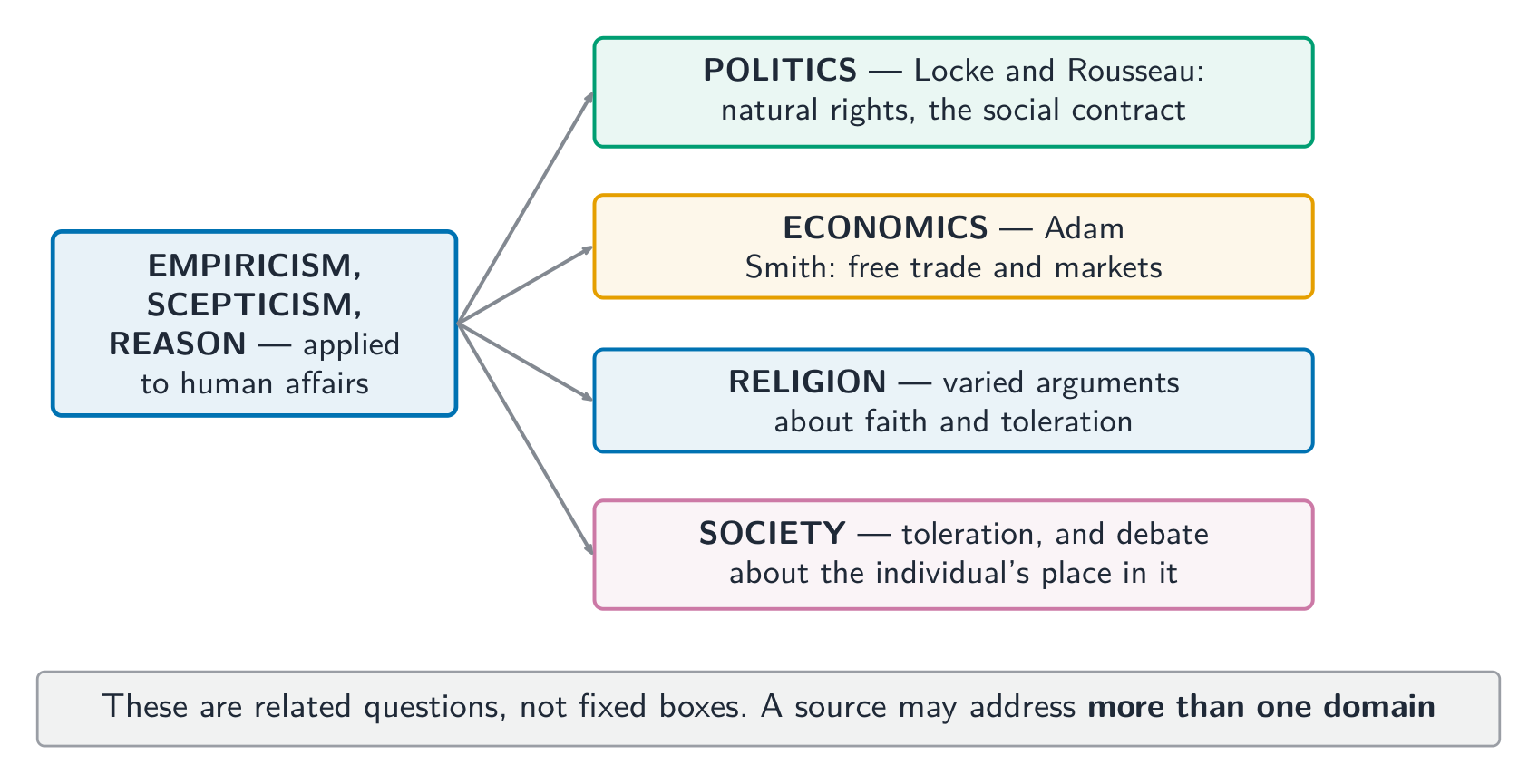
启蒙运动(Enlightenment)思想聚焦于经验主义、怀疑主义、人类理性、理性主义(empiricism, scepticism, human reason, rationalism)与古典知识来源。其产出可归为四类:

  • 政治:洛克(Locke)与卢梭(Rousseau)基于天赋权利(natural rights)与社会契约(social contract)发展出新的政治模型。洛克的理论把社会设想为由受自利驱动的个人构成,并主张国家的作用是保护他们的权利。
  • 经济:重商主义的理论与实践受到新观念的挑战,包括亚当·斯密(Adam Smith)所主张的自由贸易(free trade)与国家在经济中的有限角色
  • 宗教:包括伏尔泰(Voltaire)与狄德罗(Diderot)在内的知识分子发展出自然神论、怀疑主义与无神论(deism, scepticism, and atheism),宗教日益被视为私人而非公共事务(private rather than a public concern)。
  • 社会:多种机构,尤其是沙龙(salons),探索并传播了启蒙文化。

有一项限度在考查范围内,绝不可略去:尽管启蒙运动倡导平等原则,卢梭等知识分子却就女性的适当角色提出了有争议的论证。把启蒙运动呈现为一律平等主义的答案,不是 CED 所要的答案。

词汇表 训练
英文 中文 拼音
Enlightenment 启蒙运动 qǐ méng yùn dòng
empiricism, scepticism, human reason, rationalism 经验主义、怀疑主义、人类理性、理性主义 jīng yàn zhǔ yì 、 huái yí zhǔ yì 、 rén lèi lǐ xìng 、 lǐ xìng zhǔ yì
Locke 洛克 luò kè
Rousseau 卢梭 lú suō
natural rights 天赋权利 tiān fù quán lì
social contract 社会契约 shè huì qì yuē
Adam Smith's 亚当·斯密 yà dāng · sī mì
free trade 自由贸易 zì yóu mào yì
Voltaire 伏尔泰 fú ěr tài
Diderot 狄德罗 dí dé luó
deism, scepticism, and atheism 自然神论、怀疑主义与无神论 zì rán shén lùn 、 huái yí zhǔ yì yǔ wú shén lùn
private rather than a public concern 私人事务 sī rén shì wù
salons 沙龙 shā lóng
small landholdings, low-productivity agriculture, poor transportation, and adverse weather 不利天气 bù lì tiān qì
4.4

18世纪的社会与人口

大纲

4.4 18th-Century Society and Demographics

Thematic FocusLearning ObjectiveHistorical Developments

SCD
Social Organization and Development — Economic, political, and cultural factors have influenced the form and status of family, class, and social groups in European history, which has, in turn, affected both the individual and society.

Unit 4.E
Explain the factors contributing to and the consequences of demographic changes from 1648 to 1815.

  • KC-2.4.I In the 17th century, small landholdings, low-productivity agricultural practices, poor transportation, and adverse weather limited and disrupted the food supply, causing periodic famines. By the 18th century, the balance between population and the food supply stabilized, resulting in steady population growth.
    • KC-2.4.I.A By the middle of the 18th century, higher agricultural productivity and improved transportation increased the food supply, allowing populations to grow and reducing the number of demographic crises (a process known as the Agricultural Revolution).
    • KC-2.4.I.B In the 18th century, plague disappeared as a major epidemic disease, and inoculation reduced smallpox mortality.
  • KC-2.4.III.A Although the rate of illegitimate births increased in the 18th century, population growth was limited by the European marriage pattern, and in some areas by various birth control methods.
  • KC-2.4.III.B As infant and child mortality decreased, and commercial wealth increased, families dedicated more space and resources to children and child-rearing, as well as private life and comfort.
  • KC-2.4.IV Cities offered economic opportunities, which attracted increasing migration from rural areas, transforming urban life and creating challenges for the new urbanites and their families.
    • KC-2.4.IV.A The Agricultural Revolution produced more food using fewer workers; as a result, people migrated from rural areas to the cities in search of work.
    • KC-2.4.IV.B The growth of cities eroded traditional communal values, and city governments strained to provide protection and a healthy environment.
    • KC-2.4.IV.C The concentration of the poor in cities led to a greater awareness of poverty, crime, and prostitution as social problems, and prompted increased efforts to police marginal groups.

Illustrative examples:

  • Inoculation and disease control:
    • Lady Mary Wortley Montagu
  • Increased emphasis on childhood: §Bullet Jean-Jacques Rousseau
    • Education in Napoleonic France and Austria
    • Painting and portraiture

来源:美国大学理事会 AP 课程与考试说明

人口这条线索有清楚的前后之别:

  • 在十七世纪,小块土地持有、低生产率的农业、糟糕的交通与不利天气(adverse weather)限制了人口增长,并造成周期性的生计危机。
  • 尽管十八世纪非婚生育率上升,增长仍受欧洲婚姻模式(European marriage pattern)限制——晚婚,且有相当比例的人终身不婚。
  • 随着婴幼儿死亡率(infant and child mortality)下降与商业财富增加,家庭为子女及其教育投入了更多空间与资源。
  • 城市提供了经济机会,吸引来自乡村的迁移,改变了城市生活并造成新的社会问题。
词汇表 训练
英文 中文 拼音
European marriage pattern 欧洲婚姻模式 ōu zhōu hūn yīn mó shì
infant and child mortality decreased 婴幼儿死亡率 yīng yòu ér sǐ wáng lǜ
4.5

18世纪的文化与艺术

大纲

4.5 18th-Century Culture and Arts

Thematic FocusLearning ObjectiveHistorical Developments

CID
Cultural and Intellectual Developments — The creation and transmission of knowledge, including the relationship between traditional sources of authority and the development of differing world views, had significant political, intellectual, economic, cultural, and social effects on European and world societies.

Unit 4.F
Explain how European cultural and intellectual life was maintained and changed throughout the period from 1648 to 1815.

  • KC-2.3.II.B Despite censorship, increasingly numerous and varied printed materials served a growing literate public and led to the development of public opinion.
  • KC-2.3.II.C Natural sciences, literature, and popular culture increasingly exposed Europeans to representations of peoples outside Europe and, on occasion, challenges to accepted social norms.
  • KC-2.3.V The arts moved from the celebration of religious themes and royal power to an emphasis on private life and the public good.
    • KC-2.3.V.A Until about 1750, Baroque art and music promoted religious feeling and was employed by monarchs to illustrate state power.
    • KC-2.3.V.B 18th-century art and literature increasingly reflected the outlook and values of commercial and bourgeois society. Neoclassicism expressed new Enlightenment ideals of citizenship and political participation.
  • KC-2.4.II The consumer revolution of the 18th century was shaped by a new concern for privacy, encouraged the purchase of new goods for homes, and created new venues for leisure activities.

Illustrative examples:

  • Printed materials:
    • Newspapers
    • Periodicals
    • Books
    • Pamphlets
    • The Encyclopédie
  • Baroque artists and musicians who promoted religion or glorified monarchy:
    • Diego Velásquez
    • Gian Bernini
    • George Frideric Handel
    • J. S. Bach
  • Artistic movements that reflected commercial society or Enlightenment ideals:
    • Dutch painting
    • Rembrandt
    • Jan Vermeer
    • Jacques-Louis David
    • Pantheon in Paris
  • Literature that reflected commercial society or Enlightenment ideals:
    • Daniel Defoe
    • Samuel Richardson
    • Henry Fielding
    • Johann Wolfgang von Goethe
    • Jane Austen (CONT’D) A new concern for privacy:
    • Homes built to include private retreats, such as the boudoir §Bullet Novels that encouraged a reflection on private emotion New consumer goods for homes: §Bullet Porcelain dishes
    • Cotton and linens for home décor §Bullet Mirrors
    • Prints New leisure venues: §Bullet Coffeehouses §Bullet Taverns §Bullet Theaters and opera houses

来源:美国大学理事会 AP 课程与考试说明

  • 尽管有审查(censorship),日益增多且多样的印刷品服务于不断扩大的识字公众(literate public),并催生了一个可以在国家之外形成舆论的公共领域
  • 自然科学、文学与流行文化日益使欧洲人接触到对欧洲之外民族的表现
  • 艺术从颂扬宗教题材与王权转向强调私人生活与公共福祉(private life and the public good)——题材的转移与权威的转移同步。
  • 十八世纪的消费革命(consumer revolution)受一种新的隐私(privacy)关切塑造,鼓励了为家庭购置新物品。
词汇表 训练
英文 中文 拼音
censorship 审查 shěn chá
literate public 识字公众 shí zì gōng zhòng
from the celebration of religious themes and royal power to an emphasis on private life and the public good 私人生活与公共福祉 sī rén shēng huó yǔ gōng gòng fú zhǐ
consumer revolution 消费革命 xiāo fèi gé mìng
privacy 隐私 yǐn sī
4.6

开明专制及其他权力路径

大纲

4.6 Enlightened and Other Approaches to Power

Thematic FocusLearning ObjectiveHistorical Developments

SOP
States and Other Institutions of Power — European states and nations developed governmental and civil institutions from 1450 to the present to organize society and consolidate political power, with a variety of social, cultural, and economic effects.

Unit 4.G
Explain how different forms of political power were influenced by Enlightenment thought from 1648 to 1815. THEMATIC FOCUS National and European Identity NEI Definitions and perceptions of regional, cultural, national, and European identity have developed and been challenged over time, with varied and often profound effects on the political, social, and cultural order in Europe. LEARNING OBJECTIVE

  • KC-2.1.I.C In the 18th century, a number of states in eastern and central Europe experimented with enlightened absolutism.
  • KC-2.3.IV.C By 1800, most governments in western and central Europe had extended toleration to Christian minorities and, in some states, civil equality to Jews. HISTORICAL DEVELOPMENTS

Unit 4.H
Explain how and why political and religious developments challenged or reinforced the idea of a unified Europe from 1648 to 1815.

  • KC-2.1.III.A As a result of the Holy Roman Empire’s limitation of sovereignty in the Peace of Westphalia, Prussia rose to power, and the Habsburgs, centered in Austria, shifted their empire eastward.

Illustrative examples:

  • Enlightened monarchs: §Bullet Frederick II of Prussia §Bullet Joseph II of Austria Prussian and Habsburg rulers:
    • Maria Theresa of Austria
    • Frederick William I of Prussia
    • Frederick II of Prussia

来源:美国大学理事会 AP 课程与考试说明

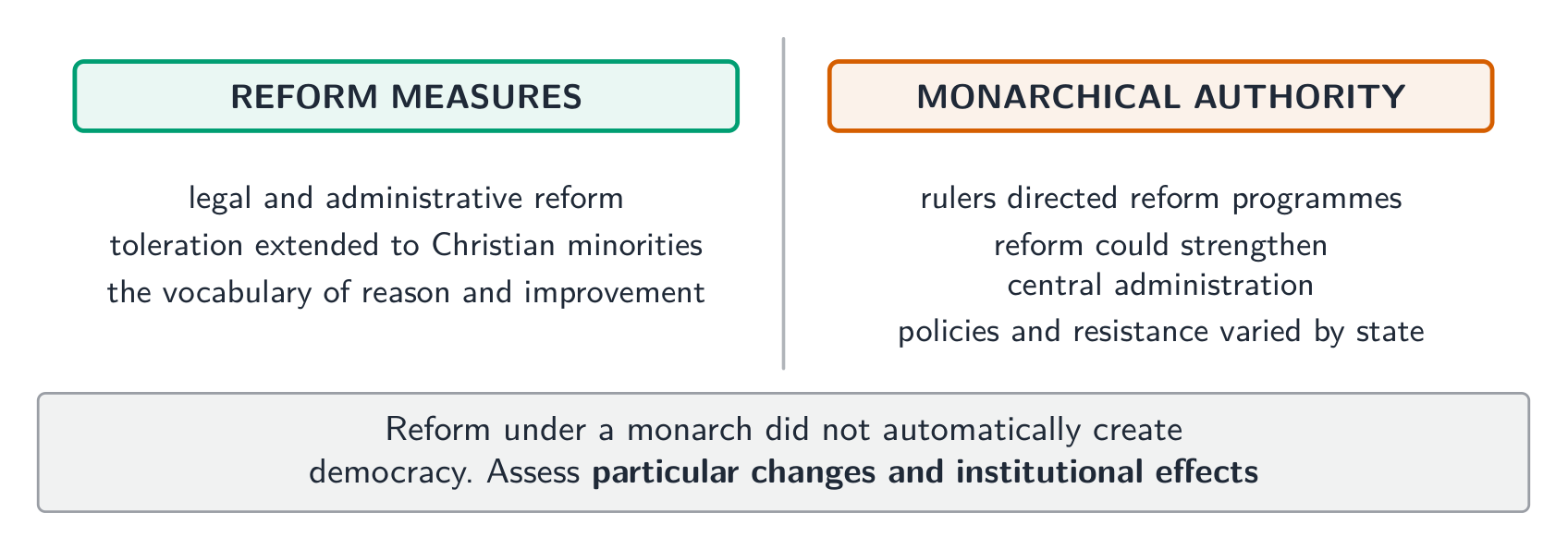
十八世纪,东欧与中欧的若干国家尝试了开明专制(enlightened absolutism)——统治者在法律、教育与行政中采纳受启蒙启发的改革,同时保留绝对权威。这一表述中的张力正是可考的要点。

到 1800 年,西欧与中欧多数政府已将宽容扩及基督教少数派,在某些国家还扩及公民权利。

而由于神圣罗马帝国在威斯特伐利亚被限制了主权,普鲁士(Prussia)崛起,哈布斯堡则转向其东部领地——这是第二单元的和约在一个世纪后到来的结构性后果。

词汇表 训练
英文 中文 拼音
enlightened absolutism 开明专制 kāi míng zhuān zhì
Prussia rose to power 普鲁士 pǔ lǔ shì
4.7

科学革命与启蒙运动时代的因果关系

大纲

4.7 Causation in the Age of the Scientific Revolution and the Enlightenment

Learning ObjectiveReview: Unit 4 Key Concepts

Unit 4.I
Explain how and why the Scientific Revolution and Enlightenment challenged the existing European order and understanding of the world.

  • KC-1.1 The rediscovery of works from ancient Greece and Rome and observation of the natural world changed many Europeans’ view of their world.
    • KC-1.1.IV New ideas in science based on observation, experimentation, and mathematics challenged classical views of the cosmos, nature, and the human body, although existing traditions of knowledge and the universe continued.
  • KC-2.3 The spread of Scientific Revolution concepts and practices and the Enlightenment’s application of these concepts and practices to political, social, and ethical issues led to an increased but not unchallenged emphasis on reason in European culture.
    • KC-2.3.I Enlightenment thought, which focused on concepts such as empiricism, skepticism, human reason, rationalism, and classical sources of knowledge, challenged the prevailing patterns of thought with respect to social order, institutions of government, and the role of faith.
    • KC-2.3.II New public venues and print media popularized Enlightenment ideas.
    • KC-2.3.III New political and economic theories challenged absolutism and mercantilism.
    • KC-2.3.IV During the Enlightenment, the rational analysis of religious practices led to natural religion and the demand for religious toleration.
  • KC-2.4 The experiences of everyday life were shaped by demographic, environmental, medical, and technological changes.
    • KC-2.4.III By the 18th century, family and private life reflected new demographic patterns and the effects of the commercial revolution.

来源:美国大学理事会 AP 课程与考试说明

本单元考查的推理能力是因果关系,并应用于这些运动如何挑战既有的欧洲世界观

**Worked example(一道真实的 AP 考题)。*本单元的 AP 欧洲史简答题会要求,例如「解释十八世纪启蒙思想挑战既有政治权威的一种方式」。满分答案会指认这一挑战并加以追溯:「洛克的天赋权利与社会契约理论主张,政府之存在是为了保护个人权利,其权威来自这些个人的同意。这直接动摇了君权神授的主张,因为它使服从取决于统治者的表现,而非无条件。」注意其中的机制:答案展示的是一种论证如何*取代另一种,而不是罗列思想家。

4.7

考试技巧

  • 记住 CED 自己的那句话:启蒙运动把科学革命的方法应用于政治、社会与伦理问题。许多题目靠拆解这句话就能作答。
  • 科学革命不是干净的断裂——炼金术与占星术仍在延续。延续性要点能得分。
  • 把启蒙运动的产出归为政治、经济、宗教、社会四类。四个有标签的类别胜过一串人名。
  • 始终点出平等的限度,尤其是就女性而言。CED 明确提到了它们。
  • 开明专制是一种张力,而不是矛盾:进行改革却不交出权威。
  • 公共领域——印刷、识字、沙龙——是观念得以政治化的机制。用它来解释,而不只是描述。

本主题的互动课程

逐步学习,并即时检测练习。

AP 欧洲历史的更多主题

登录或创建账号

IGCSE, A-Level & AP