| English | 释义 | 拼音 |
|---|---|---|
| enlightened absolutism/enˈlaɪtnd ˈæbsəluːtɪzəm/ | 开明专制 | kāi míng zhuān zhì |
| toleration | 宽容 | kuān róng |
A king abolishes torture, then invades, 1740
- In June 1740, days after he became king of Prussia, Frederick II largely abolished torture in his courts. He wrote poetry, played the flute and invited Voltaire to his palace. In December the same year, he invaded the Austrian province of Silesia without declaring war.
- Some eighteenth-century monarchs used Enlightenment ideas to reform their states — but kept all their power.
Why is Frederick II's year 1740 a contradiction?
难度 1/5 · 今日首次完成可获 100 金币及少量额外奖励
Reform and war together.
Rulers experiment
- Enlightened absolutism 开明专制 meant rulers making rational reforms in law, education and the economy from above.
- Frederick called himself "the first servant of the state". He built schools, drained marshes for farmland and allowed religious toleration.
What was enlightened absolutism?
难度 1/5 · 今日首次完成可获 100 金币及少量额外奖励
Reform from above.
A new argument for the same power
- Enlightened rulers did not claim to rule only by God's will. They argued their power was justified because it served the people's welfare.
- But they did not share power with parliaments or the people.
Enlightened absolutism, toleration, or a territorial consequence?
Sort each development.
Worked example: Joseph II and Catherine II
- Joseph II of Austria: his Edict of Toleration (1781) gave Protestants and Orthodox Christians rights, a 1782 patent extended some to Jews, and in 1781 he abolished serfdom in Bohemia and Austria. Nobles resisted, and many reforms were reversed after his death in 1790.
- Catherine II of Russia: she corresponded with Voltaire and Diderot, but after Pugachev's peasant revolt (1773–75) she gave nobles more power over their serfs.
- Judgement: reforms happened, but power stayed with the ruler, and nobles limited change.
Match each ruler to a policy.
难度 2/5 · 今日首次完成可获 140 金币及少量额外奖励
Different reforms.
Many of Joseph II's reforms were reversed after his death.
难度 1/5 · 今日首次完成可获 100 金币及少量额外奖励
Nobles resisted.
Toleration extended
- Toleration slowly grew: Jews gained some rights in Austria and later France (1791).
- Voltaire's campaign for Jean Calas, a Protestant wrongly executed in Toulouse in 1762, made religious toleration 宽容 a public cause.
What did Voltaire's campaign for Jean Calas promote?
难度 1/5 · 今日首次完成可获 100 金币及少量额外奖励
Calas was a wrongly executed Protestant.
The map changed
- Prussia's seizure of Silesia (1740) began a long rivalry with Austria for leadership of Germany.
- Prussia, Austria and Russia then divided Poland between 1772 and 1795.
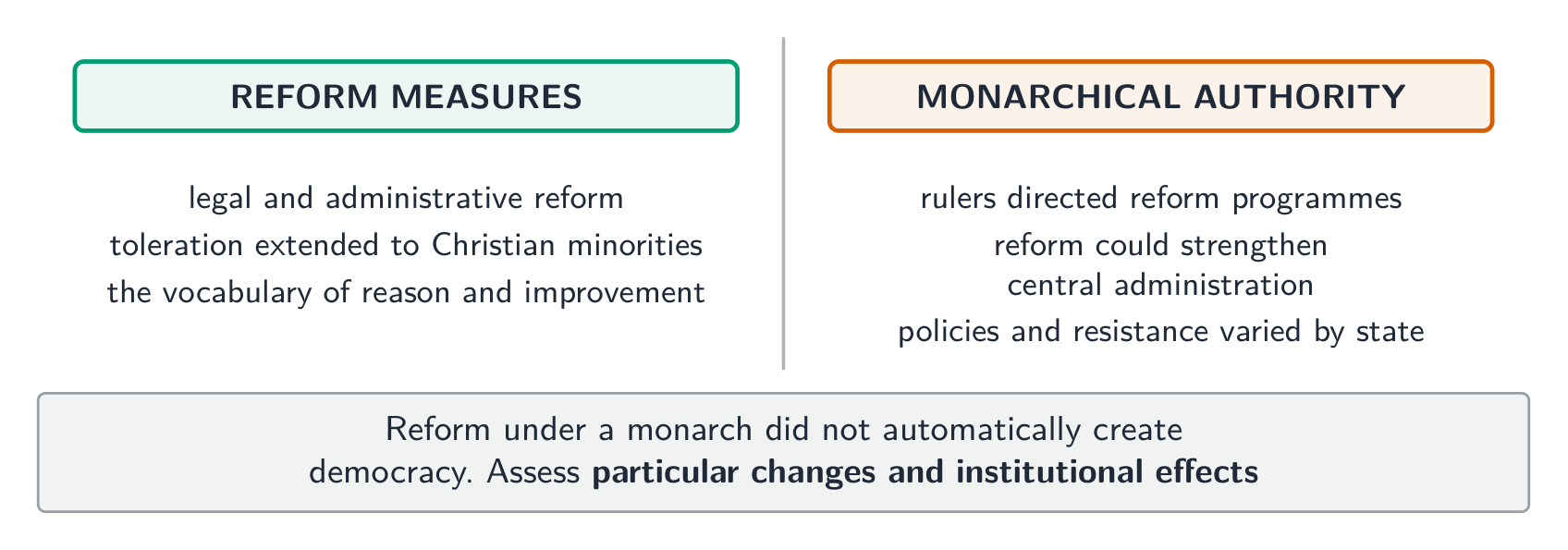
Enlightened absolutists were still absolute. Judge their reforms and their keeping of power separately. Frederick abolished torture but also started wars and kept serfdom in Prussia.
Enlightened absolutists shared power with parliaments.
难度 1/5 · 今日首次完成可获 100 金币及少量额外奖励
They kept absolute authority.
Frederick II, Joseph II and Catherine II used Enlightenment ideas to reform law, religion and economy from above, justifying their power by the welfare of the state. Toleration grew, but nobles resisted reform, and the rulers kept their absolute authority and went to war for territory.
To what extent did enlightened absolutists put Enlightenment ideas into practice?
Extent.