跳到主要内容

专制主义与宪政主义

AP 欧洲历史 · 第 3 主题

训练
讲义 词汇表
3.1

国家建构的时代背景

大纲

3.1 Contextualizing State Building

Learning ObjectivePreview: Unit 3 Key Concepts

Unit 3.A
Explain the context in which different forms of political power developed from 1648 to 1815.

  • KC-1.5 The struggle for sovereignty within and among states resulted in varying degrees of political centralization.
    • KC-1.5.I The new concept of the sovereign state and secular systems of law played a central role in the creation of new political institutions.
    • KC-1.5.III The competition for power between monarchs and corporate and minority language groups produced different distributions of governmental authority in European states.
    • KC-1.5.III.B Monarchies seeking enhanced power faced challenges from nobles who wished to retain traditional forms of shared governance and regional autonomy.
    • KC-1.5.III.C Within states, minority local and regional identities based on language and culture led to resistance against the dominant national group.
  • KC-2.1 Different models of political sovereignty affected the relationship among states and between states and individuals.
    • KC-2.1.I In much of Europe, absolute monarchy was established over the course of the 17th and 18th centuries.
    • KC-2.1.II Challenges to absolutism resulted in alternative political systems.

Illustrative examples:

  • Competition between monarchs and nobles:
    • Louis XIII and Cardinal Richelieu §Bullet
    • The Fronde in France
    • The Catalan Revolts in Spain
  • Competition between minority and dominant national groups:
    • Celtic regions of Scotland, Ireland, and France
    • Dutch resistance in the Spanish Netherlands
    • Czech identity in the Holy Roman Empire/ Jan Hus/Defenestration

来源:美国大学理事会 AP 课程与考试说明

第三单元讲述 1648 至 1815 年,其统领性论断是:不同的政治主权(political sovereignty)模式影响了国家之间的关系,以及国家与个人之间的关系。

主权争夺继续造成程度不一的政治集权——但在威斯特伐利亚之后,这场竞争发生在彼此承认为主权者的国家之间,这与第一、第二单元中的博弈已是两回事。本单元的一切都由此而来:国家如今必须在与同样如此行事的对手的长期竞争中筹措财政、供养军队并管理经济。

3.2

英国内战与光荣革命

大纲

3.2 The English Civil War and the Glorious Revolution

Thematic FocusLearning ObjectiveHistorical Developments

SOP
States and Other Institutions of Power — European states and nations developed governmental and civil institutions from 1450 to the present to organize society and consolidate political power, with a variety of social, cultural, and economic effects.

Unit 3.B
Explain the causes and consequences of the English Civil War.

  • KC-1.5.III.A The English Civil War—a conflict among the monarchy, Parliament, and other elites over their respective roles in the political structure— exemplified the competition for power among monarchs and competing groups.
  • KC-2.1.II.A The outcome of the English Civil War and the Glorious Revolution protected the rights of gentry and aristocracy from absolutism through assertions of the rights of Parliament.

Illustrative examples:

  • Competitors for power in the English Civil War:
    • James I
    • Charles I
    • Oliver Cromwell
  • Outcomes of the English Civil War and the Glorious Revolution:
    • English Bill of Rights
    • Parliamentary sovereignty

来源:美国大学理事会 AP 课程与考试说明

英国内战(English Civil War)是君主、议会与其他精英之间就各自在政治结构中的角色而展开的冲突——而不是王室与人民之间的冲突。

其结果连同光荣革命(Glorious Revolution),通过确立议会(Parliament)的权利,保护了乡绅与贵族的权利不受绝对主义(absolutism)侵夺

这句话要仔细读,因为很容易被夸大。这一安排保护的是有产精英的权利不受王权侵夺,它并没有创造民众政府;把 1688 年当作民主的答案,是误读了 CED。

词汇表 训练
英文 中文 拼音
different models of political sovereignty 政治主权 zhèng zhì zhǔ quán
English Civil War 英国内战 yīng guó nèi zhàn
Glorious Revolution 光荣革命 guāng róng gé mìng
protected the rights of the gentry and aristocracy from absolutism 绝对主义 jué duì zhǔ yì
Parliament 议会 yì huì
3.3

经济实践与发展的延续与变化

大纲

3.3 Continuities and Changes to Economic Practice and Development

Thematic FocusLearning ObjectiveHistorical Developments

ECD
Economic and Commercial Developments — Economic development, especially the development of capitalism, played an important role in Europe’s history, often having significant social, political, and cultural effects.

Unit 3.C
Explain the continuities and changes in commercial and economic developments from 1648 to 1815.

  • KC-2.2.I.B The Agricultural Revolution raised productivity and increased the supply of food and other agricultural products.
  • KC-2.2.II.D The importation and transplantation of agricultural products from the Americas contributed to an increase in the food supply in Europe.
  • KC-2.2.I.A Labor and trade in commodities were increasingly freed from traditional restrictions imposed by governments and corporate entities.
  • KC-2.2.I.C The putting-out system, or cottage industry, expanded as increasing numbers of laborers in homes or workshops produced for markets through merchant intermediaries or workshop owners.
  • KC-2.2.I.D The development of the market economy led to new financial practices and institutions.
  • KC-2.2.I Early modern Europe developed a market economy that provided the foundation for its global role.

Illustrative examples:

  • New financial practices and institutions: § Insurance § Banking institutions for turning private savings into venture capital § New definitions of property rights and protections against confiscation § Bank of England

来源:美国大学理事会 AP 课程与考试说明

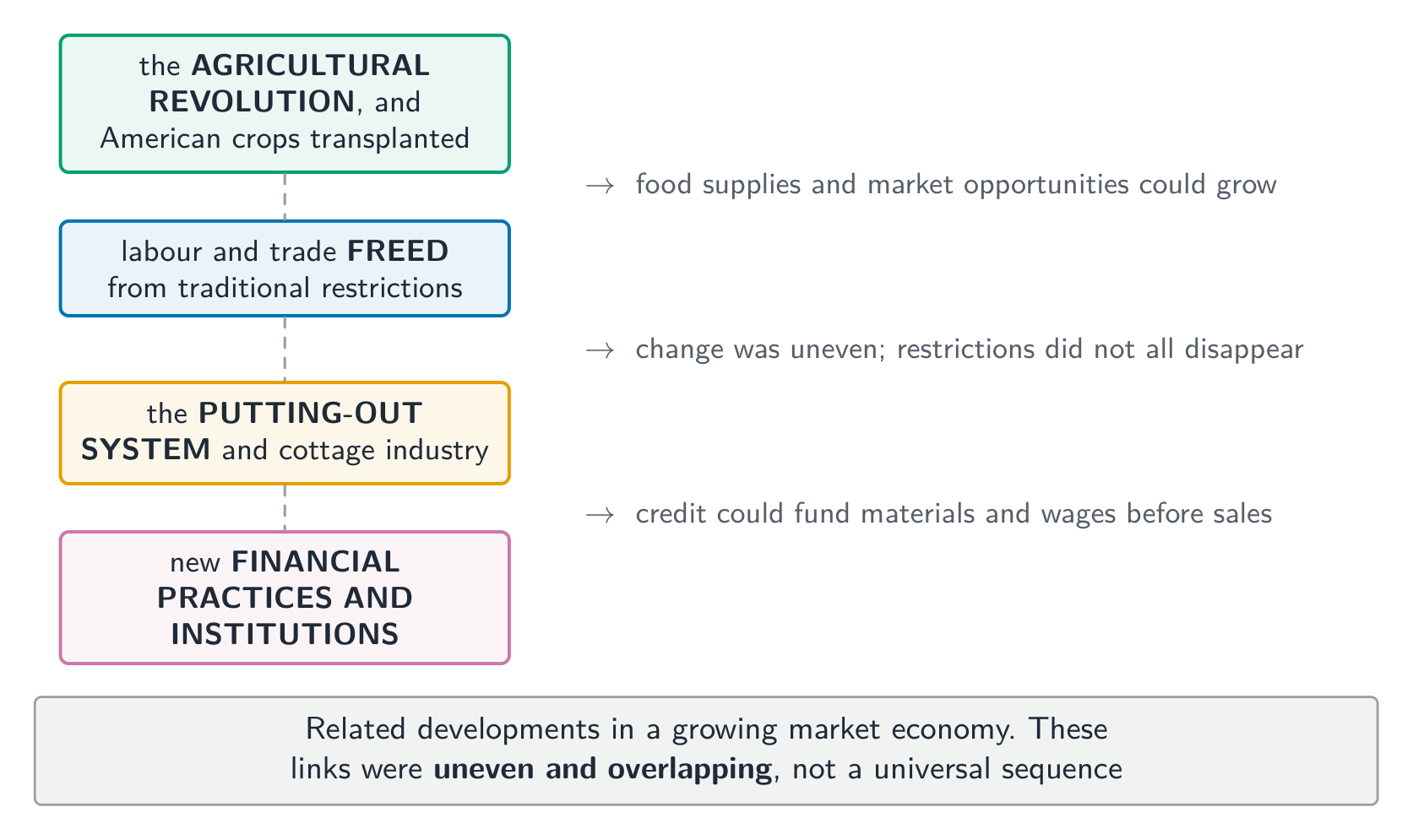
近代早期欧洲发展出一种市场经济,为其全球角色奠定了基础。CED 列出了其构成要素,而题目奖励能点出多项的答案:

  • 农业革命(Agricultural Revolution)提高了生产率,增加了粮食与其他农产品的供应。
  • 美洲作物的引进与移植进一步增加了粮食供给。
  • 劳动与商品贸易日益摆脱政府与行会等团体施加的传统限制(traditional restrictions)。
  • 包买制,即家庭手工业(cottage industry),随着更多劳动者在家中与作坊里为市场生产而扩张。
  • 市场经济催生了新的金融实践与金融制度(financial institutions)。

值得把握的链条是:更多粮食供养更多人口,被解放的劳动力与家庭手工业让这些人为市场生产,而新的金融把由此产生的资本调动起来。每一环都可单独考查,合起来则是第六单元工业化赖以建立的基础。

词汇表 训练
英文 中文 拼音
Agricultural Revolution 农业革命 nóng yè gé mìng
freed from traditional restrictions 传统限制 chuán tǒng xiàn zhì
cottage industry 家庭手工业 jiā tíng shǒu gōng yè
new financial practices and institutions 金融制度 jīn róng zhì dù
agricultural, industrial, and consumer revolutions 消费革命 xiāo fèi gé mìng
3.4

经济发展与重商主义

大纲

3.4 Economic Development and Mercantilism

Thematic FocusLearning ObjectiveHistorical Developments

ECD
Economic and Commercial Developments — Economic development, especially the development of capitalism, played an important role in Europe’s history, often having significant social, political, and cultural effects.

Unit 3.C
Explain the continuities and changes in commercial and economic developments from 1648 to 1815.

  • KC-2.2.II The European-dominated worldwide economic network contributed to the agricultural, industrial, and consumer revolutions in Europe.
    • KC-2.2.II.A European states followed mercantilist policies by drawing resources from colonies in the New World and elsewhere.
    • KC-2.2.II.B The transatlantic slave-labor system expanded in the 17th and 18th centuries as demand for New World products increased.
    • KC-2.2.II.C Overseas products and influences contributed to the development of a consumer culture in Europe.
    • KC-2.2.II.D The importation and transplantation of agricultural products from the Americas contributed to an increase in the food supply in Europe.
    • KC-2.2.II.E Foreign lands provided raw materials, finished goods, laborers, and markets for the commercial and industrial enterprises in Europe.

Illustrative examples:

  • Transatlantic slave-labor systems:
    • Middle Passage
    • Triangle trade
  • Overseas products:
    • Sugar
    • Tea
    • Silks and other fabrics
    • Tobacco
    • Rum
    • Coffee

来源:美国大学理事会 AP 课程与考试说明

由欧洲主导的全球经济网络促成了欧洲的农业、工业与消费革命(consumer revolutions)。

重商主义(mercantilism)是其政策框架:国家鼓励出口、限制进口,并获取殖民地以提供原料并购买制成品。要注意 CED 主张的因果方向——是全球网络滋养了欧洲的这些转变,因此把答案局限于欧洲内部发展是不完整的。

词汇表 训练
英文 中文 拼音
Mercantilism 重商主义 zhòng shāng zhǔ yì
3.5

荷兰黄金时代

大纲

3.5 The Dutch Golden Age

Thematic FocusLearning ObjectiveHistorical Developments

SOP
States and Other Institutions of Power — European states and nations developed governmental and civil institutions from 1450 to the present to organize society and consolidate political power, with a variety of social, cultural, and economic effects.

Unit 3.D
Explain the factors that contributed to the development of the Dutch Republic.

  • KC-2.1.II.B The Dutch Republic, established by a Protestant revolt against the Habsburg monarchy, developed an oligarchy of urban gentry and rural landholders to promote trade and protect traditional rights.

来源:美国大学理事会 AP 课程与考试说明

荷兰共和国(Dutch Republic)由反抗哈布斯堡王朝的新教起义建立,发展出城市士绅与乡村地主的寡头(oligarchy of urban gentry and rural landholders)统治,以促进贸易与宗教宽容。

荷兰这一案例之所以重要,是因为它既非绝对主义,也非英国式立宪主义——它是第三种模式,在商业上居于支配地位,表明政治形式与经济成就并未被绑定在一条公式上。

词汇表 训练
英文 中文 拼音
Dutch Republic 荷兰共和国 hé lán gòng hé guó
oligarchy of urban gentry and rural landholders 城市士绅与乡村地主寡头 chéng shì shì shēn yǔ xiāng cūn dì zhǔ guǎ tóu
3.6

势力均衡

大纲

3.6 Balance of Power

Thematic FocusLearning ObjectiveHistorical Developments

SOP
States and Other Institutions of Power — European states and nations developed governmental and civil institutions from 1450 to the present to organize society and consolidate political power, with a variety of social, cultural, and economic effects.

Unit 3.E
Explain how European states attempted to establish and maintain a balance of power on the continent throughout the period from 1648 to 1815.

  • KC-1.5.II The competitive state system led to new patterns of diplomacy and new forms of warfare.
    • KC-1.5.II.A Following the Peace of Westphalia, religion declined in importance as a cause for warfare among European states; the concept of the balance of power played an important role in structuring diplomatic and military objectives.
  • KC-2.1.I.D The inability of the Polish monarchy to consolidate its authority over the nobility led to Poland’s partition by Prussia, Russia, and Austria, and its disappearance from the map of Europe.
  • KC-2.1.III After 1648, dynastic and state interests, along with Europe’s expanding colonial empires, influenced the diplomacy of European states and frequently led to war.
    • KC-2.1.III.B After the Austrian defeat of the Turks in 1683 at the Battle of Vienna, the Ottomans ceased their westward expansion.
    • KC-2.1.III.C Louis XIV’s nearly continuous wars, pursuing both dynastic and state interests, provoked a coalition of European powers opposing him. HISTORICAL DEVELOPMENTS

Unit 3.F
Explain how advances in technology contributed to a developing balance of power on the continent throughout the period from 1648 to 1815.

  • KC-1.5.II.B Advances in military technology led to new forms of warfare, including greater reliance on infantry, firearms, mobile cannon, and more elaborate fortifications, all financed by heavier taxation and requiring a larger bureaucracy. New military techniques and institutions (i.e., the military revolution) tipped the balance of power toward states able to marshal sufficient resources for the new military environment.

Illustrative examples:

  • Louis XIV’s nearly continuous wars:
    • Dutch War
    • Nine Years’ War
    • War of the Spanish Succession
  • States that benefited from the military revolution:
    • Spain under the Habsburgs §Bullet Sweden under Gustavus Adolphus §Bullet France

来源:美国大学理事会 AP 课程与考试说明

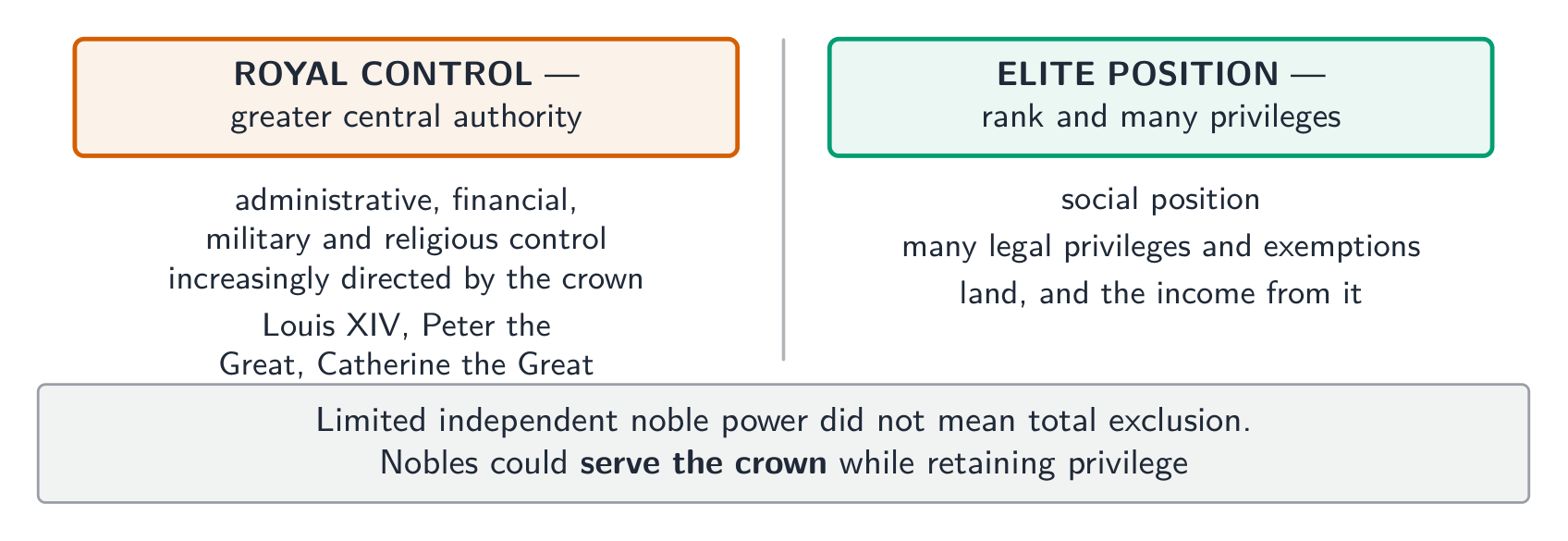
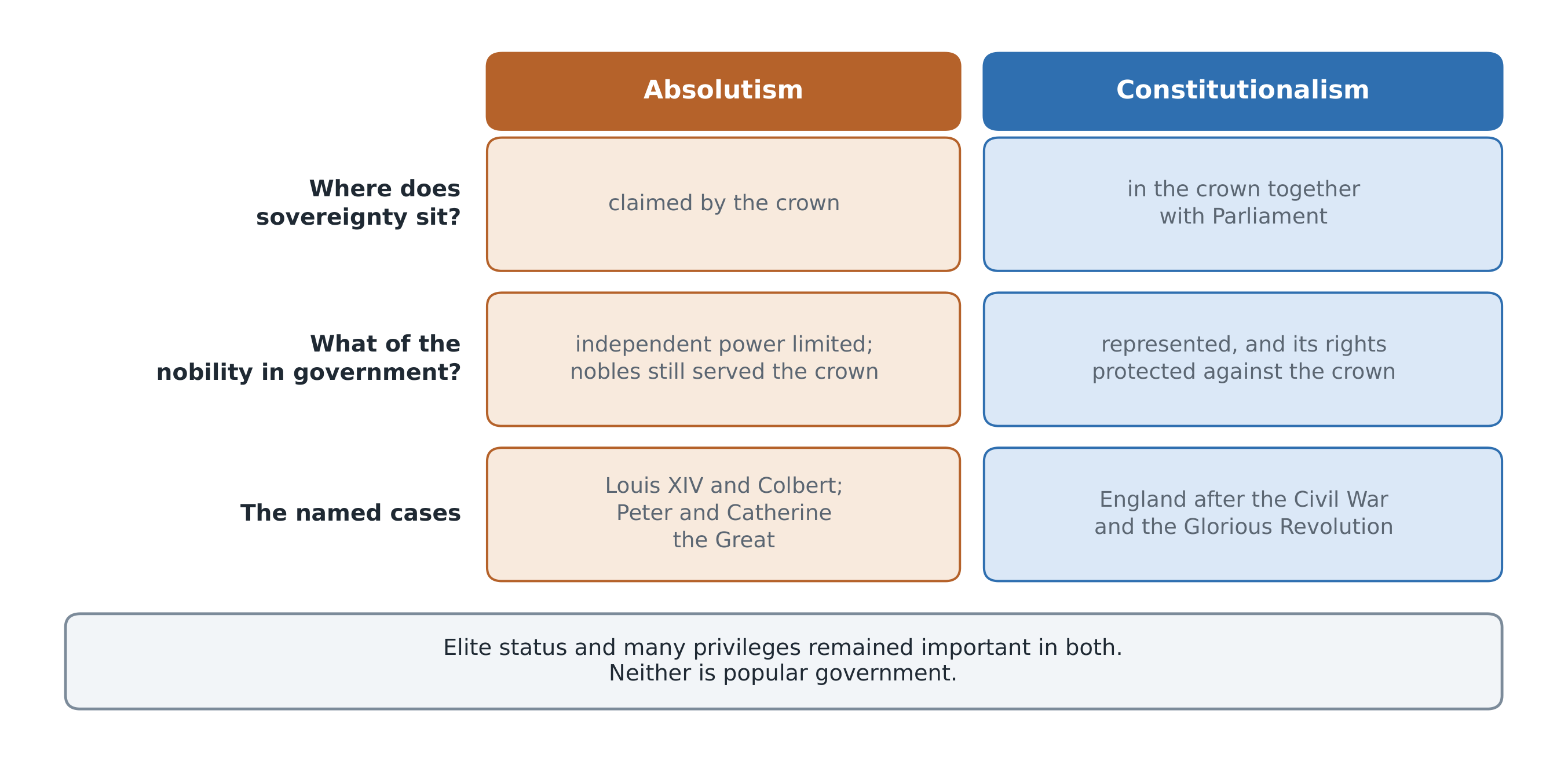
本单元的整个比较尽在一图——而 CED 自身的推理任务正是比较它们
两种模式都保留了贵族的地位;它们的分歧在于主权归属何处

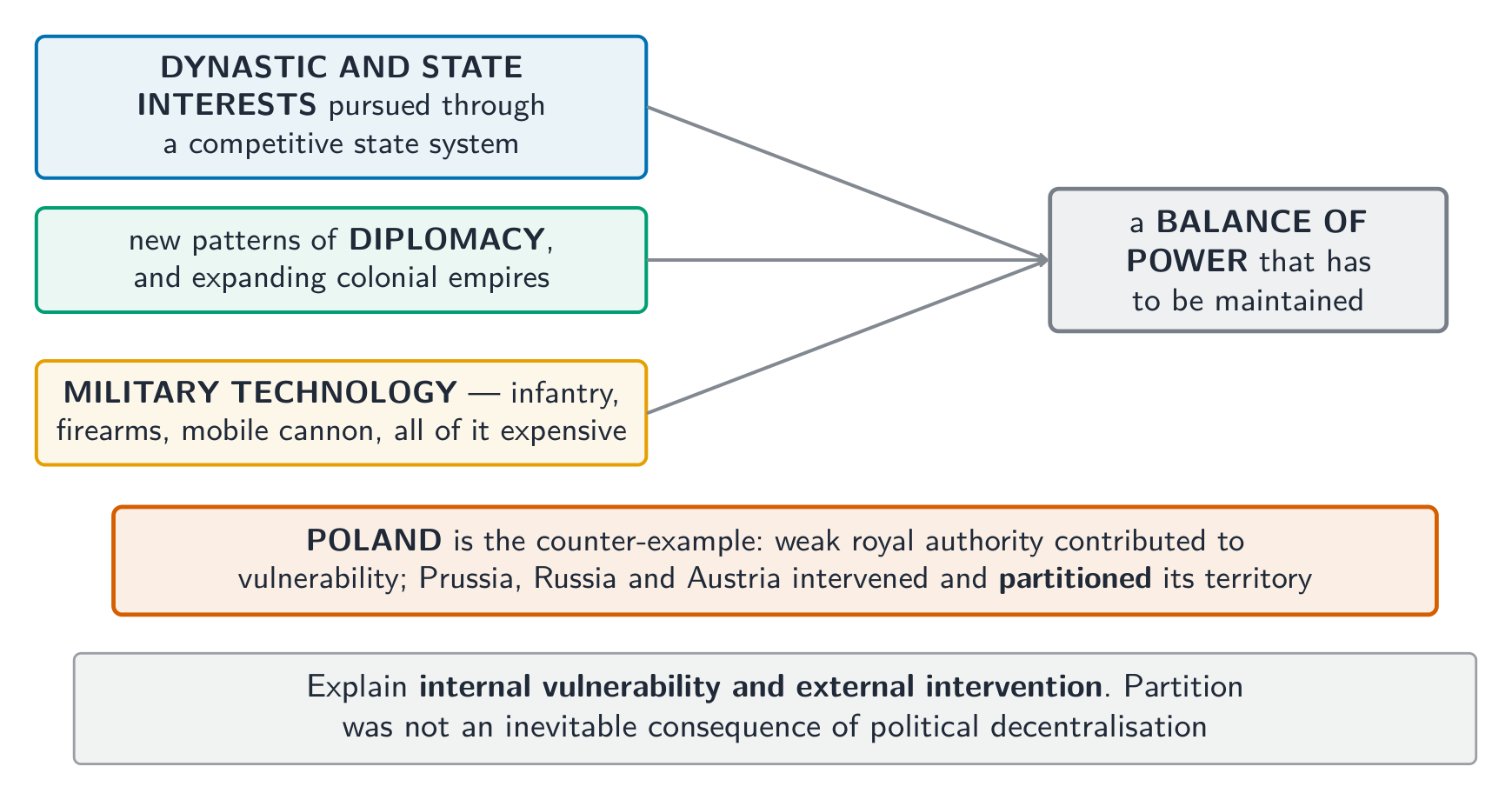
竞争性国家体系(competitive state system)带来了新的外交模式与新的战争形式。1648 年之后,王朝与国家利益,连同不断扩张的殖民帝国,共同驱动着欧洲外交。

有两项具体内容在考查范围内。军事技术的进步造就了新的战争形式——更加倚重步兵、火器与机动火炮,以及只有走向集权的国家才供养得起的常备军。而波兰君主制无法巩固对贵族的权威,导致波兰被普鲁士、俄国与奥地利瓜分(partition)——这是整门课程中最清楚的例证:未能集权是有代价的。

词汇表 训练
英文 中文 拼音
competitive state system 竞争性国家体系 jìng zhēng xìng guó jiā tǐ xì
Poland's partition 波兰被瓜分 bō lán bèi guā fēn
Absolute monarchies limited the nobility's participation in governance but preserved the aristocracy's social position and legal privileges 社会地位与法律特权 shè huì dì wèi yǔ fǎ lǜ tè quán
3.7

专制主义的权力路径

大纲

3.7 Absolutist Approaches to Power

Thematic FocusLearning ObjectiveHistorical Developments

SOP
States and Other Institutions of Power — European states and nations developed governmental and civil institutions from 1450 to the present to organize society and consolidate political power, with a variety of social, cultural, and economic effects.

Unit 3.G
Explain how absolutist forms of rule affected social and political development from 1648 to 1815.

  • KC-2.1.I.A Absolute monarchies limited the nobility’s participation in governance but preserved the aristocracy’s social position and legal privileges.
  • KC-2.1.I.B Louis XIV and his finance minister, Jean-Baptiste Colbert, extended the administrative, financial, military, and religious control of the central state over the French population.
  • KC-2.1.I.E Peter the Great “westernized” the Russian state and society, transforming political, religious, and cultural institutions; Catherine the Great continued this process.

Illustrative examples:

  • Absolute monarchs:
    • James I of England
    • Peter the Great of Russia
    • Philip II, III, and IV of Spain
  • Extended power of the state: §Bullet Intendants §Bullet Modernized, state-controlled military Russian westernization: §Bullet Russian Academy of Sciences §Bullet Education §Bullet Western fashion §Bullet Expanded military

来源:美国大学理事会 AP 课程与考试说明

绝对君主制限制了贵族参与治理,却保留了贵族的社会地位与法律特权(social position and legal privileges)。这一交换是本单元最有用的一句话:绝对主义以不触动社会等级为代价,换取了政治上的服从。

CED 点名的案例:

  • 路易十四(Louis XIV)与其财政大臣柯尔贝尔(Jean-Baptiste Colbert)扩大了对法国国家的行政、财政、军事与宗教控制
  • 彼得大帝(Peter the Great)使俄国国家与社会"西化",改造了政治、宗教与文化制度;叶卡捷琳娜大帝(Catherine the Great)延续了这一方案。
词汇表 训练
英文 中文 拼音
Louis XIV 路易十四 lù yì shí sì
Jean-Baptiste Colbert 柯尔贝尔 kē ěr bèi ěr
Peter the Great 彼得大帝 bǐ dé dà dì
Catherine the Great 叶卡捷琳娜大帝 yè kǎ jié lín nà dà dì
3.8

专制主义与宪政主义时代的比较分析

大纲

3.8 Comparison in the Age of Absolutism and Constitutionalism

Learning ObjectiveReview: Unit 3 Key Concepts

Unit 3.H
Compare the different forms of political power that developed in Europe from 1648 to 1815.

  • KC-1.5 The struggle for sovereignty within and among states resulted in varying degrees of political centralization.
    • KC-1.5.I The new concept of the sovereign state and secular systems of law played a central role in the creation of new political institutions.
    • KC-1.5.III The competition for power between monarchs and corporate and minority language groups produced different distributions of governmental authority in European states.
    • KC-1.5.III.B Monarchies seeking enhanced power faced challenges from nobles who wished to retain traditional forms of shared governance and regional autonomy.
    • KC-1.5.III.C Within states, minority local and regional identities based on language and culture led to resistance against the dominant national group.
  • KC-2.1 Different models of political sovereignty affected the relationship among states and between states and individuals.
    • KC-2.1.I In much of Europe, absolute monarchy was established over the course of the 17th and 18th centuries.
    • KC-2.1.II Challenges to absolutism resulted in alternative political systems.
  • KC-2.2 The expansion of European commerce accelerated the growth of a worldwide economic network.
    • KC-2.2.I Early modern Europe developed a market economy that provided the foundation for its global role.
    • KC-2.2.II The European-dominated worldwide economic network contributed to the agricultural, industrial, and consumer revolutions in Europe.

来源:美国大学理事会 AP 课程与考试说明

本单元考查的推理能力是比较——CED 自身的任务就是比较 1648 至 1815 年间形成的不同政治权力形式。

**Worked example(一道真实的 AP 考题)。*本单元的 AP 欧洲史简答题会要求,例如「解释 1648 至 1815 年间绝对主义与立宪主义政府形式之间的一项差异」。满分答案会以对两者都适用的措辞陈述这一差异:「两者的差异在于主权所在。在绝对主义的法国,路易十四把行政、财政与军事权威集中于王权,并把贵族排除在治理之外。在立宪主义的英国,内战与光荣革命的结果把主权定位于国王与议会共同之处,因此征税与立法都需要议会所代表的有产精英的同意。」*注意其结构:先确立一条比较轴,再在这条轴上衡量两个案例。

3.8

考试技巧

  • 英国内战是精英之间关于各自角色的冲突。不要把 1688 年写成民主。
  • 绝对主义限制政治参与却保留社会特权。这一交换能回答许多题目。
  • 备好一个第三种模式——荷兰共和国。它打破了简单的两分比较,并向阅卷人显示你了解这一时期。
  • 波兰被瓜分是未能集权的代价。它正是其他案例所需要的反例。
  • 经济各节是一条链条:农业、被解放的劳动力、家庭手工业、金融。要点出多个环节,而不是一个。
  • 回答比较题时,选定一条轴并在其上衡量两个案例。两段各自的描述并不构成比较。

本主题的互动课程

逐步学习,并即时检测练习。

AP 欧洲历史的更多主题

登录或创建账号

IGCSE, A-Level & AP