| English | 释义 | 拼音 |
|---|---|---|
| balance of power/ˈbæləns ɒv ˈpaʊə/ | 均势 | jūn shì |
| partition/pɑːˈtɪʃn/ | 瓜分 | guā fēn |
| military revolution | 军事革命 | jūn shì gé mìng |
Poland disappears, 1795
- In 1795, Russia, Prussia and Austria divided the last of Poland between them. Poland had once been one of Europe's largest states, but its nobles elected weak kings and any single noble could block a law in its parliament with the liberum veto. Without a strong army or government, it could not defend itself.
- From 1648, European states competed in a system where only strong, centralized states survived.
Why could Poland not defend itself?
难度 1/5 · 今日首次完成可获 100 金币及少量额外奖励
The liberum veto.
The balance of power
- The balance of power 均势 was the idea that no single state should dominate Europe. When one grew too strong, others joined together against it.
- When Louis XIV tried to put his grandson on the Spanish throne, Britain, the Dutch and Austria fought him in the War of the Spanish Succession (1701–14).
What was the balance of power?
难度 1/5 · 今日首次完成可获 100 金币及少量额外奖励
Coalitions against the strongest state.
Poland: the cost of weakness
- Poland was divided in three partitions 瓜分 — 1772, 1793 and 1795 — by its stronger neighbours.
- Its fate showed rulers that a weak central government could destroy a state.
Diplomacy, military change, or fiscal consequence?
Sort each element of the balance of power.
Put these events in order.
难度 3/5 · 今日首次完成可获 200 金币及少量额外奖励
1713, 1772, 1793, 1795.
Worked example: the military revolution
- Weapons: guns and cannon made old castle walls useless; new star-shaped fortresses (the trace italienne) were built to resist cannon.
- Armies: France's army grew from about 50 000 men in the 1630s to about 400 000 under Louis XIV.
- Result: the military revolution 军事革命 meant only states that could tax heavily and organize well could fight wars.
France's army grew from about 50 000 to about 400 000. By how many times did it grow?
难度 2/5 · 今日首次完成可获 140 金币及少量额外奖励
400 000 ÷ 50 000.
Who could pay?
- Armies of this size needed permanent taxes, government loans and many officials. War was the main reason states grew.
- Britain paid for its wars through the Bank of England and a national debt; Prussia spent most of its budget on its army.
How did states pay for the new warfare?
难度 2/5 · 今日首次完成可获 140 金币及少量额外奖励
War built the state.
Diplomacy
- The Treaty of Utrecht (1713) ended the War of the Spanish Succession: France and Spain could never be joined under one king.
- Ambassadors and treaties became permanent parts of European politics.
The balance of power did not mean peace. It often meant war to stop any one state from becoming too strong. Wars were frequent throughout this period.
The balance of power kept Europe at peace.
难度 1/5 · 今日首次完成可获 100 金币及少量额外奖励
It often caused coalition wars.
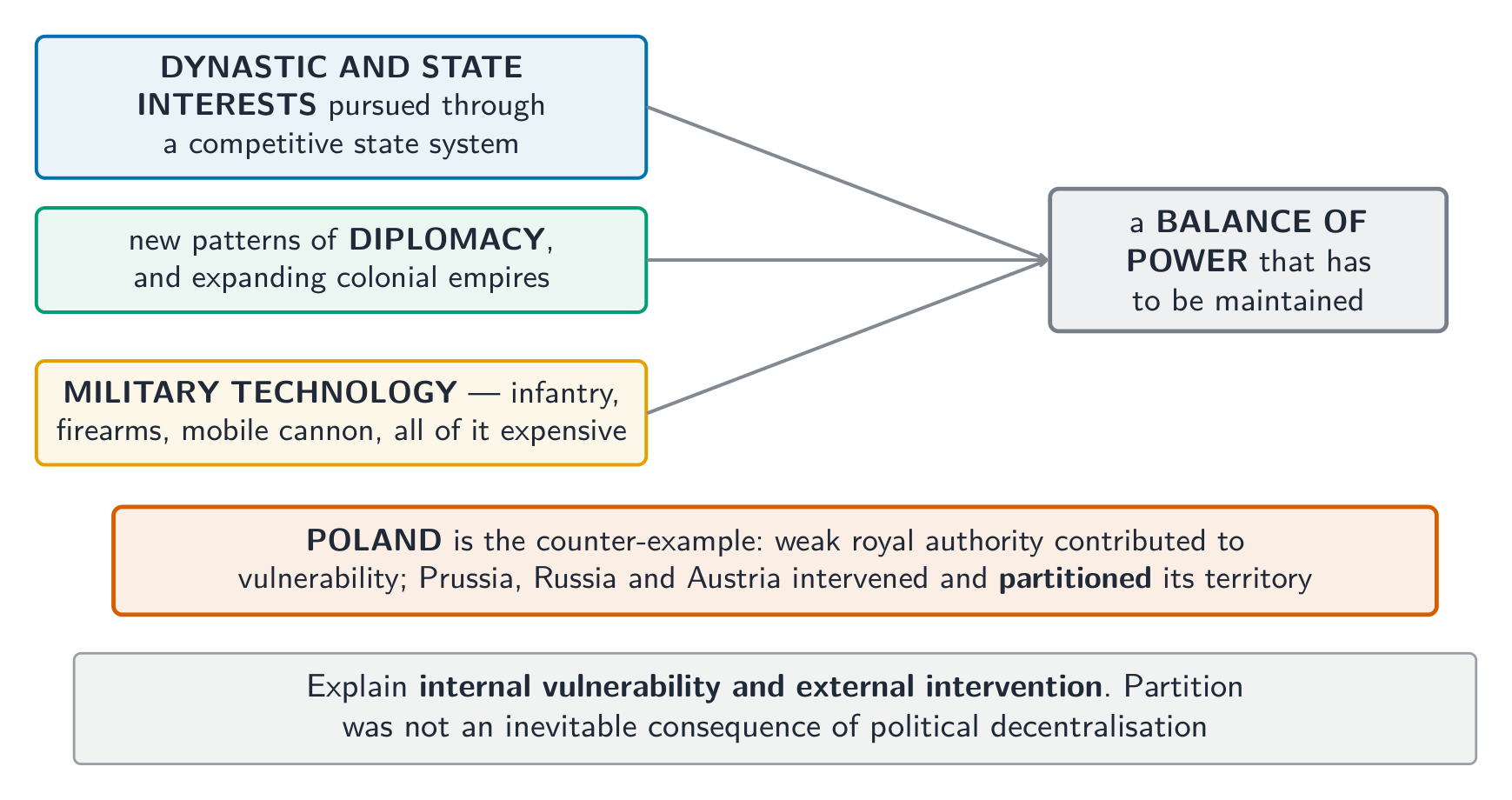
After 1648, states competed in a balance of power, fighting coalition wars against any state that grew too strong. The military revolution made war very expensive, so states built taxes, debts and bureaucracies — and Poland, which failed to centralize, was partitioned out of existence by 1795.
Explain how the military revolution changed European states.
Causation.