| English | 释义 | 拼音 |
|---|---|---|
| emancipation of the serfs/ɪˌmænsɪˈpeɪʃn ɒvðə sɜːfs/ | 农奴解放 | nóng nú jiě fàng |
| Duma | 杜马 | dù mǎ |
Barricades in Paris, February 1848
- In February 1848, Parisians angry about hunger, unemployment and a narrow right to vote built barricades in the streets. Within three days King Louis-Philippe gave up his throne and fled to England. Within weeks, revolutions broke out in Vienna, Berlin, Milan, Budapest and dozens of other cities.
- In the nineteenth century, many groups tried to overturn the existing order.
Why 1848?
- Bad harvests in 1845–47, including the potato blight that caused famine in Ireland, raised food prices and caused unemployment.
- Liberals wanted constitutions and wider voting rights; nationalists wanted states for Germans, Italians and Hungarians; workers wanted jobs.
Which caused the revolutions of 1848?
难度 2/5 · 今日首次完成可获 140 金币及少量额外奖励
Hardship, liberalism, nationalism.
Why the revolutions failed
- Revolutionaries were divided: middle-class liberals feared radical workers, and different nationalities fought each other.
- Armies stayed loyal to monarchs. By 1849, kings and emperors had regained control; the Frankfurt Parliament's offer of a German crown was refused by the king of Prussia, who called it a "crown from the gutter".
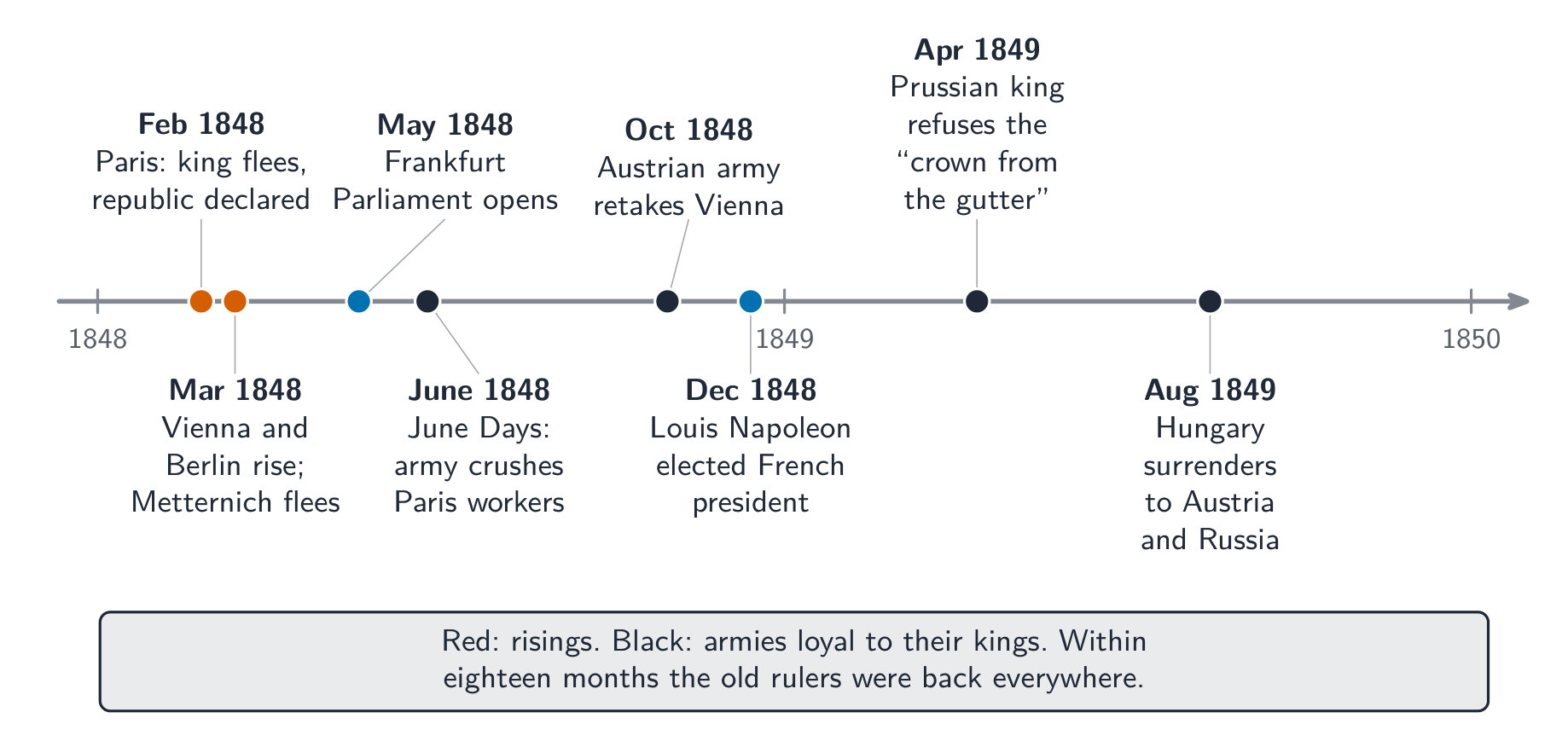
Why did most 1848 revolutions fail?
难度 1/5 · 今日首次完成可获 100 金币及少量额外奖励
Division and force.
Worked example: reform and revolution in Russia
- Reform from above: after defeat in the Crimean War, Tsar Alexander II's emancipation of the serfs 农奴解放 (1861) freed about 23 million people, but forced them to pay for land.
- Revolution from below: disappointed radicals formed secret groups; one, the People's Will, assassinated Alexander II in 1881.
- 1905: after troops fired on peaceful marchers on "Bloody Sunday", strikes forced Nicholas II to create an elected Duma 杜马 — which he then largely ignored. Each concession raised hopes that were then disappointed.
A trigger, an event, or a consequence?
Sort each element of the reaction against the order.
Put these Russian events in order.
难度 3/5 · 今日首次完成可获 200 金币及少量额外奖励
1861, 1881, 1905, 1905–06.
About how many million serfs were freed in Russia in 1861?
难度 2/5 · 今日首次完成可获 140 金币及少量额外奖励
About 23 million.
What 1848 did change
- Serfdom was abolished in Austria in 1848, and Prussia gained a constitution, though a limited one.
- France briefly had universal male suffrage, which elected Louis-Napoleon Bonaparte, who soon made himself Emperor Napoleon III.
The revolutions of 1848 ended serfdom in the Austrian Empire.
难度 1/5 · 今日首次完成可获 100 金币及少量额外奖励
A lasting change.
Who resisted the order
- Liberals, nationalists, socialists and anarchists all challenged the conservative order created at the Congress of Vienna (1815).
- Their goals often clashed, which helped conservatives survive.
The 1848 revolutions were not simply failures. They did not create lasting liberal nation-states, but they ended serfdom in Austria, and their ideas returned in the unifications of Italy and Germany.
The revolutions of 1848 achieved nothing lasting.
难度 1/5 · 今日首次完成可获 100 金币及少量额外奖励
Serfdom ended in Austria, and their ideas returned.
Economic hardship and liberal and nationalist demands produced the revolutions of 1848, which failed because revolutionaries were divided and armies stayed loyal. In Russia, reform from above — the emancipation of the serfs — was followed by revolutionary violence and the 1905 revolution.
Explain why the revolutions of 1848 broke out and why most of them failed.
Causation.