Skip to content · ⁨ข้ามไปยังเนื้อหา⁩

The price system and the microeconomy · ⁨ระบบราคาและจุลเศรษฐศาสตร์ (Microeconomy)⁩

A-Level Economics · ⁨Economics A-Level⁩ · Topic 2 · ⁨หัวข้อ 2⁩

Video lesson for this topic · ⁨บทเรียนวิดีโอสำหรับหัวข้อนี้⁩ Open the video page · ⁨เปิดหน้าวิดีโอ⁩
16:11

ระบบราคาและจุลเศรษฐศาสตร์ (Microeconomy)

ไม่มีใครในตลาดนี้เป็นผู้บังคับบัญชา ไม่มีผู้ใดตัดสินใจว่ามะเขือเทศหนึ่งกิโลกรัมควรมีราคาเท่าไร ทว่าทุกร้านมีราคา และมีเกือบทุกอย่างทั้งหมดแล้วเมื่อถึงเย็น…

English narration · English + 中文 subtitles burned in · ⁨การบรรยายภาษาอังกฤษ · คำบรรยายภาษาอังกฤษ + 中文 ลอยตัวบนภาพ⁩

2.1

Demand · ⁨ความต้องการ⁩

Syllabus · ⁨หลักสูตร⁩
English
  1. explain the determinants of demand and supply and distinguish movements along from shifts of the curves
  2. derive individual and market demand and supply
  3. explain the relationship between marginal utility and the demand curve
ไทย
  1. อธิบายปัจจัยกำหนด ความต้องการ และ การเสนอขาย以及แยกแยะการเคลื่อนที่ตามเส้นกับเส้นเลื่อน
  2. สันนิษฐานความต้องการและเสนอขายรายบุคคลและตลาด
  3. อธิบายความสัมพันธ์ระหว่าง ** Utility边际** และเส้นความต้องการ

Source: Cambridge International syllabus · ⁨แหล่งที่มา: หลักสูตร Cambridge International⁩

English
Demand shifts right: P and Q rise

demand 需求 is the quantity of a good that buyers are willing and able to buy at each price 价格 in a period of time. It is not just a wish — buyers must also be able to pay.

The law of demand says: when the price rises, the quantity demanded 需求量 falls; when the price falls, the quantity demanded rises. Price and quantity move in opposite directions.

So the demand curve 需求曲线 slopes downward, from top-left to bottom-right.

What shifts the demand curve

A change in the good's own price is shown as a movement along the demand curve. A change in any other cause shifts the whole curve to a new position — this is a shift 移动 of demand. The main causes (the determinants 决定因素) are:

  • income 收入 — for most goods, higher income raises demand.
  • the price of a substitute 替代品 — a good you can use instead (tea for coffee). If the substitute's price rises, demand for this good rises.
  • the price of a complement 互补品 — a good used together with this one (cars and petrol). If the complement's price rises, demand for this good falls.
  • tastes and fashion, the size of the population, and advertising.

Individual and market demand

One consumer 消费者 has an individual demand. The market demand 市场需求 is found by adding up the quantity that all consumers want at each price (adding the curves sideways).

Marginal utility and demand

utility 效用 is the satisfaction you get from consuming a good. marginal utility 边际效用 is the extra utility from one more unit.

The law of diminishing marginal utility 边际效用递减 says each extra unit gives less extra satisfaction than the one before. Because later units are worth less to you, you will only buy them at a lower price. This is why the demand curve slopes downward.

ไทย
อุปสงค์ shifted ขวา: ราคา (P) และปริมาณ (Q) เพิ่มขึ้น

ความต้องการ คือปริมาณของสินค้าที่ผู้ซื้อมีทั้งความตั้งใจและมีความสามารถในการซื้อในราคาต่างๆ ในช่วงเวลาหนึ่งๆ ไม่ใช่แค่ความปรารถนาเท่านั้น ผู้ซื้อ还必须ต้องสามารถชำระเงินได้

กฎแห่งความต้องการ บอกว่า: เมื่อราคาสูงขึ้น ปริมาณที่ต้องการซื้อ จะลดลง; เมื่อราคาลง ปริมาณที่ต้องการซื้อจะเพิ่มขึ้น ราคาและปริมาณเคลื่อนไหวไปในทิศทางตรงกันข้าม

ดังนั้น เส้นโค้งความต้องการ จึงลาดลงจากมุมบนซ้ายไปมุมล่างขวา

ปัจจัยที่ทำให้เส้นโค้งความต้องการเคลื่อนที่

การเปลี่ยนแปลงราคาของสินค้านั้นๆ เอง แสดงเป็นการ เคลื่อนที่ตาม เส้นโค้งความต้องการ การเปลี่ยนแปลงปัจจัยอื่นใดจะทำให้ทั้งเส้นโค้งเคลื่อนที่ไปยังตำแหน่งใหม่ — นี่คือ การเลื่อน ของความต้องการ ปัจจัยหลัก (หรือ ตัวกำหนด) ได้แก่:

  • รายได้ — สำหรับสินค้าส่วนใหญ่ รายได้ที่สูงขึ้นจะทำให้ความต้องการเพิ่มขึ้น
  • ราคาของสินค้า ทดแทน — สินค้าที่คุณสามารถใช้แทนได้ (ชาแทนกาแฟ) หากราคาสินค้าทดแทนสูงขึ้น ความต้องการสินค้านี้จะเพิ่มขึ้น
  • ราคาของสินค้า เสริม — สินค้าที่ใช้คู่กับสินค้านี้ (รถยนต์กับน้ำมัน) หากราคาสินค้าเสริมสูงขึ้น ความต้องการสินค้านี้จะลดลง
  • รสนิยมและแฟชั่น, ขนาดประชากร และการโฆษณา
เส้นโค้งความต้องการลาดลงพร้อมการเคลื่อนที่ไปทางขวาและซ้าย
การเปลี่ยนแปลงรายได้อารมณ์หรือราคาที่เกี่ยวข้อง จะทำให้ทั้งเส้นโค้งเคลื่อนที่ ($D_1$ ไปทางขวา, $D_2$ ไปทางซ้าย); การเปลี่ยนแปลงราคาของสินค้านั้นๆ เอง คือการเคลื่อนที่ตามเส้นโค้ง

ความต้องการส่วนบุคคลและความต้องการในตลาด

ผู้บริโภคหนึ่งคนมีความต้องการส่วนบุคคล ความต้องการในตลาด ได้จากการนำปริมาณที่ผู้บริโภคทุกคนต้องการที่ราคาต่างๆ มารวมกัน (โดยการรวมเส้นโค้งเข้าด้วยกันในแนวตั้ง)

ประโยชน์ส่วนเพิ่มและความต้องการ

ประโยชน์ คือความพึงพอใจที่คุณได้รับจากการบริโภคสินค้า ประโยชน์ส่วนเพิ่ม คือประโยชน์ส่วนเพิ่มที่ได้จากการบริโภคอีกหนึ่งหน่วย

กฎของ ประโยชน์ส่วนเพิ่มที่ลดลง บอกว่าทุกหน่วยเพิ่มเติมให้ผลของความพึงพอใจส่วนเพิ่มน้อยกว่าหน่วยก่อนหน้า เนื่องจากหน่วยถัดไปมีค่าต่อคุณน้อยลง คุณจึงจะซื้อเฉพาะเมื่อราคาถูกลงนี่คือเหตุผลที่เส้นโค้งความต้องการลาดลง

กราฟแท่งแสดงประโยชน์ส่วนเพิ่มที่ลดลงเมื่อบริโภคเพิ่มเติมแต่ละหน่วย โดยแท่งจะสั้นลงจากหน่วยที่หนึ่งถึงหน่วยที่ห้า
ทุกหน่วยเพิ่มเติมให้ความพึงพอใจน้อยกว่าหน่วยสุดท้าย — ดังนั้นผู้ซื้อจะยอมจ่ายน้อยลงสำหรับหน่วยที่ตามมา นั่นเป็นเหตุผลที่ความต้องการลาดลง
Explore · ⁨สำรวจ⁩

Demand & supply · ⁨อุปสงค์ & อุปทาน (Demand & supply)⁩

Demand slopes down — a lower price, more is wanted. · ⁨อุปสงค์ มีแนวโน้มลดลง — ราคา越低,ต้องการ越多 (lower price, more is wanted).⁩

Vocabulary · ⁨คำศัพท์⁩ Train · ⁨ฝึกฝน⁩
English ไทย
demand/dɪˈmænd/ ความต้องการ
shift/ʃɪft/ 平移
determinants/dɪˈtɜːmɪnənts/ ปัจจัยกำหนด
utility/juːˈtɪlɪti/ Utility
marginal utility/ˈmɑːdʒɪnl juːˈtɪlɪti/ utility边际
diminishing marginal utility/dɪˈmɪnɪʃɪŋ ˈmɑːdʒɪnl juːˈtɪlɪti/ Utility边际ลดลง
supply/səˈplaɪ/ อุปทาน
producer/prəˈdjuːsə/ ผู้ผลิต
Watch lesson · ⁨ดูบทเรียน⁩
2.1

Supply · ⁨Offer⁩

English

supply 供给 is the quantity of a good that producers 生产者 are willing and able to sell at each price in a period of time.

The law of supply says: when the price rises, the quantity supplied 供给量 rises. Higher prices mean more profit 利润, so firms make more. So the supply curve 供给曲线 slopes upward.

What shifts the supply curve

A change in the good's own price is a movement along the supply curve. Other causes shift the whole curve:

  • costs of production 生产成本 — if wages, raw materials or rent get dearer, supply falls.
  • technology — better machines raise supply.
  • a subsidy 补贴 (government payment to producers) raises supply; an indirect tax lowers it.
  • the number of firms 企业 in the market, and weather (for farm goods).

Individual and market supply

The market supply 市场供给 is found by adding up the quantity all firms will sell at each price.

ไทย

** عرضه** คือปริมาณของสินค้าที่ ผู้ผลิต มีทั้งความตั้งใจและความสามารถในการขายในราคาต่างๆ ในช่วงเวลาหนึ่ง

กฎของอุปทานระบุว่า: เมื่อราคาเพิ่มขึ้น ปริมาณที่เสนอขาย ก็เพิ่มขึ้น ราคาที่สูงขึ้นหมายถึงกำไรที่มากขึ้น ดังนั้นบริษัทจึงผลิตมากขึ้น ดังนั้น เส้นอุปทาน จึงมีแนวโน้มชันขึ้น

สิ่งที่ทำให้เส้นอุปทานเลื่อนตำแหน่ง

การเปลี่ยนแปลงในราคาของสินค้านั้นๆ เป็นเพียงการเคลื่อนที่ตามเส้นอุปทาน ส่วนสาเหตุอื่นๆ จะทำให้ทั้งเส้นเลื่อนไป:

  • ต้นทุนการผลิต — หากค่าแรง วัตถุดิบ หรือค่าเช่าแพงขึ้น ปริมาณที่เสนอขายจะลดลง
  • เทคโนโลยี — เครื่องจักรที่ดีขึ้นจะทำให้ปริมาณที่เสนอขายเพิ่มขึ้น
  • เงินอุดหนุน (เงินที่รัฐบาลจ่ายให้ producent) ทำให้ปริมาณที่เสนอขายเพิ่มขึ้น;而 indirect tax (ภาษีทางอ้อม) จะทำให้มันลดลง
  • จำนวน บริษัท ในตลาด และสภาพอากาศ (สำหรับสินค้าเกษตร)
เส้นโค้งอุปทานที่เอียงขึ้นพร้อมกับการ SHIFT ไปทางขวาและซ้าย
ต้นทุนที่ต่ำลง เทคโนโลยีที่ดีขึ้นหรือการได้รับเงินอุดหนุน会使อุปทานเลื่อนไปทางขวา ($S_1$); whereas higher costs or a tax shift it left ($S_2$).

อุปทานรายบุคคลและอุปทานตลาด

อุปทานตลาด หาได้จากการรวมปริมาณที่บริษัททั้งหมดจะขายในทุกๆ ระดับราคาเข้าด้วยกัน

Explore · ⁨สำรวจ⁩

Demand & supply · ⁨อุปสงค์ & อุปทาน (Demand & supply)⁩

Supply slopes up — a higher price, more is produced. · ⁨อุปทาน มีแนวโน้มเพิ่มขึ้น — ราคา越高,ผลิต越多 (higher price, more is produced).⁩

2.2

Price elasticity of demand · ⁨ความยืดหยุ่นของราคาต่อปริมาณความต้องการ⁩

Syllabus · ⁨หลักสูตร⁩
English
  1. define, calculate and interpret price elasticity of demand (PED), income elasticity (YED) and cross elasticity (XED)
  2. explain the determinants of each and the relationship between PED and total revenue/expenditure
  3. explain the usefulness of elasticities to firms and government
ไทย
  1. นิยาม, คำนวณและตีความ ความยืดหยุ่นของราคา (PED), ความยืดหลุมของรายได้ (YED) และ ความยืดหลุมของราคา (XED)
  2. อธิบายปัจจัยกำหนดของแต่ละชนิด以及ความสัมพันธ์ระหว่าง PED และ รายได้รวม/รายจ่าย
  3. อธิบายประโยชน์ของความยืดหลุมต่อธุรกิจและรัฐบาล

Source: Cambridge International syllabus · ⁨แหล่งที่มา: หลักสูตร Cambridge International⁩

English
Supply shifts right: P falls, Q rises

price elasticity of demand 需求价格弹性 (PED) measures how much the quantity demanded responds when the price changes.

$$\text{PED} = \frac{\%\ \text{change in quantity demanded}}{\%\ \text{change in price}}$$

PED is normally negative (because of the law of demand), but we usually look at the size and drop the minus sign.

Worked example. The price of a good rises by 10% and the quantity demanded falls by 25%. Find the PED and classify the demand.

$$\text{PED} = \frac{-25}{10} = -2.5$$

Ignoring the minus sign, $2.5 > 1$, so demand is elastic — quantity responded much more than the price did.

Value Name Meaning
more than 1 elastic 富有弹性 quantity responds a lot
less than 1 inelastic 缺乏弹性 quantity responds a little
equal to 1 unit elastic 单位弹性 quantity changes by the same % as price
0 perfectly inelastic 完全无弹性 quantity does not change at all
infinity perfectly elastic 完全有弹性 any price rise sends demand to zero

What makes demand elastic or inelastic

  • the number and closeness of substitutes (more substitutes → more elastic).
  • whether the good is a necessity 必需品 (inelastic) or a luxury 奢侈品 (elastic).
  • the share of income spent on the good (a large share → more elastic).
  • time — demand is more elastic in the long run, when buyers can find other options.
  • habit or addiction makes demand inelastic.

PED and total revenue

total revenue 总收益 is the money a firm earns: $\text{TR} = \text{price} \times \text{quantity}$. PED tells a firm what happens to revenue when it changes the price:

If demand is… price rises price falls
inelastic total revenue rises total revenue falls
elastic total revenue falls total revenue rises
unit elastic total revenue stays the same total revenue stays the same

This is useful to firms (how to price for more revenue) and to governments 政府 (a tax on an inelastic good, like petrol, raises a lot of revenue without cutting sales much).

ไทย
อุปทานเลื่อนไปทางขวา: P ลดลง, Q เพิ่มขึ้น

ความยืดหยุ่นของราคาต่อปริมาณความต้องการ (PED) วัดว่าเมื่อราคาเปลี่ยนไป ปริมาณความต้องการจะตอบสนองมากน้อยเพียงใด

$$\text{PED} = \frac{\%\ \text{change in quantity demanded}}{\%\ \text{change in price}}$$

PED มักจะเป็นค่าลบ (เนื่องจากกฎของความ Demand) แต่เรามักดูที่ขนาดของตัวเลขและตัดเครื่องหมายลบออก

ตัวอย่างวิธีทำ. ราคาของสินค้าเพิ่มขึ้น 10% และปริมาณความต้องการลดลง 25% จงหาค่า PED และจำแนกประเภทของ demand

$$\text{PED} = \frac{-25}{10} = -2.5$$

โดยovable the minus sign, $2.5 > 1$, so demand is elastic — quantity responded much more than the price did.

สถานีบริการน้ำมัน: น้ำมันมี demand ที่ไม่ยืดหยุ่นต่อราคา ดังนั้นเมื่อราคาสูงขึ้น ปริมาณการซื้อจึงลดลงเพียงเล็กน้อย
น้ำมันมี demand ที่ไม่ยืดหยุ่นต่อราคา: ผู้ขับขี่จำเป็นต้องซื้อมัน ดังนั้นเมื่อราคาสูงขึ้น ปริมาณการซื้อจึงลดลงเพียงเล็กน้อย.
ค่า ชื่อ ความหมาย
มากกว่า 1 ยืดหยุ่น ปริมาณตอบสนองมาก
น้อยกว่า 1 ไม่ยืดหยุ่น ปริมาณตอบสนองน้อย
เท่ากับ 1 ยืดหยุ่นหนึ่งหน่วย ปริมาณเปลี่ยนในเปอร์เซ็นต์เท่ากันกับราคา
0 ไม่ยืดหยุ่นอย่างสมบูรณ์ ปริมาณไม่เปลี่ยนแปลงเลย
อสมมติ ยืดหยุ่นอย่างสมบูรณ์ ราคาเพิ่มขึ้นเล็กน้อยทำให้ความต้องการเป็นศูนย์
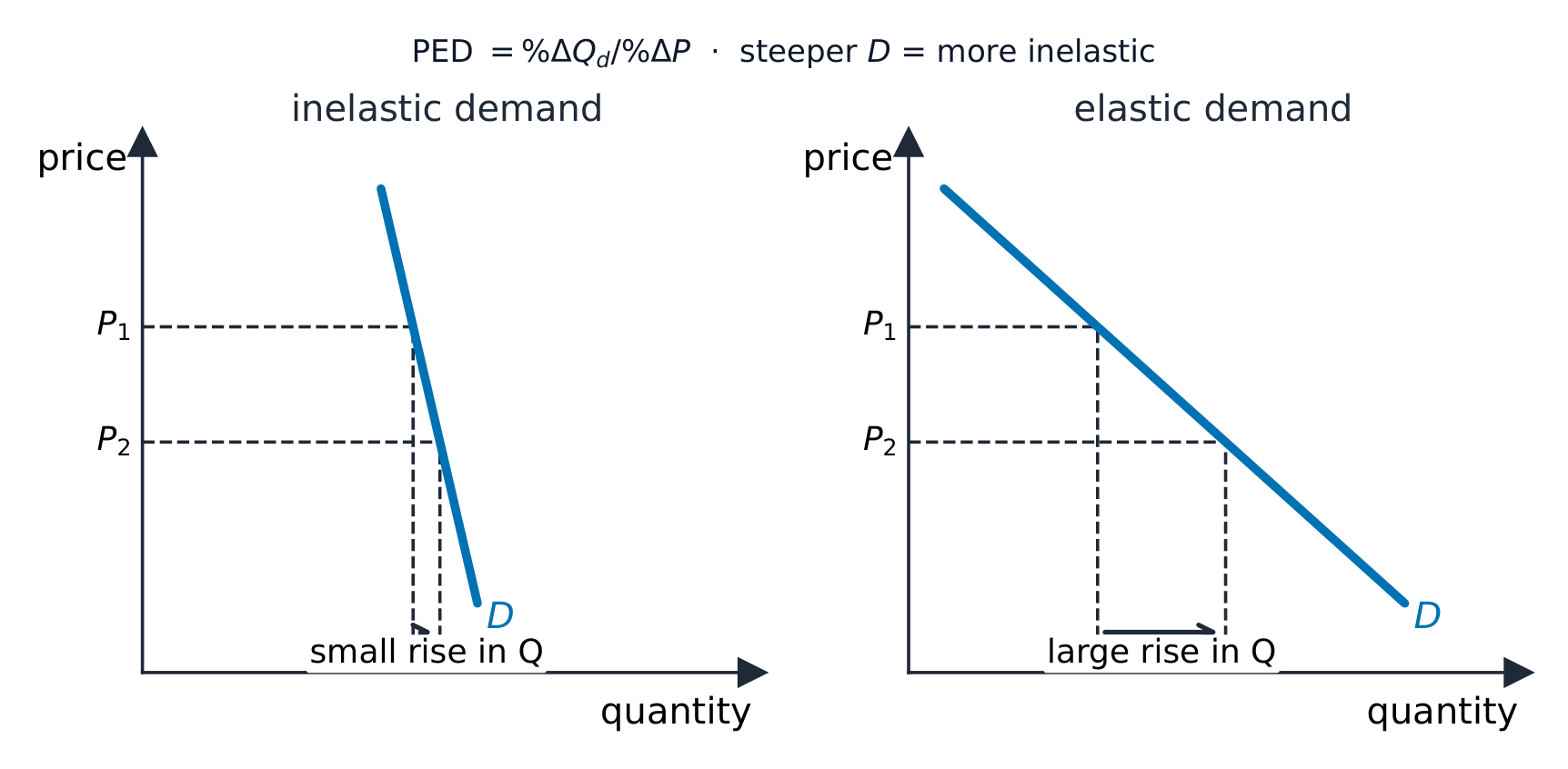
เส้นความต้องการที่ไม่ยืดหยุ่นชันอยู่ข้างเส้นที่ต้องการที่ยืดหยุ่นแบน
เมื่อความต้องการไม่ยืดหยุ่น (ชัน) การเปลี่ยนแปลงราคามีผลต่อปริมาณเพียงเล็กน้อย; แต่เมื่อต้องการยืดหยุ่น (แบน) การเปลี่ยนแปลงราคาเดียวกันจะมีผลต่อปริมาณมาก.

ปัจจัยที่ทำให้ความต้องการยืดหยุ่นหรือไม่ยืดหยุ่น

  • จำนวนและความเป็น替代品 ของสินค้า (มี替代品มากขึ้น → ยืดหยุ่นมากขึ้น).
  • สินค้าเป็น ของจำเป็น (ไม่ยืดหยุ่น) หรือ ของฟุ่มเฟือย (ยืดหยุ่น).
  • สัดส่วนรายได้ที่ใช้ซื้อสินค้า (สัดส่วนมาก → ยืดหยุ่นมากขึ้น)
  • เวลา — ความต้องการมีแนวโน้มยืดหยุ่นมากขึ้นในระยะยาว เมื่อผู้ซื้อสามารถหาทางเลือกอื่นได้
  • นิสัยหรือความติดขัดทำให้ความต้องการไม่ยืดหยุ่น

ความยืดหยุ่นของราคาต่อปริมาณต้องการ (PED) และรายได้รวม

รายได้รวม คือเงินที่บริษัทได้รับ: $\text{TR} = \text{price} \times \text{quantity}$. PED บอกบริษัทว่ารายได้จะเปลี่ยนแปลงอย่างไรเมื่อปรับราคา:

หากความต้องการ… ราคาเพิ่มขึ้น ลดลง
ไม่ยืดหยุ่น รายได้รวมเพิ่มขึ้น รายได้รวมลดลง
ยืดหยุ่น รายได้รวมลดลง รายได้รวมเพิ่มขึ้น
ยืดหยุ่นเท่ากัน (Unit Elastic) รายได้รวมคงที่ รายได้รวมคงที่

สิ่งนี้ประโยชน์ต่อบริษัท (การกำหนดราคาเพื่อเพิ่มรายได้) และต่อ รัฐบาล (ภาษีบนสินค้าที่ไม่ยืดหยุ่น เช่น น้ำมันเบนซิน สามารถสร้างรายได้สูงโดยไม่ลดยอดขายมากนัก)

Vocabulary · ⁨คำศัพท์⁩ Train · ⁨ฝึกฝน⁩
English ไทย
price/praɪs/ ราคา
quantity demanded/ˈkwɒntɪti dɪˈmændɪd/ ปริมาณที่ต้องการ
demand curve/dɪˈmænd kɜːv/ เส้นความต้องการ
elastic/ɪˈlæstɪk/ ยืดหยุ่น
inelastic/ɪnɪˈlæstɪk/ ไม่ยืดหยุ่น (inelastic)
unit elastic/ˈjuːnɪt ɪˈlæstɪk/ ความยืดหยุ่นเท่าหน่วย
perfectly inelastic/ˈpɜːfektlɪ ɪnɪˈlæstɪk/ ไม่ยืดหยุ่นอย่างสมบูรณ์
perfectly elastic/ˈpɜːfektlɪ ɪˈlæstɪk/ ยืดหยุ่นสมบูรณ์ (perfectly elastic)
necessity/nəˈsesɪti/ necessity
luxury/ˈlʌkʃəri/ สินค้าฟุ่มเฟือย
total revenue/ˈtəʊtl ˈrevənjuː/ รายได้รวม
government/ˈɡʌvənmənt/ รัฐบาล
income elasticity of demand/ˈɪŋkʌm ɪlæˈstɪsɪti ɒv dɪˈmænd/ ความยืดหยุ่นต่อรายได้
normal good/ˈnɔːml ɡʊd/ สินค้าปกติ (normal good)
Watch lesson · ⁨ดูบทเรียน⁩
2.2

Income elasticity of demand · ⁨ความยืดหยุ่นของรายได้ต่อปริมาณต้องการ⁩

English

income elasticity of demand 需求收入弹性 (YED) measures how much demand responds when income changes.

$$\text{YED} = \frac{\%\ \text{change in quantity demanded}}{\%\ \text{change in income}}$$
  • a normal good 正常品 has positive YED: demand rises as income rises. Necessities have YED between 0 and 1; luxuries have YED above 1.
  • an inferior good 低档品 has negative YED: demand falls as income rises (people switch to better goods). An example is cheap instant noodles.

Worked example. A person's income rises by 20% and their demand for restaurant meals rises by 30%. Find the YED and classify the good.

$$\text{YED} = \frac{+30}{+20} = +1.5$$

YED is positive and greater than 1, so restaurant meals are a normal good — and a luxury.

This helps firms plan: as incomes grow, demand for luxuries grows fastest.

ไทย

ความยืดหยุ่นของรายได้ต่อปริมาณต้องการ (YED) วัดว่าความต้องการเปลี่ยนแปลงมากน้อยเพียงใดเมื่อรายได้เปลี่ยนไป

เมื่อรายได้เพิ่มขึ้น ความต้องการสินค้าปกติจะเพิ่มขึ้น แต่ความต้องการสินค้าคุณภาพต่ำจะลดลง
เมื่อรายได้เพิ่มขึ้น ความต้องการสินค้าปกติ会增加แต่สินค้าด้อยคุณภาพจะลดลง
$$\text{YED} = \frac{\%\ \text{change in quantity demanded}}{\%\ \text{change in income}}$$
  • สินค้าปกติ มี YED เป็นบวก: ความต้องการเพิ่มขึ้นเมื่อรายได้เพิ่มขึ้น สินค้าจำเป็นมี YED ระหว่าง 0 ถึง 1; สินค้าหรูมี YED มากกว่า 1
  • สินค้าคุณภาพต่ำ (Inferior Good) มี YED เป็นลบ: ความต้องการลดลงเมื่อรายได้เพิ่มขึ้น (ผู้บริโภคเปลี่ยนไปใช้สินค้าที่ดีขึ้น) ตัวอย่างเช่น บะหมี่กึ่งสำเร็จรูปราคาถูก

ตัวอย่างคำนวณ. รายได้ของผู้บริโภคเพิ่มขึ้น 20% และความต้องการอาหารในร้านอาหารเพิ่มขึ้น 30% จงหาค่า YED และจัดประเภทสินค้า

$$\text{YED} = \frac{+30}{+20} = +1.5$$

YED เป็นบวกและมากกว่า 1 ดังนั้นอาหารในร้านอาหารจึงเป็นสินค้าปกติ — และเป็นสินค้าหรู

สิ่งนี้ช่วยบริษัทวางแผน: เมื่อรายได้เพิ่มขึ้น ความต้องการสินค้าหรูจะเพิ่มขึ้นเร็วที่สุด

Vocabulary · ⁨คำศัพท์⁩ Train · ⁨ฝึกฝน⁩
English ไทย
income/ˈɪŋkʌm/ รายได้
substitute/ˈsʌbstɪtjuːt/ แทนที่
complement/ˈkɒmplɪmənt/ คอมพลีเมนต์
consumer/kənˈsuːmə/ ผู้บริโภค
market demand/ˈmɑːkɪt dɪˈmænd/ ความต้องการในตลาด
inferior good/ɪnˈfɪərɪə ɡʊd/ สินค้าด้อยคุณภาพ (inferior good)
cross elasticity of demand/krɒs ɪlæˈstɪsɪti ɒv dɪˈmænd/ ความยืดหยุ่นข้ามกันของความต้องการ
price elasticity of supply/praɪs ɪlæˈstɪsɪti ɒv səˈplaɪ/ ความยืดหยุ่นของราคาต่อปริมาณเสนอขาย
spare capacity/speə kəˈpæsɪti/ กำลังการผลิตสำรอง
stocks/stɒks/ สินค้าคงคลัง
2.2

Cross elasticity of demand · ⁨ความยืดหยุ่นข้าม (Cross elasticity of demand)⁩

English

cross elasticity of demand 需求交叉弹性 (XED) measures how much demand for one good responds when the price of another good changes.

$$\text{XED} = \frac{\%\ \text{change in quantity demanded of A}}{\%\ \text{change in price of B}}$$
  • for substitutes, XED is positive (the price of B rises, so people buy more A).
  • for complements, XED is negative (the price of B rises, so people buy less A and less B).
  • for goods that are not related, XED is about zero.

Worked example. When the price of tea rises by 10%, the quantity of coffee demanded rises by 4%. Find the XED and say how the two goods are related.

$$\text{XED} = \frac{+4}{+10} = +0.4$$

XED is positive, so tea and coffee are substitutes.

This helps a firm watch its rivals: if XED with a rival's good is high and positive, a price cut by the rival will hurt its sales.

ไทย

ความยืดหยุ่นข้าม (XED) วัดว่าความต้องการของสินค้าหนึ่งจะตอบสนองต่อการเปลี่ยนแปลงราคาของ สินค้าอื่น มากน้อยเพียงใด

$$\text{XED} = \frac{\%\ \text{change in quantity demanded of A}}{\%\ \text{change in price of B}}$$
  • สำหรับ สินค้าทดแทน, XED เป็นบวก (ราคา B เพิ่มขึ้น ผู้คนจึงซื้อ A มากขึ้น)
  • สำหรับ สินค้าประกอบ, XED เป็นลบ (ราคา B เพิ่มขึ้น ผู้คนจึงซื้อ A น้อยลงและ B น้อยลง)
  • สำหรับสินค้าที่ไม่มีสัมพันธ์กัน, XED จะอยู่ที่ประมาณศูนย์

ตัวอย่างคำนวณ. เมื่อราคาชาเพิ่มขึ้น 10% ปริมาณกาแฟที่ต้องการเพิ่มขึ้น 4% จงหาค่า XED และบอกความสัมพันธ์ของสินค้าทั้งสอง

$$\text{XED} = \frac{+4}{+10} = +0.4$$
สามการ์ด: ราคาชาเพิ่มขึ้นทำให้ความต้องการกาแฟเพิ่มขึ้น ทำให้ XED เป็นบวกสำหรับสินค้าทดแทน; ราคาเครื่องพิมพ์เพิ่มขึ้นทำให้ความต้องการหมึกลดลง ทำให้ XED เป็นลบสำหรับสินค้าประกอบ; สินค้าที่ไม่มีสัมพันธ์กันจะมี XED Near zero
เครื่องหมายของ XED: เป็นบวกสำหรับสินค้าทดแทน, เป็นลบสำหรับสินค้าประกอบ, ประมาณศูนย์สำหรับสินค้าที่ไม่มีสัมพันธ์กัน

XED เป็นบวก ดังนั้นชาและกาแฟจึงเป็นสินค้าทดแทน

สิ่งนี้ช่วยบริษัทสังเกตคู่แข่ง: หาก XED กับสินค้าของคู่แข่งมีค่าสูงและเป็นบวก การลดราคาสินค้าของคู่แข่งจะทำให้ยอดขายของบริษัทเราเสียหาย

2.3

Price elasticity of supply · ⁨ความยืดหยุ่นของราคาต่อปริมาณเสนอขาย⁩

Syllabus · ⁨หลักสูตร⁩
English
  1. define, calculate and interpret price elasticity of supply (PES)
  2. explain the determinants of PES, including time period (momentary, short run, long run)
ไทย
  1. นิยาม, คำนวณและตีความ ความยืดหลุมของราคาของการเสนอขาย (PES)
  2. อธิบายปัจจัยกำหนด PES, รวมถึงช่วงเวลา (ทันที, ระยะสั้น, ระยะยาว)

Source: Cambridge International syllabus · ⁨แหล่งที่มา: หลักสูตร Cambridge International⁩

English
Elastic vs inelastic demand

price elasticity of supply 供给价格弹性 (PES) measures how much the quantity supplied responds when the price changes.

$$\text{PES} = \frac{\%\ \text{change in quantity supplied}}{\%\ \text{change in price}}$$

PES is positive. Supply is elastic if it responds a lot, inelastic if it responds little.

Worked example. The price of a good rises by 8% and the quantity supplied rises by 4%. Find the PES.

$$\text{PES} = \frac{4}{8} = 0.5$$

PES is less than 1, so supply is inelastic.

What makes supply more elastic:

  • spare capacity 闲置产能 — unused machines and workers, so firms can quickly make more.
  • stocks 库存 — goods stored in a warehouse that can be sold fast.
  • how easily factors of production can move into the industry.
  • time. Economists split time into three periods:
    • the momentary 瞬时 period — supply is fixed; PES is zero.
    • the short run 短期 — at least one factor is fixed, so supply can rise only a little.
    • the long run 长期 — all factors can change, so supply is most elastic.
ไทย
ความยืดหยุ่นของอุปสงค์ vs ความไม่ยืดหยุ่นของอุปสงค์

ความยืดหยุ่นของราคาต่อปริมาณเสนอขาย (PES) วัดว่าปริมาณเสนอขายจะตอบสนองต่อการเปลี่ยนแปลงราคามากน้อยเพียงใด

$$\text{PES} = \frac{\%\ \text{change in quantity supplied}}{\%\ \text{change in price}}$$

PES เป็นบวก การเสนอขายมีความยืดหยุ่นหากตอบสนองมาก และไม่ยืดหยุ่นหากตอบสนองน้อย

ตัวอย่างคำนวณ. ราคาสินค้าเพิ่มขึ้น 8% และปริมาณเสนอขายเพิ่มขึ้น 4% จงหาค่า PES

$$\text{PES} = \frac{4}{8} = 0.5$$

PES น้อยกว่า 1 ดังนั้นการเสนอขายจึงไม่ยืดหยุ่น

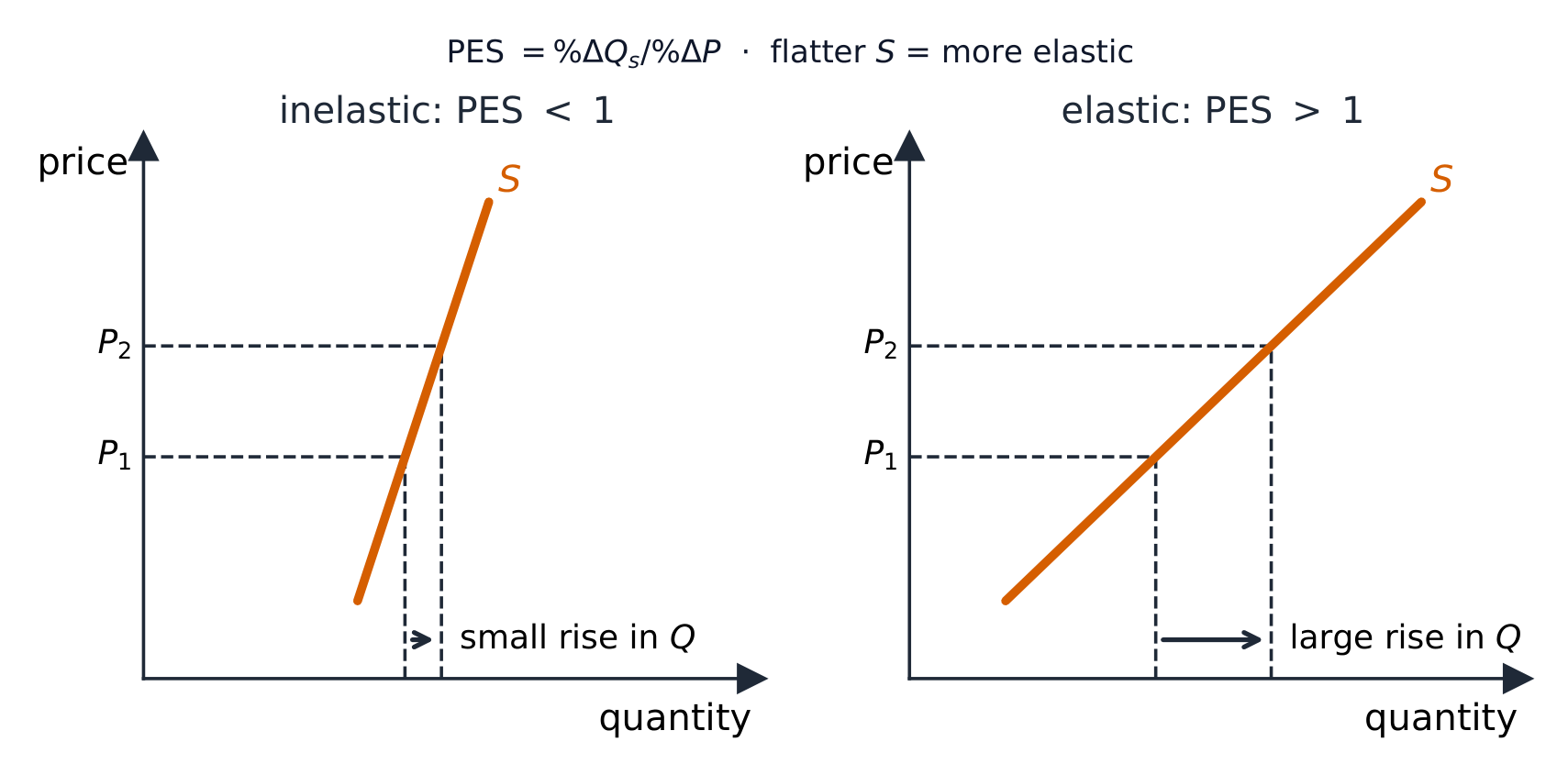
เส้นเสนอขายสองเส้น: ราคาเพิ่มขึ้นเท่าเดิม导致การตอบสนองของปริมาณน้อยบนเส้นไม่ยืดหยุ่น (ชัน) และมากบนเส้นยืดหยุ่น (ราบเรียบ)
ราคาเพิ่มขึ้นเท่ากัน: การตอบสนองของการเสนอขายน้อยเมื่อ PES ต่ำกว่า 1, มากเมื่อ PES สูงกว่า 1

ปัจจัยที่ทำให้การเสนอขายยืดหยุ่นมากขึ้น:

  • กำลังการผลิตสำรอง — เครื่องจักรและแรงงานที่ยังไม่ได้ใช้งาน ทำให้บริษัทผลิตเพิ่มเติมได้รวดเร็ว
  • สต็อกสินค้า — สินค้าเก็บไว้ในคลังที่จำหน่ายได้รวดเร็ว
  • ความง่ายในการเคลื่อนย้ายปัจจัยการผลิตเข้าสู่อุตสาหกรรมนั้น
  • เวลา นักเศรษฐศาสตร์แบ่งเวลาออกเป็นสามช่วง:
    • ช่วง ทันที (Momentary) — การเสนอขายคงที่; PES เป็นศูนย์
    • ระยะ สั้น (Short run) — ปัจจัยอย่างน้อยหนึ่งตัวคงที่ ทำให้การเสนอขายเพิ่มขึ้นได้เพียงเล็กน้อย
    • ระยะ ยาว (Long run) — ปัจจัยทั้งหมดสามารถเปลี่ยนแปลงได้ จึงเป็นการเสนอขายที่ยืดหยุ่นมากที่สุด
Explore · ⁨สำรวจ⁩

Demand & supply · ⁨อุปสงค์ & อุปทาน (Demand & supply)⁩

Supply elasticity is how much quantity responds to price. · ⁨ความยืดหยุ่นของอุปทาน คือปริมาณตอบสนองต่อราคาเพียงใด⁩

Vocabulary · ⁨คำศัพท์⁩ Train · ⁨ฝึกฝน⁩
English ไทย
quantity supplied/ˈkwɒntɪti səˈplaɪd/ ปริมาณเสนอขาย
profit/ˈprɒfɪt/ profit
supply curve/səˈplaɪ kɜːv/ เส้น_supply curve
costs of production/kɒsts ɒv prəˈdʌkʃn/ ต้นทุนการผลิต
subsidy/ˈsʌbsɪdi/ เงินอุดหนุน
firm/fɜːm/ บริษัท
market supply/ˈmɑːkɪt səˈplaɪ/ อุปทานในตลาด
price elasticity of demand/praɪs ɪlæˈstɪsɪti ɒv dɪˈmænd/ ความยืดหยุ่นของราคาต่อความต้องการ
momentary/ˈməʊməntəri/ ชั่วขณะ
short run/ʃɔːt rʌn/ ระยะสั้น
long run/lɒŋ rʌn/ ระยะยาว
Watch lesson · ⁨ดูบทเรียน⁩
2.4

The interaction of demand and supply · ⁨ปฏิกิริยาระหว่างความต้องการและการเสนอขาย⁩

Syllabus · ⁨หลักสูตร⁩
English
  1. explain equilibrium price and quantity and how shifts in demand and supply change equilibrium
  2. explain disequilibrium (excess demand and excess supply) and the functions of the price mechanism
  3. apply demand and supply analysis to product, factor and foreign exchange markets
ไทย
  1. อธิบาย ราคาและปริมาณสมดุล以及如何เปลี่ยนแปลงสมดุลจากการเลื่อนของความต้องการและการเสนอขาย
  2. อธิบาย ความไม่สมดุล (ความต้องการเกิน และ เสนอขายเกิน)以及หน้าที่ของกลไกราคา
  3. นำการวิเคราะห์ความต้องการและการเสนอขายไปใช้ในตลาดสินค้า, ปัจจัยและตลาดเงินตราต่างประเทศ

Source: Cambridge International syllabus · ⁨แหล่งที่มา: หลักสูตร Cambridge International⁩

English

Equilibrium

The market is in equilibrium 均衡 where the demand curve crosses the supply curve. Here demand equals supply. This gives the equilibrium price 均衡价格 and the equilibrium quantity 均衡数量. There is no pressure for the price to change.

Disequilibrium

When the price is not at equilibrium, the market is in disequilibrium 非均衡:

  • if the price is too low, there is excess demand 超额需求 (a shortage 短缺). Buyers compete, so the price is pushed up.
  • if the price is too high, there is excess supply 超额供给. Sellers cannot sell everything, so the price is pushed down.

In both cases the price moves back to equilibrium. This shows the price mechanism doing its jobs of signalling, rationing and giving an incentive.

How shifts change the equilibrium

Change Effect on price Effect on quantity
demand rises (shifts right) rises rises
demand falls (shifts left) falls falls
supply rises (shifts right) falls rises
supply falls (shifts left) rises falls

Demand and supply in different markets

The same analysis works in many markets:

  • in product markets 产品市场, demand and supply set the price of goods and services.
  • in factor markets 要素市场, they set the price of factors — for example, the demand for and supply of labour set the wage 工资.
  • in the foreign exchange market 外汇市场, the demand for and supply of a currency set the exchange rate 汇率 (the price of one currency in terms of another).
ไทย
ตลาดกลางแจ้งจริง: แผงผักของร้านขายผักพร้อมป้ายราคาเขียนมือ และลูกค้าเข็นรถเข็นเลือกซื้อผลผลิต
ในตลาด ผู้ซื้อและผู้ขายมาพบกันและราคาปรับอยู่ที่จุดที่ Demand เท่ากับ Supply

จุดสมดุล

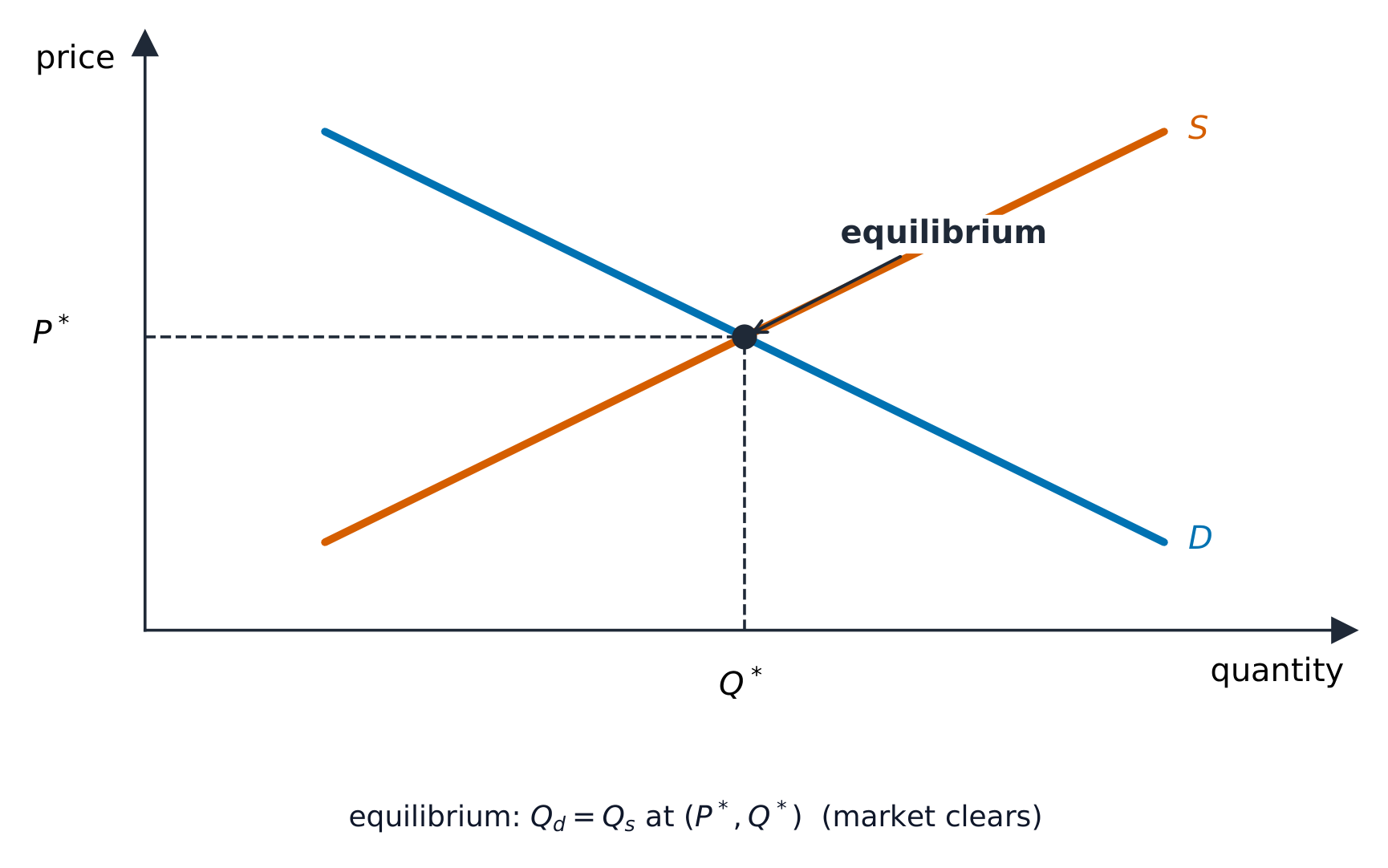
ตลาดอยู่ในสภาวะ สมดุล ที่จุดที่เส้นความต้องการตัดกับเส้นเสนอขาย此处的需求等于供给。这里给出了均衡价格和均衡数量。此时没有压力使价格发生变化。

需求和供给在均衡价格和数量处相交
在均衡价格 $P^*$ 和均衡数量 $Q^*$ 处,曲线相交,因此需求量等于供给量。

عدمสมดุล

เมื่อราคาไม่อยู่ที่จุดสมดุล ตลาดจะอยู่ในสภาวะ ไม่สมดุล :

  • หากราคา ต่ำเกินไป จะมี ความต้องการเกิน (ขาดแคลน) ผู้ซื้อแข่งขันกัน ทำให้ราคาถูกดันขึ้น
  • หากราคา สูงเกินไป จะมี การเสนอขายเกิน ผู้ขายไม่สามารถขายทุกอย่างได้ ทำให้ราคาถูกดันลง

ในทั้งสองกรณี ราคาจะกลับเข้าสู่จุดสมดุล สิ่งนี้แสดงถึงกลไกการทำงานของการกำหนดราคา ทั้งการส่งสัญญาณ การจัดสรร และการให้แรงจูงใจ

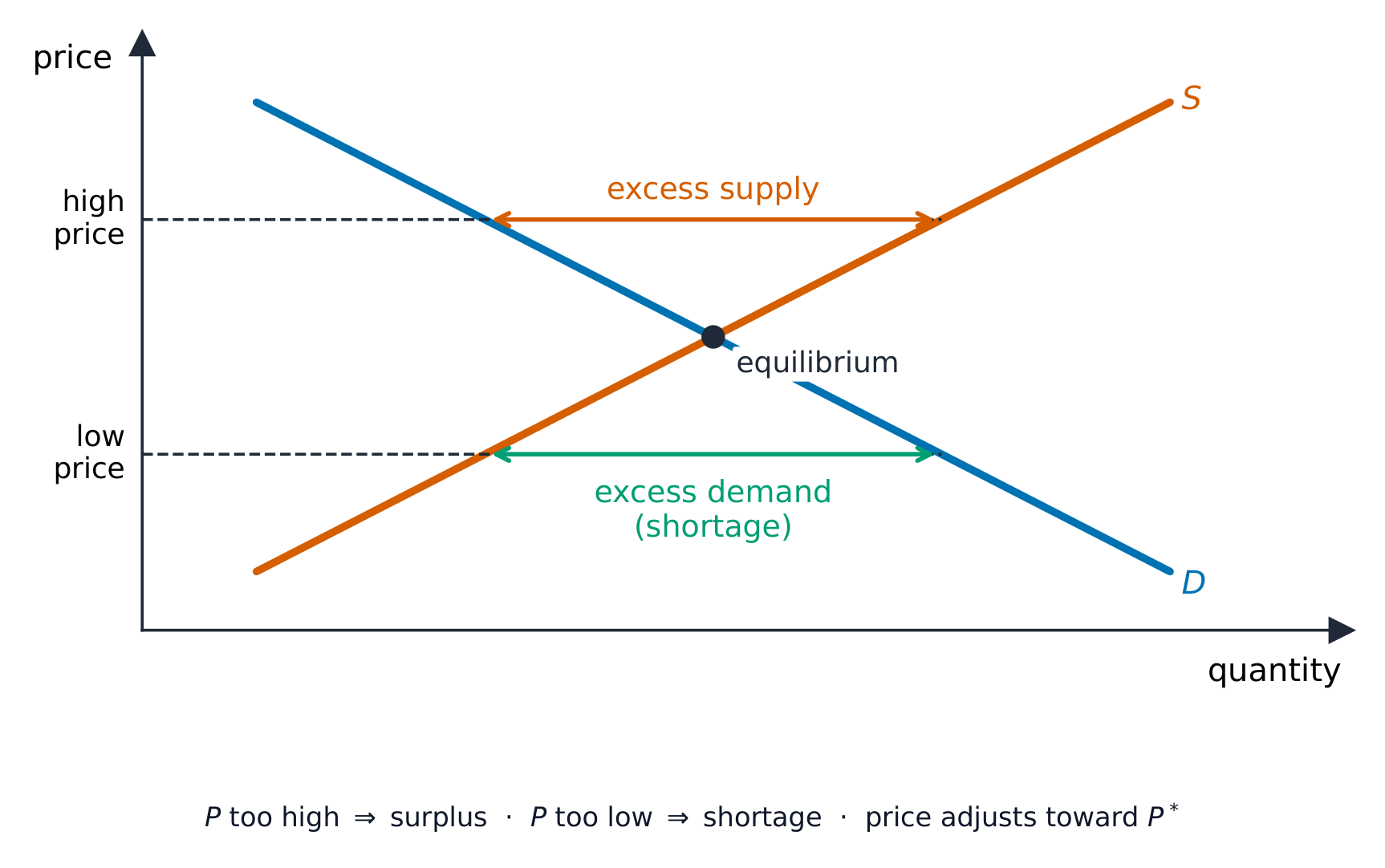
การเสนอขายเกินเหนือจุดสมดุลและความต้องการเกินใต้จุดสมดุล
เหนือจุดสมดุลมีการเสนอขายเกิน; ใต้จุดสมดุลมีความต้องการเกิน (ขาดแคลน) ในทุกกรณีราคาจะถูกดันกลับสู่จุดสมดุล

การเปลี่ยนแปลงสมดุลจากการ SHIFT

การเปลี่ยนแปลง ผลกระทบต่อราคา ผลกระทบต่อปริมาณ
ความต้องการเพิ่มขึ้น (เลื่อนไปทางขวา) เพิ่มขึ้น เพิ่มขึ้น
ความต้องการลดลง (เลื่อนไปทางซ้าย) ลดลง ลดลง
การเสนอขายเพิ่มขึ้น (เลื่อนไปทางขวา) ลดลง เพิ่มขึ้น
การเสนอขายลดลง (เลื่อนไปทางซ้าย) เพิ่มขึ้น ลดลง
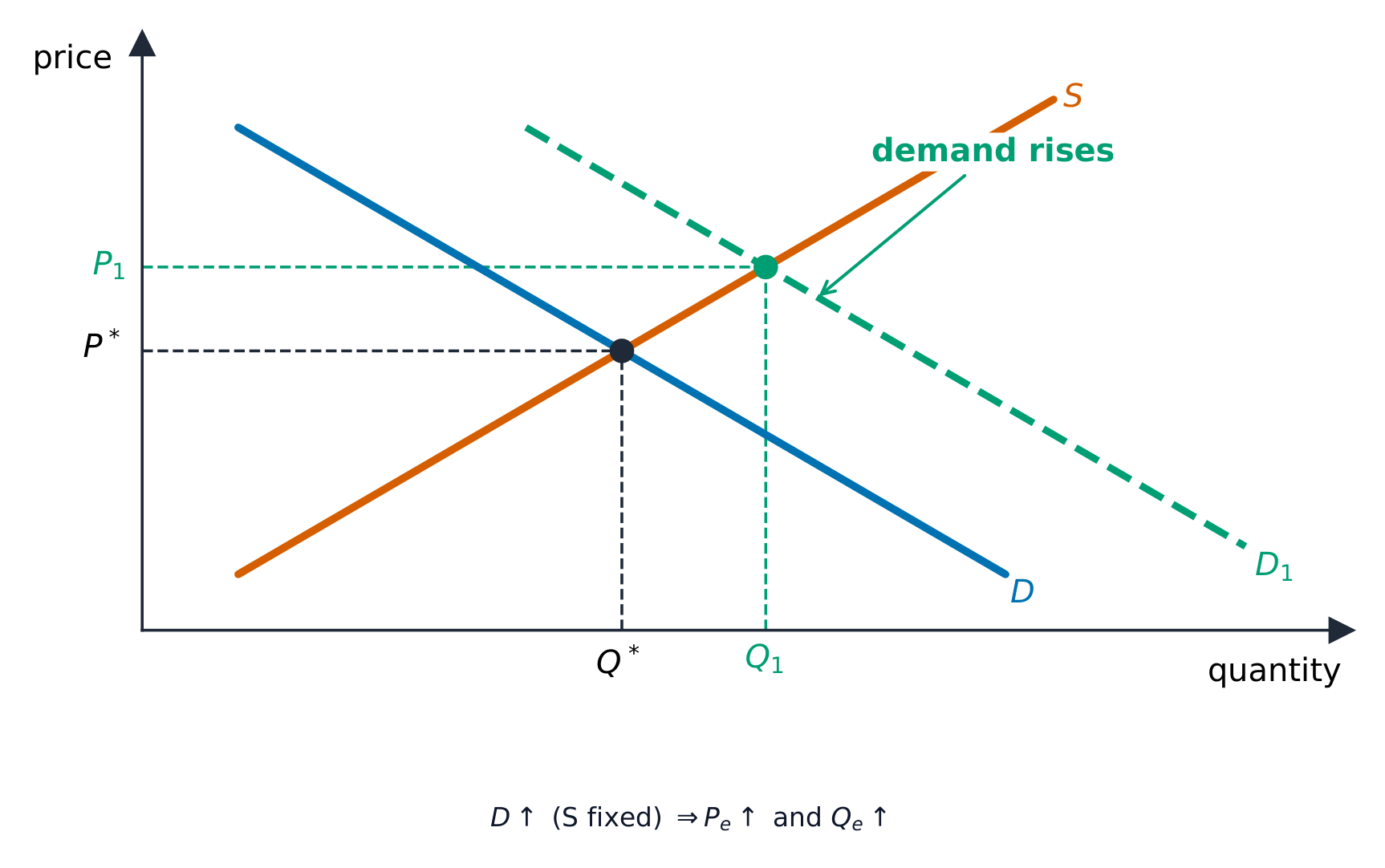
การ SHIFT ความต้องการไปทางขวาทำให้ราคาและปริมาณดุลยภาพเพิ่มขึ้น
เมื่ออุปทานคงที่ การเพิ่มขึ้นของความ demand ($D \to D_1$) จะทำให้ทั้งราคาและปริมาณดุลยภาพเพิ่มขึ้น

ความ demand และอุปทานในตลาดต่างๆ

การวิเคราะห์เดียวกันนี้สามารถใช้ได้ในหลายตลาด:

  • ใน ตลาดสินค้า ความ demand และอุปทานกำหนดราคาสินค้าและบริการ
  • ใน ตลาดปัจจัยการผลิต它们กำหนดราคาของปัจจัย — ตัวอย่างเช่น ความ demand และอุปทานของแรงงานกำหนด ค่าจ้าง
  • ใน ตลาดเงินตราต่างประเทศ ความ demand และอุปทานของสกุลเงินกำหนด อัตราแลกเปลี่ยน (ราคาของสกุลหนึ่งเทียบกับอีกสกุล)
Explore · ⁨สำรวจ⁩

Demand & supply · ⁨อุปสงค์ & อุปทาน (Demand & supply)⁩

Where demand meets supply sets the equilibrium price and quantity. · ⁨จุดที่ อุปสงค์ ตัดกับ อุปทาน จะกำหนดราคาและปริมาณดุลยภาพ⁩

Explore · ⁨สำรวจ⁩

Finding the equilibrium price · ⁨หาจุดดุลยภาพของราคา⁩

Shift demand or supply and watch the equilibrium price and quantity move to where the two lines cross. · ⁨ย้าย Demand หรือ Supply แล้วดูว่า ดุลยภาพ ราคาและปริมาณเคลื่อนที่ไปที่จุดตัดกันของเส้นทั้งสอง⁩

Vocabulary · ⁨คำศัพท์⁩ Train · ⁨ฝึกฝน⁩
English ไทย
equilibrium/ˌiːkwɪˈlɪbrɪəm/ จุดดุลยภาพ
equilibrium price/ˌiːkwɪˈlɪbrɪəm praɪs/ ราคาสมดุล
equilibrium quantity/ˌiːkwɪˈlɪbrɪəm ˈkwɒntɪti/ ปริมาณสมดุล
disequilibrium/ˌdɪˌsiːkwɪˈlɪbrɪəm/ disequilibrium
excess demand/ekˈses dɪˈmænd/ ความต้องการเกิน
shortage/ˈʃɔːtɪdʒ/ ขาดแคลน
excess supply/ekˈses səˈplaɪ/ อุปทานเกิน
product market/ˈprɒdʌkt ˈmɑːkɪt/ ตลาดสินค้า
factor market/ˈfæktə ˈmɑːkɪt/ ตลาดปัจจัยการผลิต
wage/weɪdʒ/ ค่าจ้าง
foreign exchange market/ˈfɒrən eksˈtʃeɪndʒ ˈmɑːkɪt/ ตลาด valuta foreign exchange
exchange rate/eksˈtʃeɪndʒ reɪt/ อัตราแลกเปลี่ยน
consumer surplus/kənˈsuːmə ˈsɜːpləs/ ส่วนเกินของผู้บริโภค
producer surplus/prəˈdjuːsə ˈsɜːpləs/ ส่วนเกินของผู้ผลิต
welfare/ˈwelfeə/ สวัสดิภาพ
Watch lesson · ⁨ดูบทเรียน⁩
2.5

Consumer and producer surplus · ⁨ส่วนเกินของผู้บริโภคและผู้ผลิต⁩

Syllabus · ⁨หลักสูตร⁩
English
  1. define and identify consumer surplus and producer surplus on a diagram
  2. explain how changes in demand, supply and price affect consumer and producer surplus
ไทย
  1. นิยามและระบุ ส่วนเกินของผู้บริโภค และ ส่วนเกินของผู้ผลิตบนแผนภาพ
  2. อธิบายว่าความเปลี่ยนแปลงของความต้องการอุปทานและราคาส่งผลกระทบต่อส่วนเกินของผู้บริโภคและผู้ผลิตอย่างไร

Source: Cambridge International syllabus · ⁨แหล่งที่มา: หลักสูตร Cambridge International⁩

English

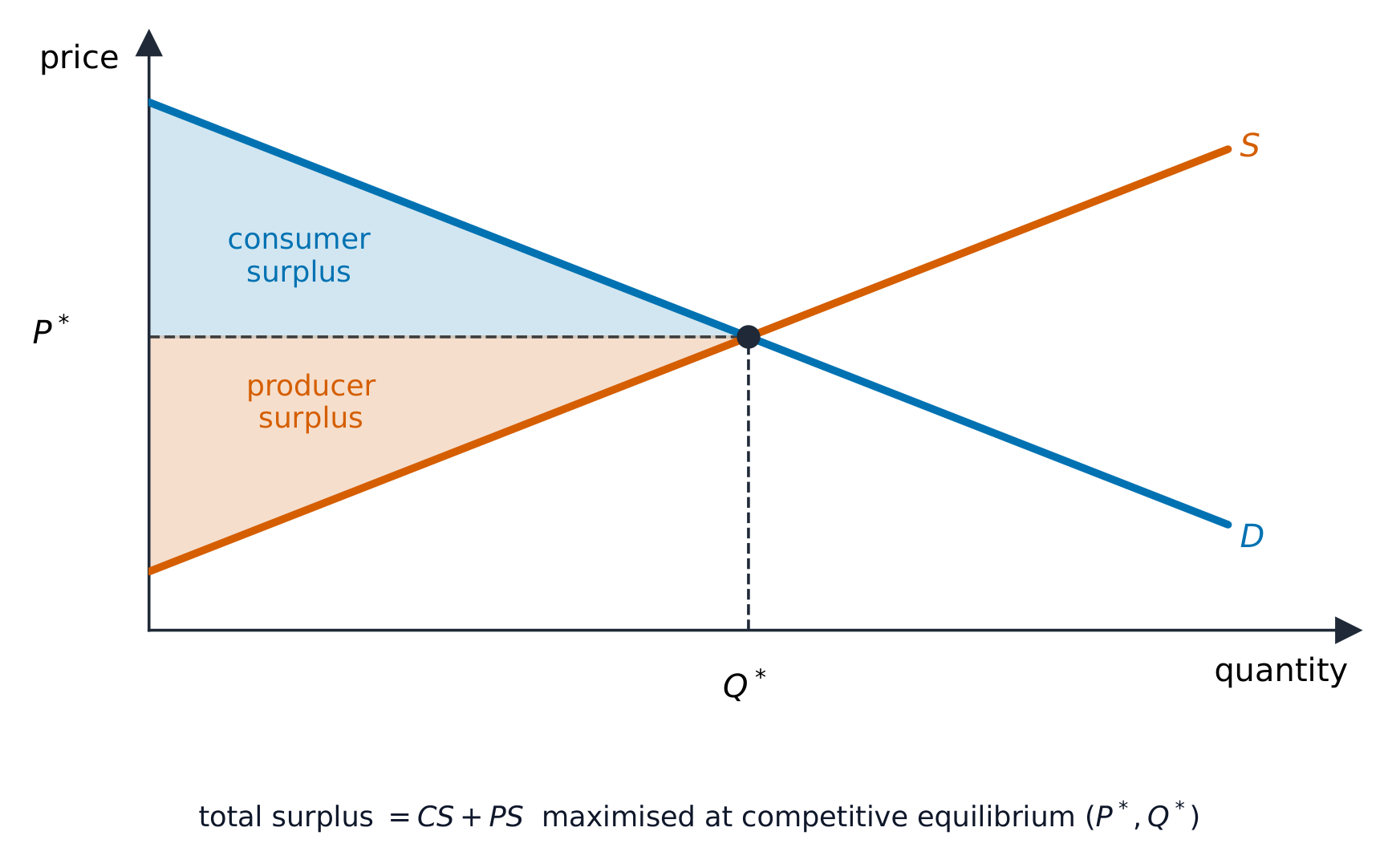
consumer surplus 消费者剩余 is the gain to buyers. It is the difference between the most a consumer was willing to pay and the price actually paid. On a diagram it is the area below the demand curve and above the price line.

producer surplus 生产者剩余 is the gain to sellers. It is the difference between the price a producer receives and the lowest price the producer would have accepted. On a diagram it is the area above the supply curve and below the price line.

How they change:

  • if demand rises, the price and quantity rise, so producer surplus rises and consumer surplus usually rises too.
  • if supply rises, the price falls and quantity rises, so consumer surplus rises.
  • a higher price (with the curves fixed) raises producer surplus but lowers consumer surplus.

Together, consumer surplus plus producer surplus is the total welfare 福利 (gain to society) from the market. It is largest at the free-market equilibrium.

ไทย

ส่วนเกินของผู้บริโภค คือผลได้สำหรับผู้ซื้อ เป็นส่วนต่างระหว่างจำนวนสูงสุดที่ผู้บริโภคยินดีจ่ายกับราคาที่จ่ายจริง บนแผนภูมิคือพื้นที่ใต้เส้น demand และเหนือเส้นราคา

ส่วนเกินของผู้ผลิต คือผลได้สำหรับผู้ขาย เป็นส่วนต่างระหว่างราคาที่ผู้ผลิตได้รับกับราคาต่ำสุดที่ผู้ผลิตจะยอมรับบนแผนภูมิคือพื้นที่เหนือเส้น supply และใต้เส้นราคา

ส่วนเกินของผู้บริโภคและผู้ผลิตถูกแรเงาโดยรอบจุดดุลยภาพ
ส่วนเกินของผู้บริโภคคือพื้นที่ใต้ demand และเหนือราคา; ส่วนเกินของผู้ผลิตคือพื้นที่เหนือ supply และใต้ราคา

วิธีการเปลี่ยนแปลง:

  • หาก demand เพิ่มขึ้น ราคาและปริมาณจะเพิ่มขึ้น ดังนั้นส่วนเกินของผู้ผลิตจะเพิ่มขึ้นและส่วนเกินของผู้บริโภคก็มักจะเพิ่มขึ้นด้วย
  • หาก supply เพิ่มขึ้น ราคาจะลดลงและปริมาณจะเพิ่มขึ้น ดังนั้นส่วนเกินของผู้บริโภคจะเพิ่มขึ้น
  • ราคาที่สูงขึ้น (โดยที่เส้นคงที่)会增加部分过生产者 surplus แต่ลดส่วนเกินของผู้บริโภค

รวมกันแล้ว ส่วนเกินของผู้บริโภคบวกกับส่วนเกินของผู้ผลิตคือ สวัสดิภาพรวม (ผลได้ต่อสังคม) จากตลาด มีค่ามากที่สุดในจุดดุลยภาพของตลาดเสรี

Explore · ⁨สำรวจ⁩

Demand & supply · ⁨อุปสงค์ & อุปทาน (Demand & supply)⁩

Surplus sits between the curves and the going price. · ⁨ส่วนเกิน อยู่ระหว่างเส้นโค้งและราคาปัจจุบัน⁩

Watch lesson · ⁨ดูบทเรียน⁩
2.5

Exam tips · ⁨ข้อแนะนำสำหรับการสอบ⁩

English
  • Quote the elasticity formula and interpret the value: PED inelastic ($<1$), elastic ($>1$); link PED to total revenue.
  • Distinguish a movement along (a price change) from a shift (a non-price factor) of demand or supply.
  • Use the sign of XED (substitutes $+$, complements $-$) and YED (normal $+$, inferior $-$).
  • On a diagram, label consumer and producer surplus and show how a price change alters each.
ไทย
  • 引用 สูตรความยืดหยุ่น และตีความค่า: PED ไม่ยืดหยุ่น ($<1$), ยืดหยุ่น ($>1$); เชื่อมโยง PED กับรายได้รวม
  • แยกแยะระหว่าง การเคลื่อนที่ตามเส้น (การเปลี่ยนแปลงราคา) กับ การ SHIFT (ปัจจัยที่ไม่ใช่ราคา) ของ demand หรือ supply
  • ใช้ เครื่องหมาย ของ XED (สินค้าทดแทน $+$, สินค้าเสริม $-$) และ YED (สินค้าปกติ $+$, สินค้าด้อยคุณภาพ $-$)
  • บนแผนภูมิ กำหนดย่อ ส่วนเกินของผู้บริโภคและผู้ผลิต และแสดงว่ามีการเปลี่ยนแปลงราคาส่งผลต่อแต่ละส่วนอย่างไร

Interactive lessons on this topic · ⁨บทเรียนเชิงโต้ตอบสำหรับหัวข้อนี้⁩

Work through it step by step, with instant-check exercises. · ⁨ทำทีละขั้นตอน พร้อมแบบฝึกหัดตรวจสอบผลทันที⁩

Past Papers · ⁨ข้อสอบย้อนหลัง⁩

More topics in A-Level Economics · ⁨Economics A-Level⁩ · ⁨หัวข้อเพิ่มเติมใน A-Level Economics · ⁨Economics A-Level⁩⁩

Log in or create account · ⁨เข้าสู่ระบบหรือสร้างบัญชี⁩

IGCSE, A-Level & AP