Income and cross elasticity of demand
Introduced| English | Meaning |
|---|---|
| income elasticity/ˈɪŋkʌm ɪlæˈstɪsɪti/ | The percentage change in quantity demanded divided by the percentage change in income, other factors unchanged. |
| cross elasticity/krɒs ɪlæˈstɪsɪti/ | cross elasticity |
| normal good/ˈnɔːml ɡʊd/ | A good for which demand increases as consumer income rises, with other factors held constant. |
| luxury/ˈlʌkʃəri/ | In economics, a good whose demand rises more than proportionally as income rises over the relevant range. |
| inferior good/ɪnˈfɪərɪə ɡʊd/ | A good for which demand falls as consumer income rises, with other factors held constant. |
| substitutes/ˈsʌbstɪtjuːts/ | Goods or services that can be used in place of each other. |
| complements/ˈkɒmplɪmənts/ | Goods or services typically used together, so demand for one is linked to the use of the other. |
What a pay rise does to your shopping
- Get a raise and you buy more restaurant meals — but maybe fewer tins of cheap noodles. Income changes demand differently for different goods.
- Two more elasticities capture this: income elasticity 收入弹性 (YED) and cross elasticity 交叉弹性 (XED).
Income elasticity (YED)
- YED measures how demand responds to a change in income:
- Normal good 正常品: YED $> 0$ (demand rises with income); a luxury 奢侈品 has YED $> 1$.
- Inferior good 低档品: YED $< 0$ (demand falls as income rises — e.g. cheap noodles).
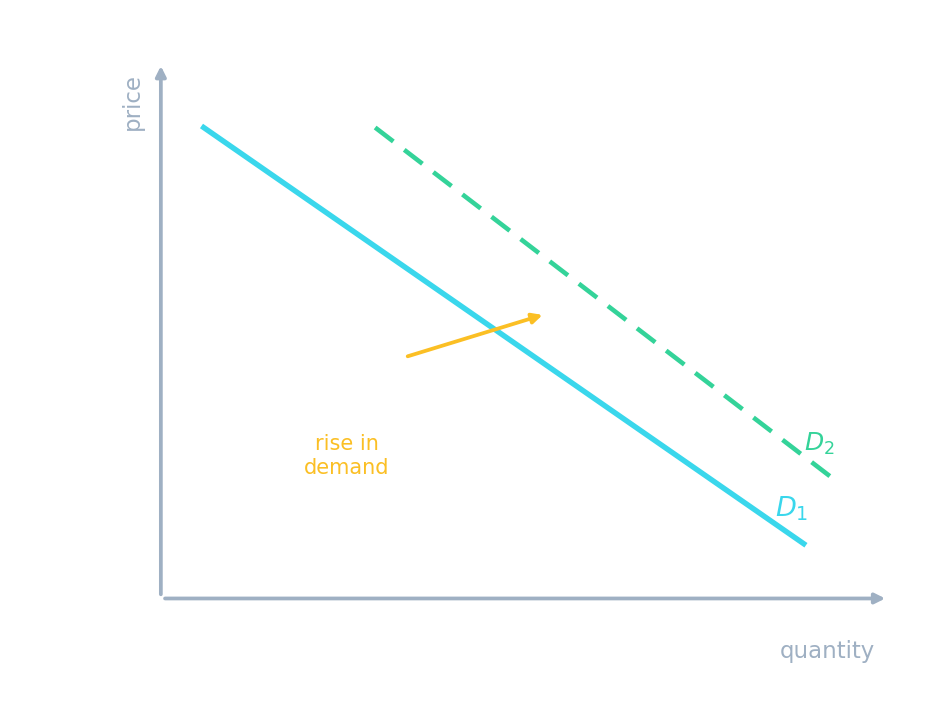
For a normal good, a rise in income shifts demand right; for an inferior good it would shift left.
Worked example. Income rises 10% and demand rises 20%. YED $= \dfrac{20\%}{10\%} = 2$ — a normal luxury good.

As income rises, demand for a normal good rises but an inferior good falls
Elastic vs inelastic demand
A steep demand curve is inelastic (quantity barely responds to price); a shallow one is elastic. Shift the curves to compare.
Income rises 10% and quantity demanded rises 20%. What is the YED?
Difficulty 2/5 · 140 coins + a small bonus on first completion today
YED = 20% / 10% = 2 — a normal luxury good.
An inferior good has an income elasticity (YED) that is:
Difficulty 1/5 · 100 coins + a small bonus on first completion today
For an inferior good, demand falls as income rises, so YED < 0.
Cross elasticity (XED)
- XED measures how demand for good A responds to a change in the price of good B:
- Substitutes 替代品: XED $> 0$ (B dearer → buy more A). Complements 互补品: XED $< 0$ (B dearer → buy less A).
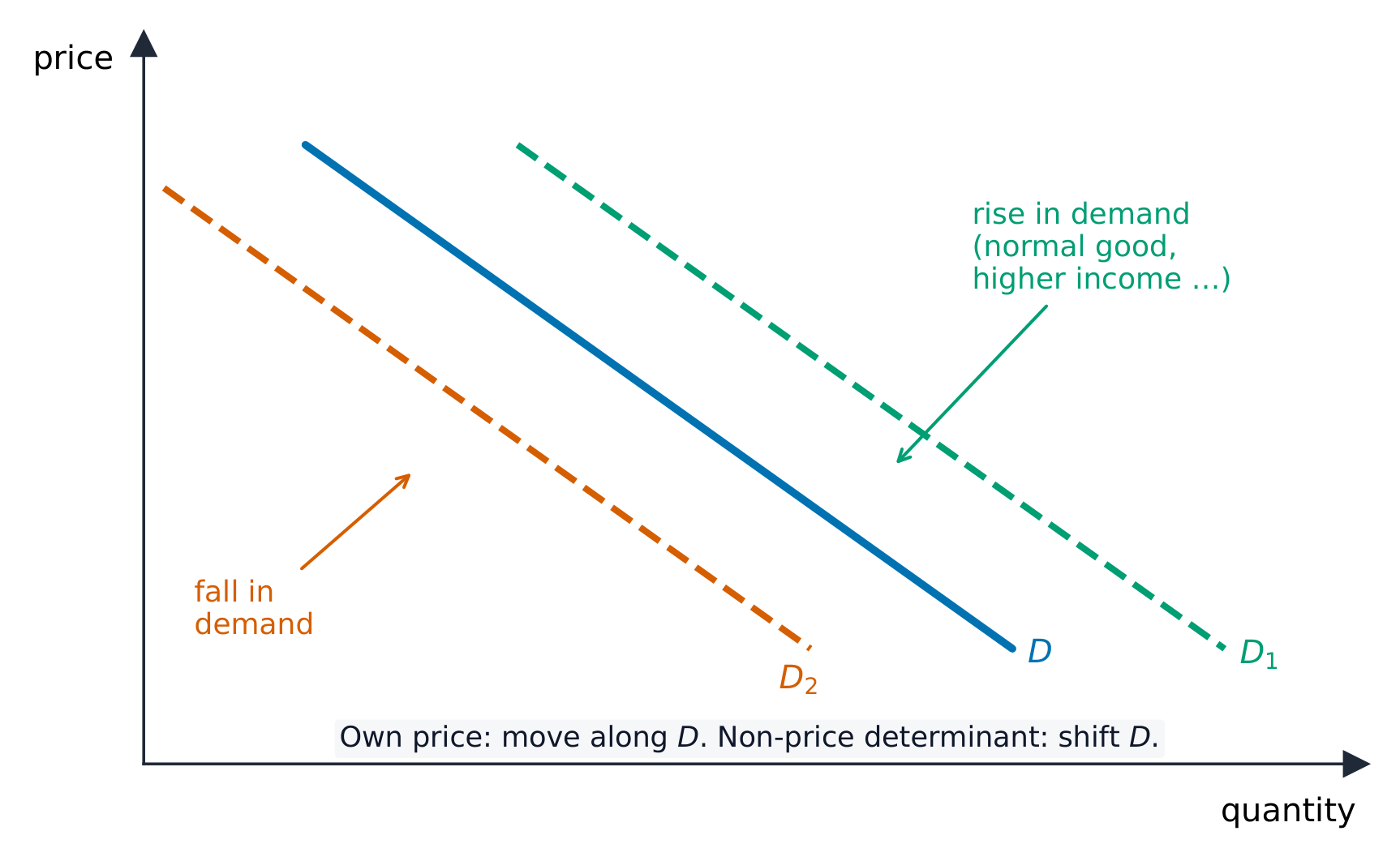
The demand curve slopes down; income, tastes and related prices shift it
Two goods are substitutes if their cross elasticity (XED) is:
Difficulty 1/5 · 100 coins + a small bonus on first completion today
Substitutes: a rise in B's price raises demand for A, so XED > 0.
Complements (like printers and ink) have a positive cross elasticity of demand.
Difficulty 1/5 · 100 coins + a small bonus on first completion today
False. A rise in the price of printers reduces demand for ink, so XED for complements is negative. A positive XED indicates substitutes.
Match each elasticity value to the type of good.
Difficulty 2/5 · 140 coins + a small bonus on first completion today
Sign and size of YED/XED classify the good and the relationship.
Why the signs matter
- The sign of YED/XED classifies the good; the size shows how strong the effect is.
- Firms use YED to forecast demand as incomes change, and XED to spot rivals (substitutes) and partners (complements).
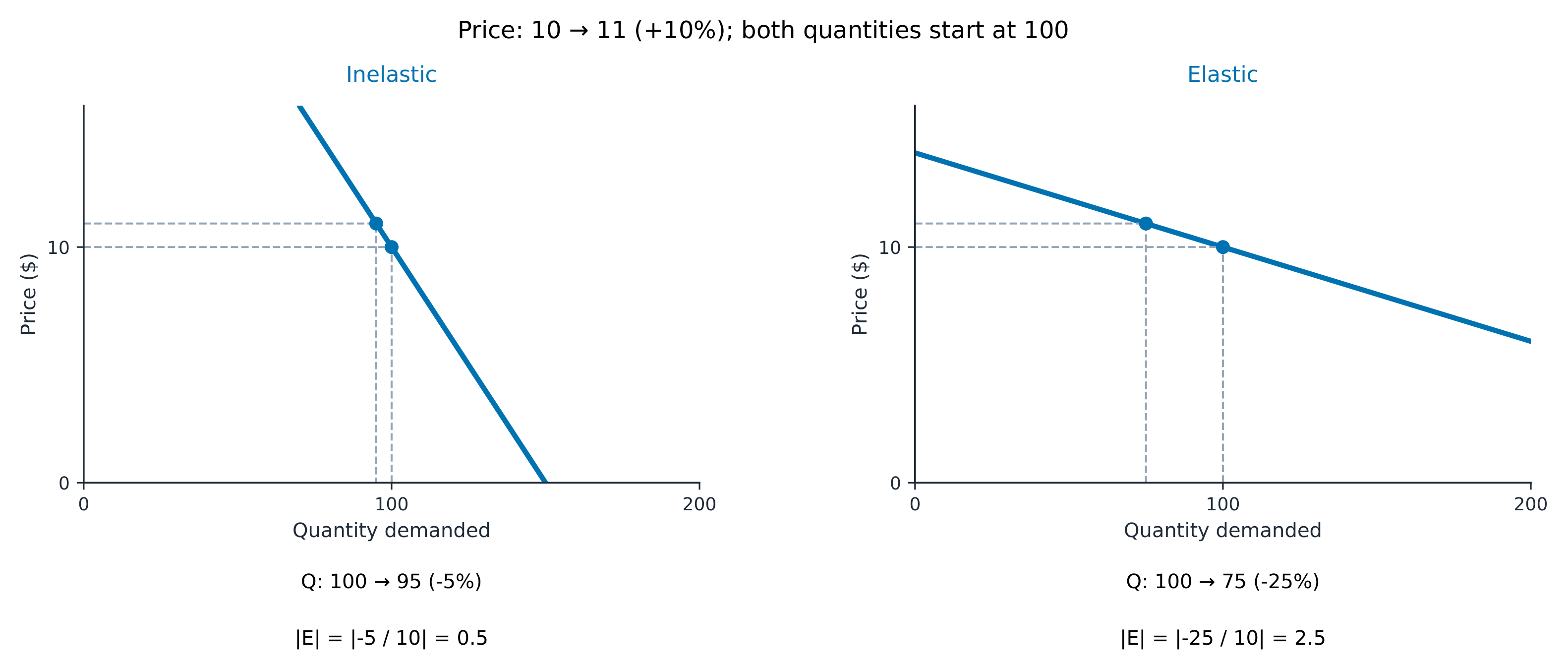
Inelastic vs elastic demand: small vs large response to a price change
You've got it
- YED $= \dfrac{\%\Delta Q_d}{\%\Delta \text{income}}$: normal $>0$ (luxury $>1$), inferior $<0$
- XED $= \dfrac{\%\Delta Q_A}{\%\Delta P_B}$: substitutes $>0$, complements $<0$
- the sign tells you the type of good; the size tells you how strong the link is
Write from a YED of 2
- Income rises by 20 percent.
- Demand for holidays rises by 40 percent.
What is the YED, and what does the sign say?
40 percent over 20 percent is a YED of 2.
What is the YED of holidays?
Difficulty 1/5 · 100 coins + a small bonus on first completion today
A positive YED above 1 is a normal luxury.