Price elasticity of supply
Introduced| English | Meaning |
|---|---|
| price elasticity of supply/praɪs ɪlæˈstɪsɪti ɒv səˈplaɪ/ | The percentage change in quantity supplied divided by the percentage change in price. |
| elastic/ɪˈlæstɪk/ | Describing demand or supply whose percentage response exceeds the percentage change in its determining price or income. |
| inelastic/ɪnɪˈlæstɪk/ | Describing demand or supply whose percentage response is smaller than the percentage change in its determining price or income. |
| spare capacity/speə kəˈpæsɪti/ | The difference between current output and the output that could be produced with available resources. |
| mobility of factors/məʊˈbɪlɪti ɒv ˈfæktəz/ | mobility of factors |
Why farmers can't react overnight
- If strawberry prices jump, a factory can boost output in days — but a farmer must wait a whole growing season. Producers differ in how fast they respond.
- Price elasticity of supply 供给价格弹性 (PES) measures that responsiveness.
Measuring PES
- PES measures how quantity supplied responds to a price change:
- It is normally positive (price and quantity supplied move together).
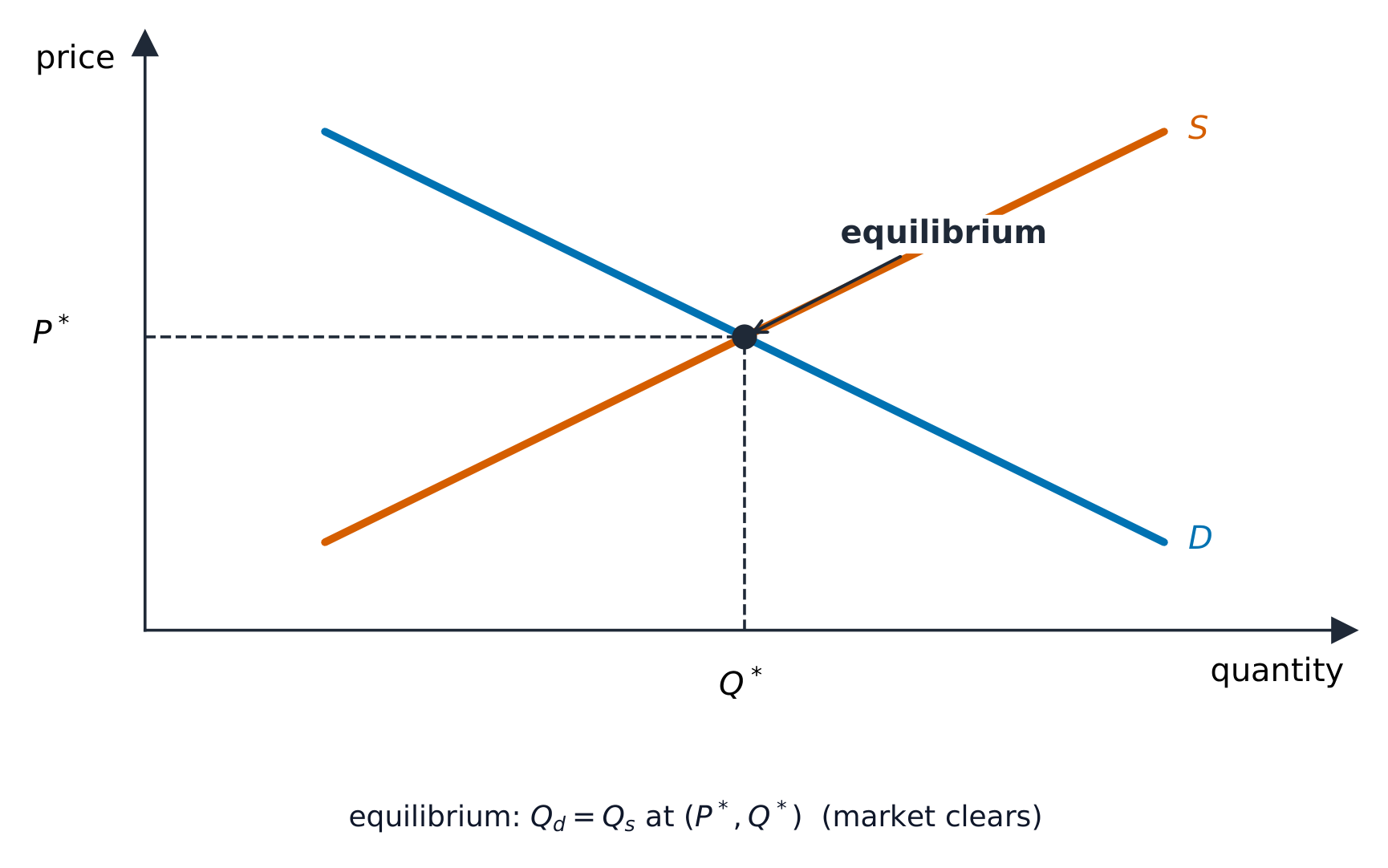
Equilibrium price and quantity where demand meets supply
Demand & supply
Supply elasticity is how much quantity responds to price.
Price rises 20% and quantity supplied rises 30%. What is the PES?
Difficulty 2/5 · 140 coins + a small bonus on first completion today
PES = 30% / 20% = 1.5 — elastic.
PES = (% change in quantity supplied) ÷ (% change in ______).
Difficulty 1/5 · 100 coins + a small bonus on first completion today
PES divides the % change in quantity supplied by the % change in price.
Elastic 富有弹性 vs inelastic 缺乏弹性 supply
- $\text{PES} > 1$ → elastic (output responds easily — spare capacity 闲置产能, easy to store).
- $\text{PES} < 1$ → inelastic (output is hard to change quickly — farming, limited capacity).

A steep supply curve is inelastic; a flat one is elastic. Spare capacity and time make supply more elastic.
Worked example. Price rises 20% and quantity supplied rises 30%. PES $= \dfrac{30\%}{20\%} = 1.5$ — elastic.
Supply is elastic when PES is:
Difficulty 1/5 · 100 coins + a small bonus on first completion today
PES > 1 means quantity supplied responds strongly to price.
Why is the supply of a farm crop usually inelastic in the short run?
Difficulty 1/5 · 100 coins + a small bonus on first completion today
Production takes a season, so quantity supplied can't respond quickly to price — inelastic.
Time is the key
- The longer the time period, the more elastic supply becomes — firms can build capacity, hire, and adjust.
- Other determinants: spare capacity, ease of storing stock, and mobility of factors 要素流动性.
Supply tends to be less elastic over a longer time period.
Difficulty 1/5 · 100 coins + a small bonus on first completion today
False. Given more time, firms can expand capacity, hire workers and enter the market, so supply becomes more elastic in the long run.
You've got it
- $\text{PES} = \dfrac{\%\Delta Q_s}{\%\Delta P}$, normally positive
- $\text{PES}>1$ elastic, $\text{PES}<1$ inelastic
- supply is more elastic with more time, spare capacity, and storable stock
Write from a PES of 0.4
- Price rises by 25 percent.
- Quantity supplied rises by 10 percent in the same period.
What is the PES?
10 percent over 25 percent is a PES of 0.4.
What is this PES?
Difficulty 1/5 · 100 coins + a small bonus on first completion today
Supply elasticity is positive and here below 1.