The interaction of demand and supply
Introduced| English | Meaning |
|---|---|
| equilibrium/ˌiːkwɪˈlɪbrɪəm/ | A state in which opposing influences balance so there is no tendency for the relevant quantities to change. |
| clears/klɪəz/ | Describes a market when quantity demanded equals quantity supplied at the prevailing price. |
| shortage/ˈʃɔːtɪdʒ/ | A situation in which quantity demanded exceeds quantity supplied at the prevailing price. |
| surplus/ˈsɜːpləs/ | An amount exceeding what is required; in a market, quantity supplied above quantity demanded at a given price. |
How a market finds its price
- No committee sets the price of apples — yet markets settle on one. How?
- Demand and supply pull in opposite directions until they meet at the equilibrium 均衡 price, where the market just clears 出清.
Equilibrium
- Equilibrium is where the demand and supply curves cross: quantity demanded = quantity supplied.
- At that price there is no shortage 短缺 and no surplus 过剩 — the market clears.
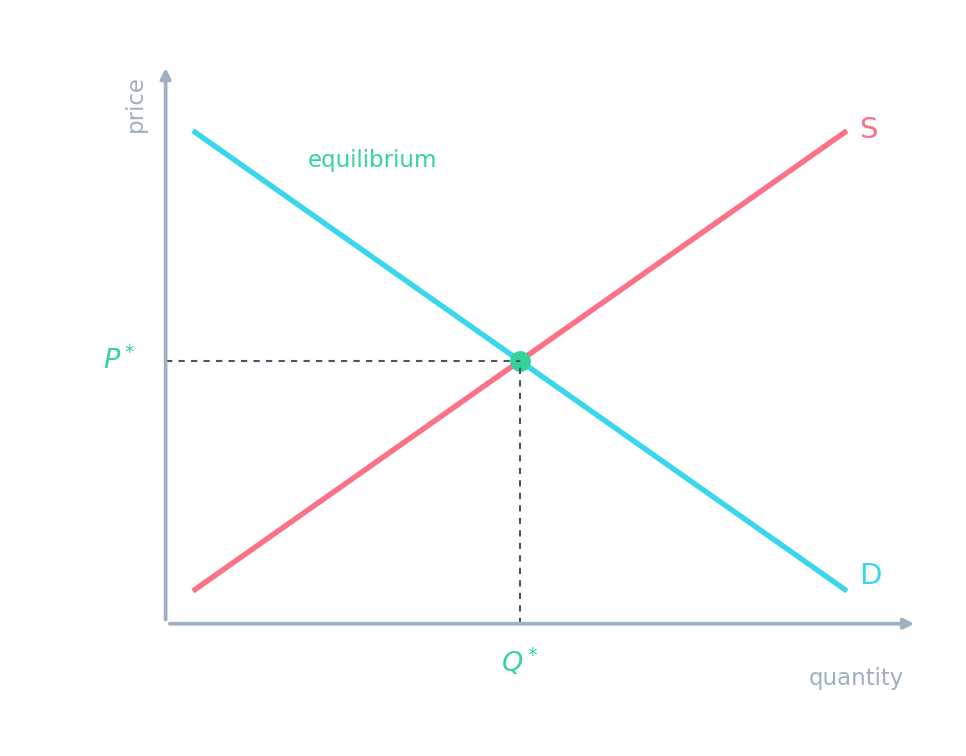
Where the curves cross, the price clears the market — quantity demanded equals quantity supplied.
Demand & supply
Where demand meets supply sets the equilibrium price and quantity.
Market equilibrium occurs where:
Difficulty 1/5 · 100 coins + a small bonus on first completion today
At equilibrium the curves cross: Qd = Qs and the market clears.
At the equilibrium price the market just ______ — no shortage and no surplus.
Difficulty 1/5 · 100 coins + a small bonus on first completion today
Market clearing means quantity demanded equals quantity supplied.
Shortages and surpluses
- Below equilibrium: demand exceeds supply → a shortage → price is bid up.
- Above equilibrium: supply exceeds demand → a surplus → price is pushed down.
- Either way, price moves back to equilibrium — the self-correcting market.
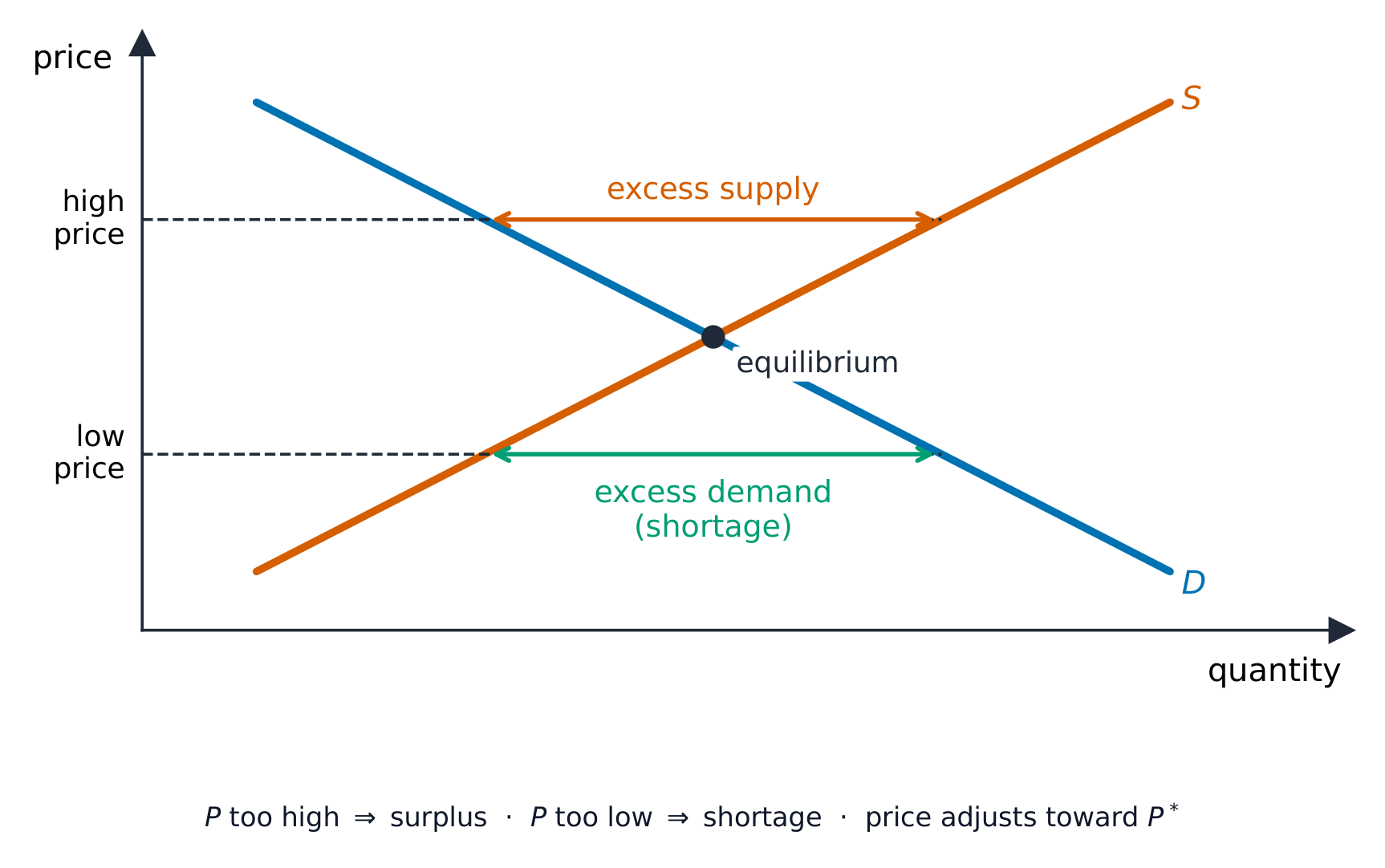
Above equilibrium: excess supply; below: excess demand
If the price is set below equilibrium, the result is a:
Difficulty 1/5 · 100 coins + a small bonus on first completion today
Below equilibrium, demand exceeds supply → shortage → upward pressure on price.
Shifts change the equilibrium
- A rise in demand → equilibrium price and quantity both rise.
- A rise in supply → equilibrium price falls, quantity rises.
- Work out the new crossing point by shifting the relevant curve.
Worked example. A frost destroys part of the coffee crop. Supply shifts left; the new equilibrium has a higher price and lower quantity.
A rise in demand (supply unchanged) moves the equilibrium to:
Difficulty 1/5 · 100 coins + a small bonus on first completion today
Demand shifts right along the supply curve → both P and Q rise.
A frost that destroys part of the coffee crop raises the equilibrium price of coffee.
Difficulty 1/5 · 100 coins + a small bonus on first completion today
Supply shifts left → higher equilibrium price, lower quantity.
You've got it
- equilibrium = where D and S cross; the market clears (Qd = Qs)
- below equilibrium → shortage (price rises); above → surplus (price falls)
- a demand rise raises P and Q; a supply rise lowers P, raises Q