Consumer and producer surplus
Introduced| English | Meaning |
|---|---|
| consumer surplus/kənˈsuːmə ˈsɜːpləs/ | The difference between what buyers are willing to pay and what they actually pay, summed across purchases. |
| welfare/ˈwelfeə/ | People's economic and social well-being, or support provided to protect it. |
| producer surplus/prəˈdjuːsə ˈsɜːpləs/ | The amount sellers receive above the minimum they would accept for the units sold; in the standard supply model, revenue minus variable cost. |
| total welfare/ˈtəʊtl ˈwelfeə/ | CS + PS, maximised at the free-market equilibrium. |
| price control/praɪs kənˈtrəʊl/ | A government rule setting a maximum or minimum permitted price. |
| deadweight loss/ˈdedweɪt lɒs/ | The loss of total economic surplus when a market produces an inefficient quantity. |
The bonus you get on every purchase
- You'd have paid £5 for that coffee — but it costs £3. That extra £2 of value is yours to keep. Economists call it consumer surplus 消费者剩余.
- Surplus measures the welfare 福利 a market creates — for buyers and sellers alike.
Consumer surplus
- Consumer surplus = the gap between what buyers are willing to pay (the demand curve) and what they actually pay (the price).
- On the diagram it's the triangle below demand and above the price.
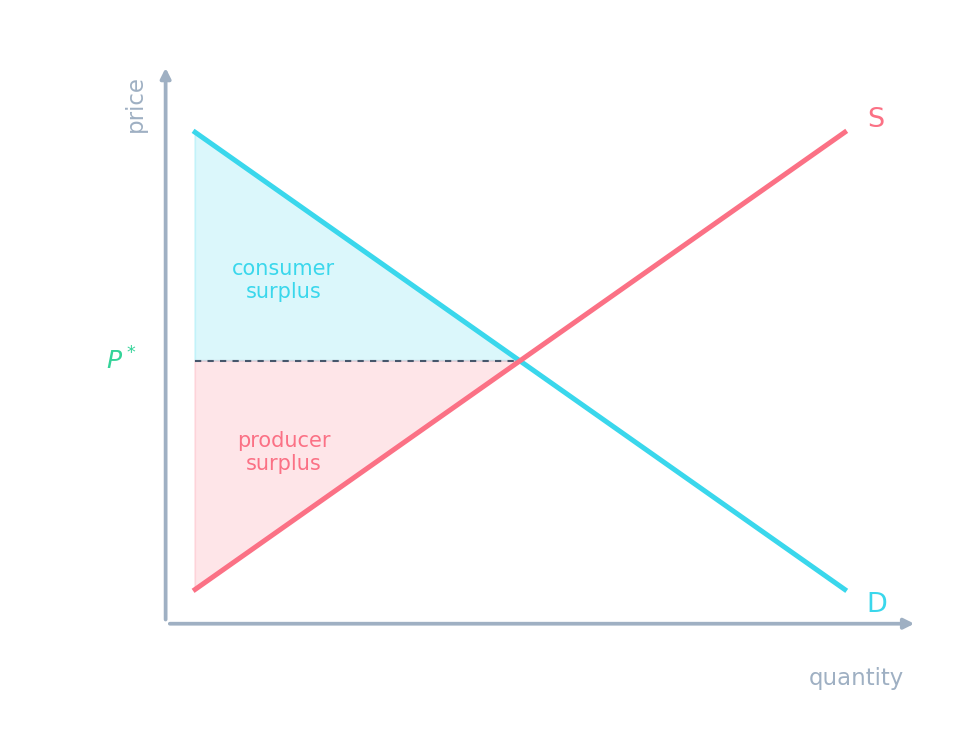
Consumer surplus sits below the demand curve and above the price; producer surplus 生产者剩余 sits above supply and below the price.
Demand & supply
Surplus sits between the curves and the going price.
Consumer surplus is the difference between:
Difficulty 1/5 · 100 coins + a small bonus on first completion today
It is the value buyers get above the price — the area below demand and above price.
Producer surplus
- Producer surplus = the gap between the price firms receive and the minimum they'd accept (the supply curve).
- It's the triangle above supply and below the price.
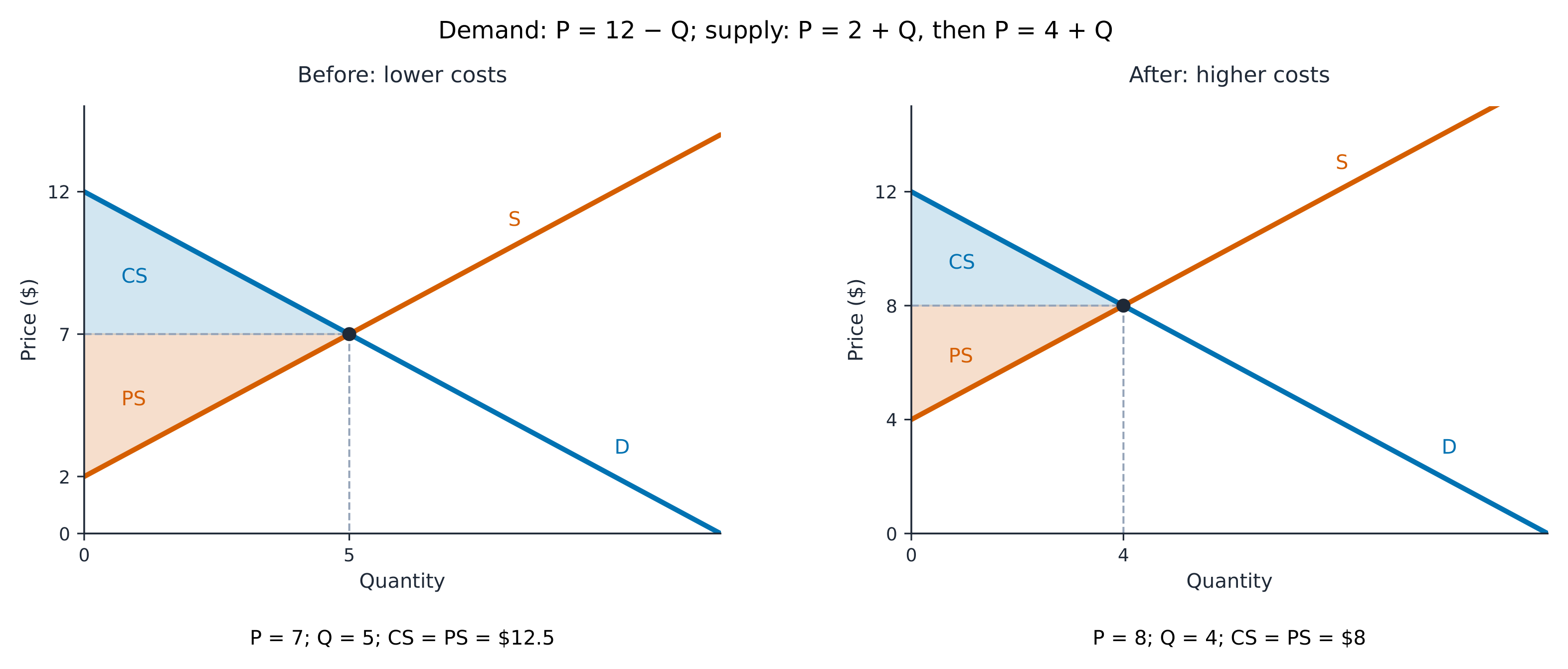
Consumer surplus and producer surplus at the market equilibrium
Producer surplus is shown on the diagram as the area:
Difficulty 1/5 · 100 coins + a small bonus on first completion today
Producer surplus = price received minus minimum acceptable (the supply curve).
Match each surplus to its area on the diagram.
Difficulty 2/5 · 140 coins + a small bonus on first completion today
Consumers gain above the price up to the demand curve; producers gain below the price down to supply.
Total welfare 总福利
- Total welfare (economic surplus) = consumer surplus + producer surplus.
- At the free-market equilibrium this total is maximised — one reason economists prize competitive markets.
A price control 价格管制 shrinks total surplus. A price ceiling or floor moves the market away from equilibrium, creating a deadweight loss 无谓损失 — surplus that simply disappears.
Total welfare is maximised when a maximum price is set below the free-market equilibrium.
Difficulty 1/5 · 100 coins + a small bonus on first completion today
False. A binding maximum price cuts the quantity traded below equilibrium, which creates a deadweight loss. Without externalities, total surplus is largest at the free-market equilibrium.
A price control creates a loss of surplus called a ______ loss.
Difficulty 1/5 · 100 coins + a small bonus on first completion today
Moving away from equilibrium destroys some total surplus — deadweight loss.
You've got it
- consumer surplus = below demand, above price (buyers' bonus)
- producer surplus = above supply, below price (sellers' bonus)
- total welfare = CS + PS, maximised at the free-market equilibrium
Write from a consumer surplus of 5
- A buyer is willing to pay 12.
- The market price is 7.
What is this buyer's consumer surplus?
Willingness to pay minus price is 5.
What is the consumer surplus?
Difficulty 1/5 · 100 coins + a small bonus on first completion today
12 minus 7 is consumer surplus. Other options — 12 (the whole willingness to pay); 0 (as if the price were 12).