Market failure and externalities
Introduced| English | Meaning |
|---|---|
| externality/ekˈstɜːnælɪti/ | A cost or benefit of an activity affecting third parties that is not fully reflected in the decision-maker's private costs or benefits. |
| market failure/ˈmɑːkɪt ˈfeɪlɪə/ | A situation in which markets alone allocate resources inefficiently or fail to provide a socially desirable outcome. |
| third party/θɜːd ˈpɑːti/ | A person or group affected by a decision or transaction despite not being one of its direct participants. |
| negative externality/ˈneɡətɪv ekˈstɜːnælɪti/ | A cost imposed on others by production or consumption that is not fully reflected in the decision-maker's private costs. |
| overproduction/ˌəʊvəprəˈdʌkʃn/ | overproduction |
| positive externality/ˈpɒzɪtɪv ekˈstɜːnælɪti/ | A benefit received by others from production or consumption that is not fully reflected in the decision-maker's private benefits. |
| underproduction/ˌʌndəprəˈdʌkʃn/ | underproduction |
| marginal social cost/ˈmɑːdʒɪnl ˈsəʊʃl kɒst/ | The additional total cost to society of producing or consuming one more unit, including private and external costs. |
| social optimum/ˈsəʊʃl ˈɒptɪməm/ | An allocation that maximises overall social welfare, commonly where marginal social benefit equals marginal social cost. |
The cost no one pays
- A factory dumps smoke; the price of its product never counts the cost to people downwind. The market price is "wrong".
- That gap between private and social costs is an externality 外部性 — the most important kind of market failure 市场失灵.
Market failure means the free market:
Difficulty 1/5 · 100 coins + a small bonus on first completion today
It produces too much or too little of a good for society — an inefficient allocation.
Market failure
- Market failure is when a free market allocates resources inefficiently — too much or too little is produced.
- Externalities, public goods, and information gaps are the main causes.

Cigarettes are a demerit good: people overconsume them because they misjudge the harm
The market and where it fails
Supply and demand set the market price and quantity at their intersection. Market failure is when this free-market outcome is not the best one for society.
A negative externality (like pollution) leads a free market to:
Difficulty 1/5 · 100 coins + a small bonus on first completion today
Social cost exceeds private cost, so the market makes more than is socially optimal.
A positive externality (like vaccination) tends to be under-produced by the free market.
Difficulty 1/5 · 100 coins + a small bonus on first completion today
Social benefit exceeds private benefit, so the market produces too little.
Externalities
- An externality is a cost or benefit that falls on a third party 第三方 not involved in the transaction.
- Negative externality 负外部性 (pollution): the social cost exceeds the private cost → overproduction 生产过多.
- Positive externality 正外部性 (vaccination, education): the social benefit exceeds the private → underproduction 生产不足.
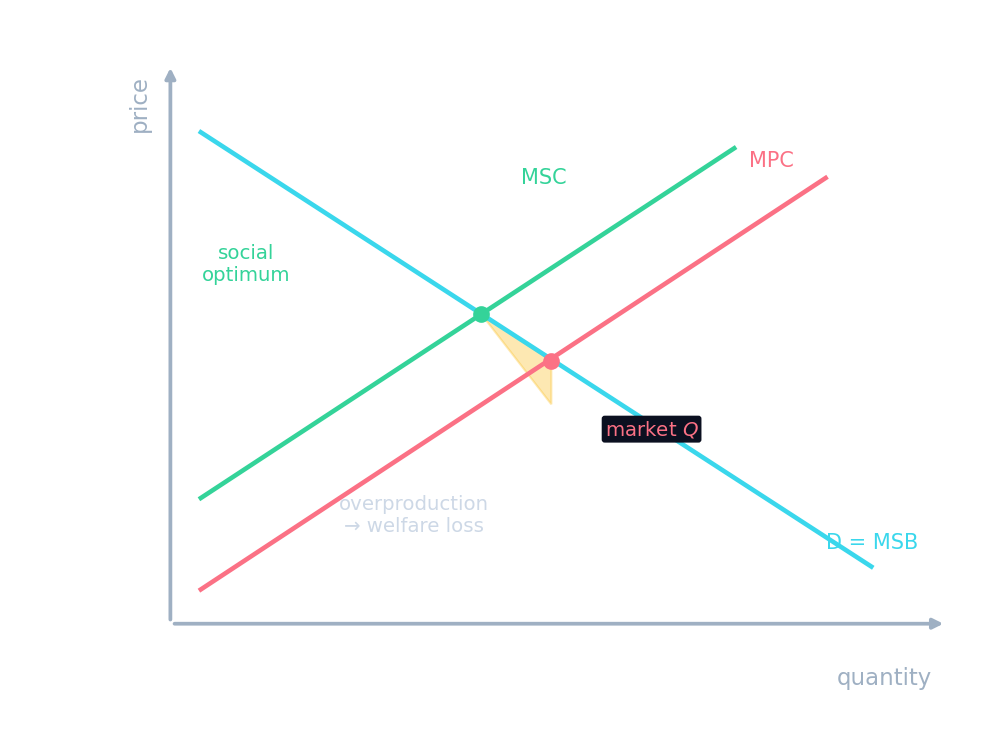
With a negative externality, marginal social cost 边际社会成本 (MSC) lies above private cost (MPC); the market over-produces, creating a welfare loss.
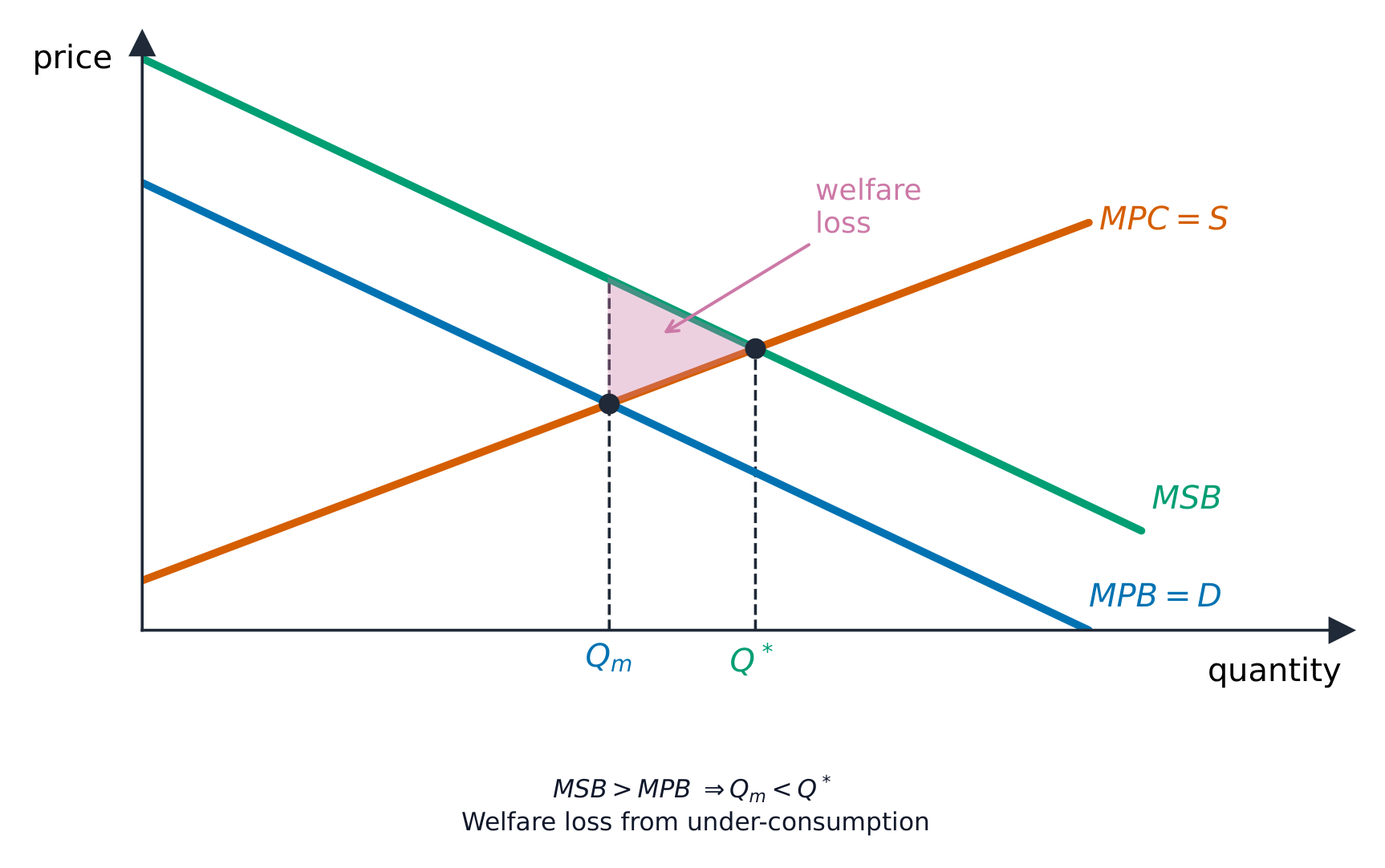
A positive externality: the market under-produces, causing welfare loss
Match each case to its externality.
Difficulty 2/5 · 140 coins + a small bonus on first completion today
Costs on third parties are negative (over-produced); benefits to third parties are positive (under-produced).
Private vs social
- Marginal private cost/benefit = what the individual bears or gains.
- Marginal social cost/benefit = private plus the externality.
- The market sets output where private cost = private benefit; the social optimum 社会最优 is where social cost = social benefit.
Negative externality = over-production, not under. The classic slip is to reverse them. Pollution → too much is made (MSC above MPC); positive externalities → too little.
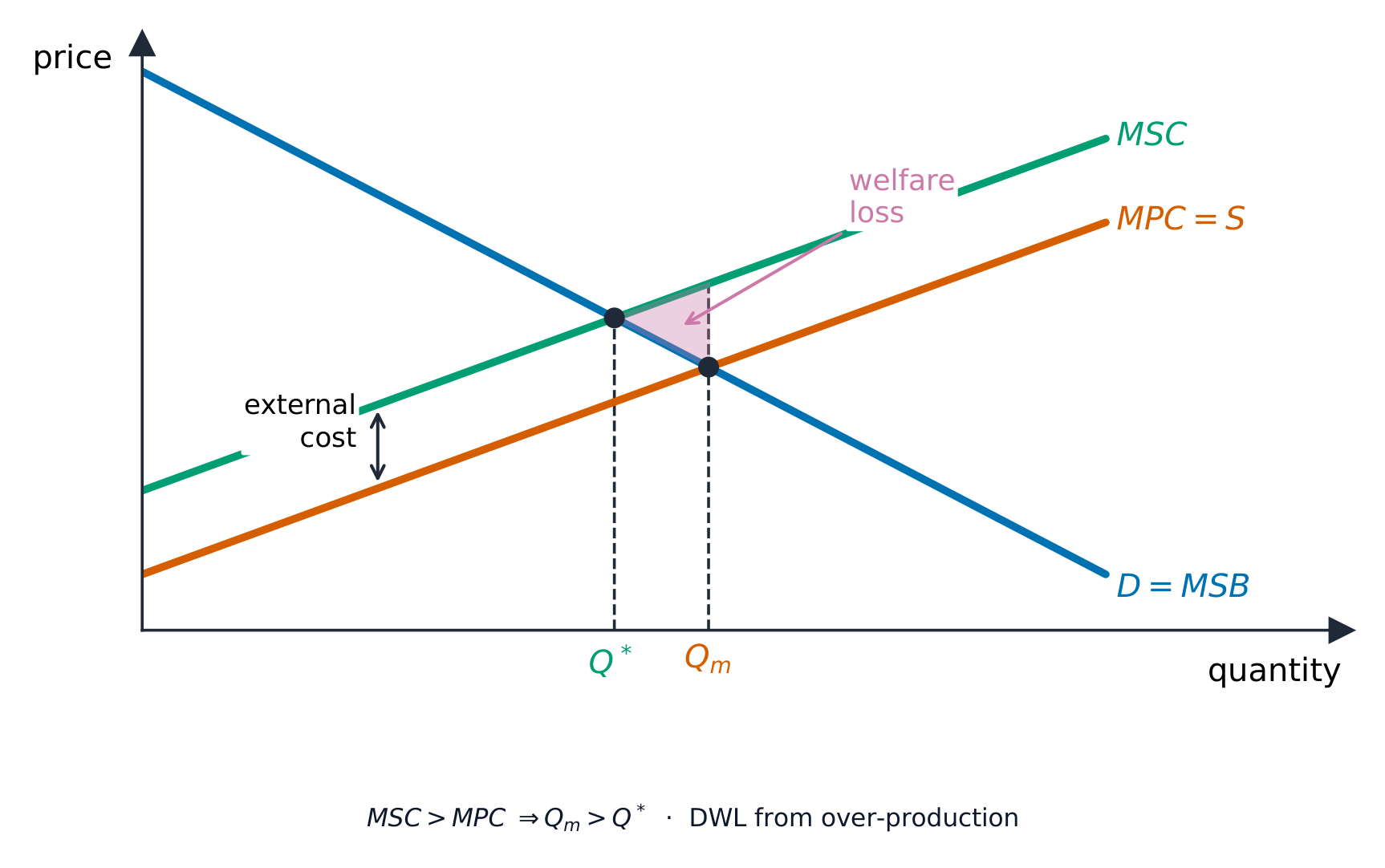
A negative externality: the market over-produces, causing welfare loss
Marginal social cost = marginal private cost plus the ______.
Difficulty 1/5 · 100 coins + a small bonus on first completion today
MSC = MPC + the external cost imposed on third parties.
You've got it
- market failure = inefficient allocation; externalities are costs/benefits on third parties
- negative externality → social cost > private → over-production (welfare loss)
- positive externality → social benefit > private → under-production