Supply
Introduced| English | Meaning |
|---|---|
| supply/səˈplaɪ/ | The quantity sellers are willing and able to offer at different prices over a specified period. |
| law of supply/lɔː ɒv səˈplaɪ/ | The tendency for quantity supplied to rise as price rises, with other relevant factors held constant. |
| quantity supplied/ˈkwɒntɪti səˈplaɪd/ | The amount sellers are willing and able to offer at a particular price over a specified period. |
| technology/tekˈnɒlədʒi/ | The application of knowledge, methods and tools to practical tasks. |
| subsidy/ˈsʌbsɪdi/ | Financial assistance, usually from government, that reduces costs or supports a particular activity. |
| costs of production/kɒsts ɒv prəˈdʌkʃn/ | costs of production |
Why high prices bring more sellers
- When the price of a crop soars, farmers plant more of it next season. High prices pull supply 供给 out of producers.
- That's the law of supply 供给定律 — the mirror image of demand, and the other half of every market.
The supply curve slopes upward because, as price rises, firms:
Difficulty 1/5 · 100 coins + a small bonus on first completion today
Higher prices reward production, so quantity supplied rises — an upward curve.
The law of supply
- Supply is the quantity producers are willing and able to sell at each price.
- The law of supply: as price rises, quantity supplied 供给量 rises — so the supply curve slopes upward (higher prices reward more production).
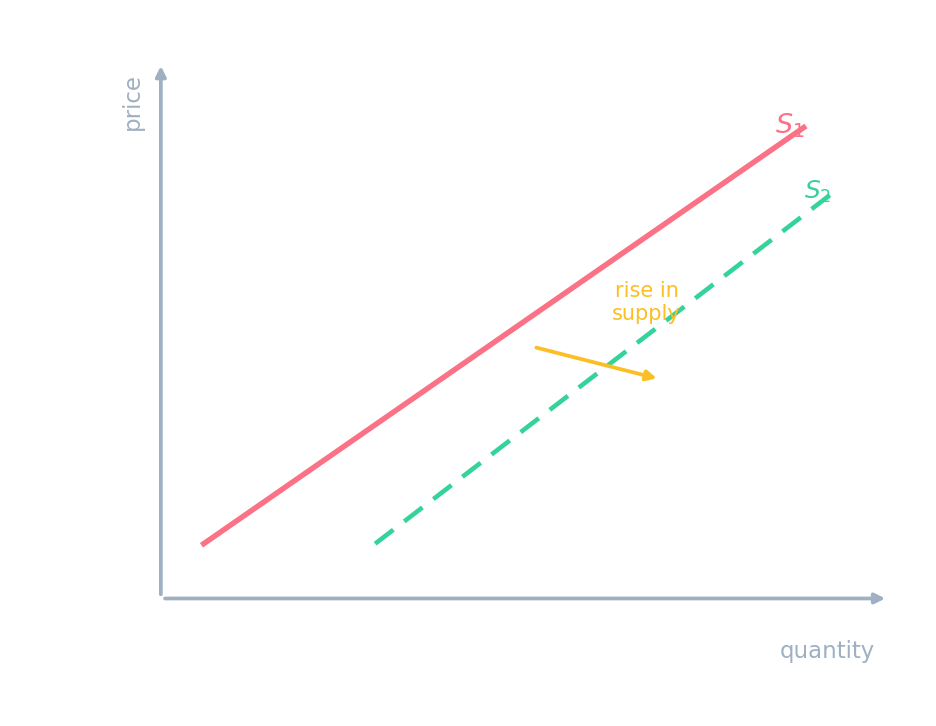
Higher price → more supplied (move along S₁); lower costs or better technology 技术 shift supply right to S₂.
Demand & supply
Supply slopes up — a higher price, more is produced.
Movement vs shift
- A change in the good's own price → movement along the supply curve.
- A change in costs, technology, taxes/subsidies → a shift of the whole curve.
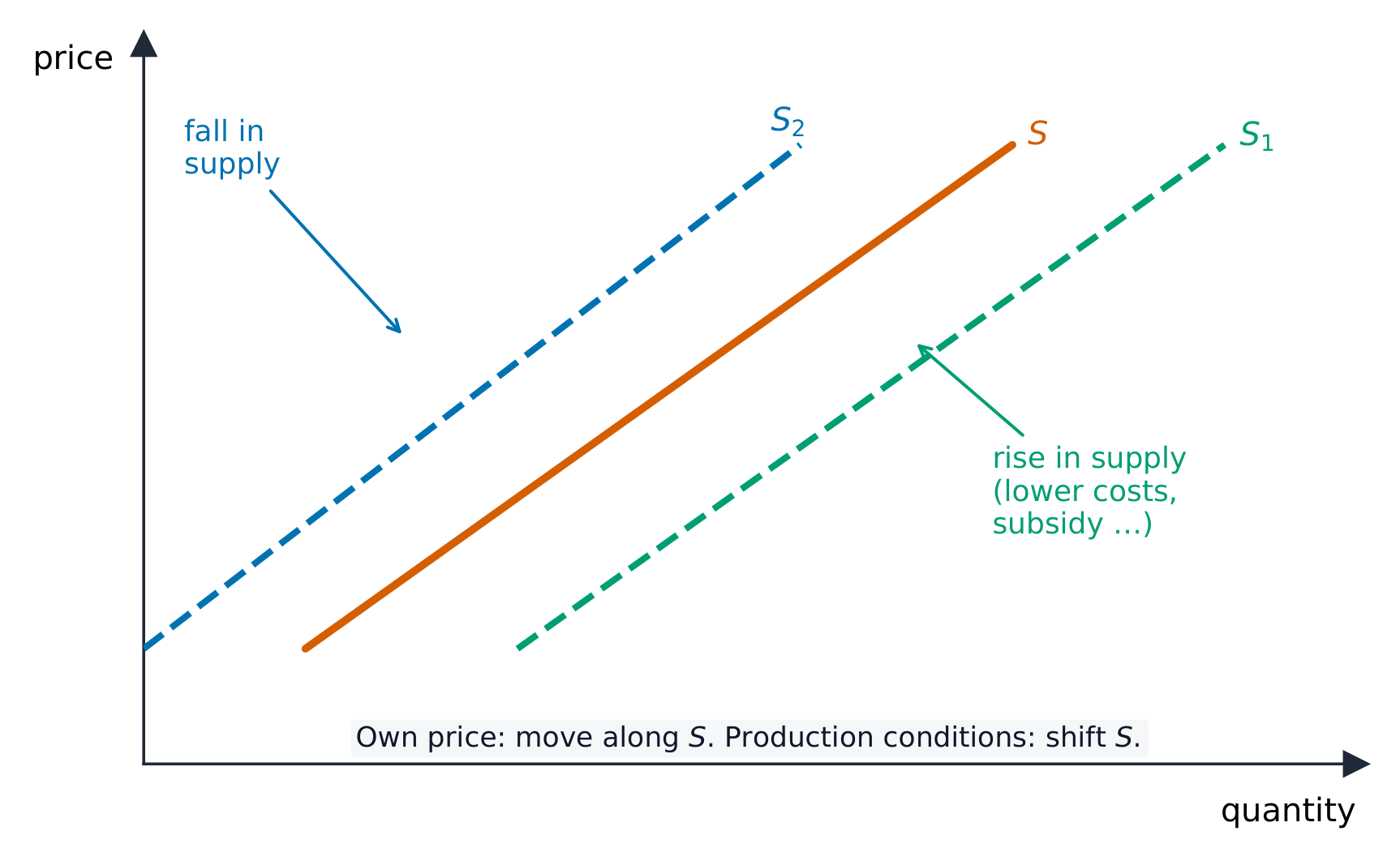
The supply curve slopes up; costs, technology, tax and subsidy 补贴 shift it
Which causes the supply curve to shift right (an increase in supply)?
Difficulty 1/5 · 100 coins + a small bonus on first completion today
Lower costs raise supply at every price (shift right); own-price is a movement along; tax shifts left.
A government subsidy shifts the supply curve to the right.
Difficulty 1/5 · 100 coins + a small bonus on first completion today
A subsidy lowers effective costs, so firms supply more at each price.
Match each change to its effect on supply.
Difficulty 2/5 · 140 coins + a small bonus on first completion today
Lower costs and better tech raise supply; a tax raises costs and lowers it.
A per-unit ______ raises firms' costs and shifts the supply curve left.
Difficulty 1/5 · 100 coins + a small bonus on first completion today
A tax adds to cost, reducing supply at every price.
What shifts supply
- Costs of production 生产成本 (cheaper inputs → supply rises),
- Technology (better tech → supply rises),
- Taxes (raise costs → supply falls) and subsidies (lower costs → supply rises),
- Number of firms and weather (for farm goods).
A subsidy shifts supply right. A per-unit subsidy lowers each firm's effective cost, so they supply more at every price — the whole curve moves right.
You've got it
- law of supply: price up → quantity supplied up (upward curve)
- own-price change = movement along; costs/technology/tax = shift
- supply shifts with costs, technology, taxes, subsidies, number of firms