Price elasticity of demand
Introduced| English | Meaning |
|---|---|
| price elasticity of demand/praɪs ɪlæˈstɪsɪti ɒv dɪˈmænd/ | The percentage change in quantity demanded divided by the percentage change in price. |
| revenue/ˈrevənjuː/ | Income received by a business from selling goods or services before costs are deducted. |
| elastic/ɪˈlæstɪk/ | Describing demand or supply whose percentage response exceeds the percentage change in its determining price or income. |
| inelastic/ɪnɪˈlæstɪk/ | Describing demand or supply whose percentage response is smaller than the percentage change in its determining price or income. |
| substitutes/ˈsʌbstɪtjuːts/ | Goods or services that can be used in place of each other. |
| necessity/nəˈsesɪti/ | A normal good whose quantity demanded rises proportionately less than income when other factors are unchanged. |
| luxury/ˈlʌkʃəri/ | In economics, a good whose demand rises more than proportionally as income rises over the relevant range. |
Why petrol prices can soar without denting sales
- Double the price of a designer handbag and sales collapse. Double the price of petrol and people grumble but keep buying.
- Price elasticity of demand 需求价格弹性 (PED) measures exactly how sensitive buyers are — and it decides what happens to a firm's revenue 营业收入.
Measuring PED
- PED measures the responsiveness of quantity demanded to a price change:
- It is usually negative (price and quantity move opposite ways); we focus on its size.

In a market, buyers and sellers meet and the price settles where demand equals supply
Demand & supply
Elasticity is the steepness of demand — flatter means more responsive.
Demand is described as elastic when the size of PED is:
Difficulty 1/5 · 100 coins + a small bonus on first completion today
|PED| > 1 is elastic (quantity is very responsive); |PED| < 1 is inelastic.
PED = (% change in quantity demanded) ÷ (% change in ______).
Difficulty 1/5 · 100 coins + a small bonus on first completion today
PED divides the % change in quantity demanded by the % change in price.
Elastic 富有弹性 vs inelastic 缺乏弹性
- $|\text{PED}| > 1$ → elastic (quantity is very responsive — luxuries, many substitutes 替代品).
- $|\text{PED}| < 1$ → inelastic (quantity barely responds — necessities, few substitutes).
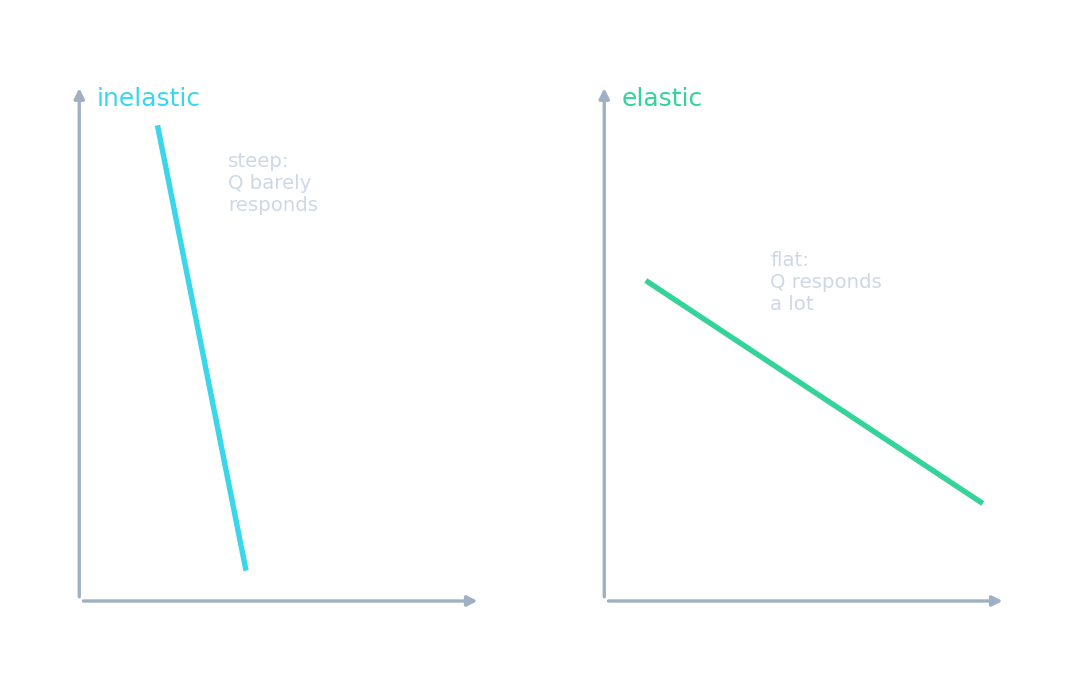
A steep curve is inelastic; a flat curve is elastic. The flatter the curve, the more buyers respond.
Worked example. Price rises 20% and quantity demanded falls 10%. PED $= \dfrac{-10\%}{+20\%} = -0.5$ — inelastic (size < 1).
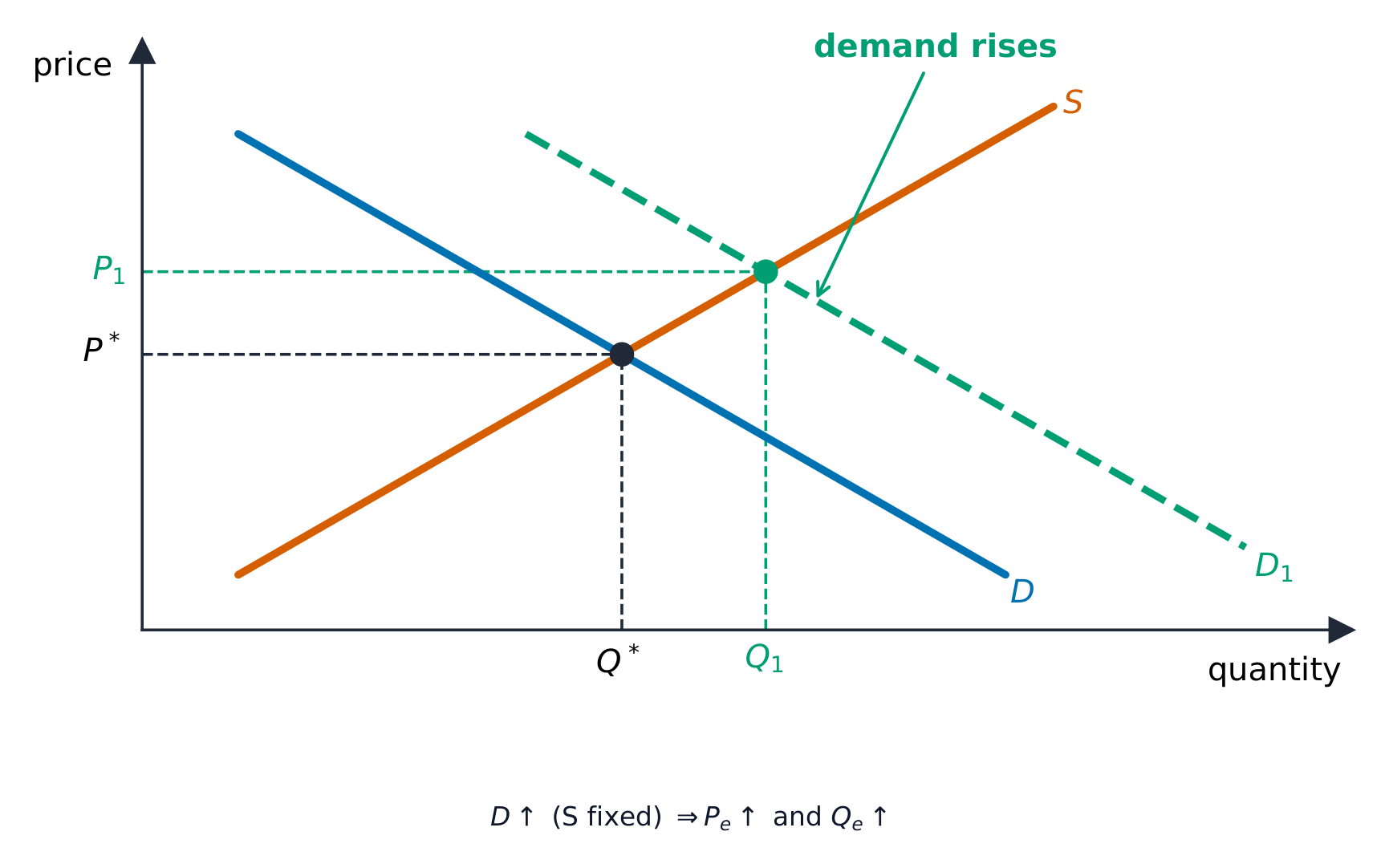
A rise in demand raises both equilibrium price and quantity
Price rises 20% and quantity demanded falls 10%. What is the PED (as a decimal, keep the sign)?
Difficulty 2/5 · 140 coins + a small bonus on first completion today
PED = −10% / +20% = −0.5 (inelastic).
PED and revenue
- The link firms care about: if demand is inelastic, raising price raises total revenue; if elastic, raising price lowers revenue.
- Determinants of PED: substitutes (more → more elastic), whether it's a necessity 必需品 or luxury 奢侈品, and the time period (more elastic over time).

Petrol has price-inelastic demand: drivers must buy it, so a price rise cuts the quantity bought only a little
If demand is inelastic, a firm that raises its price will find total revenue:
Difficulty 1/5 · 100 coins + a small bonus on first completion today
Inelastic: quantity barely falls, so the higher price raises revenue.
Necessities with few substitutes tend to have inelastic demand.
Difficulty 1/5 · 100 coins + a small bonus on first completion today
People keep buying necessities even when the price rises → inelastic.
You've got it
- $\text{PED} = \dfrac{\%\Delta Q_d}{\%\Delta P}$ — focus on the size
- $|\text{PED}|>1$ elastic (flat curve); $|\text{PED}|<1$ inelastic (steep curve)
- inelastic → raise price to raise revenue; elastic → raising price cuts revenue