Skip to content · ⁨본문 바로가기⁩

The price system and the microeconomy · ⁨가격 체계와 미시경제⁩

A-Level Economics · ⁨A-Level 경제학⁩ · Topic 2 · ⁨주제 2⁩

Video lesson for this topic · ⁨이 주제용 영상 수업⁩ Open the video page · ⁨영상 페이지 열기⁩
16:11

The price system and the microeconomy · ⁨가격 체계와 미시경제⁩

Nobody in this market is in charge. No official decides what a kilo of tomatoes should cost. Yet every stall has a price, and by evening almost everything is…

English narration · English + 中文 subtitles burned in · ⁨영어 내레이션 · 영어 + 중국어 자막 burned-in⁩

2.1

Demand · ⁨수요⁩

Syllabus
English
  1. explain the determinants of demand and supply and distinguish movements along from shifts of the curves
  2. derive individual and market demand and supply
  3. explain the relationship between marginal utility and the demand curve
한국어
  1. 수요와 공급의 결정 요인을 설명하고, 곡선상의 이동과 곡선의 이동(shift)을 구분함
  2. 개별 수요와 시장 수요, 개별 공급과 시장 공급을 유도함
  3. 한계 효용(marginal utility) 과 수요 곡선 사이의 관계를 설명함

Source: Cambridge International syllabus · ⁨출처: Cambridge International syllabus⁩

English
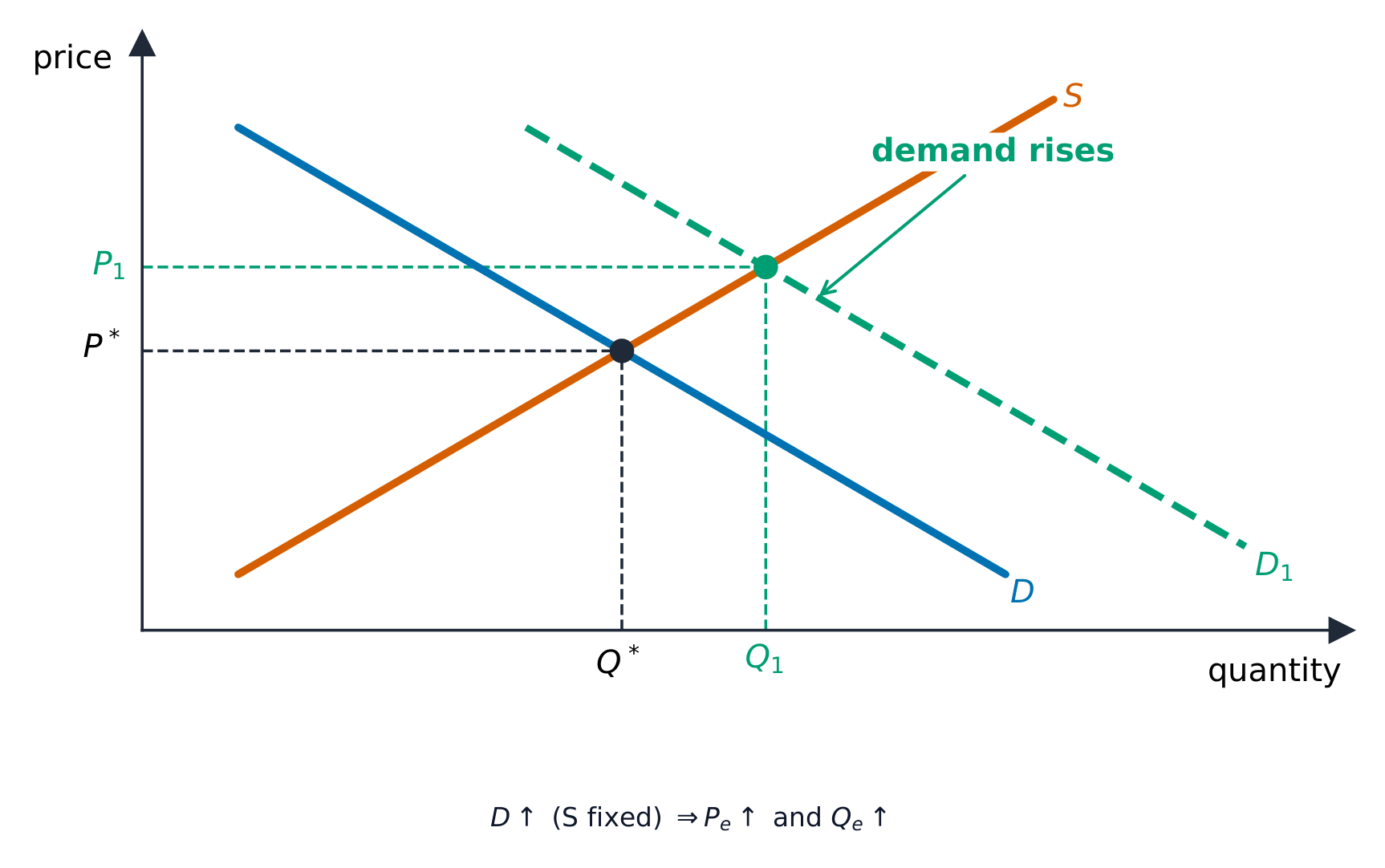
Demand shifts right: P and Q rise

demand 需求 is the quantity of a good that buyers are willing and able to buy at each price 价格 in a period of time. It is not just a wish — buyers must also be able to pay.

The law of demand says: when the price rises, the quantity demanded 需求量 falls; when the price falls, the quantity demanded rises. Price and quantity move in opposite directions.

So the demand curve 需求曲线 slopes downward, from top-left to bottom-right.

What shifts the demand curve

A change in the good's own price is shown as a movement along the demand curve. A change in any other cause shifts the whole curve to a new position — this is a shift 移动 of demand. The main causes (the determinants 决定因素) are:

  • income 收入 — for most goods, higher income raises demand.
  • the price of a substitute 替代品 — a good you can use instead (tea for coffee). If the substitute's price rises, demand for this good rises.
  • the price of a complement 互补品 — a good used together with this one (cars and petrol). If the complement's price rises, demand for this good falls.
  • tastes and fashion, the size of the population, and advertising.

Individual and market demand

One consumer 消费者 has an individual demand. The market demand 市场需求 is found by adding up the quantity that all consumers want at each price (adding the curves sideways).

Marginal utility and demand

utility 效用 is the satisfaction you get from consuming a good. marginal utility 边际效用 is the extra utility from one more unit.

The law of diminishing marginal utility 边际效用递减 says each extra unit gives less extra satisfaction than the one before. Because later units are worth less to you, you will only buy them at a lower price. This is why the demand curve slopes downward.

한국어
수요 곡선이 오른쪽으로 이동: P와 Q 상승

수요는 특정 기간 동안 구매자가 각 가격에 대해 구매할 의사와 능력을 가진 재화의 양입니다. 단순히 원망하는 것뿐만 아니라, 구매자가 실제로 지불할 수 있어야 합니다.

수요의 법칙은 다음과 같이 말합니다: 가격이 오르면 수요량이 감소하고, 가격이 떨어지면 수요량이 증가합니다. 가격과 수량은 반대 방향으로 움직입니다.

따라서 수요 곡선은 좌상단에서 우하단으로 아래로 기울어집니다.

수요 곡선이 이동하는 요인

해당 재화의 자신 가격 변화는 수요 곡선을 따라 이동으로 표시됩니다. 그 외의 다른 원인 변화는 곡선 전체를 새로운 위치로 이동시킵니다. 이를 수요의 이동이라고 합니다. 주요 원인(결정 요인)은 다음과 같습니다:

  • 소득 — 대부분의 재화에 대해 소득이 높아지면 수요가 증가합니다.
  • 대체재의 가격 — 대신 사용할 수 있는 재화(예: 커피 대신 차)입니다. 대체재의 가격이 오르면 해당 재화의 수요가 증가합니다.
  • 보완재의 가격 — 해당 재화와 함께 사용하는 재화(예: 자동차와 휘발유)입니다. 보완재의 가격이 오르면 해당 재화의 수요가 감소합니다.
  • 취향과 유행, 인구의 규모, 광고 등.
오름차선的需求曲선과 우측 및 좌측 이동
소득, 취향 또는 관련 가격의 변화는 곡선 전체를 이동시킵니다($D_1$ 우측, $D_2$ 좌측); 해당 재화의 자신 가격 변화는 곡선을 따라 이동합니다.

개별 수요와 시장 수요

한 소비자는 개별 수요를 가집니다. 시장 수요는 각 가격에서 모든 소비자가 원하는 수량을 합산하여 구합니다(곡선을 가로로 더함).

한계 효용과 수요

효용은 재화를 소비함으로써 얻는 만족도입니다. 한계 효용은 추가적으로 1단위를 소비할 때 얻는 추가적인 효용입니다.

한계 효용 체감의 법칙은 추가적인 단위가 이전 단위보다 적은 추가 만족을 제공함을 말합니다. 후속 단위는对您에게 가치가 적으므로, 낮은 가격에서만 구매하게 됩니다. 이것이 수요 곡선이 아래로 기울어지는 이유입니다.

마진 효용이 소비 단위가 증가함에 따라 감소하는 막대그래프, 첫 번째 단위부터 다섯 번째 단위까지 막대가 짧아짐
추가 단위는 마지막 단위보다 적은 만족을 더하므로, 구매자는 후속 단위에 대해 더 낮은 가격을 지불하며, 이것이 수요 곡선이 아래로 기울어지는 이유입니다
Explore · ⁨탐색하기⁩

Demand & supply · ⁨수요 & 공급⁩

Demand slopes down — a lower price, more is wanted. · ⁨수요 곡선은 아래로 경사됨 — 가격이 낮을수록 더 많이 원함.⁩

Vocabulary · ⁨어휘⁩ Train · ⁨연습하기⁩
English 한국어
demand/dɪˈmænd/ 수요
shift/ʃɪft/ 평이동
determinants/dɪˈtɜːmɪnənts/ 영향 요인(determinants)
utility/juːˈtɪlɪti/ 유틸리티/utility
marginal utility/ˈmɑːdʒɪnl juːˈtɪlɪti/ 마진 효용
diminishing marginal utility/dɪˈmɪnɪʃɪŋ ˈmɑːdʒɪnl juːˈtɪlɪti/ 한계 효용 체감의 법칙
supply/səˈplaɪ/ 공급 장치
producer/prəˈdjuːsə/ 생산자
Watch lesson · ⁨수업 보기⁩
2.1

Supply · ⁨공급⁩

English

supply 供给 is the quantity of a good that producers 生产者 are willing and able to sell at each price in a period of time.

The law of supply says: when the price rises, the quantity supplied 供给量 rises. Higher prices mean more profit 利润, so firms make more. So the supply curve 供给曲线 slopes upward.

What shifts the supply curve

A change in the good's own price is a movement along the supply curve. Other causes shift the whole curve:

  • costs of production 生产成本 — if wages, raw materials or rent get dearer, supply falls.
  • technology — better machines raise supply.
  • a subsidy 补贴 (government payment to producers) raises supply; an indirect tax lowers it.
  • the number of firms 企业 in the market, and weather (for farm goods).

Individual and market supply

The market supply 市场供给 is found by adding up the quantity all firms will sell at each price.

한국어

공급은 특정 기간 동안 생산자가 각 가격에 대해 판매할 의사와 능력을 가진 재화의 양입니다.

공급의 법칙은 다음과 같이 말합니다: 가격이 오르면 공급량이 증가합니다. 높은 가격은 더 많은 이익을 의미하므로 기업들은 더 많이 생산합니다. 따라서 공급 곡선은 위로 기울어집니다.

공급 곡선이 이동하는 요인

해당 재화의 자신 가격 변화는 공급 곡선을 따라 이동합니다. 다른 원인들은 곡선 전체를 이동시킵니다:

  • 생산 비용 — 임금, 원자재 또는 임대료가 비싸지면 공급이 감소합니다.
  • 기술 — 더 나은 기계는 공급을 증가시킵니다.
  • 보조금(정부의 생산자 지급)은 공급을 증가시키고, 간접세는 공급을 감소시킵니다.
  • 시장의 기업 수, 그리고 날씨(농산물에 한함).
오른쪽으로 이동하거나 왼쪽으로 이동하는 우상승 공급 곡선
비용 감소, 기술 개선 또는 보조금은 공급을 우측으로 이동시킵니다($S_1$); 비용 증가 또는 세금은 좌측으로 이동시킵니다($S_2$).

개별 공급과 시장 공급

시장 공급은 각 가격에서 모든 기업이 판매할 수 있는 수량을 합산하여 구합니다.

Explore · ⁨탐색하기⁩

Demand & supply · ⁨수요 & 공급⁩

Supply slopes up — a higher price, more is produced. · ⁨공급 곡선은 위로 경사됨 — 가격이 높을수록 더 많이 생산됨.⁩

2.2

Price elasticity of demand · ⁨가격 수요 탄력성⁩

Syllabus
English
  1. define, calculate and interpret price elasticity of demand (PED), income elasticity (YED) and cross elasticity (XED)
  2. explain the determinants of each and the relationship between PED and total revenue/expenditure
  3. explain the usefulness of elasticities to firms and government
한국어
  1. 가격 수요 탄력성(PED), 소득 탄력성(YED), 교차 탄력성(XED) 를 정의, 계산, 해석함
  2. 각 탄력성의 결정 요인과 PED와 총Revenue(총매출) / 지출 사이의 관계를 설명함
  3. 탄력성이 기업과 정부에게 갖는 유용함을 설명함

Source: Cambridge International syllabus · ⁨출처: Cambridge International syllabus⁩

English
Supply shifts right: P falls, Q rises

price elasticity of demand 需求价格弹性 (PED) measures how much the quantity demanded responds when the price changes.

$$\text{PED} = \frac{\%\ \text{change in quantity demanded}}{\%\ \text{change in price}}$$

PED is normally negative (because of the law of demand), but we usually look at the size and drop the minus sign.

Worked example. The price of a good rises by 10% and the quantity demanded falls by 25%. Find the PED and classify the demand.

$$\text{PED} = \frac{-25}{10} = -2.5$$

Ignoring the minus sign, $2.5 > 1$, so demand is elastic — quantity responded much more than the price did.

Value Name Meaning
more than 1 elastic 富有弹性 quantity responds a lot
less than 1 inelastic 缺乏弹性 quantity responds a little
equal to 1 unit elastic 单位弹性 quantity changes by the same % as price
0 perfectly inelastic 完全无弹性 quantity does not change at all
infinity perfectly elastic 完全有弹性 any price rise sends demand to zero

What makes demand elastic or inelastic

  • the number and closeness of substitutes (more substitutes → more elastic).
  • whether the good is a necessity 必需品 (inelastic) or a luxury 奢侈品 (elastic).
  • the share of income spent on the good (a large share → more elastic).
  • time — demand is more elastic in the long run, when buyers can find other options.
  • habit or addiction makes demand inelastic.

PED and total revenue

total revenue 总收益 is the money a firm earns: $\text{TR} = \text{price} \times \text{quantity}$. PED tells a firm what happens to revenue when it changes the price:

If demand is… price rises price falls
inelastic total revenue rises total revenue falls
elastic total revenue falls total revenue rises
unit elastic total revenue stays the same total revenue stays the same

This is useful to firms (how to price for more revenue) and to governments 政府 (a tax on an inelastic good, like petrol, raises a lot of revenue without cutting sales much).

한국어
공급이 우측으로 이동: P 하락, Q 상승

**가격 수요 탄력성(PED)**은 가격이 변할 때 수요량이 얼마나 반응하는지를 측정합니다.

$$\text{PED} = \frac{\%\ \text{change in quantity demanded}}{\%\ \text{change in price}}$$

PED는 일반적으로 음수(수요의 법칙 때문)이지만, 우리는 보통 크기에 집중하고 마이너스 부호를 생략합니다.

**worked example.**某商品的价格上涨10%,需求量下降25%。求PED并分类需求。

$$\text{PED} = \frac{-25}{10} = -2.5$$

마이너스 부호를 무시하면, $2.5 > 1$이므로, 수요는 탄력적입니다 — 수량의 반응이 가격의 변화보다 훨씬 큽니다.

유류 주유구: 유류는 가격 비탄력적 수요를 가지므로, 가격 인상은 구매 수량을 소폭만 줄입니다
유류는 가격 비탄력적 수요를 가집니다: 운전객은 반드시 구매해야 하므로, 가격 인상 시 구매 수량은 소폭만 감소합니다.
값 이름 의미
1보다 클 때 탄력적 수량이 크게 반응
1보다 작을 때 비탄력적 수량이 소폭 반응
1과 같을 때 단위 탄력적 수량이 가격과 동일한 %만큼 변동
0 완전 비탄력적 수량이 전혀 변동하지 않음
무한대 완전 탄력적 어떤 가격 인상도 수요를 0으로 만듦
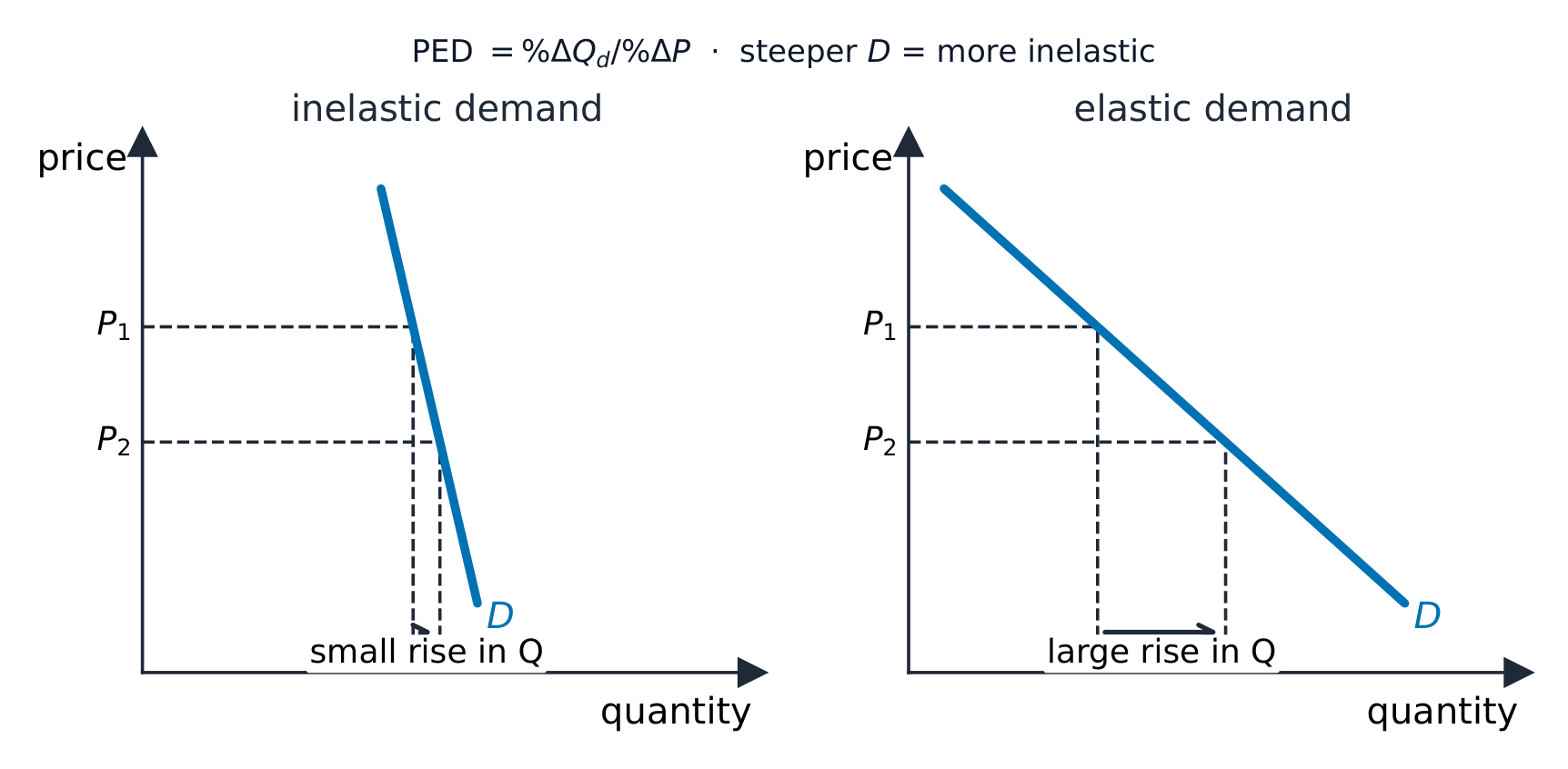
가파른 비탄력적 수요와 완만한 탄력적 수요 옆에 배치
수요가 비탄력적(가파름)일 때는 가격 변화가 수량에 거의 영향을 미치지 않지만, 탄력적(완만)일 때는 같은 가격 변화가 수량을 크게变动시킵니다.

수요가 탄력적이거나 비탄력적이게 만드는 요인

  • 대체재의 수와 근접성 (대체재가 많을수록 → 탄력적임).
  • 해당 재화가 필수품(비탄력적)인지 사치품(탄력적)인지 여부.
  • 재화 구매에 지출되는 소득의 비중 (큰 비중 → 수요 탄력성 큼).
  • 시간 — 장기에는 구매자가 다른 대안을 찾을 수 있으므로 수요가 더 탄력적이다.
  • 습관이나 중독은 수요를 비탄력적으로 만든다.

가격수요탄력성과 총매출

총매출은 기업이 얻는 돈으로, $\text{TR} = \text{price} \times \text{quantity}$이다. PED는 기업이 가격을 변경할 때 매출이 어떻게 변하는지를 알려준다:

수요가… 가격이 상승함 가격이 하락함
비탄력적일 경우 총매출 증가 총매출 감소
탄력적일 경우 총매출 감소 총매출 증가
단위 탄력적일 경우 총매출 유지 총매출 유지

이는 기업(더 높은 매출을 위한 가격 설정)과 정부(석유와 같은 비탄력적 재화에 부과된 세수는 판매량을 크게 줄이지 않으면서 많은 수익을 창출함)에게 유용하다.

Vocabulary · ⁨어휘⁩ Train · ⁨연습하기⁩
English 한국어
price/praɪs/ 가격
quantity demanded/ˈkwɒntɪti dɪˈmændɪd/ 수요량이라 합니다.
demand curve/dɪˈmænd kɜːv/ 수요 곡선(demand curve)
elastic/ɪˈlæstɪk/ 탄성 충돌
inelastic/ɪnɪˈlæstɪk/ 비 탄력적일 때
unit elastic/ˈjuːnɪt ɪˈlæstɪk/ 단위 탄력성
perfectly inelastic/ˈpɜːfektlɪ ɪnɪˈlæstɪk/ 완전 비탄성 충돌
perfectly elastic/ˈpɜːfektlɪ ɪˈlæstɪk/ 완전 탄력적일 때
necessity/nəˈsesɪti/ 필요성
luxury/ˈlʌkʃəri/ 고급재
total revenue/ˈtəʊtl ˈrevənjuː/ 총매출
government/ˈɡʌvənmənt/ 정부
income elasticity of demand/ˈɪŋkʌm ɪlæˈstɪsɪti ɒv dɪˈmænd/ 소득 수요 탄력성
normal good/ˈnɔːml ɡʊd/ 정품
inferior good/ɪnˈfɪərɪə ɡʊd/ 저급품
cross elasticity of demand/krɒs ɪlæˈstɪsɪti ɒv dɪˈmænd/ 수요의 교차 탄력성
price elasticity of supply/praɪs ɪlæˈstɪsɪti ɒv səˈplaɪ/ 공급 가격 탄력성
spare capacity/speə kəˈpæsɪti/ 여유 용량
stocks/stɒks/ 재고(stocks)
momentary/ˈməʊməntəri/ 일시적인/momentary
short run/ʃɔːt rʌn/ 단기
long run/lɒŋ rʌn/ 장기
Watch lesson · ⁨수업 보기⁩
2.2

Income elasticity of demand · ⁨소득수요탄력성⁩

English

income elasticity of demand 需求收入弹性 (YED) measures how much demand responds when income changes.

$$\text{YED} = \frac{\%\ \text{change in quantity demanded}}{\%\ \text{change in income}}$$
  • a normal good 正常品 has positive YED: demand rises as income rises. Necessities have YED between 0 and 1; luxuries have YED above 1.
  • an inferior good 低档品 has negative YED: demand falls as income rises (people switch to better goods). An example is cheap instant noodles.

Worked example. A person's income rises by 20% and their demand for restaurant meals rises by 30%. Find the YED and classify the good.

$$\text{YED} = \frac{+30}{+20} = +1.5$$

YED is positive and greater than 1, so restaurant meals are a normal good — and a luxury.

This helps firms plan: as incomes grow, demand for luxuries grows fastest.

한국어

소득수요탄력성(YED)은 소득이 변화할 때 수요가 얼마나 반응하는지를 측정한다.

소득이 증가하면 정품재에 대한 수요는 증가하지만 저급재에 대한 수요는 감소함
소득 증가 시 정상재의 수요는 증가하지만 저급재의 수요는 감소합니다
$$\text{YED} = \frac{\%\ \text{change in quantity demanded}}{\%\ \text{change in income}}$$
  • 정품재는 양의 YED를 가진다: 소득이 증가하면 수요도 증가한다. 필수품은 YED가 0과 1 사이이며, 사치재는 YED가 1보다 크다.
  • 저급재는 음의 YED를 가진다: 소득이 증가하면 수요가 감소한다(사람들은 더 나은 재화로 대체하기 때문). 예로 싼 즉면이 있다.

**해설 예제.**某人의 소득이 20% 증가하고 식당 식사에 대한 수요가 30% 증가했다. YED를 구하고 이 재화의 종류를 판별하시오.

$$\text{YED} = \frac{+30}{+20} = +1.5$$

YED가 양수이고 1보다 크므로 식당 식사는 정품재이자 사치재이다.

이는 기업이 계획하는 데 도움이 된다: 소득이 성장함에 따라 사치재에 대한 수요가 가장 빠르게 증가한다.

Vocabulary · ⁨어휘⁩ Train · ⁨연습하기⁩
English 한국어
income/ˈɪŋkʌm/ 소득
substitute/ˈsʌbstɪtjuːt/ 치환
complement/ˈkɒmplɪmənt/ 보 event
consumer/kənˈsuːmə/ 소비자
market demand/ˈmɑːkɪt dɪˈmænd/ 시장 수요(market demand)
2.2

Cross elasticity of demand · ⁨교차수요탄력성⁩

English

cross elasticity of demand 需求交叉弹性 (XED) measures how much demand for one good responds when the price of another good changes.

$$\text{XED} = \frac{\%\ \text{change in quantity demanded of A}}{\%\ \text{change in price of B}}$$
  • for substitutes, XED is positive (the price of B rises, so people buy more A).
  • for complements, XED is negative (the price of B rises, so people buy less A and less B).
  • for goods that are not related, XED is about zero.

Worked example. When the price of tea rises by 10%, the quantity of coffee demanded rises by 4%. Find the XED and say how the two goods are related.

$$\text{XED} = \frac{+4}{+10} = +0.4$$

XED is positive, so tea and coffee are substitutes.

This helps a firm watch its rivals: if XED with a rival's good is high and positive, a price cut by the rival will hurt its sales.

한국어

교차수요탄력성(XED)은 다른 재화의 가격이 변화할 때 한 재화에 대한 수요가 얼마나 반응하는지를 측정한다.

$$\text{XED} = \frac{\%\ \text{change in quantity demanded of A}}{\%\ \text{change in price of B}}$$
  • 대체재의 경우 XED는 양수이다(B의 가격이 상승하여 사람들이 A를 더 많이 구매하기 때문).
  • 보완재의 경우 XED는 음수이다(B의 가격이 상승하여 사람들이 A와 B를 모두 적게 구매하기 때문).
  • 관련이 없는 재화의 경우 XED는 약 0이다.

해설 예제. 차의 가격이 10% 상승했을 때 커의 수량 수요가 4% 증가했다. XED를 구하고 두 재화의 관계를 설명하시오.

$$\text{XED} = \frac{+4}{+10} = +0.4$$
세 장의 카드: 차 가격 상승이 커피 수요를 높여 대체재의 XED는 양수; 프린터 가격 상승이 잉크 수요를 낮춰 보완재의 XED는 음수; 무관한 재화는 XED가 거의 0
XED의 부호: 대체재는 양수, 보완재는 음수, 무관한 재화는 약 0

XED가 양수이므로 차와 커피는 대체재이다.

이는 기업이 경쟁사를 감시하는 데 도움이 된다: 경쟁사의 재화와 XED가 높고 양수라면 경쟁사의 가격 인하가 자사의 판매에 악영향을 미친다.

2.3

Price elasticity of supply · ⁨공급가격탄력성⁩

Syllabus
English
  1. define, calculate and interpret price elasticity of supply (PES)
  2. explain the determinants of PES, including time period (momentary, short run, long run)
한국어
  1. 공급의 가격 탄력성(PES) 를 정의, 계산, 해석함
  2. PES의 결정 요인을 설명하며, 시간 범위(즉시, 단기, 장기)를 포함함

Source: Cambridge International syllabus · ⁨출처: Cambridge International syllabus⁩

English
Elastic vs inelastic demand

price elasticity of supply 供给价格弹性 (PES) measures how much the quantity supplied responds when the price changes.

$$\text{PES} = \frac{\%\ \text{change in quantity supplied}}{\%\ \text{change in price}}$$

PES is positive. Supply is elastic if it responds a lot, inelastic if it responds little.

Worked example. The price of a good rises by 8% and the quantity supplied rises by 4%. Find the PES.

$$\text{PES} = \frac{4}{8} = 0.5$$

PES is less than 1, so supply is inelastic.

What makes supply more elastic:

  • spare capacity 闲置产能 — unused machines and workers, so firms can quickly make more.
  • stocks 库存 — goods stored in a warehouse that can be sold fast.
  • how easily factors of production can move into the industry.
  • time. Economists split time into three periods:
    • the momentary 瞬时 period — supply is fixed; PES is zero.
    • the short run 短期 — at least one factor is fixed, so supply can rise only a little.
    • the long run 长期 — all factors can change, so supply is most elastic.
한국어
탄력적 수요 vs 비탄력적 수요

공급가격탄력성(PES)은 가격이 변화할 때 공급량이 얼마나 반응하는지를 측정한다.

$$\text{PES} = \frac{\%\ \text{change in quantity supplied}}{\%\ \text{change in price}}$$

PES는 양수이다. 가격이 변화할 때 공급량이 많이 반응하면 탄력적이고, 적게 반응하면 비탄력적이다.

**해설 예제.**某재화의 가격이 8% 상승하고 공급량이 4% 증가했다. PES를 구하시오.

$$\text{PES} = \frac{4}{8} = 0.5$$

PES가 1보다 작으므로 공급은 비탄력적이다.

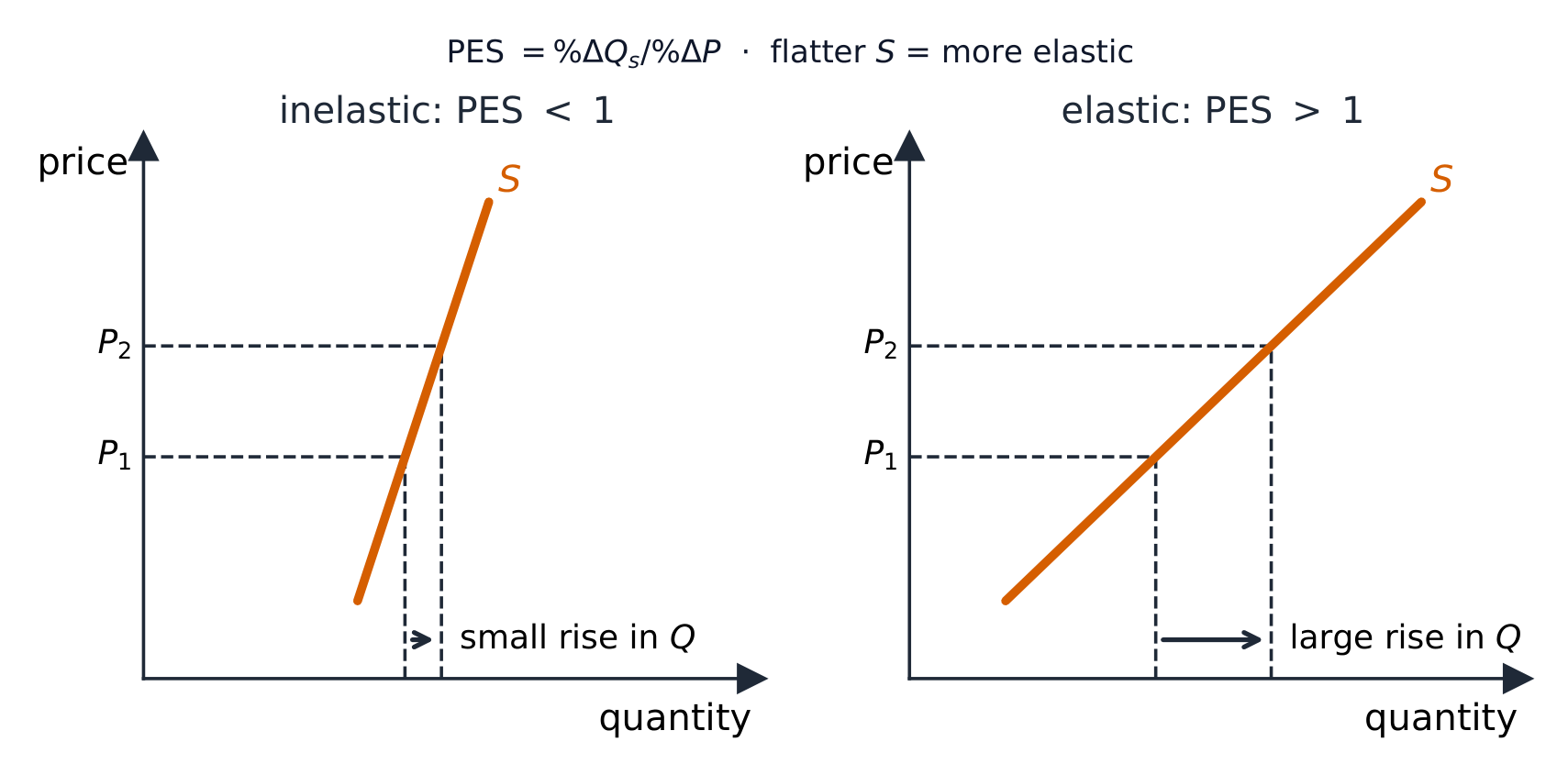
두 개의 공급 곡선: 동일한 가격 상승이 가파른 비탄력적 곡선에서는 작은 수량 반응을, 완만한 탄력적 곡선에서는 큰 반응을 가져옴
동일한 가격 상승: PES가 1 미만일 때는 작은 공급 반응, PES가 1 초과일 때는 큰 반응

공급을 더 탄력적으로 만드는 요인:

  • 여유 용량 — 사용하지 않는 기계와 근로자가 있어 기업이 빠르게 생산량을 늘릴 수 있음.
  • 재고 — 창고에 보관되어 있어 빠르게 판매할 수 있는 상품.
  • 생산요소가 해당 산업으로 유입되기 쉬운 정도.
  • 시간. 경제학자는 시간을 세 가지 기간으로 나눈다:
    • 즉시 기간 — 공급은 고정되어 있으며, PES는 0이다.
    • 단기 — 최소 한 가지 생산요소는 고정되어 있으므로 공급량은 약간만 증가할 수 있다.
    • 장기 — 모든 생산요소가 변동 가능하므로 공급은 가장 탄력적이다.
Explore · ⁨탐색하기⁩

Demand & supply · ⁨수요 & 공급⁩

Supply elasticity is how much quantity responds to price. · ⁨공급 탄력성은 가격이 수량에 얼마나 영향을 미치는지를 나타냄.⁩

Vocabulary · ⁨어휘⁩ Train · ⁨연습하기⁩
English 한국어
quantity supplied/ˈkwɒntɪti səˈplaɪd/ 공급량
profit/ˈprɒfɪt/ 이익
supply curve/səˈplaɪ kɜːv/ 공급 곡선
costs of production/kɒsts ɒv prəˈdʌkʃn/ 생산 비용
subsidy/ˈsʌbsɪdi/ 보조금
firm/fɜːm/ 기업(firm)
market supply/ˈmɑːkɪt səˈplaɪ/ 시장 공급(market supply)
price elasticity of demand/praɪs ɪlæˈstɪsɪti ɒv dɪˈmænd/ 가격 수요 탄력성
Watch lesson · ⁨수업 보기⁩
2.4

The interaction of demand and supply · ⁨수요와 공급의 상호작용⁩

Syllabus
English
  1. explain equilibrium price and quantity and how shifts in demand and supply change equilibrium
  2. explain disequilibrium (excess demand and excess supply) and the functions of the price mechanism
  3. apply demand and supply analysis to product, factor and foreign exchange markets
한국어
  1. 균형 가격과 균형 수량을 설명하고, 수요와 공급의 변화가 균형을 어떻게 바꾸는지 서술함
  2. 불균형(과잉 수요, 과잉 공급) 을 설명하고 가격 메커니즘의 기능을 서술함
  3. 제품 시장,要素市場, 외환 시장에 대한 수요·공급 분석을 적용함

Source: Cambridge International syllabus · ⁨출처: Cambridge International syllabus⁩

English

Equilibrium

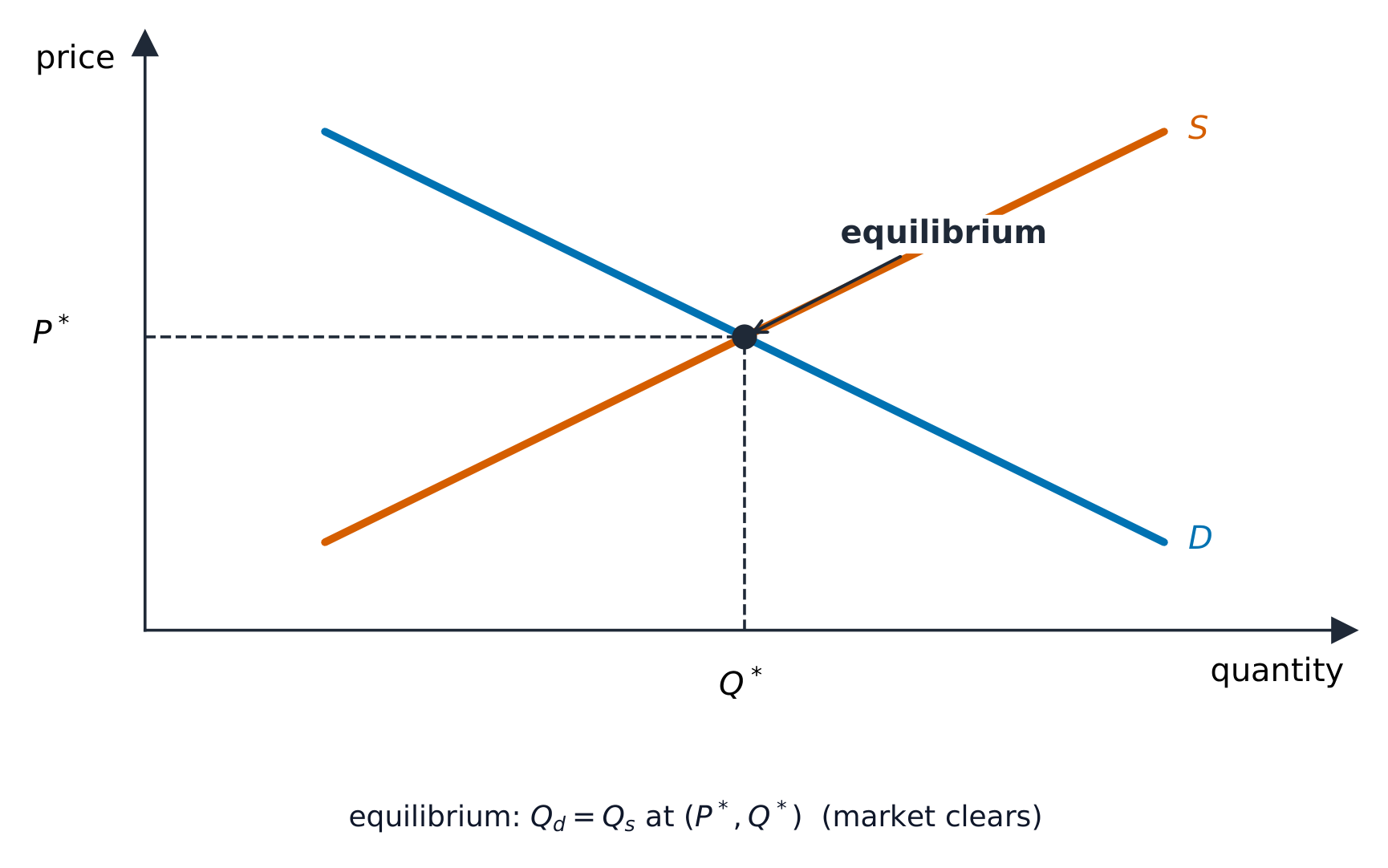
The market is in equilibrium 均衡 where the demand curve crosses the supply curve. Here demand equals supply. This gives the equilibrium price 均衡价格 and the equilibrium quantity 均衡数量. There is no pressure for the price to change.

Disequilibrium

When the price is not at equilibrium, the market is in disequilibrium 非均衡:

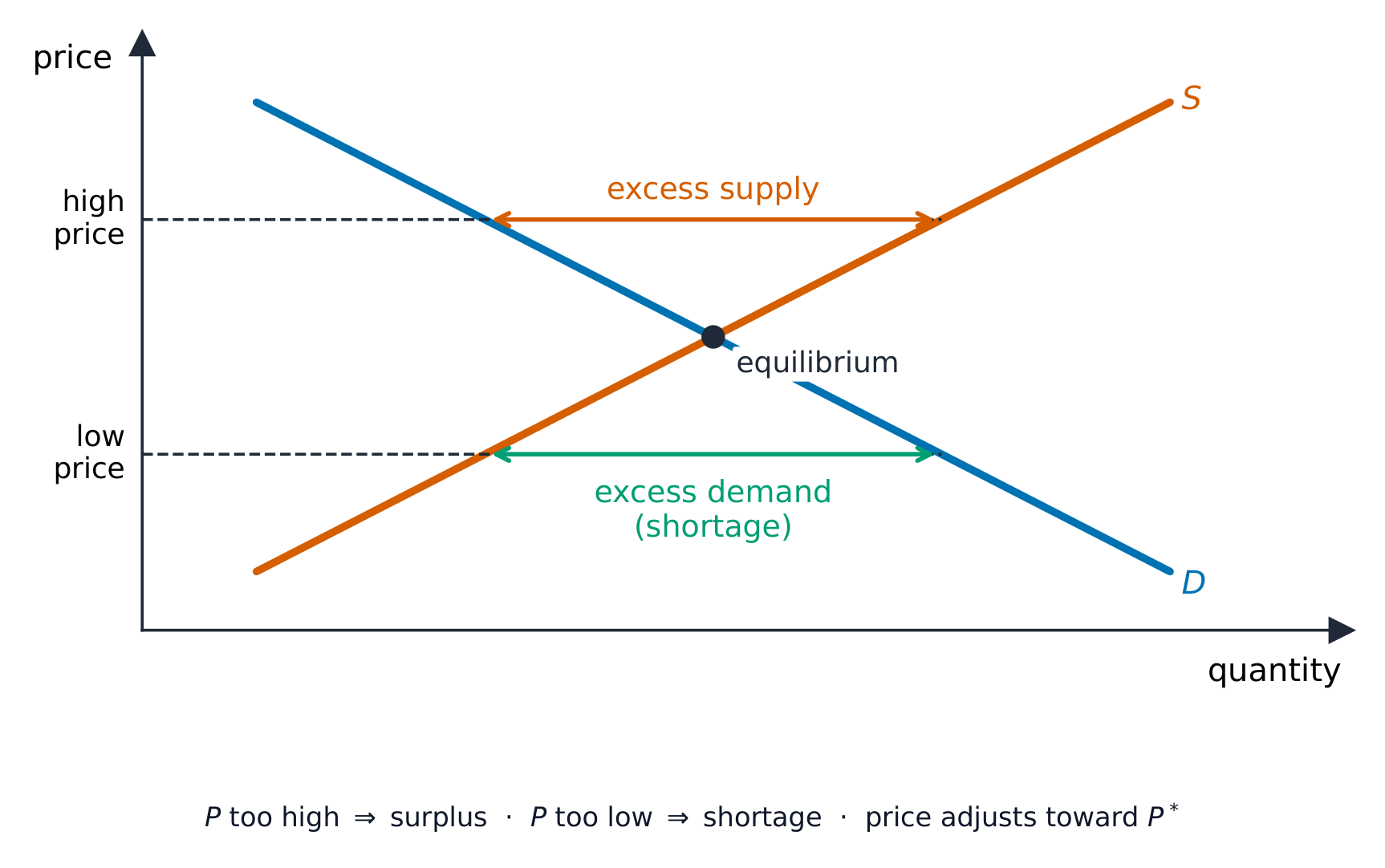
  • if the price is too low, there is excess demand 超额需求 (a shortage 短缺). Buyers compete, so the price is pushed up.
  • if the price is too high, there is excess supply 超额供给. Sellers cannot sell everything, so the price is pushed down.

In both cases the price moves back to equilibrium. This shows the price mechanism doing its jobs of signalling, rationing and giving an incentive.

How shifts change the equilibrium

Change Effect on price Effect on quantity
demand rises (shifts right) rises rises
demand falls (shifts left) falls falls
supply rises (shifts right) falls rises
supply falls (shifts left) rises falls

Demand and supply in different markets

The same analysis works in many markets:

  • in product markets 产品市场, demand and supply set the price of goods and services.
  • in factor markets 要素市场, they set the price of factors — for example, the demand for and supply of labour set the wage 工资.
  • in the foreign exchange market 外汇市场, the demand for and supply of a currency set the exchange rate 汇率 (the price of one currency in terms of another).
한국어
실외 시장 상점: 파프리커의 야채 진열대 손글씨 가격표, 그리고 장바구니를 밀고 농산물을 고르는 쇼핑객들
시장에서 구매자와 판매자가 만나 수요와 공급이 같아지는 지점에서 가격이 결정됩니다

균형

수요 곡선과 공급 곡선이 만나는 지점에서 시장은 균형 상태에 있다. 여기서는 수요와 공급이 같다. 이는 균형 가격과 균형 수량을 제공한다. 가격은 변동할 압력을 받지 않는다.

균형 가격과 수량에서 수요와 공급 곡선이 교차함
균형 가격 $P^*$과 수량 $Q^*$에서 곡선이 교차하므로 수량 수요는 수량 공급과 같다.

불균형

가격이 균형 수준이 아닐 때 시장은 불균형 상태에 있다:

  • 가격이 너무 낮으면 초과 수요(부족)가 발생한다. 구매자들이 경쟁하므로 가격은 상승압력을 받는다.
  • 가격이 너무 높으면 초과 공급이 발생한다. 판매자들이 모든 물건을 팔지 못하므로 가격은 하락압력을 받는다.

두 경우 모두 가격은 균형으로 다시 이동한다. 이는 가격 메커니즘이 신호 전달, 배분, 인센티브 제공이라는 기능을 수행함을 보여준다.

균형 가격 위에는 초과 공급, 아래에는 초과 수요가 존재함
균형 가격 위에는 초과 공급이, 아래에는 초과 수요(부족)가 있다. 어떤 경우든 가격은 균형으로 다시 밀려난다.

균형에 미치는 이동의 영향

변화 가격에 미치는 영향 수량에 미치는 영향
수요 증가(오른쪽으로 이동) 상승 증가
수요 감소(왼쪽으로 이동) 하락 감소
공급 증가(오른쪽으로 이동) 하락 증가
공급 감소(왼쪽으로 이동) 상승 감소
수요의 우측 이동이 균형 가격과 수량을 높임
공급이 고정된 상태에서 수요가 증가하면($D \to D_1$), 균형 가격과 균형 수량 모두 상승한다.

다양한 시장의 수요와 공급

동일한 분석은 여러 시장에 적용된다:

  • 제품 시장에서 수요와 공급은 재화 및 서비스의 가격을 결정한다.
  • 요소 시장에서它们是要素의 가격을 결정하며, 예를 들어 노동의 수요와 공급은 임금을 결정한다.
  • 외환 시장에서 한 통화의 수요와 공급은 그 통화의 환율(한 화폐를 다른 화폐로 환산한 가격)을 결정한다.
Explore · ⁨탐색하기⁩

Demand & supply · ⁨수요 & 공급⁩

Where demand meets supply sets the equilibrium price and quantity. · ⁨수요와 공급이 만나는 지점이 균형 가격과 수량을 결정합니다.⁩

Explore · ⁨탐색하기⁩

Finding the equilibrium price · ⁨균형 가격 찾기⁩

Shift demand or supply and watch the equilibrium price and quantity move to where the two lines cross. · ⁨수요나 공급 곡선을 이동시키면 두 선이 만나는 지점으로 균형 가격과 수량이 어떻게 움직이는지 확인하세요.⁩

Vocabulary · ⁨어휘⁩ Train · ⁨연습하기⁩
English 한국어
equilibrium/ˌiːkwɪˈlɪbrɪəm/ 평형
equilibrium price/ˌiːkwɪˈlɪbrɪəm praɪs/ 균형 가격
equilibrium quantity/ˌiːkwɪˈlɪbrɪəm ˈkwɒntɪti/ 균형 물량
disequilibrium/ˌdɪˌsiːkwɪˈlɪbrɪəm/ Disequilibrium
excess demand/ekˈses dɪˈmænd/ 과잉 수요(excess demand)
shortage/ˈʃɔːtɪdʒ/ 부족을 초래한다
excess supply/ekˈses səˈplaɪ/ 과잉 공급(excess supply)
product market/ˈprɒdʌkt ˈmɑːkɪt/ 제품 시장(product market)
factor market/ˈfæktə ˈmɑːkɪt/ 要素市場
wage/weɪdʒ/ 임금
foreign exchange market/ˈfɒrən eksˈtʃeɪndʒ ˈmɑːkɪt/ 외환 시장에서 실질 금리를 인상시킨다.
exchange rate/eksˈtʃeɪndʒ reɪt/ 환율
consumer surplus/kənˈsuːmə ˈsɜːpləs/ 소비자 surplus
producer surplus/prəˈdjuːsə ˈsɜːpləs/ Producer surplus
welfare/ˈwelfeə/ 복지
Watch lesson · ⁨수업 보기⁩
2.5

Consumer and producer surplus · ⁨소비자와 생산자잉여⁩

Syllabus
English
  1. define and identify consumer surplus and producer surplus on a diagram
  2. explain how changes in demand, supply and price affect consumer and producer surplus
한국어
  1. 소비자盈余(consumer surplus) 과 생산자盈余(producer surplus) 를 정의하고 도표에서 식별함
  2. 수요, 공급 및 가격의 변화가 소비자余裕와 생산자余裕에 미치는 영향을 설명하시오

Source: Cambridge International syllabus · ⁨출처: Cambridge International syllabus⁩

English

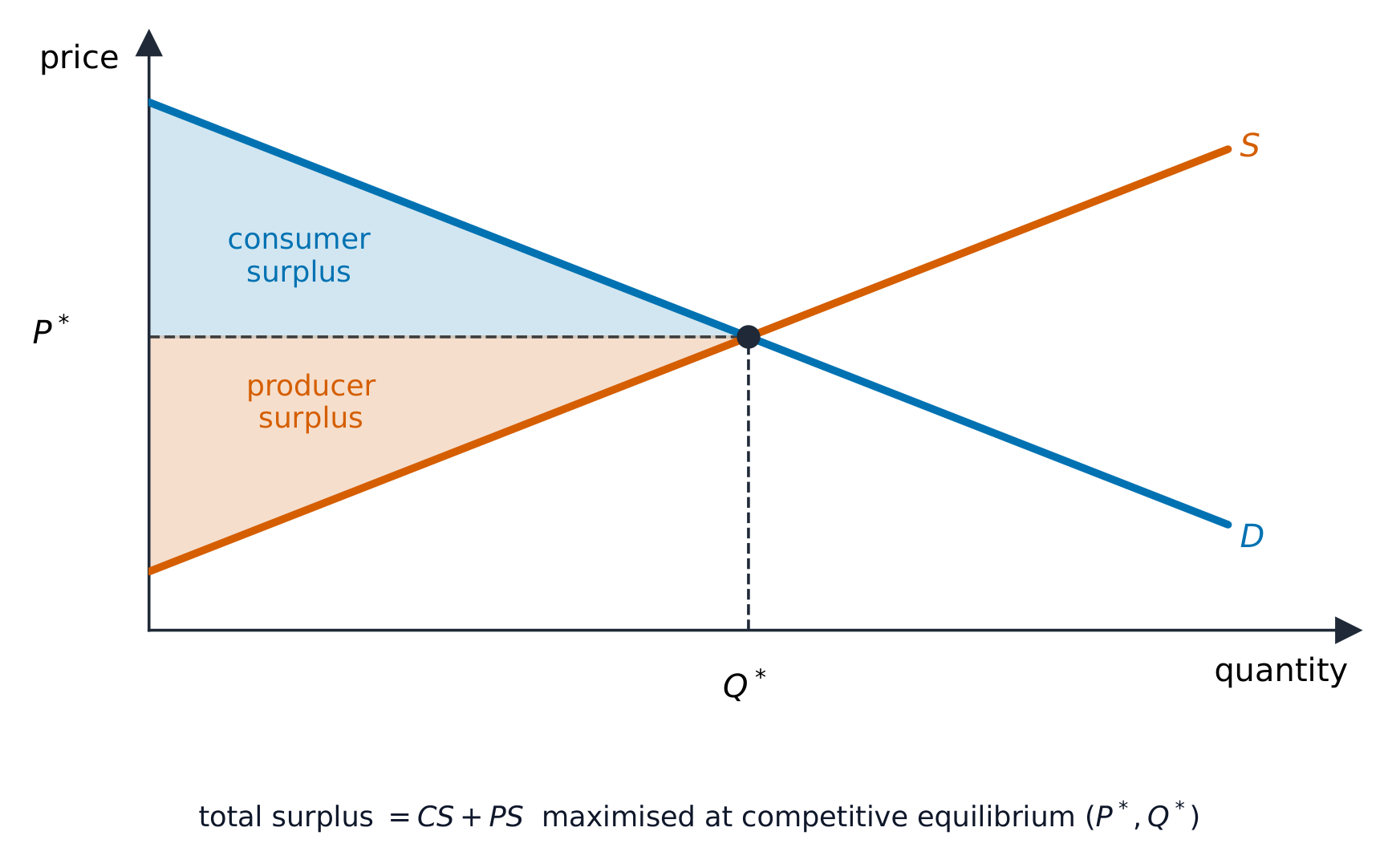
consumer surplus 消费者剩余 is the gain to buyers. It is the difference between the most a consumer was willing to pay and the price actually paid. On a diagram it is the area below the demand curve and above the price line.

producer surplus 生产者剩余 is the gain to sellers. It is the difference between the price a producer receives and the lowest price the producer would have accepted. On a diagram it is the area above the supply curve and below the price line.

How they change:

  • if demand rises, the price and quantity rise, so producer surplus rises and consumer surplus usually rises too.
  • if supply rises, the price falls and quantity rises, so consumer surplus rises.
  • a higher price (with the curves fixed) raises producer surplus but lowers consumer surplus.

Together, consumer surplus plus producer surplus is the total welfare 福利 (gain to society) from the market. It is largest at the free-market equilibrium.

한국어

소비자잉여는 구매자에게 발생하는 이득이다. 이는 소비자가 지불할 의사가 있던 최대 금액과 실제 지출한 금액의 차이이다. 도표상에서는 수요 곡선 아래쪽이자 가격 선 위쪽에 해당하는 면적이다.

생산자잉여는 판매자에게 발생하는 이득이다. 이는 생산자가 받는 가격과 생산자가 수용했을 minimal인 가격 사이의 차이이다. 도표상에서는 공급 곡선 위쪽이자 가격 선 아래쪽에 해당하는 면적이다.

균형점 주변에 색칠된 소비자잉여와 생산자잉여
소비자잉여는 수요 곡선 아래쪽이자 가격 선 위쪽의 면적이며, 생산자잉여는 공급 곡선 위쪽이자 가격 선 아래쪽의 면적이다.

변화 방식:

  • 수요가 증가하면 가격과 수량이 증가하므로 생산자잉여가 늘어나고 소비자잉여도 일반적으로 증가한다.
  • 공급이 증가하면 가격이 하락하고 수량이 증가하므로 소비자잉여가 늘어난다.
  • 곡선이 고정된 상태에서 가격이 상승하면 생산자잉여는 증가하지만 소비자잉여는 감소한다.

소비자잉여와 생산자잉여를 더한 총합은 시장으로부터 얻어지는 전체 복지(사회적 이득)이다. 이는 자유시장 균형점에서 가장 크다.

Explore · ⁨탐색하기⁩

Demand & supply · ⁨수요 & 공급⁩

Surplus sits between the curves and the going price. · ⁨Surplus는 곡선과 현재 가격 사이에 위치합니다.⁩

Watch lesson · ⁨수업 보기⁩
2.5

Exam tips · ⁨시험 팁⁩

English
  • Quote the elasticity formula and interpret the value: PED inelastic ($<1$), elastic ($>1$); link PED to total revenue.
  • Distinguish a movement along (a price change) from a shift (a non-price factor) of demand or supply.
  • Use the sign of XED (substitutes $+$, complements $-$) and YED (normal $+$, inferior $-$).
  • On a diagram, label consumer and producer surplus and show how a price change alters each.
한국어
  • 탄력성 공식을 인용하고 그 값을 해석한다: PED 비탄력적 ($<1$), 탄력적 ($>1$); PED와 총수익의 관계를 설명한다.
  • 이동(movement along) (가격 변화에 따른 것)과 이동(shift) (비가격 요인에 의한 것)을 구별하여 수요 또는 공급의 변화를 설명한다.
  • XED(대체재 $+$, 보완재 $-$)와 YED(정품재 $+$, 열등재 $-$)의 **부호(sign)**를 사용한다.
  • 도표 상에서 소비자잉여와 생산자잉여를 표시하고 가격 변화가 각각에 미치는 영향을 보여준다.

Interactive lessons on this topic · ⁨이 주제에 대한 인터랙티브 수업⁩

Work through it step by step, with instant-check exercises. · ⁨즉시 체크 기능 exercises를 통해 단계별로 진행하세요.⁩

Past Papers · ⁨과거 시험지⁩

More topics in A-Level Economics · ⁨A-Level 경제학⁩ · ⁨A-Level Economics · ⁨A-Level 경제학⁩ 내 추가 주제⁩

Log in or create account · ⁨로그인 또는 계정 만들기⁩

IGCSE, A-Level & AP