跳到主要内容

全球冲突

AP 世界历史 · 第 7 主题

训练
讲义 词汇表
7.1

1900年后权力格局的转变

大纲

7.1 Shifting Power After 1900

Thematic FocusLearning ObjectiveHistorical Developments

GOV
Governance — A variety of internal and external factors contribute to state formation, expansion, and decline. Governments maintain order through a variety of administrative institutions, policies, and procedures, and governments obtain, retain, and exercise power in different ways and for different purposes.

Unit 7.A
Explain how internal and external factors contributed to change in various states after 1900.

  • KC-6.2.I The West dominated the global political order at the beginning of the 20th century, but both land-based and maritime empires gave way to new states by the century’s end.
  • KC-6.2.I.A The older, land-based Ottoman, Russian, and Qing empires collapsed due to a combination of internal and external factors. These changes in Russia eventually led to communist revolution.
  • KC-6.2.II.D States around the world challenged the existing political and social order, including the Mexican Revolution that arose as a result of political crisis.

来源:美国大学理事会 AP 课程与考试说明

第七单元讲述 1900 年以来的全球冲突,其核心问题不是"两次大战发生了什么",而是1900 年时存在的政治秩序为何瓦解、又被什么取代

二十世纪初,西方主导着全球政治秩序。在此后数十年间,陆基帝国与海上帝国都让位于新的国家形态,CED 把其机制表述为内外因素(internal and external factors)的共同作用。

  • 更为古老的陆基帝国——奥斯曼、俄国与清朝——在这种内外交加的作用下瓦解:内部压力与外部压力同时存在。
  • 世界各地都有力量挑战既有政治与社会秩序,CED 点名的例证是因政治与经济不平等而爆发的墨西哥革命(Mexican Revolution)。

这里可考的习惯是"配对"。只写内部衰弱或只写外部压力的答案,只解释了一半。

词汇表 训练
英文 中文 拼音
internal and external factors 内外因素 nèi wài yīn sù
Mexican Revolution 墨西哥革命 mò xī gē gé mìng
7.2

第一次世界大战的起因

大纲

7.2 Causes of World War I

Thematic FocusLearning ObjectiveHistorical Developments

GOV
Governance — A variety of internal and external factors contribute to state formation, expansion, and decline. Governments maintain order through a variety of administrative institutions, policies, and procedures, and governments obtain, retain, and exercise power in different ways and for different purposes.

Unit 7.B
Explain the causes and consequences of World War I.

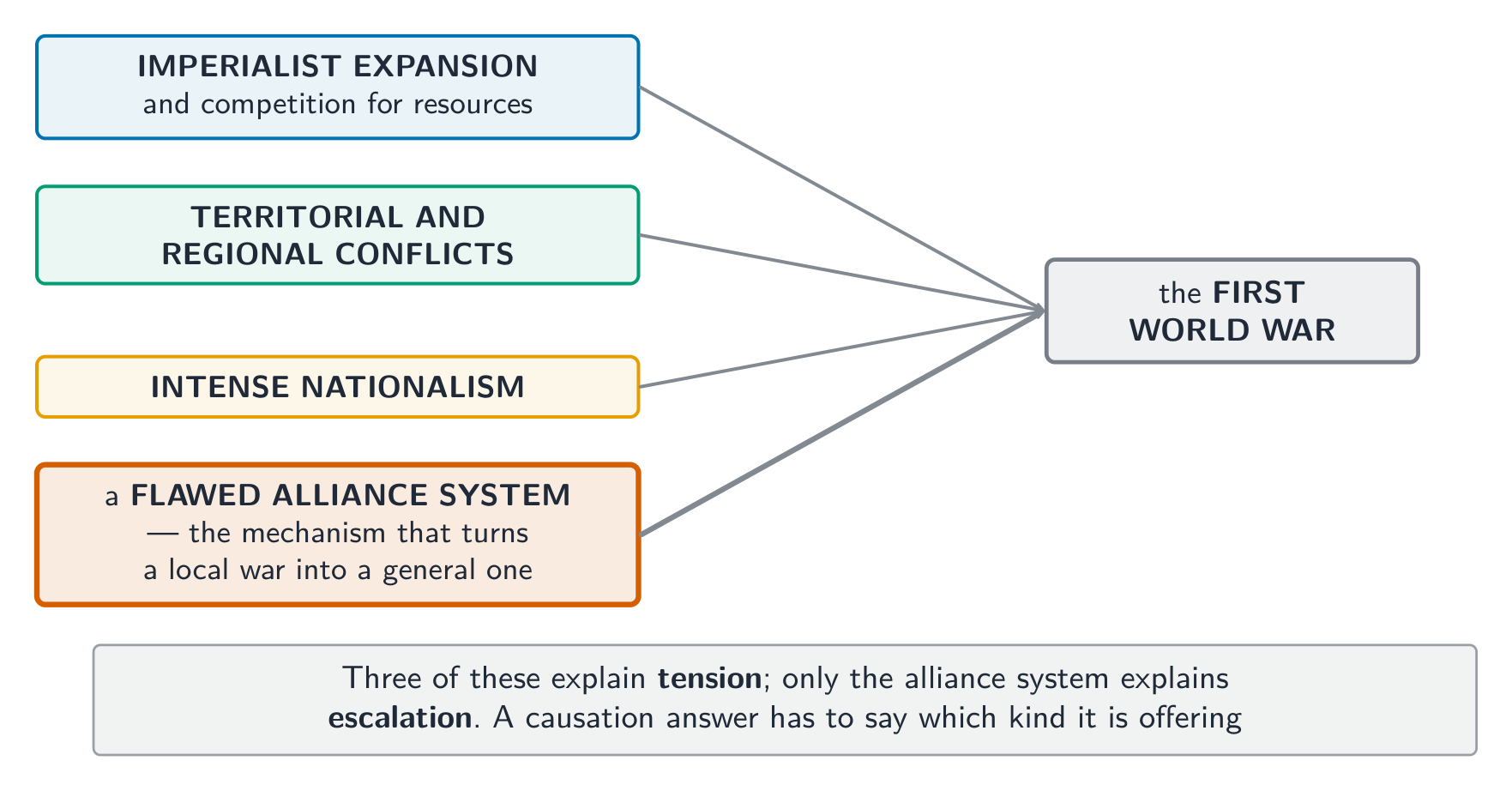
  • KC-6.2.IV.B.i The causes of World War I included imperialist expansion and competition for resources. In addition, territorial and regional conflicts combined with a flawed alliance system and intense nationalism to escalate the tensions into global conflict.

来源:美国大学理事会 AP 课程与考试说明

CED 把一战的起因压缩为一句话,而其中每个要素都值得分数:

  • 帝国主义扩张(imperialist expansion)与资源竞争(competition for resources)。
  • 领土与地区冲突(territorial and regional conflicts)。
  • 把局部冲突转化为全面冲突的结盟体系缺陷(flawed alliance system)。
  • 极端民族主义(intense nationalism)。

注意这一论断的结构:前三项提供了紧张关系,而结盟体系提供了升级(escalation)。这一区分——什么使冲突变得可能,与什么使冲突变成全球性的——是本节最有用的一点。

词汇表 训练
英文 中文 拼音
Imperialist expansion 帝国主义扩张 dì guó zhǔ yì kuò zhāng
competition for resources 资源竞争 zī yuán jìng zhēng
Territorial and regional conflicts 领土与地区冲突 lǐng tǔ yǔ dì qū chōng tū
flawed alliance system 结盟体系 jié méng tǐ xì
Intense nationalism 极端民族主义 jí duān mín zú zhǔ yì
escalation 升级 shēng jí
7.3

第一次世界大战的进行

大纲

7.3 Conducting World War I

Thematic FocusLearning ObjectiveHistorical Developments

TEC
Technology and Innovation — Human adaptation and innovation have resulted in increased efficiency, comfort, and security, and technological advances have shaped human development and interactions with both intended and unintended consequences.

Unit 7.C
Explain how governments used a variety of methods to conduct war.

  • KC-6.2.IV.A.i World War I was the first total war. Governments used a variety of strategies, including political propaganda, art, media, and intensified forms of nationalism, to mobilize populations (both in the home countries and the colonies) for the purpose of waging war.
  • KC-6.1.III.C.i New military technology led to increased levels of wartime casualties.

来源:美国大学理事会 AP 课程与考试说明

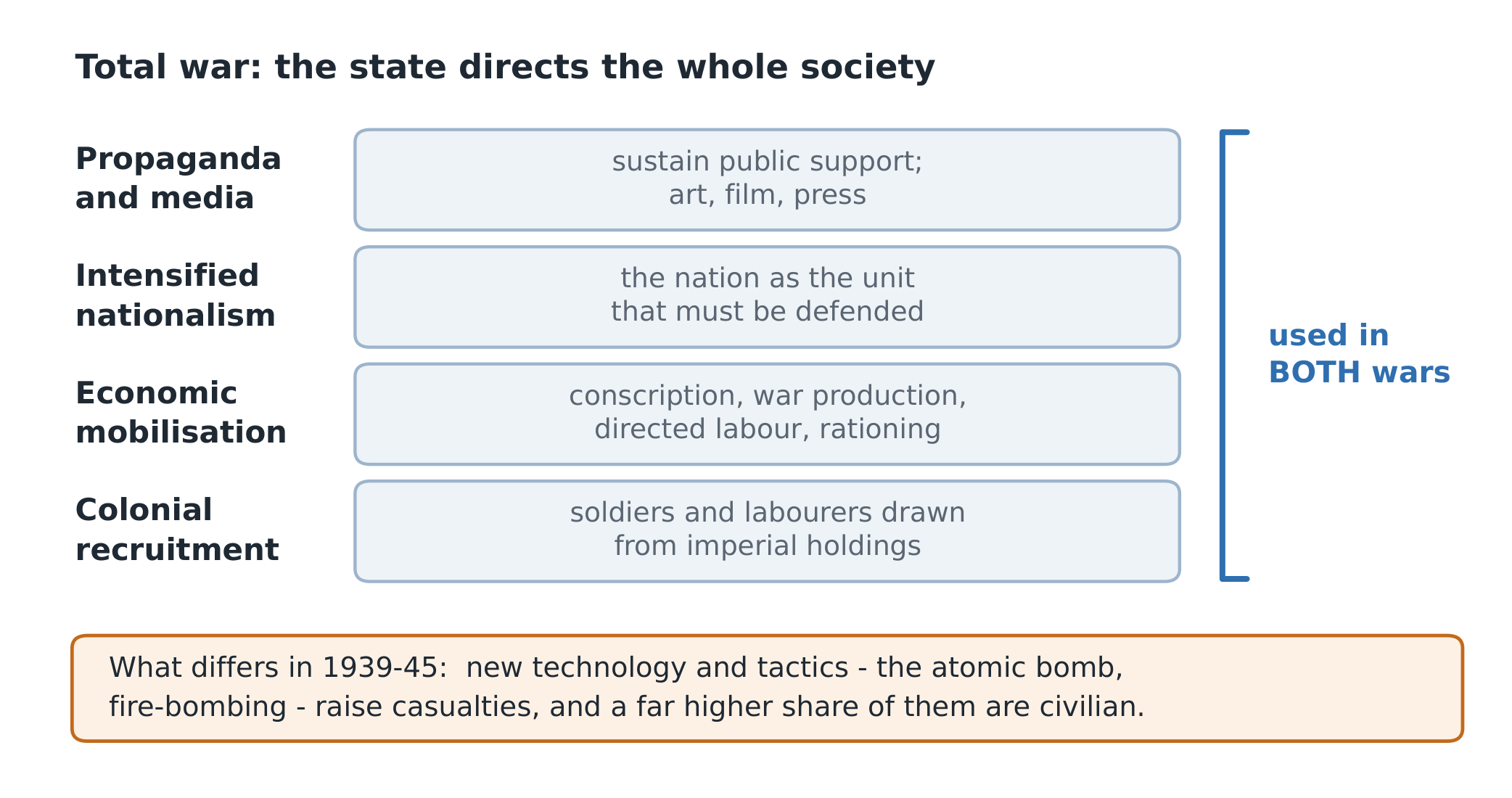
总体战:一旦战争不再只是军队的事,国家必须控制什么
同样的四种手段在两次大战中都出现,这正是比较题得以作答的原因

一战是第一场总体战(first total war)。CED 列出的政府手段并不只是军事性的:

  • 用于维持公众支持的政治宣传(political propaganda)、艺术与媒体。
  • 强化的民族主义(intensified forms of nationalism)。
  • 经济与人口(economies and populations)的动员——征兵、军工生产与劳动力调配。
  • 征召并使用殖民地臣民(colonial subjects)充当士兵与劳工。

与此同时,新式军事技术导致战时伤亡(casualties)大幅上升。技术这一点与动员那一点是两个独立的得分点,两者都要写。

词汇表 训练
英文 中文 拼音
first total war 总体战 zǒng tǐ zhàn
Political propaganda 政治宣传 zhèng zhì xuān chuán
Intensified forms of nationalism 强化的民族主义 qiáng huà de mín zú zhǔ yì
economies and populations 经济与人口动员 jīng jì yǔ rén kǒu dòng yuán
colonial subjects 殖民地臣民 zhí mín dì chén mín
new military technology led to increased levels of wartime casualties 伤亡 shāng wáng
7.4

两次大战之间的经济

大纲

7.4 Economy in the Interwar Period

Thematic FocusLearning ObjectiveHistorical Developments

ECN
Economics Systems — As societies develop, they affect and are affected by the ways that they produce, exchange, and consume goods and services.

Unit 7.D
Explain how different governments responded to economic crisis after 1900.

  • KC-6.3.I.B Following World War I and the onset of the Great Depression, governments began to take a more active role in economic life.
  • KC-6.3.I.A.i In the Soviet Union, the government controlled the national economy through the Five Year Plans, often implementing repressive policies, with negative repercussions for the population.

Illustrative examples:

  • Government intervention in the economy:
    • The New Deal
    • The fascist corporatist economy
    • Governments with strong popular support in Brazil and Mexico

来源:美国大学理事会 AP 课程与考试说明

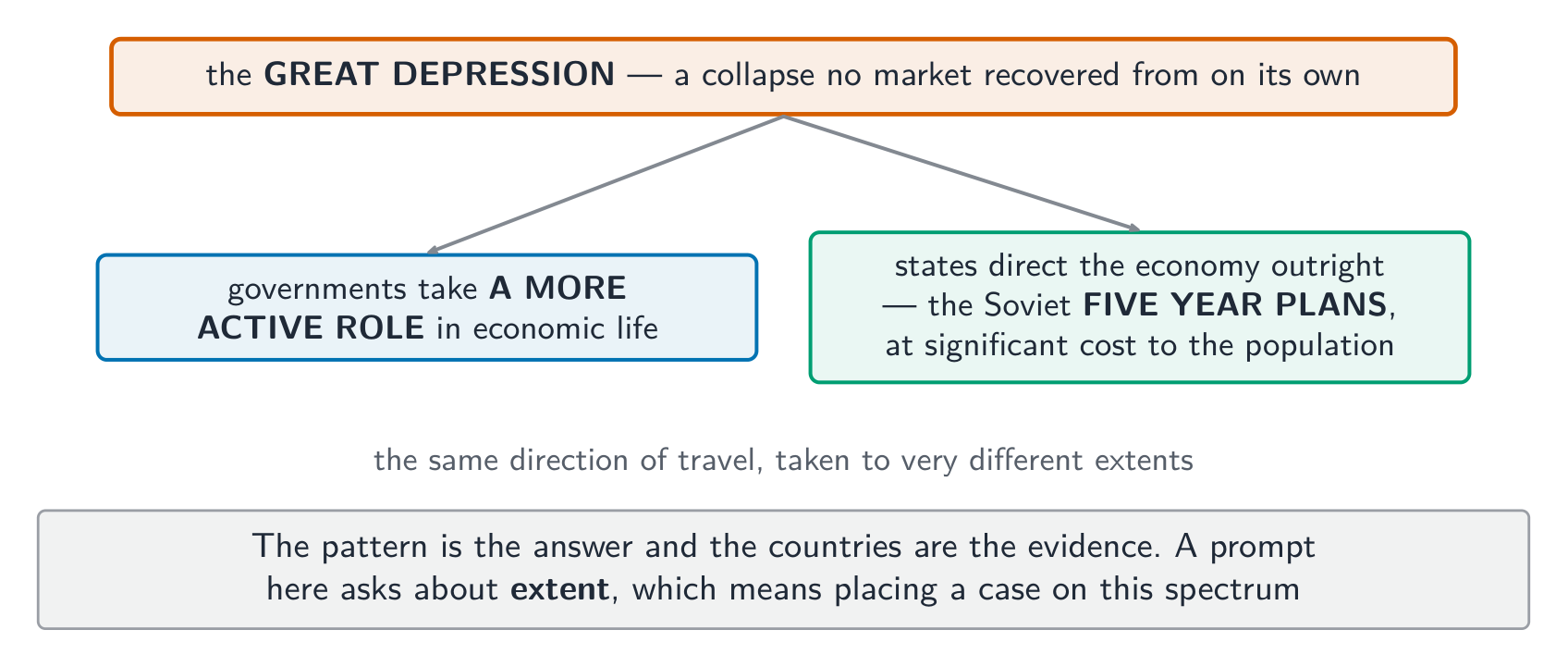
一战结束与大萧条(Great Depression)来临之后,各国政府开始在经济生活中扮演更积极的角色(more active role)。这是总的论断;CED 随后给出了这一角色可以走多远的对照案例。

苏联(Soviet Union),政府通过五年计划(Five Year Plans)控制国民经济,推行压制性政策并付出重大的人口代价(cost to the population),同时实现了快速工业化。

使各案例得以比较的总体模式是:经济危机在各地都扩大了国家对经济的支配,但程度(extent)差异极大——从一端的监管与公共工程,到另一端的全面国家控制。有关战间期经济的题目几乎总是奖励这一光谱式的把握。

词汇表 训练
英文 中文 拼音
Great Depression 大萧条 dà xiāo tiáo
a more active role in economic life 更积极的经济角色 gèng jī jí de jīng jì jué sè
Soviet Union 苏联 sū lián
Five Year Plans 五年计划 wǔ nián jì huà
cost to the population 人口代价 rén kǒu dài jià
extent 程度 chéng dù
7.5

第一次世界大战后悬而未决的紧张关系

大纲

7.5 Unresolved Tensions After World War I

Thematic FocusLearning ObjectiveHistorical Developments

GOV
Governance — A variety of internal and external factors contribute to state formation, expansion, and decline. Governments maintain order through a variety of administrative institutions, policies, and procedures, and governments obtain, retain, and exercise power in different ways and for different purposes.

Unit 7.E
Explain the continuities and changes in territorial holdings from 1900 to the present.

  • KC-6.2.I.B Between the two world wars, Western and Japanese imperial states predominantly maintained control over colonial holdings; in some cases, they gained additional territories through conquest or treaty settlement and in other cases faced anti-imperial resistance.

Illustrative examples:

  • Territorial gains:
    • Transfer of former German colonies to Great Britain and France under the system of League of Nations mandates
    • Manchukuo/Greater East Asia Co-Prosperity Sphere
  • Anti-imperial resistance:
    • Indian National Congress
    • West African resistance (strikes/congresses) to French rule

来源:美国大学理事会 AP 课程与考试说明

在两次大战之间,西方与日本的帝国基本维持了对殖民地的控制,某些情况下还获得了新领土。和约所激起的民族自决(self-determination)期望,对被殖民民族而言在很大程度上并未实现。

这是承上启下的一节:和约遗留的紧张关系直接通向下一场战争的起因,以及第八单元的反帝运动。点明这一联系,正是延续性答案得以有力的原因。

词汇表 训练
英文 中文 拼音
self-determination 民族自决 mín zú zì jué
7.6

第二次世界大战的起因

大纲

7.6 Causes of World War II

Thematic FocusLearning ObjectiveHistorical Developments

GOV
Governance — A variety of internal and external factors contribute to state formation, expansion, and decline. Governments maintain order through a variety of administrative institutions, policies, and procedures, and governments obtain, retain, and exercise power in different ways and for different purposes.

Unit 7.F
Explain the causes and consequences of World War II.

  • KC-6.2.IV.B.ii The causes of World War II included the unsustainable peace settlement after World War I, the global economic crisis engendered by the Great Depression, continued imperialist aspirations, and especially the rise to power of fascist and totalitarian regimes that resulted in the aggressive militarism of Nazi Germany under Adolf Hitler.

来源:美国大学理事会 AP 课程与考试说明

CED 同样给出了复合的起因,每一项都在考查范围内:

  • 一战之后无法持续的和约(unsustainable peace settlement)。
  • 大萧条造成的全球经济危机(global economic crisis)。
  • 持续的帝国主义行径(continued imperialist practices)。
  • 法西斯主义与极端民族主义(fascism and extreme nationalism)的兴起。

把这份清单与一战的对照,会显出一个真实的模式:经济压力与民族主义为两者共有,而 1939 年特有的新增项是失败的和约与新出现的意识形态政权。比较题要的正是这一结构——先点出共有起因,再点出差异。

词汇表 训练
英文 中文 拼音
unsustainable peace settlement 和约 hé yuē
global economic crisis 全球经济危机 quán qiú jīng jì wēi jī
Continued imperialist practices 帝国主义行径 dì guó zhǔ yì xíng jìng
rise of fascism and extreme nationalism 法西斯主义与极端民族主义 fǎ xī sī zhǔ yì yǔ jí duān mín zú zhǔ yì
7.7

第二次世界大战的进行

大纲

7.7 Conducting World War II

Thematic FocusLearning ObjectiveHistorical Developments

GOV
Governance — A variety of internal and external factors contribute to state formation, expansion, and decline. Governments maintain order through a variety of administrative institutions, policies, and procedures, and governments obtain, retain, and exercise power in different ways and for different purposes.

Unit 7.G
Explain similarities and differences in how governments used a variety of methods to conduct war.

  • KC-6.2.IV.A.ii World War II was a total war. Governments used a variety of strategies, including political propaganda, art, media, and intensified forms of nationalism, to mobilize populations (both in the home countries and the colonies or former colonies) for the purpose of waging war. Governments used ideologies, including fascism and communism to mobilize all of their state’s resources for war and, in the case of totalitarian states, to repress basic freedoms and dominate many aspects of daily life during the course of the conflicts and beyond.
  • KC-6.1.III.C.ii New military technology and new tactics, including the atomic bomb, fire-bombing, and the waging of “total war” led to increased levels of wartime casualties.

Illustrative examples:

  • Western democracies mobilizing for war:
    • Great Britain under Winston Churchill
    • United States under Franklin Roosevelt
  • Totalitarian states mobilizing for war:
    • Germany under Adolf Hitler
    • USSR under Joseph Stalin

来源:美国大学理事会 AP 课程与考试说明

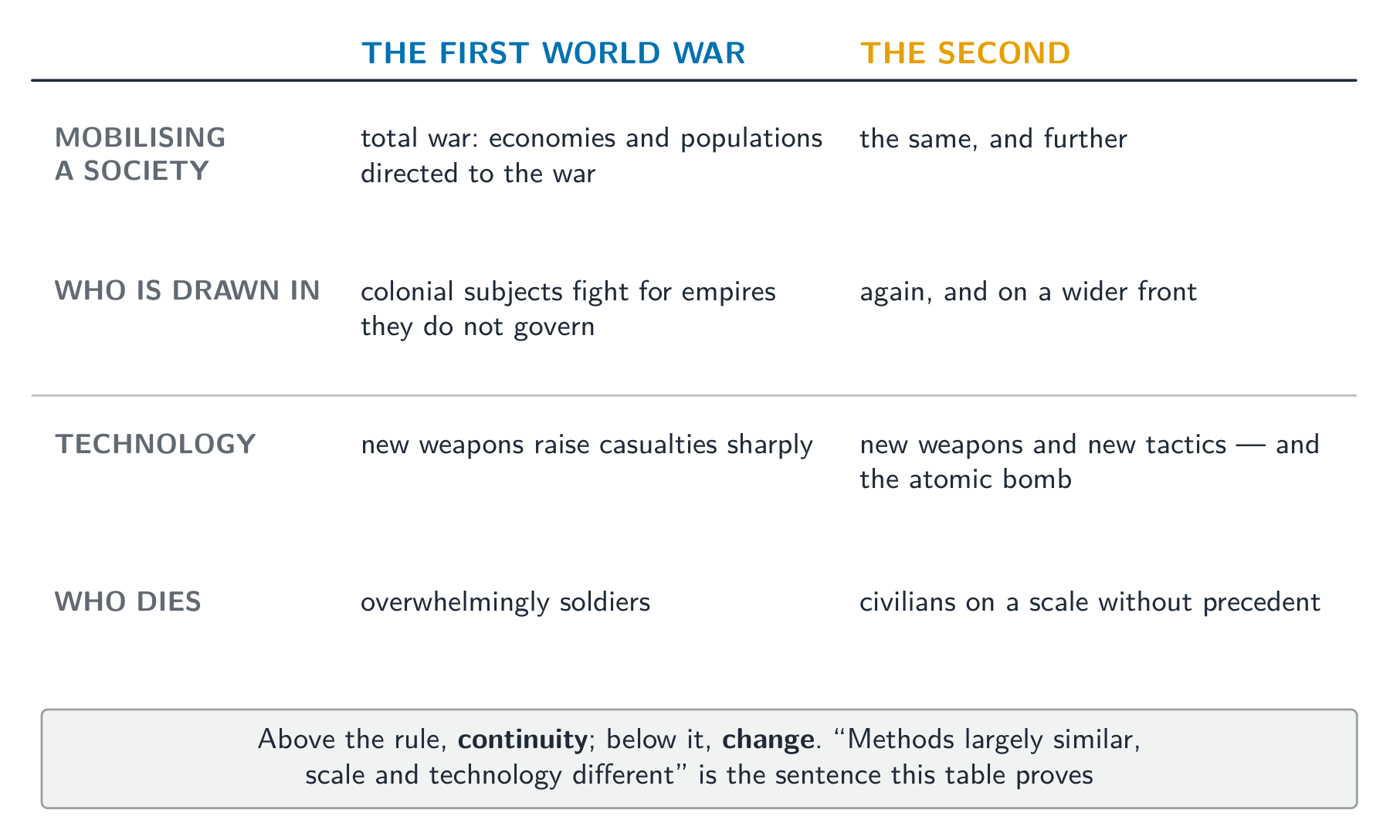
二战同样是总体战,各国政府使用的手段大类相同:宣传、艺术与媒体、强化的民族主义,以及对经济与人口(包括殖民地臣民)的动员。

改变的是技术及其规模。新式军事技术与新战术——包括原子弹(atomic bomb)、燃烧弹轰炸与总体战的实施——导致伤亡上升,其中平民(civilian)死亡所占比例远高于前一次冲突。

因此可考的比较是:手段大体相同,规模与技术不同。只写"两者都是总体战"并没有作比较;只写"第二次更具毁灭性"则没有解释原因。

词汇表 训练
英文 中文 拼音
atomic bomb 原子弹 yuán zǐ dàn
civilian 平民 píng mín
causes and consequences of mass atrocities 大规模暴行 dà guī mó bào xíng
7.8

1900年后的大规模暴行

大纲

7.8 Mass Atrocities After 1900

Thematic FocusLearning ObjectiveHistorical Developments

SIO
Social Interactions and Organization — The process by which societies group their members and the norms that govern the interactions between these groups and between individuals influence political, economic, and cultural institutions and organization.

Unit 7.H
Explain the various causes and consequences of mass atrocities in the period from 1900 to the present.

  • KC-6.2.III.C The rise of extremist groups in power led to the attempted destruction of specific populations, notably the Nazi killing of the Jews in the Holocaust during World War II, and to other atrocities, acts of genocide, or ethnic violence.

Illustrative examples:

  • Genocide, ethnic violence, or attempted destruction of specific populations:
    • Armenians in the Ottoman Empire during and after World War I
    • Cambodia during the late 1970s
    • Tutsi in Rwanda in the 1990s
    • Ukraine in the Soviet Union in the 1920s and 1930s

来源:美国大学理事会 AP 课程与考试说明

本节要求给出 1900 年至今大规模暴行(mass atrocities)的起因与后果。CED 的表述是:掌权的极端主义团体(extremist groups in power)的兴起导致了对特定人群的灭绝企图,并点名犹太人大屠杀(Holocaust)——纳粹对犹太人的杀戮——为主要案例,以及二十世纪其他种族灭绝与大规模屠杀。

作为历史来处理,可考的内容是其模式:一个极端主义政权取得国家权力,把某一人群界定在政治共同体之外,再动用现代国家的机器——官僚体系、交通、通信——以早先政权无法企及的规模实施毁灭。最后这一点把本节与贯穿整个单元的技术主题连接了起来。

词汇表 训练
英文 中文 拼音
extremist groups in power 极端主义团体 jí duān zhǔ yì tuán tǐ
Holocaust 犹太人大屠杀 yóu tài rén dà tú shā
7.9

全球冲突中的因果关系

大纲

7.9 Causation in Global Conflict

Learning ObjectiveReview: Unit 7 Key Concepts

Unit 7.I
Explain the relative significance of the causes of global conflict in the period 1900 to the present.

  • KC-6.1 Rapid advances in science and technology altered the understanding of the universe and the natural world and led to advances in communication, transportation, industry, agriculture, and medicine.
  • KC-6.2 Peoples and states around the world challenged the existing political and social order in varying ways, leading to unprecedented worldwide conflicts.
    • KC-6.2.I The West dominated the global political order at the beginning of the 20th century, but both land-based and maritime empires gave way to new states by the century’s end.
    • KC-6.2.I.A The older, land-based Ottoman, Russian, and Qing empires collapsed due to a combination of internal and external factors. These changes in Russia eventually led to communist revolution.
    • KC-6.2.II.D States around the world challenged the existing political and social order, including the Mexican Revolution that arose as a result of political crisis.

来源:美国大学理事会 AP 课程与考试说明

本单元考查的推理能力是因果关系,而且特指各项起因的相对重要性(relative significance)。"相对"二字就是全部任务所在:你要做的不是罗列起因,而是为它们排序并为这一排序辩护。

Worked example(一道真实的 AP 考题)。本单元的 AP 世界历史简答题会要求,例如「解释各国政府在一战与二战中作战方式的一项相似之处」。满分答案会点出相似之处并用两场战争的具体证据支撑:「两场战争都是总体战,政府动员了整个经济与全部人口。在两场战争中,国家都使用宣传与媒体维持公众支持,把工业生产导向军需,并从殖民地征召士兵与劳工。」*注意其要求:相似性的论断必须两边都有证据*。只有一场战争的证据无法证明相似。

词汇表 训练
英文 中文 拼音
relative significance 相对重要性 xiāng duì zhòng yào xìng
7.9

考试技巧

  • 奥斯曼、俄国与清朝帝国的瓦解,始终要把内部压力与外部压力配对。任何一方单独出现都只是半个答案。
  • 把使一战变得可能的因素(帝国竞争、民族主义、地区冲突)与使其变成全球性的因素(结盟体系)区分开。
  • 总体战有一份清单:宣传、民族主义、经济动员、殖民地征召。对两场战争都用这份清单,比较自然成形。
  • 战间期经济是国家介入的光谱,而不是单一政策。要写出一个国家走了多远,而不只是写它进行了干预。
  • 比较题需要两边的证据。只涉及一个案例的细节无法支撑相似或差异的论断。
  • "相对重要性"意味着排序并论证。罗列起因却不就何者最重要作出论证,并没有回答所问的问题。

本主题的互动课程

逐步学习,并即时检测练习。

AP 世界历史的更多主题

登录或创建账号

IGCSE, A-Level & AP