| English | 释义 | 拼音 |
|---|---|---|
| total war/ˈtəʊtl wɔː/ | 总体战 | zǒng tǐ zhàn |
| propaganda/ˌprɒpəˈɡændə/ | 宣传 | xuān chuán |
One bomb, one city, August 1945
- At 8:15 a.m. on 6 August 1945, an American B-29 dropped an atomic bomb on Hiroshima. About 70 000 people died at once, and about 140 000 by the end of the year. Three days later, a second bomb hit Nagasaki. On 15 August, Japan announced its surrender. The bombs were the most extreme example of a war fought against whole societies.
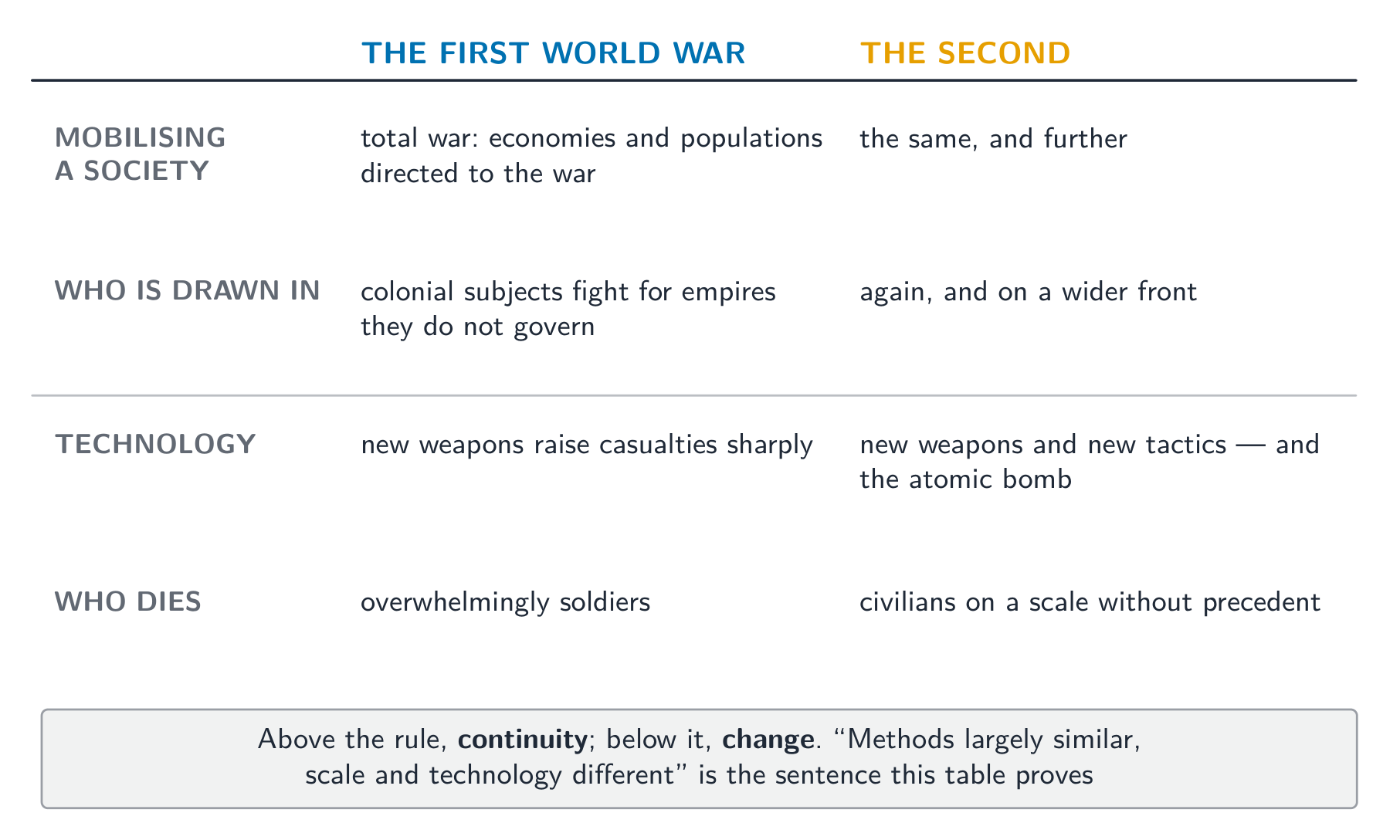
- World War II was a total war 总体战 again, like World War I — but more destructive and more ideological.
About 70 000 died at once in Hiroshima and about 140 000 by the end of 1945. How many times as many?
难度 2/5 · 今日首次完成可获 140 金币及少量额外奖励
140 000 ÷ 70 000.
The same kind of war, a second time
- As in 1914–18, governments directed factories to war production, controlled the press and rationed food.
- The US built about 300 000 aircraft during the war; women entered factories in millions.
Which were features of total war in both world wars?
难度 2/5 · 今日首次完成可获 140 金币及少量额外奖励
Continuity.
Ideology as a tool
- Governments used propaganda 宣传 to mobilise people: Nazi Germany against Jews and communists, Japan for the emperor, the Allies for democracy.
- Totalitarian states such as Nazi Germany and the Soviet Union controlled daily life and repressed basic freedoms.
Similarity, difference, or a cause of casualties?
Sort each method or effect.
Match each to its category.
难度 2/5 · 今日首次完成可获 140 金币及少量额外奖励
Compare.
Worked example: why casualties rose
- Known: about 17 million people died in World War I, and about 70–85 million in World War II.
- Method: 70 ÷ 17 ≈ 4, so at least four times as many.
- Why: fire-bombing of cities (Tokyo, March 1945, about 100 000 killed in one night), atomic bombs, mass killing of civilians and fighting across a wider area. Most of the dead were civilians.
About 17 million died in World War I and about 70 million in World War II. About how many times as many? (whole number)
难度 2/5 · 今日首次完成可获 140 金币及少量额外奖励
70 ÷ 17 ≈ 4.1.
Democracies and dictatorships compared
- Similarity: all governments mobilised their economies and used propaganda.
- Difference: democracies such as Britain and the US kept elections and some free debate, though the US interned about 120 000 Japanese Americans.
About how many thousand Japanese Americans did the US intern?
难度 2/5 · 今日首次完成可获 140 金币及少量额外奖励
A democracy limiting freedoms.
Technology and tactics
- Tanks and aircraft made fast offensives possible, such as Germany's invasion of France in 1940.
- Long-range bombers carried war to cities far from the front.
Democracies were not free of repression in total war. The US internment of Japanese Americans and Britain's control of the press show that all governments limited freedoms.
Democracies did not limit freedoms during the war.
难度 1/5 · 今日首次完成可获 100 金币及少量额外奖励
Internment and press control.
World War II was a total war like the first, with economies, media and people mobilised. But ideology, propaganda and new technology — fire-bombing and atomic bombs — made it far deadlier: about four times as many died, most of them civilians.
Compare World War II with World War I as total wars.
Comparison.