跳到主要内容

工业化的后果

AP 世界历史 · 第 6 主题

训练
讲义 词汇表
6.1

1750年至1900年帝国主义的理据

大纲

6.1 Rationales for Imperialism from1750 to 1900

Thematic FocusLearning ObjectiveHistorical Developments

CDI
Cultural Developments and Interactions — The development of ideas, beliefs, and religions illustrates how groups in society view themselves, and the interactions of societies and their beliefs often have political, social, and cultural implications.

Unit 6.A
Explain how ideologies contributed to the development of imperialism from 1750 to 1900.

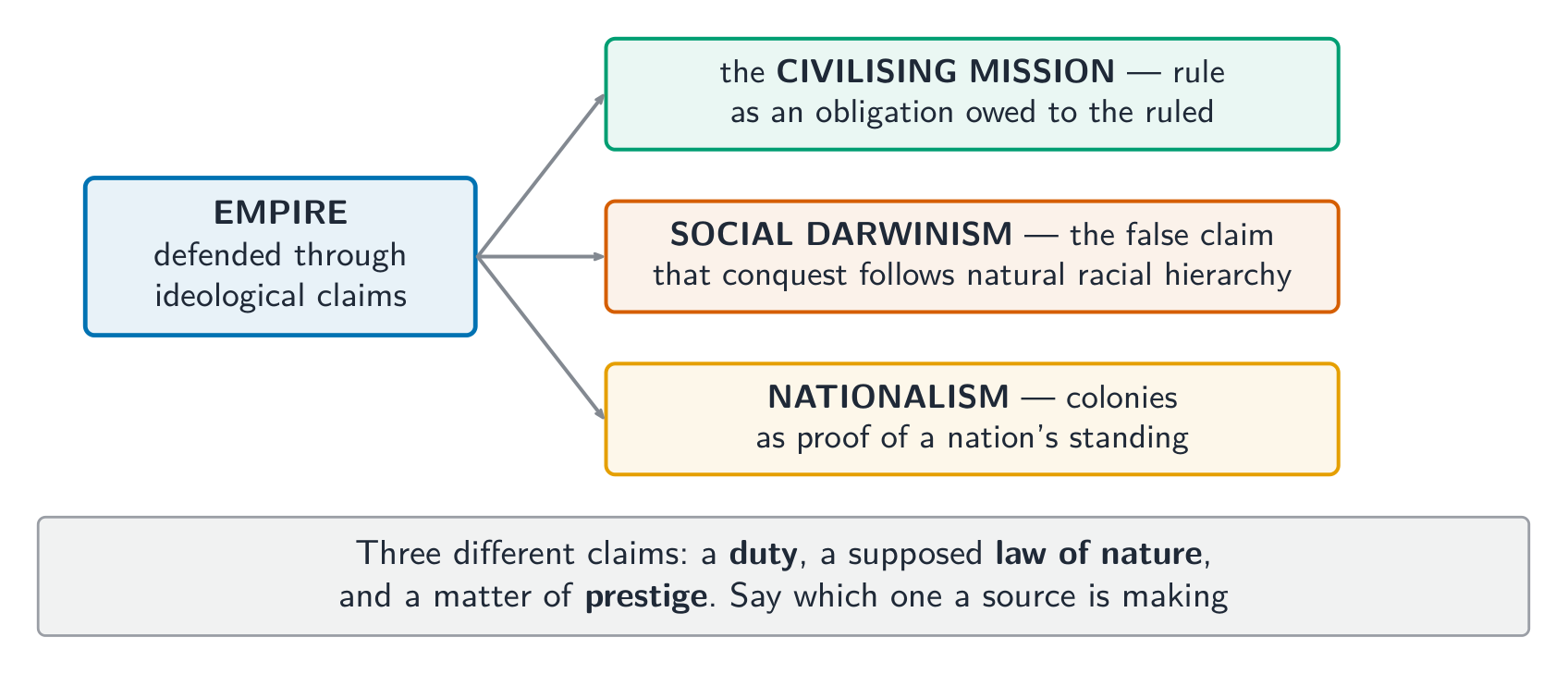
  • KC-5.2.III A range of cultural, religious, and racial ideologies were used to justify imperialism, including Social Darwinism, nationalism, the concept of the civilizing mission, and the desire to religiously convert indigenous populations.

来源:美国大学理事会 AP 课程与考试说明

第六单元讲述 1750 至 1900 年工业化的后果:工业国家为何扩张、人们如何抵抗、世界经济如何重组,以及谁在迁移。

各种文化、宗教与种族意识形态(cultural, religious, and racial ideologies)被用来为帝国主义辩护。考试范围内的包括文明教化使命(civilising mission)、传教活动、被用于国家与族群的社会达尔文主义(Social Darwinism),以及民族主义——即认为殖民地证明了一个国家的伟大。

这些是辩护理由,而不是原因。把它们指认为意识形态,并与下文的经济与战略动机区分开,正是有力答案的做法。

词汇表 训练
英文 中文 拼音
cultural, religious, and racial ideologies 文化、宗教与种族意识形态 wén huà 、 zōng jiào yǔ zhǒng zú yì shí xíng tài
civilising mission 文明教化使命 wén míng jiào huà shǐ mìng
Social Darwinism 社会达尔文主义 shè huì dá ěr wén zhǔ yì
6.2

1750年至1900年的国家扩张

大纲

6.2 State Expansion from 1750 to 1900

Thematic FocusLearning ObjectiveHistorical Developments

GOV
Governance — A variety of internal and external factors contribute to state formation, expansion, and decline. Governments maintain order through a variety of administrative institutions, policies, and procedures, and governments obtain, retain, and exercise power in different ways and for different purposes.

Unit 6.B
Compare processes by which state power shifted in various parts of the world from 1750 to 1900.

  • KC-5.2.I.A Some states with existing colonies strengthened their control over those colonies and in some cases assumed direct control over colonies previously held by non-state entities.
  • KC-5.2.I.B European states as well as the United States and Japan acquired territories throughout Asia and the Pacific, while Spanish and Portuguese influence declined.
  • KC-5.2.I.C Many European states used both warfare and diplomacy to expand their empires in Africa.
  • KC-5.2.I.D Europeans established settler colonies in some parts of their empires.
  • KC-5.2.II.B The United States, Russia, and Japan expanded their land holdings by conquering and settling neighboring territories.

Illustrative examples:

  • Non-state to state colonial control:
    • Shift from the private ownership of the Congo by King Leopold II to the Belgium government
    • Shift from the Dutch East India Company to Dutch government control in Indonesia and Southeast Asia
  • European states that expanded empires in Africa:
    • Britain in West Africa
    • Belgium in the Congo
    • French in West Africa
  • Settler colonies established in empires:
    • New Zealand

来源:美国大学理事会 AP 课程与考试说明

扩张有多种形式,CED 对它们作了区分:

  • 一些国家加强对既有殖民地的控制,把贸易关系转变为直接统治。
  • 欧洲国家、美国与日本都取得了新领土,可见帝国主义并非欧洲独有。
  • 许多欧洲国家同时使用战争与外交(warfare and diplomacy)来扩张——既有征服,也有条约、保护国与在欧洲达成的瓜分协议。
  • 欧洲人在某些地方建立定居殖民地(settler colonies),对原住民人口的排挤远比行政统治彻底。
  • 美国、俄国与日本通过夺取毗连陆地而非海外领地来扩张。
词汇表 训练
英文 中文 拼音
warfare and diplomacy 战争与外交 zhàn zhēng yǔ wài jiāo
settler colonies 定居殖民地 dìng jū zhí mín dì
6.3

1750年至1900年原住民对国家扩张的回应

大纲

6.3 Indigenous Responses to State Expansion from 1750 to 1900

Thematic FocusLearning ObjectiveHistorical Developments

GOV
Governance — A variety of internal and external factors contribute to state formation, expansion, and decline. Governments maintain order through a variety of administrative institutions, policies, and procedures, and governments obtain, retain, and exercise power in different ways and for different purposes.

Unit 6.C
Explain how and why internal and external factors have influenced the process of state building from 1750 to 1900.

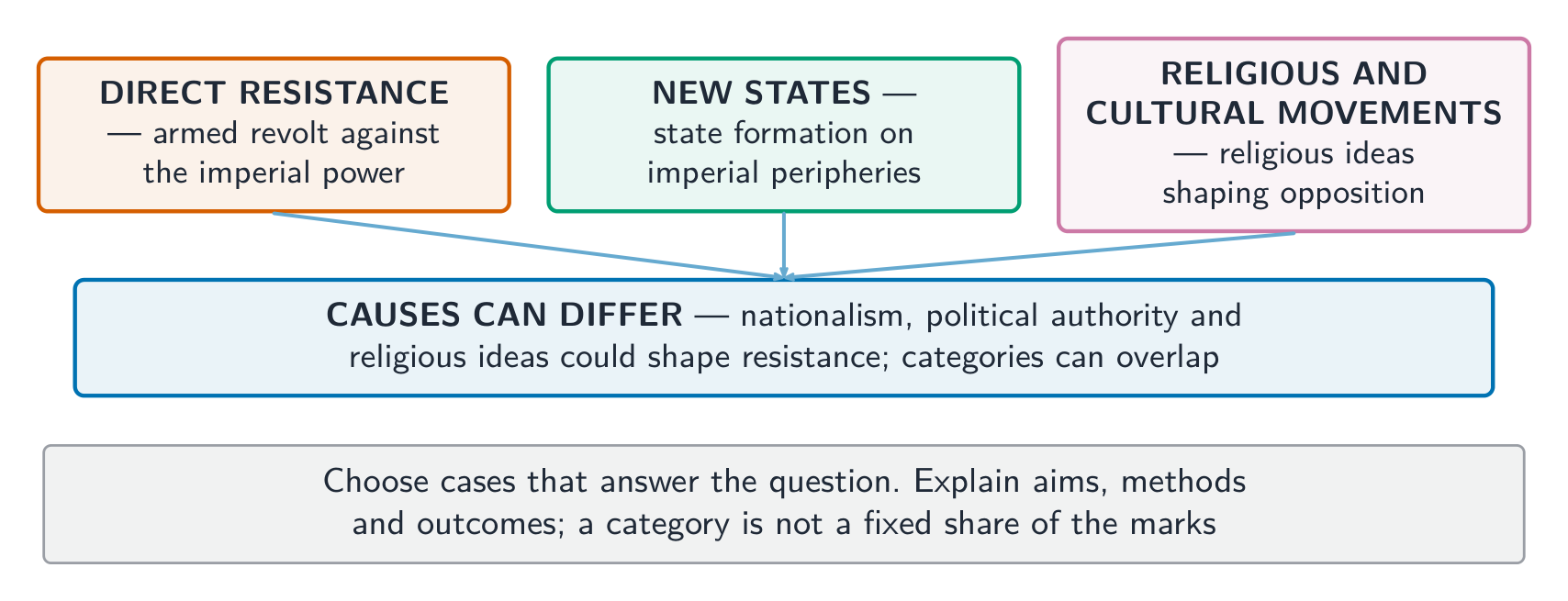
  • KC-5.3.III.D Increasing questions about political authority and growing nationalism contributed to anticolonial movements.
  • KC-5.2.II.C Anti-imperial resistance took various forms, including direct resistance within empires and the creation of new states on the peripheries.
  • KC-5.3.III.E Increasing discontent with imperial rule led to rebellions, some of which were influenced by religious ideas.

Illustrative examples:

  • Direct resistance:
    • Túpac Amaru II’s rebellion in Peru
    • Samory Touré’s military battles in West Africa
    • Yaa Asantewaa War in West Africa
    • 1857 rebellion in India
  • New states:
    • Establishment of independent states in the Balkans
    • Sokoto Caliphate in modern-day Nigeria
    • Cherokee Nation
    • Zulu Kingdom
  • Rebellions:
    • Ghost Dance in the U.S.
    • Xhosa Cattle-Killing Movement in Southern Africa
    • Mahdist wars in Sudan

来源:美国大学理事会 AP 课程与考试说明

反帝抵抗(resistance)有多种形式,只写武装反抗会失分:

  • 直接抵抗(direct resistance)——对殖民当局的武装反抗。
  • 领导者组织力量对抗帝国势力,建立新国家(creation of new states)。
  • 在殖民统治下重申本地认同的宗教与文化运动(religious and cultural movements)。

对政治权威日益增多的质疑,以及被殖民地区不断增长的民族主义,引发了各种起义,其中一些持续之久足以改变帝国政策。要点在于:抵抗贯穿整个时期,而不是后期才出现的反应。

词汇表 训练
英文 中文 拼音
resistance 抵抗 dǐ kàng
Direct resistance 直接抵抗 zhí jiē dǐ kàng
Creation of new states 建立新国家 jiàn lì xīn guó jiā
Religious and cultural movements 宗教与文化运动 zōng jiào yǔ wén huà yùn dòng
6.4 6.5

1750年至1900年的全球经济发展

大纲

6.4 Global Economic Development from1750 to 1900

Thematic FocusLearning ObjectiveHistorical Developments

ENV
Humans and the Environments — The environment shapes human societies, and as populations grow and change, these populations in turn shape their environments.

Unit 6.D
Explain how various environmental factors contributed to the development of the global economy from 1750 to 1900.

  • KC-5.1.II.A The need for raw materials for factories and increased food supplies for the growing population in urban centers led to the growth of export economies around the world that specialized in commercial extraction of natural resources and the production of food and industrial crops. The profits from these raw materials were used to purchase finished goods.

Illustrative examples:

  • Resource export economies:
    • Cotton production in Egypt
    • Rubber extraction in the Amazon and the Congo basin
    • The palm oil trade in West Africa
    • The guano industries in Peru and Chile
    • Meat from Argentina and Uruguay
    • Diamonds from Africa

6.5 Economic Imperialism from 1750 to 1900

Thematic FocusLearning ObjectiveHistorical Developments

ECN
Economics Systems — As societies develop, they affect and are affected by the ways that they produce, exchange, and consume goods and services.

Unit 6.E
Explain how various economic factors contributed to the development of the global economy from 1750 to 1900.

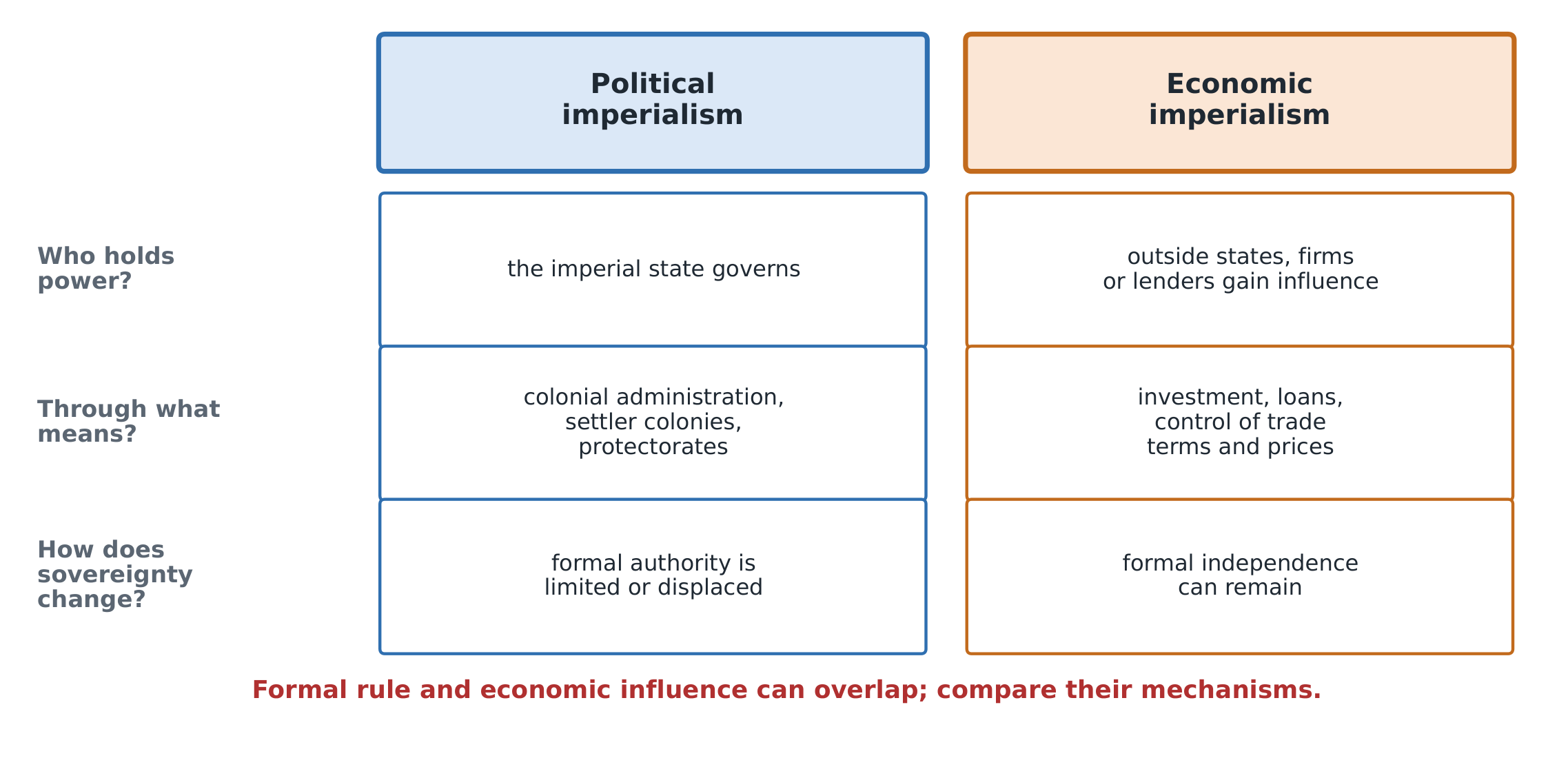
  • KC-5.2.I.E Industrialized states and businesses within those states practiced economic imperialism primarily in Asia and Latin America.
  • KC-5.1.II.C Trade in some commodities was organized in a way that gave merchants and companies based in Europe and the U.S. a distinct economic advantage.

Illustrative examples:

  • Industrialized states practicing economic imperialism:
    • Britain and France expanding their influence in China through the Opium Wars
    • The construction of the Port of Buenos Aires with the support of British firms
  • Commodities that contributed to European and American economic advantage:
    • Opium produced in the Middle East or South Asia and exported to China
    • Cotton grown in South Asia and Egypt and exported to Great Britain and other European countries
    • Palm oil produced in sub-Saharan Africa and exported to European countries
    • Copper extracted in Chile

来源:美国大学理事会 AP 课程与考试说明

工业国家需要原材料与市场;殖民地被重组以供应它们
经济帝国主义并不总是需要政治控制——这正是必须把两者区分开的原因

工厂对原材料(raw materials)的需求,以及不断增长的城市人口对粮食供应(food supplies)的需求,重组了全世界的生产。殖民地与依附地区被推向经济作物(cash crops)与采掘业(extractive industries),往往以牺牲本地口粮生产为代价。

经济帝国主义(economic imperialism)是考点所在的区分。工业化国家及其企业通过投资、贷款与贸易支配(investment, loans, and trade dominance)施加控制,而不一定取得政治控制——因此一个地区可以在保持形式独立的同时被经济支配。

某些大宗商品的贸易被组织成这样一种方式:工业化国家的商人与公司对生产者拥有不成比例的权力(disproportionate power),得以决定价格与条件。

词汇表 训练
英文 中文 拼音
raw materials 原材料 yuán cái liào
food supplies 粮食供应 liáng shí gōng yìng
cash crops 经济作物 jīng jì zuò wù
extractive industries 采掘业 cǎi jué yè
Economic imperialism 经济帝国主义 jīng jì dì guó zhǔ yì
investment, loans, and trade dominance 投资、贷款与贸易支配 tóu zī 、 dài kuǎn yǔ mào yì zhī pèi
disproportionate power 不成比例的权力 bù chéng bǐ lì de quán lì
6.6

互联世界中人口迁移的原因

大纲

6.6 Causes of Migration in an Interconnected World

Thematic FocusLearning ObjectiveHistorical Developments

ECN
Economics Systems — As societies develop, they affect and are affected by the ways that they produce, exchange, and consume goods and services.

Unit 6.F
Explain how various environmental factors contributed to the development of varied patterns of migration from 1750 to 1900.

  • KC-5.4.I Migration in many cases was influenced by changes in demographics in both industrialized and unindustrialized societies that presented challenges to existing patterns of living.
  • KC-5.4.I.B Because of the nature of new modes of transportation, both internal and external migrants increasingly relocated to cities. This pattern contributed to the significant global urbanization of the 19th century. The new methods of transportation also allowed for many migrants to return, periodically or permanently, to their home societies.

Unit 6.G
Explain how various economic factors contributed to the development of varied patterns of migration from 1750 to 1900.

  • KC-5.4.II.A Many individuals chose freely to relocate, often in search of work.
  • KC-5.4.II.B The new global capitalist economy continued to rely on coerced and semicoerced labor migration, including enslavement Chinese and Indian indentured servitude, and convict labor.

Illustrative examples:

  • Return of migrants:
    • Japanese agricultural workers in the Pacific
    • Lebanese merchants in the Americas
    • Italian industrial workers in Argentina
  • (CONT’D) Migrants:
    • Irish to the United States
    • British engineers and geologists to South Asia and Africa

来源:美国大学理事会 AP 课程与考试说明

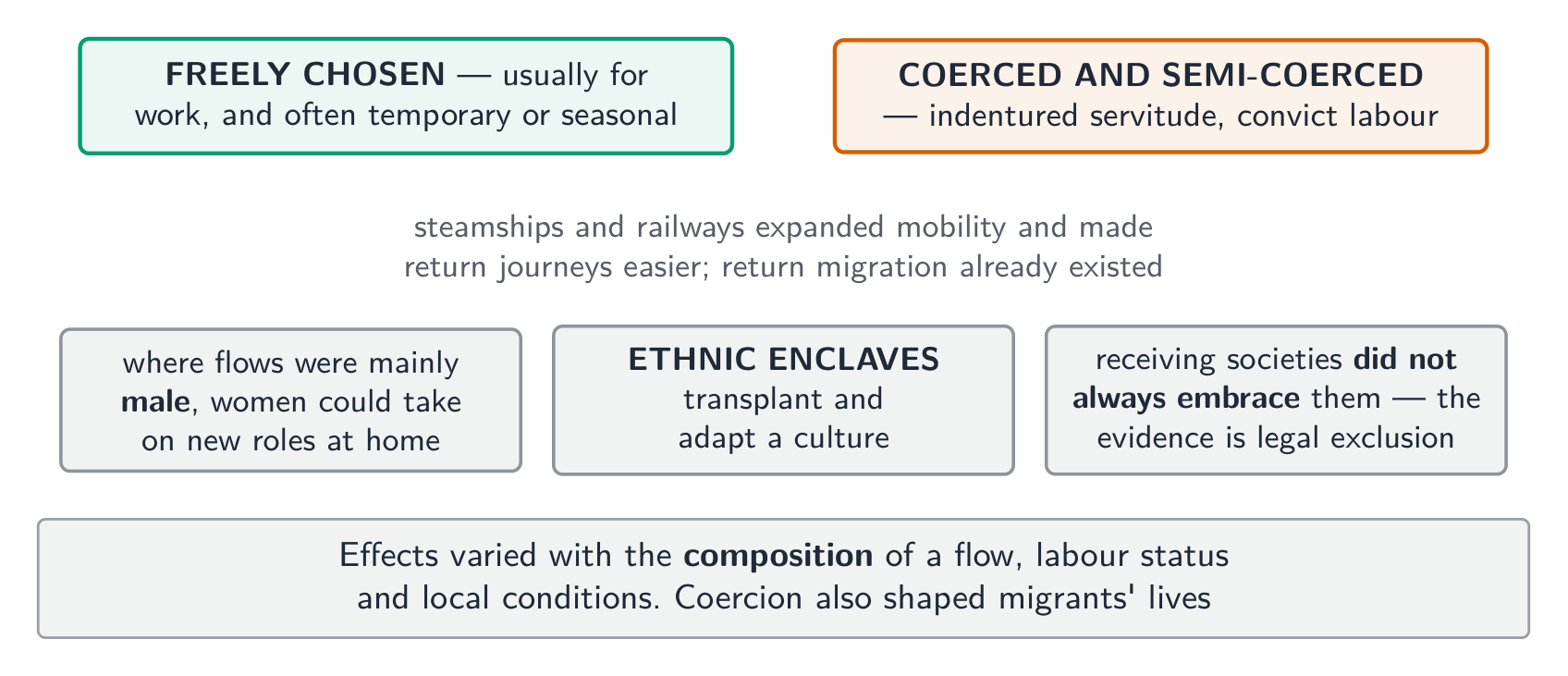
这一时期的迁移受输出与输入社会人口变化的影响,也受新的交通方式(modes of transportation)——蒸汽船与铁路——影响,后者首次使长距离且常常是临时或季节性(temporary or seasonal)的流动成为可能。

必须区分两类:

  • 许多人自愿迁移,通常是为了寻找工作。
  • 全球资本主义经济在奴隶贸易法律上终结之后,仍继续依赖强制与半强制劳动(coerced and semi-coerced labour),包括契约劳工(indentured servitude)与囚犯劳动。
词汇表 训练
英文 中文 拼音
modes of transportation 交通方式 jiāo tōng fāng shì
temporary or seasonal 临时或季节性 lín shí huò jì jié xìng
coerced and semi-coerced labour 强制与半强制劳动 qiáng zhì yǔ bàn qiáng zhì láo dòng
indentured servitude 契约劳工 qì yuē láo gōng
6.7

人口迁移的影响

大纲

6.7 Effects of Migration

Thematic FocusLearning ObjectiveHistorical Developments

SIO
Social Interactions and Organization — The process by which societies group their members and the norms that govern the interactions between these groups and between individuals influence political, economic, and cultural institutions and organization.

Unit 6.H
Explain how and why new patterns of migration affected society from 1750 to 1900.

  • KC-5.4.III.A Migrants tended to be male, leaving women to take on new roles in the home society that had been formerly occupied by men.
  • KC-5.4.III.B Migrants often created ethnic enclaves in different parts of the world that helped transplant their culture into new environments.
  • KC-5.4.III.C Receiving societies did not always embrace immigrants, as seen in the various degrees of ethnic and racial prejudice and the ways states attempted to regulate the increased flow of people across their borders.

Illustrative examples:

  • Migrant ethnic enclaves:
    • Chinese in Southeast Asia, the Caribbean, South America, and North America
    • Indians in East and Southern Africa, the Caribbean, and Southeast Asia
    • Irish in North America
    • Italians in North and South America
  • Regulation of immigrants:
    • Chinese Exclusion Act
    • White Australia policy

来源:美国大学理事会 AP 课程与考试说明

CED 直接点名了三项影响:

  • 迁移者多为男性,使女性在其离开的社会中承担新角色(women to take on new roles)。
  • 迁移者在目的地社会形成族裔聚居区(ethnic enclaves),移植并调适自身文化。
  • 接收社会并不总是接纳移民,考试范围内的证据是法律排斥——最明显的是若干国家对华人及其他亚洲移民的限制。
词汇表 训练
英文 中文 拼音
women to take on new roles 女性承担新角色 nǚ xìng chéng dān xīn jué sè
ethnic enclaves 族裔聚居区 zú yì jù jū qū
6.8

帝国时代的因果关系

大纲

6.8 Causation in the Imperial Age

Learning ObjectiveReview: Unit 6 Key Concepts

Unit 6.I
Explain the relative significance of the effects of imperialism from 1750 to 1900.

  • KC-5.1 The development of industrial capitalism led to increased standards of living for some, and to continued improvement in manufacturing methods that increased the availability, affordability, and variety of consumer goods.
  • KC-5.2 As states industrialized, they also expanded existing overseas empires and established new colonies and transoceanic relationships.
  • KC-5.3 The 18th century marked the beginning of an intense period of revolution and rebellion against existing governments, leading to the establishment of new nation-states around the world.
  • KC-5.4 As a result of the emergence of transoceanic empires and a global capitalist economy, migration patterns changed dramatically, and the numbers of migrants increased significantly.

来源:美国大学理事会 AP 课程与考试说明

本单元考查的推理能力是因果关系。最有力的链条是:工业生产造成对原材料与市场的需求,从而推动扩张;扩张需要辩护,意识形态提供了它;而两者又共同引发抵抗与大规模迁移。

Worked example(一道真实的 AP 考题)。本单元的 AP 世界历史简答题会要求,例如「解释 1750 至 1900 年间工业化促成帝国主义的一种方式」。满分答案会追溯其机制:「工业工厂需要棉花、橡胶等欧洲无法生产的原材料,于是工业国家对能够供应这些原料的地区取得政治或经济控制,并把那些经济体重组为以出口作物为中心。」*注意其结构:得分点在于那个联系*,而不是断言工业化与帝国主义有关。

6.8

考试技巧

  • 辩护理由(文明教化使命、社会达尔文主义)与原因(原材料、市场、战略)区分开。题目常常只问其中一方,并奖励不把两者混淆。
  • 经济帝国主义无需政治控制即可运作;仅这一区分本身就能回答许多题目。
  • 给出三类抵抗——直接抵抗、建立新国家、宗教与文化运动。
  • 迁移类题目要求区分自愿强制或半强制的流动。
  • 谈影响时,用 CED 自己的三项:男性迁移改变输出社会、族裔聚居区,以及排斥性法律
  • 因果类答案必须追溯机制。断言存在联系不等于解释这一联系。

本主题的互动课程

逐步学习,并即时检测练习。

AP 世界历史的更多主题

登录或创建账号

IGCSE, A-Level & AP