跳到主要内容

交流网络

AP 世界历史 · 第 2 主题

训练
讲义 词汇表
2.1

丝绸之路

大纲

2.1 The Silk Roads

Thematic FocusLearning ObjectiveHistorical Developments

ECN
Economics Systems — As societies develop, they affect and are affected by the ways that they produce, exchange, and consume goods and services.

Unit 2.A
Explain the causes and effects of growth of networks of exchange after 1200.

  • KC-3.1.I.A.i Improved commercial practices led to an increased volume of trade and expanded the geographical range of existing trade routes— including the Silk Roads—promoting the growth of powerful new trading cities.
  • KC-3.1.I.C.i The growth of interregional trade in luxury goods was encouraged by innovations in previously existing transportation and commercial technologies, including the caravanserai, forms of credit, and the development of money economies.
  • KC-3.3.I.B Demand for luxury goods increased in Afro-Eurasia. Chinese, Persian, and Indian artisans and merchants expanded their production of textiles and porcelains for export; manufacture of iron and steel expanded in China.

Illustrative examples:

  • Trading cities:
    • Kashgar
    • Samarkand
  • New forms of credit and money economies:
    • Bills of exchange
    • Banking houses
    • Use of paper money

来源:美国大学理事会 AP 课程与考试说明

第二单元讲述 1200 至 1450 年三大交流网络——丝绸之路、印度洋与跨撒哈拉商路——并对每一个提出同样的问题:是什么使贸易增长,而这种增长又改变了什么?

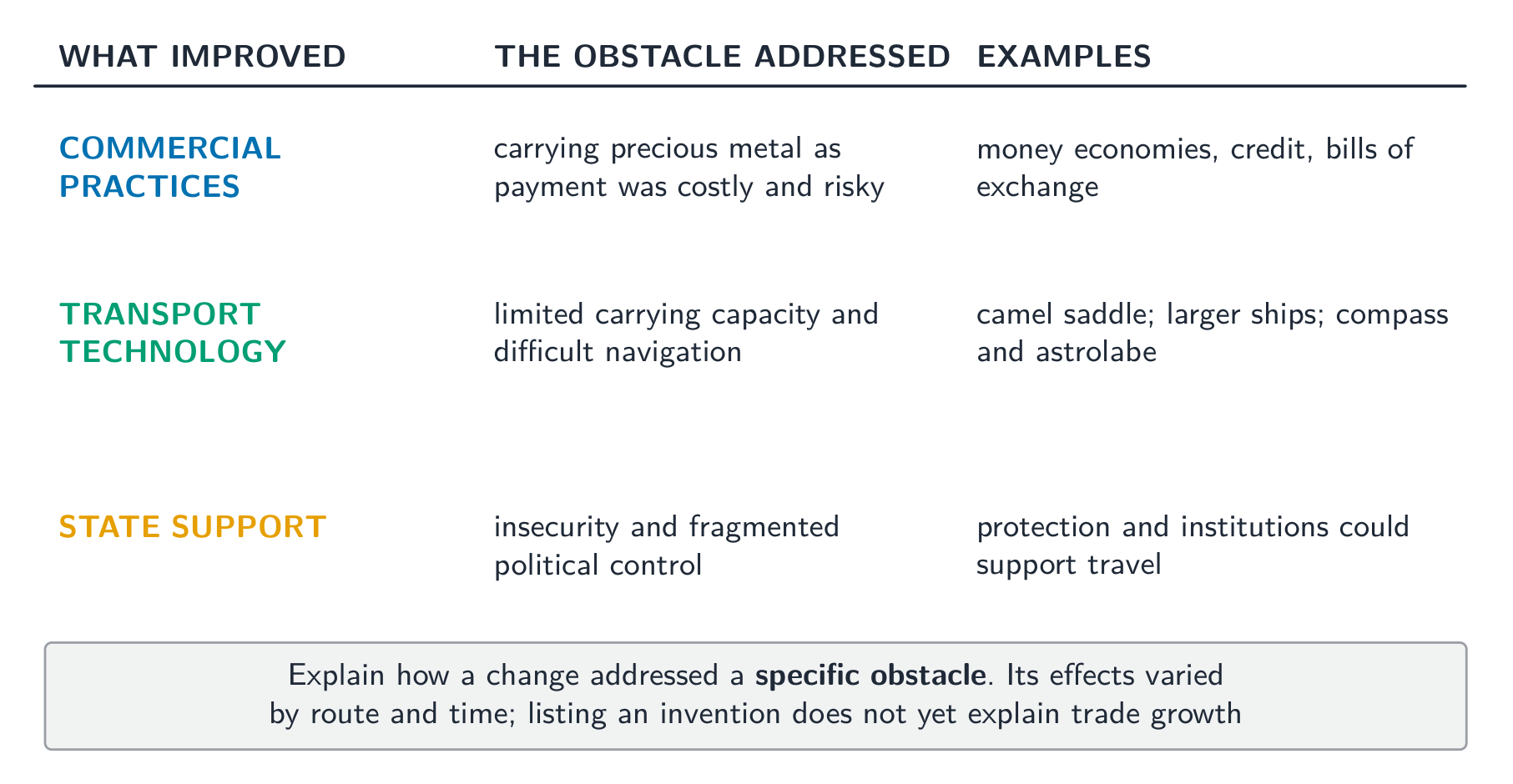
增长有三个共同原因,点出它们比罗列商品更有价值:

  • 商业惯例的改进(improved commercial practices)——货币经济(money economies)、信贷(credit),以及分摊风险的各种合伙形式。
  • 交通技术的改进(improved transportation technologies)——更好的船只、鞍具与导航手段。
  • 国家支持(state support)——保障商路并对贸易征税的帝国,从保护贸易中获益。

需求同样重要:来自中国、波斯与印度工匠的奢侈品(luxury goods)在欧亚非找到不断扩大的市场,生产者随之扩大产量以满足需求。

词汇表 训练
英文 中文 拼音
Improved commercial practices 商业惯例的改进 shāng yè guàn lì de gǎi jìn
money economies 货币经济 huò bì jīng jì
credit 信贷 xìn dài
Improved transportation technologies 交通技术的改进 jiāo tōng jì shù de gǎi jìn
State support 国家支持 guó jiā zhī chí
luxury goods 奢侈品 shē chǐ pǐn
2.1

丝绸之路

大纲

2.1 The Silk Roads

Thematic FocusLearning ObjectiveHistorical Developments

ECN
Economics Systems — As societies develop, they affect and are affected by the ways that they produce, exchange, and consume goods and services.

Unit 2.A
Explain the causes and effects of growth of networks of exchange after 1200.

  • KC-3.1.I.A.i Improved commercial practices led to an increased volume of trade and expanded the geographical range of existing trade routes— including the Silk Roads—promoting the growth of powerful new trading cities.
  • KC-3.1.I.C.i The growth of interregional trade in luxury goods was encouraged by innovations in previously existing transportation and commercial technologies, including the caravanserai, forms of credit, and the development of money economies.
  • KC-3.3.I.B Demand for luxury goods increased in Afro-Eurasia. Chinese, Persian, and Indian artisans and merchants expanded their production of textiles and porcelains for export; manufacture of iron and steel expanded in China.

Illustrative examples:

  • Trading cities:
    • Kashgar
    • Samarkand
  • New forms of credit and money economies:
    • Bills of exchange
    • Banking houses
    • Use of paper money

来源:美国大学理事会 AP 课程与考试说明

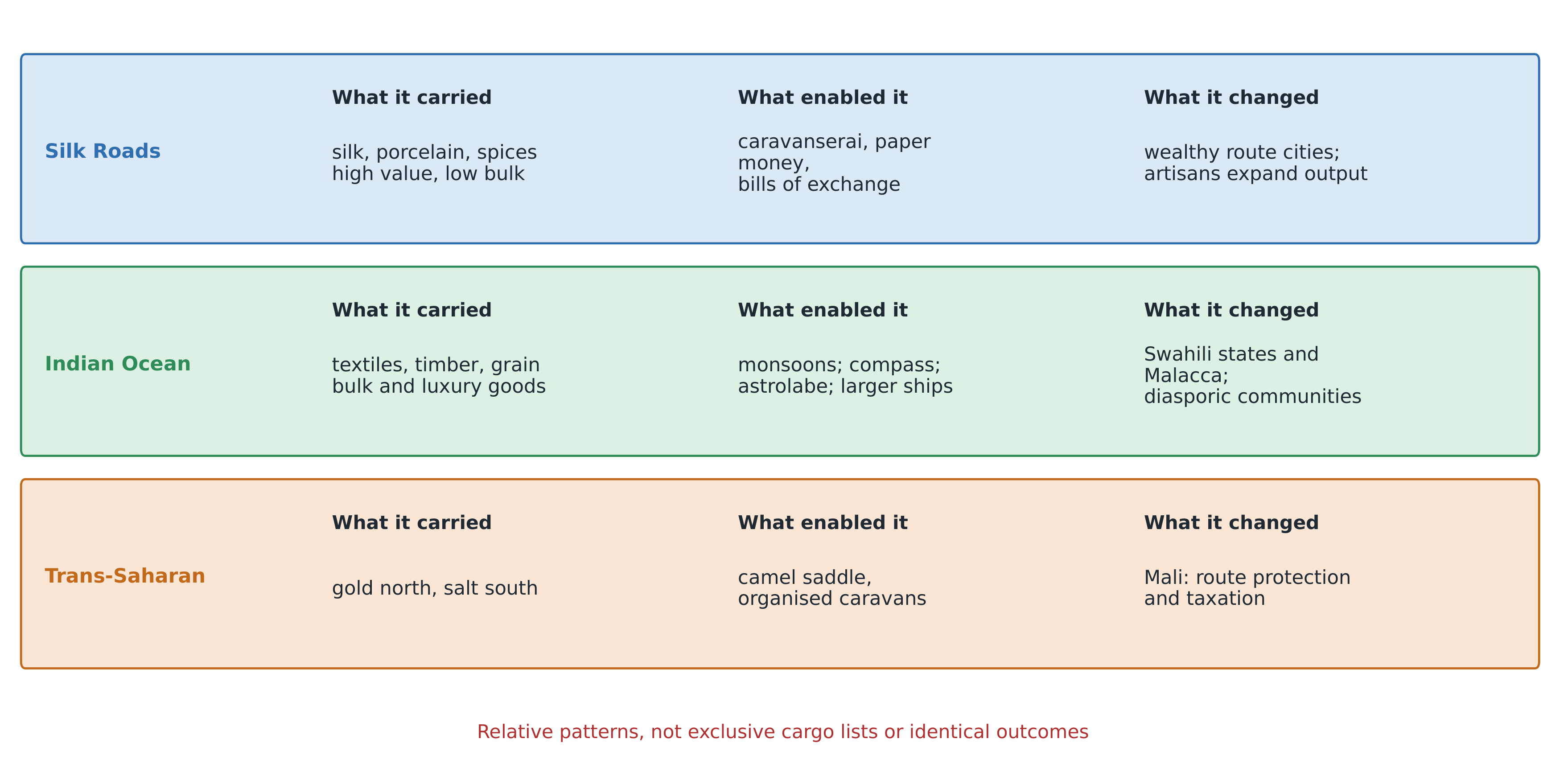
丝绸之路(Silk Roads)在欧亚大陆上运送高价值、低体积的商品:丝绸、瓷器、香料与贵金属。

促成它的创新既是技术上的,更是商业上的——沿线的商队旅馆(caravanserai)、中国使用的纸币(paper money)与汇票(bills of exchange),以及使商人无需携带金银即可交易的各种信贷形式。

对生产者的影响是:中国工匠扩大产量,沿线城市因过境贸易而富庶。

词汇表 训练
英文 中文 拼音
Silk Roads 丝绸之路 sī chóu zhī lù
caravanserai 商队旅馆 shāng duì lǚ guǎn
paper money 纸币 zhǐ bì
bills of exchange 汇票 huì piào
caravans 商队 shāng duì
2.2

蒙古帝国与现代世界的形成

大纲

2.2 The Mongol Empire and the Making of the Modern World

Thematic FocusLearning ObjectiveHistorical Developments

CDI
Cultural Developments and Interactions — The development of ideas, beliefs, and religions illustrates how groups in society view themselves, and the interactions of societies and their beliefs often have political, social, and cultural implications.

Unit 2.B
Explain the process of state building and decline in Eurasia over time. THEMATIC FOCUS Economics Systems ECN As societies develop, they affect and are affected by the ways that they produce, exchange, and consume goods and services. LEARNING OBJECTIVE

  • KC-3.2.I.B.iii Empires collapsed in different regions of the world and in some areas were replaced by new imperial states, including the Mongol khanates. HISTORICAL DEVELOPMENTS

Unit 2.C
Explain how the expansion of empires influenced trade and communication over time.

  • KC-3.1.I.E.i The expansion of empires—including the Mongols—facilitated Afro-Eurasian trade and communication as new people were drawn into their conquerors’ economies and trade networks.

Unit 2.D
Explain the significance of the Mongol Empire in larger patterns of continuity and change.

  • KC-3.2.II.A.ii Interregional contacts and conflicts between states and empires, including the Mongols, encouraged significant technological and cultural transfers.

Illustrative examples:

  • Technological and cultural transfers:
    • Transfer of Greco– Islamic medical knowledge to western Europe
    • Transfer of numbering systems to Europe
    • Adoption of Uyghur script

来源:美国大学理事会 AP 课程与考试说明

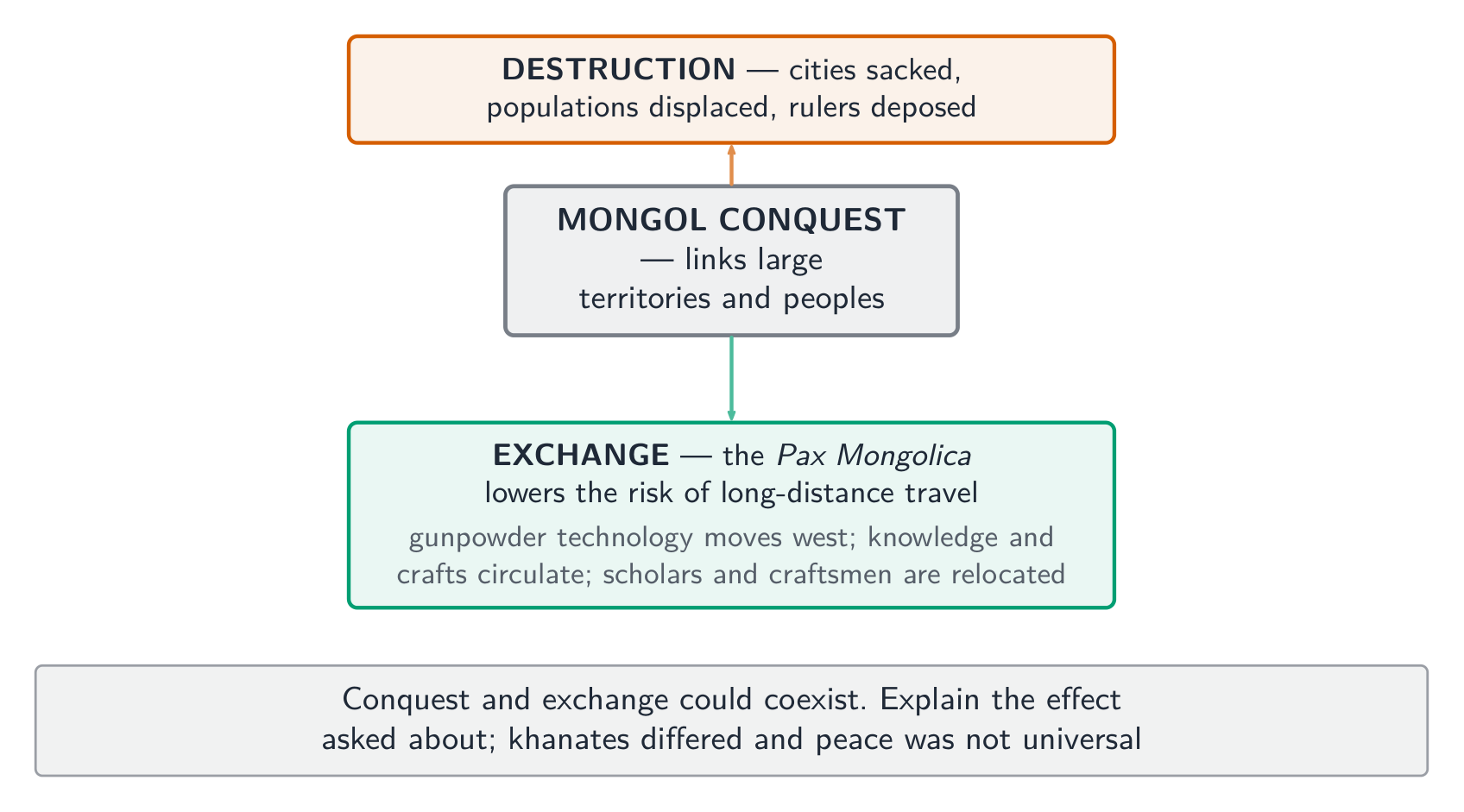
这一时期各地帝国有兴有衰,而最大的变化来自蒙古帝国(Mongol Empire)。

蒙古扩张把网络的大部分纳入单一权威之下,降低了长途旅行的风险,从而便利了欧亚非的贸易与交流——这一时期常被称为蒙古和平(Pax Mongolica)。

跨区域的接触与冲突也促进了技术与文化传播(technological and cultural transfers):火药技术西传,中国的行政与医学知识流通,学者与工匠在帝国范围内被迁移安置。

蒙古人体现了本单元的核心反讽:征服与破坏反而创造了交流的条件。

词汇表 训练
英文 中文 拼音
Mongol Empire 蒙古帝国 méng gǔ dì guó
Pax Mongolica 蒙古和平 méng gǔ hé píng
encouraged technological and cultural transfers 技术与文化传播 jì shù yǔ wén huà chuán bō
2.3

印度洋上的交流

大纲

2.3 Exchange in the Indian Ocean

Thematic FocusLearning ObjectiveHistorical Developments

CDI
Cultural Developments and Interactions — The development of ideas, beliefs, and religions illustrates how groups in society view themselves, and the interactions of societies and their beliefs often have political, social, and cultural implications.

Unit 2.E
Explain the causes of the growth of networks of exchange after 1200.

  • KC-3.1.I.A.ii Improved transportation technologies and commercial practices led to an increased volume of trade and expanded the geographical range of existing trade routes, including the Indian Ocean, promoting the growth of powerful new trading cities.
  • KC-3.1.I.C.ii The growth of interregional trade in luxury goods was encouraged by significant innovations in previously existing transportation and commercial technologies, including the use of the compass, the astrolabe, and larger ship designs.
  • KC-3.1.I.A.iii The Indian Ocean trading network fostered the growth of states.

Unit 2.F
Explain the effects of the growth of networks of exchange after 1200. THEMATIC FOCUS Humans and the Environments ENV The environment shapes human societies, and as populations grow and change, these populations in turn shape their environments. LEARNING OBJECTIVE

  • KC-3.1.III.B In key places along important trade routes, merchants set up diasporic communities where they introduced their own cultural traditions into the indigenous cultures and, in turn, indigenous cultures influenced merchant cultures.
  • KC-3.2.II.A.iii Interregional contacts and conflicts between states and empires encouraged significant technological and cultural transfers, including during Chinese maritime activity led by Ming Admiral Zheng He. HISTORICAL DEVELOPMENTS

Unit 2.G
Explain the role of environmental factors in the development of networks of exchange in the period from c. 1200 to c. 1450.

  • KC-3.1.II.A.i The expansion and intensification of long-distance trade routes often depended on environmental knowledge, including advanced knowledge of the monsoon winds.

Illustrative examples:

  • Growth of states:
    • City-states of the Swahili Coast
    • Gujarat
    • Sultanate of Malacca
  • (CONT’D) Diasporic communities:
    • Arab and Persian communities in East Africa
    • Chinese merchant communities in Southeast Asia
    • Malay communities in the Indian Ocean basin

来源:美国大学理事会 AP 课程与考试说明

三大网络按运送何物、依托何种技术、改变了什么进行对比
三个网络,一套框架:商品、使之成为可能的技术,以及产生的后果,正是比较题所要问的

印度洋(Indian Ocean)网络运送的商品比丝绸之路更笨重——纺织品、木材、粮食与香料——因为船比骆驼装得多。

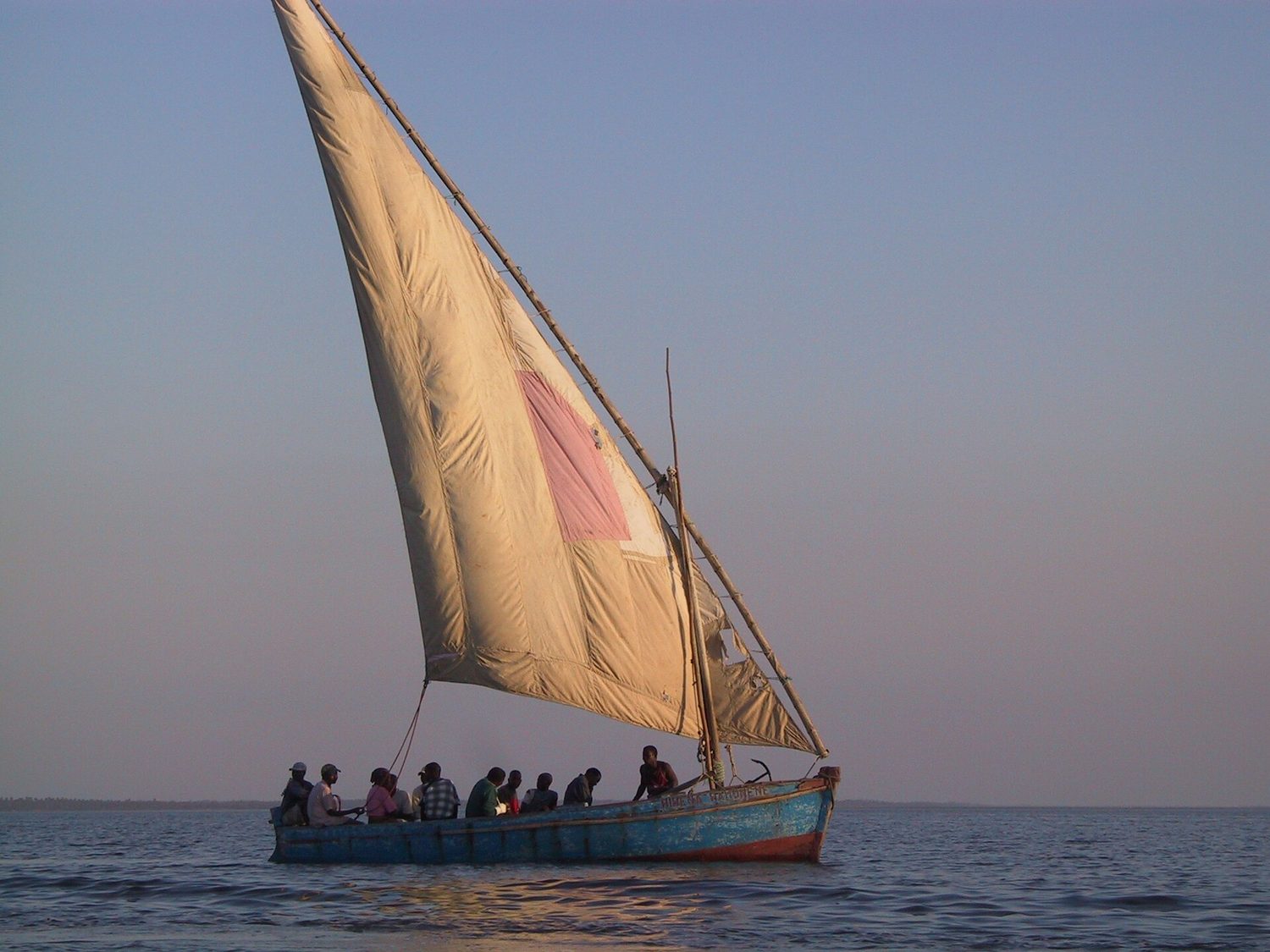
促成它的技术是航海性的:对季风(monsoon winds)的掌握、三角帆(lateen sail)、单桅帆船(dhow),以及包括罗盘(compass)与星盘(astrolabe)在内的导航工具。

它的后果是本单元最常考的内容:

  • 该网络促进国家成长(fostered the growth of states),如东非海岸的斯瓦希里城邦,以及东南亚的室利佛逝与满者伯夷。
  • 商人在重要港口建立侨居社群(diasporic communities),既带入自身文化,也吸收当地习俗。
  • 长途贸易依赖并扩大了强制劳动,人口的流动与货物的流动同样重要。
词汇表 训练
英文 中文 拼音
monsoon winds 季风 jì fēng
lateen sail 三角帆 sān jiǎo fān
dhow 单桅帆船 dān wéi fān chuán
compass 罗盘 luó pán
astrolabe 星盘 xīng pán
fostered the growth of states 促进国家成长 cù jìn guó jiā chéng zhǎng
diasporic communities 侨居社群 qiáo jū shè qún
2.4

跨撒哈拉贸易路线

大纲

2.4 Trans-Saharan Trade Routes

Thematic FocusLearning ObjectiveHistorical Differences

GOV
Governance — A variety of internal and external factors contribute to state formation, expansion, and decline. Governments maintain order through a variety of administrative institutions, policies, and procedures, and governments obtain, retain, and exercise power in different ways and for different purposes.

Unit 2.H
Explain the causes and effects of the growth of trans-Saharan trade.

  • KC-3.1.II.A.ii The growth of interregional trade was encouraged by innovations in existing transportation technologies.
  • KC-3.1.I.A.iv Improved transportation technologies and commercial practices led to an increased volume of trade and expanded the geographical range of existing trade routes, including the trans-Saharan trade network.

Unit 2.I
Explain how the expansion of empires influenced trade and communication over time.

  • KC-3.1.I.E.ii The expansion of empires—including Mali in West Africa–facilitated Afro-Eurasian trade and communication as new people were drawn into the economies and trade networks.

Illustrative examples:

  • Technologies encouraging interregional trade:
    • Camel saddle
    • Caravans

来源:美国大学理事会 AP 课程与考试说明

跨撒哈拉(trans-Saharan)商路依靠对既有技术的改良穿越沙漠——最重要的是骆驼鞍(camel saddle)与有组织的商队(caravans)。

西非的黄金北运,(salt)南运。包括马里帝国(Mali)在内的帝国扩张,通过保障并征税于这些商路,便利了欧亚非贸易——而马里的财富及其君主著名的朝觐,使该地区在伊斯兰世界声名远播。

词汇表 训练
英文 中文 拼音
camel saddle 骆驼鞍 luò tuó ān
salt yán
Mali 马里帝国 mǎ lǐ dì guó
2.5 2.6

互联互通的文化影响

大纲

2.5 Cultural Consequences of Connectivity

Thematic FocusLearning ObjectiveHistorical Developments

CDI
Cultural Developments and Interactions — The development of ideas, beliefs, and religions illustrates how groups in society view themselves, and the interactions of societies and their beliefs often have political, social, and cultural implications.

Unit 2.J
Explain the intellectual and cultural effects of the various networks of exchange in Afro-Eurasia from c. 1200 to c. 1450.

  • KC-3.1.III.D Increased cross-cultural interactions resulted in the diffusion of literary, artistic, and cultural traditions, as well as scientific and technological innovations.
  • KC-3.3.II The fate of cities varied greatly, with periods of significant decline and periods of increased urbanization, buoyed by rising productivity and expanding trade networks.
  • KC-3.1.III.C As exchange networks intensified, an increasing number of travelers within Afro-Eurasia wrote about their travels.

Illustrative examples:

  • Diffusion of cultural traditions:
    • The influence of Buddhism in East Asia
    • The spread of Hinduism and Buddhism into Southeast Asia
    • The spread of Islam in sub-Saharan Africa and Asia
  • Diffusion of scientific or technological innovations:
    • Gunpowder from China
    • Paper from China
  • Travelers:
    • Ibn Battuta
    • Margery Kempe
    • Marco Polo

2.6 Environmental Consequences of Connectivity

Thematic FocusLearning ObjectiveHistorical Developments

ENV
Humans and the Environments — The environment shapes human societies, and as populations grow and change, these populations in turn shape their environments.

Unit 2.K
Explain the environmental effects of the various networks of exchange in Afro-Eurasia from c. 1200 to c. 1450.

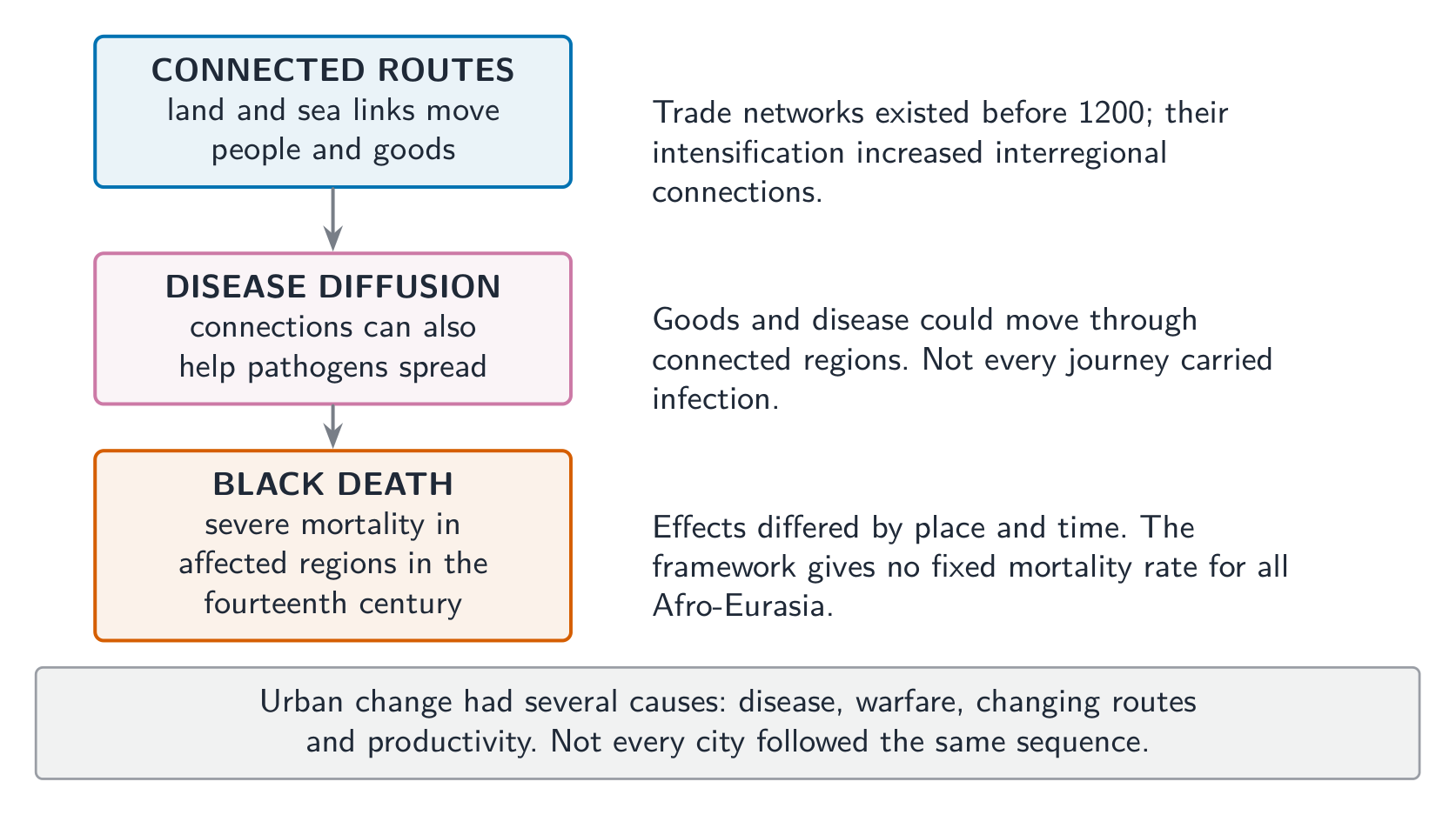
  • KC-3.1.IV There was continued diffusion of crops and pathogens, with epidemic diseases, including the bubonic plague, along trade routes.

Illustrative examples:

  • Diffusion of crops:
    • Bananas in Africa
    • New rice varieties in East Asia
    • Spread of citrus in the Mediterranean

来源:美国大学理事会 AP 课程与考试说明

跨文化交往的增加带来了文学、艺术、科学与宗教传统的传播(diffusion)——伊斯兰教沿商路扩散、佛教与新儒学在东亚的影响,以及科学与数学知识的流动。

越来越多的旅行者(travellers)在区域内部与区域之间移动,他们的记述是这一时期的关键史料。

城市的命运各不相同:有的因商路改道或遭遇入侵而衰落,有的则成长为重要的商业中心。

环境后果与文化后果同样巨大。作物与病原体的传播(diffusion of crops and pathogens)持续进行,流行病随贸易而行——其中最具灾难性的是黑死病(Black Death),它沿着运送货物的同一条条商路蔓延,夺去了欧亚非相当大一部分人口的生命。

词汇表 训练
英文 中文 拼音
diffusion 传播 chuán bō
travellers 旅行者 lǚ xíng zhě
diffusion of crops and pathogens 作物与病原体的传播 zuò wù yǔ bìng yuán tǐ de chuán bō
Black Death 黑死病 hēi sǐ bìng
2.7

经济交流的比较分析

大纲

2.7 Comparison of Economic Exchange

Learning ObjectiveReview: Unit 2 Key Concepts

Unit 2.L
Explain the similarities and differences among the various networks of exchange in the period from c. 1200 to c. 1450.

  • KC-3.1 A deepening and widening of networks of human interaction within and across regions contributed to cultural, technological, and biological diffusion within and between various societies.
    • KC-3.1.I.A.i Improved commercial practices led to an increased volume of trade and expanded the geographical range of existing trade routes—including the Silk Roads—promoting the growth of powerful new trading cities.
    • KC-3.1.I.C.i The growth of interregional trade in luxury goods was encouraged by innovations in previously existing transportation and commercial technologies, including the caravanserai, forms of credit, and the development of money economies.
  • KC-3.3 Changes in trade networks resulted from and stimulated increasing productive capacity, with important implications for social and gender structures and environmental processes.
    • KC-3.3.I.B Demand for luxury goods increased in Afro-Eurasia. Chinese, Persian, and Indian artisans and merchants expanded their production of textiles and porcelains for export; manufacture of iron and steel expanded in China.

来源:美国大学理事会 AP 课程与考试说明

本单元考查的推理能力是比较。要就"运送什么、靠什么成为可能、改变了什么"来比较这些网络,而不是去比较哪一个"最重要"。

**Worked example(一道真实的 AP 考题)。*AP 世界历史的简答题常要求学生「解释一处相似之处」「解释一处不同之处」,对象是这一时期的两个贸易网络。满分答案会点出某一特征、同时套用于两者,并加以解释:「丝绸之路与印度洋网络的扩张都得益于商业惯例的改进,但印度洋运送的是更重、单位价值更低的商品,如木材与粮食,因为船只的运载量远大于陆上商队。」*注意其结构:because 从句才把"不同"变成"解释",没有它就只是描述。

2.7

考试技巧

  • 用三个原因——商业惯例、交通技术、国家支持——来解释增长,而不要罗列贸易商品。
  • 让货物与运输方式相匹配:陆路运送高价值、低体积的商品;海路运送大宗商品。
  • 按网络记住其关键技术:商队旅馆与信贷;季风、三角帆与单桅帆船;骆驼鞍。
  • 蒙古人在考试中的角色是便利交流,而不是征服本身。
  • 黑死病是必须点出的环境后果,而且它正是沿着贸易网络本身传播的。
  • 回答"不同之处"的题目时,一定要补上原因。只写出差异而不给原因,只答了一半。

本主题的互动课程

逐步学习,并即时检测练习。

AP 世界历史的更多主题

登录或创建账号

IGCSE, A-Level & AP