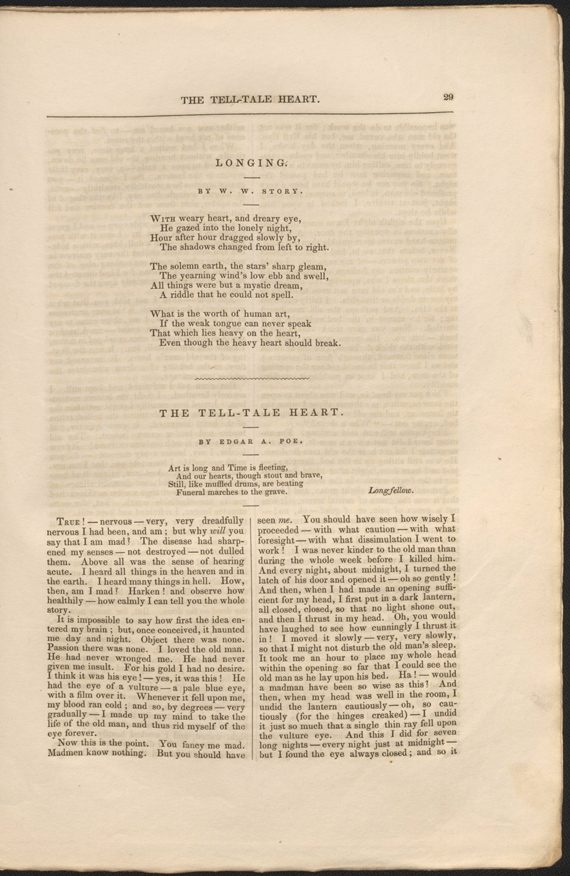
The Tell-Tale Heart as first printed in The Pioneer, January 1843
Edgar Allan Poe's "The Tell-Tale Heart" (1843) opens with a narrator arguing with you. He says he is not mad, and the proof he offers is how calmly he can tell you how he killed an old man. Every sentence he speaks is evidence against him.
In this unit you will:
trace where a change in a character 人物 comes from and how fast it arrives;
read a group or a whole community as a character;
use contrasted settings and a character's behaviour in a place as evidence;
measure pacing 节奏 and say what it makes the reader feel;
tell a motif 母题 from a symbol 象征, and analyse a simile 明喻 by its two halves.
The CED's points on change:
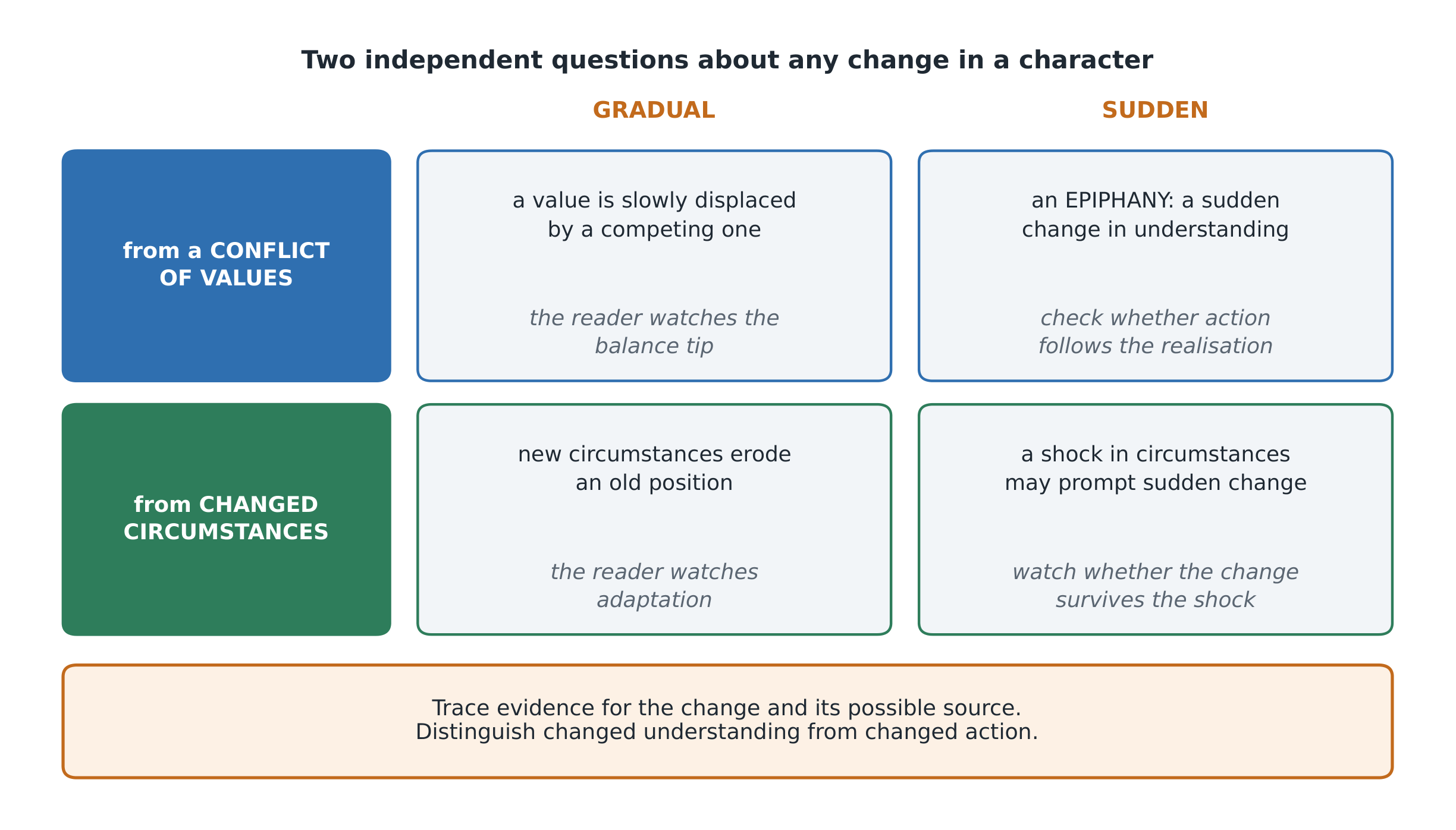
Often the change in a character comes directly from a conflict of values 价值冲突 represented in the narrative 叙事.
Changes in a character's circumstances 处境 may lead to changes in that character.
Characters can change gradually, but they can also change suddenly.
An epiphany 顿悟 may affect the plot 情节 by causing a character to act on a sudden realisation 领悟.
Trace the evidence for a change, its possible source and its consequences or limits.
The two questions (where a change comes from, how fast it arrives) are independent. A change caused by a conflict of values can arrive gradually or in a moment, and an epiphany can change a character's understanding even if no action follows. Say separately whether it changes the plot; the absence of action may itself matter.
Worked example: an epiphany with no action. James Joyce's "The Dead" (1914) ends after a Christmas party in Dublin. Gabriel Conroy learns that his wife Gretta once loved a boy, Michael Furey, who died young, perhaps for her. Gabriel, proud and self-conscious all evening, suddenly sees himself as "a ludicrous figure". He does nothing: he lies in a hotel room and watches the snow. The change is sudden and internal, it comes from a conflict of values (his vanity against her deep feeling for the dead boy), and its result is not an act but a new way of seeing.
Readers should examine how a character interacts with other characters.
The relationship between a character and a group, including their inclusion in or exclusion from it, is significant. Being shut out of a group is exclusion 排斥.
Take the group-as-character idea literally. A town, a family or an institution can hold values, put pressure on people and oppose a protagonist 主人公 exactly as an individual antagonist 对立者 would. Reading it this way often unlocks a story with no obvious enemy.
Worked example. In Shirley Jackson's "The Lottery" (1948), no single villain kills Tessie Hutchinson. The whole village does, following a yearly custom. The villagers chat, joke and gather stones together. The antagonist is the community and its tradition, and Tessie's protest that the draw "wasn't fair" comes only when she is excluded by it.
A shift is shown by the same thing measured twice, far apart
When a setting 背景 changes, it may suggest other movements, changes or shifts in the narrative.
Settings may be contrasted to establish a conflict of values or ideas associated with them.
Contrasted settings may carry competing values. Show the link through description and behaviour; do not assume that every change of place stands for a conflict.
Worked example. In Wuthering Heights (1847), the two houses are opposites. Wuthering Heights stands on the open moor, battered by wind, rough and dark. Thrushcross Grange sits in a sheltered park, with carpets, a chandelier and a lit drawing room. When young Catherine is taken in at the Grange and returns five weeks later as a fine lady, the change of setting marks a change in her: she has begun to choose comfort and rank over the wildness she shared with Heathcliff.
The way characters interact with their surroundings 周围环境 gives insight into them.
The way characters behave in or describe their surroundings reveals an attitude toward those surroundings.
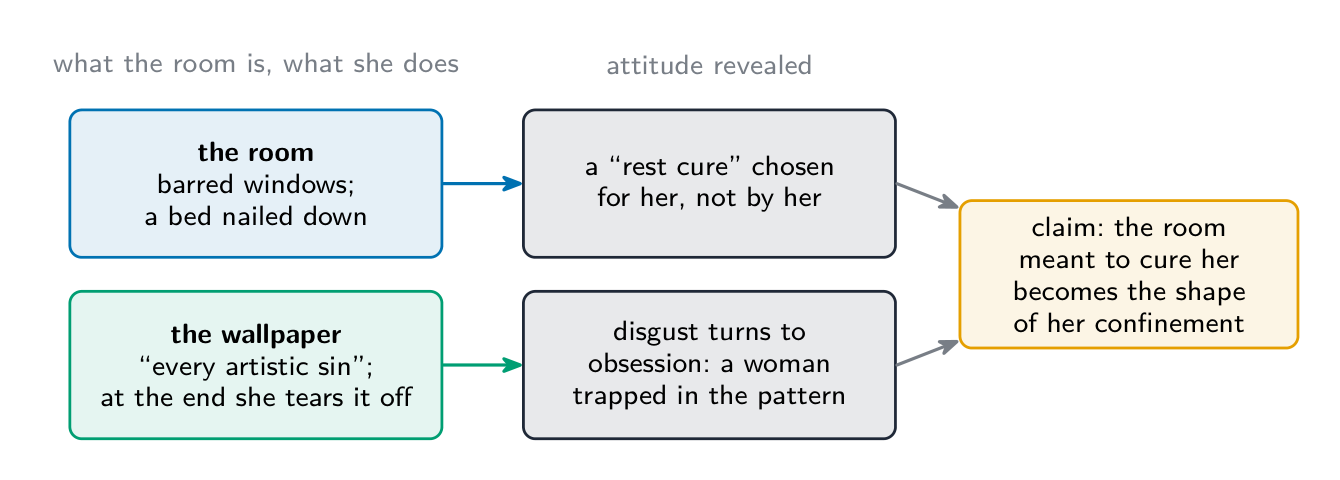
Worked example. In Charlotte Perkins Gilman's "The Yellow Wallpaper" (1892), a young mother is ordered to rest in an upstairs room with barred windows, chosen by her doctor husband. She describes the wallpaper with disgust:
I never saw a worse paper in my life. One of those sprawling flamboyant patterns committing every artistic sin.
What she does in the room. She is forbidden to write, so she studies the paper for hours. Slowly she begins to see a woman trapped behind its pattern; at the end she tears the paper off the walls and creeps around the room.
What that reveals. Her attitude moves from disgust to obsession to identification: the trapped woman in the paper is herself.
A claim with commentary. "The narrator's changing behaviour toward the wallpaper shows that the 'rest cure' her husband chose is the cause of her illness, not its cure: the room meant to heal her becomes the shape of her confinement."
The claim is about the character, and the evidence is how she behaves in the setting. Describing the room alone ("the room has barred windows") would only summarise the setting.
Behaviour in a setting reveals an attitude: "The Yellow Wallpaper"
Pacing is the manipulation of time in a text. Several factors produce it: the length given to an event, the compression 压缩 of long periods, and interruptions to chronology.
Worked example. Virginia Woolf's To the Lighthouse (1927) spends its long first part on a single afternoon and evening with the Ramsay family. The short middle part, "Time Passes", covers about ten years. Mrs Ramsay's death, the centre of the family, is given in one sentence in square brackets:
[Mr. Ramsay, stumbling along a passage one dark morning, stretched his arms out, but Mrs. Ramsay having died rather suddenly the night before, his arms, though stretched out, remained empty.]
The technique is scene against summary: a hundred pages for one evening, a bracketed clause for a death. The effect is shock. A life that filled the first part is gone in an aside, and the reader feels how time empties a house.
Narrative pacing may evoke an emotional reaction in readers by the order in which information is revealed.
Pacing can be measured, so it is very useful evidence. Count the pages a text gives to an afternoon and to the following decade, then interpret the difference alongside syntax 句法, chronology 时间顺序 and context. Length alone does not prove which event matters most.
Worked example. In "The Tell-Tale Heart" the narrator spends a whole week of nights on the slow opening of a door, then tells the murder itself in a few lines. The order slows the reader to his own obsessive pace and makes the sudden violence more shocking.
Some narrators or speakers may provide details and information that others do not or cannot provide.
Compare narrators 叙述者 when a text offers more than one. Differences in access, emphasis or contradiction show how the text directs the reader. Different access alone does not prove dishonesty.
Worked example. Mary Shelley's Frankenstein (1818) has three narrators inside one another: the explorer Walton, Victor Frankenstein, and the creature. Victor calls the creature a "wretch" and a "daemon". Only the creature's own story tells us that he first loved and helped the people he watched in secret, and turned violent after they drove him away. The second narrator gives what the first cannot, and the reader must judge between them.
A setting may become symbolic 有象征意义的 when it is associated with abstractions 抽象概念: emotions, ideas, times of life.
Over time, some settings have developed associations so strong that they almost always symbolise something.
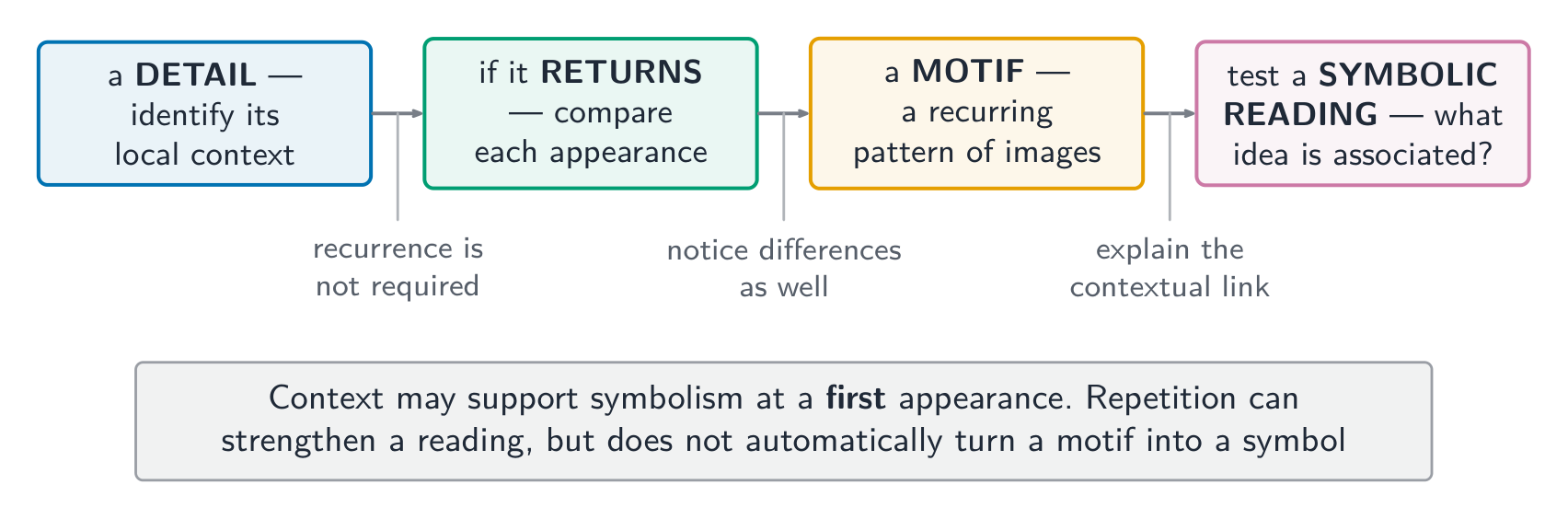
Test symbolic meaning against context; recurrence can strengthen a reading but is not required
Worked example. At the end of "The Dead", snow falls over all of Ireland, on the living and on the grave of Michael Furey. Snow has old associations (cold, death, stillness), and the story uses them: it covers everyone alike. But the story also makes it gentle and shared, so the snow can be associated not only with death but with a common human end that makes Gabriel's pride look small.
A motif is a unified pattern of recurring 反复出现的 objects or images used to emphasise a significant idea.
A motif differs from a symbol because it need not stand for one thing. It builds up: each return adds to what the pattern means, so compare what changes across its appearances, including exceptions. Repetition makes a motif; a single detail can carry symbolic meaning when its context supports it.
Worked example: blood in Macbeth. After killing King Duncan, Macbeth looks at his hands: "Will all great Neptune's ocean wash this blood / Clean from my hand?" Lady Macbeth answers that "A little water clears us of this deed." Late in the play, sleepwalking, she rubs her hands: "Out, damned spot!" and "all the perfumes of Arabia will not sweeten this little hand." The motif changes: first Macbeth cannot wash the blood away while his wife thinks it easy; at the end she is the one who cannot. The pattern traces guilt passing from one partner to the other.
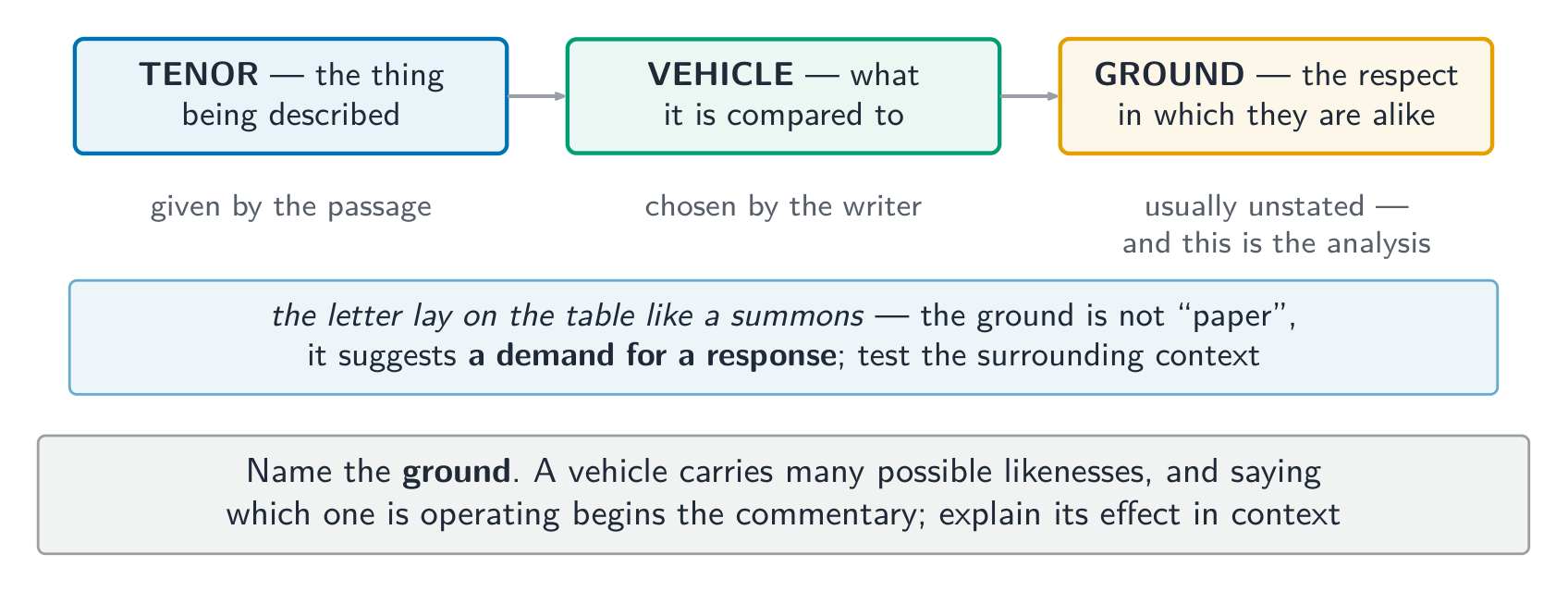
The function of a simile relies on the choice of the objects being compared as well as the traits transferred. Both halves are choices, and both can be analysed.
Name the ground - a vehicle carries many possible likenesses
Worked example. T. S. Eliot's "The Love Song of J. Alfred Prufrock" (1915) begins:
Let us go then, you and I,
When the evening is spread out against the sky
Like a patient etherized upon a table;
The object chosen is not a sunset or a painting but a patient made unconscious for surgery. The traits carried across are stillness, helplessness and waiting for something painful. So the simile tells us more about the speaker than the sky: he sees the world as numbed and sick, and the poem's first image already shows a man who cannot act.
The CED adds the reverse move here: giving the qualities of a nonhuman object, entity or idea to a person or character, describing a person as a machine, as weather, as an animal.
Watch for it, because it usually signals a judgement. In Great Expectations, Pip says the clerk Wemmick has "such a post-office of a mouth that he had a mechanical appearance of smiling". A man whose mouth is a letter slot is a man who has turned himself into part of the office, and the novel later shows the warm private self he hides at home.
As before: a thesis 论题 expresses an interpretation 解读 that requires textual defence.
New: more sophisticated literary arguments may explain the significance or relevance of an interpretation: why this reading matters, not only that it can be supported. Explain the significance with evidence; no single phrase guarantees a scoring point.
New: textual evidence may require revision to an interpretation if the evidence does not support it.
A real text for the whole unit: James Joyce, "The Dead" (1914)
The story's last paragraphs:
A few light taps upon the pane made him turn to the window. It had begun to snow again.
Yes, the newspapers were right: snow was general all over Ireland.
His soul swooned slowly as he heard the snow falling faintly through the universe and faintly falling, like the descent of their last end, upon all the living and the dead.
Worked analysis: change and its limits. Gabriel's realisation is an epiphany: he sees his own vanity and the depth of a love he never felt. But the story stops before any action. It does not show whether he will act differently tomorrow, so a strong essay does not claim that he is "transformed"; it claims that he has seen, and leaves the rest open.
Worked analysis: setting and imagery. The setting moves from a warm, crowded party to a cold hotel room, then out through the window to all of Ireland. The snow, "general all over Ireland", can be associated with a shared end that levels everyone. "Faintly falling" and "falling faintly" repeat with the words reversed, so the sentence itself seems to drift down like snow.
Worked analysis: pacing and significance. The party takes most of the story, hour by hour; the epiphany takes one paragraph. The long build-up of small talk and speeches makes the ending's silence stronger. Its significance: Joyce ends a story about public performance with a private moment no one else sees.
Another real text: Edgar Allan Poe, "The Tell-Tale Heart" (1843)
True!—nervous—very, very dreadfully nervous I had been and am; but why will you say that I am mad?
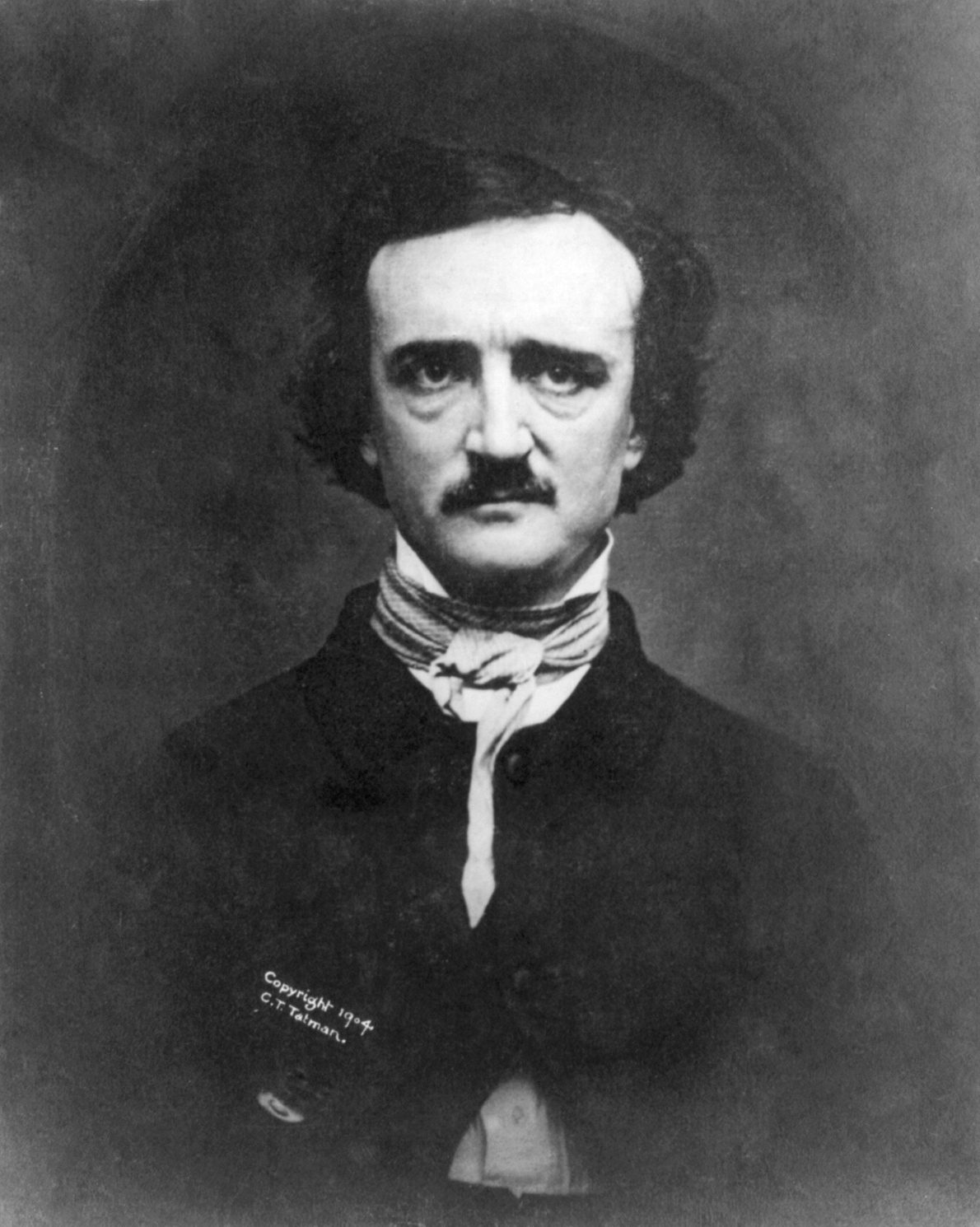
Edgar Allan Poe in a photograph from the late 1840s
It took me an hour to place my whole head within the opening so far that I could see him as he lay upon his bed.
Worked analysis.
Reliability. The narrator claims calm, but his first sentence breaks into dashes and repeats "very, very". The way he speaks contradicts what he says.
Pacing. One hour for one movement of the head: the story slows time almost to a stop. The narrator gives this detail as proof of his care and good sense; the reader sees obsession.
Symbol. He wants to kill the old man only because of his "vulture" eye. At the end he hears a heart beating under the floor and cries to the police, "tear up the planks!" The sound can be associated with his guilt, since no one else hears it.
Change. He moves from total control to collapse, and the cause is inside him: at first he takes the officers' calm manner as a sign that they suspect nothing; their private thoughts are never reported.
Claim: Poe makes the narrator's own pacing and punctuation testify against him, so the story he tells to prove his sanity becomes the reader's evidence of his madness and guilt.
"He changes" with no source. Say what causes the change: a conflict of values, new circumstances, or an epiphany.
Assuming an epiphany leads to action. Check whether the text shows any; often it does not.
Looking only for individual antagonists. A community or a custom can be the opposing force.
Calling every repeated object a symbol. A motif builds up meaning; follow how it changes.
Analysing only the second half of a simile. Say why this object was chosen and which traits carry across.
Measuring pacing without interpreting it. Count the pages, then say what the difference makes the reader feel.
7.12 7.13 7.14
关键术语
English
epiphany: a sudden moment when a character understands something important.
conflict of values: a struggle between two things a character or group believes matter.
circumstances: the conditions of a character's life, such as money, place or health.
exclusion: being shut out of a group.
pacing: the speed at which a text tells events, controlled by how much space each gets.
compression: telling a long period of time in a few words.
abstraction: an idea that cannot be touched, such as love, death or freedom.
motif: an object, image or idea that keeps coming back in a text and gathers meaning.
symbol: an object, person or place that comes to stand for an idea.
simile: a comparison using "like" or "as".
interpretation: a reading of what a text means that needs to be defended.
7.12 7.13 7.14
自我检测
English
Read the end of James Joyce's "Eveline" (1914). Eveline, a young Dublin woman, has agreed to sail to Buenos Aires with Frank, a sailor who loves her. At the dock, as the ship is boarding, she grips the iron railing and will not move. Frank calls to her to come.
She set her white face to him, passive, like a helpless animal. Her eyes gave him no sign of love or farewell or recognition.
Has Eveline changed? What kind of change, or failure to change, does the ending show?
What does the simile "like a helpless animal" carry across?
Why does the ending give Eveline no words?
Answers: 1. The story has built towards a change of circumstances (escape to a new life), but at the last moment she cannot act. The change that happens is the reverse of an epiphany: she freezes, and her old life holds her. 2. The object chosen is a trapped animal, not a person deciding. The traits transferred are fear, helplessness and lack of choice, so the simile suggests she is not refusing Frank but is unable to move. 3. Silence matches her paralysis: words would be a decision, and she can make none. Her blank eyes, with "no sign of love or farewell or recognition", show that she has withdrawn even from herself.
7.12 7.13 7.14
本课资料
English
College Board, AP English Literature and Composition Course and Exam Description, Unit 7.
Edgar Allan Poe, "The Tell-Tale Heart" (1843).
James Joyce, "The Dead" and "Eveline", in Dubliners (1914).
Shirley Jackson, "The Lottery" (1948).
Emily Brontë, Wuthering Heights (1847).
Charlotte Perkins Gilman, "The Yellow Wallpaper" (1892).
Virginia Woolf, To the Lighthouse (1927).
Mary Shelley, Frankenstein (1818).
William Shakespeare, Macbeth (c. 1606).
T. S. Eliot, "The Love Song of J. Alfred Prufrock" (1915).